
Life, 1915-07-29 · page 19 of 40
Life — July 29, 1915 — page 19: what you’re looking at
What you’re looking at
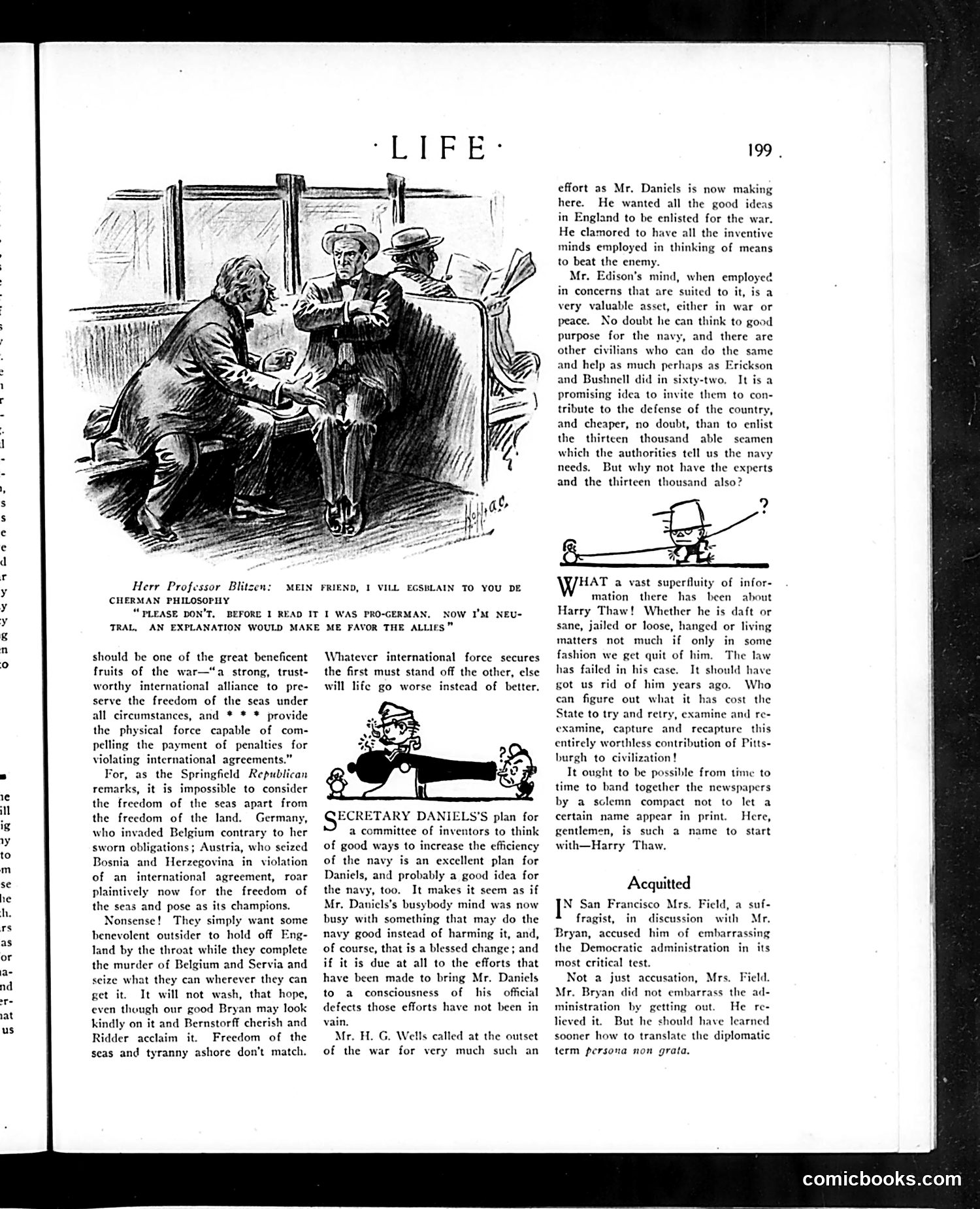
This page contains three separate satirical pieces from Life magazine during World War I: **"Herr Professor Blitzen"** mocks German philosophy through a dialogue joke: a German professor offers to explain German logic, but his listener warns that before hearing it, he was pro-German—hearing it would make him neutral. The satire attacks German justifications for invading Belgium and seizing other nations while hypocritically claiming to defend "freedom of the seas." **The Daniels/Edison section** praises Secretary of the Navy Josephus Daniels's plan to recruit inventors (including Thomas Edison) to improve naval efficiency, though sarcastically noting this redirects his "busybody mind" toward something actually useful rather than harmful. **"Harry Thaw"** expresses exasperation with media coverage of Thaw, a wealthy Pittsburgh man involved in a sensational murder case. The author argues the legal system has repeatedly failed to resolve his case and proposes newspapers sign a compact to stop printing his name entirely. All three pieces reflect wartime concerns, bureaucratic frustration, and the press's role in public discourse.
📄 Transcribed text from this page (OCR, searchable)
Machine-transcribed from the original scan — historical spelling and the odd misread are preserved.
Herr Professor Blitzen: CHERMAN PHILOSOPHY “ PLEASE DON'T. BEFORE 1 READ IT I WAS PRO-GERMAN. MEIN FRIEND, I VILL EGSBLAIN TO YOU DE NOW I'M NEU- TRAL, AN EXPLANATION WOULD MAKE ME FAVOR THE ALLIES” should be one of the great beneficent fruits of the war—‘“a strong, trust- worthy international alliance to pre- serve the freedom of the seas under all circumstances, and * * * provide the physical force capable of com- pelling the payment of penalties for violating international agreements.” For, as the Springfield Republican remarks, it is impossible to consider the freedom of the seas apart from the freedom of the land. Germany, who invaded Belgium contrary to her sworn obligations; Austria, who seized Bosnia and Herzegovina in violation of an international agreement, roar plaintively now for the freedom of the seas and pose as its champions. Nonsense! They simply want some benevolent outsider to hold off Eng- land by the throat while they complete the murder of Belgium and Servia and seize what they can wherever they can get it. It will not wash, that hope, even though our good Bryan may look kindly on it and Bernstorff cherish and Ridder acclaim it. Freedom of the seas and tyranny ashore don’t match. Whatever international force secures the first must stand off the other, else will life go worse instead of better. CRETARY DANIELS'S plan for a committee of inventors to think of good ways to increase the efficiency of the navy is an excellent plan for Daniels, and probably a good idea for the navy, too. It makes it seem as if Mr. Danicls’s busybody mind was now busy with something that may do the navy good instead of harming it, and, of course, that is a blessed change; and if it is due at all to the efforts that have been made to bring Mr. Daniels to a consciousness of his official defects those efforts have not been in Mr. H. G. Wells called at the outset of the war for very much such an 199 . effort as Mr. Daniels is now making here. He wanted all the good ideas in England to be enlisted for the war. He clamored to have all the inventive minds employed in thinking of means to beat the enemy. Mr. Edison's mind, when employed in concerns that are suited to it, is a very valuable asset, either in war or peace. No doubt he can think to good purpose for the navy, and there are other civilians who can do the same and help as much perhaps as Erickson and Bushnell did in sixty-two, It is a promising idea to invite them to con- tribute to the defense of the country, and cheaper, no doubt, than to enlist the thirteen thousand able seamen which the authorities tell us the navy needs. But why not have the experts and the thirteen thousand also? Wat a vast superfluity of infor- mation there has been about Harry Thaw! Whether he is daft or sane, jailed or loose, hanged or living matters not much if only in some fashion we get quit of him. The law has failed in his case. It should have got us rid of him years ago. Who can figure out what it has cost the State to try and retry, examine and re- examine, capture and recapture this entirely worthless contribution of Pitts- burgh to civilization! It ought to be possible from time to time to band together the newspapers by a solemn compact not to let a certain name appear in print. Here, gentlemen, is such a name to start with—Harry Thaw. Acquitted N San Francisco Mrs. Field, a suf- fragist, in discussion with Mr. Bryan, accused him of embarrassing the Democratic administration in its most critical test. Not a just accusation, Mrs. Fi Mr. Bryan did not embarrass the ay ministration by getting out. He re lieved it. But he should have learned sooner how to translate the diplomatic term persona non grata. comicbooks.com