
Life, 1915-07-29 · page 18 of 40
Life — July 29, 1915 — page 18: what you’re looking at
What you’re looking at
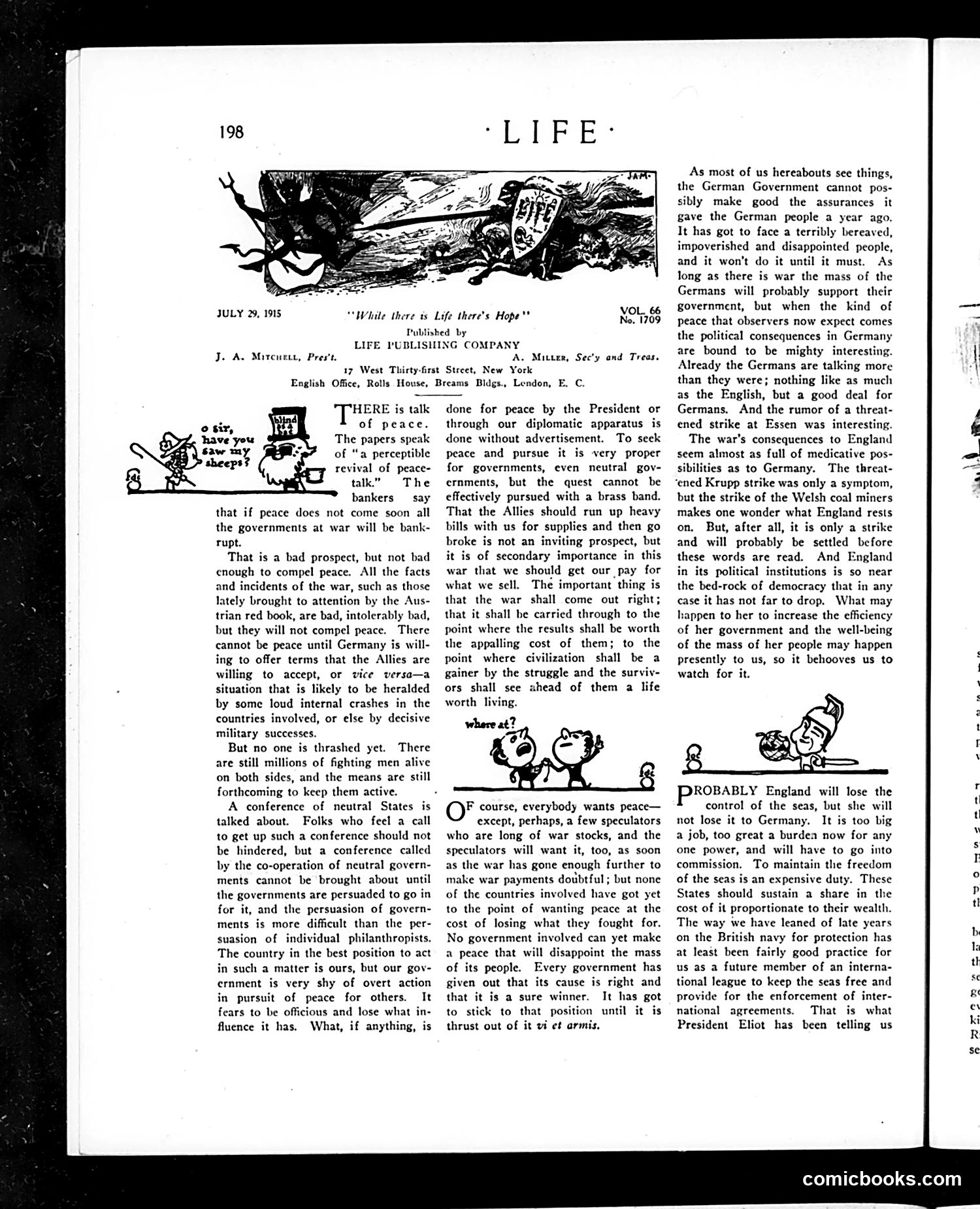
This editorial page discusses prospects for peace in World War I, then roughly a year old. The cartoons (small illustrations of figures) appear to satirize the naive hope for peace—one shows a dejected figure, another depicts the phrase "where at?" suggesting confusion about where peace negotiations might occur. The text argues peace is impossible until one side achieves decisive military victory or internal collapse forces settlement. It criticizes the notion that neutral conferences or diplomatic efforts can succeed when governments remain committed to their stated war aims. Notably, it predicts Germany will face severe political consequences after the war when its government must confront a "bereaved, impoverished and disappointed people"—an astute observation about post-war instability. The piece presents American neutrality as appropriate caution, warning against "officious" peace efforts that might squander diplomatic influence. The Latin phrase *vi et armis* ("by force of arms") emphasizes that only military resolution will end the conflict.
📄 Transcribed text from this page (OCR, searchable)
Machine-transcribed from the original scan — historical spelling and the odd misread are preserved.
JULY 2, 1915 “While there ts Life there's Hope" Published by LIFE PUBLISHING COMPANY J. A. Mitcurts, Pres’t. A. Miture, Sec'y and Treas. 17 West Thirty-first Street, New York English Office, Rolls House, Breams Bldgs. Lendon, E. C. 'HERE is talk of peace. The papers speak of “a perceptible revival of peace- talk.” The bankers = say that if peace does not come soon all the governments at war will be bank- rupt. That is a bad prospect, but not bad cnough to compel peace. All the facts and incidents of the war, such as those lately brought to attention by the Aus- trian red book, are bad, intolerably bad, but they will not compel peace. There cannot be peace until Germany is will- ing to offer terms that the Allies are willing to accept, or vice versa—a situation that is likely to be heralded by some loud internal crashes in the countries involved, or else by decisive military successes. But no one is thrashed yet. There are still millions of fighting men alive on both sides, and the means are still forthcoming to keep them active. A conference of neutral States is talked about. Folks who feel a call to get up such a conference should not be hindered, but a conference called by the co-operation of neutral govern- ments cannot be brought about until the governments are persuaded to go in for it, and the persuasion of govern- ments is more difficult than the per- suasion of individual philanthropists. The country in the best position to act in such a matter is ours, but our gov- ernment is very shy of overt action in pursuit of peace for others. It fears to be officious and lose what in- fluence it has, What, if anything, is done for peace by the President or through our diplomatic apparatus is done without advertisement. To seek peace and pursue it is very proper for governments, even neutral gov- ernments, but the quest cannot be effectively pursued with a brass band. That the Allies should run up heavy bills with us for supplies and then go broke is not an inviting prospect, but it is of secondary importance in this war that we should get our pay for what we sell. The important thing is that the war shall come out right; that it shall be carried through to the point where the results shall be worth the appalling cost of them; to the point where civilization shall be a gainer by the struggle and the surviv- ors shall see ahead of them a life worth living. where at? 6 @ RQ F course, everybody wants peace— except, perhaps, a few speculators who are long of war stocks, and the speculators will want it, too, as soon as the war has gone enough further to make war payments doubtful; but none of the countries involved have got yet to the point of wanting peace at the cost of losing what they fought for. No government involved can yet make a peace that will disappoint the mass of its people. Every government has given out that its cause is right and that it is a sure winner. It has got to stick to that position until it is thrust out of it vi et armis, As most of us hereabouts see things, the German Government cannot pos- sibly make good the assurances it gave the German people a year ago. It has got to face a terribly bereaved, impoverished and disappointed people, and it won't do it until it must. As long as there is war the mass of the Germans will probably support their government, but when the kind of peace that observers now expect comes the political consequences in Germany are bound to be mighty interesting. Already the Germans are talking more than they were; nothing like as much as the English, but a good deal for Germans, And the rumor of a threat- ened strike at Essen was interesting. The war’s consequences to England seem almost as full of medicative pos- sibilities as to Germany. The threat- ‘ened Krupp strike was only a symptom, but the strike of the Welsh coal miners makes one wonder what England rests on, But, after all, it is only a strike and will probably be settled before these words are read. And England in its political institutions is so near the bed-rock of democracy that in any case it has not far to drop. What may happen to her to increase the efficiency of her government and the well-being of the mass of her people may happen presently to us, so it behooves us to watch for it. PROBABLY England will lose the control of the seas, but she will not lose it to Germany. It is too big a job, too great a burdea now for any one power, and will have to go into commission, To maintain the freedom of the seas is an expensive duty. These States should sustain a share in the cost of it proportionate to their wealth. The way we have leaned of late years on the British navy for protection has at least been fairly good practice for us as a future member of an interna- tional league to keep the seas free and provide for the enforcement of inter- national agreements. That is what President Eliot has been telling us comicbooks.com ; '