
Life, 1915-07-29 · page 24 of 40
Life — July 29, 1915 — page 24: what you’re looking at
What you’re looking at
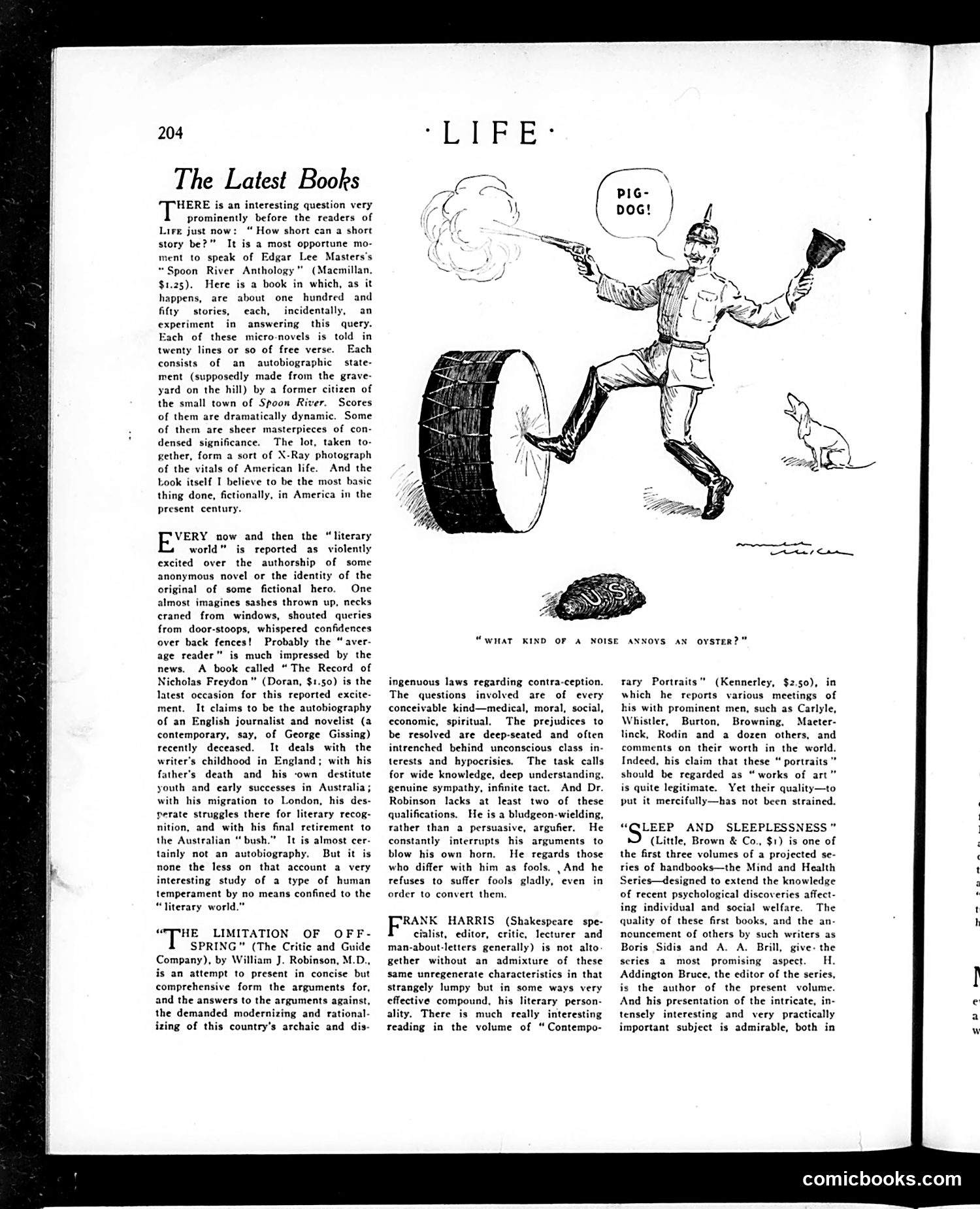
This page from *Life* magazine contains a book review section alongside a humorous cartoon. The illustration depicts a military or uniformed figure shouting "BIG DOG!" while gesturing wildly with a broom, confronting a small rabbit or hare. Below appears the caption "WHAT KIND OF A NOISE ANNOYS AN OYSTER?"—a playful nonsense phrase. The cartoon likely satirizes literary pretension or bombastic criticism. The figure's exaggerated posturing and theatrical gestures mock overwrought or self-important commentary on literature. The absurdist caption reinforces the joke: just as the question about what noise annoys an oyster is nonsensical, so too is the loud, blustering approach to discussing serious literary matters. The surrounding book reviews discuss substantive works like Edgar Lee Masters's *Spoon River Anthology* and philosophical texts on birth control, contrasting with the page's satirical visual humor.
📄 Transcribed text from this page (OCR, searchable)
Machine-transcribed from the original scan — historical spelling and the odd misread are preserved.
204 The Latest Books HERE is an interesting question very prominently before the readers of Lire just now: “ How short can a short story be?” It is a most opportune mo- ment to speak of Edgar Lee Masters’s “Spoon River Anthology" (Macmillan. $1.25). Here is a book in which, as it happens, are about one hundred and fifty stories, each, incidentally, an experiment in answering this query. Zach of these micro-novels is told in twenty lines or so of free verse. Each consists of an autobiographic state- ment (supposedly made from the grave- yard on the hill) by a former citizen of the small town of Spoon River. Scores of them are dramatically dynamic, Some of them are sheer masterpieces of con- densed significance. The lot, taken to- gether, form a sort of X-Ray photograph of the vitals of American life. And the Look itself I believe to be the most basic thing done, fictionally, in America in the present century. ERY now and then the “literary world” is reported as violently excited over the authorship of some anonymous novel or the identity of the original of some fictional hero. One almost imagines sashes thrown up, necks craned from windows, shouted queries from door-stoops, whispered confidences over back fences! Probably the “ aver- age reader” is much impressed by the news. A book called “The Record of Nicholas Freydon" (Doran, $1.50) is the latest occasion for this reported excite- ment. It claims to be the autobiography of an English journalist and novelist (a contemporary, say, of George Gissing) recently deceased. It deals with the writer's childhood in England; with his father’s death and his -own destitute youth and early successes in Australia; with his migration to London, his des- perate struggles there for literary recog- nition, and with his final retirement to the Australian “bush.” It is almost cer- tainly not an autobiography, But it is none the less on that account a very interesting study of a type of human temperament by no means confined to the “literary world.” “"THE LIMITATION OF OFF- SPRING” (The Critic and Guide Company), by William J. Robinson, M.D., is an attempt to present in concise but comprehensive form the arguments for, and the answers to the arguments against, the demanded modernizing and rational- izing of this country’s archaic and dis- “WHAT KIND OF A NOISE ingenuous laws regarding contra-ception. The questions involved are of every conceivable kind—medical, moral, social, economic, spiritual. The prejudices to be resolved are deep-seated and often intrenched behind unconscious class in- terests and hypocrisies. The task calls for wide knowledge, deep understanding, genuine sympathy, infinite tact. And Dr. Robinson lacks at least two of these qualifications. He is a bludgeon-wielding, rather than a persuasive, atgufier. He constantly interrupts his arguments to blow his own horn, He regards those who differ with him as fools. , And he refuses to suffer fools gladly, even in order to convert them. RANK HARRIS (Shakespeare spe- cialist, editor, critic, lecturer and man-about-letters generally) is not alto gether without an admixture of these same unregenerate characteristics in that strangely lumpy but in some ways very effective compound, his literary person- ality. There is much really interesting reading in the volume of “Contempo- ANNOYS AN OYSTER?” rary Portraits” (Kennerley, $2.50), in which he reports various meetings of his with prominent men, such as Carlyle, Whistler, Burton, Browning, Maeter- linck, Rodin and a dozen others, and comments on their worth in the world. Indeed, his claim that these “ portraits” should be regarded as “works of art” is quite legitimate. Yet their quality—to put it mercifully—bas not been strained. “QLEEP AND SLEEPLESSNESS” (Little, Brown & Co., $1) is one of the first three volumes of a projected se- ries of handbooks—the Mind and Health Series—designed to extend the knowledge of recent psychological discoveries affect- ing individual and social welfare. The quality of these first books, and the an- nouncement of others by such writers as Boris Sidis and A. A. Brill, give. the scries a most promising aspect. H. Addington Bruce, the editor of the series, is the author of the present volume. And his presentation of the intricate, in- tensely interesting and very practically important subject is admirable, both in comicbooks.com one hee