
Life, 1915-07-29 · page 3 of 40
Life — July 29, 1915 — page 3: what you’re looking at
What you’re looking at
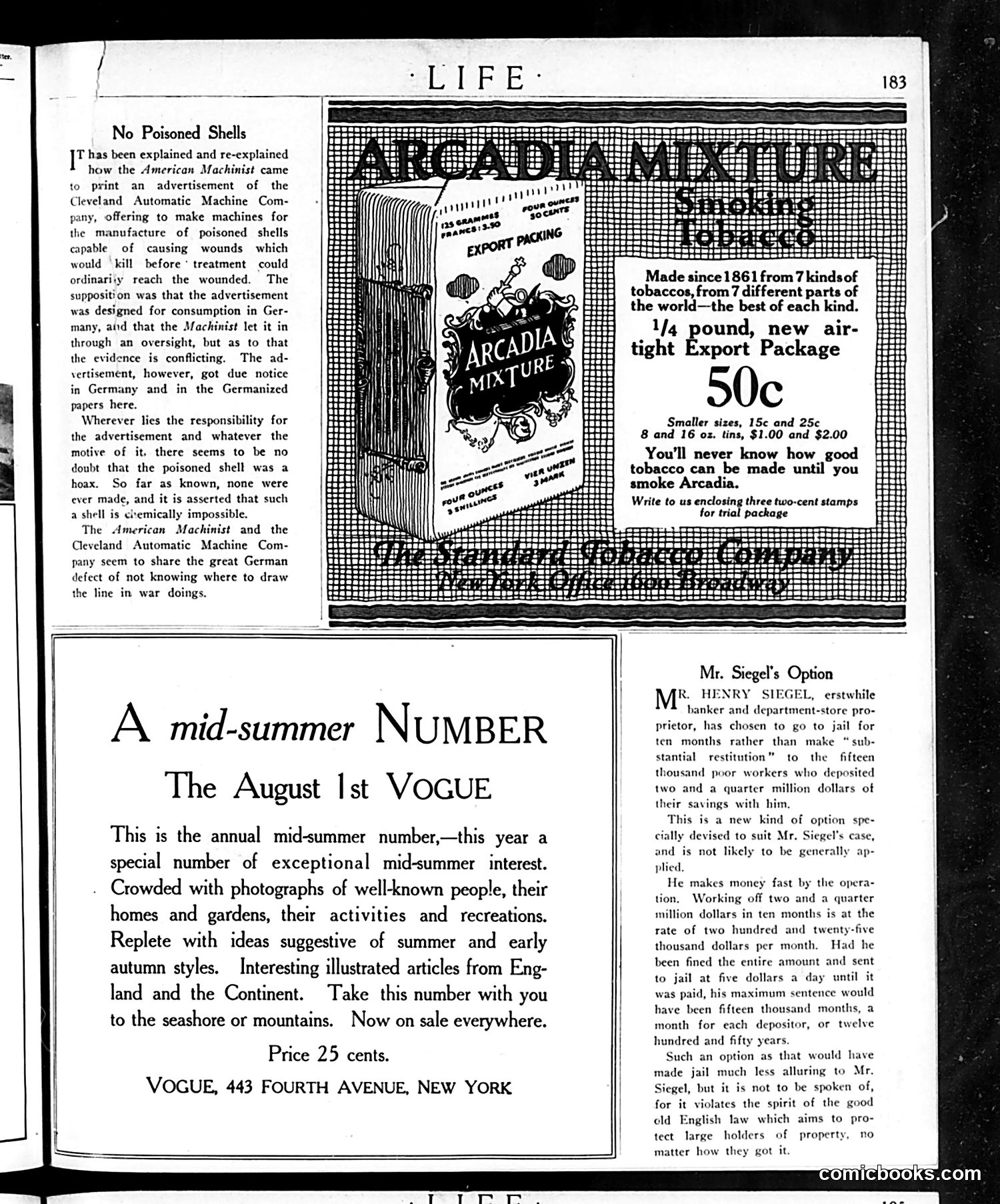
This page is primarily **advertising and editorial content** from *Life* magazine, not political satire. The top half features an **Arcadia Mixture tobacco advertisement** promoting smoking tobacco in various package sizes (50 cents for the main "Export Package"). The ad claims the blend uses "7 kinds of tobacco from 7 different parts of the world." Below is an **announcement for Vogue magazine's August 1st mid-summer issue**, promoting it as containing photographs of notable people, their homes, gardens, and summer/early autumn fashion ideas. The right column contains **"Mr. Siegel's Opinion,"** discussing Henry Siegel (a bankers and department-store proprietor) choosing jail over paying restitution to poor workers who deposited savings with him. The text critiques this as violating "English law" protecting large property holders. No significant political cartoon or satire appears on this page.
📄 Transcribed text from this page (OCR, searchable)
Machine-transcribed from the original scan — historical spelling and the odd misread are preserved.
No Poisoned Shells T has been explained and re-explained how the American Machinist came to print an advertisement of the Cleveland Automatic Machine Com- pany, offering to make machines for the manufacture of poisoned shells capable of causing wounds which would ‘kill before * treatment could ordinarity reach the wounded. The supposition was that the advertisement was designed for consumption in Ger- many, aid that the Machinist let it in through an oversight, but as to that the evidence is conflicting. The ad- vertisement, however, got due notice in Germany and in the Germanized papers here. Wherever lies the responsibility for the advertisement and whatever the motive of it, there seems to be no doubt that the poisoned shell was a hoax. So far as known, none were ever made, and it is asserted that such a shell is mically impossible. The American Machinist and the Cleveland Automatic Machine Com- pany seem to share the great German defect of not knowing where to draw the line in war doings. A mid-summer NUMBER The August Ist WOGUE This is the annual mid-summer number,—this year a special number of exceptional mid-summer interest. Crowded with photographs of well-known people, their homes and gardens, their activities and recreations. Replete with ideas suggestive of summer and early autumn styles. Interesting illustrated articles from Eng- land and the Continent. Take this number with you to the seashore or mountains. Now on sale everywhere. Price 25 cents. VOGUE, 443 FOURTH AVENUE, NEW YORK Made since 1861 from 7 kinds of tobaccos, from 7 different parts of the world—the best of each kind. 1/4 pound, new air- tight Export Package 50c Smaller sizes, 15¢ and 25¢ 8 and 16 oz. tins, $1.00 and $2.00 You'll never know how good tobacco can be made until you smoke Arcadia. Write to us andoene three two-cent stamps for trial package Mr. Siegel's Option M* HENRY SIEGEL, erstwhile banker and department-store pro- prietor, has chosen to go to jail for ten months rather than make “ sub- stantial restitution” to the fifteen thousand poor workers who deposited two and a quarter million dollars of their ings with him. This is a new kind of option spe- cially devised to suit Mr. Siegel's case, and is not likely to be generally ap- plied. He makes money fast by the opera- tion, Working off two and a quarter million dollars in ten months is at the rate of two hundred and twenty-five thousand dollars per month. Had he been fined the entire amount and sent to jail at five dollars a day until it was paid, his maximum sentence would have been fifteen thousand months, a month for each depositor, or twelve hundred and fifty years. Such an option as that would have made jail much less alluring to Mr. Siegel, but it is not to be spoken of, for it violates the spirit of the good old English law which aims to pro- tect large holders of property, no matter how they got it.