
Life, 1915-07-29 · page 13 of 40
Life — July 29, 1915 — page 13: what you’re looking at
What you’re looking at
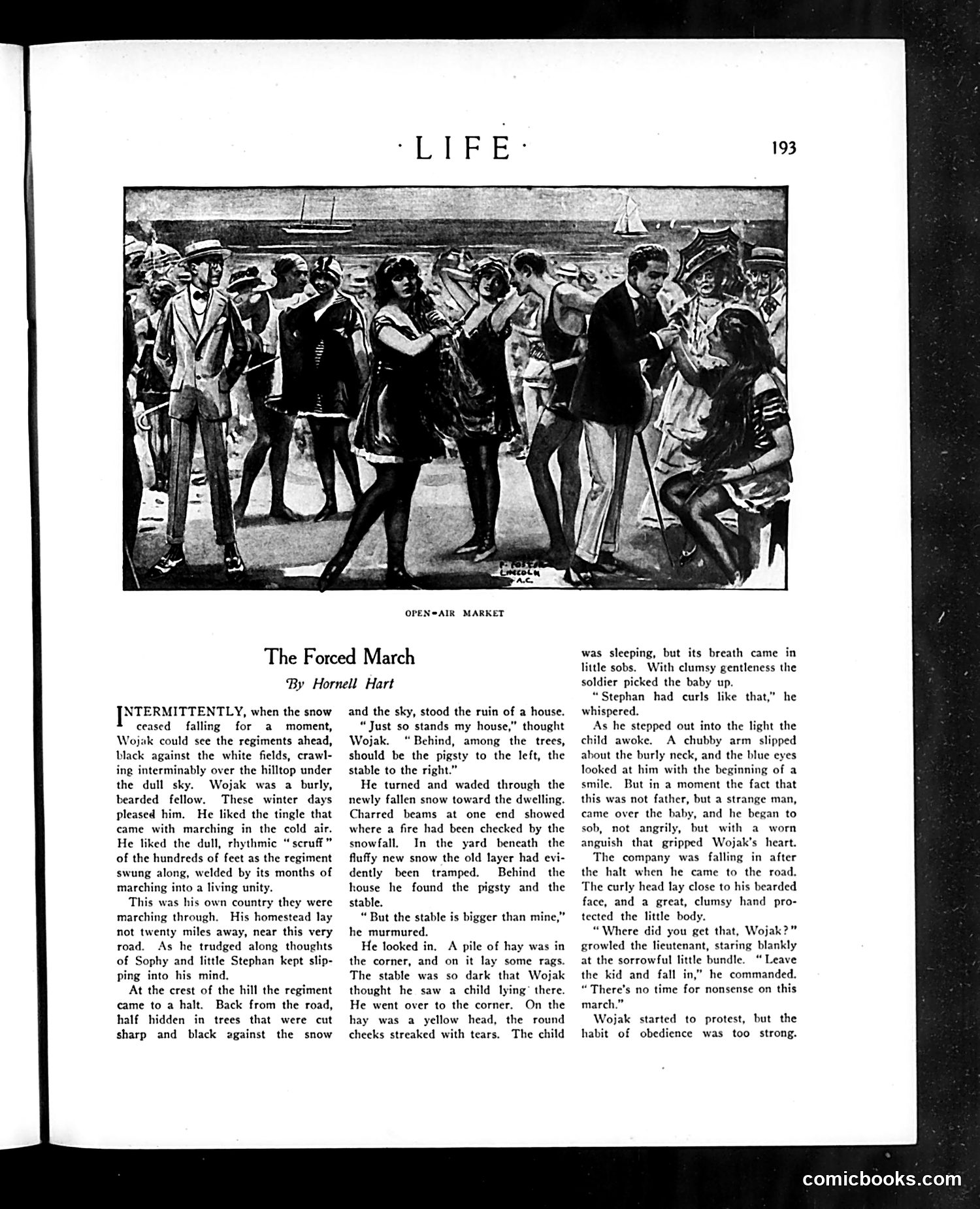
This page presents a short story rather than political satire. The narrative follows a soldier named Wojak during a military march in winter, who discovers an abandoned child in a ruined house. Despite the child's obvious distress and suffering, Wojak is ordered to abandon it and continue marching—hence "forced march." The illustration at top shows what appears to be a beach or marketplace scene with civilians in 1920s-style clothing, though its connection to the story text is unclear. The story's point seems to be critiquing military discipline and the human cost of war—the conflict between compassion for a suffering child and the absolute obedience demanded of soldiers. It's a sentimental anti-war commentary rather than political satire.
📄 Transcribed text from this page (OCR, searchable)
Machine-transcribed from the original scan — historical spelling and the odd misread are preserved.
OPEN*AIR MARKET The Forced March ‘By Hornell Hart NTERMITTENTLY, when the snow ceased falling for a moment, Wojak could see the regiments ahead, Diack against the white fields, crawl- ing interminably over the hilltop under the dull sky. Wojak was a burly, bearded fellow. These winter days pleased him. He liked the tingle that came with marching in the cold air. He liked the dull, rhythmic “ scruff” of the hundreds of feet as the regiment swung along, welded by its months of marching into a living unity. This was his own country they were marching through. His homestead lay not twenty miles away, near this very road. As he trudged along thoughts of Sophy and little Stephan kept slip- ping into his mind, At the crest of the hill the regiment came to a halt. Back from the road, half hidden in trees that were cut sharp and black against the snow and the sky, stood the ruin of a house. “Just so stands my house,” thought Wojak. “Behind, among the trees, should be the pigsty to the left, the stable to the right.” He turned and waded through the newly fallen snow toward the dwelling. Charred beams at one end showed where a fire had been checked by the snowfall, In the yard beneath the fluffy new snow the old layer had evi- dently been tramped. Behind the house he found the pigsty and the stable. “But the stable is bigger than mine,” he murmured. He looked in. A pile of hay was in the corner, and on it lay some rags. The stable was so dark that Wojak thought he saw a child lying’ there. He went over to the corner. On the hay was a yellow head, the round cheeks streaked with tears. The child was sleeping, but its breath came in little sobs. With clumsy gentleness the soldier picked the baby up. “Stephan had curls like that,” he whispered. As he stepped out into the light the child awoke. A chubby arm slipped about the burly neck, and the blue eyes looked at him with the beginning of a smile. But in a moment the fact that this was not father, but a strange man, came over the baby, and he began to sob, not angrily, but with a worn anguish that gripped Wojak’s heart. The company was falling in after the halt when he came to the road. The curly head lay close to his bearded face, and a great, clumsy hand pro- tected the little body. “Where did you get that, Wojak?” growled the lieutenant, staring blankly at the sorrowful little bundle. “ Leave the kid and fall in,” he commanded. “There's no time for nonsense on this march.” Wojak started to protest, but the habit of obedience was too strong. comicbooks.com