
A complete issue · 44 pages · 1915
Life — July 1, 1915
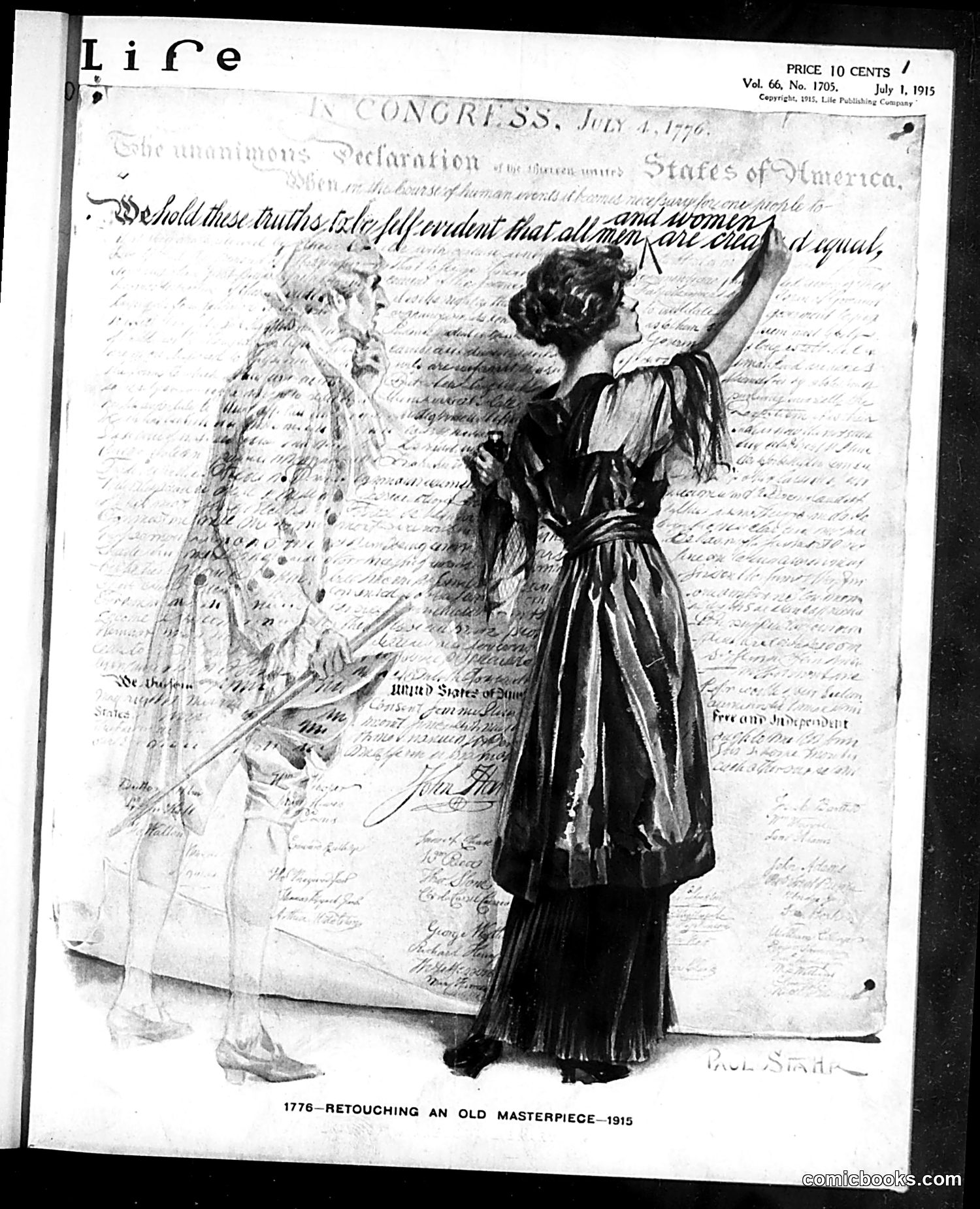
This Life magazine cover from July 1, 1915 shows a woman in dark Edwardian dress gesturing toward the Declaration of Independence. The caption reads "1776—Retouching an Old Masterpiece—1915." The satire concerns women's suffrage. The woman appears to be "retouching" or editing the Declaration by pointing to its promise of equality—"that all men are created equal"—suggesting the phrase needs updating to include women. The 1915 date marks the height of the American suffrage movement, which would succeed with the 19th Amendment in 1920. The joke critiques the gap between the nation's founding ideals and its actual practice regarding women's rights, presenting suffrage advocates as simply demanding the Declaration fulfill its own stated principles.
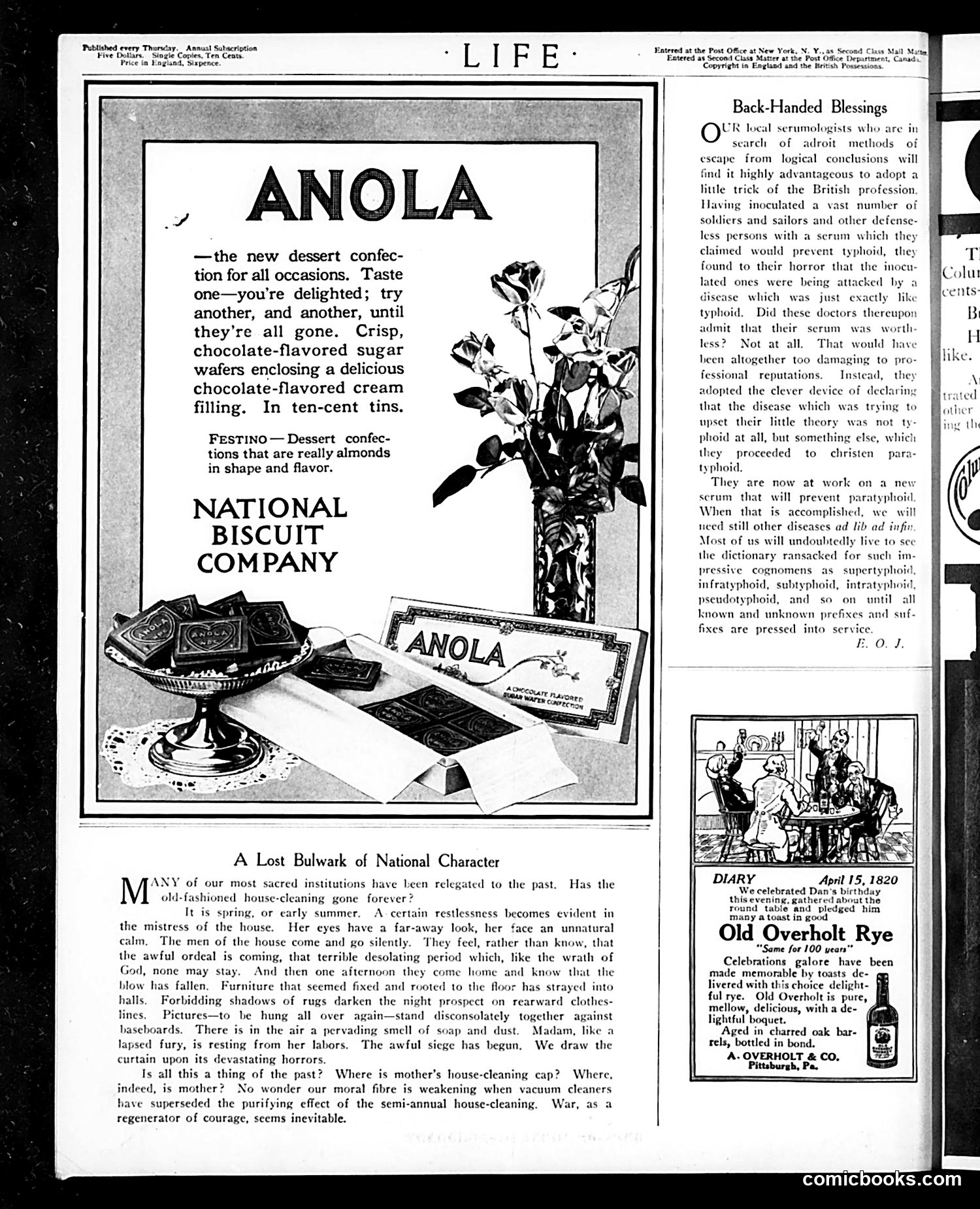
This page is **primarily advertising** for National Biscuit Company products (Anola and Festino desserts), not political satire. The main editorial content, "A Lost Bulwark of National Character," laments the decline of old-fashioned spring house-cleaning rituals. The author argues that traditional domestic labor—mothers thoroughly cleaning their homes seasonally—represented important cultural values. With modern conveniences like vacuum cleaners reducing the need for such labor-intensive cleaning, the writer suggests this loss reflects broader moral decline, warning that wartime conditions may further erode these traditional practices. The "Diary" entry advertises Old Overholt Rye whiskey. The satire here targets modernization's effect on traditional domesticity, a common 1910s-era conservative concern.
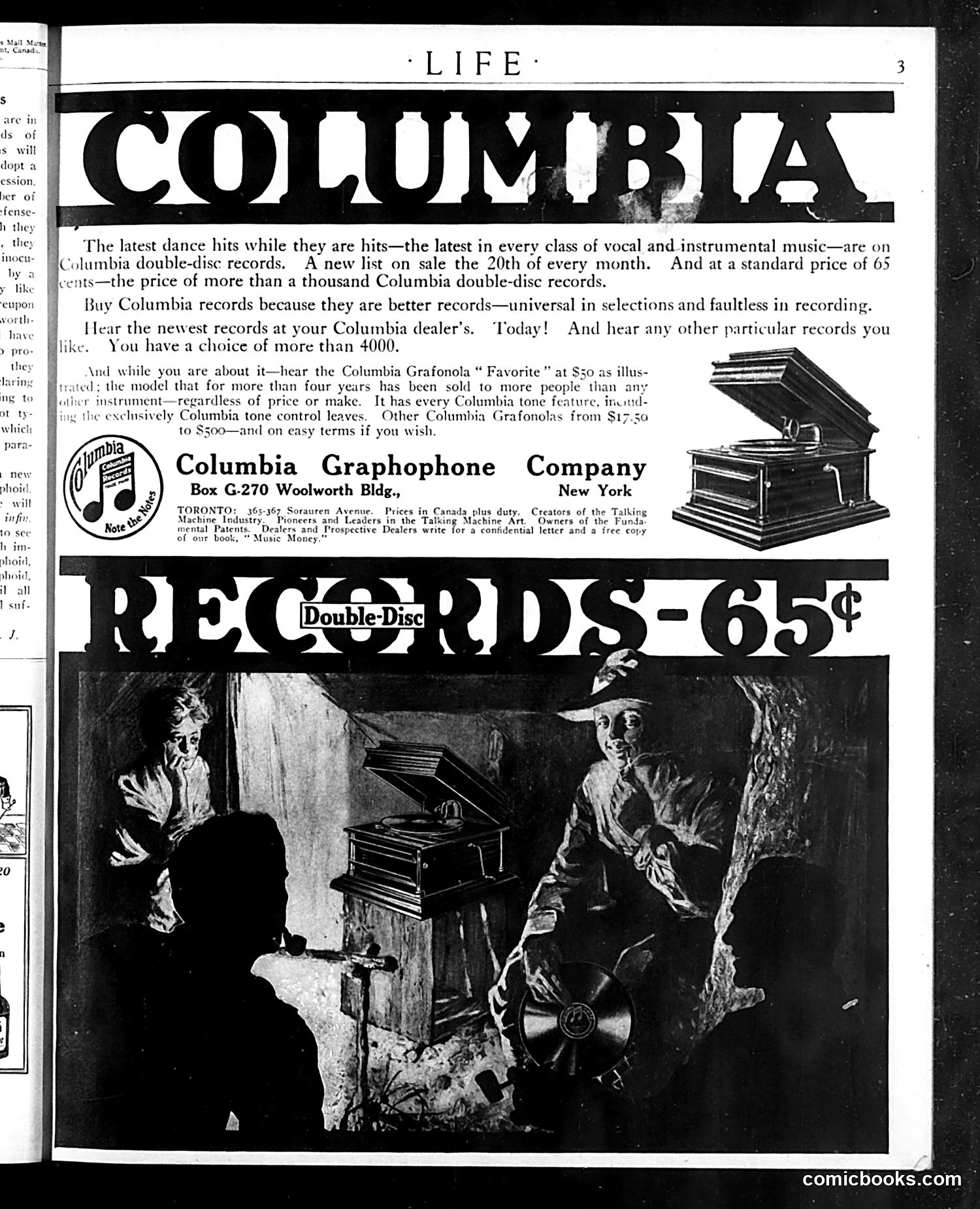
This page is primarily a **Columbia Records advertisement**, not political satire. The ad promotes Columbia's double-disc records at 65 cents, emphasizing their superior quality and selection (over 4,000 titles available). The illustrated scene below shows people gathered around a Columbia Graphophone (phonograph) in what appears to be a casual, social setting—likely depicting the appeal of owning one of these devices for home entertainment. The imagery suggests the social pleasure of listening to recorded music together. The advertisement's appeal targets middle-class consumers seeking affordable access to "the latest dance hits" and "every class of vocal and instrumental music." There is no political cartoon or satire on this page—it is straightforward commercial messaging typical of early 20th-century Life magazine advertising.
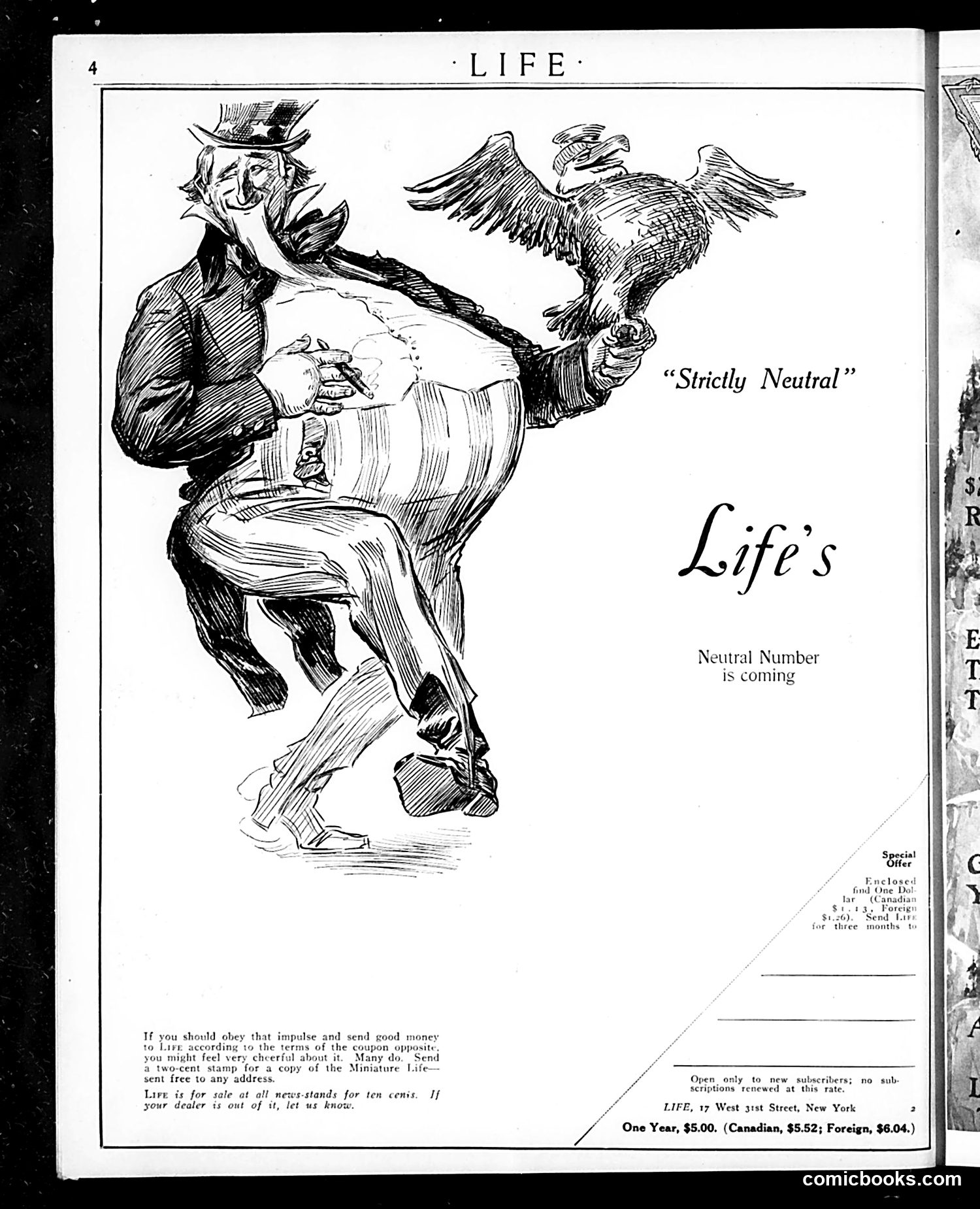
This is a satirical cartoon titled **"Strictly Neutral"** with the subtitle **"Life's Neutral Number is coming."** The image shows a grotesque figure—appearing to be Uncle Sam or an American political figure—sitting precariously balanced, clutching papers and looking anxious. A vulture or eagle hovers above menacingly, likely symbolizing war or danger. The satire concerns American **neutrality during wartime**, probably referencing World War I (when Life published this). The "neutral number" joke appears to mock the U.S. government's attempt to remain neutral while clearly being drawn into conflict. The unstable posture and predatory bird suggest the precariousness of neutrality—that it's an impossible or unsustainable position. The cartoon critiques political hypocrisy: maintaining a facade of neutrality while actually supporting one side.
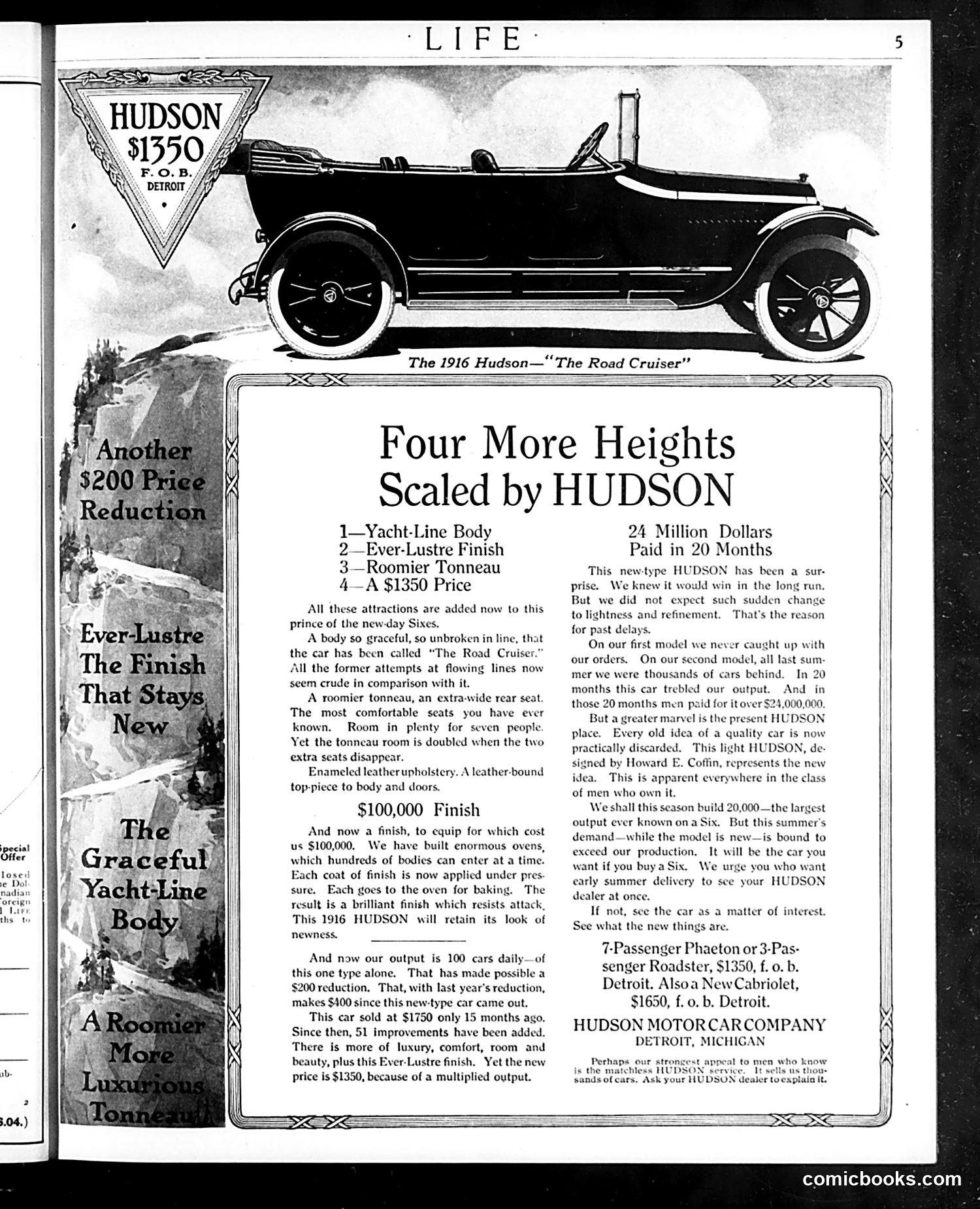
This page is primarily a **Hudson automobile advertisement**, not a political cartoon. It announces the 1916 Hudson "Road Cruiser" model at $1,350 (down $200 from a prior price). The ad emphasizes luxury features: yacht-line body, ever-lustre finish, roomier tonneau (rear seating), and leather upholstery. It boasts the company's production capacity—100 cars daily, 20,000 annually—positioning Hudson as a quality competitor to higher-priced models. The left sidebar lists competing features: yacht-line body design, graceful styling, and roomy interiors. The ad's tone suggests Hudson is marketing affordability without sacrificing luxury, appealing to middle-class buyers seeking status symbols. This reflects early automotive industry competition and the era's emphasis on mass production meeting consumer demand.
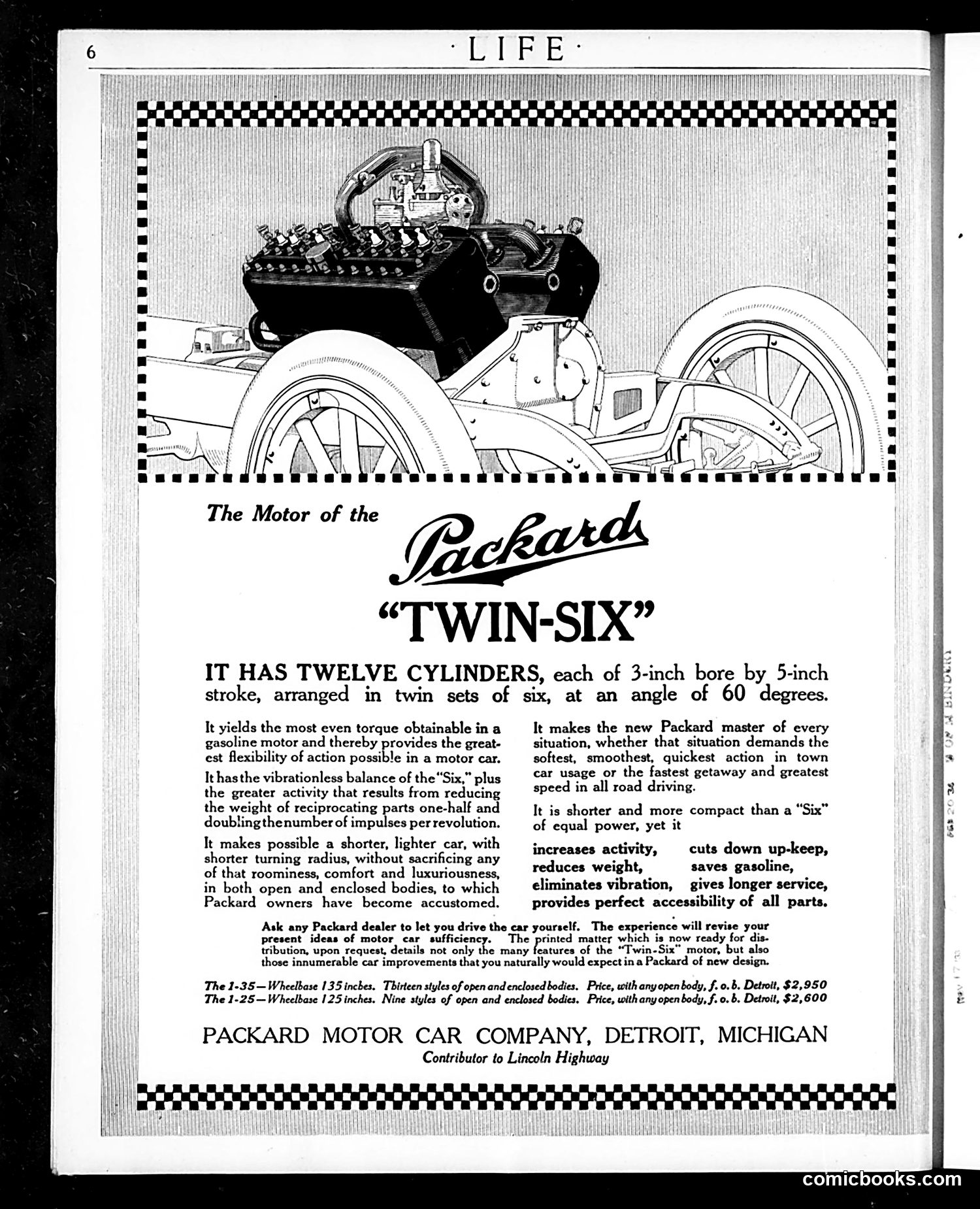
This is primarily **advertising content, not satire or political commentary**. The page features a full advertisement for the Packard "Twin-Six" automobile, published by the Packard Motor Car Company of Detroit, Michigan. The illustration shows an early 1900s luxury car with an operator and passengers. The ad emphasizes the vehicle's twelve-cylinder engine (arranged in two sets of six at 60-degree angles), highlighting technical innovations: smooth torque, compact design, reduced vibration, and improved accessibility. The copy appeals to luxury car buyers by promising superior performance and comfort. This represents straightforward automotive marketing from the era, not editorial cartooning or satirical commentary. The decorative checkered border is typical design ornamentation of the period.
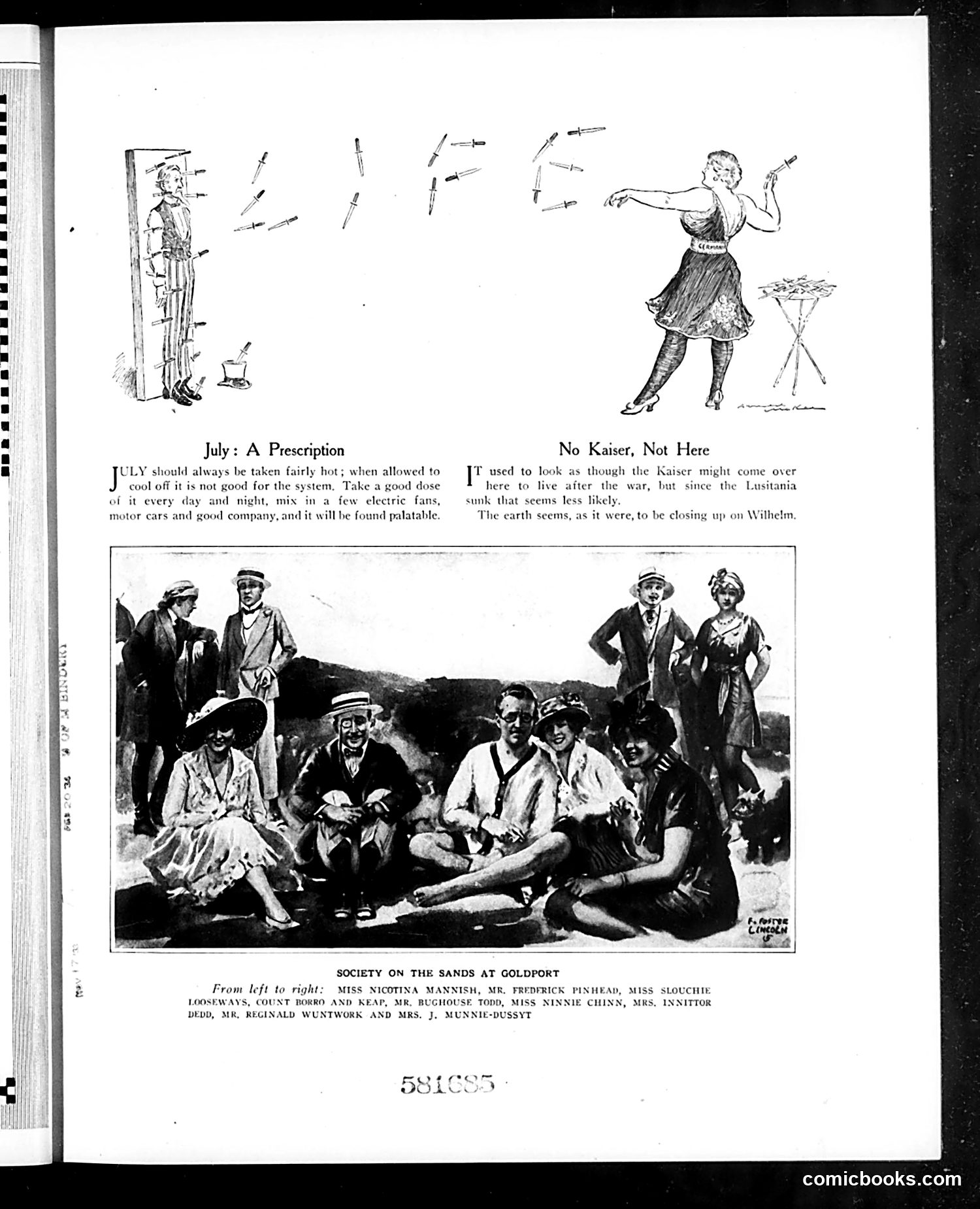
This page contains two satirical cartoons and a photograph from Life magazine, likely from 1917-1918 based on the Lusitania reference. **Top cartoons:** - "July: A Prescription" shows medical advice about staying cool in summer - "No Kaiser, Not Here" depicts a woman throwing darts at a target, with text referencing Kaiser Wilhelm and the Lusitania sinking, expressing relief the Kaiser won't come to America after the war. This reflects American anti-German sentiment during WWI. **Bottom photograph:** "Society on the Sands at Goldport" shows a group of well-dressed people relaxing at a beach, accompanied by a list of names. This appears to be typical social reportage from Life magazine's society coverage. The page juxtaposes lighthearted summer advice and beach society scenes with pointed political commentary about the ongoing war and American security concerns.
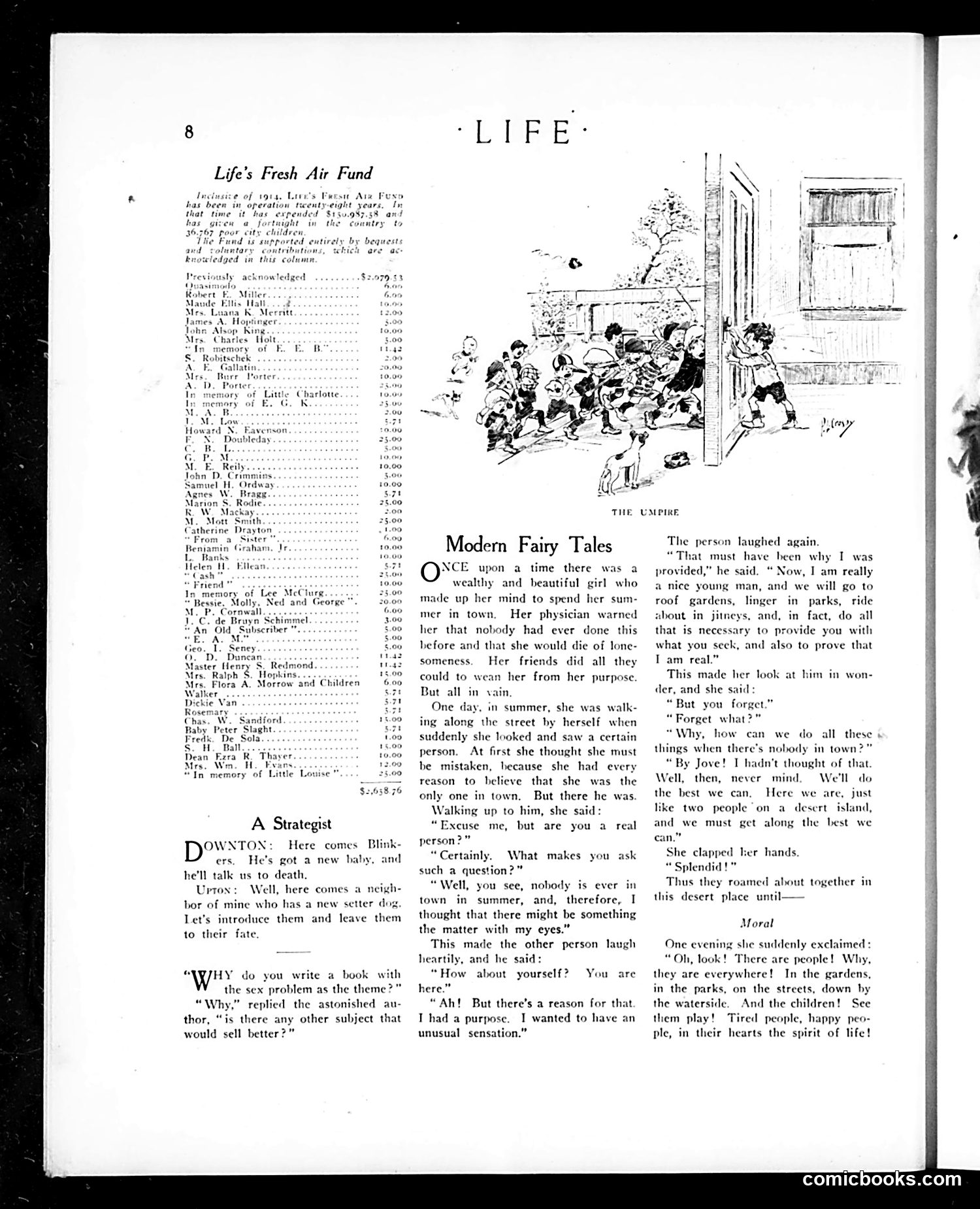
This page contains two distinct pieces: **"The Umpire"** (illustration, top right): Shows children playing a game while an adult figure stands at a doorway. The cartoon satirizes childhood games and authority figures, though the specific reference is unclear without additional context. **"Modern Fairy Tales"** (main story): A serialized fiction piece about a wealthy girl who spends summer in town despite her physician's warnings about loneliness. She encounters a man claiming to be "real" and proposes they explore the city together—parks, gardens, streets. The narrative appears to satirize wealthy idle society and romanticized notions of authenticity versus privilege. **"A Strategist"** (bottom left): A brief dialogue joke about book publishing, where someone suggests writing about "the sex problem" as a marketable subject. It's light social satire on publishing trends. The page primarily features fiction and light humor rather than political commentary.
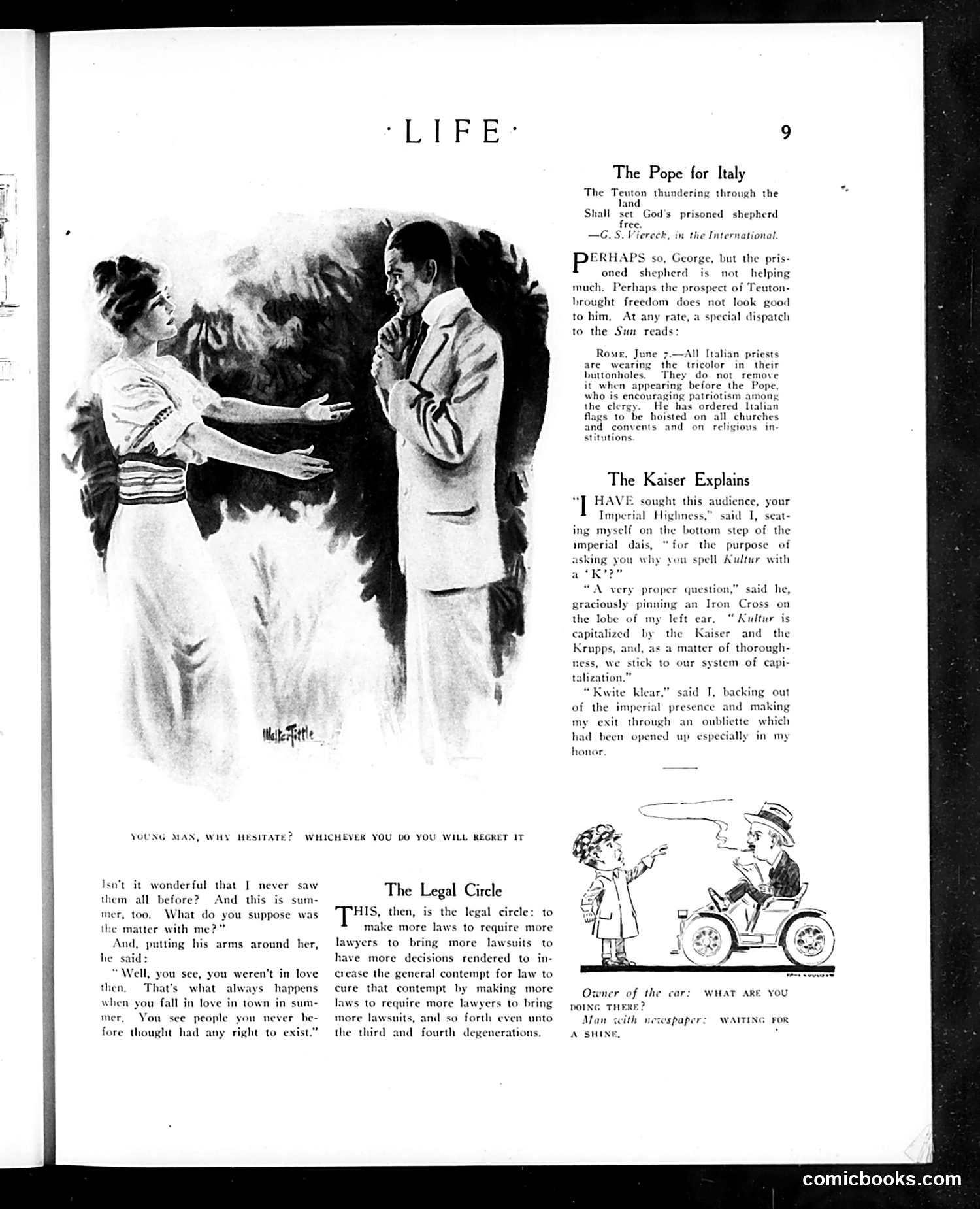
This page from *Life* magazine contains three separate satirical pieces: 1. **"The Pope for Italy"** – A sketch featuring two figures in conversation, likely commenting on the Pope's political influence in Italy during WWI, with a quote suggesting tension between religious authority and nationalism. 2. **"The Kaiser Explains"** – A humorous anecdote about the German Kaiser being pedantic regarding spelling ("Kultur" with a capital K), satirizing German attention to detail and the Kaiser's self-importance during the war era. 3. **"The Legal Circle"** – A critique of the legal system's self-perpetuating nature: more laws require more lawyers, more lawsuits, and more judges, creating endless litigation. The accompanying cartoon shows a motorist delayed by paperwork. The magazine employs humor to critique WWI-era politics, German militarism, and institutional inefficiency.
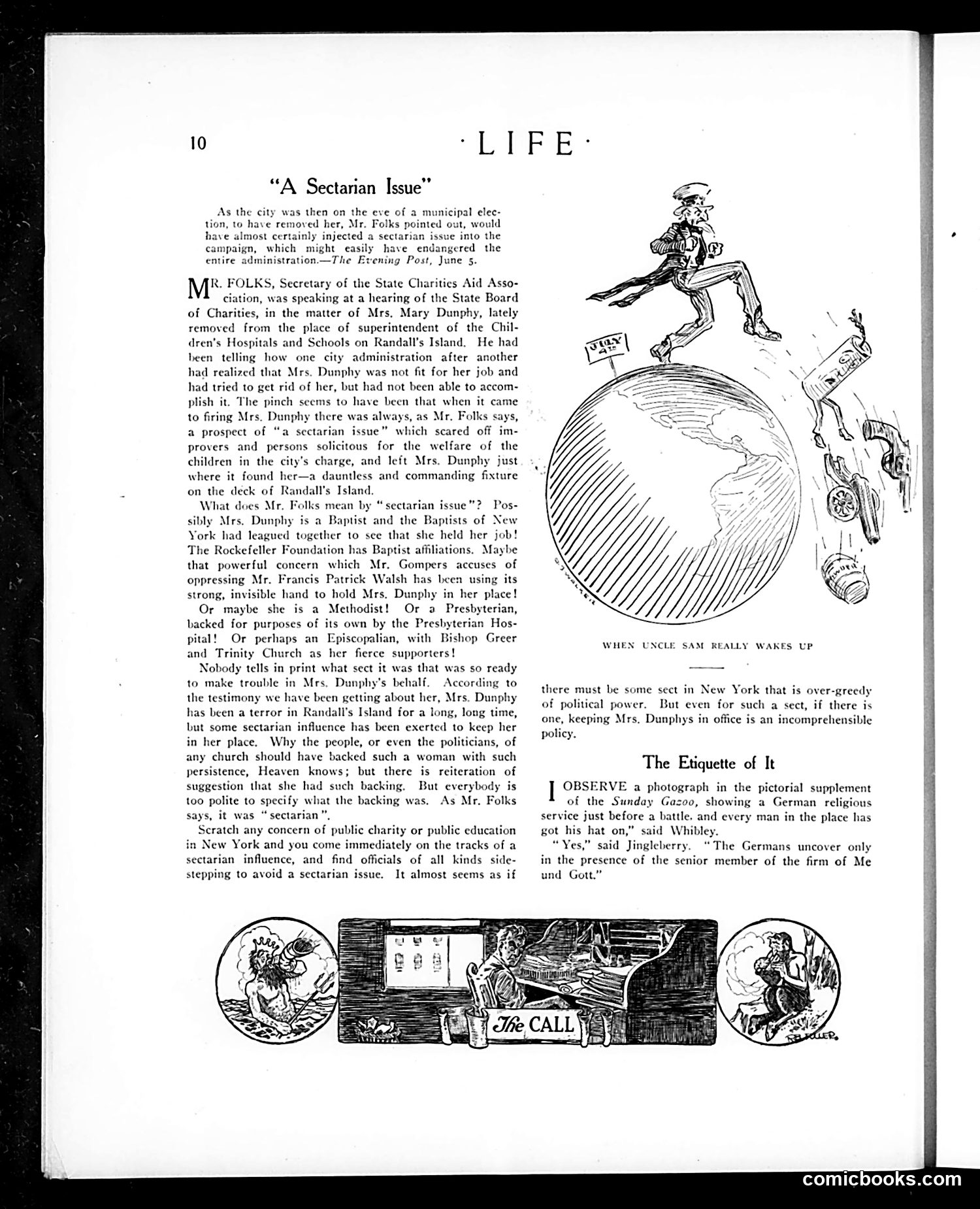
This page satirizes accusations that Mrs. Mary Dunphy's removal as superintendent of Children's Hospitals and Schools on Randall's Island resulted from sectarian religious conflict. Mr. Folks (Secretary of State Charities Aid Association) defends against claims that Baptist, Methodist, Presbyterian, or other denominational groups orchestrated her firing for political reasons. The cartoon "When Uncle Sam Really Wakes Up" depicts Uncle Sam jolting awake atop a spinning globe, suggesting the satirist's view that the public remains oblivious to behind-the-scenes religious faction-fighting in New York politics. The satire implies that such "sectarian issues" secretly influence public charity administration, contradicting official denials of religious bias in her dismissal.
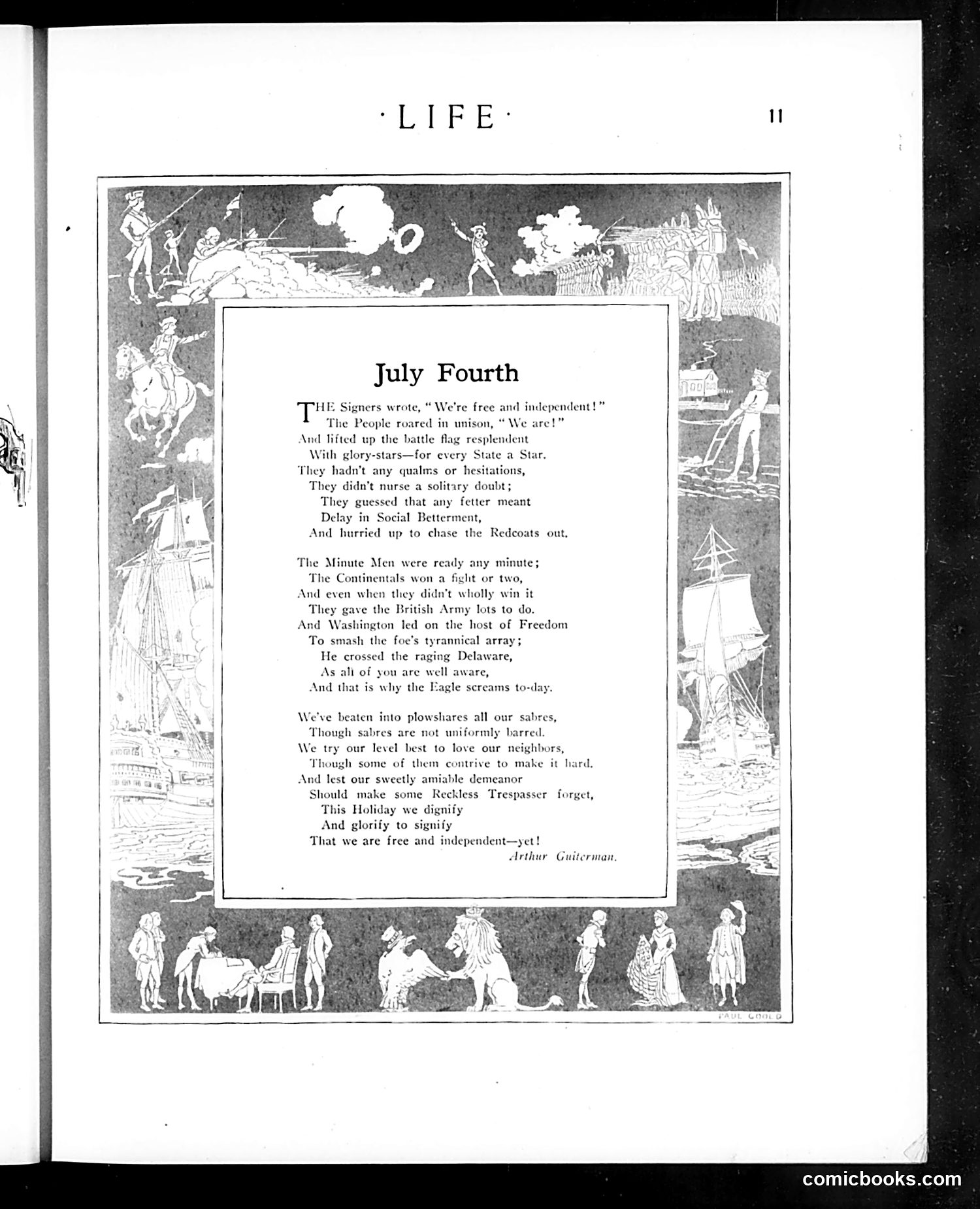
This page presents a patriotic poem by Arthur Guiterman celebrating American Independence Day. The illustrated border depicts Revolutionary War scenes—ships, soldiers, and colonial figures—establishing the historical context. The poem humorously contrasts the grand ideals of the Declaration ("We're free and independent!") with contemporary American social realities. It references the Minute Men and Continental Army fighting British tyranny, with Washington crossing the Delaware as the heroic centerpiece. However, the satirical turn appears in later stanzas acknowledging that Americans have "beaten into plowshares all our sabres" yet still struggle with neighborly love and "Reckless Trespasser" conflicts. The satire suggests Americans celebrate freedom from external oppression while remaining internally divided and contentious—a pointed commentary on post-Revolutionary American social discord.
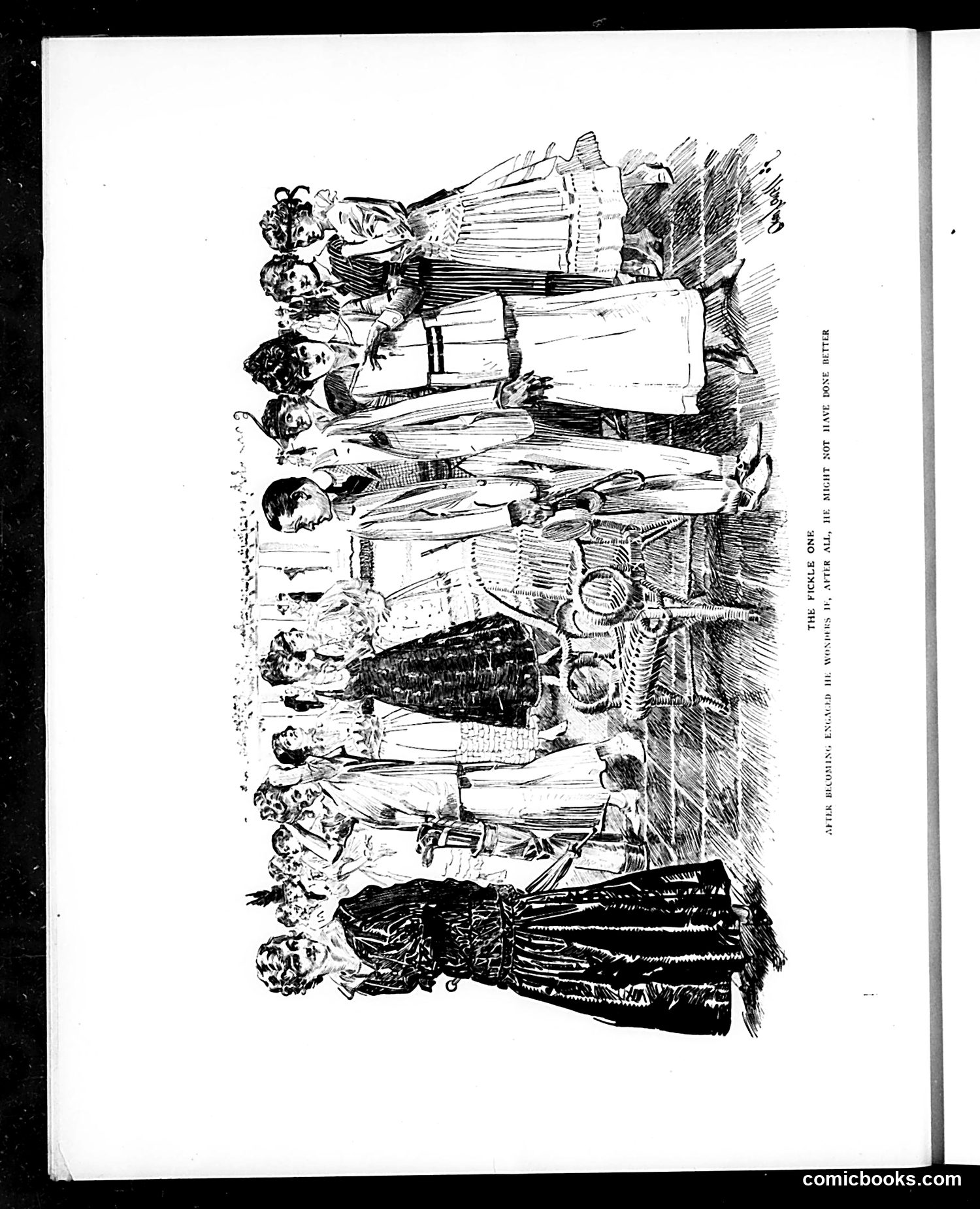
This page displays a single illustration titled "THE VOICES ON - ALL IS RIGHT WITH THE WORLD," printed sideways (rotated 90 degrees). The image shows a group of figures arranged vertically, depicting what appears to be a satirical commentary on public opinion or social commentary during the early 20th century. The illustration uses caricature style typical of *Life* magazine's political satire. However, without being able to read the caption text clearly or identify specific individuals depicted, I cannot definitively explain which political figures or events are referenced. The title suggests ironic commentary on claims that "all is right with the world" despite apparent social concerns. The artistic style and composition indicate social or political criticism, but **I cannot confidently identify the specific figures or historical context without clearer textual information.**
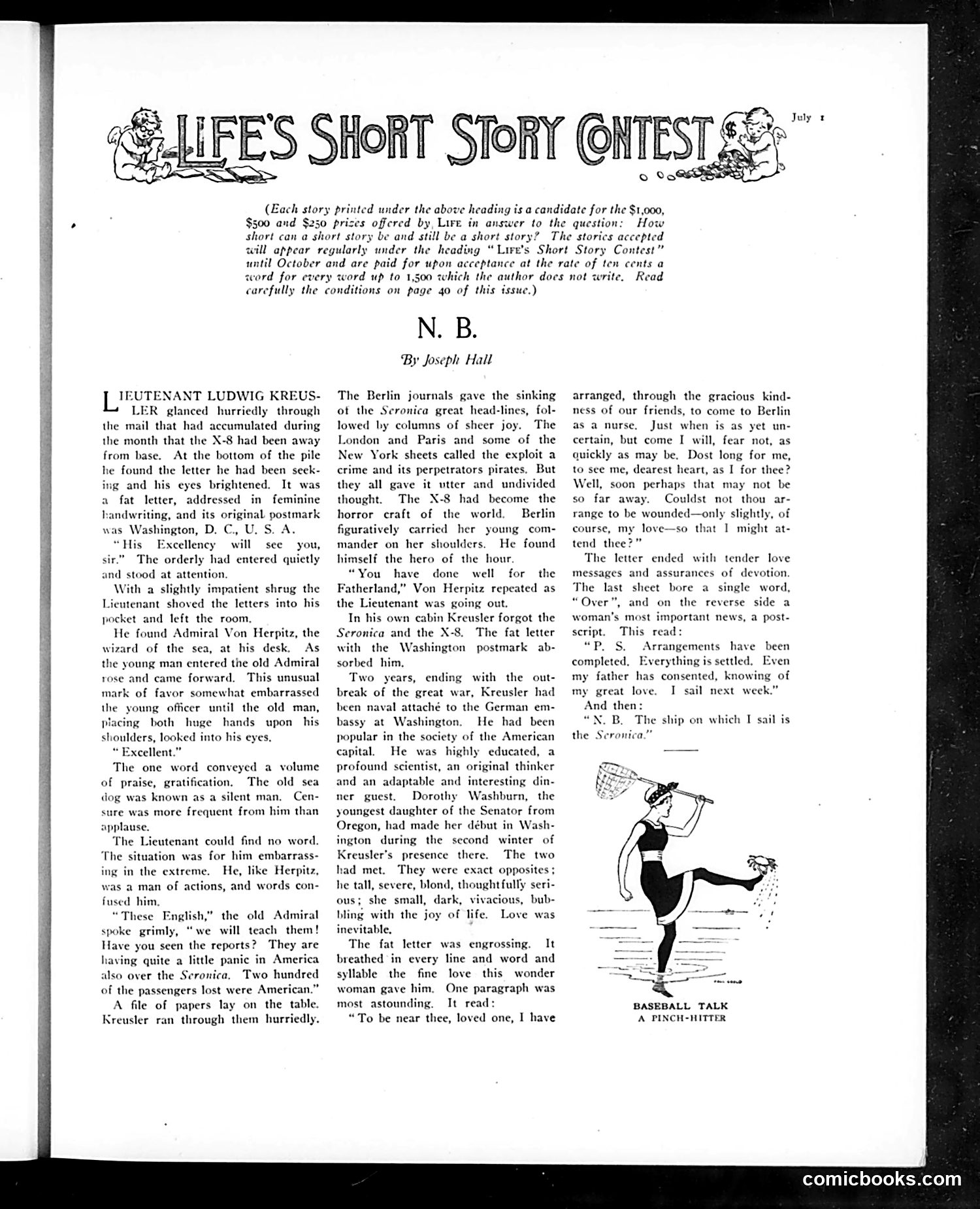
This page presents a short story titled "N.B." by Joseph Hall about Lieutenant Ludwig Kreusler, a German naval officer during World War I who discovers a letter addressed to him aboard the SMS X-8 submarine. The story describes Kreusler's emotional journey upon learning the letter is from Dorothy Washburn, a senator's daughter from Oregon with whom he'd fallen in love in Washington, D.C. The accompanying illustration shows a baseball player executing a "pinch-hitter" maneuver—appearing unrelated to the story's wartime romance narrative. The page announces Life's short story contest offering $1,000, $500, and $250 prizes, with stories accepted for publication in the magazine.
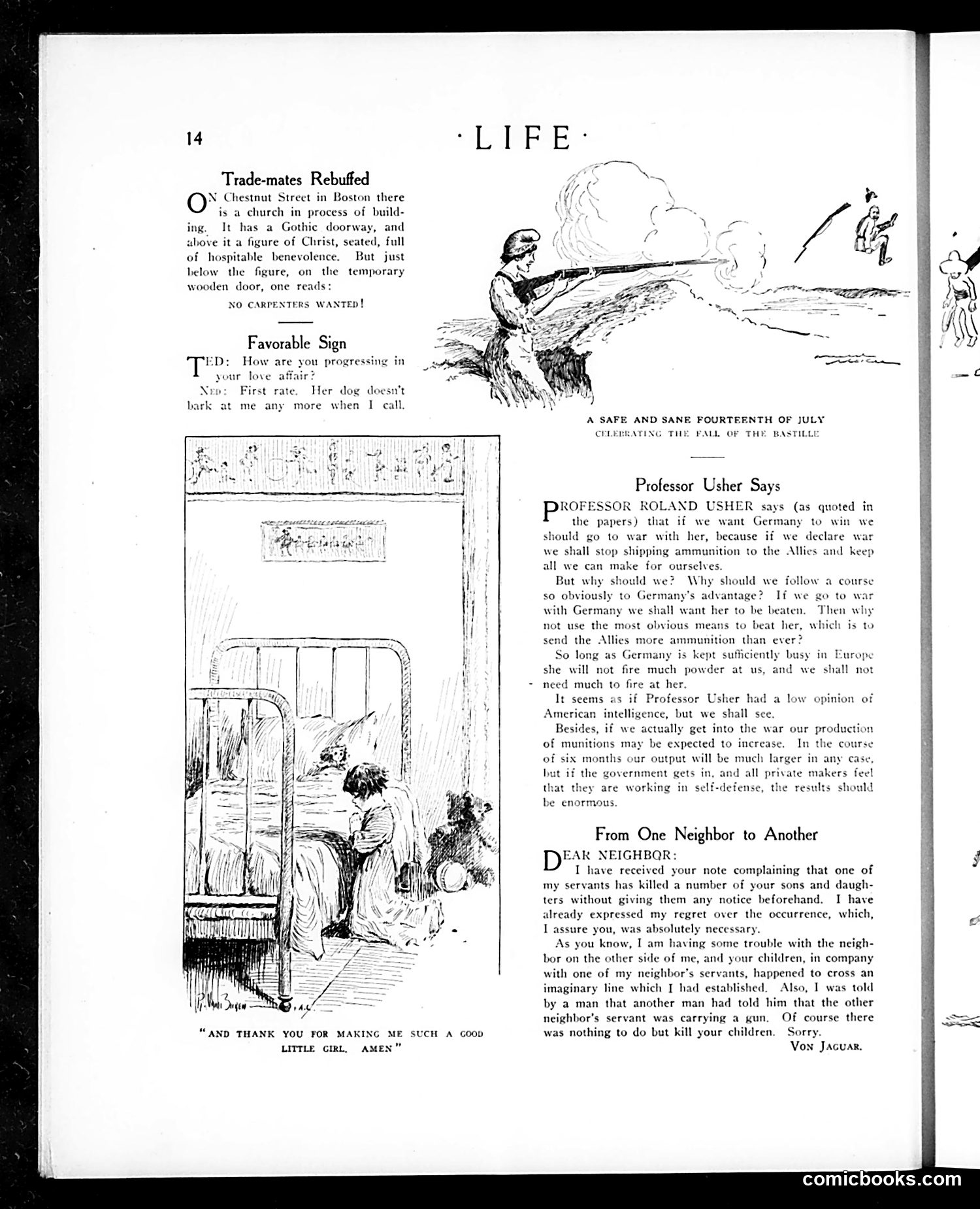
This page contains three separate satirical pieces from what appears to be WWI-era Life magazine: 1. **"Trade-mates Rebuffed"**: A brief joke about a Boston church under construction with a "no carpenters wanted" sign—likely mocking tradespeople or labor disputes. 2. **"A Safe and Sane Fourteenth of July"**: An illustration showing someone firing a cannon, celebrating Independence Day. The caption references "the fall of the Bastille," suggesting Franco-American solidarity during WWI. 3. **"Professor Usher Says"**: Commentary on a professor's argument against declaring war on Germany, suggesting American munitions production could defeat Germany without direct combat. The text critiques this view as naive regarding American industrial capacity. 4. **"From One Neighbor to Another"**: A letter-to-the-editor style piece addressing a neighbor's complaint about servant misconduct, with a dismissive tone characteristic of period class attitudes. The page reflects wartime American political debate and social commentary.
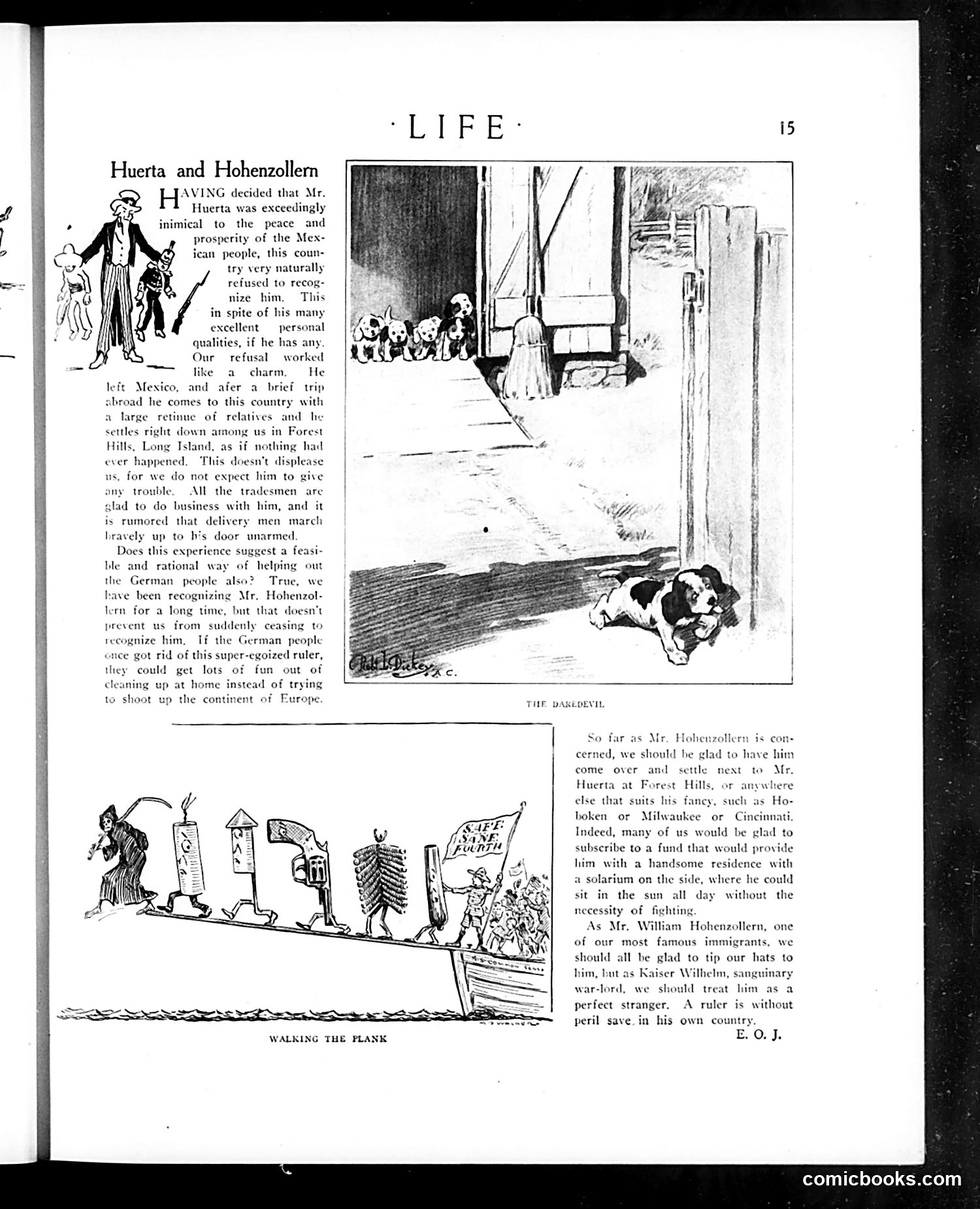
This page discusses **Huerta and Hohenzollern**, satirizing their perceived threat to American peace. The text suggests that Mexican leader Huerta, after a brief foreign trip, has settled suspiciously near Forest Hills, Long Island—implying secret German (Hohenzollern) influence or collaboration. The cartoons mock this scenario: "The Daredevil" shows a dog entering a confined space (suggesting danger or entrapment), while "Walking the Flask" depicts figures carrying prohibited alcohol during Prohibition, satirizing hypocrisy among the elite. The author (E.O.J.) argues Americans should welcome Hohenzollern to America rather than fear him, suggesting through irony that open scrutiny is preferable to covert activity. The satire targets both foreign intrigue fears and American social anxieties of the era.
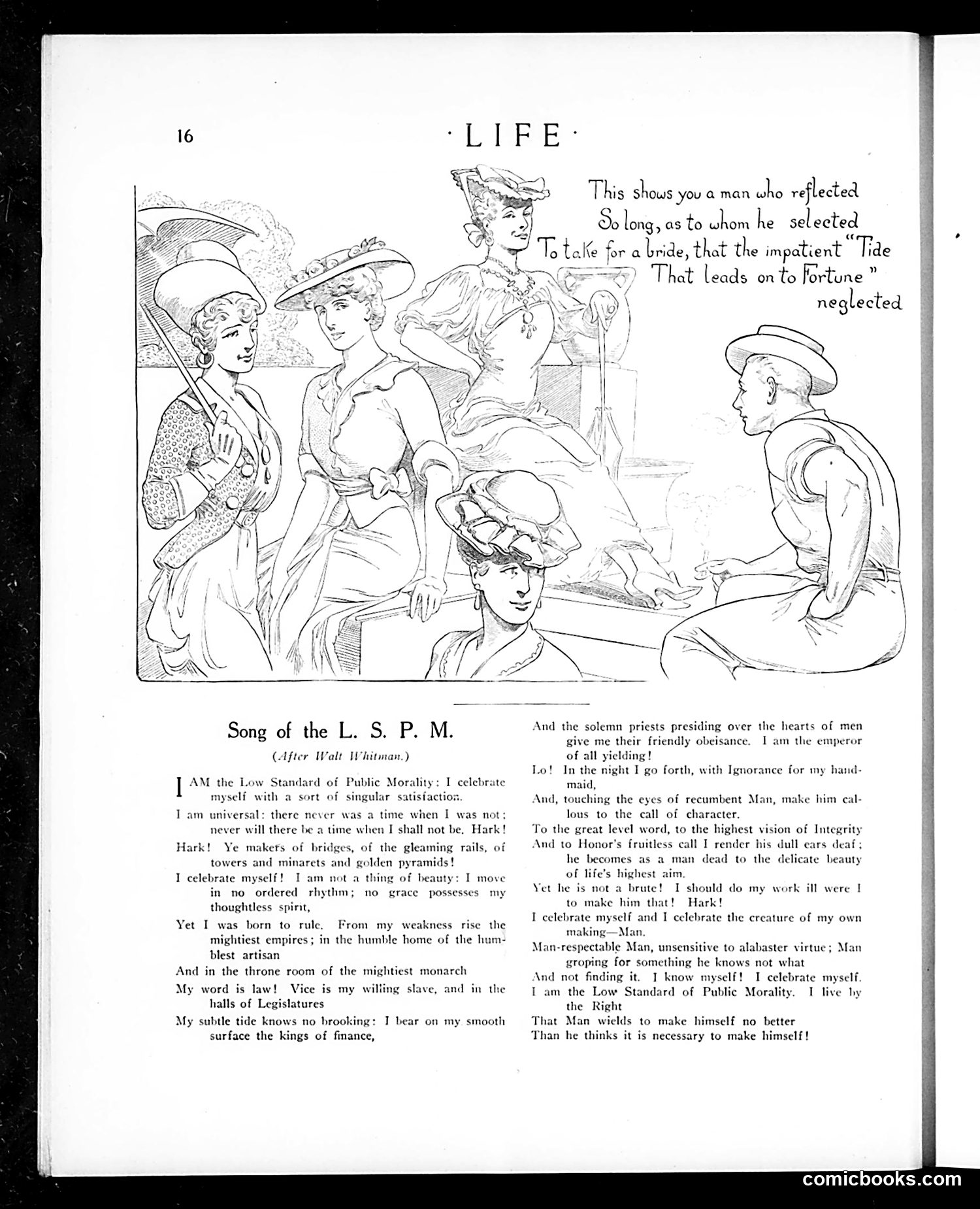
This page satirizes the "Low Standard of Public Morality" (L.S.P.M.) as a corrupting force in society. The illustrated scene shows well-dressed women at leisure while a man on the right appears to be a laborer or working-class figure—suggesting class division and moral decay among the wealthy. The poem, written in the style of Walt Whitman (as noted), personifies Public Morality as a boastful entity that celebrates its own pervasiveness and power. It claims dominion over legislatures, finance, and religion, corrupting mankind into moral apathy. The satire argues that society collectively enables this decline by accepting lower moral standards than necessary. The caption criticizes a man who "reflected so long" before choosing a bride that he missed his fortune—suggesting that hesitation and poor moral judgment have real consequences. Overall, the piece is a Progressive Era critique of widespread ethical compromise in American institutions and among the public.
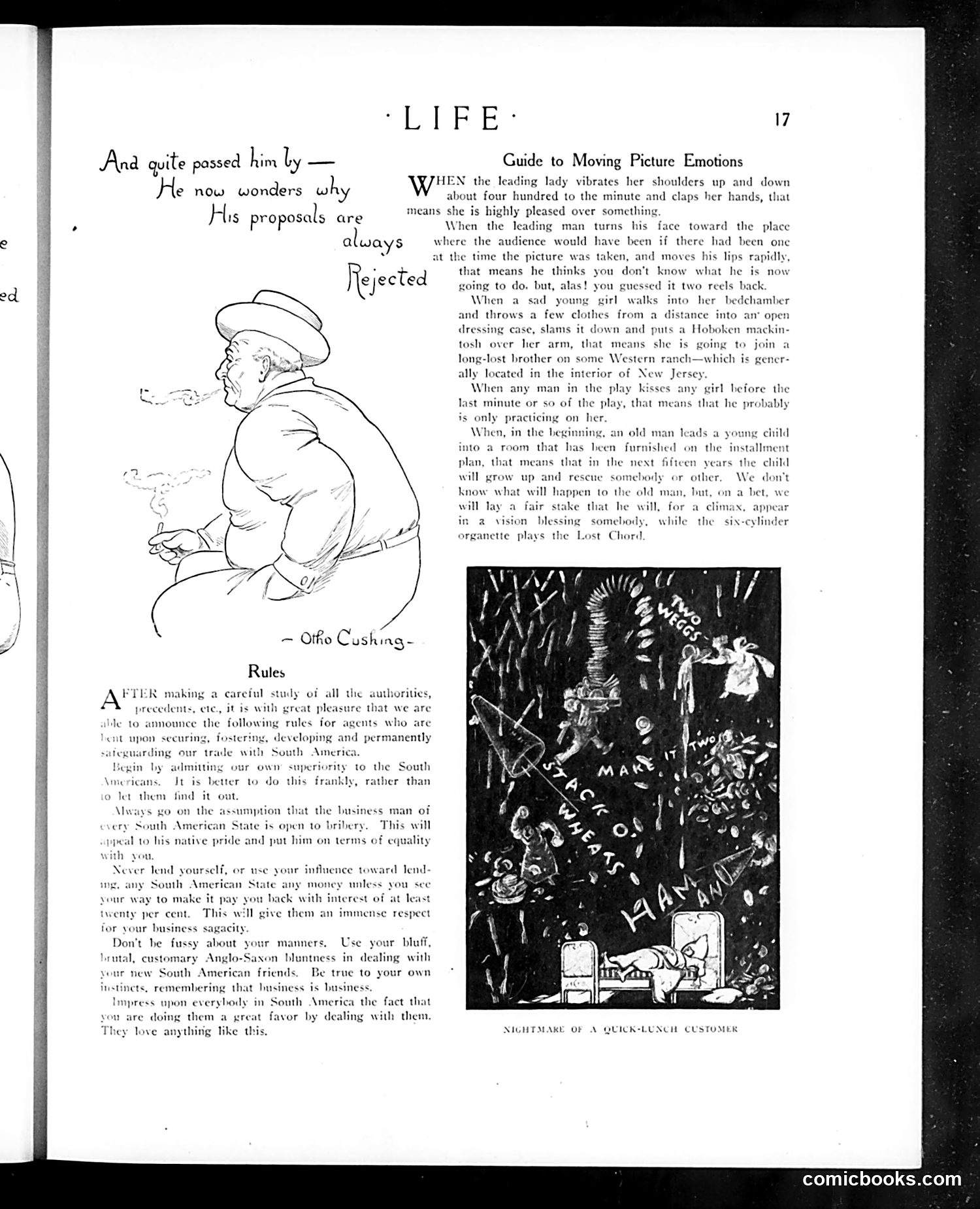
## The Cartoons **Left cartoon (Othe Cushing):** Depicts a rotund man being rejected, illustrating the caption "And quite passed him by — He now wonders why. His proposals are always Rejected." This appears to be a generic romantic comedy scenario about a suitor's repeated rejections. **Right cartoon ("Nightmare of a Quick-Lunch Customer"):** Shows a surreal, nightmarish scene with grotesque figures and distorted imagery surrounding a sleeping figure. It satirizes the indigestion or bad dreams caused by eating quick, cheap food—a common subject for humor about urban lunch culture. ## The "Rules" Section The text presents satirical "rules" for American businessmen dealing with South America. It mocks American commercial arrogance by advising agents to assume South Americans are bribeable, to claim superiority frankly, and to treat business dealings as a personal favor. This reflects early 20th-century American imperialist attitudes and economic colonialism in Latin America. The satire targets both the actual exploitative practices and American obliviousness to how offensive such behavior was.
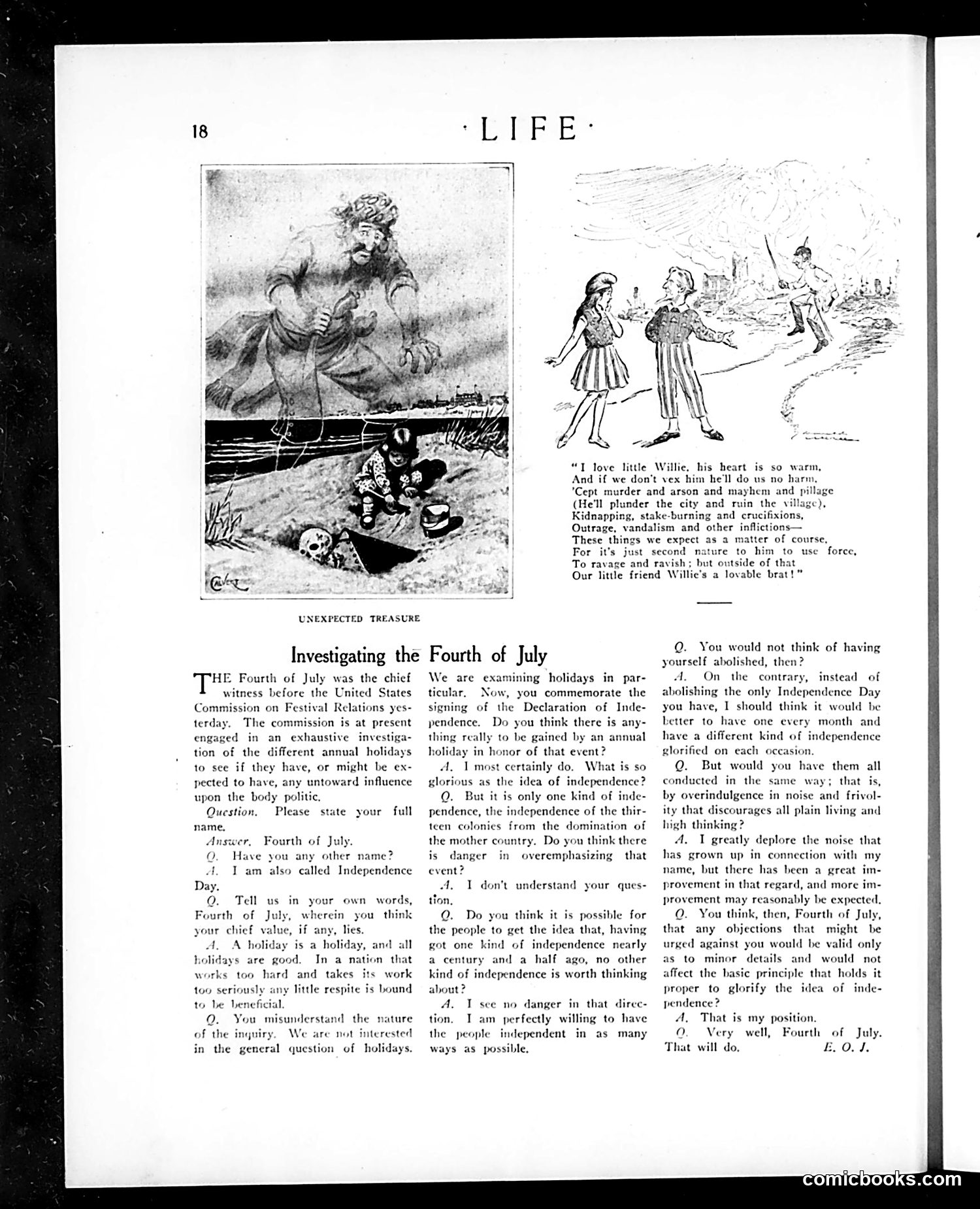
This is satirical social commentary disguised as a mock government inquiry. The "United States Commission on Festival Relations" is interrogating the Fourth of July personified as a witness, using absurdist humor to critique American Independence Day celebrations. The satire targets two things: First, the proliferation of different "independence" movements and causes (the interviewer suggests celebrating independence monthly in different ways). Second, and more sharply, the cartoon on the left—captioned "Unexpected Treasure"—depicts a menacing figure emerging from water while a child plays nearby, accompanying doggerel verse praising "little Willie" despite his tendencies toward "murder and arson...mayhem and pillage." This appears to satirize how Americans romanticize youthful wildness and destructiveness under the guise of "independent spirit." The piece mocks both excessive civic pride in the founding holiday and the chaotic, violent behavior—particularly urban rioting and lawlessness—that characterized Fourth of July celebrations in this era.
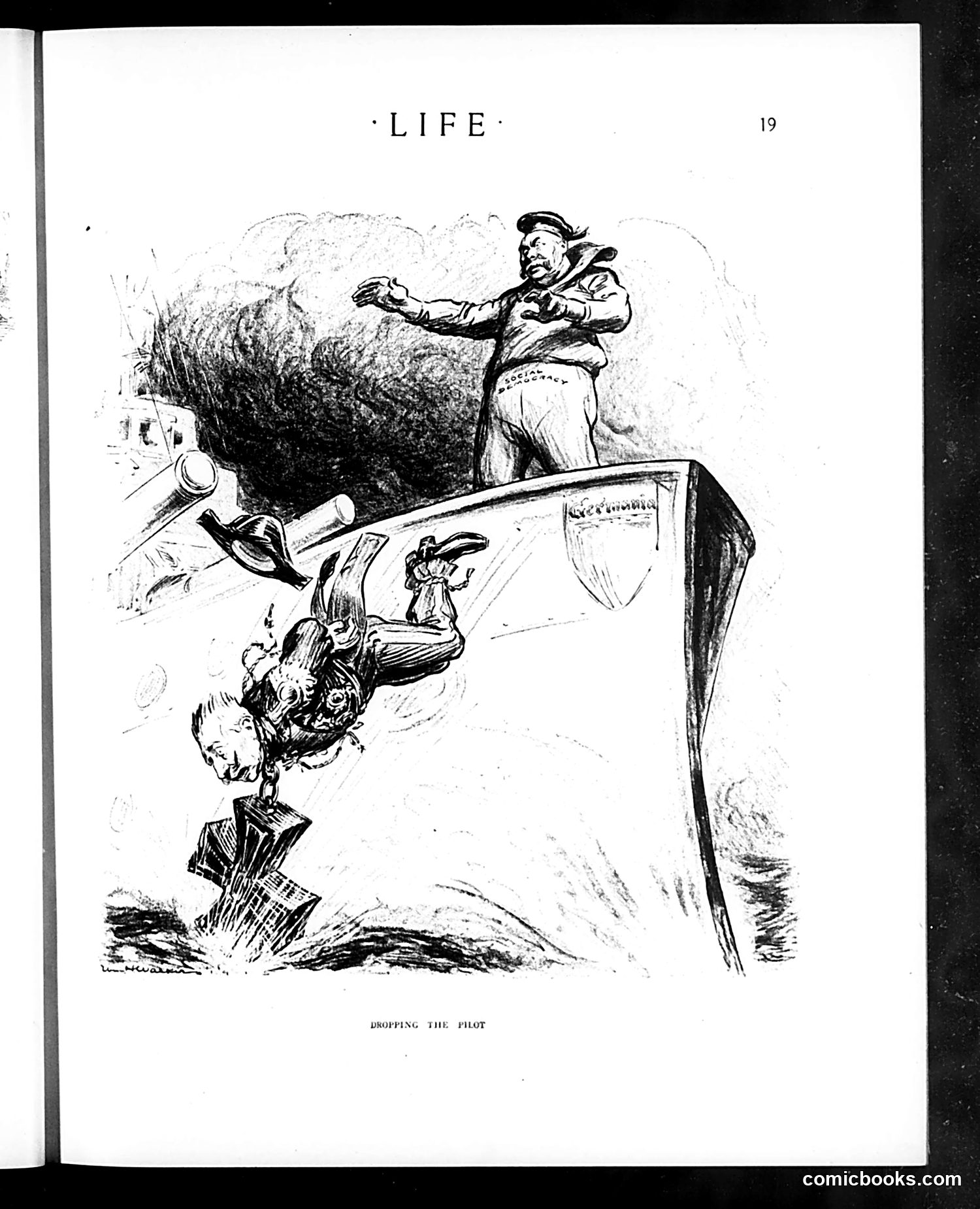
This political cartoon depicts a man being ejected from a boat or vessel by another figure. The caption "Dropping the Pilot" is a famous historical reference to the removal of Otto von Bismarck as German Chancellor in 1890 by Kaiser Wilhelm II. The cartoon uses this maritime metaphor to suggest that dismissing a skilled leader (the "pilot" steering the ship of state) is dangerous and foolish. The figure being thrown overboard likely represents Bismarck or a comparable political leader, while the standing figure represents the authority removing him. The satire critiques impulsive leadership decisions that jettison experienced governance. This was a popular subject in late 19th-century political cartooning, warning against the consequences of losing wise guidance during turbulent times.
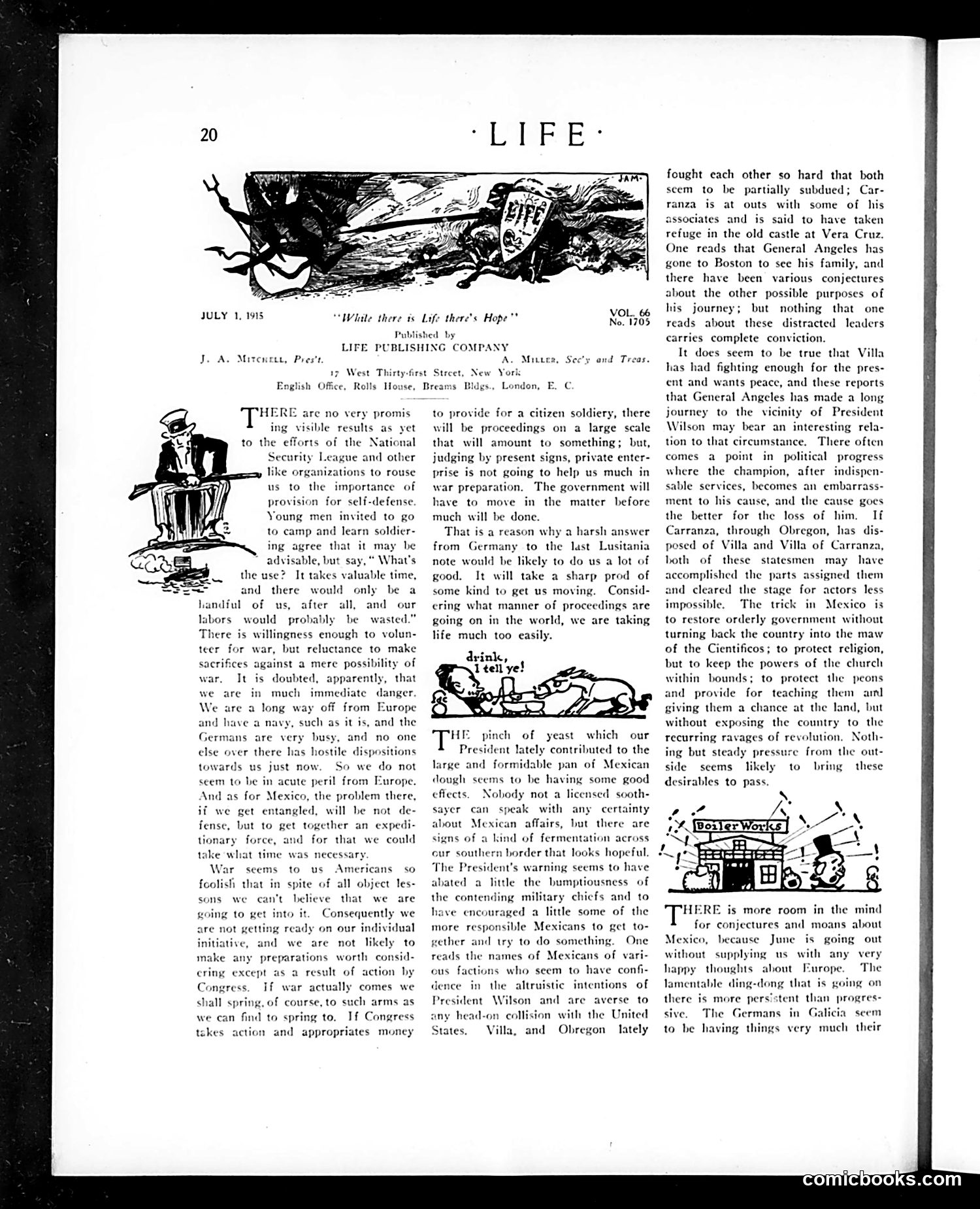
This page addresses American preparedness for potential war, reflecting anxieties following the *Lusitania* sinking (May 1915). **Main Cartoon**: The header illustration shows a figure in a trash can labeled "LIFE," captioned "While there is Life there's Hope"—satirizing American complacency about military readiness. **Key Arguments**: - The National Security League's preparedness campaigns are failing because Americans doubt immediate danger - Citizens resist military training camps, viewing war as unlikely despite European conflict - Only a "sharp prod" (like a harsh German response) will motivate action - Congress must lead since private citizens won't volunteer preparation **Mexican Content**: The text discusses President Wilson's recent intervention in Mexican civil unrest, noting that Villa, Carranza, and Obregon—rival military factions—show signs of accepting negotiated settlement. General Angeles visiting Boston fuels speculation about his intentions. **Overall Point**: Americans are dangerously passive about potential war involvement, requiring government intervention and external crisis to spur defensive action.
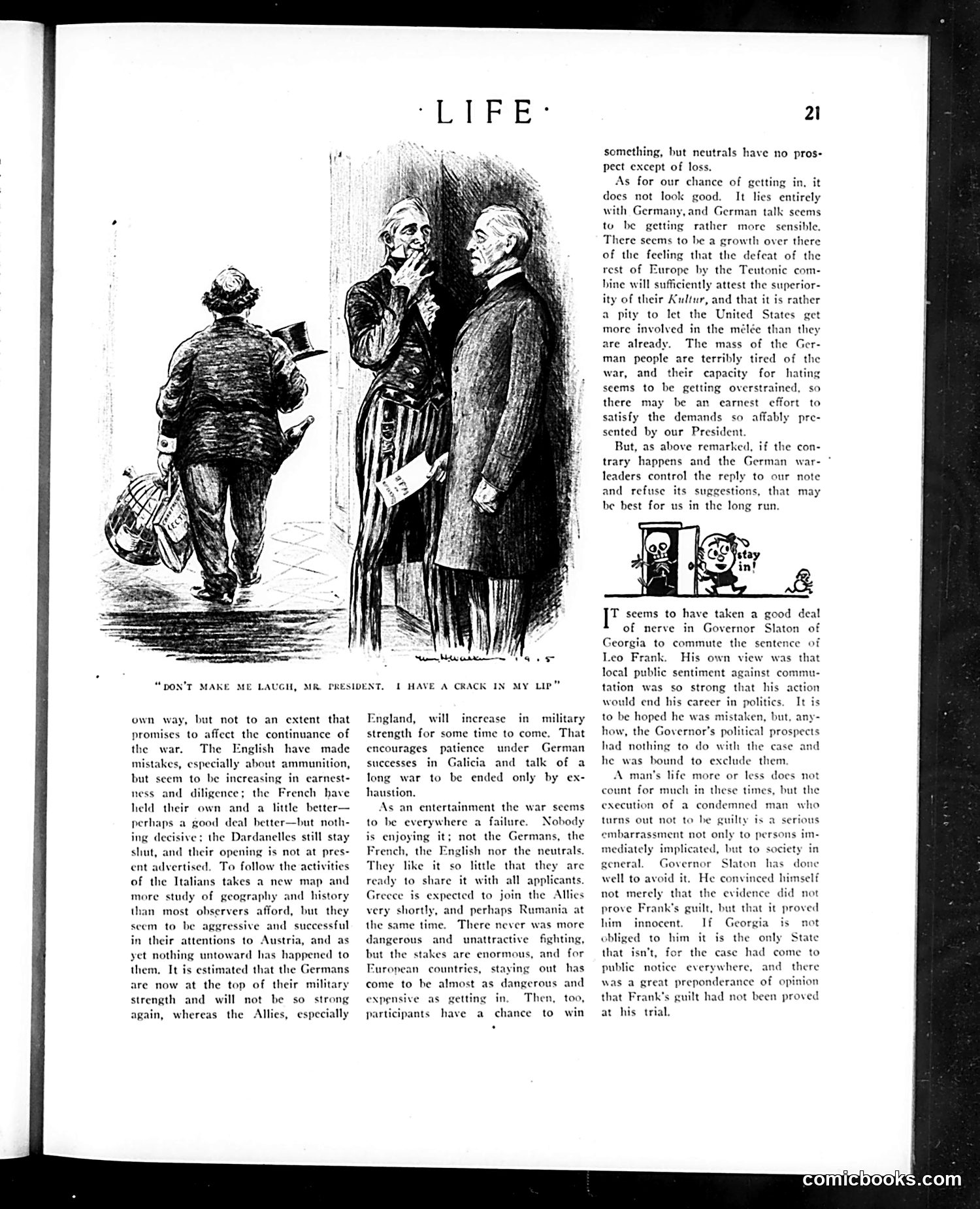
This satirical cartoon depicts a weary soldier returning home, encountering two well-dressed officials (likely representing President Wilson and another government figure). The soldier's caption—"Don't make me laugh, Mr. President. I have a crack in my lip"—is a dark joke about his war injuries, sarcastically rejecting whatever optimistic rhetoric the President offers about the war. The surrounding text discusses World War I (then ongoing), examining whether America should enter the conflict. The author argues Germany controls whether the U.S. joins, notes the war's unpopularity everywhere, and expresses skepticism about American involvement looking "good." The cartoon's point: mock the gap between government officials' comfortable positions and soldiers' brutal reality. It suggests presidential rhetoric rings hollow to those actually suffering combat wounds.
This is a pen-and-ink illustration from *Life* magazine showing a fashionably dressed woman seated at a piano in an elegant, ornate interior. The drawing emphasizes her stylish upswept hair and flowing gown, rendered in the magazine's characteristic fine-line style. However, the OCR text provided ("comicbooks.com") appears to be only a watermark from the digital archive, not the actual caption or article text from the original magazine page. Without the accompanying text, headline, or caption visible in the image itself, I cannot definitively identify who this woman represents, what social or political commentary is intended, or what the satire's specific point may be. The illustration appears to be social commentary on upper-class women or fashion, but context is insufficient for accurate interpretation.
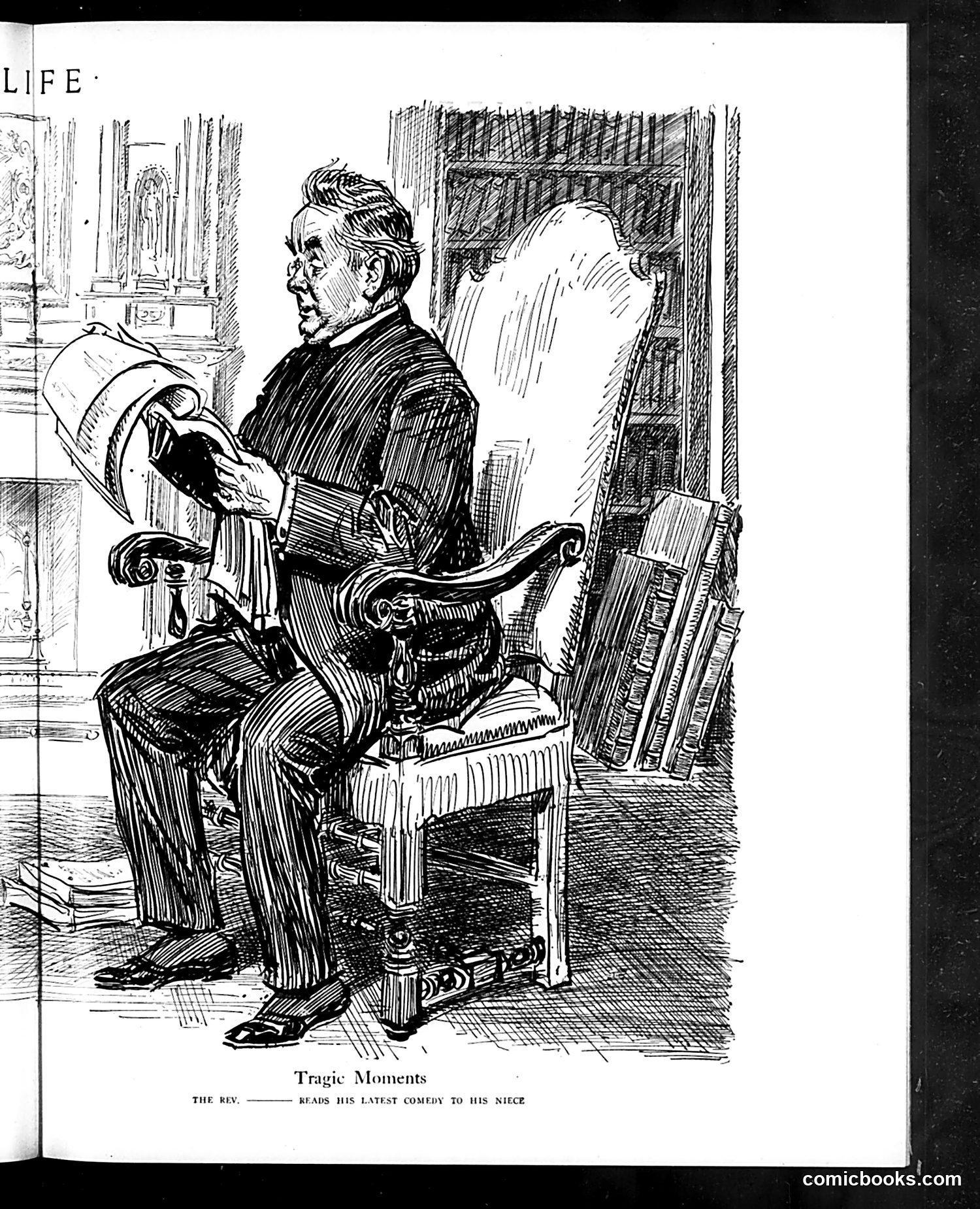
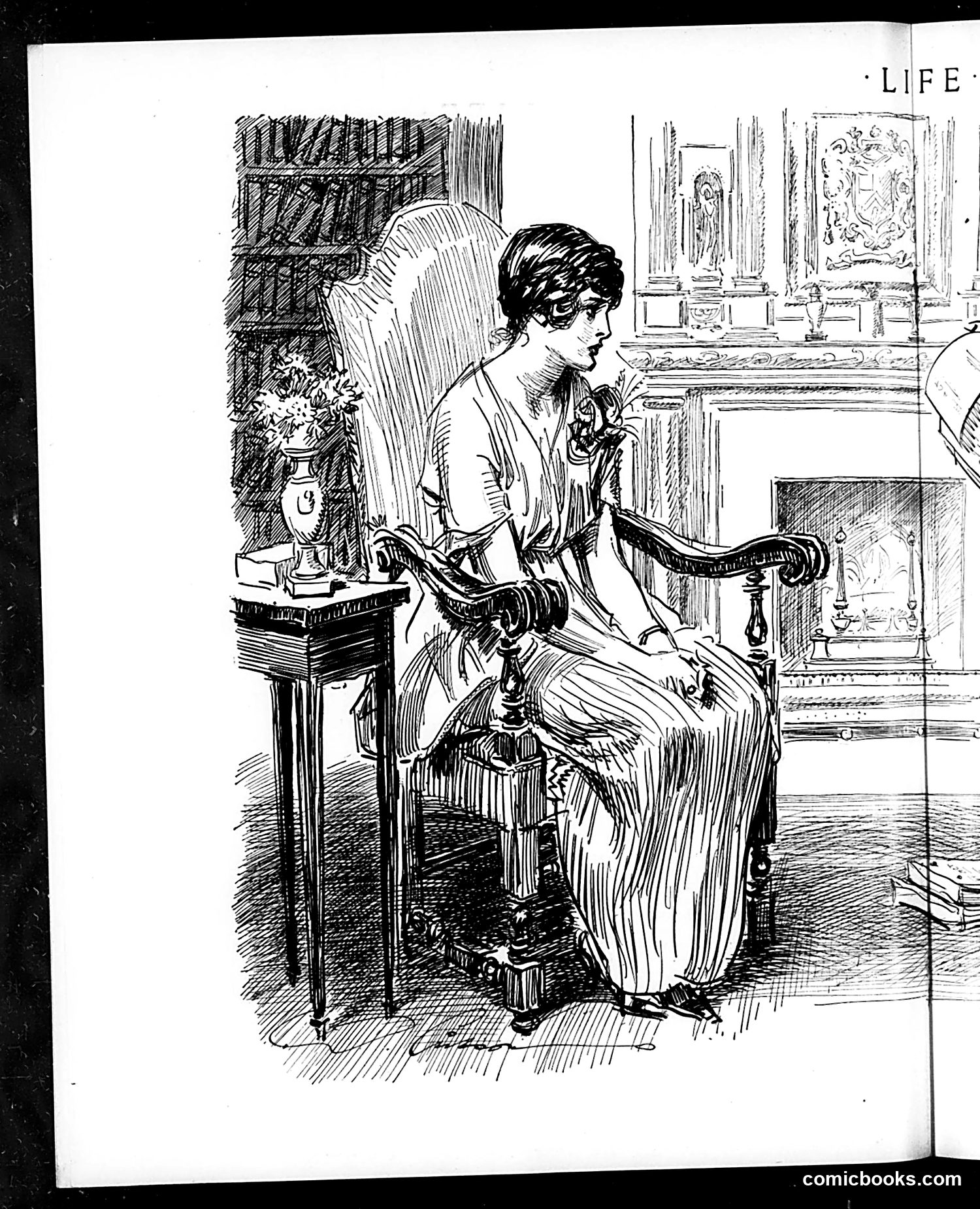
This cartoon satirizes a clergyman ("The Rev.") reading his comedic writing to his niece. The humor lies in the contrast between his profession (clergy) and his attempt at comedy writing—suggesting an inherent incompatibility. The niece's visible discomfort (she appears to be enduring the reading rather than enjoying it) reinforces the joke: his comedy is presumably bad or unfunny. The satire mocks both amateur writers who inflict their work on captive audiences and the assumption that someone in a serious religious role might lack comedic sensibility. The title "Tragic Moments" adds ironic wordplay—what should be entertaining becomes tragic for the listener. This reflects Life magazine's tradition of gentle social humor about everyday pretensions and amateur pursuits.
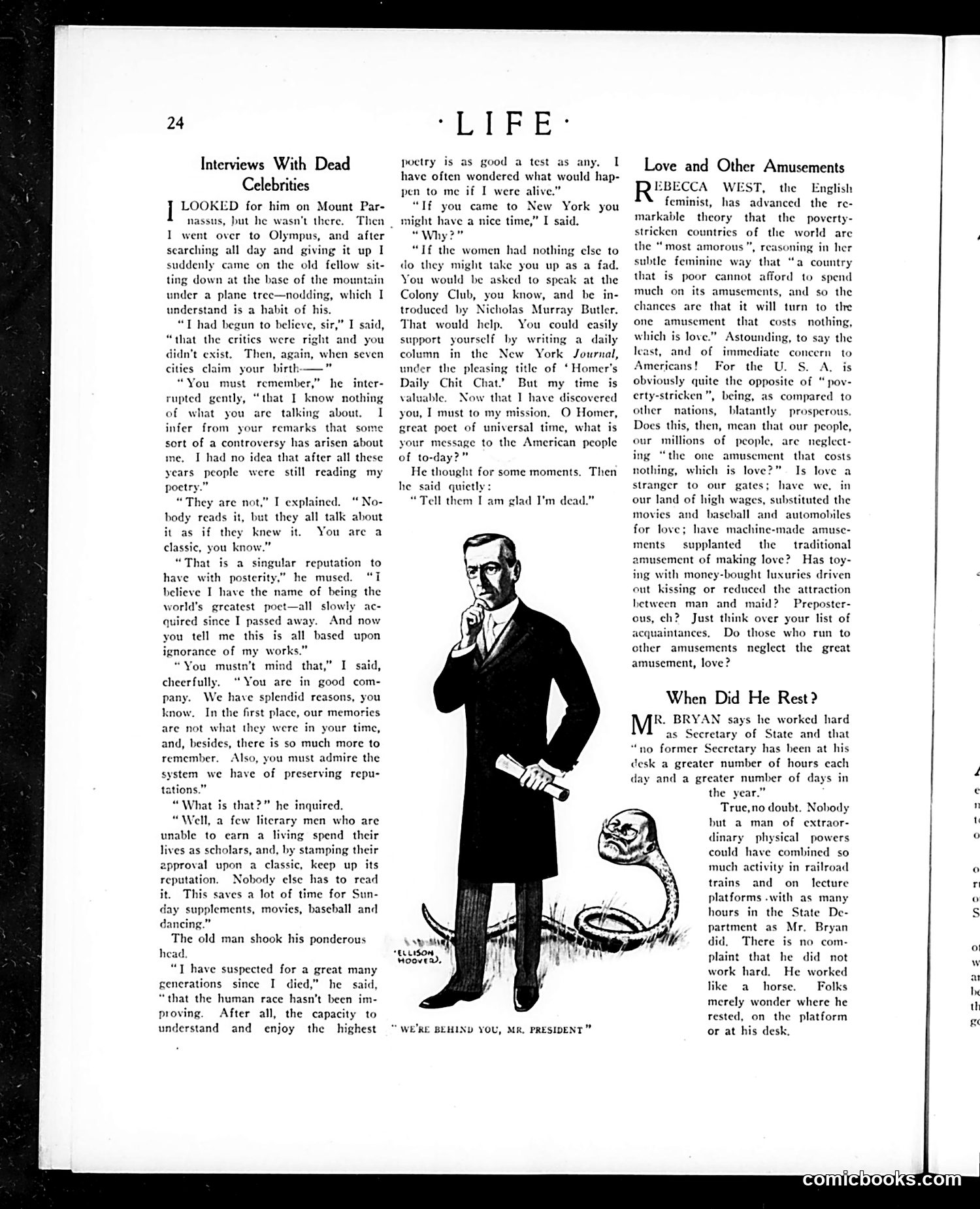
The page contains two distinct pieces: **"Interviews With Dead Celebrities"** presents a fictional conversation with Homer, the ancient Greek poet. The satire mocks modern literary culture: scholars preserve Homer's reputation without anyone actually reading his work, and he's reduced to a potential New York celebrity attraction or newspaper columnist. Homer's final message—"Tell them I am glad I'm dead"—is the joke's punchline, expressing disgust at contemporary American priorities (movies, baseball, dancing) over serious art. The cartoon shows a classical figure haunted by a death's head, visualizing this cultural decline. **"Love and Other Amusements"** references Rebecca West's feminist theory that poverty-stricken nations are "most amorous" because they can't afford other entertainments. The piece sarcastically applies this to prosperous America, implying that wealthy Americans have replaced love with commercial amusements (movies, baseball, automobiles), having literally "substituted" genuine human connection for manufactured entertainment. Both pieces critique American materialism and the erosion of cultural and romantic values in modern consumer society.
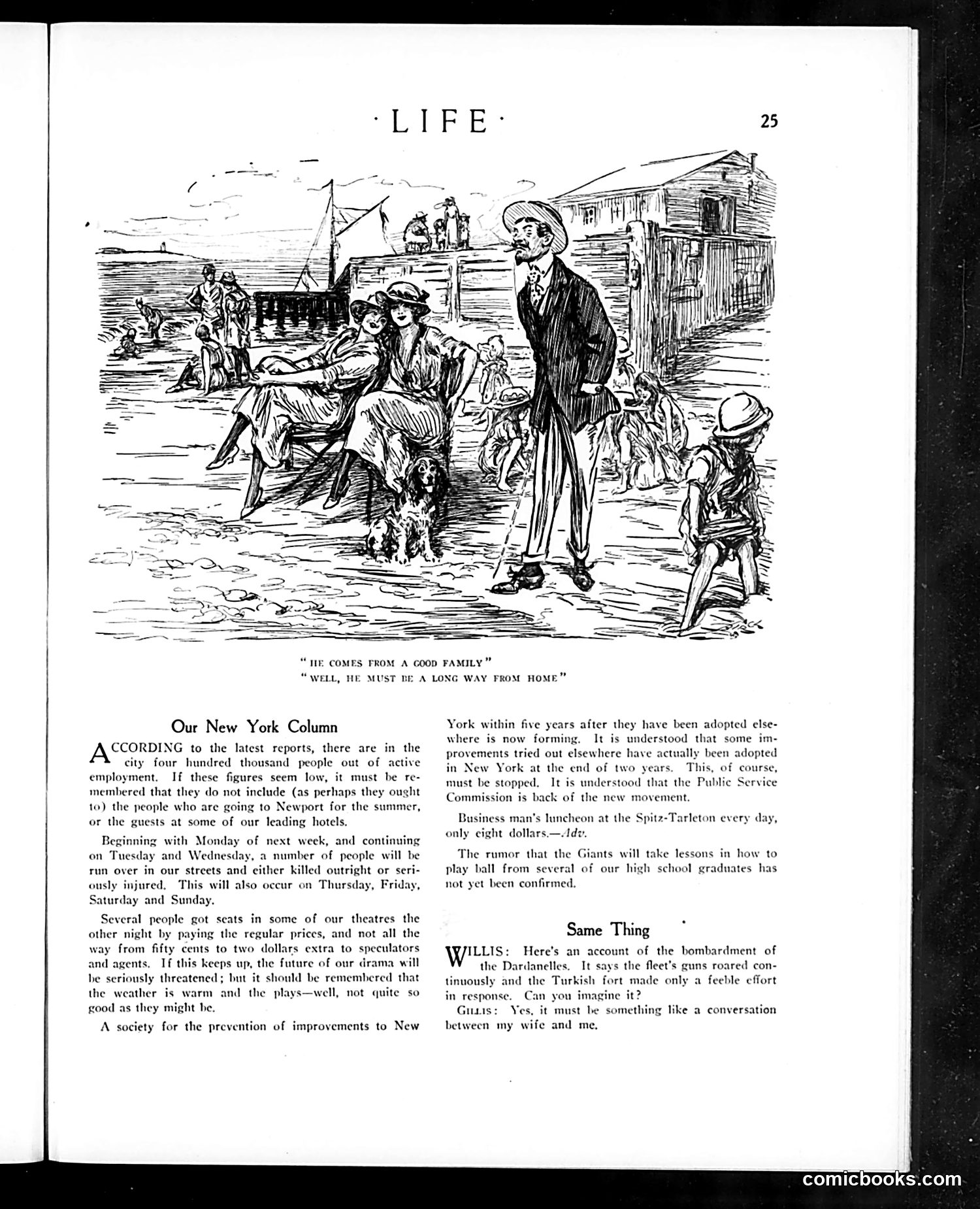
The cartoon depicts a beach or seaside scene with well-dressed people and a poorly dressed man in a suit with a small child. The caption jokes that because he "comes from a good family," he must be "a long way from home"—satirizing class pretense and suggesting someone overdressed for their circumstances is either displaced or fraudulent. The accompanying column uses biting satire about New York City life: it mocks unemployment statistics by excluding wealthy people vacationing in Newport; predicts casual traffic deaths as inevitable; jokes that paying full theater prices (rather than bribing scalpers) threatens the drama industry; and ridicules a society opposing rapid urban improvements. The "Same Thing" dialog compares the Dardanelles naval bombardment (likely WWI-era) to a married couple arguing—both apparently featuring one party making noise while the other barely responds. It's cynical domestic humor typical of the era.
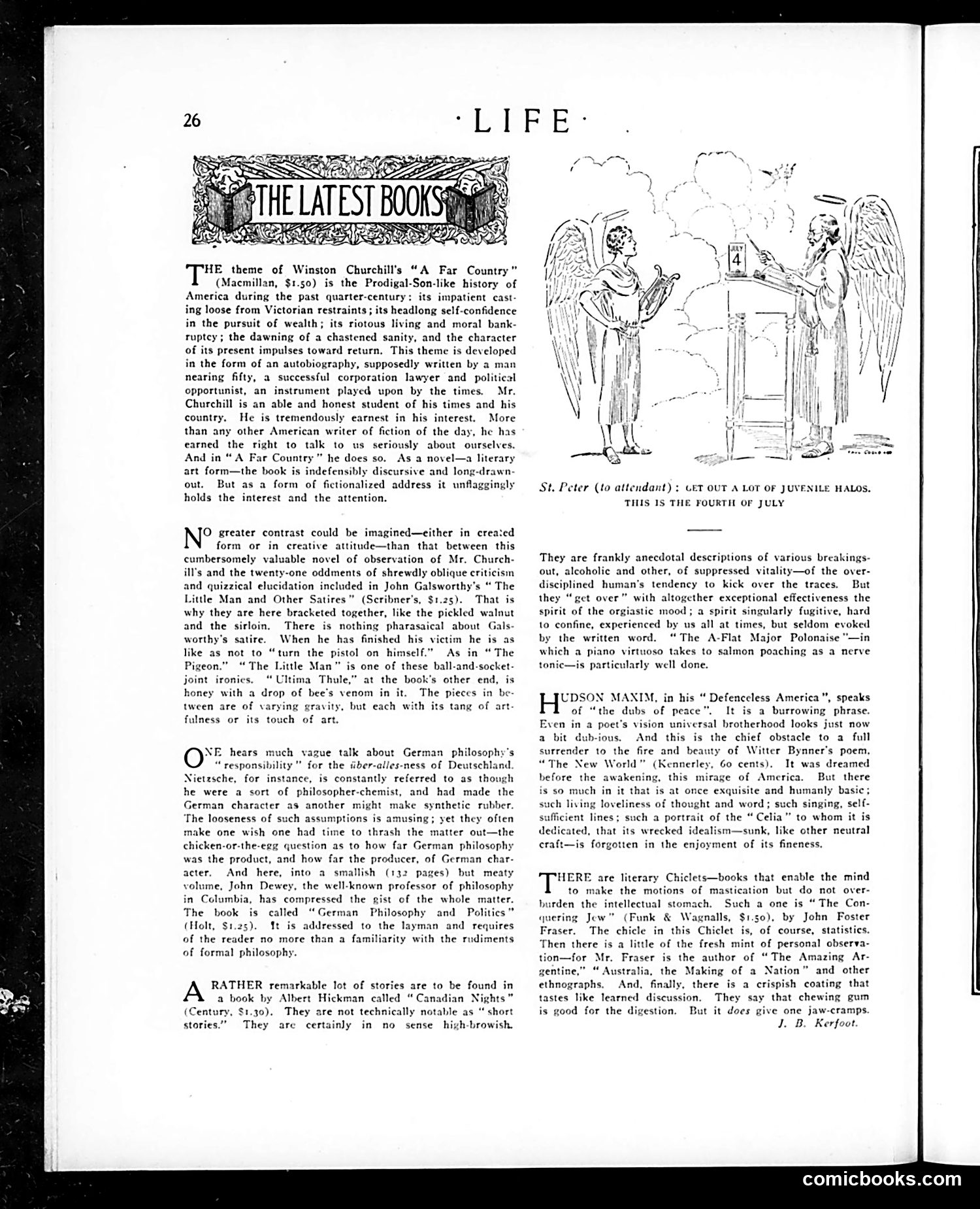
This is a book review page from Life magazine, centered on literary criticism rather than political satire. The small cartoon depicts **St. Peter at heaven's gate** instructing an attendant to "get out a lot of juvenile halos" because "this is the fourth of July"—a joke playing on the American Independence Day holiday. The humor suggests that on July 4th, many rowdy or misbehaving Americans will die and need halos, implying that Independence Day celebrations involve excessive drinking and wild behavior. The page reviews several books, including Winston Churchill's *"A Far Country"* (about American moral decline and recovery), John Galsworthy's *"The Little Man and Other Satires,"* and John Dewey's *"German Philosophy and Politics."* The reviews are earnest literary criticism, not satire. The July 4th cartoon is the only satirical element—a mild jab at American holiday excess.
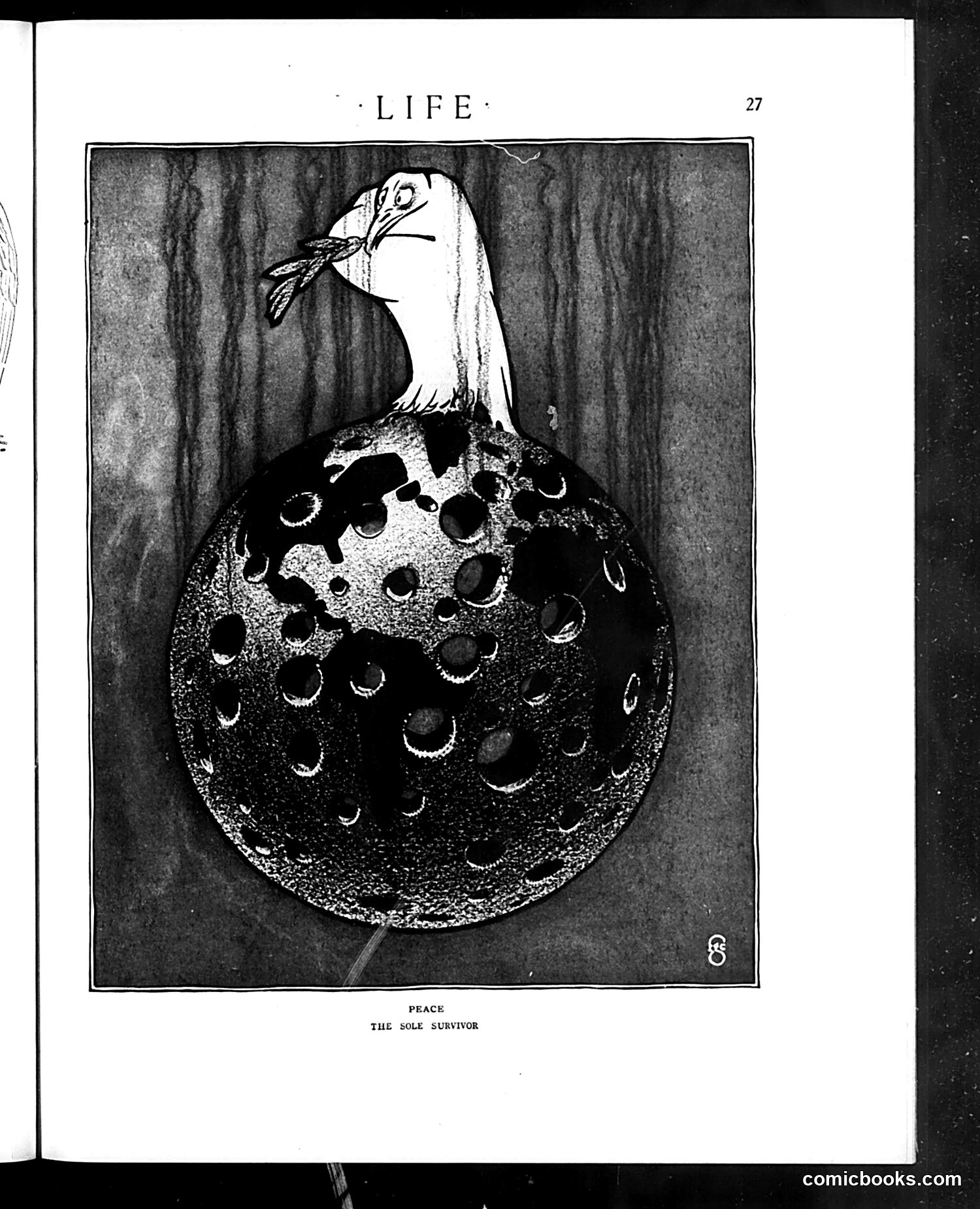
This political cartoon depicts an eagle—the symbol of America—with its head emerging from a large, heavily cratered sphere resembling the moon or a war-devastated planet. The eagle holds an olive branch, traditionally symbolizing peace. The "sole survivor" caption suggests this is post-war commentary, likely from World War I or II era, depicting a grim vision where peace itself barely survives amid massive destruction. The cratered sphere represents a war-torn world, while the eagle's survival with its peace offering implies that though America endures, the global landscape has been catastrophically damaged. The satirical point: peace is fragile and lonely in a devastated world, and even American ideals of peace emerge battered from widespread conflict.
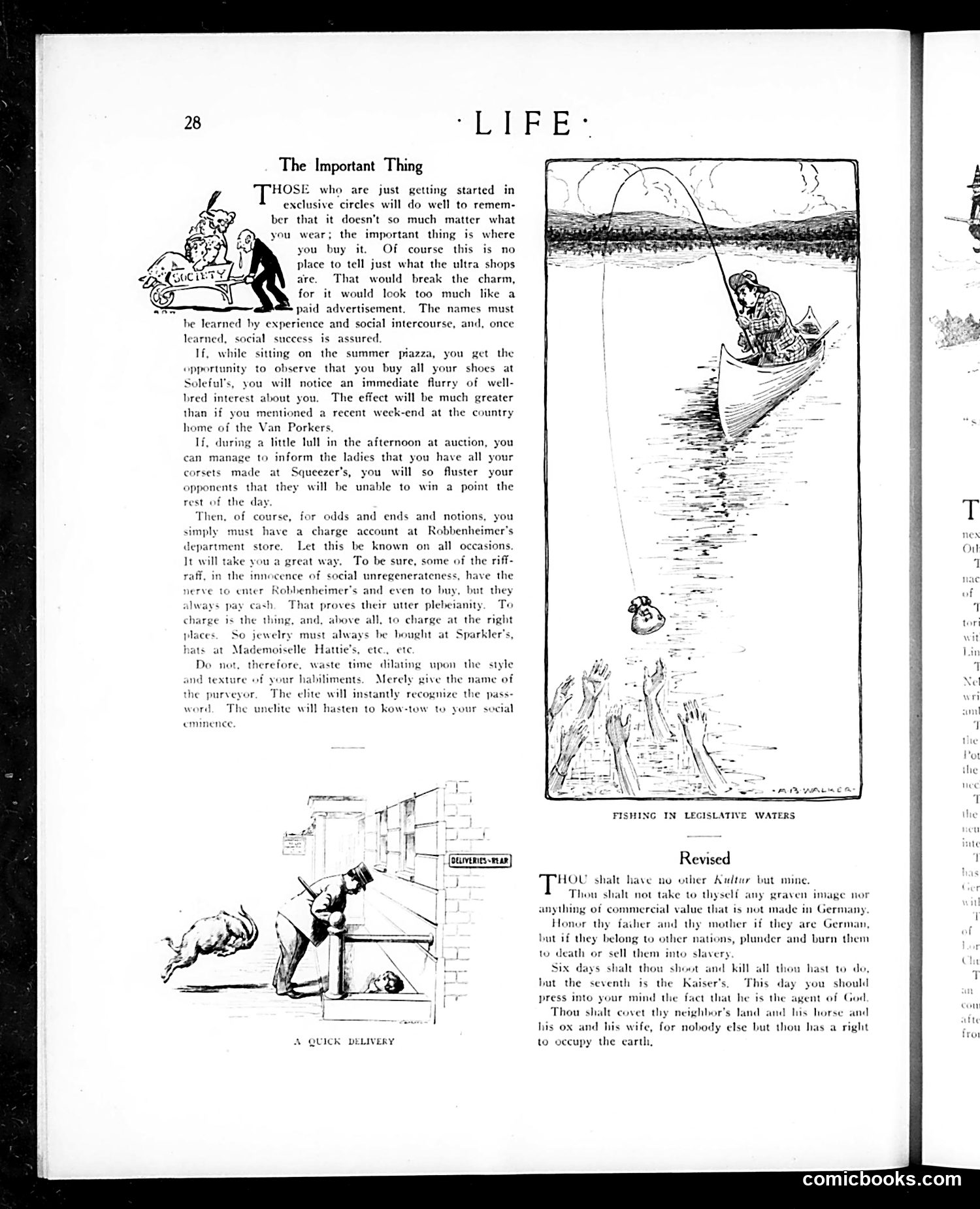
**Left Section:** This text satirizes social climbing through conspicuous consumption. The piece mocks new money trying to infiltrate "exclusive circles" by name-dropping luxury retailers (Soleful's shoes, Squeezer's corsets, Robbenheimer's department store). The joke is that true status comes not from *what* you buy but *where*—and that merely mentioning these shops signals wealth and refinement. The satire peaks with the observation that paying *cash* at Robbenheimer's proves one's "plebeianity," while having a charge account signals elite status. It's commentary on American materialism and status anxiety. **Right Section (Revised):** This appears to be anti-German WWI propaganda disguised as parody "commandments." It mocks German militarism and imperial ideology by presenting grotesquely exaggerated German values (Kaiser worship, territorial conquest, plunder). The context suggests this was published during or shortly after World War I, when such direct satirical attacks on enemy nations were common propaganda.
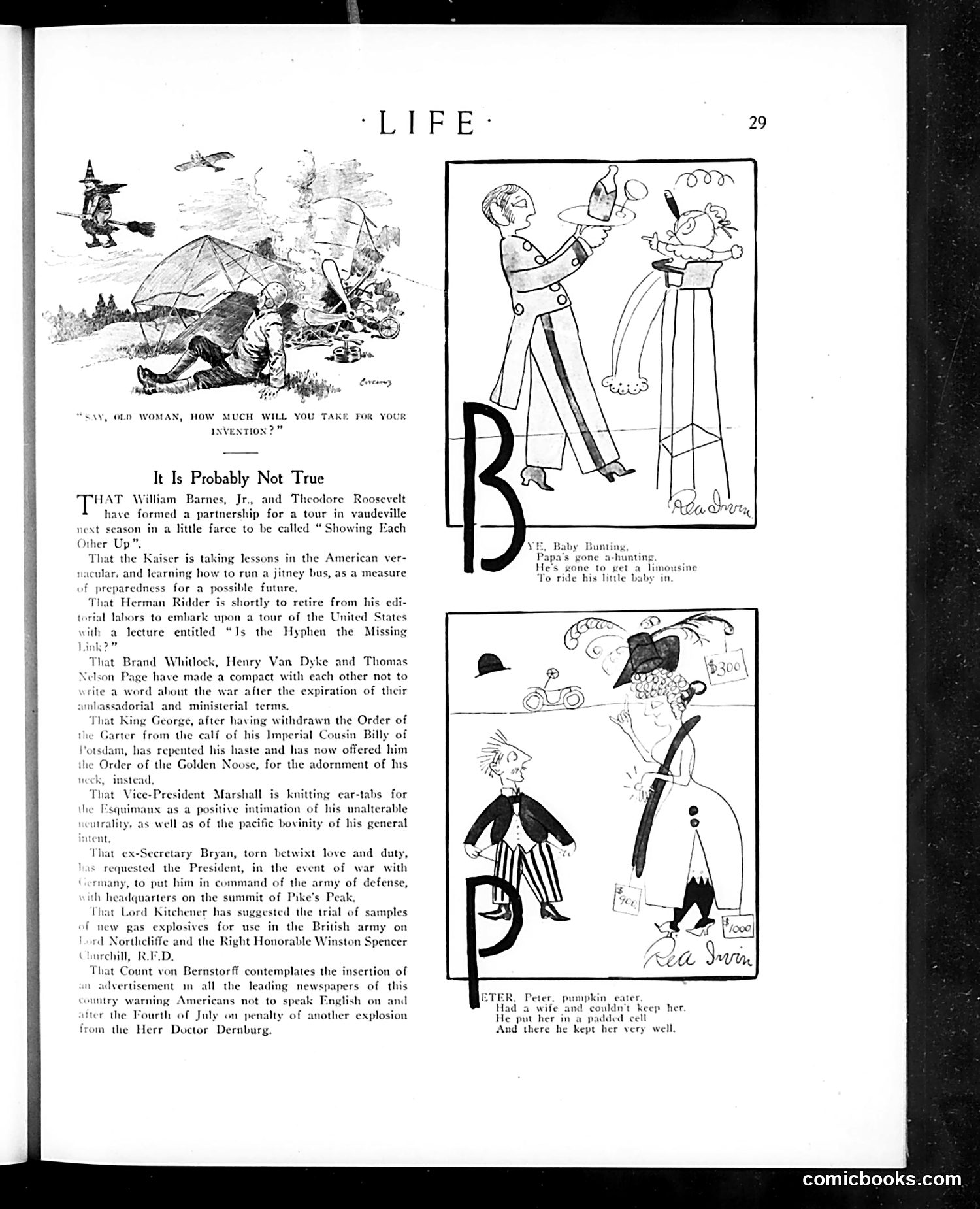
This page contains satirical rumors ("It Is Probably Not True") mocking prominent 1910s figures during World War I tensions. **Key references:** - **Theodore Roosevelt** and William Barnes Jr.: satirizing rumors of vaudeville tour - **The Kaiser**: mocking German preparedness efforts - **King George and "Billy" (Kaiser Wilhelm)**: British-German royal family tensions; the "Order of the Golden Noose" joke references Wilhelm as an enemy - **Vice-President Marshall, Bryan, Kitchener, Winston Churchill**: mocking American neutrality debates and military preparedness - **Count von Bernstorff** (German ambassador): joking about German propaganda warning Americans not to speak English—referencing real tensions over American aid to Britain **The cartoons** (B and P, signed "Cesare" and "Rea Irvin") illustrate nursery rhymes applied to contemporary figures: "Baby Bunting" shows someone going hunting in a limousine; "Peter, Peter Pumpkin Eater" depicts domestic confinement, possibly satirizing political imprisonment or control. The humor relies on readers recognizing these public figures and understanding pre-WWI American political debates.
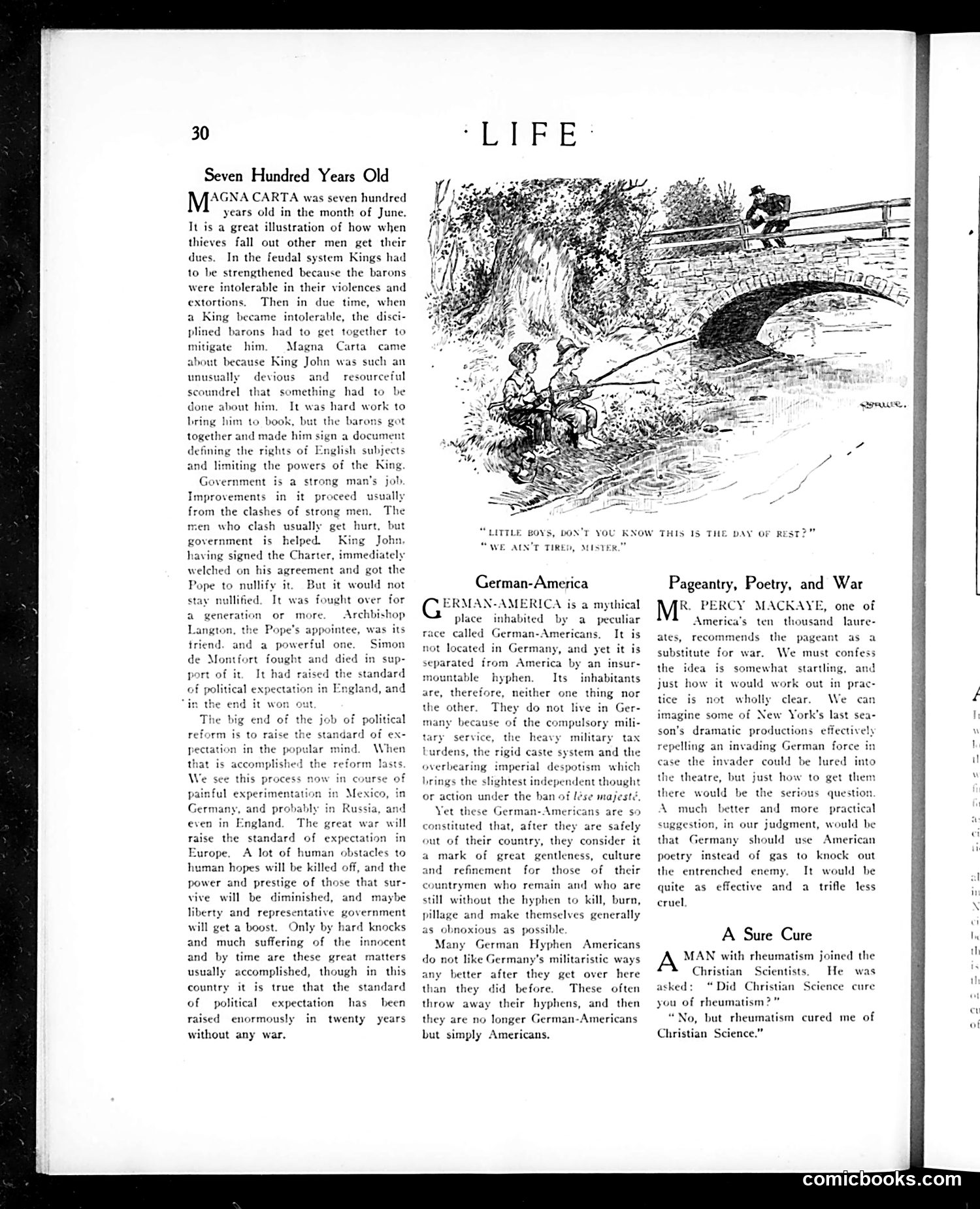
This page contains two distinct pieces of political commentary: **"Seven Hundred Years Old"** discusses the 700th anniversary of the Magna Carta (June 1215), framing it as a model for political reform. The author argues that progress comes through conflict between powerful figures—King John was forced by barons to accept limits on royal power. The piece suggests this same pattern is occurring in contemporary Mexico, Germany, Russia, and England, with World War I raising expectations for liberty and representative government. **"German-America"** satirizes hyphenated Americans of German descent. The piece mocks the concept of "German-Americans" as an impossible contradiction—they've fled Germany's militarism and despotism yet sentimentally support German aggression abroad. The satire suggests such divided loyalties are absurd; immigrants should either fully assimilate ("simply Americans") or acknowledge their hypocrisy. The accompanying sketch depicts boys fishing on a Sunday, with a figure scolding them about the Sabbath—likely illustrating leisure and youthful defiance of social convention.
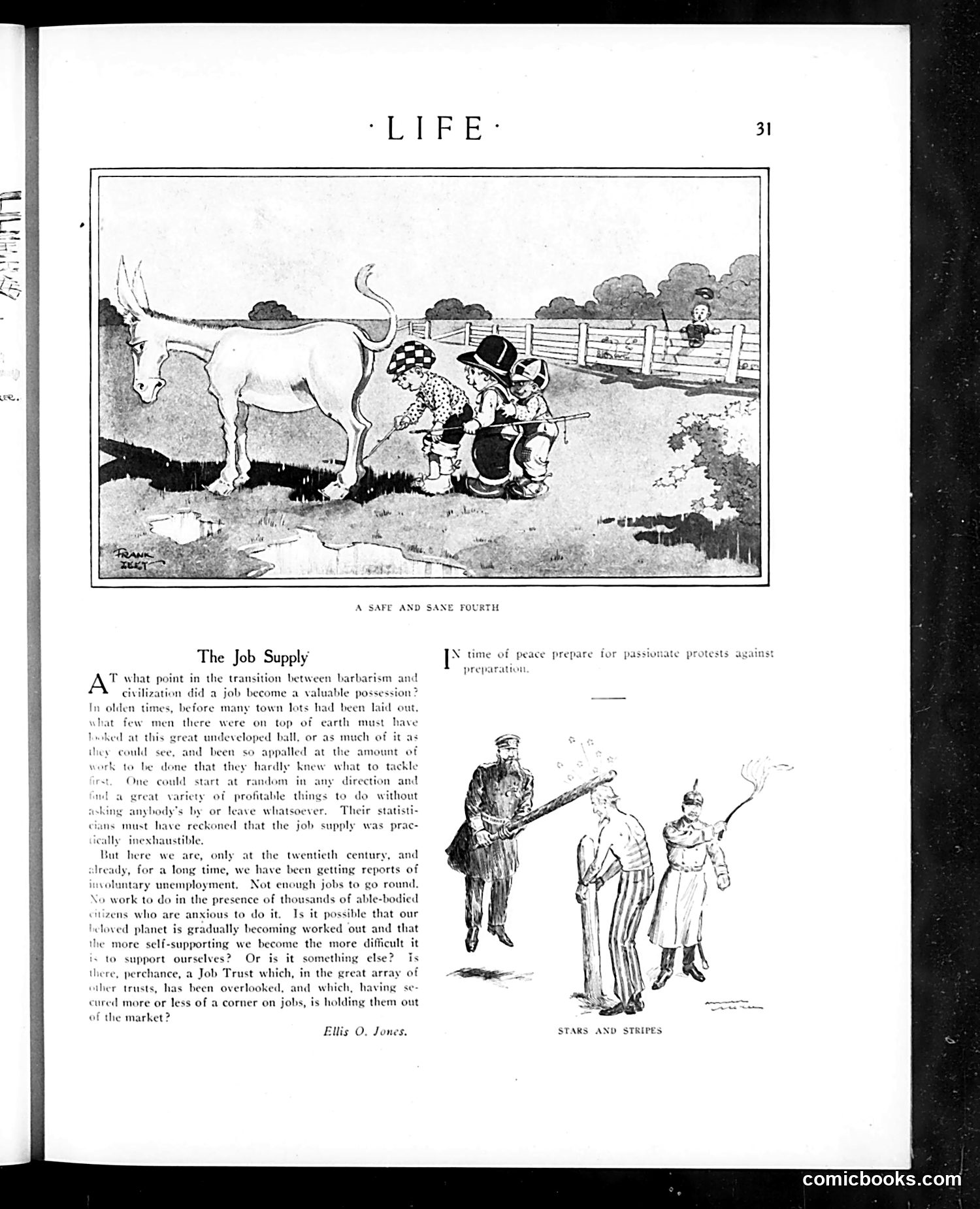
This page presents **two satirical cartoons** addressing early 20th-century American social anxieties. **Top cartoon ("A Safe and Sane Fourth"):** Shows well-dressed figures with military/patriotic imagery near a cow, satirizing July 4th celebrations. The caption suggests preparation for "passive protests against preparation"—likely mocking both pacifist movements and militarism during a period of international tension (likely pre-WWI). **Main article ("The Job Supply")** by Ellis O. Jones argues that unemployment exists despite widespread available work. Jones questions whether jobs have become a scarce "trust" (monopoly) deliberately withheld from the market—a reference to the **trust-busting era** when Americans feared wealthy industrialists were artificially controlling commodities and labor. **"Stars and Stripes" cartoon** (bottom right): Depicts military or political figures, though specifics are unclear from the image alone. The page reflects **Progressive Era concerns**: unemployment, monopolistic control of resources, labor availability, and peace versus militarism.
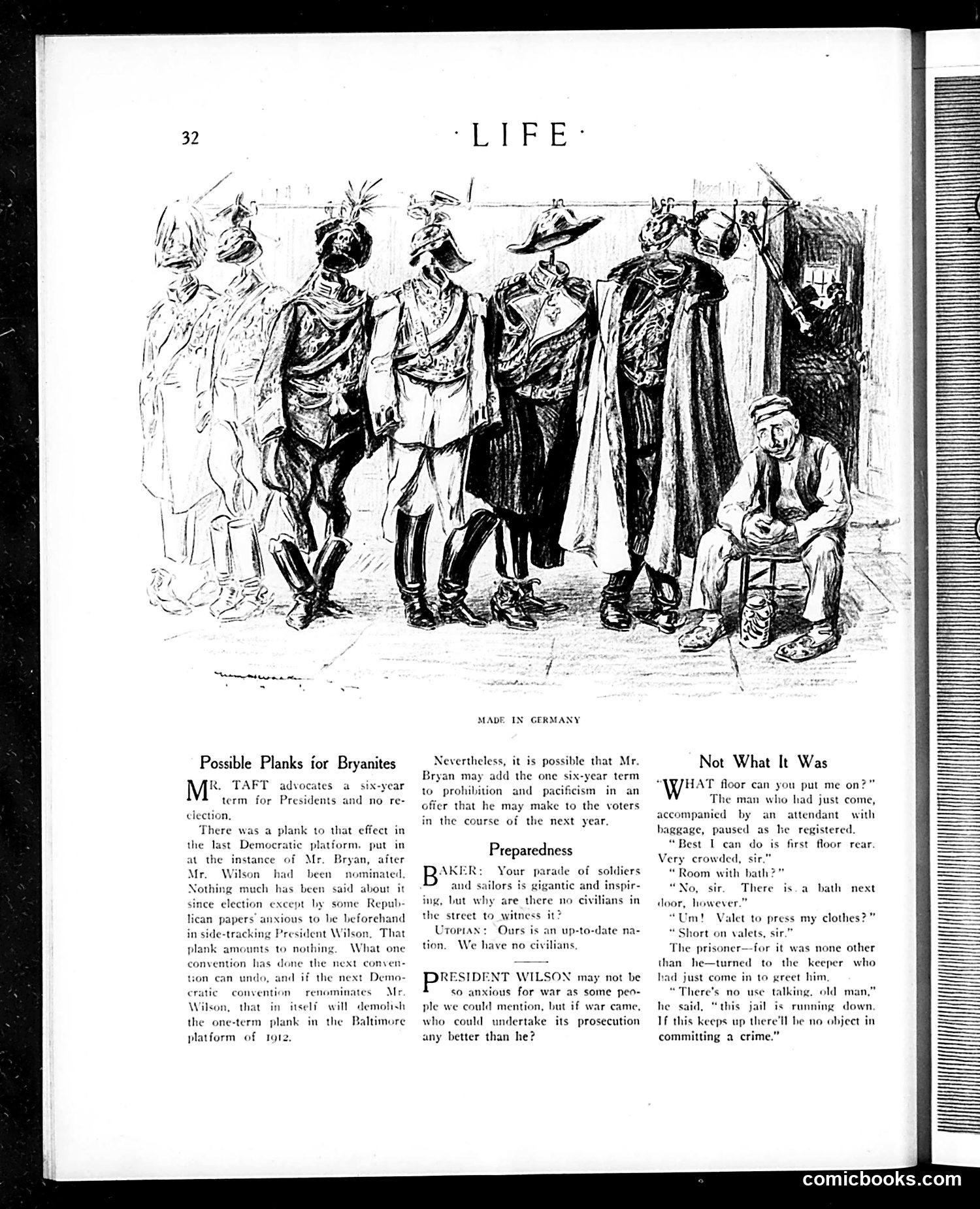
**Top Cartoon ("Made in Germany"):** This satirical illustration critiques German military preparedness. It shows elaborately uniformed German military officers parading while a shabby civilian bystander watches. The caption jokes that Germany is so militarized ("up-to-date") that it has no civilians left—implying the entire nation has been absorbed into military service. This reflects American anxieties about German militarism during the pre-WWI era. **Text Articles:** The pieces discuss William Jennings Bryan's potential presidential platform (including a one-term presidency proposal) and President Wilson's capacity to prosecute war if necessary. There's also a brief comedic sketch about a prison's declining conditions, suggesting incarceration is becoming less punitive as a deterrent. The page's overall theme appears to be political commentary on American pacifism versus preparedness debates of the 1910s era.
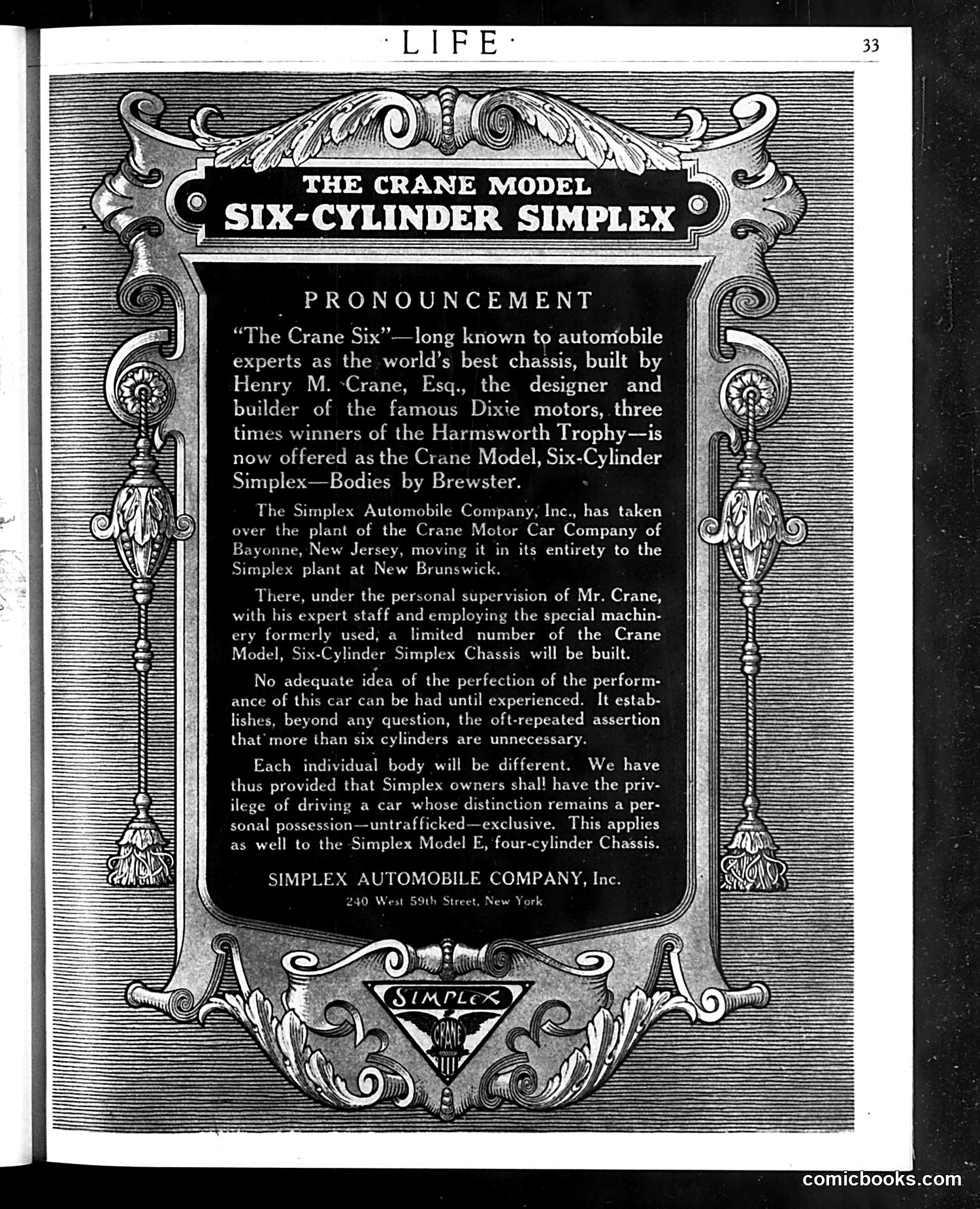
This page is **not a cartoon or satire** — it's a luxury automobile advertisement from Life magazine's advertising section (page 33). The Simplex Automobile Company announces the "Crane Model Six-Cylinder Simplex," a high-end car built by Henry M. Crane, renowned designer of Dixie motors (three-time Harmsworth Trophy winners). The company has acquired Crane's New Jersey plant and relocated it to New Brunswick, where Crane will personally oversee limited production. The advertisement emphasizes exclusivity and quality: each body will be handcrafted and unique, appealing to wealthy buyers seeking distinction. It also makes a technical claim that six cylinders are sufficient—implying competitors' multi-cylinder engines are unnecessary. The ornate art-deco border design reinforces the luxury positioning. This represents early automotive marketing targeting affluent consumers, circa 1910s-1920s.
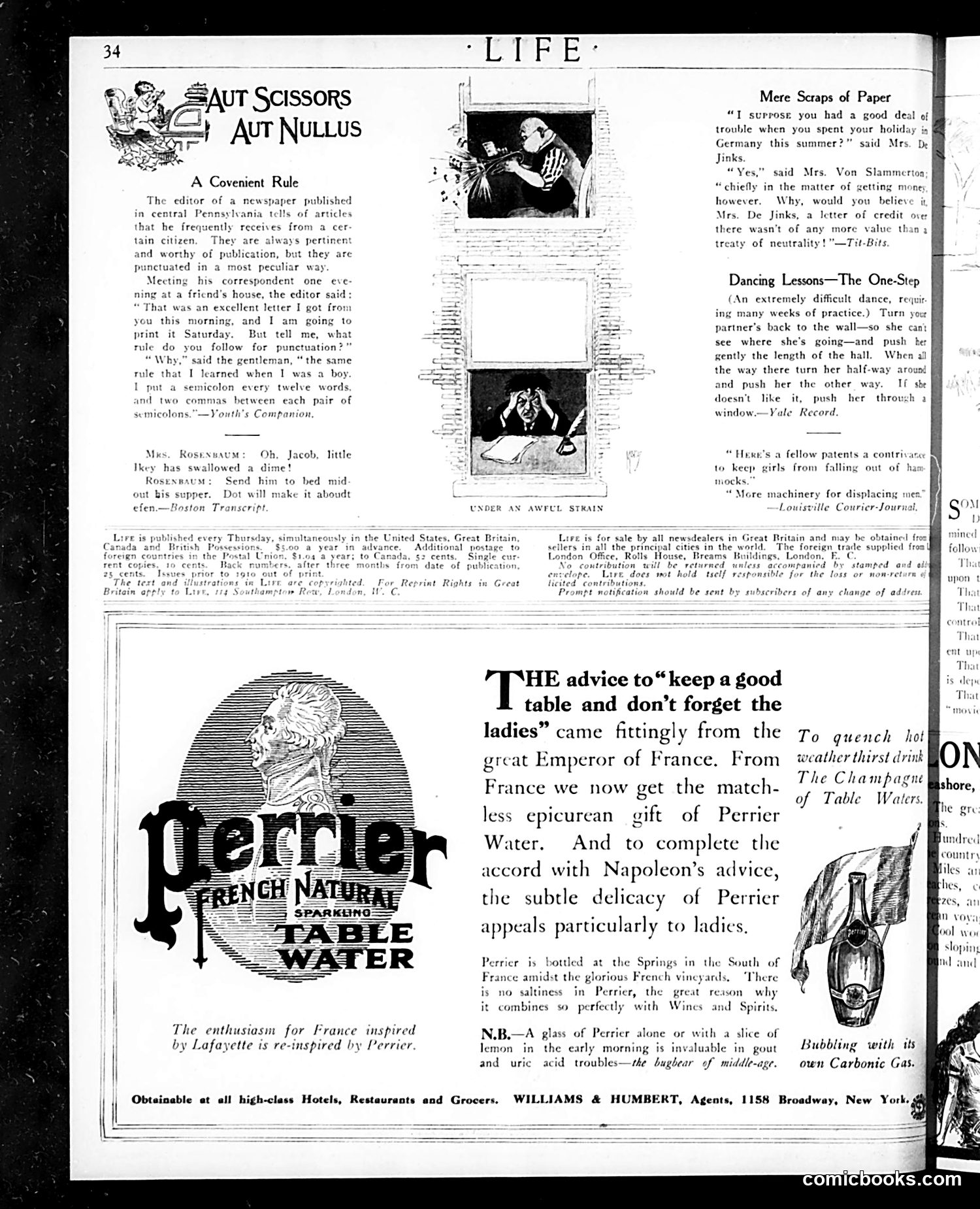
This page mixes humor columns with advertising. The "Aut Scissors Aut Nullus" section presents brief jokes about punctuation rules and a Yiddish-dialect gag about a child swallowing a dime—typical early 20th-century ethnic humor. The central cartoons labeled "Under an Awful Strain" (image unclear in OCR) appear to satirize social awkwardness or domestic situations. The bulk of the page promotes **Perrier Water** through advertising that exploits French cultural prestige. It references Napoleon's advice to "keep a good table and don't forget the ladies," positioning Perrier as an elegant, sophisticated beverage—particularly for women. The ad emphasizes French origin and epicurean refinement to market sparkling water as a luxury item. The smaller humor pieces mock dancing instruction and letter-of-credit embarrassments while traveling abroad, reflecting early 1900s leisure-class concerns about propriety and international travel.
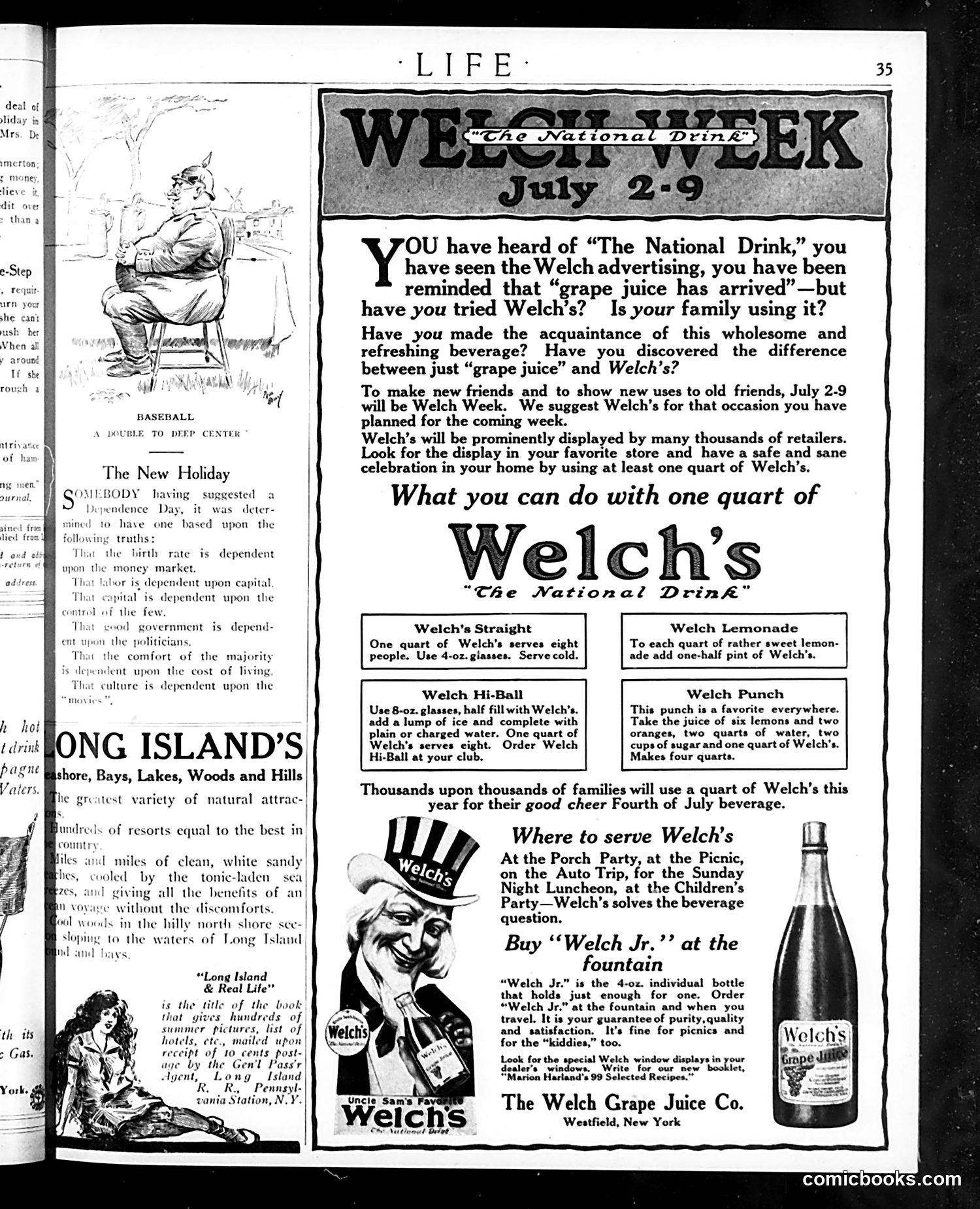
This page is **primarily a full-page advertisement** for Welch's grape juice, promoting "Welch Week" (July 2-9). The small editorial content on the left is incidental. **The Advertisement's Appeal:** The ad emphasizes Welch's as "The National Drink" and distinguishes it from ordinary grape juice. It promotes wholesome family consumption and suggests multiple uses—served straight, as lemonade, hi-balls, and punch—for various social occasions (picnics, auto trips, porch parties, children's parties). **Historical Context:** This ad likely dates to the **Prohibition era** (1920-1933), when alcohol was banned. Welch's grape juice became enormously popular as a "wholesome" substitute beverage. The emphasis on "safe and sane celebration" and family-friendly contexts reflects Prohibition's moral framework promoting temperance. **The Baseball Cartoon:** The small cartoon labeled "A Double to Deep Center" shows a rotund man in a chair—likely satirizing either leisure culture or the sedentary life, though the specific reference is unclear without additional context. The Long Island tourism section below is unrelated filler content.
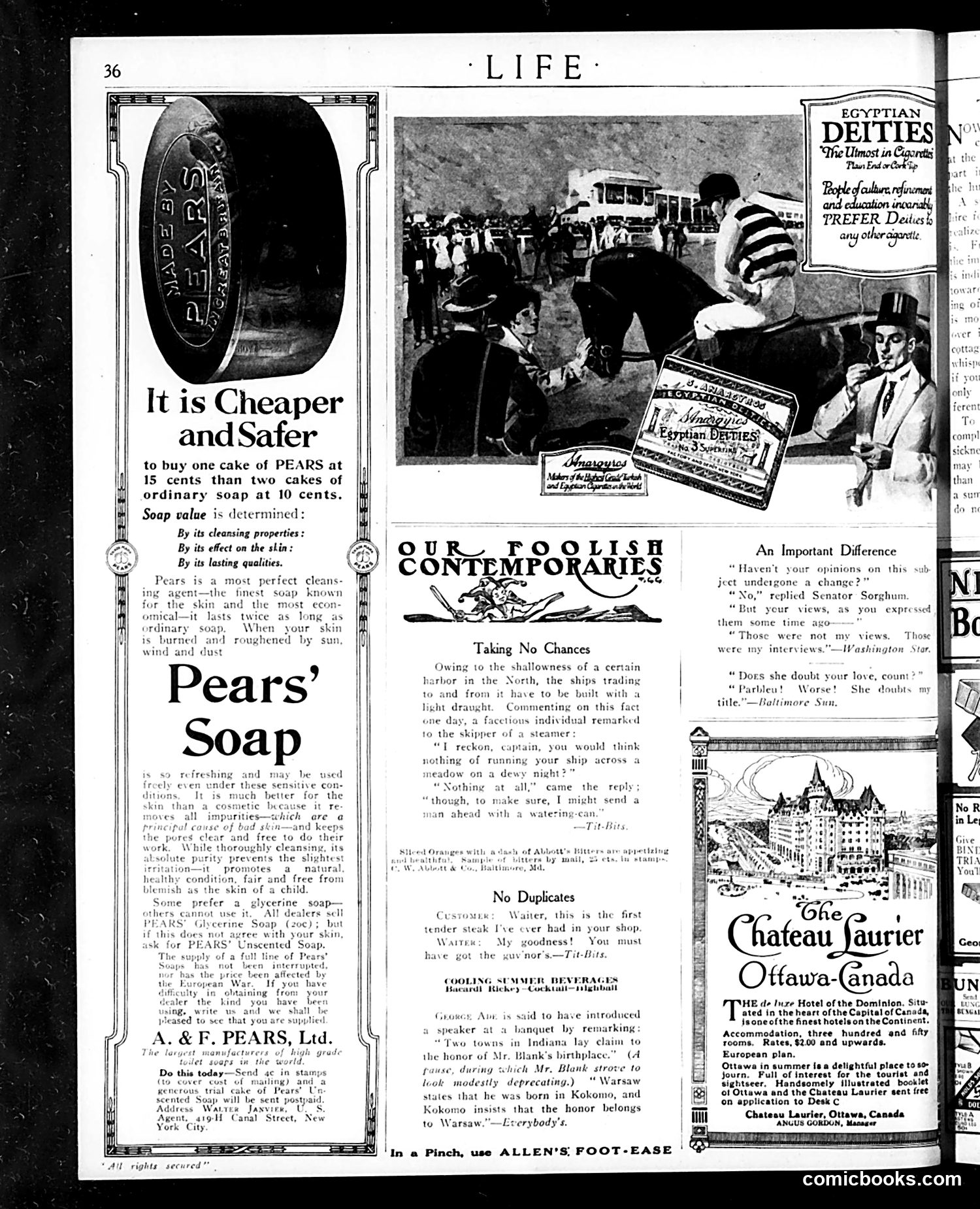
This page is primarily **advertising** with brief satirical humor sections interspersed. The main content includes: **Pears' Soap Advertisement** (left): A standard product ad emphasizing soap's cleansing, skin-friendly, and economical qualities compared to cheaper alternatives. **"Our Foolish Contemporaries"** (center): A humor section featuring three brief anecdotes: - A captain's joke about shallow waters - A waiter's quip about serving an unusually good steak - A politician's awkward moment when two Indiana towns claim his birthplace, with commentary about distinguishing between actual views and "interviews" **Egyptian Deities Advertisement** (top right): Promotes a cigarette brand. **Château Laurier Hotel Advertisement** (bottom right): Promotes Ottawa's luxury hotel. The satirical humor is light, focusing on wordplay and social awkwardness rather than political commentary. The "interviews" joke appears to mock politicians' inconsistency or the unreliability of reported statements.
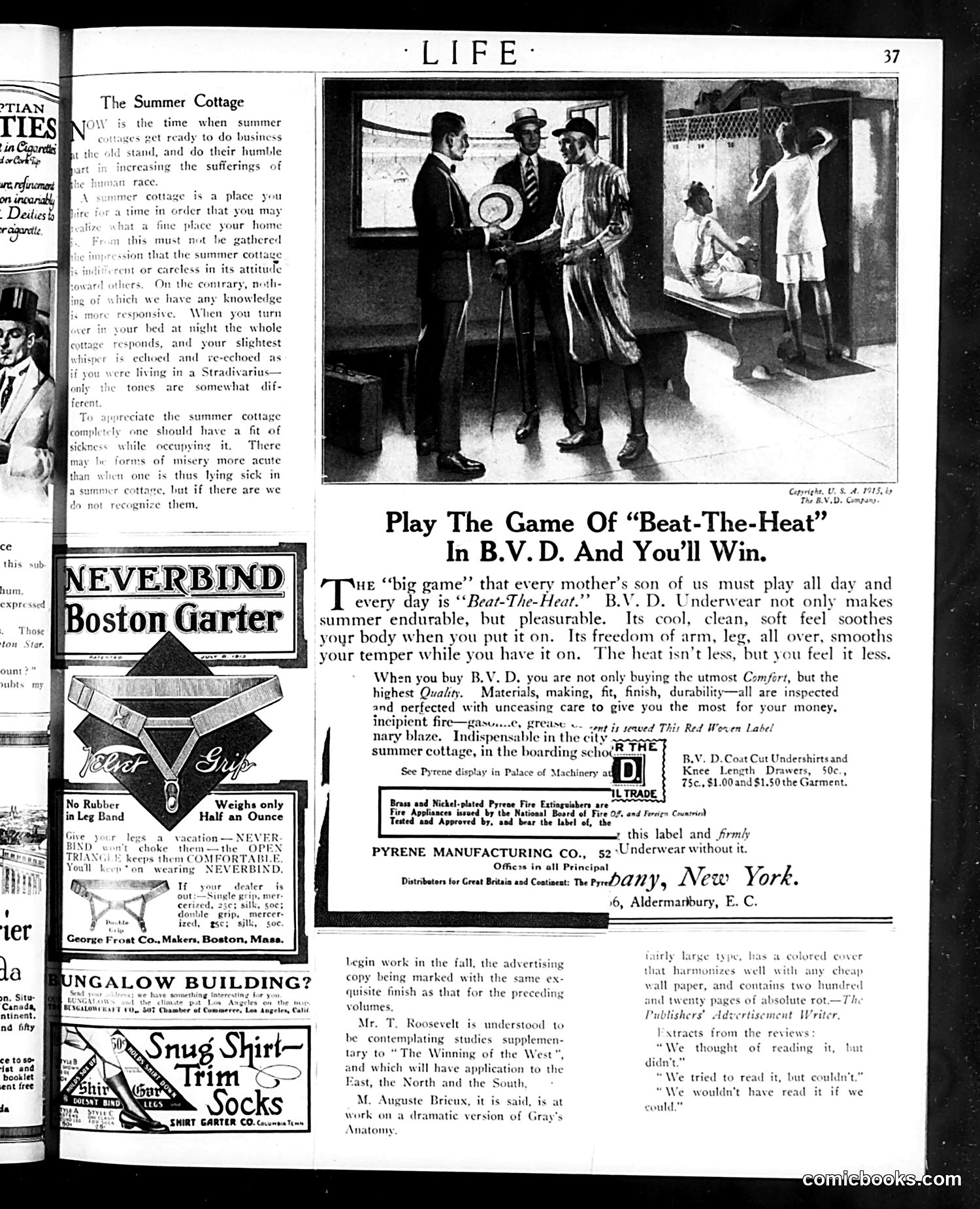
This page contains **advertising and light social commentary**, not political satire. **"The Summer Cottage"** (left column) is a humorous essay about summer cottage etiquette—how guests should respect their hosts' homes. The tone is gently mocking toward inconsiderate visitors. **The main content** is a **B.V.D. underwear advertisement** featuring a cartoon showing men in business attire discussing the product indoors. The pitch uses the phrase "Beat-The-Heat"—a play on the popular 1920s game show concept—to market underwear as a solution to summer discomfort. The appeal is straightforward: B.V.D. underwear keeps you cool and comfortable during hot weather. The advertisement emphasizes **quality and comfort**, noting that buying B.V.D. means purchasing "utmost Comfort" and "highest Quality." **Other advertisements** on the page include the "Neverbind Boston Garter," the "Snug Shirt-Trim Socks," and mentions of a bungalow building offer. The page is primarily commercial rather than satirical—typical magazine content from this era mixing editorial material with advertising.
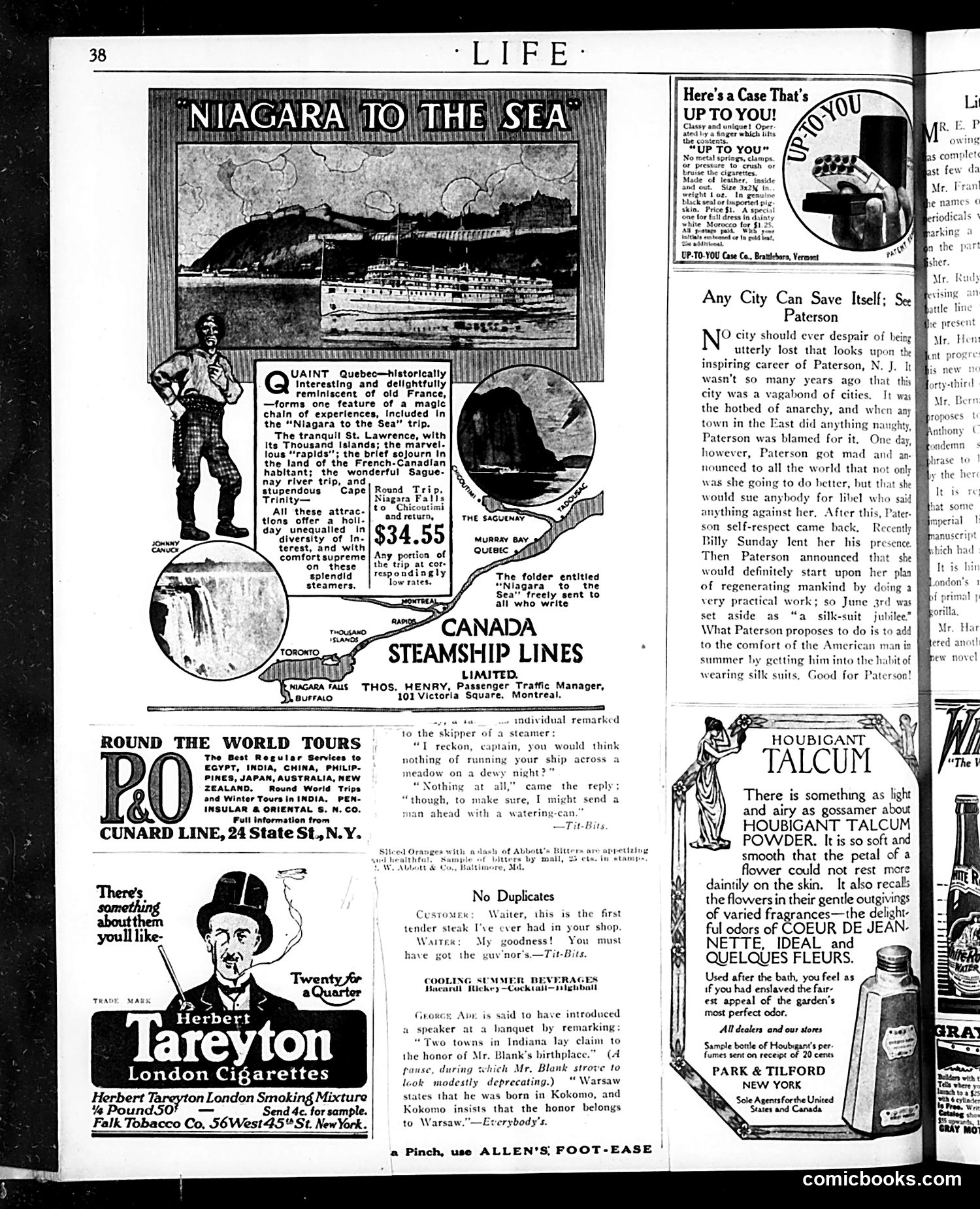
This page combines travel and product advertising with humorous filler content typical of Life magazine's satirical approach. **Main Advertorial Content:** The "Niagara to the Sea" feature advertises Canada Steamship Lines' tourist cruises along the St. Lawrence River, touting Quebec's charm and natural attractions (Thousand Islands, rapids, waterfalls). **Political/Social Content:** The article "Any City Can Save Itself; See Paterson" celebrates Paterson, New Jersey's urban renewal. It describes how Paterson overcame its reputation as an anarchist hotbed by hiring evangelist Billy Sunday and promoting civic pride through a "silk-suit jubilee" (apparently encouraging men to wear silk suits as a modernization gesture). **Humor/Filler:** Small joke columns ("No Duplicates," exchanges between diners and captains) provide gentle comedic relief typical of the era. **Advertisements:** Herbert Tareyton cigarettes, Houbigant talcum powder, and Park & Tilford perfumes represent luxury products marketed to upper-class readers. The page reflects 1920s-era optimism about urban improvement, consumer culture, and leisure travel.
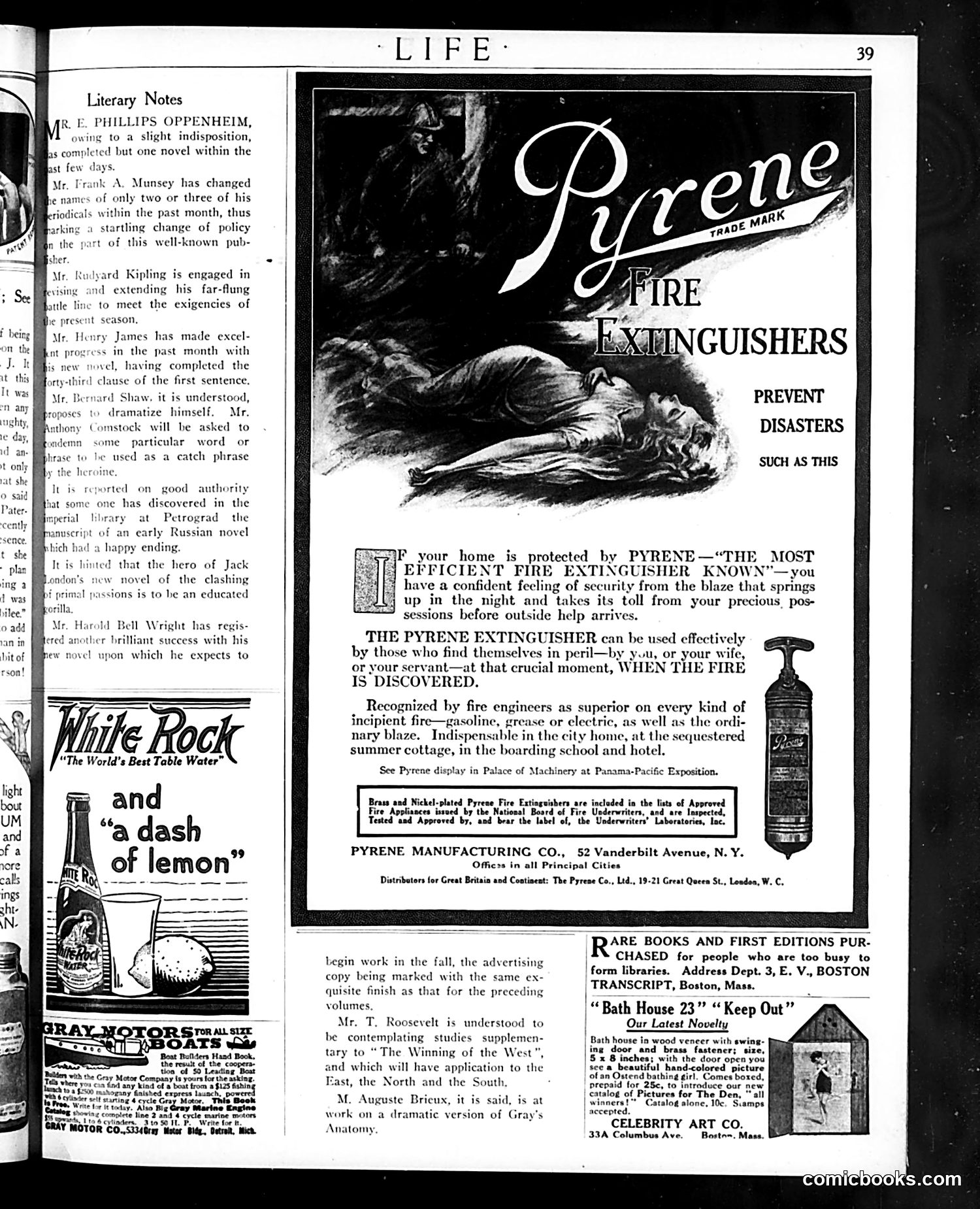
This page features satirical commentary on famous authors of the early 1900s. The "Literary Notes" section mocks well-known writers through exaggerated descriptions of their work habits: - **R.E. Phillips** completed only one novel due to "indisposition" - **Frank Munsey** changed character names—a trivial editorial choice presented as major news - **Rudyard Kipling** is "extending his far-flung battle line" (military metaphor for his prolific output) - **Henry James** has written only "the thirty-third clause of the first sentence"—mocking his notoriously long, complex prose style - **Bernard Shaw** plans to "dramatize himself"—poking fun at his self-promotion - **Theodore Roosevelt** plans supplementary studies to "The Winning of the West"—suggesting his endless productivity The humor relies on readers' familiarity with these authors' actual writing styles and public personas. Henry James's joke is the sharpest, directly referencing his reputation for baroque, sentence-length paragraphs. The rest of the page is advertising (fire extinguishers, bottled water, books).
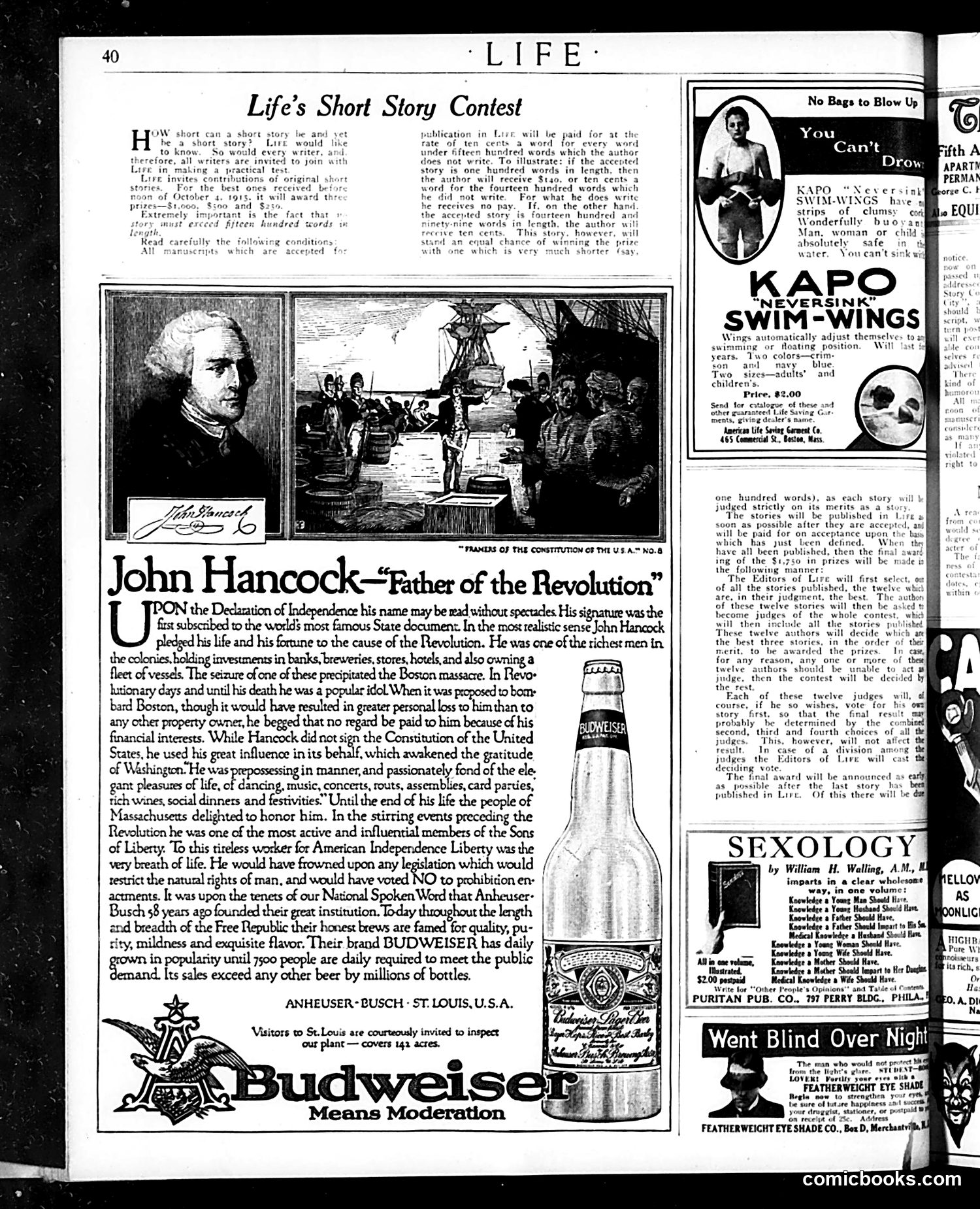
This page primarily contains **advertising disguised as editorial content**. The main article celebrates John Hancock as a "Father of the Revolution," emphasizing his wealth, patriotism, and opposition to prohibition—but this is actually a **Budweiser beer advertisement**. The company uses Hancock's historical prestige and his presumed anti-prohibition stance to market alcohol during or near the Prohibition era, connecting beer consumption to American liberty and founding principles. The surrounding ads (Kapo Swim-Wings, a "Sexology" book, and "Went Blind Over Night") are typical period advertisements with exaggerated health or lifestyle claims. The page also announces Life's short-story writing contest. The satirical irony—typical of Life magazine—is that a patriotic historical figure is being co-opted to sell commercial products, using nationalist rhetoric to justify consumption.
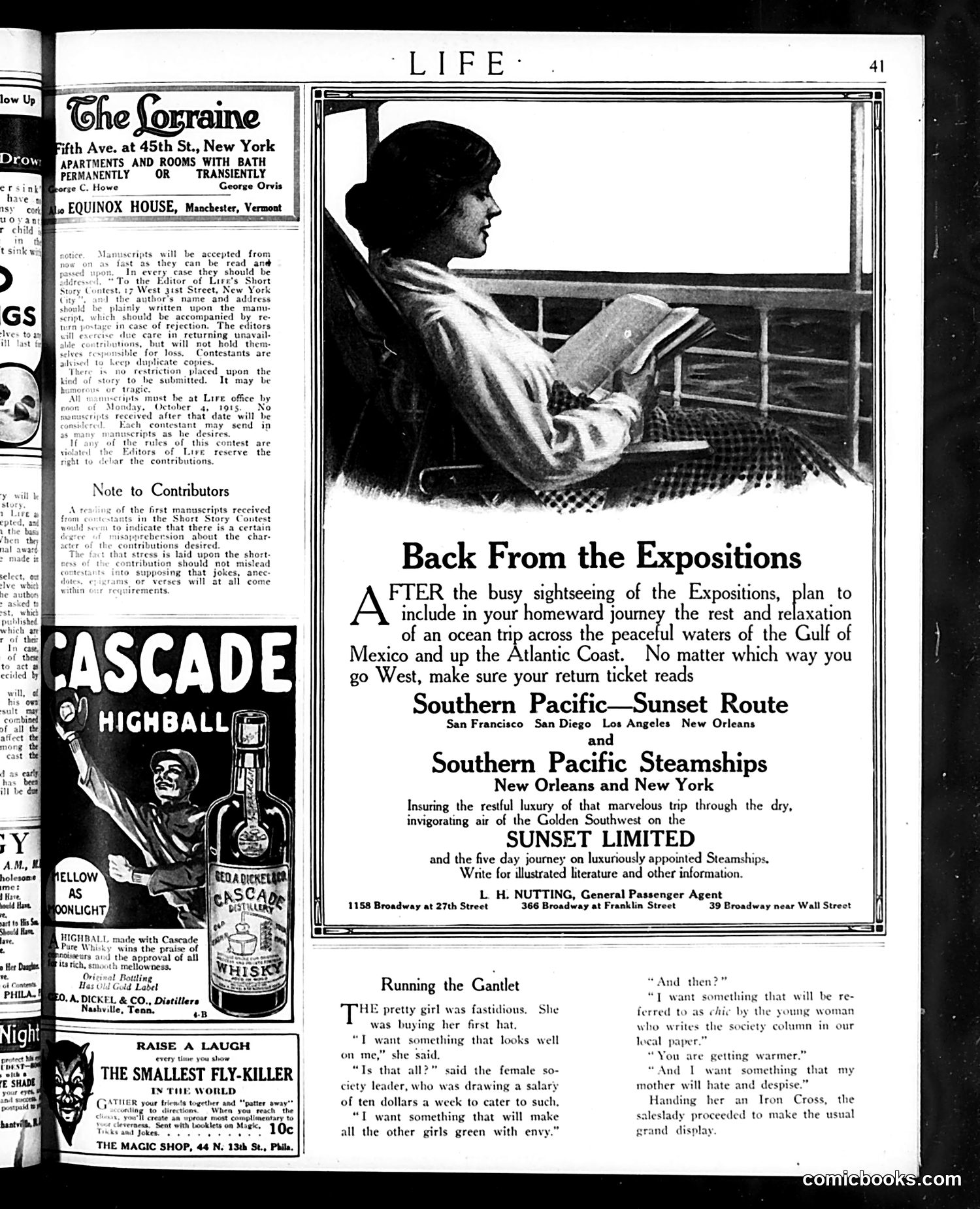
This page is primarily **advertising and editorial content** rather than political satire. The main elements are: **Central Advertisement**: The Southern Pacific Railroad promotes the "Sunset Limited" train and steamship service for travelers returning from the 1915 Panama-Pacific Expositions (major world's fairs held that year in San Francisco and San Diego). The accompanying photograph shows a woman gazing from a train window, emphasizing leisure travel. **"Running the Gantlet" Story**: A brief satirical humor piece about a fastidious young woman shopping for her first hat. The joke hinges on social climbing: she wants a hat that appears "chic" to society columnists, makes other girls jealous, and—crucially—that her mother will *hate and despise*. The punchline (handing her an Iron Cross, a German military medal) appears to mock both her vanity and perhaps anti-German sentiment during WWI. **Minor Ads**: Cascade whiskey and a "fly-killer" novelty toy also appear. The page reflects early 20th-century concerns: travel aspirations, social status anxiety, and wartime tensions.
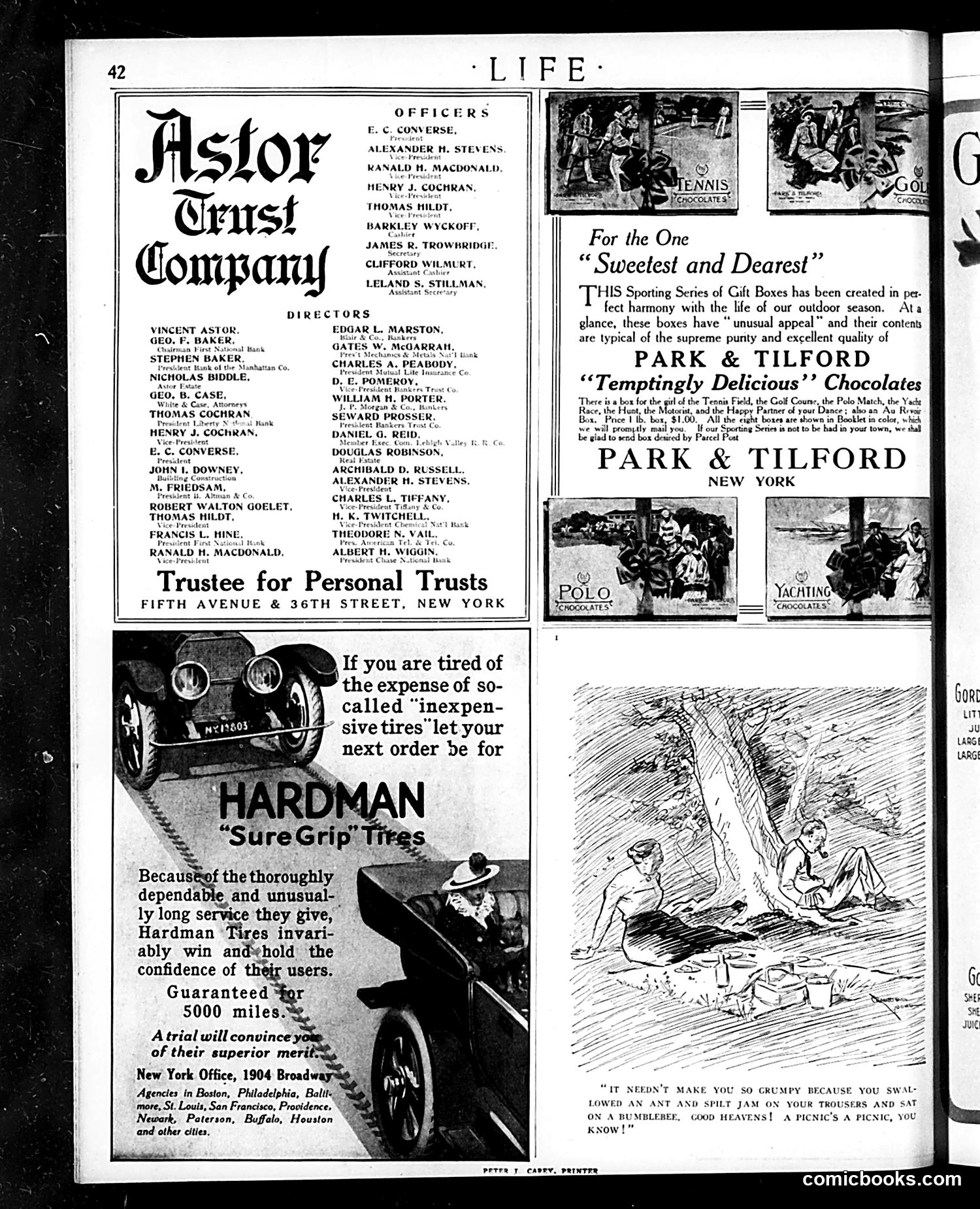
This page is primarily **advertising and corporate listings**, not political satire. The main content includes the Astor Trust Company's officers and directors (a financial institution), alongside period advertisements for Hardman "Sure Grip" Tires and Park & Tilford chocolates. The only cartoon element is a small sketch at the bottom right showing a child complaining about picnic mishaps (swallowing an ant, spilling jam on clothes, sitting on a bumblebee). An adult responds dismissively that "a picnic's a picnic"—gentle, domestic humor about children's outdoor complaints rather than political commentary. This is a commercial page from *Life* magazine's advertising section, typical of early 20th-century publications where corporate sponsorship and product ads dominated. The cartoon is lighthearted family humor, not satire.
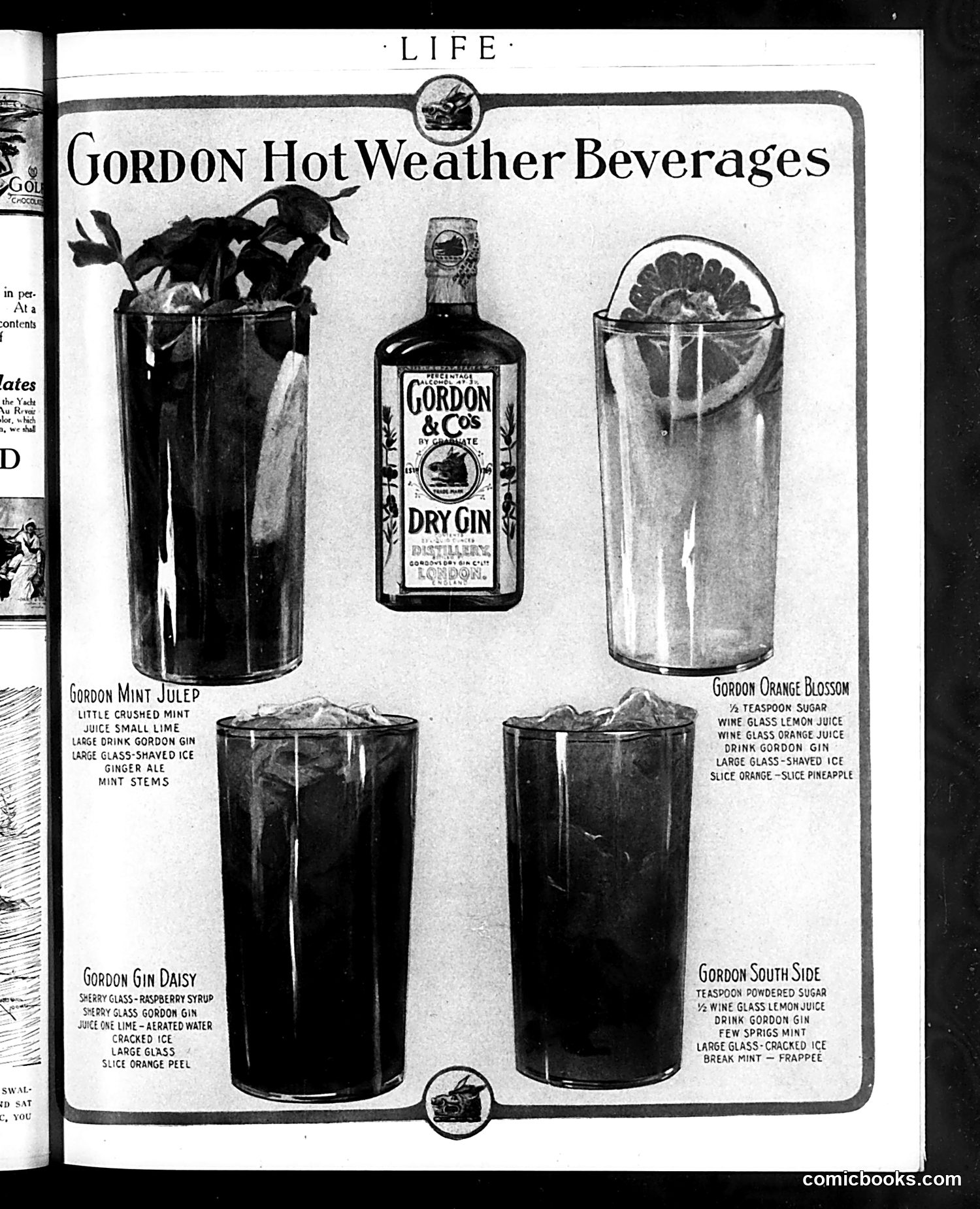
This is a straightforward **advertisement**, not satire or political content. It promotes Gordon & Co.'s dry gin through four cocktail recipes designed for hot weather consumption: - **Gordon Mint Julep** (mint, lime, gin, ginger ale) - **Gordon Gin Daisy** (raspberry syrup, gin, lime, aerated water) - **Gordon Orange Blossom** (lemon juice, orange juice, gin) - **Gordon South Side** (lemon juice, gin, mint) The page appeared in *Life* magazine during what was likely the Prohibition era or shortly after, when gin advertisements were common in satirical publications. The emphasis on "hot weather beverages" and specific preparation instructions reflects early 20th-century cocktail culture. This is product marketing dressed in magazine editorial format—no political commentary or caricature is present.
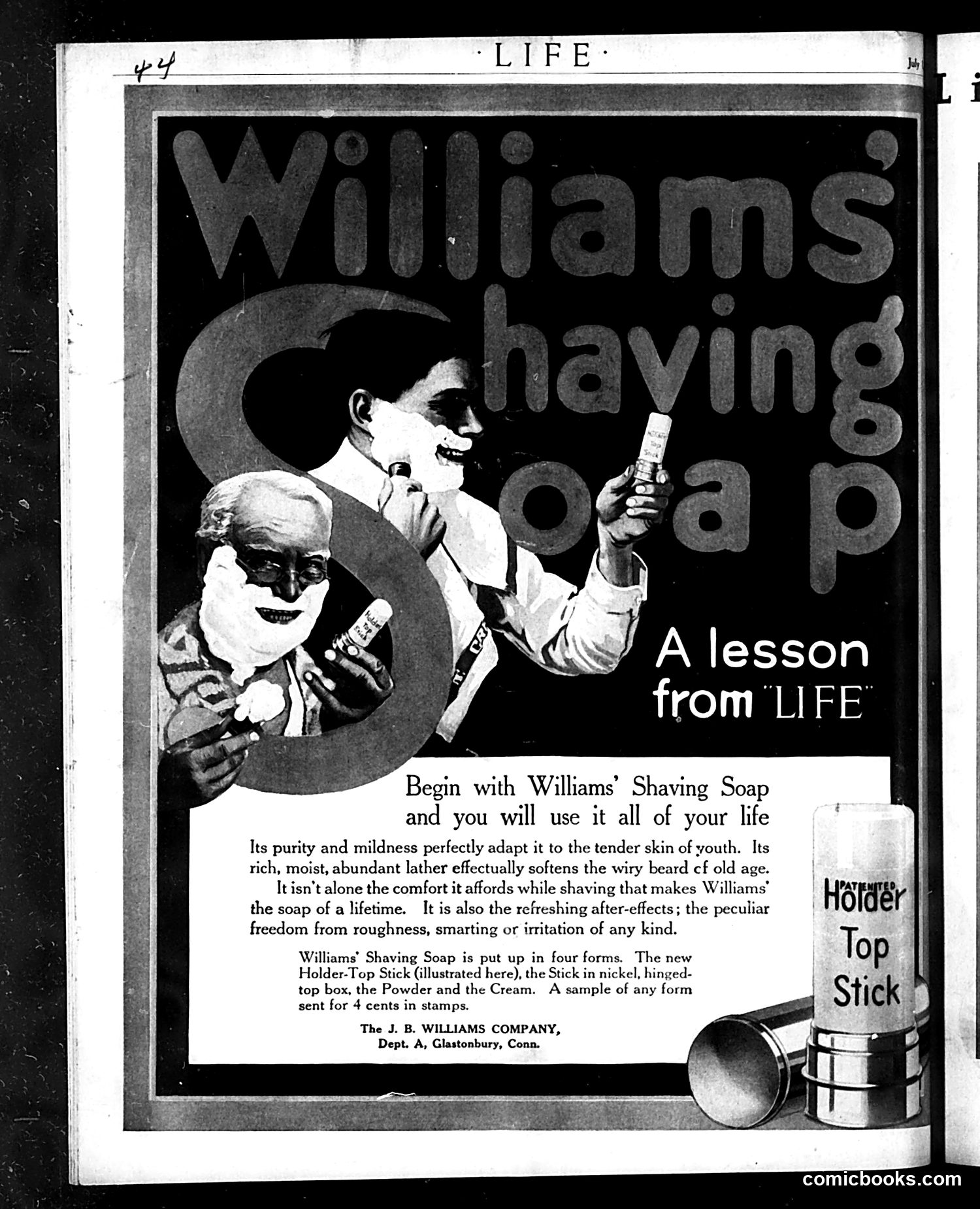
This is primarily a **Williams' Shaving Soap advertisement**, not political satire. The page uses the format of Life magazine's humorous editorial style to sell a consumer product. The illustration shows two figures—a young man and an elderly man—demonstrating the soap's appeal across a lifetime. The tagline "A lesson from LIFE" plays on the magazine's name to suggest this is editorial wisdom rather than mere advertising. The satirical element is mild: the ad humorously frames soap selection as a profound life choice ("the soap of a lifetime"), exaggerating the product's importance. The elderly character's caricatured features were common in period advertising. The ad emphasizes the soap's gentleness for youth and effectiveness on aging skin, listing four product formats available, with a mail-order sample offer for 4 cents. This represents straightforward early-20th-century product marketing dressed in editorial clothing.