
Life, 1915-07-01 · page 26 of 44
Life — July 1, 1915 — page 26: what you’re looking at
What you’re looking at
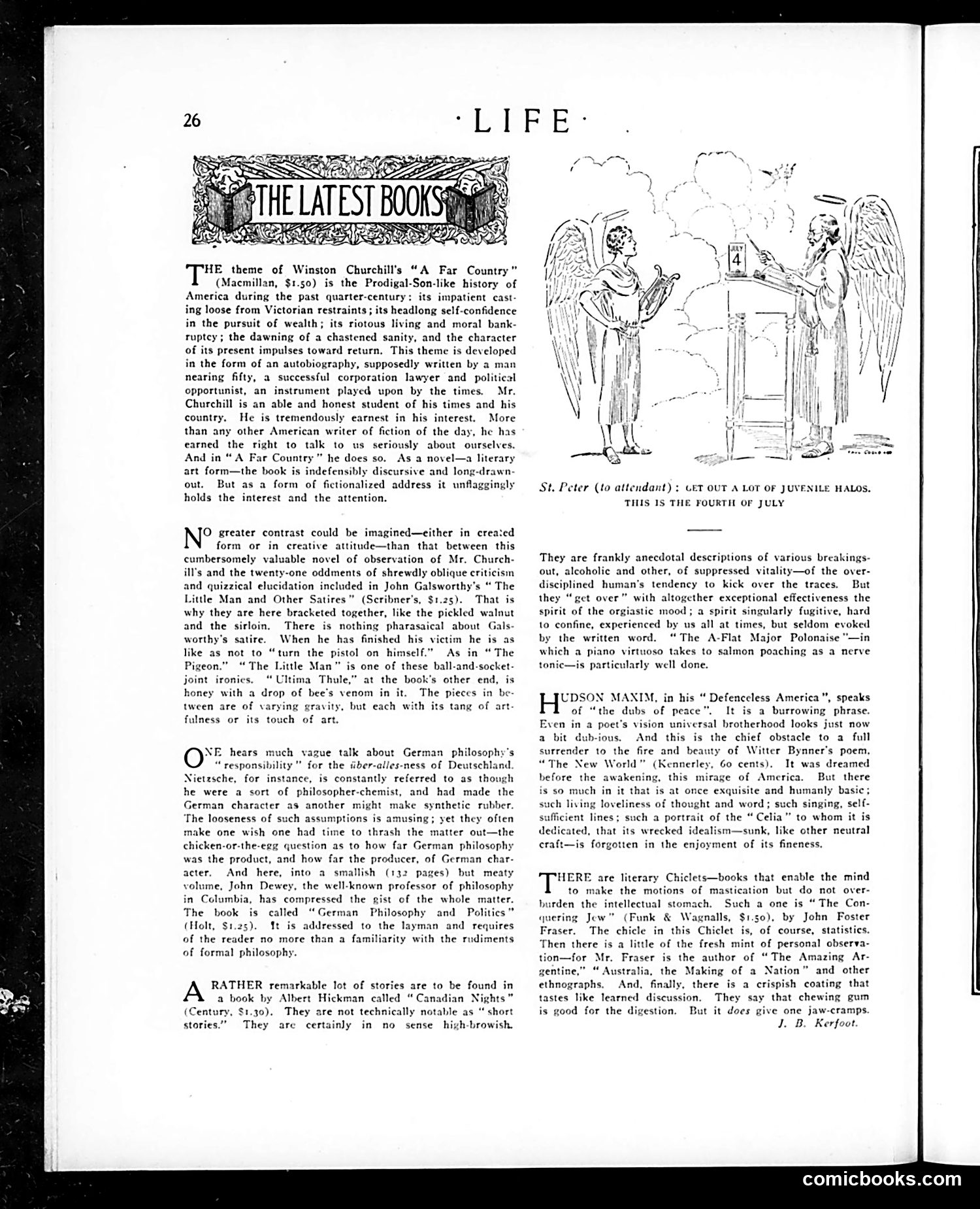
This is a book review page from Life magazine, centered on literary criticism rather than political satire. The small cartoon depicts **St. Peter at heaven's gate** instructing an attendant to "get out a lot of juvenile halos" because "this is the fourth of July"—a joke playing on the American Independence Day holiday. The humor suggests that on July 4th, many rowdy or misbehaving Americans will die and need halos, implying that Independence Day celebrations involve excessive drinking and wild behavior. The page reviews several books, including Winston Churchill's *"A Far Country"* (about American moral decline and recovery), John Galsworthy's *"The Little Man and Other Satires,"* and John Dewey's *"German Philosophy and Politics."* The reviews are earnest literary criticism, not satire. The July 4th cartoon is the only satirical element—a mild jab at American holiday excess.
📄 Transcribed text from this page (OCR, searchable)
Machine-transcribed from the original scan — historical spelling and the odd misread are preserved.
HE theme of Winston Churchill's “A Far Country” (Macmillan, $1.50) is the Prodigal-Son-like history of America during the past quarter-century: its impatient cast ing loose from Victorian restraints ; its headlong self-confidence in the pursuit of wealth; its riotous living and moral bank- ruptcy; the dawning of a chastened sanity, and the character of its present impulses toward return. This theme is developed in the form of an autobiography, supposedly written by a man nearing fifty, a successful corporation lawyer and political opportunist, an instrument played upon by the times, Mr. Churchill is an able and honest student of his times and his country, He is tremendously earnest in his interest. More than any other American writer of fiction of the day, he has earned the right to talk to us seriously about ourselves. And in “A Far Country” he does so. As a novel—a literary art form—the book is indefensibly discursive and long-drawn- out. But as a form of fictionalized address it unflaggingly holds the interest and the attention. 'O greater contrast could be imagined—either in created form or in creative attitude—than that between this cumbersomely valuable novel of observation of Mr. Church- ill’s and the twenty: ne oddments of shrewdly oblique criticism and quizzical elucidation included in John Galsworthy’s “ The Little Man and Other Satires” (Scribner's, $1.25). That is why they are here bracketed together, like the pickled walnut and the sirloin. There is nothing pharasaical about Gals- worthy’s satire. When he has finished his victim he is as like as not to “turn the pistol on himself.” As in “The Pigeon.” “The Little Man” is one of these ball-and-socket- joint ironies. “Ultima Thule,” at the book's other end, is honey with a drop of bee's venom in it. The pieces in b tween are of varying gravity, but each with its tang of art- fulness or its touch of art. O hears much vague talk about German philosophy’ responsibility " for the fiber-alles-ness of Deutschland. Nietzsche, for instance, is constantly referred to as though he were a sort of philosopher-chemist, and had made the German character as another might make synthetic rubber. The looseness of such assumptions is amusing; yet they often make one wish one had time to thrash the matter out—the chicken-or-the-egg question as to how far German philosophy was the product, and how far the producer, of German char- acter, And here, into a smallish (132 pages) but meaty volume, John Dewey, the well-known professor of philosophy in Columbia, has compressed the gist of the whole matter. The book is called “German Philosophy and Politics” (Holt, $1.25), {t is addressed to the layman and requires of the reader no more than a familiarity with the rudiments of formal philosophy. RATHER remarkable lot of stories are to be found in a book by Albert Hickman called “Canadian Nights” (Century, $1.30). They are not technically notable as “ short stories.” They are certainly in no sense high-browish. St. Peter (to attendant) ; GET OUT A LOT OF JUVENILE HALOS. THIS 1S THE FOURTH OF JULY They are frankly anecdotal descriptions of various breakings- out, alcoholic and other, of suppressed vitality—of the over- disciplined human's tendency to kick over the traces. But they “get over” with altogether exceptional effectiveness the spirit of the orgiastic mood; a spirit singularly fugitive, hard to confine, experienced by us all at times, but seldom evoked by the written word. “The A-Flat Major Polonaise "—in which a piano virtuoso takes to salmon poaching as a nerve tonic—is particularly well done. UDSON MAXIM, in his “ Defenceless America”, speaks of “the dubs of peace”. It is a burrowing phrase. Even in a poet's vision universal brotherhood looks just now a bit dub-ious. And this is the chief obstacle to a full surrender to the fire and beauty of Witter Bynner's poem, The New World” (Kennerley, Go cents). It was dreamed before the awakening, this mirage of America. But there is so much in it that is at once exquisite and humanly basi ch living loveliness of thought and word; such singing, self- afficient lines; such a portrait of the “Celia” to whom it is dedicated, that its wrecked idealism—sunk, like other neutral craft—is forgotten in the enjoyment of its fineness. HERE are literary Chiclets—books that enable the mind to make the motions of mastication but do not over- burden the intellectual stomach. Such a one is “ The Con- quering Jew” (Funk & Wagnalls, $1.50), by John Foster Fraser. The chicle in this Chiclet is, of course, statistics. Then there is a little of the fresh mint of personal observa- tion—for Mr. Fraser is the author of “The Amazing Ar- gentine,” “Australia, the Making of a Nation” and other ethnographs, And, finally, there is a crispish coating that tastes like learned discussion. They say that chewing gum is good for the digestion. But it does give one jaw-cramps. comicbooks.com