
Life, 1915-07-01 · page 17 of 44
Life — July 1, 1915 — page 17: what you’re looking at
What you’re looking at
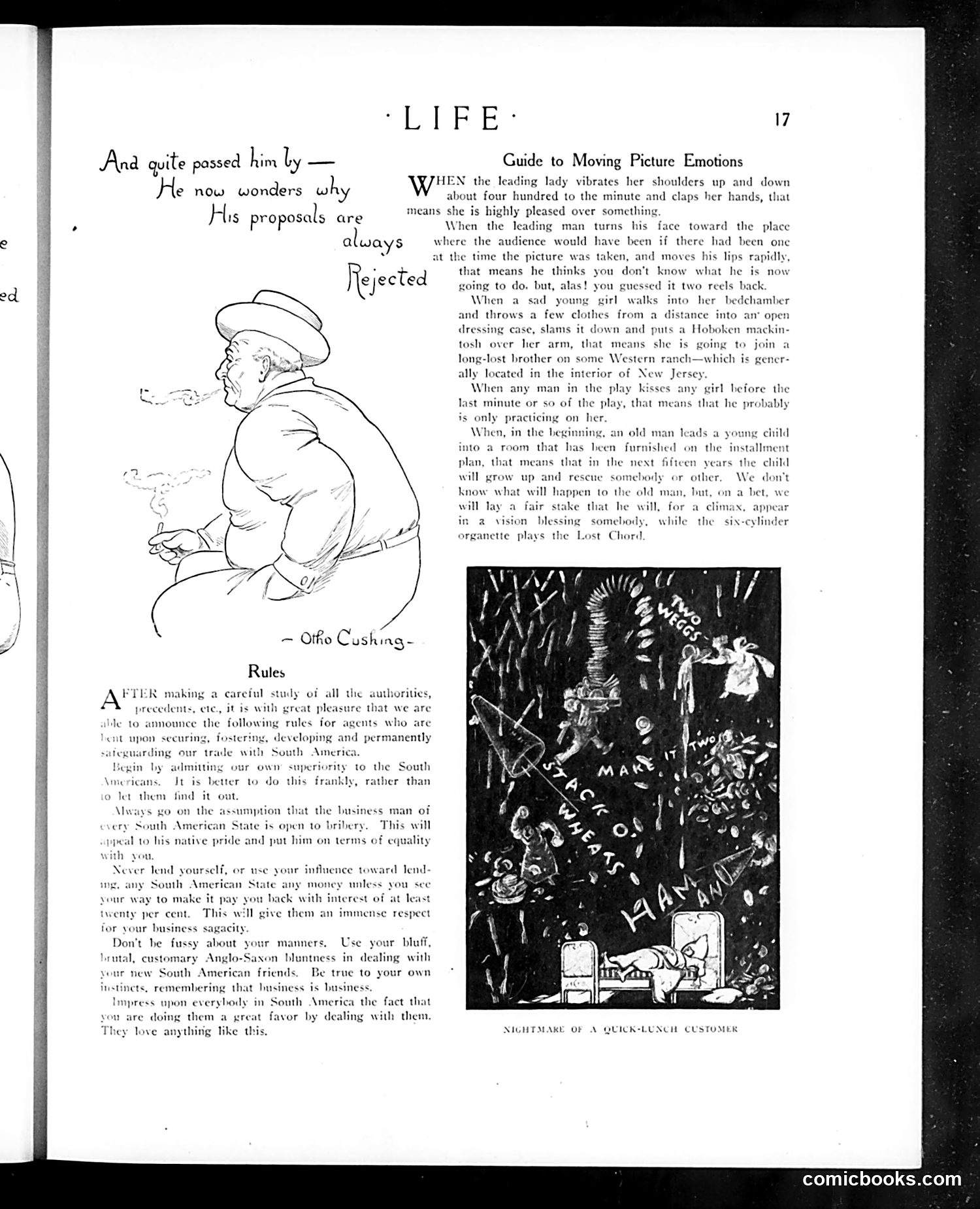
## The Cartoons **Left cartoon (Othe Cushing):** Depicts a rotund man being rejected, illustrating the caption "And quite passed him by — He now wonders why. His proposals are always Rejected." This appears to be a generic romantic comedy scenario about a suitor's repeated rejections. **Right cartoon ("Nightmare of a Quick-Lunch Customer"):** Shows a surreal, nightmarish scene with grotesque figures and distorted imagery surrounding a sleeping figure. It satirizes the indigestion or bad dreams caused by eating quick, cheap food—a common subject for humor about urban lunch culture. ## The "Rules" Section The text presents satirical "rules" for American businessmen dealing with South America. It mocks American commercial arrogance by advising agents to assume South Americans are bribeable, to claim superiority frankly, and to treat business dealings as a personal favor. This reflects early 20th-century American imperialist attitudes and economic colonialism in Latin America. The satire targets both the actual exploitative practices and American obliviousness to how offensive such behavior was.
📄 Transcribed text from this page (OCR, searchable)
Machine-transcribed from the original scan — historical spelling and the odd misread are preserved.
Ana quite passed him ly — e now wonders Ww bY. His proposals are always i ected ~ Othe Cushing - Rules AFTER making a careful study of all the authorities, precedents, ete, it is with great pleasure that we are Je to ammounce the following rules for agents who are «, developing and permanently safeguarding our trade with South America. admitting our own’ superiority to the South \mericans. It is better to do this frankly, rather than o Jet them find it out. t upon securing, fe Begin by hat the business man of \ways go on th umption his will cry South American State is open to bribery. ppeal to his native pride and put him on terms of equality you. Never lend yourself, or use ing, any South American State a you see to make it pay you hack with interest of at least will give them an immense respect r influence toward Jend- y money unte your w twenty per cent. TI for your business sa; ty Don't he fussy about your manners, Use your bluff, rutal, customary Anglo-Saxon bluntness in dealing with ur new South American friends. Be true to your own instinets, remembering that business is business. npress upon everybody in South America the fact that © doing them a great favor by dealing with them, ig like this. ‘LIFE: 7 HEN the lea means she is highly pleased over something When the leading man turns hi where the audience would have be at the time the picture was taken, Guide to Moving Picture Emotions ding lady vibrates her shoulders up and down about four hundred to the minute and claps her hands, that face toward the place n if there had been one moves his lips rapidly, that means he thinks you don’t know what he is now going to do. but, alas! you guessed it two reels back When a sad young girl walks into her bed and throws a few clothes from a distance into z dressing case, slams it down and puts a Hoboken mackin- tosh over her arm, that means she is going to join a long-lost brother on some Western ranch—which is gener- ally located in the interior of New Jersey. When any man in the play kisses any girl before last minute or so of the play, that means that he probably ie is only practicing on he When, in the beginning, an old man leads a yc into a room that 1 x child s been furnished on the installment plan, that means that in the nest fifteen years the child t will grow up and rescue somebody or other, We do know what will happen to the old man, but, on a bet, we will lay a fair in a vision blessi organette plays the Lost Chord. © that he will, for a climax, appear ly, while the @ some! six-cylinder =~ ~ y - NIGHTMAKE OF A QUICK-LUNCH CUSTOMER comicbooks.com