
Life, 1915-07-01 · page 21 of 44
Life — July 1, 1915 — page 21: what you’re looking at
What you’re looking at
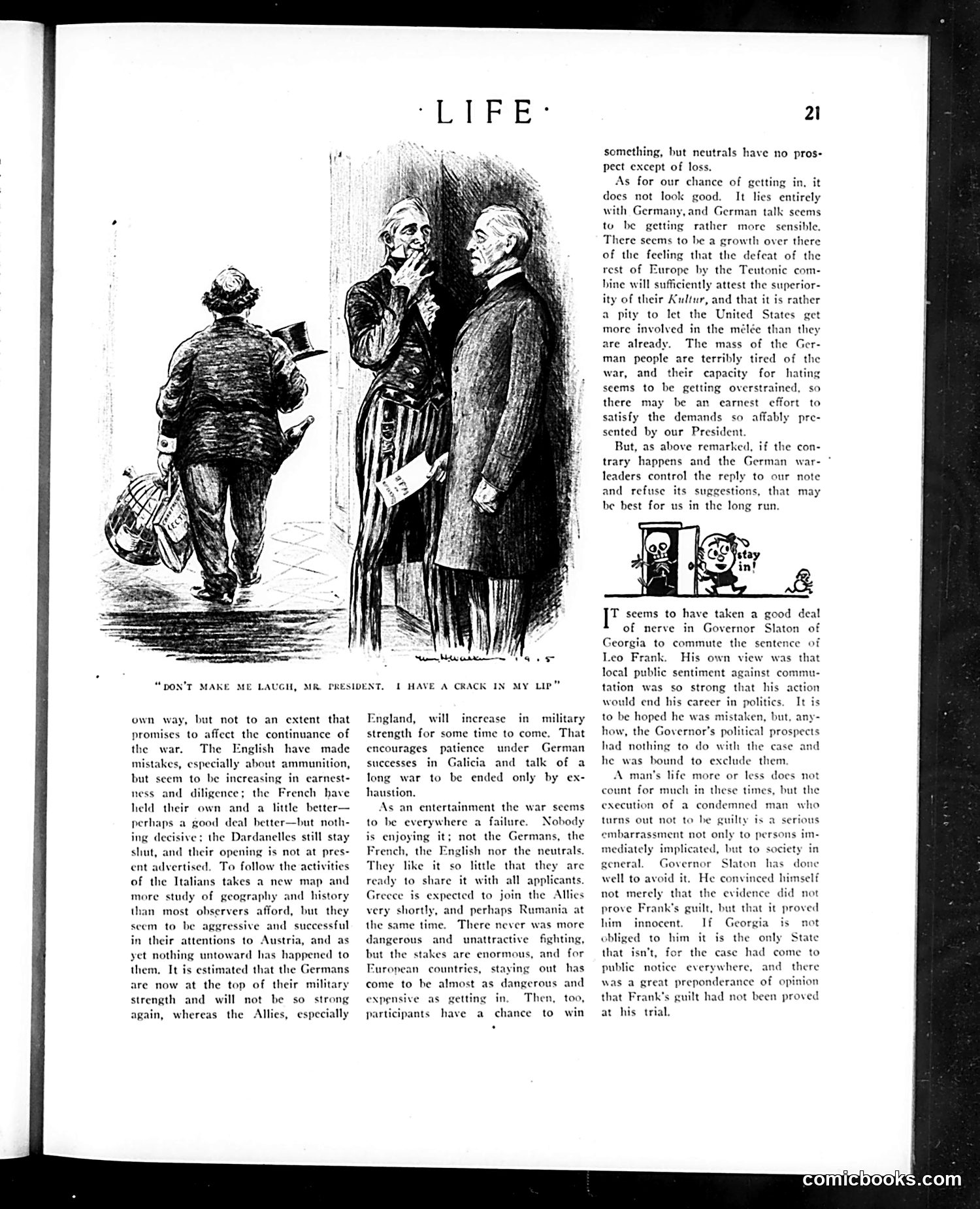
This satirical cartoon depicts a weary soldier returning home, encountering two well-dressed officials (likely representing President Wilson and another government figure). The soldier's caption—"Don't make me laugh, Mr. President. I have a crack in my lip"—is a dark joke about his war injuries, sarcastically rejecting whatever optimistic rhetoric the President offers about the war. The surrounding text discusses World War I (then ongoing), examining whether America should enter the conflict. The author argues Germany controls whether the U.S. joins, notes the war's unpopularity everywhere, and expresses skepticism about American involvement looking "good." The cartoon's point: mock the gap between government officials' comfortable positions and soldiers' brutal reality. It suggests presidential rhetoric rings hollow to those actually suffering combat wounds.
📄 Transcribed text from this page (OCR, searchable)
Machine-transcribed from the original scan — historical spelling and the odd misread are preserved.
“DON’T MAKE ME LAUGH, MR own way, but not to an extent that promises to affect the continuance of the war. The English have made mistakes, especially about ammunition, but seem to be increasing in carnest- ness and diligence; the French have held their own and a little better— perhaps a good deal hetter—but noth- ing decisive: the Dardanelles still stay shut, and their opening is not at pres- ent advertised. To follow the activiti of the Italians S$ a new map and more study of geography and history than most observers afford, but they seem to be aggressive and successful in their attentions to Austria, and as yet nothing untoward has happened to them. It is estimated that the Germans are now at the top of their military strength and will not be so strong again, whereas the Allies, especially PRESIDENT. 1 HAVE A CRACK IN MY LIP” England, will increase in military strength for some time to come, That encourages patience under German successes in Galicia and talk of a long war to be ended only by ex haustion. As an entertainment the war seems to be everywhere a failure. Nobody is enjoying it; not the Germans, the French, the English nor the neutrals. They like it so little that they are ready to share it with all applicants. Greece is expected to join the Allies very shortly, and perhaps Rumania at the same time. There never was more dangerous and unattractive fighting, but the stakes are enormous, and for European countries, staying out has come to be almost as dangerous and Then, too, win expensive as getting in. have a chance to participants 21 something, but neutrals have no pros- pect except of loss. As for our chance of getting in, it does not look good. It lies entirely with Germany,and German talk seems to be getting rather more There seems to be a growth over there of the feeling that the defeat of the rest of Europe by the Teutonic com- hine will sufficiently attest the superior- ity of their Kultur, and that it is rather a pity to let the United States get more involved in the mélée than they are already. The mass of the Ger- man people are terribly tired of the war, and their capacity for hating seems to be getting overstrained, so there may be an earnest effort to satisfy the demands so affably pre- sented by our President. But, as above remarked, if the con- trary happens and the German war- leaders control the reply to our note and refuse its suggestions, that may be best for us in the long run. sensible, T seems to have taken a good deal of nerve in Governor Slaton of Georgia to commute the sentence of Leo Frank. His own view was that local public sentiment against commu- tation was so strong that his action would end his career in politics. It is to be hoped he was mistaken, but, any- how, the Governor's political prospects had nothing to do with the case d he was bound to exclude them A man’s life more or less does not count for much in these times, but the of a condemned man who sutilty execution turns out not to he is a serious embarrassment not only to persons im- ated, but to society in general Slaton has well to avoid it, He convinced himself not merely that the evidence did not prove Frank's guilt, but that it proved him innocent. If Georgia is not obliged to him it is the only State that isn’t, for the case had come to public notice everywhere, and. there was a great preponderance of opinion that Frank's guilt had not been proved at his trial. mediately impli Governor done