
Life, 1915-07-01 · page 30 of 44
Life — July 1, 1915 — page 30: what you’re looking at
What you’re looking at
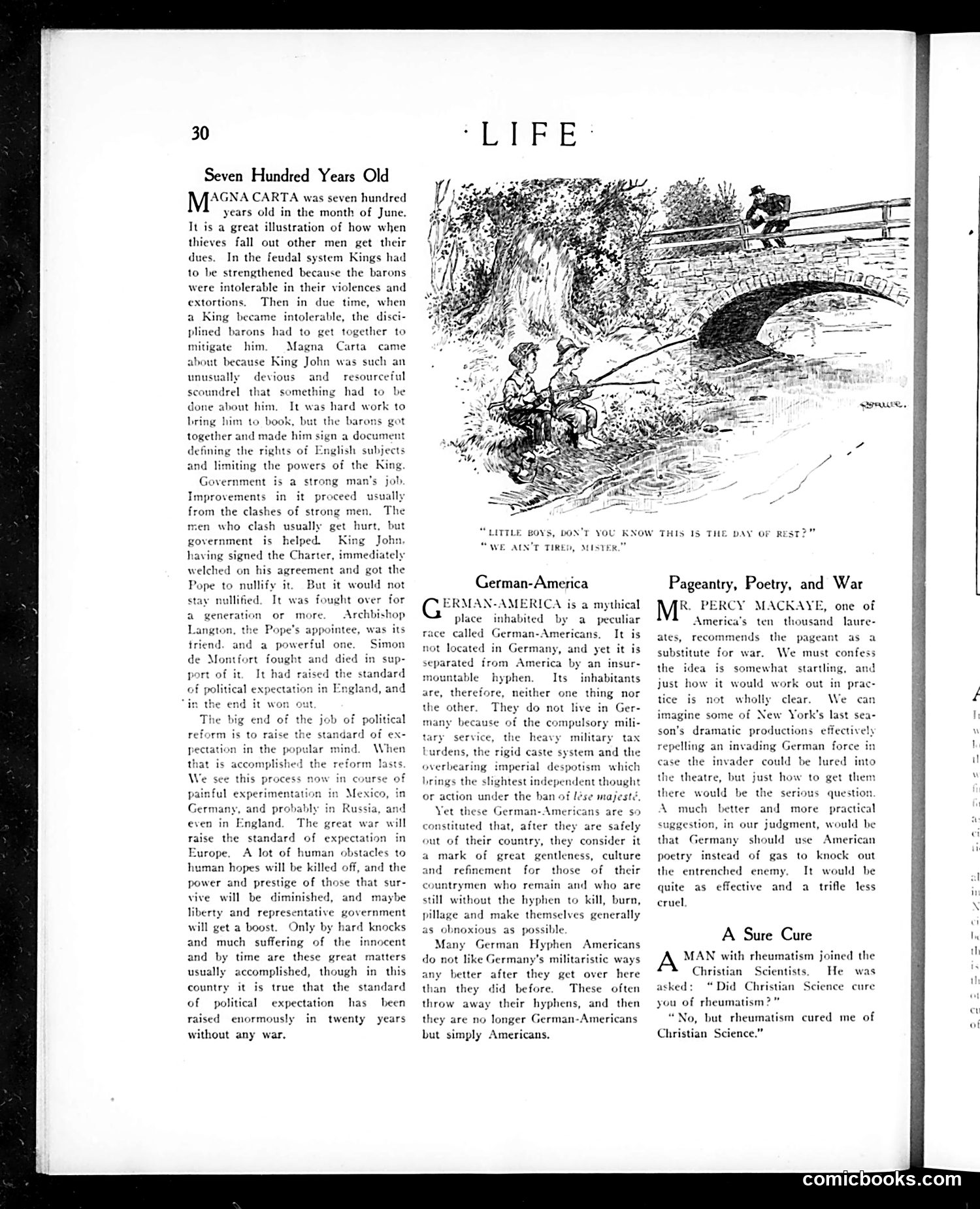
This page contains two distinct pieces of political commentary: **"Seven Hundred Years Old"** discusses the 700th anniversary of the Magna Carta (June 1215), framing it as a model for political reform. The author argues that progress comes through conflict between powerful figures—King John was forced by barons to accept limits on royal power. The piece suggests this same pattern is occurring in contemporary Mexico, Germany, Russia, and England, with World War I raising expectations for liberty and representative government. **"German-America"** satirizes hyphenated Americans of German descent. The piece mocks the concept of "German-Americans" as an impossible contradiction—they've fled Germany's militarism and despotism yet sentimentally support German aggression abroad. The satire suggests such divided loyalties are absurd; immigrants should either fully assimilate ("simply Americans") or acknowledge their hypocrisy. The accompanying sketch depicts boys fishing on a Sunday, with a figure scolding them about the Sabbath—likely illustrating leisure and youthful defiance of social convention.
📄 Transcribed text from this page (OCR, searchable)
Machine-transcribed from the original scan — historical spelling and the odd misread are preserved.
30 Seven Hundred Years Old AGNA CARTA was seven hundred years old in the month of June. It is a great illustration of how when thieves fall out other men get their dues. In the feudal system Kings had to be strengthened because the barons were intolerable in their violences and extortions. Then in due time, when a King became intolerable, the disci- plined barons had to get together to mitigate him. Magna Carta came about because King John was such an unusually devious and resourceful scoundrel that something had to be done about him. It was hard work to bring him to book, but the barons got together and made him sign a document defining the rights of English subjects and limiting the powers of the King. Government is a strong man’s job, Improvements in it proceed usually from the clashes of strong men, The n who clash usually get hurt, but government is helped. King John, having signed the Charter, immediately welched on his agreement and got the Pope to nullify it. But it would not stay nullified. It was fought over for a generation or more. Archbishop Langton, the Pope's appointee, was its triend. and a powerful one. Simon de Montfort fought and died in sup- of it. It had raised the standard of political expectation in England, and “in the end it we The big end of the job of political reform is to rais ¢ standard of ex- pectation in the popular mind. When that is accomplished the reform lasts We see this process now in course of painful experimentation in Mexico, Germany, and probably in Russia, and even in England. The great war will raise the standard of expectation in Europe. A lot of human obstacles to human hopes will be killed off, and the power and prestige of those that sur- vive will be diminished, and maybe liberty and representative government will get a boost. Only by hard knocks and much suffering of the innocent and by time are these great matters usually accomplished, though in this country it is true that the standard of political expectation has been raised enormously in twenty years without any war. “LITTLE BOYS, DON'T YOU KNOW THIS 15 THE DAY OF REST? “WE AIN'T TIRED, MISTER.” German-America G AN-AMERICA is a mythical place inhabited by a peculiar race called German-Americans, It is not located in Germany, and yet it is separated from America by an insur- jountable hyphen. Its inhabitants are, therefore, neither one thing nor the other. They do not live in Ger- many because of the compulsory mili- ry service, the heavy military tax burdens, the rigid caste system and the overbearing imperial despotism which brings the slightest independent thought or action under the ban of lése maje Yet these German-Americans are so constituted that, after they are safely out of their country, they consider it a mark of great gentleness, culture and refinement for those of their countrymen who remain and who are still without the hyphen to kill, burn, pillage and make themselves generally as obnoxious as possible Many German Hyphen Americans do not like Germany's militaristic ways any better after they get over here than they did before. These often throw away their hyphens, and then they are no longer German-Americans but simply Americans. Pageantry, Poetry, and War Mé& PERCY MACKAYE, one of America’s ten thousand laure- ates, recommends the pageant as substitute for war. We must the idea is somewhat startling, and just how it would work out in prac- tice is not wholly clear. We can imagine some of New York's last sea son's dramatic productions effectively repelling an invading German force in case the invader could be lured into the theatre, but just how to get the there would be the serious question \ much better and more practica suggestion, in our judgment, would be that Germany should use American poetry instead of gas to knock out the entrenched enemy, It would be quite as effective and a trifle less cruel A Sure Cure MAN with rheumatism joined the Christian Scientists, He was asked: “Did Christian Science cure you of rheumatism?” “No, but rheumatism cured me of Christian Science. comicbooks.com