
Life, 1915-07-01 · page 24 of 44
Life — July 1, 1915 — page 24: what you’re looking at
What you’re looking at
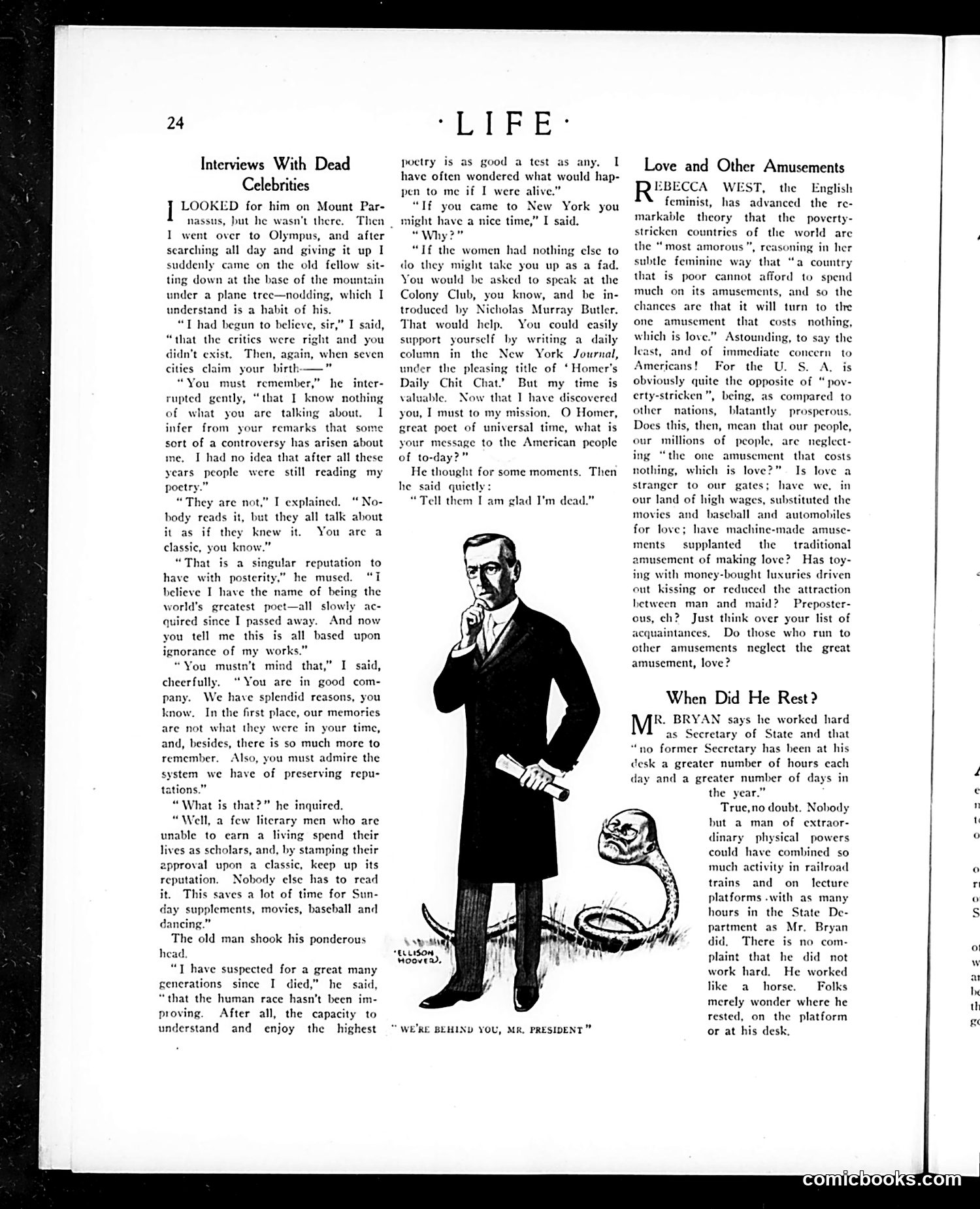
The page contains two distinct pieces: **"Interviews With Dead Celebrities"** presents a fictional conversation with Homer, the ancient Greek poet. The satire mocks modern literary culture: scholars preserve Homer's reputation without anyone actually reading his work, and he's reduced to a potential New York celebrity attraction or newspaper columnist. Homer's final message—"Tell them I am glad I'm dead"—is the joke's punchline, expressing disgust at contemporary American priorities (movies, baseball, dancing) over serious art. The cartoon shows a classical figure haunted by a death's head, visualizing this cultural decline. **"Love and Other Amusements"** references Rebecca West's feminist theory that poverty-stricken nations are "most amorous" because they can't afford other entertainments. The piece sarcastically applies this to prosperous America, implying that wealthy Americans have replaced love with commercial amusements (movies, baseball, automobiles), having literally "substituted" genuine human connection for manufactured entertainment. Both pieces critique American materialism and the erosion of cultural and romantic values in modern consumer society.
📄 Transcribed text from this page (OCR, searchable)
Machine-transcribed from the original scan — historical spelling and the odd misread are preserved.
Interviews With Dead Celebrities LOOKED for him on Mount Par- nassus, but he wasn't there. Then 1 went over to Olympus, and after searching all day and giving it up I suddenly came on the old fellow sit- ting down at the base of the mountain under a plane tree—nodding, which I understand is a habit of his. “T had begun to believe, sir,” I said, “that the critics were right and you didn’t exist, Then, again, when seven cities claim your birth— “You must remember,” he inter- rupted gently, “that I know nothing of what you are talking about. 1 infer from your remarks that sor sort of a controversy has arisen about me, I had no idea that after all these years people were still reading my poetry.” “They are not,” I explained. body reads it, but they all talk about it_as if they knew it. You are a classic, you know.” “That is a singular reputation to have with posterity,” he mused. “1 Delieve I have the name of being the world’s greatest. poct—all slowly ac- quired since I passed away. And now you tell me this is all based upon ignorance of my works.” “You mustn’t mind that,” I said, cheerfully. “You are in good com- pany. We have splendid reasons, you know. In the first place, our memories are not what they were in your time, and, besides, there is so much more to remember. Also, you must admire the system we have of preserving repu- tations.” “What is that?” he inquired. “Well, a few literary men who are unable to earn a living spend their lives as scholars, and, by stamping their approval upon a classic, keep up its reputation. Nobody else has to read it. This saves a lot of time for Sun- day supplements, movies, baseball and dancing.” The old man shook his ponderous head. “J have suspected for a great many generations since I died,” he said, “that the human race hasn't been im- proving. After all, the capacity to understand and enjoy the highest o- Ua il co poctry is as good a test as any, I have often wondered what would hap- pen to me if I were alive.” “If you came to New York you might have a nice time,” I said. “Why?” “If the women had nothing else to do they might take you up as a fad. You would be asked to speak at the Colony Club, you know, and be in- troduced by Nicholas Murray Butler. That would help. You could easily support yourself by writing a daily column in the New York Journal, under the pleasing title of ‘Homer's Daily Chit Chat’ But my time is valuable. Now that 1 have discovered you, I must to my mission, O Homer, great poct of universal time, what is your message to the American people of to-day?” He thought for some moments. Then he said quietly: “Tell them I am glad I'm dead.” Soo seuurson. 7) Moovea), “WE'RE BEHIND YOU, MR. PRESIDENT” Love and Other Amusements EBECC. WEST, the English feminist, has advanced the re- markable theory that the poverty- stricken countries of the world are the “most amorous”, reasoning in her subtle feminine way that “a country that is poor not afford to spend much on its amusements, and so the chances are that it will turn to the one amusement that costs nothing, which is love.” Astounding, to say the least, and of immediate concern to Americans!’ For the U. S. A, is obviously quite the opposite of “ pov- erty-stricken”, being, as compared to other nations, blatantly prosperous. Does this, then, mean that our people, our millions of people, are neglect- ing “the one amusement that costs nothing, which is love?” Is love a stranger to our gates; have we, in our land of high wages, substituted the movies and baseball and automobiles for love; have machine-made amuse- ments supplanted — the __ traditional amusement of making love? Has toy- ing with money-bought luxuries driven out kissing or reduced the attraction hetween man and maid? Preposter- ous, ch? Just think over your list of acquaintances, Do those who run to other amusements neglect the great amusement, love? When Did He Rest? M* BRYAN says he worked hard as Secretary of State and that no former Secretary has heen at his desk a greater number of hours each and a greater number of days in the year.” True,no doubt. Nobody but a man of extraor- dinary physical powers could have combined so much activity in railroad trains and on lecture platforms .with as many hours in the State De- partment as Mr. Bryan did. There is no com- plaint that he did not work hard. He worked like horse. Folks merely wonder where he rested, on the platform or at his desk,