
A complete issue · 48 pages · 1914
Life — November 12, 1914
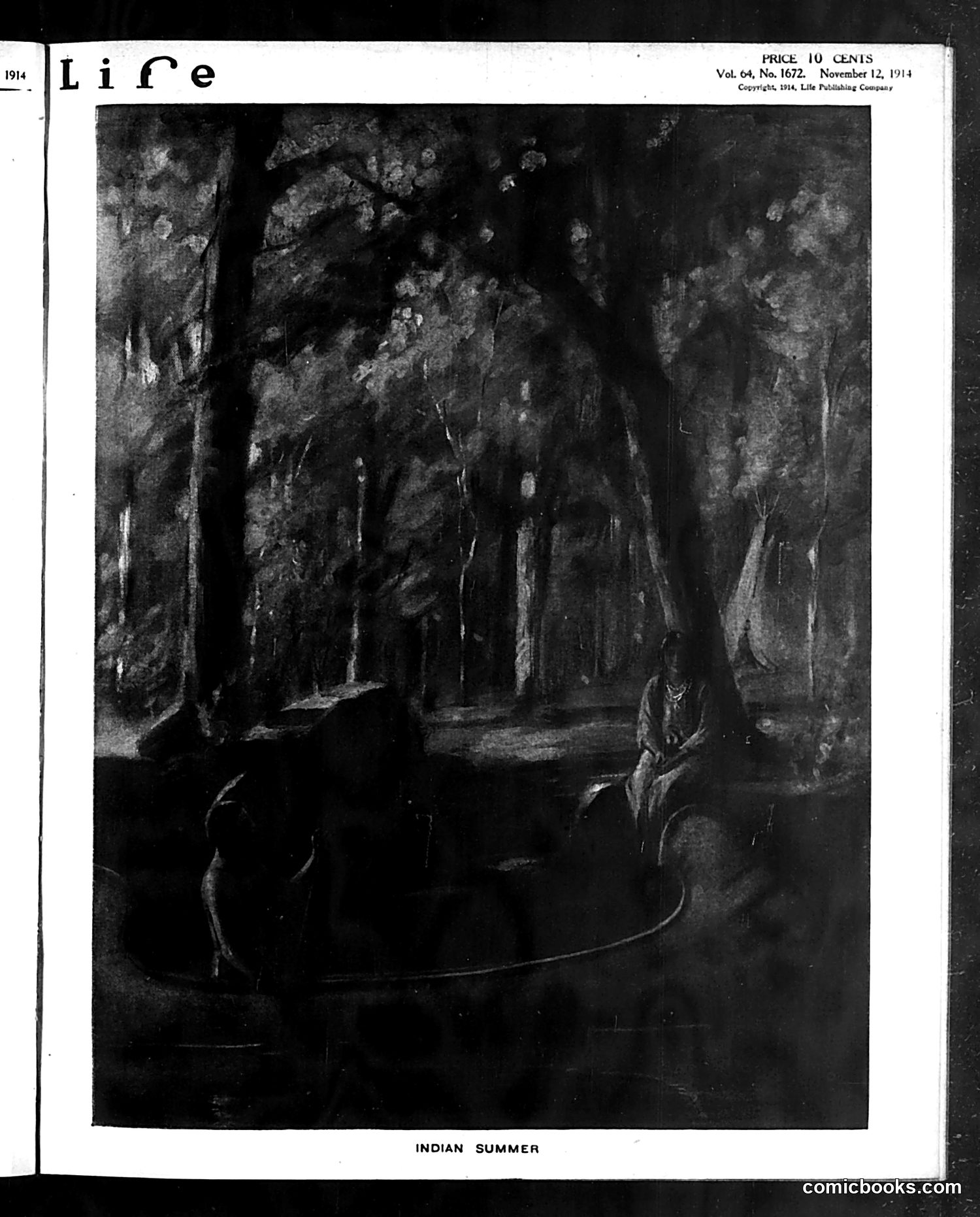
This appears to be an atmospheric illustration rather than a political cartoon. The image depicts a dark, moody forest or wooded scene with tall trees and figures in a canoe or boat on water below. The composition emphasizes shadows and natural landscape rather than satirical commentary. Given the title "Indian Summer" and the 1914 date, this is likely a romantic or atmospheric piece celebrating the seasonal phenomenon. However, the OCR provides no accompanying text explaining the illustration's specific purpose or meaning. Without additional context or captions, the precise satirical or social intent—if any—remains unclear. The image quality and dark tones are characteristic of early 20th-century photographic reproduction in magazines.
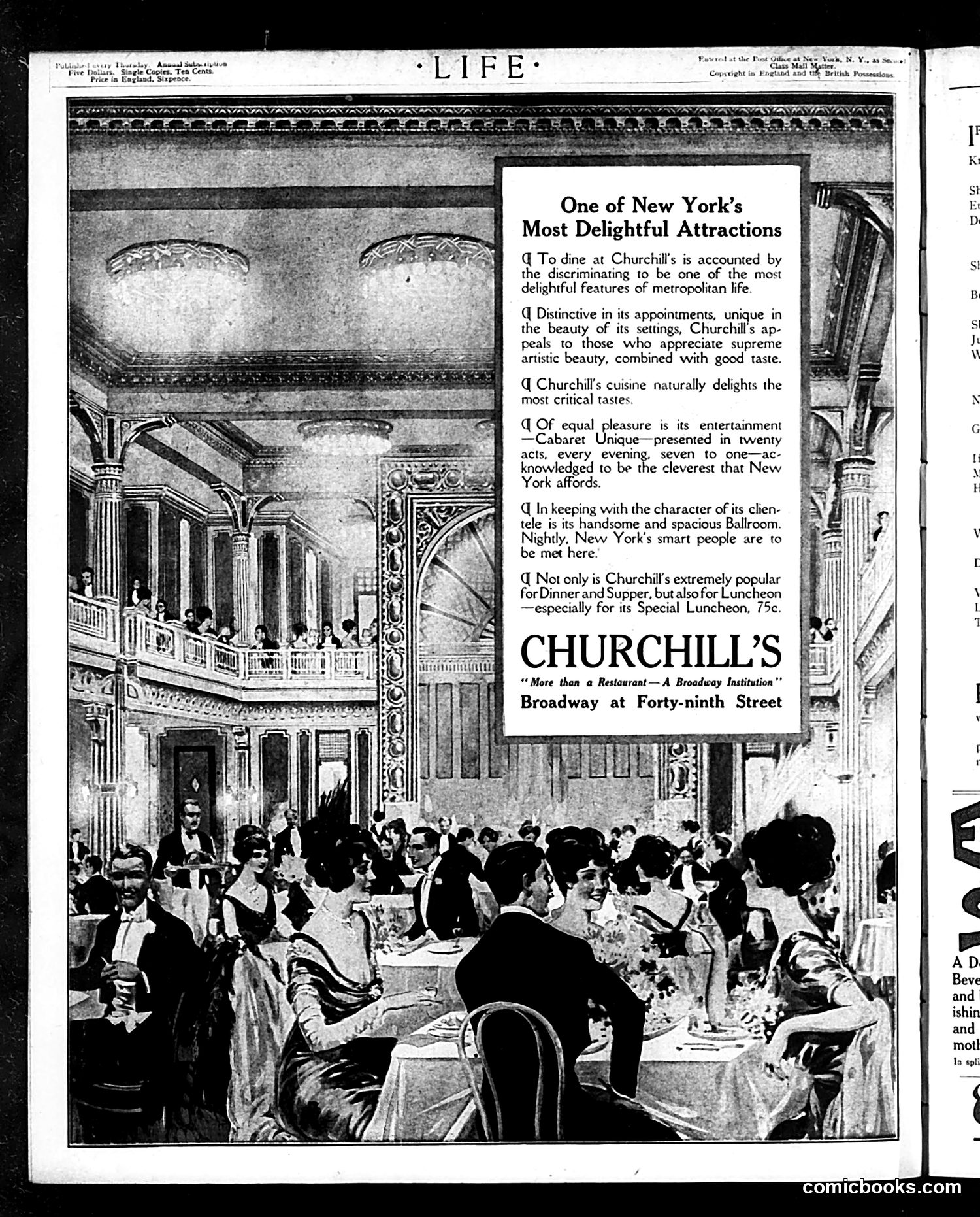
This page is primarily **advertising, not political satire**. It's a full-page ad for Churchill's restaurant in New York City, located at Broadway and Forty-ninth Street (in the theater district). The ad emphasizes Churchill's as "one of New York's Most Delightful Attractions," highlighting its elegant appointments, fine cuisine, and evening entertainment featuring the "Cabaret Unique" with twenty acts nightly. It notes the restaurant is popular for dinners, suppers, and lunches, with a special lunch offered for 75 cents. The illustration shows a crowded, upscale dining room with well-dressed patrons in formal evening wear, conveying sophistication and social prestige. This is purely commercial messaging aimed at affluent New Yorkers seeking fine dining and entertainment.
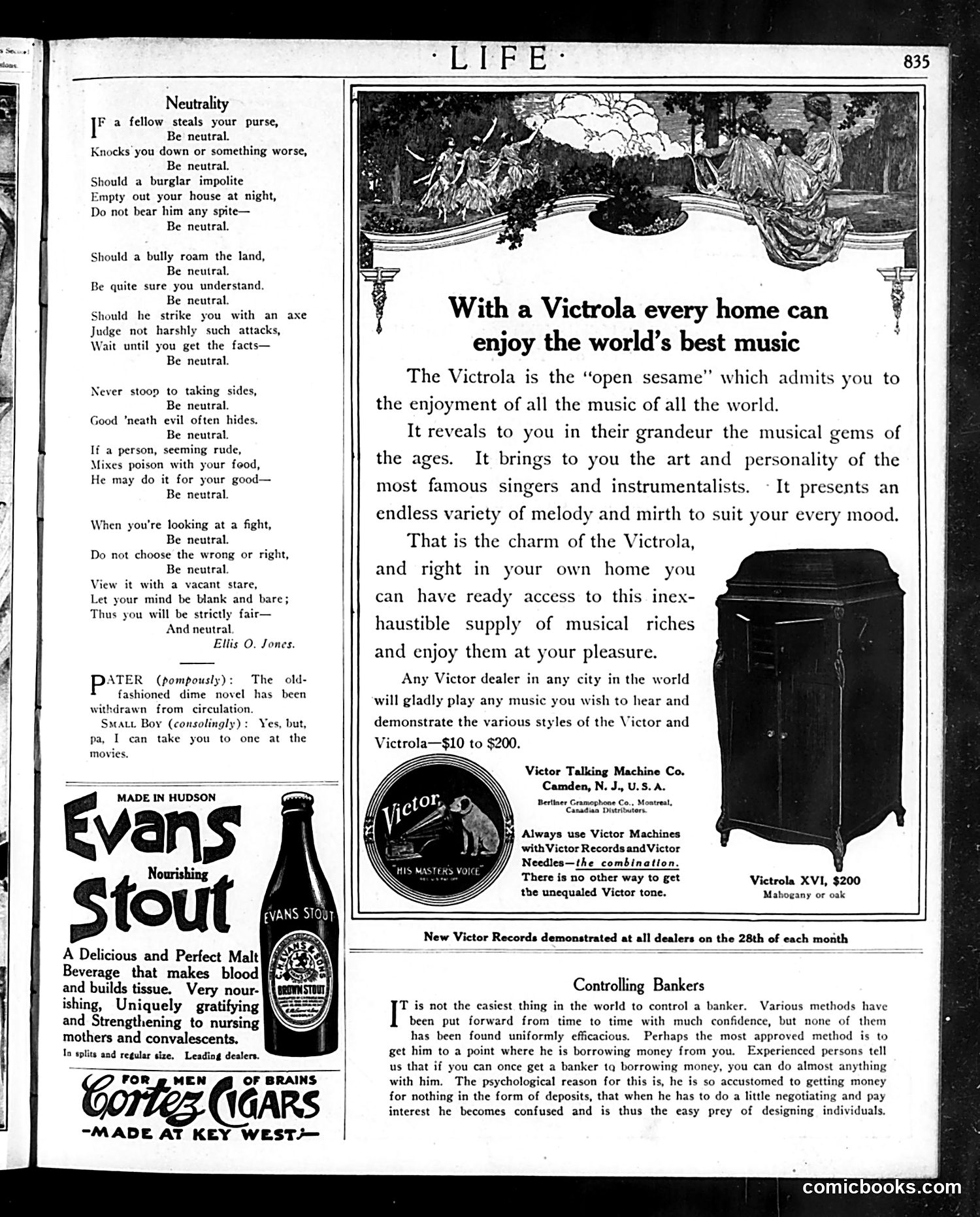
The left side features a poem titled "Neutrality" by Ella O. Jones, which satirizes American neutrality during international conflicts. The poem uses ironic scenarios—a thief stealing your purse, a burglar robbing your house, a bully roaming the land, or someone striking you with an axe—to mock the policy of remaining neutral when facing injustice or aggression. The repeated refrain "Be neutral" emphasizes the absurdity of non-intervention in the face of clear wrongdoing. This likely references American isolationist sentiment in the 1930s-early 1940s, before or during WWII, when the U.S. maintained official neutrality despite growing fascist aggression in Europe and Asia. The right side contains advertisements for Victrola gramophones, Evans Stout beer, and Cortez cigars—typical period product promotions unrelated to the political content.
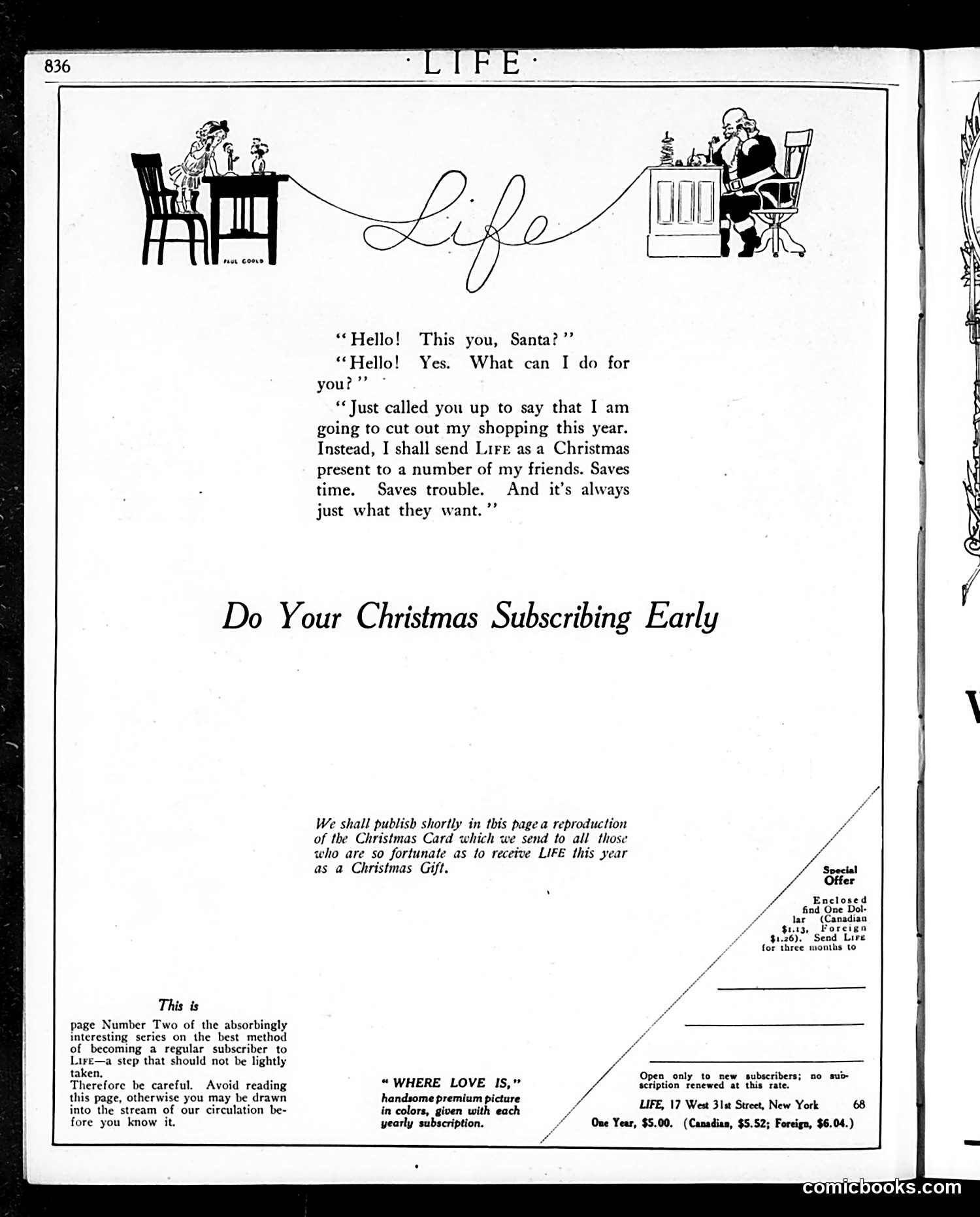
This is primarily a **subscription advertisement** for *Life* magazine, presented as a humorous dialogue. The cartoon shows someone calling Santa Claus to announce they'll give *Life* magazine subscriptions as Christmas gifts instead of shopping for individual presents. The joke's appeal is practical: gifting subscriptions saves time and money while recipients "always" want the magazine. The two small illustrations depict typical office/home scenes from the era. The ad emphasizes the convenience angle—a relatable pitch for busy holiday shoppers. A "Special Offer" section mentions a Christmas card reproduction available to new subscribers, with pricing for domestic ($5.00) and foreign ($5.52-$6.04) subscriptions. This reflects mid-20th century consumer culture and magazine subscription marketing strategies.
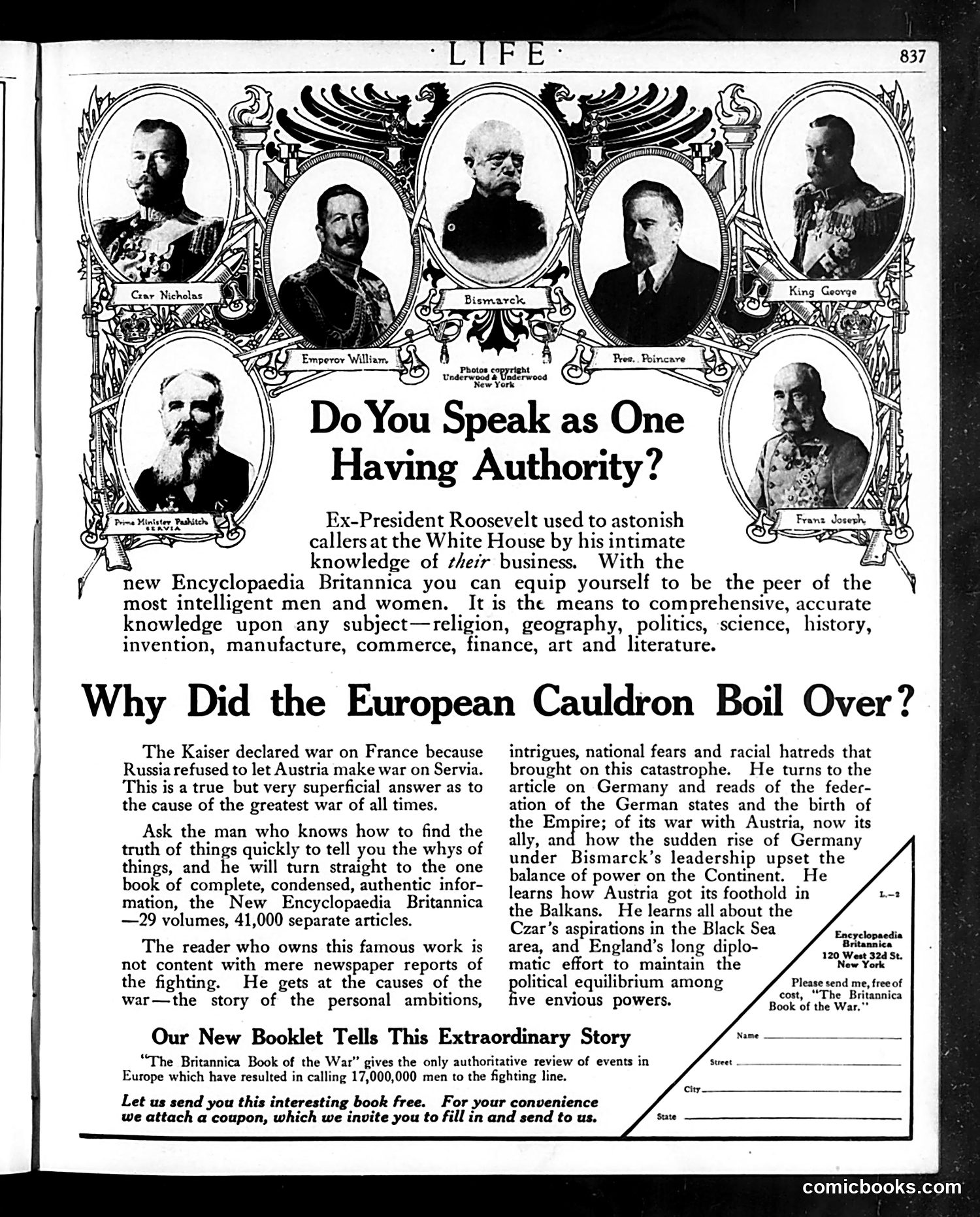
This is primarily **advertising disguised as editorial content** for Encyclopedia Britannica (29 volumes, 41,000 articles). The page uses World War I as a hook to sell reference materials. The **seven portrait medallions** appear to show world leaders of WWI era—likely including Czar Nicholas, Emperor William, Bismarck, King George, and Franz Joseph, though labels are small. The copy poses a rhetorical question: "Do You Speak as One Having Authority?" suggesting readers need comprehensive knowledge to discuss current events intelligently. The satirical angle is subtle: the ad implies that without owning an encyclopedia, ordinary people cannot understand complex geopolitical causes (the article title asks "Why Did the European Cauldron Boil Over?"), positioning the product as essential for educated conversation during wartime.
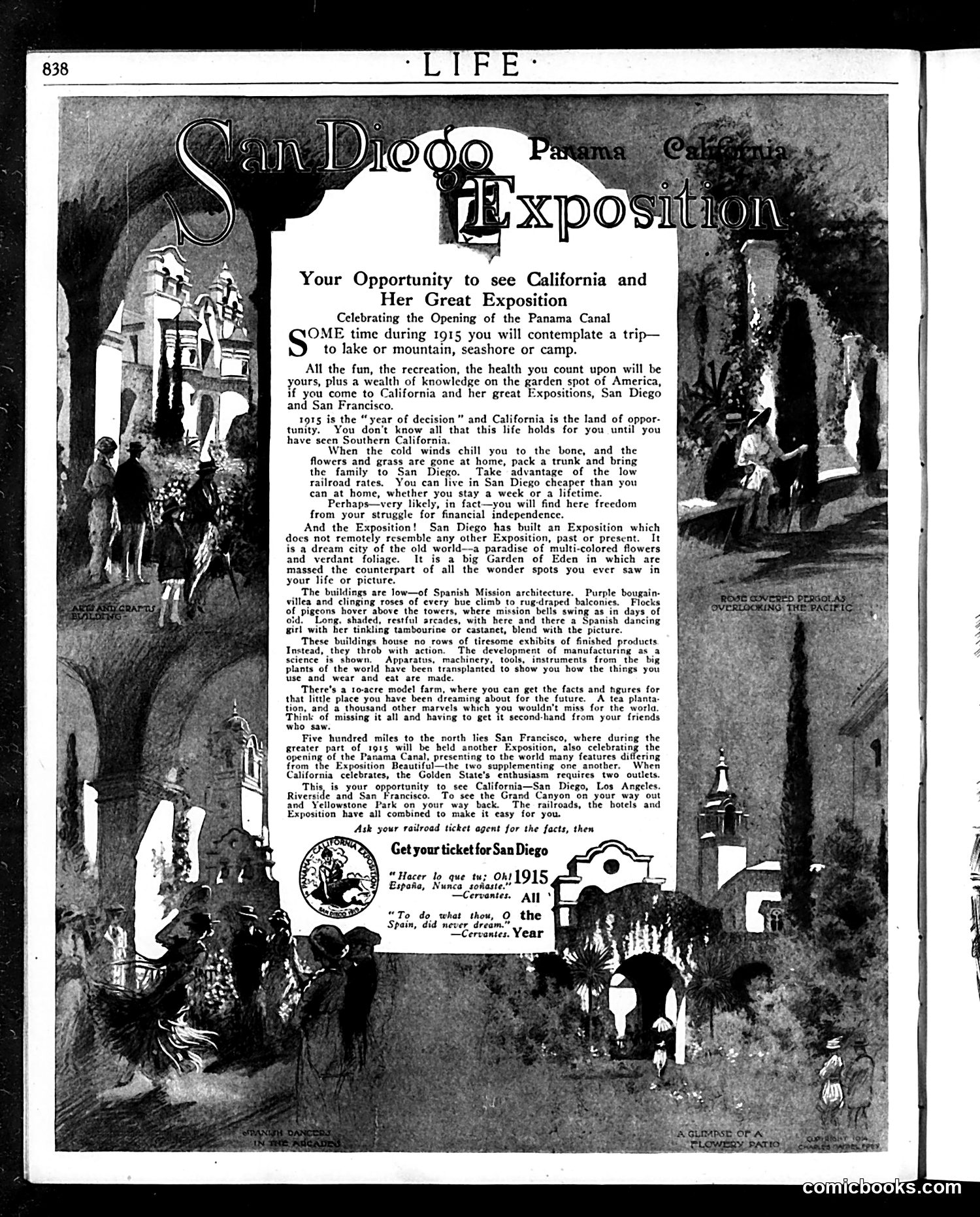
This is primarily a **promotional advertisement** for the 1915 San Diego Panama-California Exposition, celebrating the Panama Canal's opening. The page is not satirical—it's marketing copy. The text encourages Americans to visit California during 1915, highlighting the Exposition's attractions: Spanish Mission architecture, gardens resembling the Garden of Eden, and exhibits showcasing manufacturing and agriculture. The ad emphasizes San Diego's affordability compared to home living. The illustrated borders show Spanish Colonial architecture and period figures in costume, reinforcing the Exposition's "dream city of the old world" theme. At bottom, it quotes Columbus ("Haber lo que tu, O! 1915 / España, Nunca soñaste") to connect the exploration narrative. This is standard early-20th-century advertising—promoting regional tourism and celebrating American technological progress via the Panama Canal achievement.
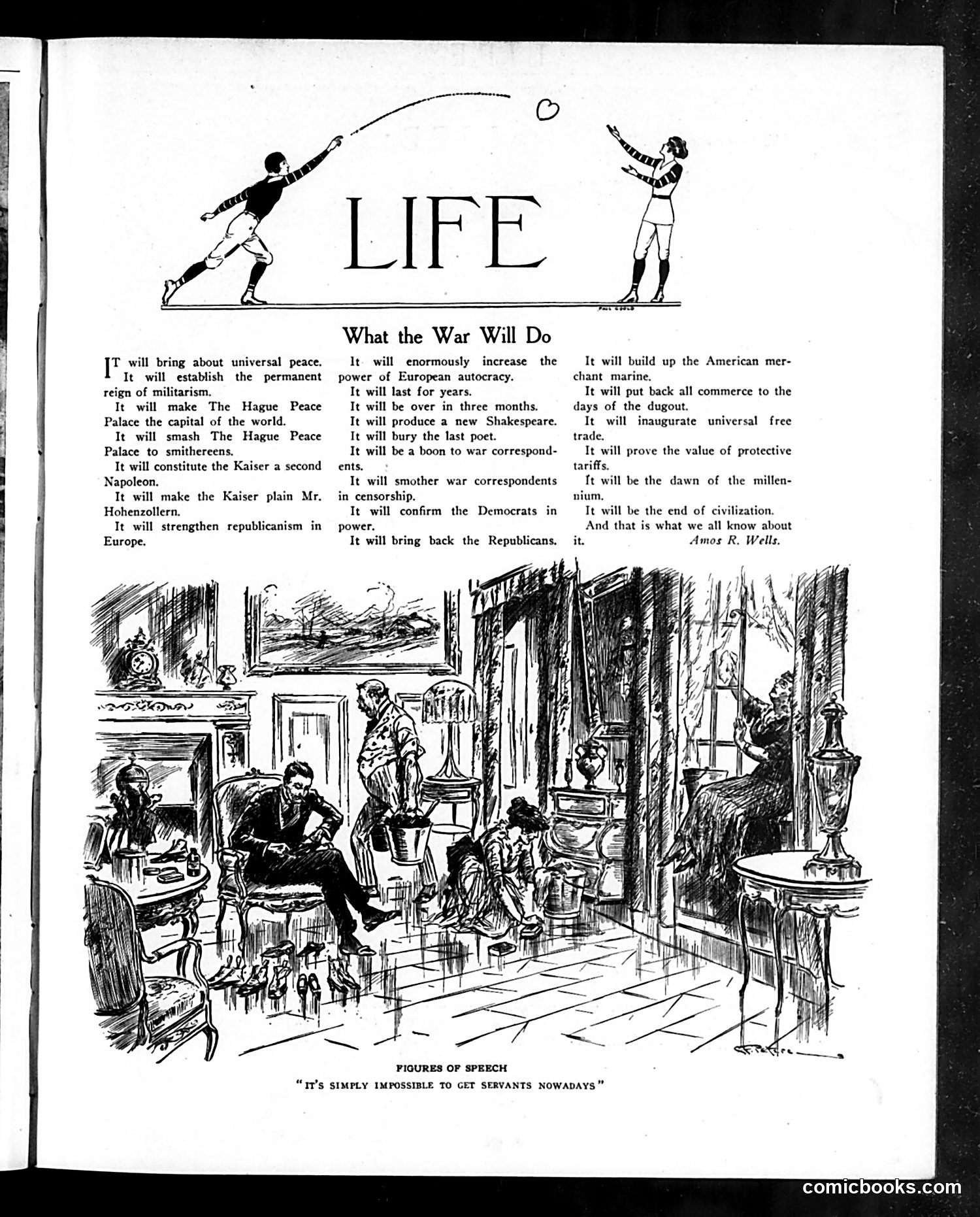
This page from *Life* magazine presents satirical commentary on World War I's anticipated outcomes. The header illustration shows two figures playfully tossing a heart, symbolizing optimistic romantic notions about war. The main text, attributed to Amor R. Wells, lists competing predictions about what "The War Will Do"—offering ironic, contradictory claims. Some predictions are absurdist (producing "a new Shakespeare"), while others mock political positions (strengthening republicanism in Europe, confirming Democrats in power). The satire suggests people held wildly unrealistic expectations about the war's consequences. The bottom cartoon, "Figures of Speech: It's Simply Impossible to Get Servants Nowadays," depicts a domestic scene where the absence of working-class servants (presumably due to war) has created household chaos. This satirizes how the war disrupted class hierarchies and servant availability—a pressing concern for wealthy readers.
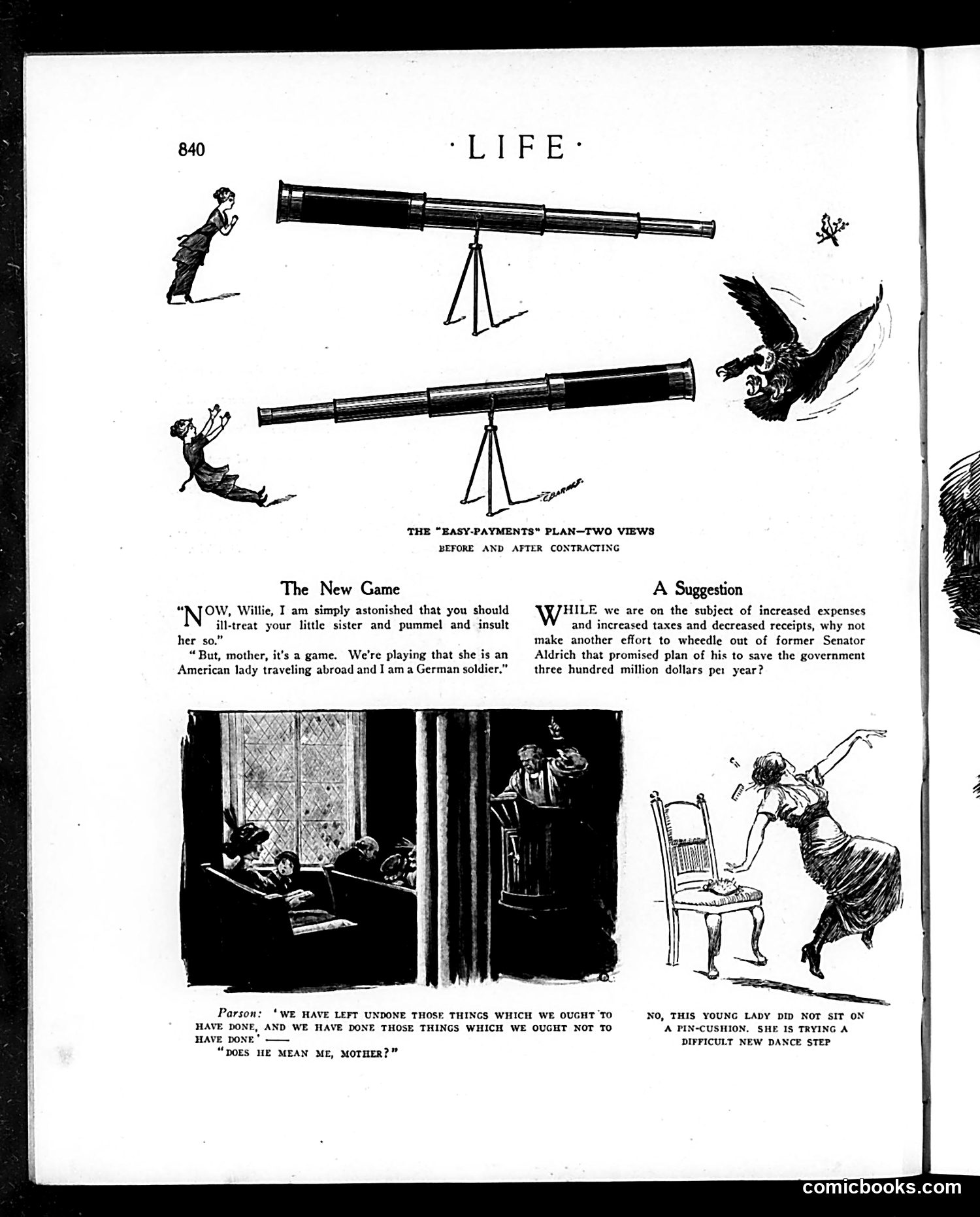
This page contains political satire from *Life* magazine critiquing government spending and military expenditure. **"The Easy-Payments Plan"** (top) uses telescopes as metaphor: figures strain to look through them, illustrating difficulty observing distant government waste. **"The New Game"** (bottom left) depicts a mother and child discussing pretend play—the boy imagines mistreating his sister while claiming she's "an American lady traveling abroad" and he's "a German soldier." This satirizes how Americans might rationalize aggressive foreign policy under patriotic pretense. **"A Suggestion"** (right) directly proposes eliminating Senator Aldrich's promised "$300 million per year" government plan to address economic problems, arguing such spending worsens the financial crisis rather than solving it. The cartoons collectively mock government fiscal irresponsibility and jingoistic militarism during an era of economic strain.
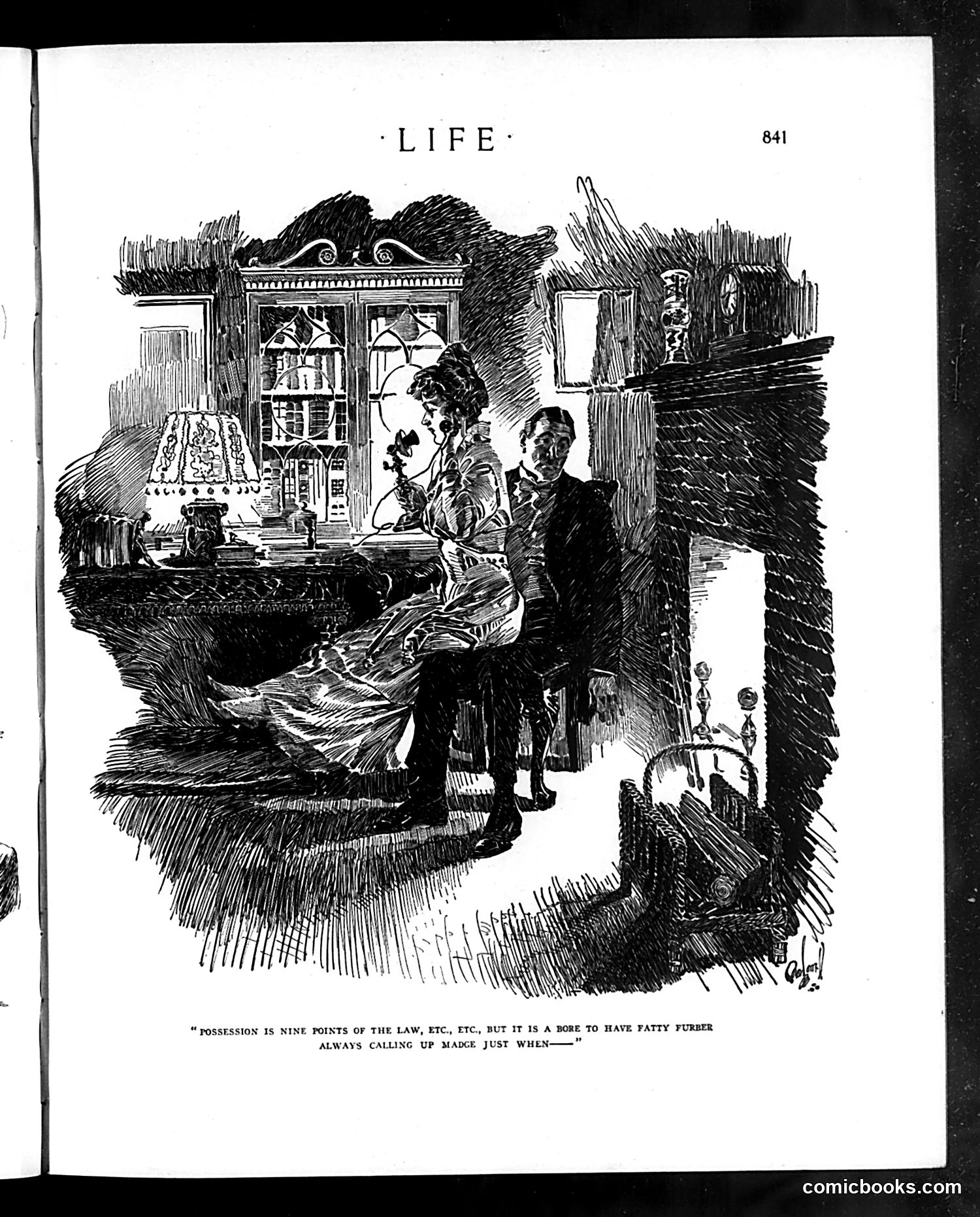
This is a satirical cartoon from *Life* magazine (page 841) depicting a domestic scene where a woman reclines on a couch while a man stands nearby. The caption reads: "POSSESSION IS NINE POINTS OF THE LAW, ETC., ETC., BUT IT IS A BORE TO HAVE PATTY FURBER ALWAYS CALLING UP MARGE JUST WHEN—" The joke satirizes the legal principle that possession is "nine points of the law" by applying it absurdly to personal relationships. The humor turns on a woman (apparently "Patty Furber") constantly interrupting her friend "Marge" at inconvenient moments—likely when Marge is with her romantic interest. The cartoon mocks how the legal concept of possession proves meaningless in social situations, where someone's claim on another person's time can be frustratingly asserted through persistent phone calls.
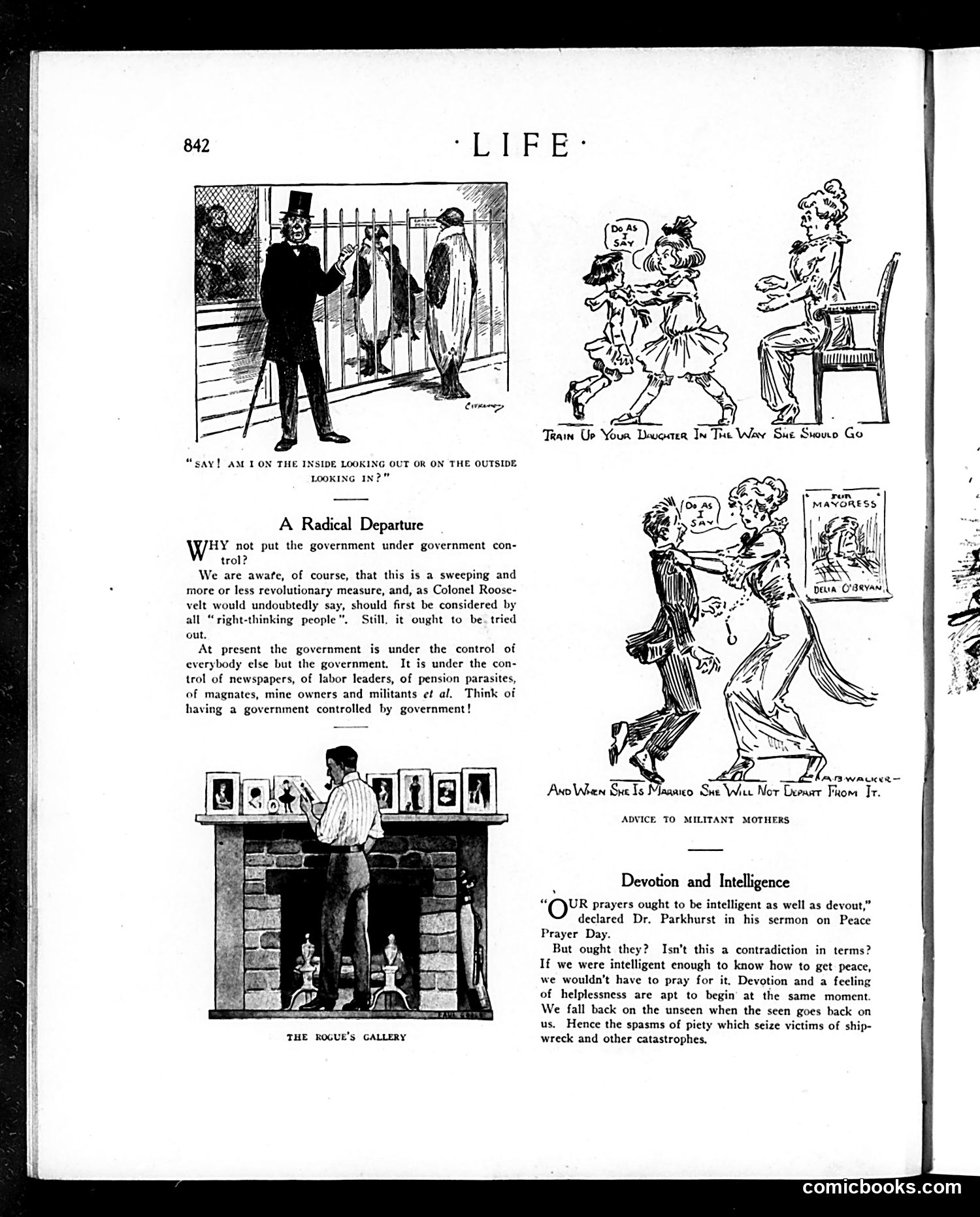
**"A Radical Departure"** article advocates putting government under government control—a satirical proposal the author acknowledges as revolutionary. The piece criticizes current governmental influence by newspapers, labor leaders, pension recipients, and military interests. **"The Rogue's Gallery"** illustration depicts a man examining portraits on a mantelpiece, apparently representing different types of people controlling government. The right-side cartoons offer social commentary: one depicts children being trained in proper deportment, another shows a woman escaping from what appears to be a "masquerade" (likely representing social pretense). **"Devotion and Intelligence"** discusses Dr. Parkhurst's sermon on Peace Day, questioning whether intelligent prayer contradicts devotion, and critiques relying on prayer rather than practical prevention of catastrophes. The page blends political satire with social commentary on early 20th-century American concerns.
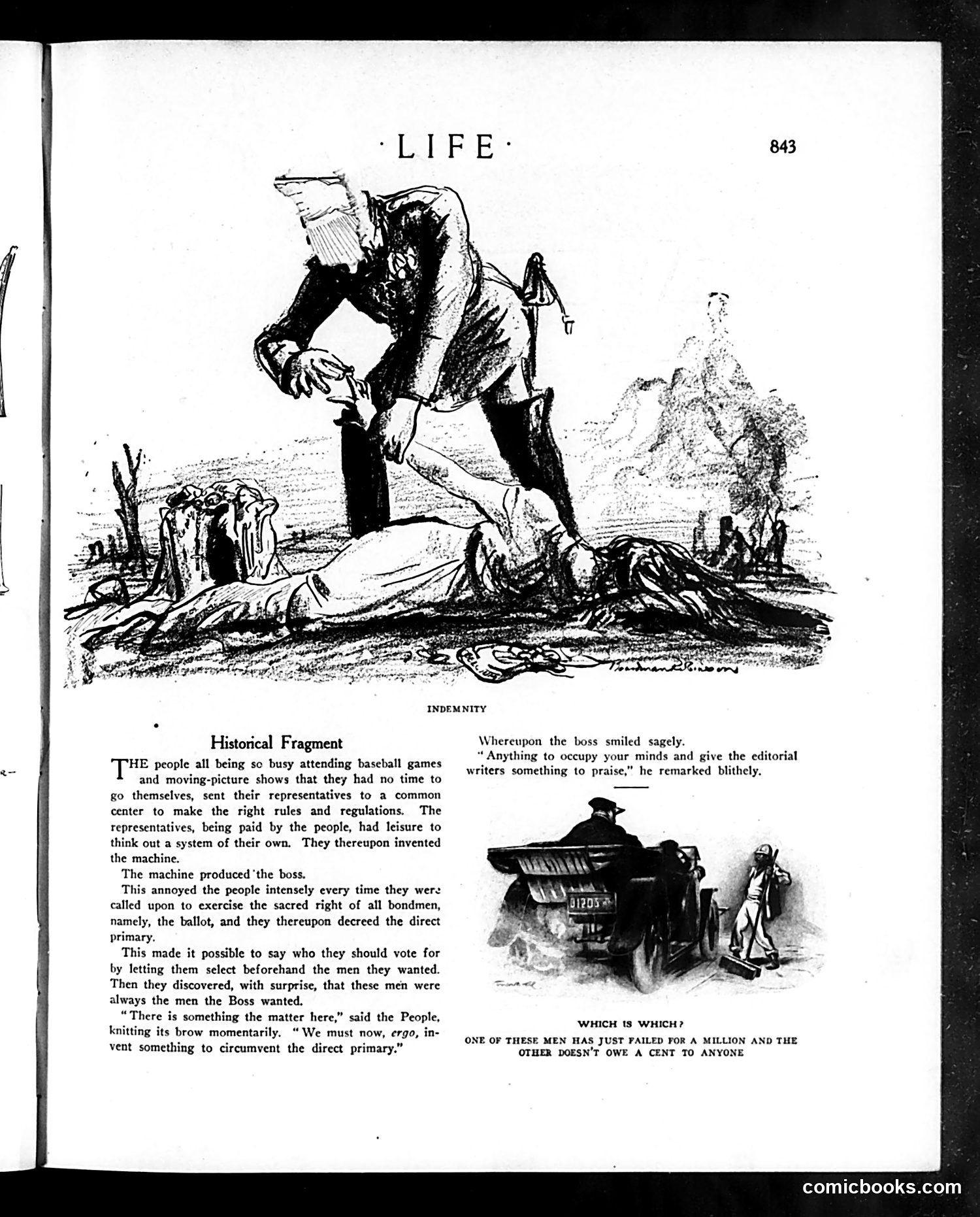
**Top Cartoon ("Indemnity"):** A military or political authority figure stands over a fallen person, holding a sword. This illustrates the concept of "indemnity"—compensation demanded after conflict or wrongdoing. The imagery suggests military victory or political dominance being used to extract payment from a weaker party. **Bottom Cartoon ("Which Is Which?"):** Shows two men near a vehicle labeled "JIGGS" (likely referencing the comic strip character Jiggs). The caption notes one man "has just failed for a million and the other doesn't owe a cent to anyone." This satirizes wealth and financial status—questioning whether visible success distinguishes those who are genuinely solvent from those who appear successful but are bankrupt. Both cartoons mock power dynamics and appearances versus reality in American society.
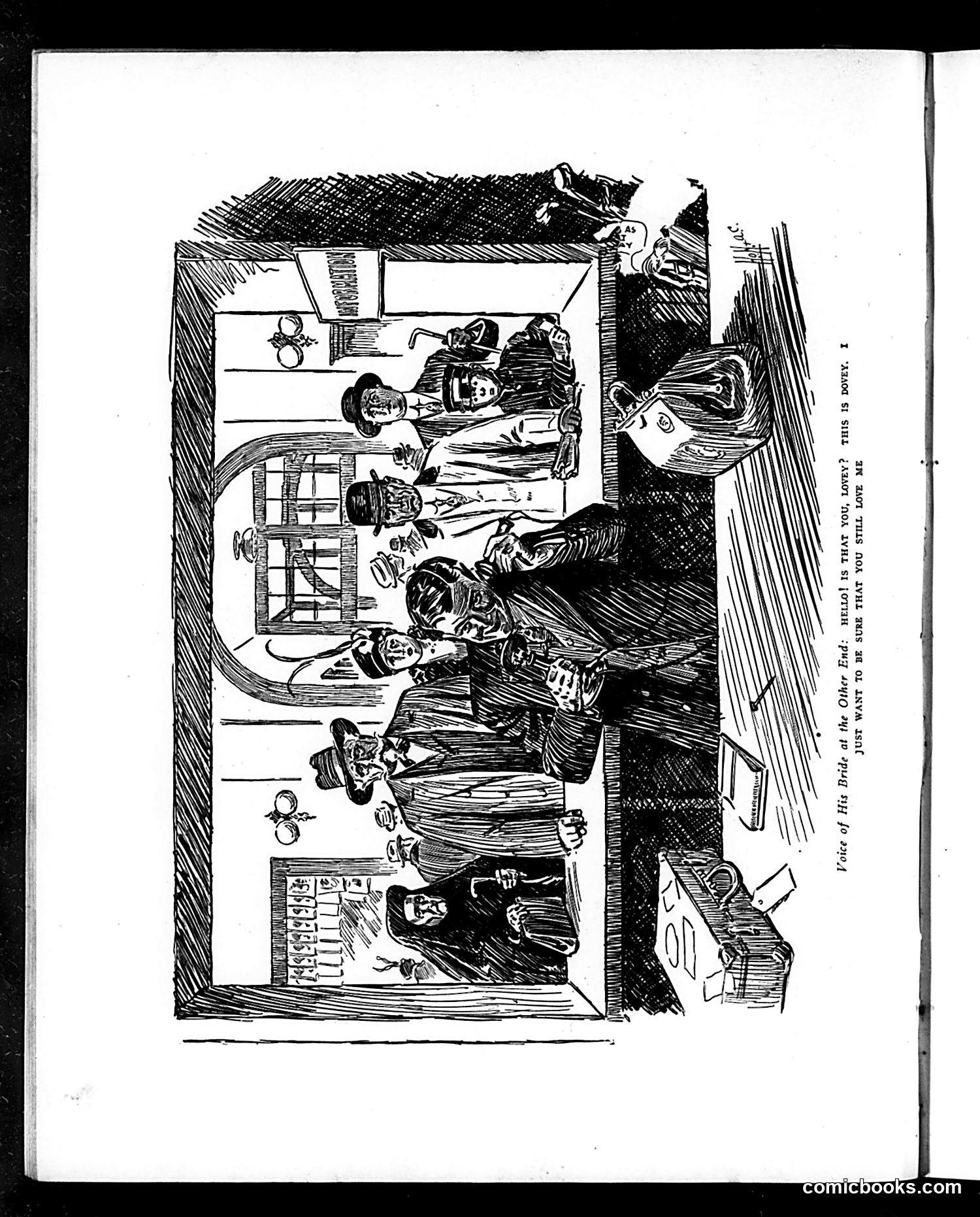
This is a satirical illustration showing an interior domestic scene, likely depicting a middle or upper-class household. The image appears rotated 90 degrees and shows multiple figures in period dress engaged in various activities within a home setting. The caption references "Prior of the Irish...want to be the Irish Lord" — suggesting this satirizes Irish political or social aspirations, possibly mocking pretensions to aristocratic status or power. The specific figures and their identities are unclear from the image quality and rotation. The satirical point appears to target Irish social climbing or political ambitions of the era, though without clearer text or context, the precise political reference remains uncertain. This would require additional publication date and authorial information to fully contextualize.
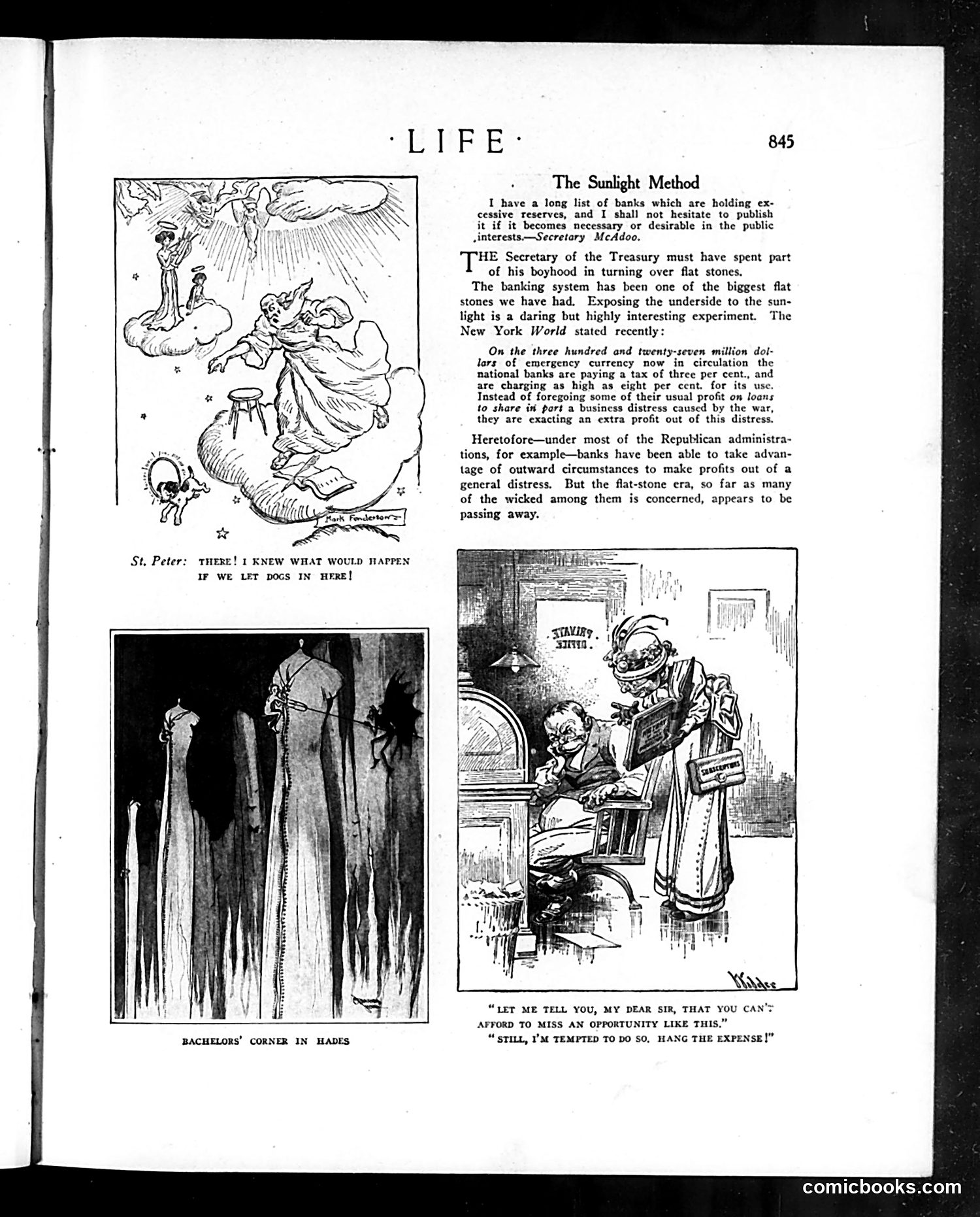
This page critiques banking practices during an economic crisis. The article "The Sunlight Method" discusses how banks are exploiting wartime distress by charging high interest rates (up to 8%) while claiming patriotic necessity. The Secretary of the Treasury is mentioned as having oversight of this system. The cartoons illustrate the hypocrisy: - "Bachelors' Corner in Hades" shows damned souls, satirizing those profiting from others' misery - The second cartoon depicts a clergy member (identifiable by vestments) tempting a businessman with financial opportunity while urging him to "hang the expense"—mocking religious hypocrisy in endorsing war profiteering The satire targets financial institutions and moral authorities exploiting national emergency for personal gain.
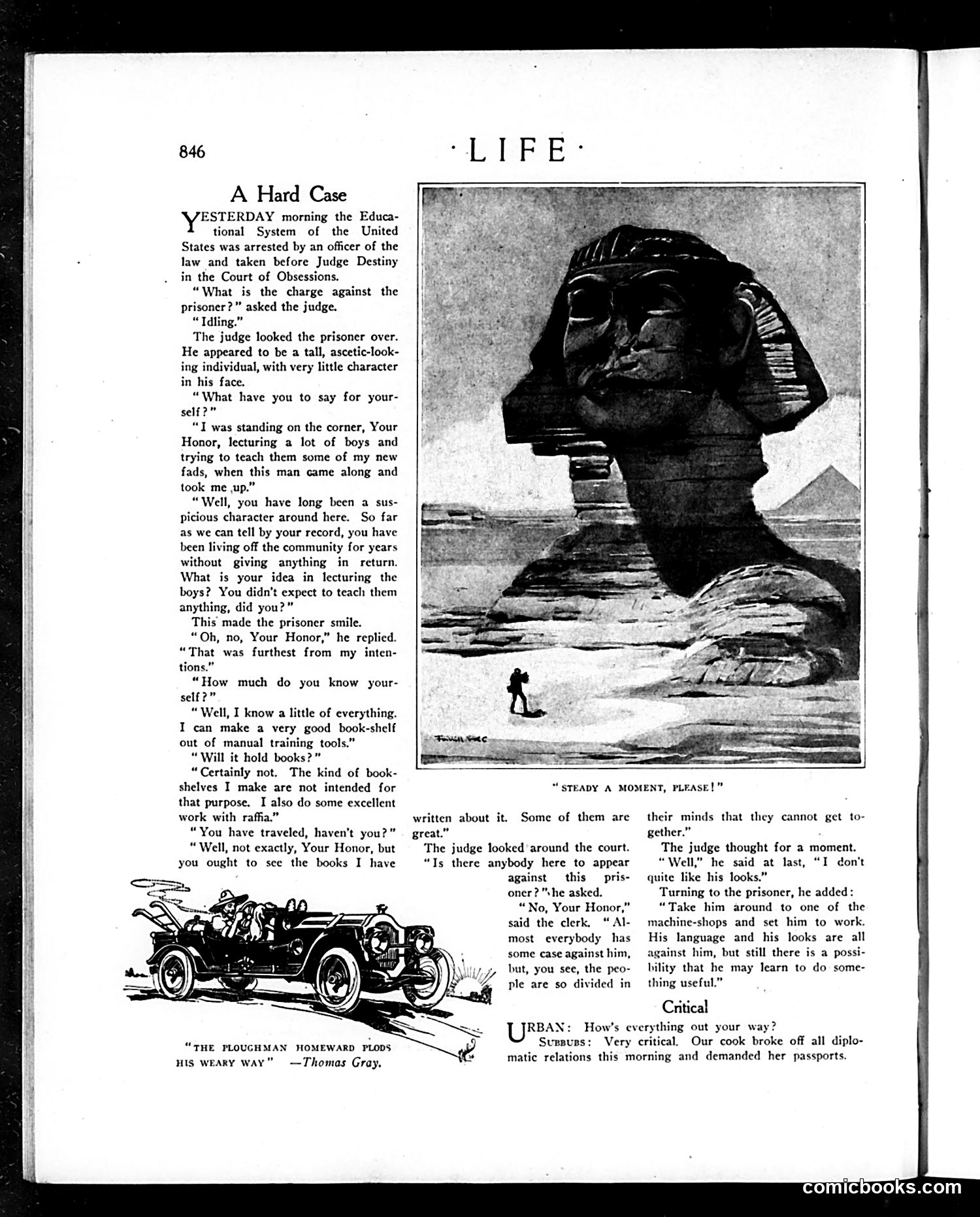
This page contains a satirical courtroom story about a man arrested for "telling" (spreading propaganda). The judge questions the prisoner's character and his plan to lecture boys about "new facts." The prisoner claims he makes "book-shelves" and can "make a very good book-shelf out of manual training tools." The satire targets **educational reformers or progressive educators** whose methods the judge views suspiciously. The story suggests the man lacks credentials ("How much do you know yourself?") yet presumes to teach youth. The accompanying car illustration ("The Ploughman Homeward Plods His Weary Way") is unrelated visual humor. The page also includes a brief "Critical" section about domestic discord. The overall point mocks educational experimentation and self-proclaimed teachers lacking traditional authority.
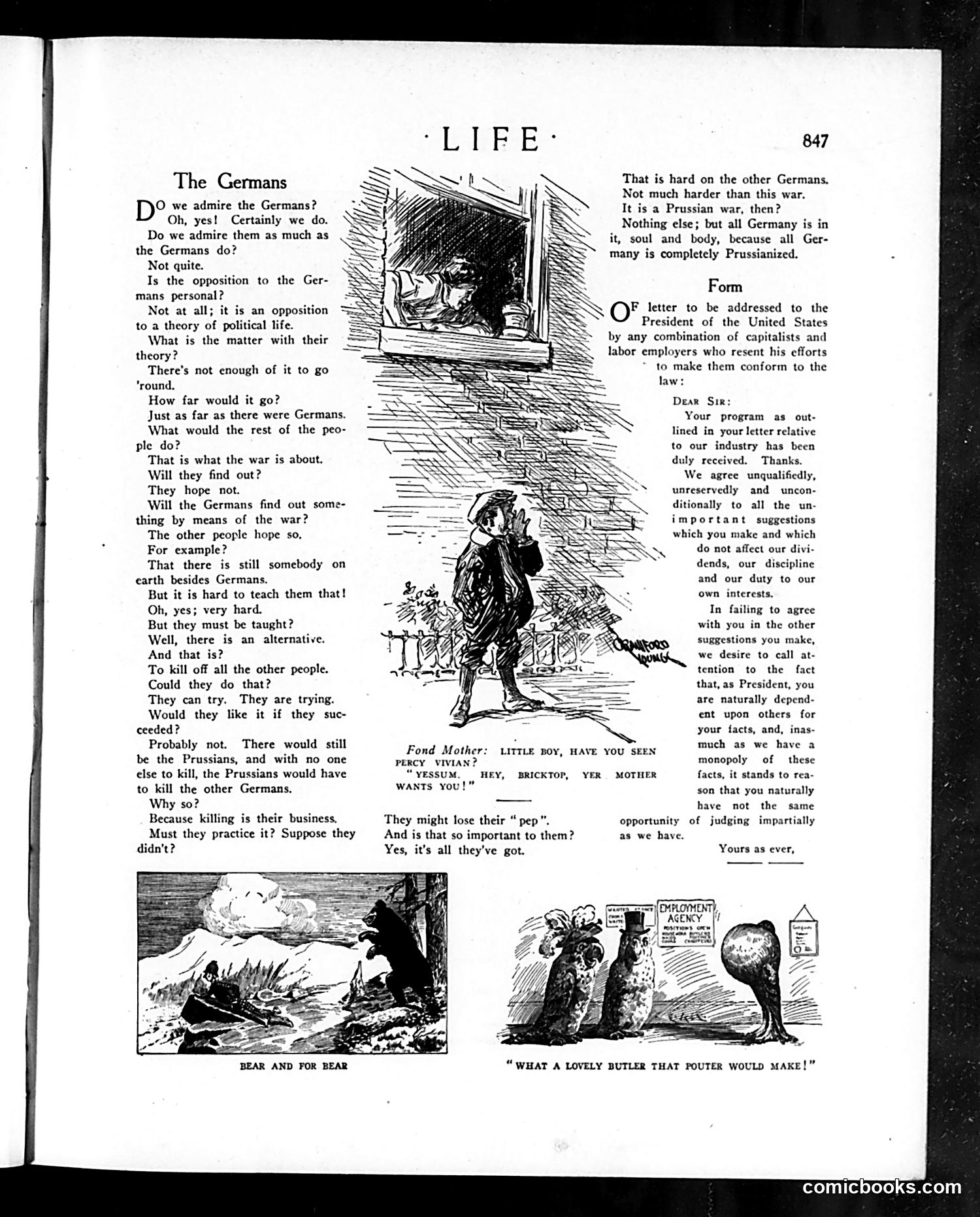
This wartime satirical page critiques German militarism and Prussian culture through dialogue and cartoons. **"The Germans" dialogue**: Uses Q&A format to argue that Germany's political theory aims at dominating all other peoples—that the war exists because Germany wants territorial/ideological supremacy. The piece claims killing is central to Prussian culture, suggesting Germans would even turn on each other without external enemies. It's anti-German propaganda framed as philosophical critique. **The form letter**: Mocks American business leaders who claim to support the President's policies while actually resisting regulation. The letter sarcastically agrees with "unimportant suggestions" while protecting profits and discipline—satirizing corporate resistance to wartime labor/industry controls. **The cartoons**: "Bear and For Bear" and "What a Lovely Butler That Pouter Would Make!" appear to use animal/servant imagery, likely continuing themes of German aggression and American industrial arrogance. The page reflects WWI-era American attitudes: German militarism as inherently expansionist and dangerous, and domestic corporate resistance to government oversight.
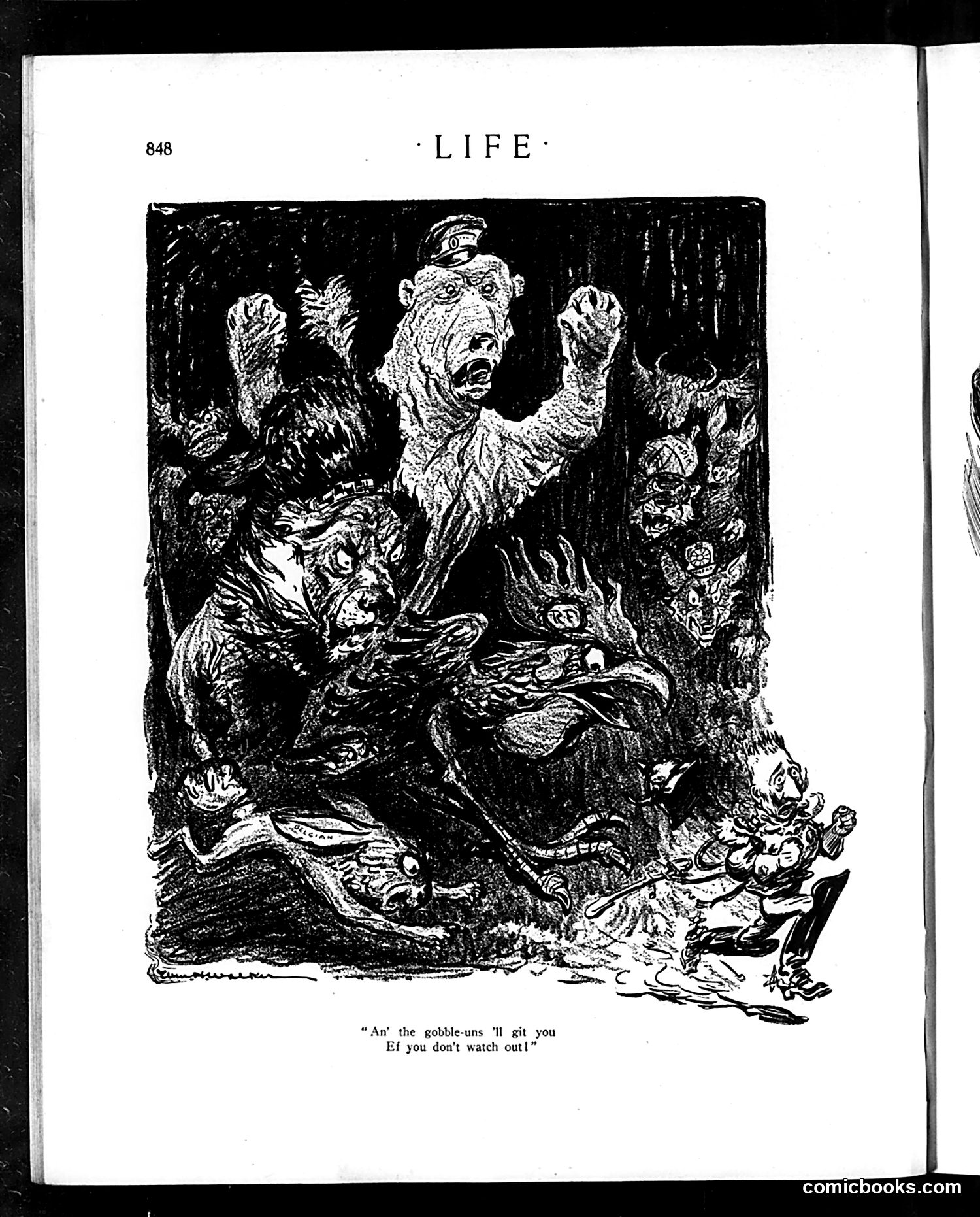
This illustration references James Whitcomb Riley's famous 1888 children's poem "Little Orphant Annie," which warns misbehaving children that "the gobble-uns'll git you / Ef you don't watch out!" The cartoon adapts this well-known phrase as political satire. A menacing figure with goblin-like features threatens what appears to be military or political figures. The grotesque creatures surrounding the scene suggest corruption or malevolent forces. Without additional context on the specific issue number, the exact political targets remain unclear, but the cartoon likely warns contemporary readers (likely from the early-to-mid 20th century) about some political danger—using the familiar nursery rhyme as a vehicle for satirizing specific threats to society or government. The ominous tone suggests serious political commentary disguised in popular cultural reference.
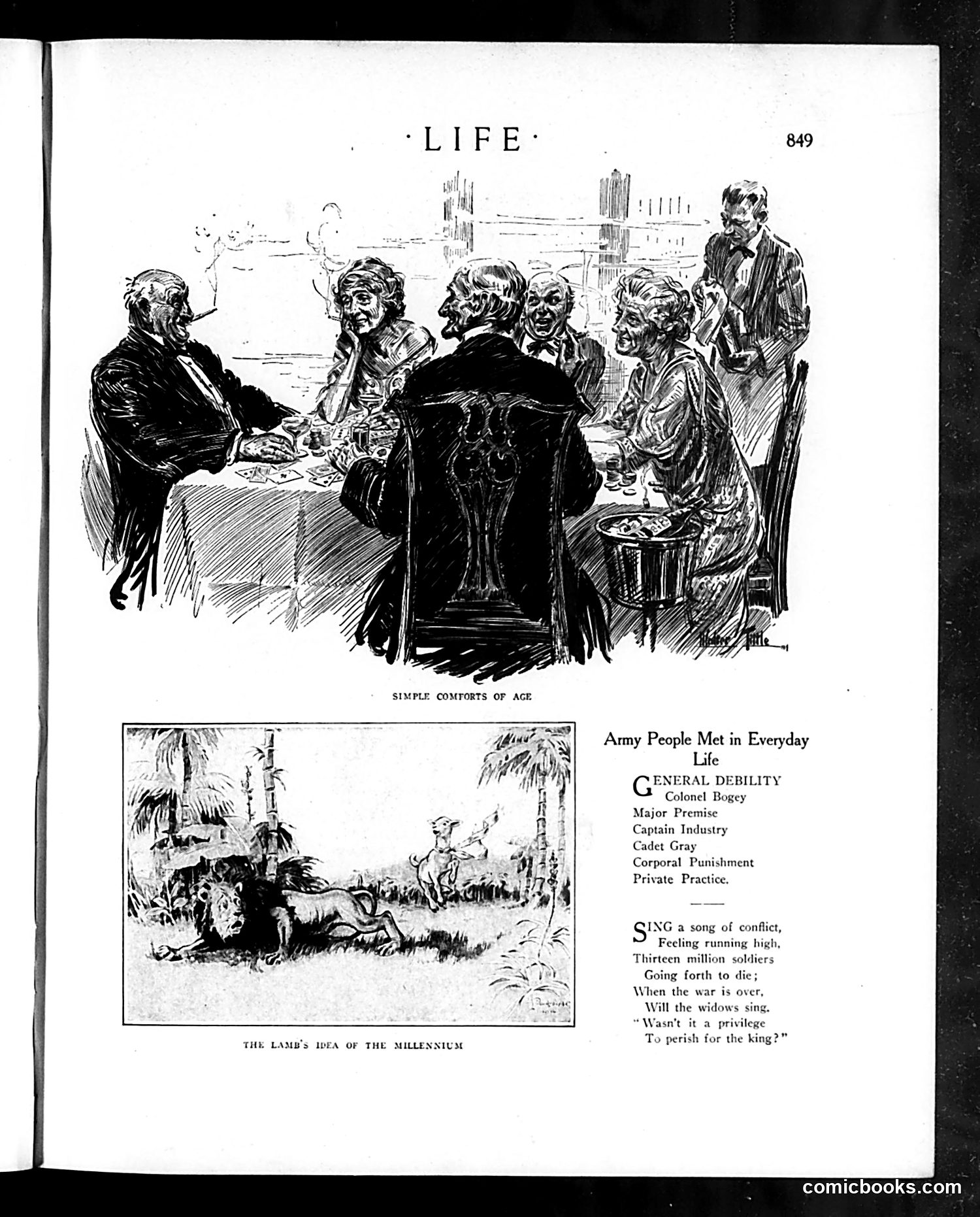
This page from *Life* magazine (appears to be WWI-era, based on "thirteen million soldiers") contains two satirical cartoons critiquing militarism and war. **Top cartoon ("Simple Comforts of Age"):** Depicts elderly men dining together, labeled with military ranks and afflictions—"Colonel Bogey," "Major Premise," "Captain Industry"—treating war-related hardships as casual dinner conversation among the comfortable classes who don't fight. **Bottom cartoon ("The Lamb's Idea of the Millennium"):** Shows pastoral peace, contrasting sharply with the poem's dark sarcasm. The verse mocks nationalist propaganda by asking whether widows will truly celebrate their husbands' deaths "for the king"—exposing the disconnect between patriotic rhetoric and actual human suffering. Together, these works satirize how those in power (the elderly, the wealthy) profit from or philosophize about war while working-class soldiers die, and how jingoistic language masks the tragedy of mass casualties.
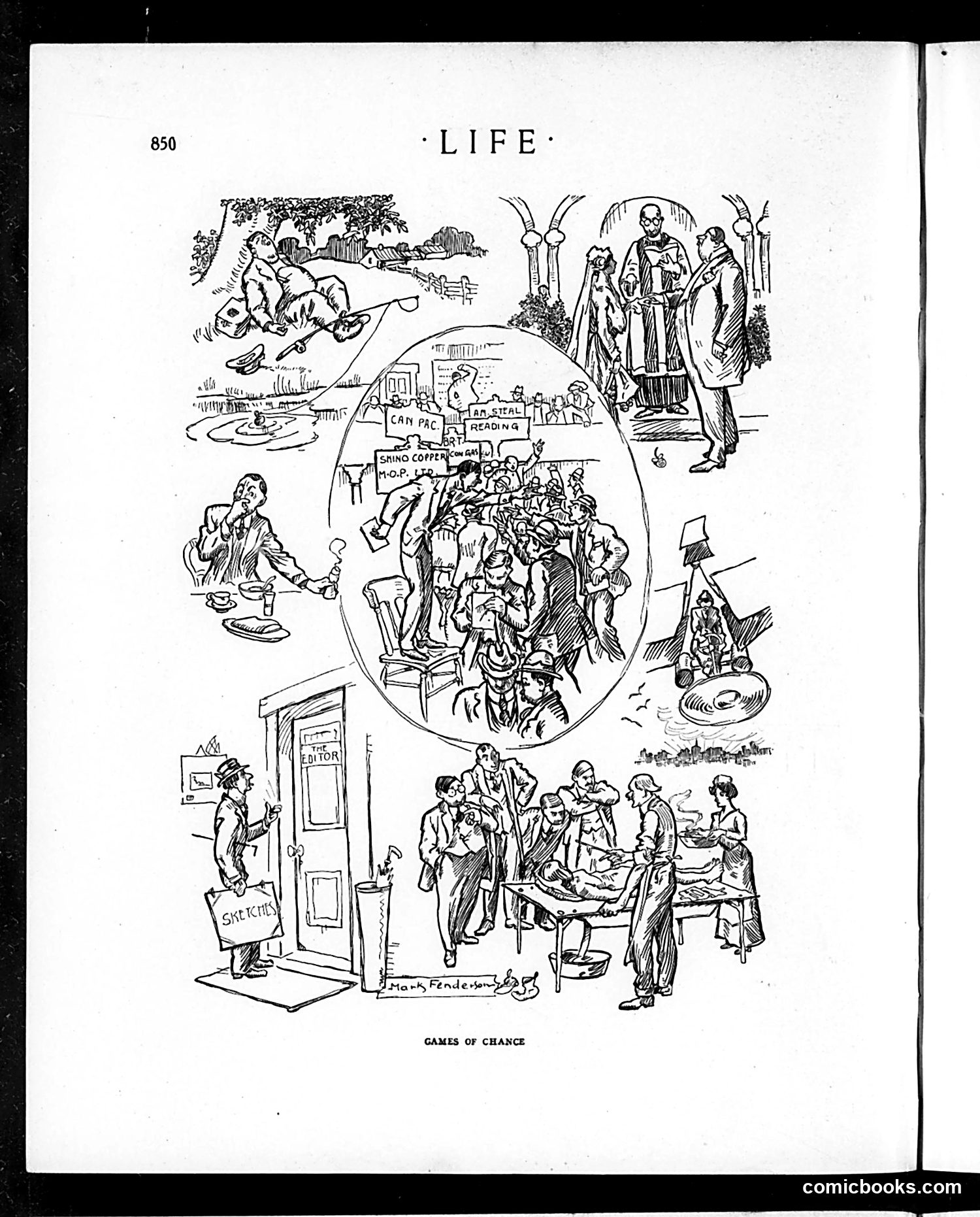
This satirical illustration from Life magazine depicts various aspects of American society as literal "games of chance." The central oval contains crowded indoor scenes labeled with references to gambling, drinking (visible signs for "CHINO COFFEE"), and reading—suggesting everyday activities as risky ventures. Surrounding vignettes show: - Fishing and leisure activities (upper left) - What appears to be death or fate figures (upper right) - A figure at a door marked "EDITOR" (left)—likely satirizing the uncertainty of publishing The overall message critiques how ordinary life decisions—work, entertainment, romance, career—are fundamentally uncertain gambles. By framing daily activities within the metaphor of gambling, the cartoonist suggests Americans navigate existence through luck rather than control, a commentary on economic and social unpredictability of the era.
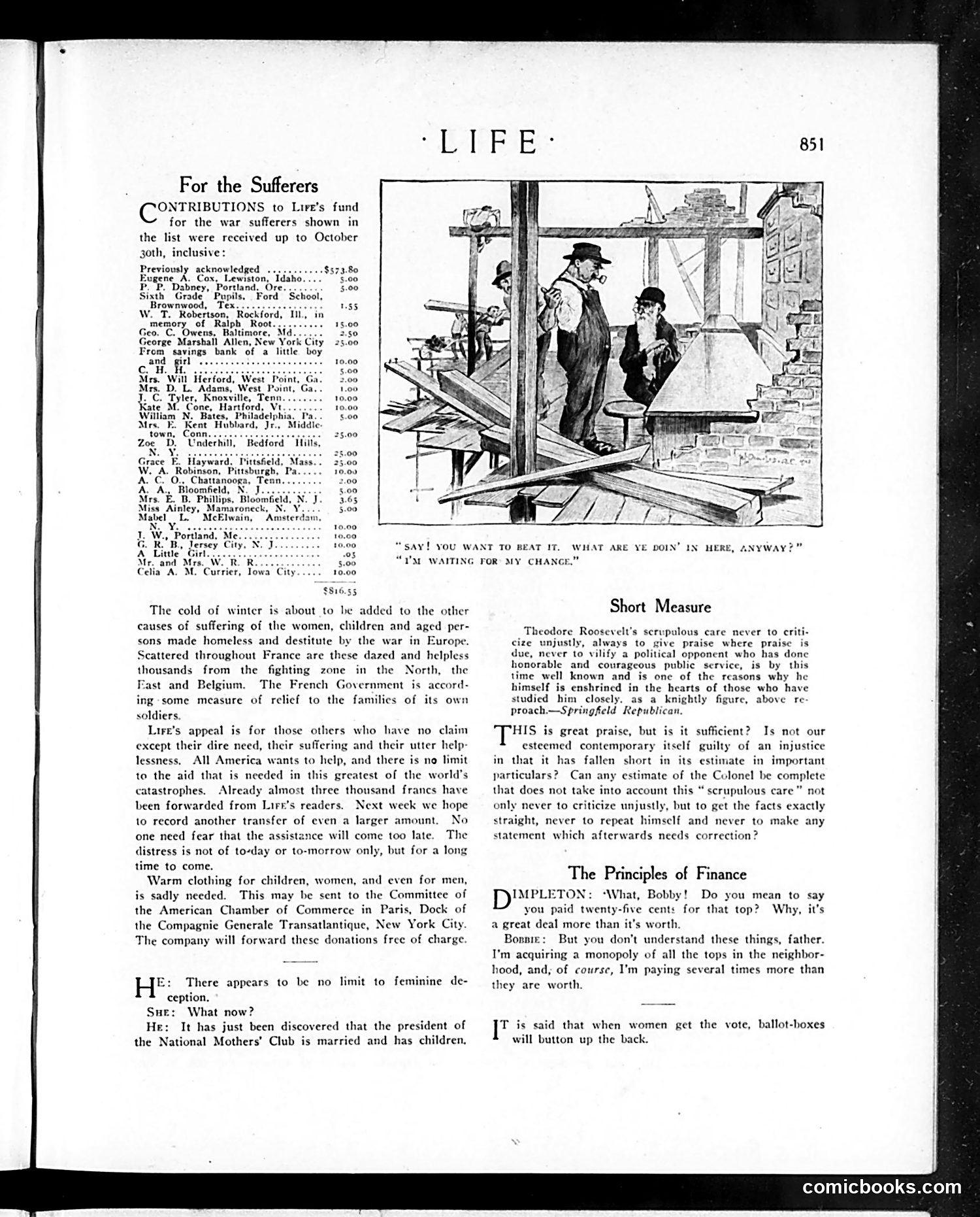
This page contains three distinct satirical pieces: **Main Cartoon**: Shows working-class men in what appears to be a shop or establishment. The caption "Say! you want to beat it. What are ye doin' in here, anyway?" / "I'm waiting for my change" satirizes short-changing or fraud—likely depicting a merchant or bartender who shortchanges customers, with the victim waiting fruitlessly for their proper change. **"Feminine Deception" Joke**: A brief satirical quip mocking women's hypocrisy. The National Mothers' Club president is revealed to be married with children—apparently suggesting the irony or contradiction in her public role. **"Short Measure" Editorial**: Praises Theodore Roosevelt's scrupulous integrity, then sardonically suggests the Springfield Republican's own praise falls "short"—it omits Roosevelt's tendency to repeat himself and make statements requiring later correction. It's self-aware satire about incomplete praise. The page also lists charitable donations for war refugees in Europe (likely WWI), requesting warm clothing contributions through the American Chamber of Commerce in Paris.
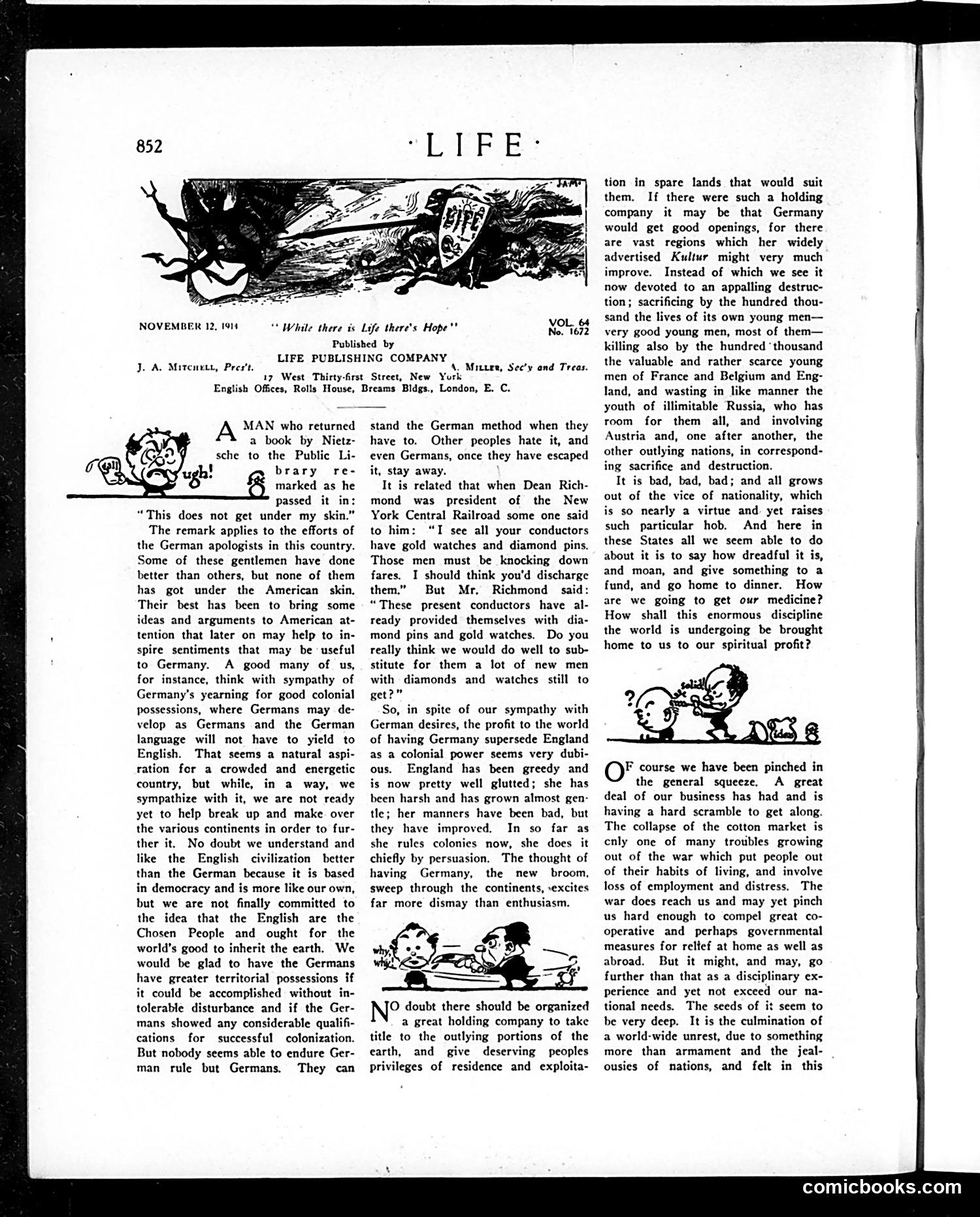
This editorial argues against German imperial ambitions while acknowledging sympathy for Germany's desire for colonial territories. Published early in World War I, it uses a Nietzsche library book anecdote to mock German propaganda efforts in America as ineffective ("doesn't get under my skin"). The piece concedes that Germany's yearning for colonies is understandable, but contends Germans lack the qualifications to rule effectively. The author cites a railroad anecdote suggesting established colonial powers (like England), though flawed and greedy, have become gentler through experience. Germany as a "new broom" would sweep destructively through continents. The critique peaks sardonically: rather than debate colonial rights, war is "sacrificing by the hundred thousand" Germany's own young men while killing French, Belgian, and English youth—a waste of valuable human resources that undermines any colonial project's rationale.
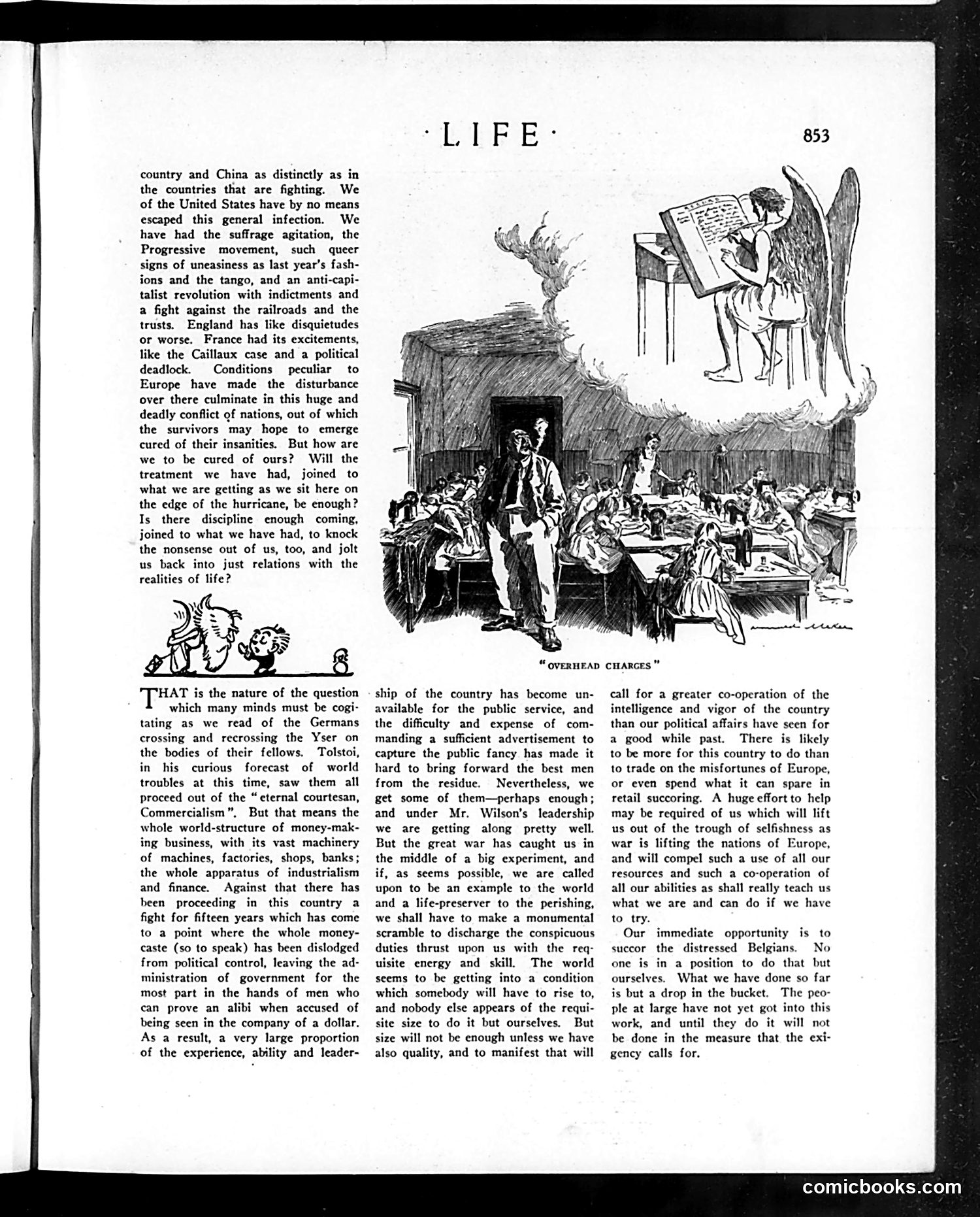
This page critiques American society during World War I (text references the war's ongoing devastation). The cartoon titled "Overhead Charges" depicts a crowded, chaotic scene—likely representing government bureaucracy or business inefficiency, with an angel figure overhead observing the mess below. The accompanying text argues that America has undergone progressive reforms (suffrage, trust-busting) that removed experienced businessmen from public service due to anti-capitalist sentiment. The author contends this "dislodging" of the "money-caste" from political control has left the nation under-equipped in talent and expertise, precisely when World War I demands maximum national capacity and cooperation. The satire's point: America's internal political battles have eliminated valuable leadership just when the country might need to aid Europe and demonstrate moral authority. The cartoon visualizes this ironic cost—the "overhead charges" of ideological reform.
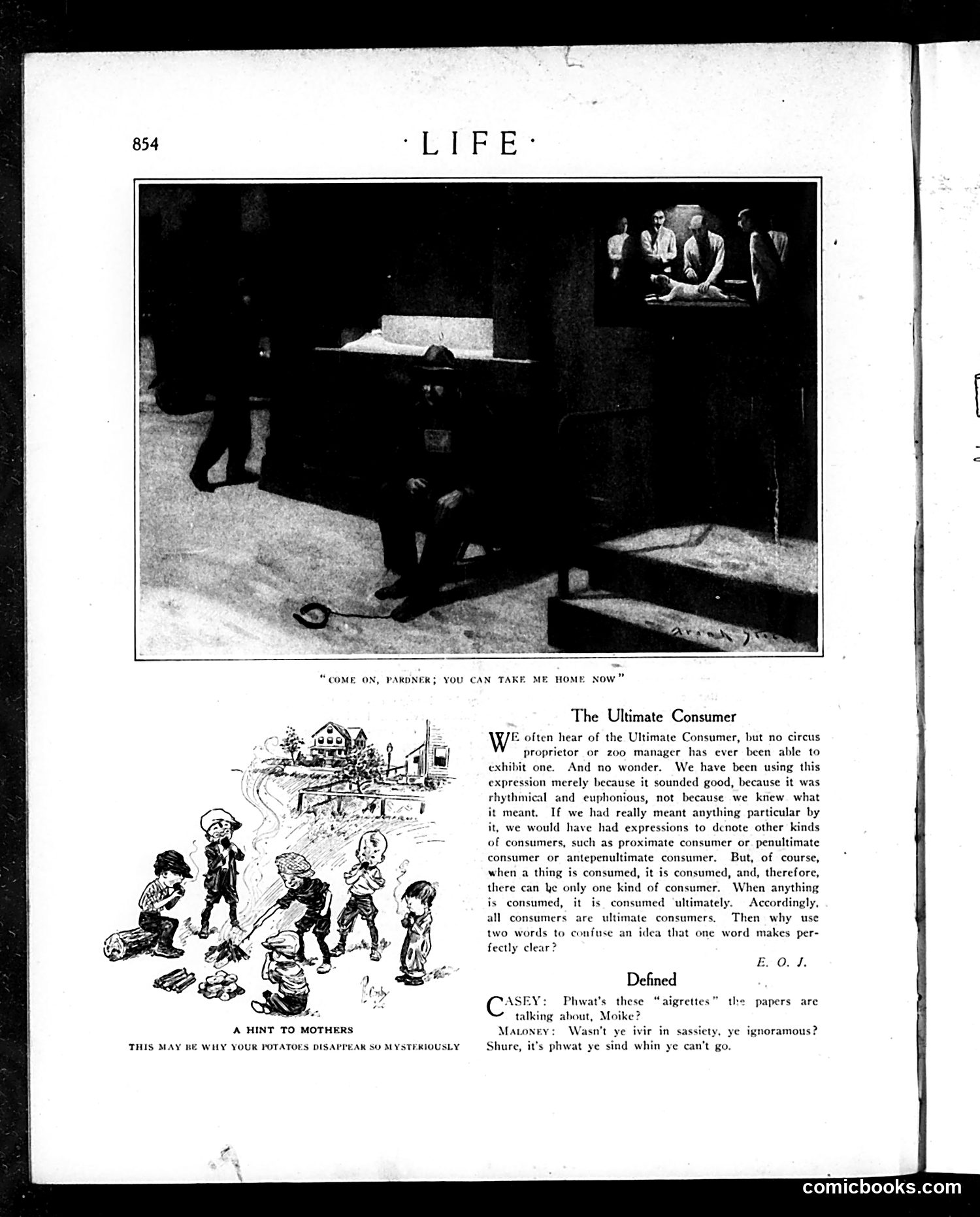
**Top Image:** A darkly lit scene showing what appears to be a coffin or casket with mourners gathered around it—likely depicting a funeral or wake. The caption "Come on, pardner; you can take me home now" suggests morbid humor about death. **Middle Section ("A Hint to Mothers"):** A cartoon illustration showing children playing with potatoes as toys, implying this explains why potatoes mysteriously disappear from households—children are consuming them during play rather than meals. **"The Ultimate Consumer" Essay:** Satirical commentary on vague business jargon. The author (E.O.J.) ridicules the term "ultimate consumer" as pretentious and meaningless. The point: anything consumed is consumed "ultimately" by definition, so using both words is redundant and confuses rather than clarifies. **"Defined" Dialogue:** Two working-class Irish characters (Casey and Maloney, suggested by dialect spelling) discuss "aigrettes" (feathered hat ornaments). Maloney defines it crudely as what you produce when you can't leave—a crude bodily function joke playing on class and accent stereotypes.
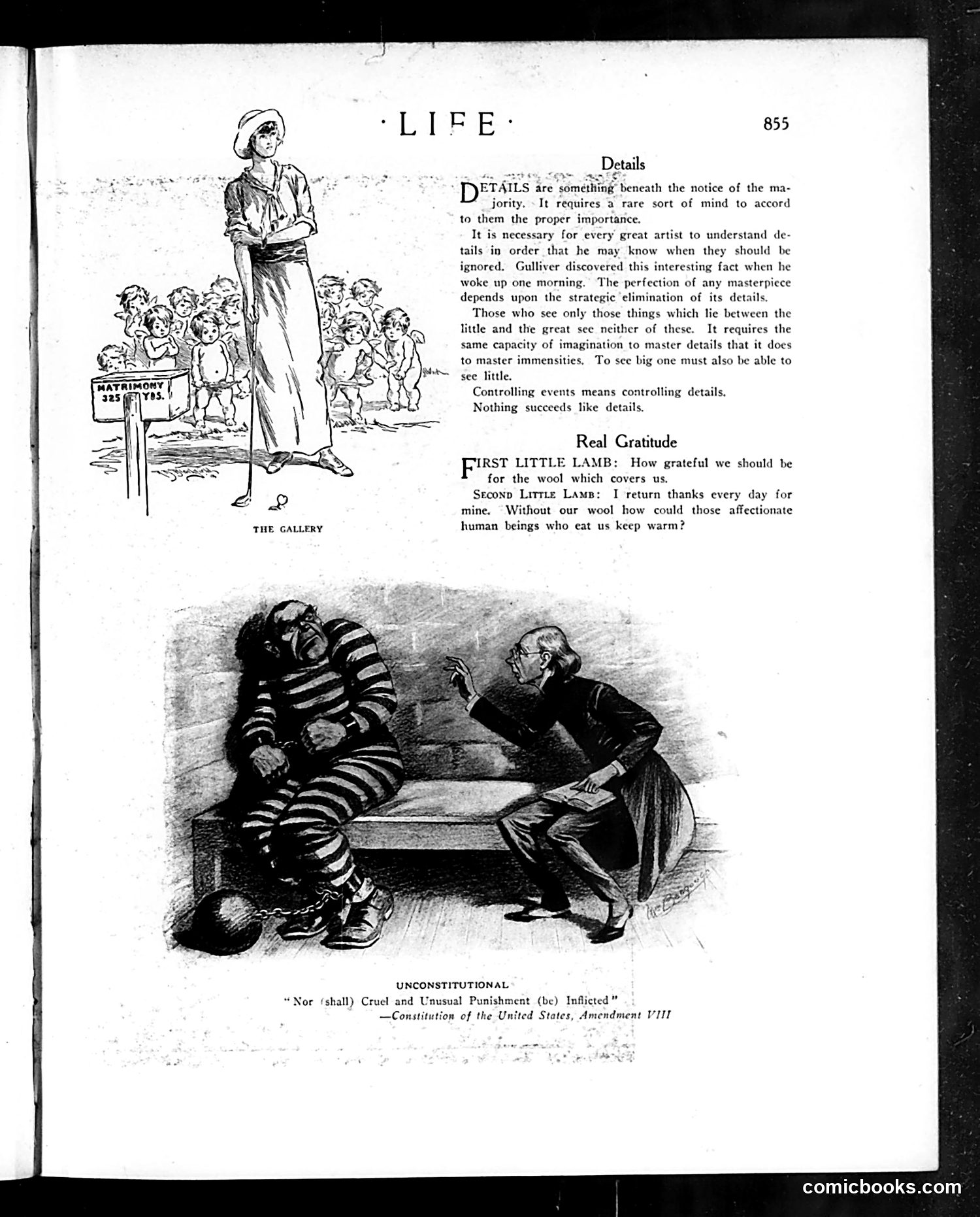
**"The Gallery"** (top): A woman shepherds children, likely representing a teacher or caregiver guiding young minds—illustrating the essay's theme about appreciating details and perspective. **"Real Gratitude"** (middle): Two lambs discuss their wool with naive gratitude, unaware they're destined for slaughter. The dark humor satirizes false consciousness—the lambs thank humans for keeping them warm while those same humans will eat them. It's social satire about people failing to recognize their own exploitation. **"Unconstitutional"** (bottom): A figure in striped prison garb appears tortured or abused by a jailer, with a caption quoting the Eighth Amendment prohibition on cruel punishment. This appears to critique actual cruel prison conditions despite constitutional protections—suggesting the law is ignored in practice. The page mixes philosophical commentary on artistic "details" with biting social satire about hypocrisy, exploitation, and institutional cruelty.
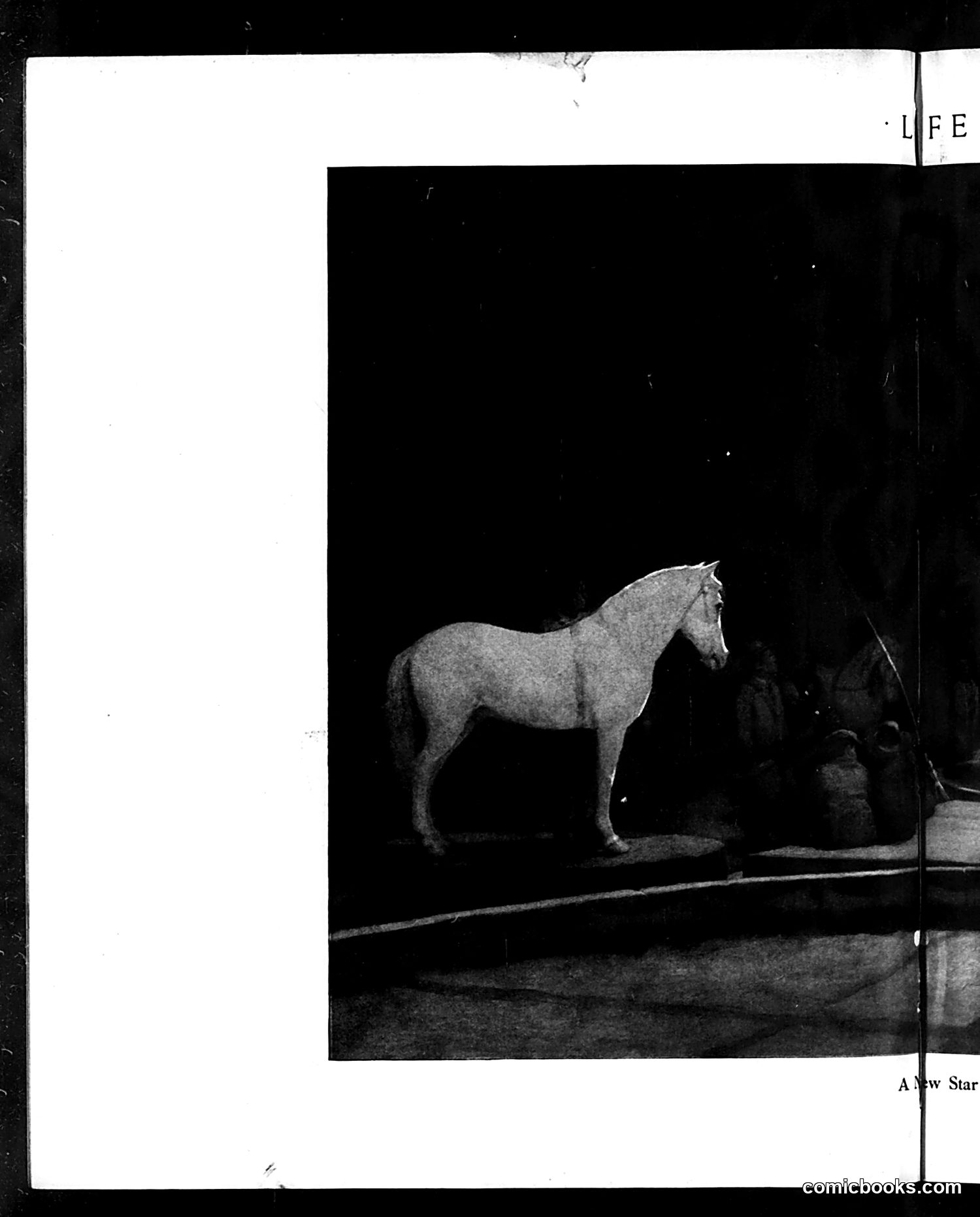
This page features a black and white photograph of a horse standing in profile against a dark background, with a handler visible beside it. The caption reads "A New Star." The image appears to be from Life magazine's satirical section. Without additional context visible on this page, the specific satire is unclear—it could be mocking: - A new political figure compared unfavorably to a horse - A celebrity or public personality being promoted - A business or sports venture The humor likely relies on calling someone or something a "star" while showing only an actual horse, suggesting the subject is no better than an animal, or that their fame is undeserved. However, without identifying the specific person or event referenced, the exact target of the satire cannot be definitively stated.
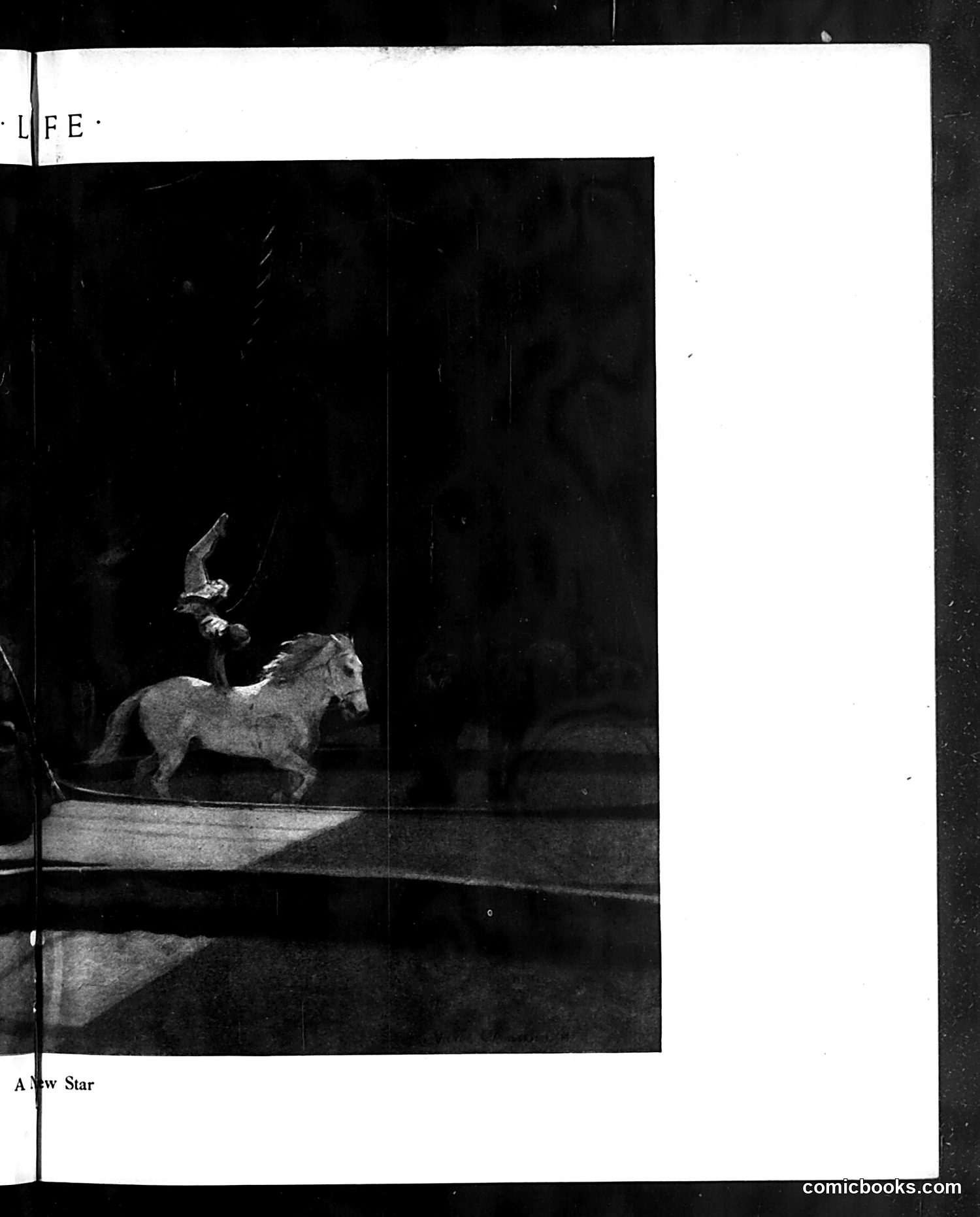
This Life magazine page shows a dramatic circus or performance scene titled "A New Star." The image depicts a horse and rider in what appears to be a circus ring, photographed in stark black and white with dramatic lighting against a dark background. The rider's pose suggests athletic skill or acrobatic performance. Without additional context or visible text explaining the satirical point, the exact political or social commentary is unclear. The title "A New Star" suggests this may be celebrating or ironically commenting on an emerging performer or public figure, but the specific identity and target of satire cannot be determined from the image alone. The theatrical setting and dramatic photography style are characteristic of Life's visual approach to satirical commentary.
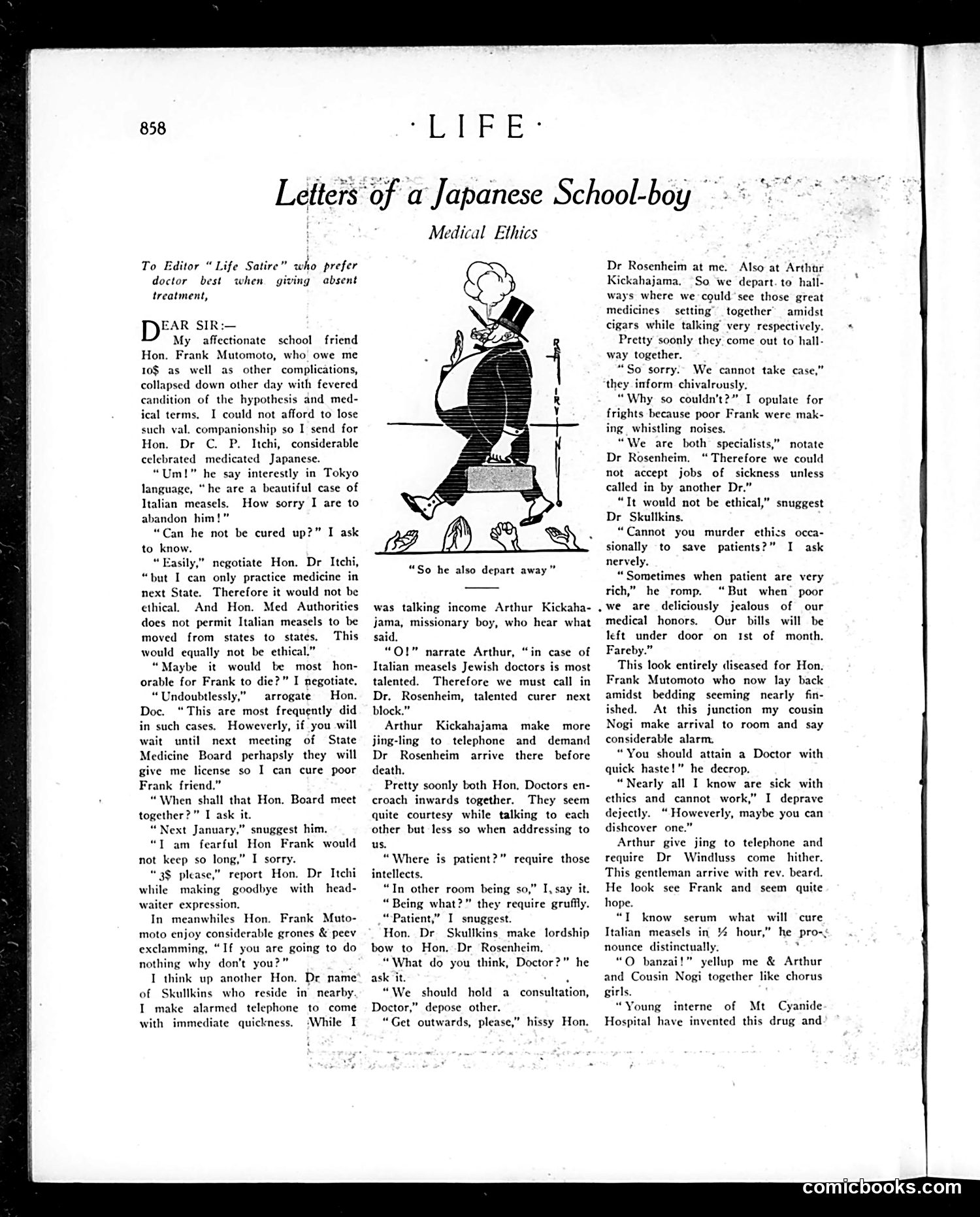
This satirical letter mocks early-20th-century medical professional ethics and licensing restrictions. The narrator's Japanese schoolboy character uses deliberately broken English ("he are," "Um!") to narrate a farcical situation where his friend Frank falls ill with Italian measles. The satire targets licensing laws: Dr. Itchi cannot treat the patient because he's licensed only in another state. When two specialists (Dr. Skullkins and Dr. Rosenheim) finally arrive, they refuse to treat Frank because he wasn't referred by another doctor—calling this "ethical." The cartoon's visual shows a doctor examining a patient with a cane, emphasizing the absurdity. The joke exposes how medical professionals hide behind bureaucratic "ethics" and professional rules to avoid treating poor patients, while actually serving their own financial interests. The broken English of the Japanese character provides comic distance, allowing American readers to laugh at their own system's hypocrisy without directly confronting it.
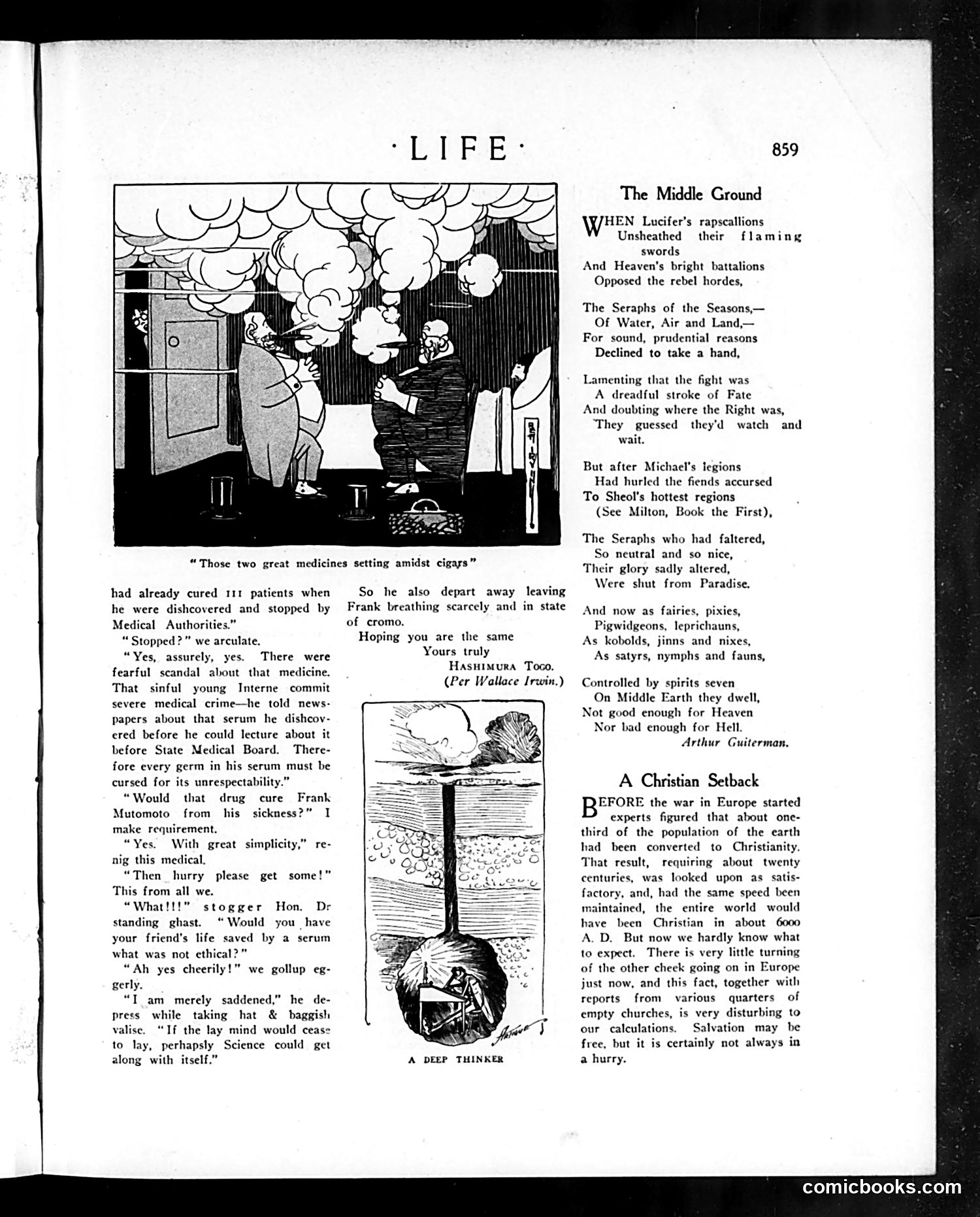
**The Main Cartoon ("Those two great medicines setting amidst cigars"):** This satirizes medical bureaucracy and ethics. A young doctor discovered a serum that cured 111 patients but was stopped by "Medical Authorities" because he publicized his discovery before presenting it to the State Medical Board—violating professional protocol. The cartoon mocks this rigid adherence to procedure over human welfare. A character named Frank (likely a friend) is dying, but the authorities refuse to use the effective serum because it wasn't developed "ethically" through proper channels. The doctor departs sadly, allowing Frank to die, while the authorities prioritize institutional rules over saving lives. **"The Middle Ground" (Poem by Arthur Guiterman):** An allegorical poem about the Seraphs (celestial beings) who remained neutral during the war between Heaven and Hell (referencing Milton's *Paradise Lost*). Their refusal to take sides cost them—they were exiled to Earth as minor supernatural creatures, "not good enough for Heaven nor bad enough for Hell." The satire likely comments on contemporary neutrality during World War I as morally compromising.
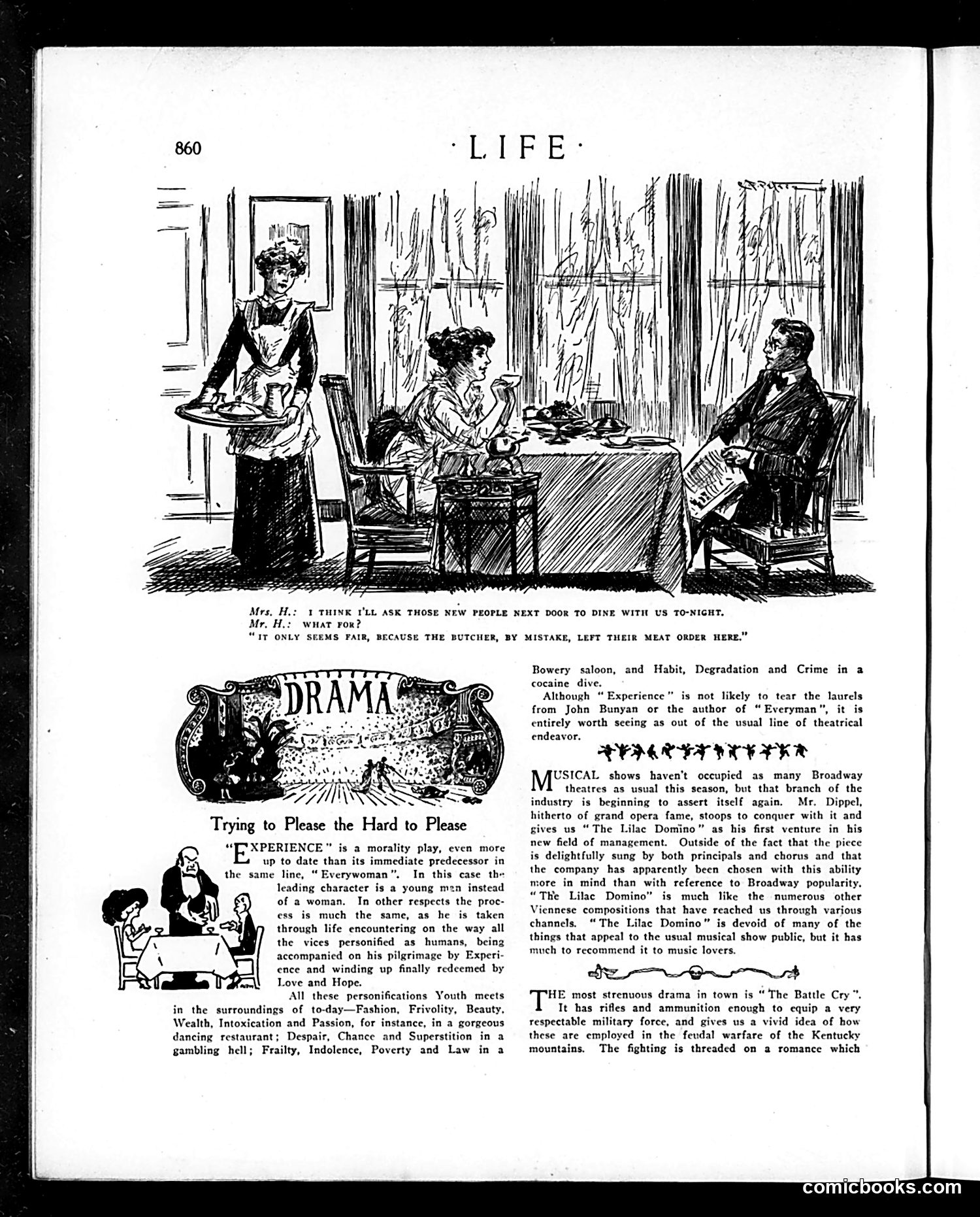
The main cartoon depicts a domestic scene where Mrs. H. proposes inviting new neighbors to dinner. The joke hinges on social obligation mixed with practical advantage: she'll invite them because the butcher mistakenly delivered *their* meat order to the H's house. The satire targets bourgeois social conventions—the facade of neighborly generosity masking self-interest and convenience. Inviting neighbors to consume food meant for them presents as charity while actually solving a minor domestic problem. The page also reviews theatrical productions: a morality play called "Experience" (structured like "Everyman," showing a young man encountering vices personified); a musical called "The Lilac Domino"; and a melodrama "The Battle Cry" set in Kentucky mountain feuds. The reviews are straightforward theatrical criticism rather than satire.
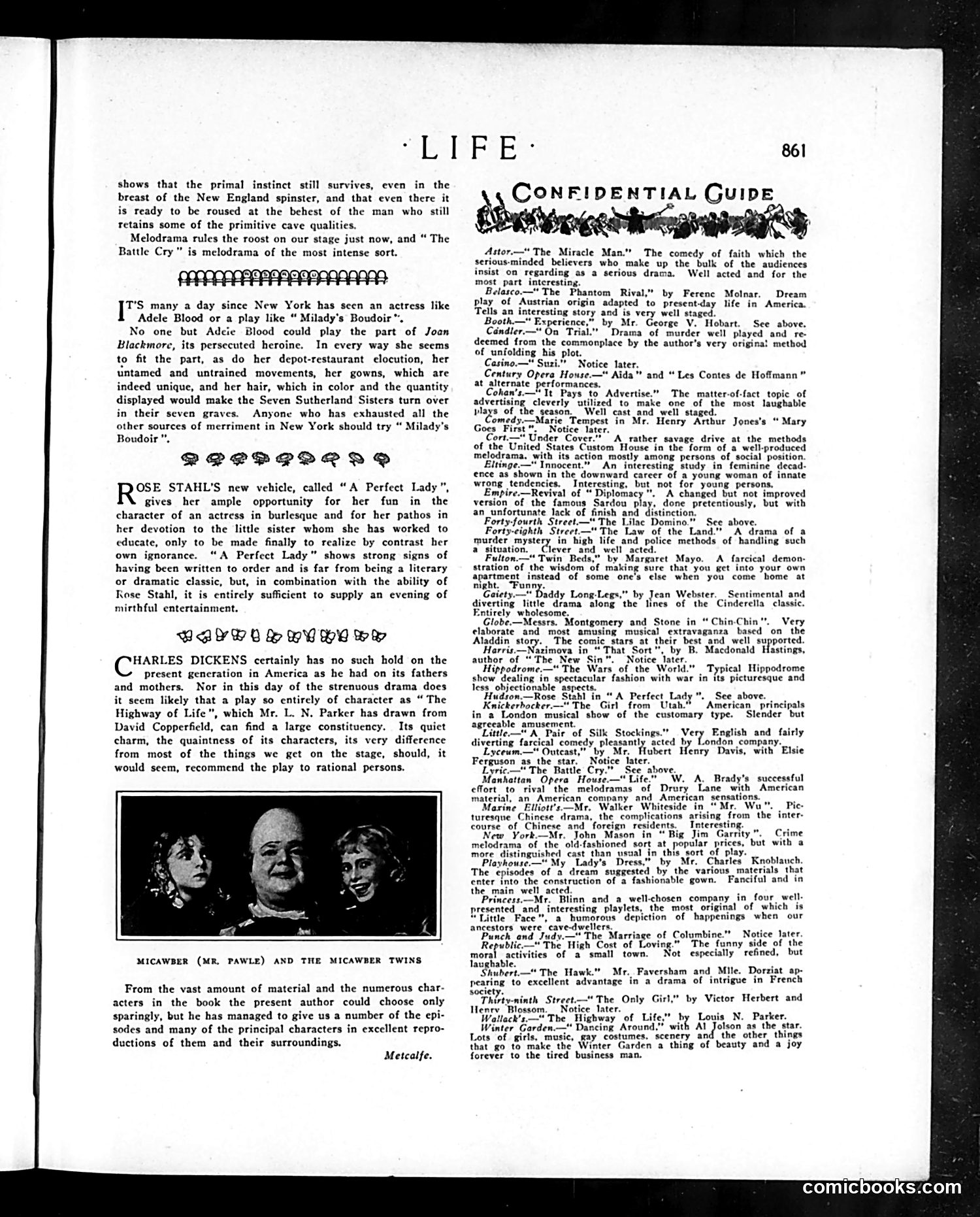
This page from *Life* magazine presents theater criticism and reviews rather than political satire. The visible photograph shows **Micawber (Mr. Pawle) and the Micawber Twins**, characters from a stage adaptation of Charles Dickens's *David Copperfield*. The critic notes that while Dickens holds less appeal to modern American audiences than to previous generations, this particular adaptation by L. N. Parker succeeds through its "quiet charm" and "quaintness of characters"—qualities that should appeal to "rational persons" despite competition from more sensational melodramas dominating contemporary theater. The page includes brief reviews of various Broadway productions, evaluating their merit, casting, and staging. The tone is sophisticated but accessible, treating theater as worthy of serious critical attention while acknowledging popular taste for melodrama and comedy.
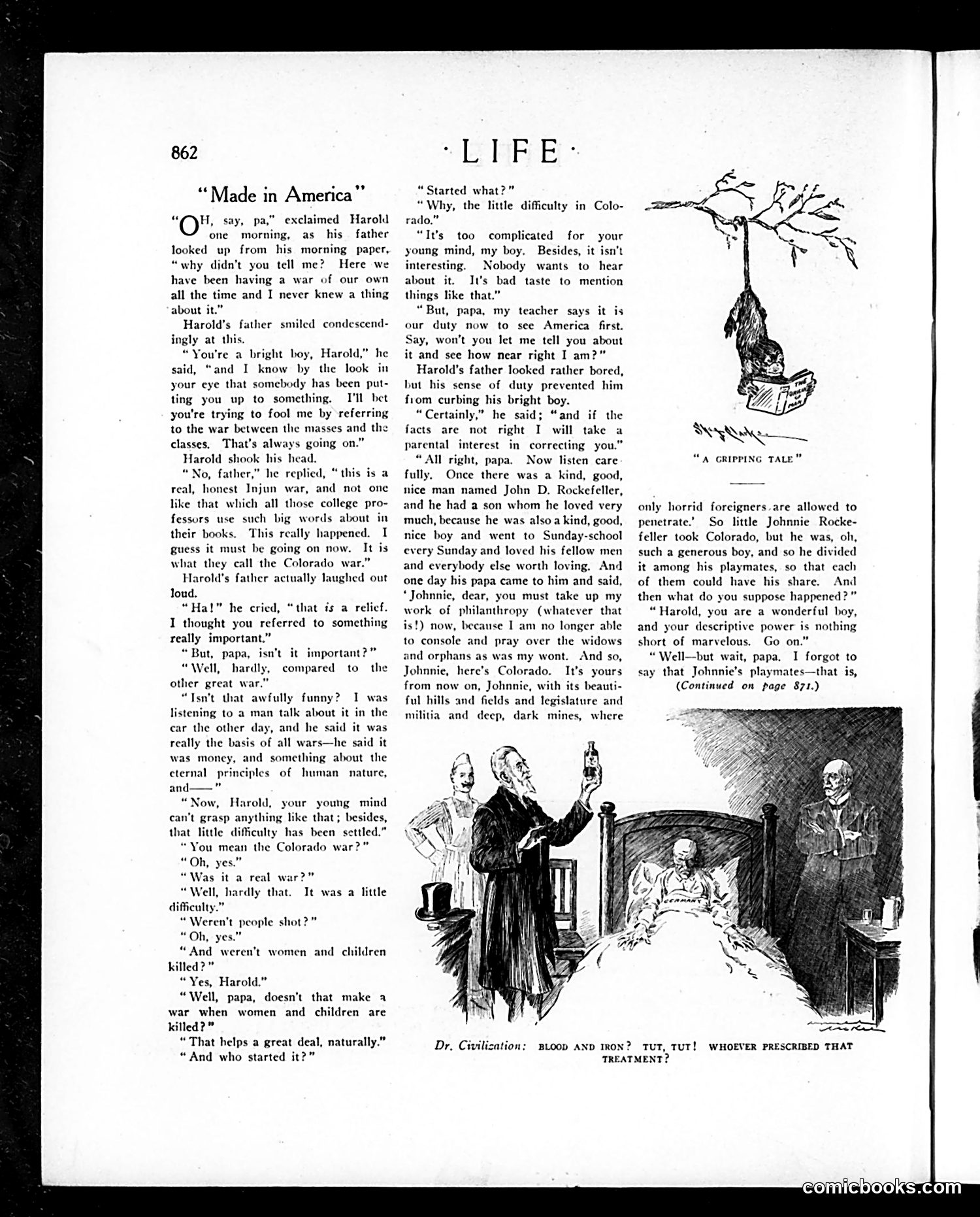
This 1914 *Life* magazine page satirizes American indifference to the Colorado Coal War (1913-1914), a violent labor conflict between coal miners and Rockefeller-owned mines. The dialogue between Harold and his father mocks adult dismissal of the "little difficulty"—despite admitting people, including women and children, were killed. The father calls it unimportant compared to "other great wars," refuses to discuss it as "bad taste," and claims it's "too complicated" for a young mind. The satire cuts sharply: Harold innocently exposes the hypocrisy—if women and children die, isn't that a war? The father has no logical answer. The secondary cartoon shows a doctor prescribing "blood and iron" treatment, likely mocking both Prussian militarism and the violent suppression of the Colorado strikers. The piece criticizes how privileged Americans ignored or minimized a domestic labor massacre while claiming moral authority about global conflicts.
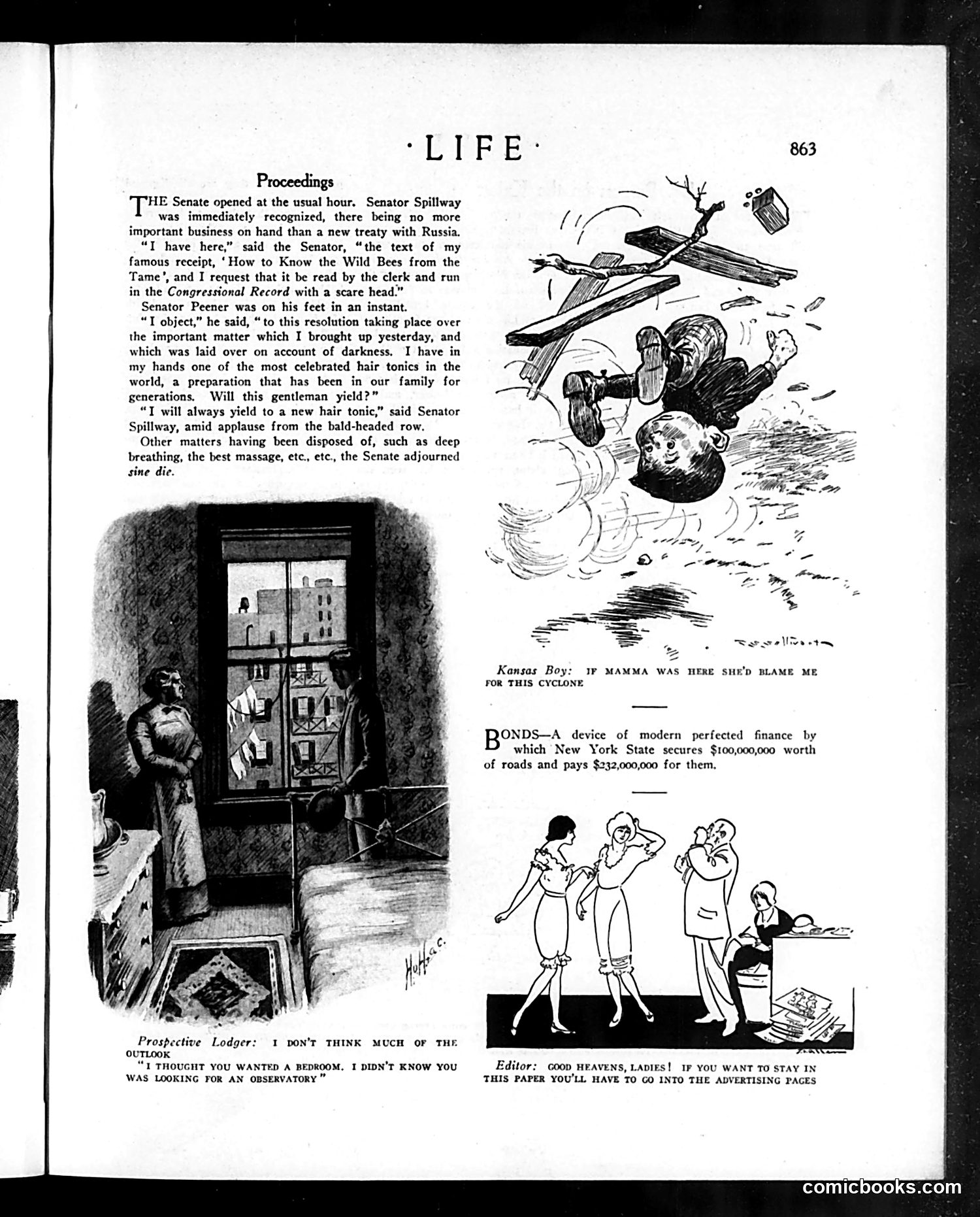
This page contains three distinct satirical pieces mocking American institutions: **"Proceedings"** ridicules the U.S. Senate as frivolous and self-absorbed. Senators debate trivial matters (a recipe about bees, a hair tonic) while neglecting serious business. The joke: senators prioritize vanity (the "bald-headed row" applauds hair tonic discussion) over governance. "Sine die" (adjournment) suggests nothing substantive occurs. **"Kansas Boy"** cartoon shows a child amid a cyclone, joking he'd be blamed by his mother—absurdist humor about accepting blame for uncontrollable events. **"Bonds" section** criticizes New York State's road-financing scheme, where the state secures $100 million in roads but pays $232 million—satirizing wasteful government spending and financial mismanagement. **"Prospective Lodger"** and **"Editor"** cartoons appear to be separate, unrelated gags about observatory confusion and advertising pressures on publications. The page exemplifies *Life*'s satirical focus on governmental incompetence and financial corruption.
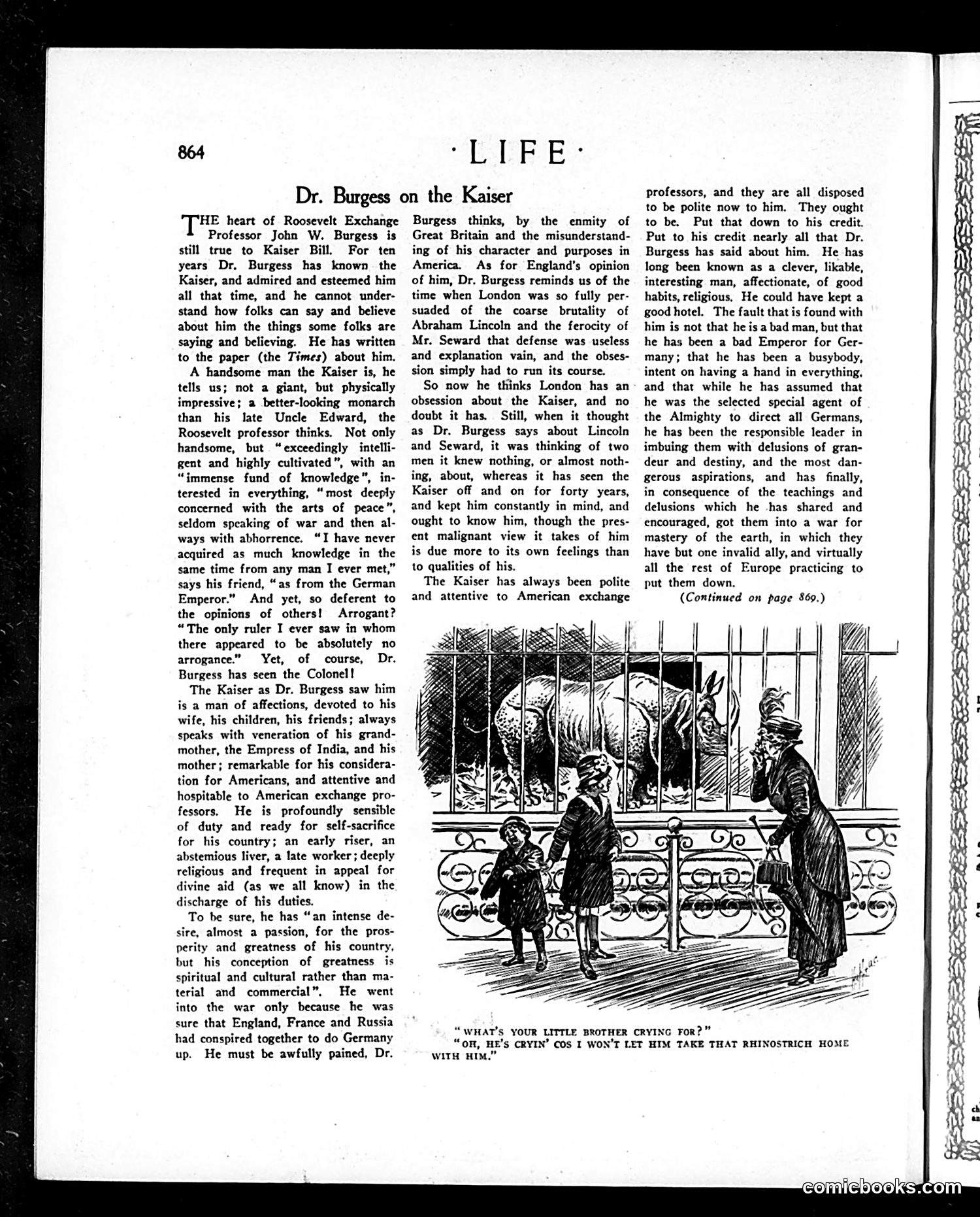
This page satirizes Professor John W. Burgess's defense of Kaiser Wilhelm II in the *New York Times*. The text mockingly catalogs Burgess's praise—the Kaiser as handsome, intelligent, cultured, moral, and kind to American professors—while undermining these claims with cutting irony. The cartoon below illustrates the satire's point: children at a palace window cry over a dead rhinoceros, while below, figures (likely representing diplomats or politicians) reassure them the animal won't be taken away. This darkly depicts German imperial aggression as childish brutality masked by polite excuses. The article's core argument: Burgess mistakes personal charm and courtesy to American academics for evidence of the Kaiser's fitness as a ruler. Life suggests the Kaiser's real problem isn't his manners but his disastrous imperial ambitions—Germany's warmaking itself proves his unfitness, regardless of his politeness to exchange professors or love of "the arts of peace."
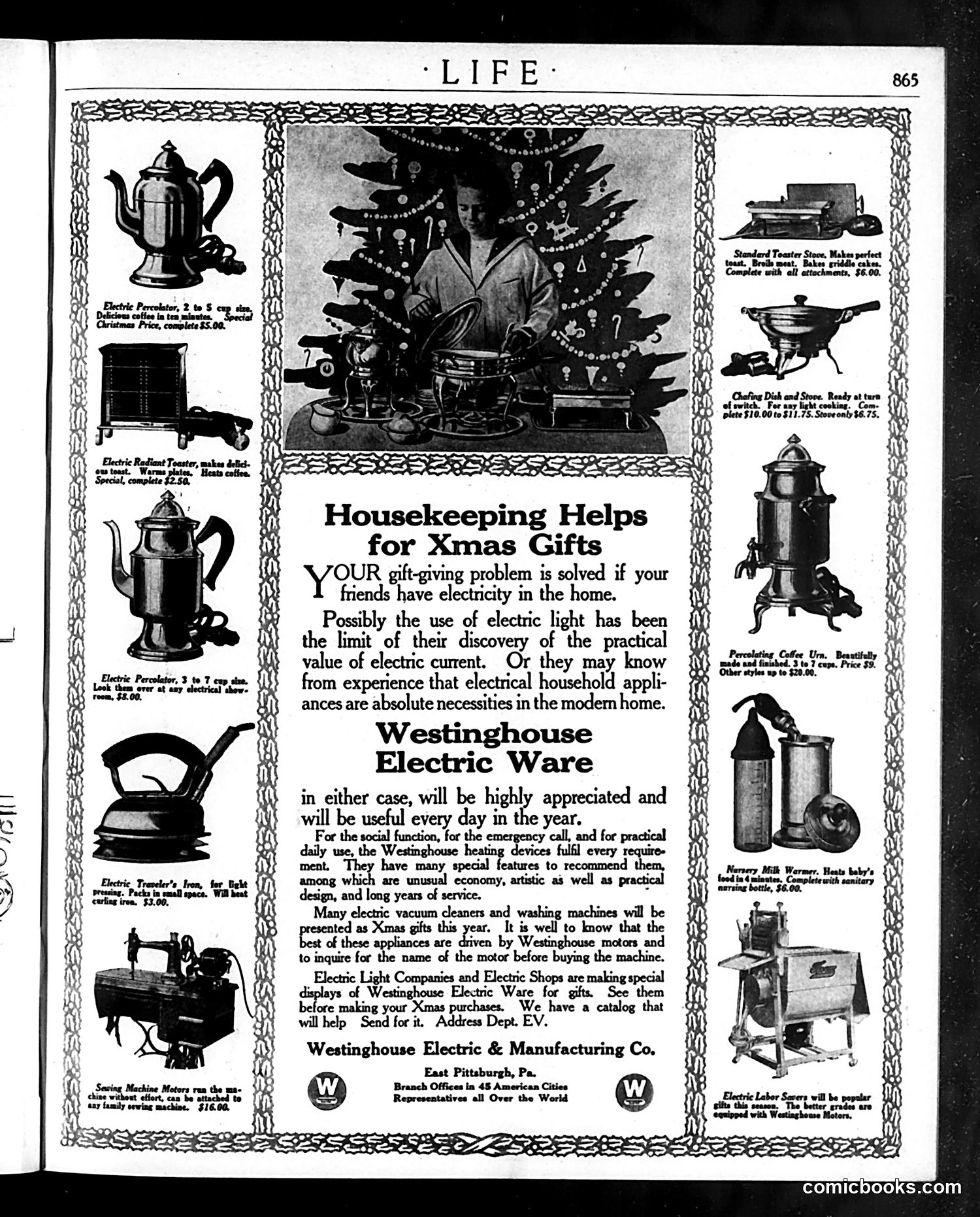
This is a **Westinghouse Electric advertisement**, not satire or a cartoon. It appears in *Life* magazine's advertising section (page 865). The ad promotes electrical household appliances as Christmas gifts, targeting people who already have electricity in their homes but may not realize its practical value beyond lighting. It lists products like coffee urns, percolators, irons, and sewing machines—items that seem mundane today but represented significant labor-saving innovations in the early 20th century. The central image shows a woman surrounded by Westinghouse electrical appliances, emphasizing how electricity could simplify domestic work. The ad encourages readers to visit electric light companies and shops for gift displays before purchasing. This reflects a historical moment when home electrification was expanding, and manufacturers were aggressively marketing electrical appliances as modern necessities rather than luxuries.
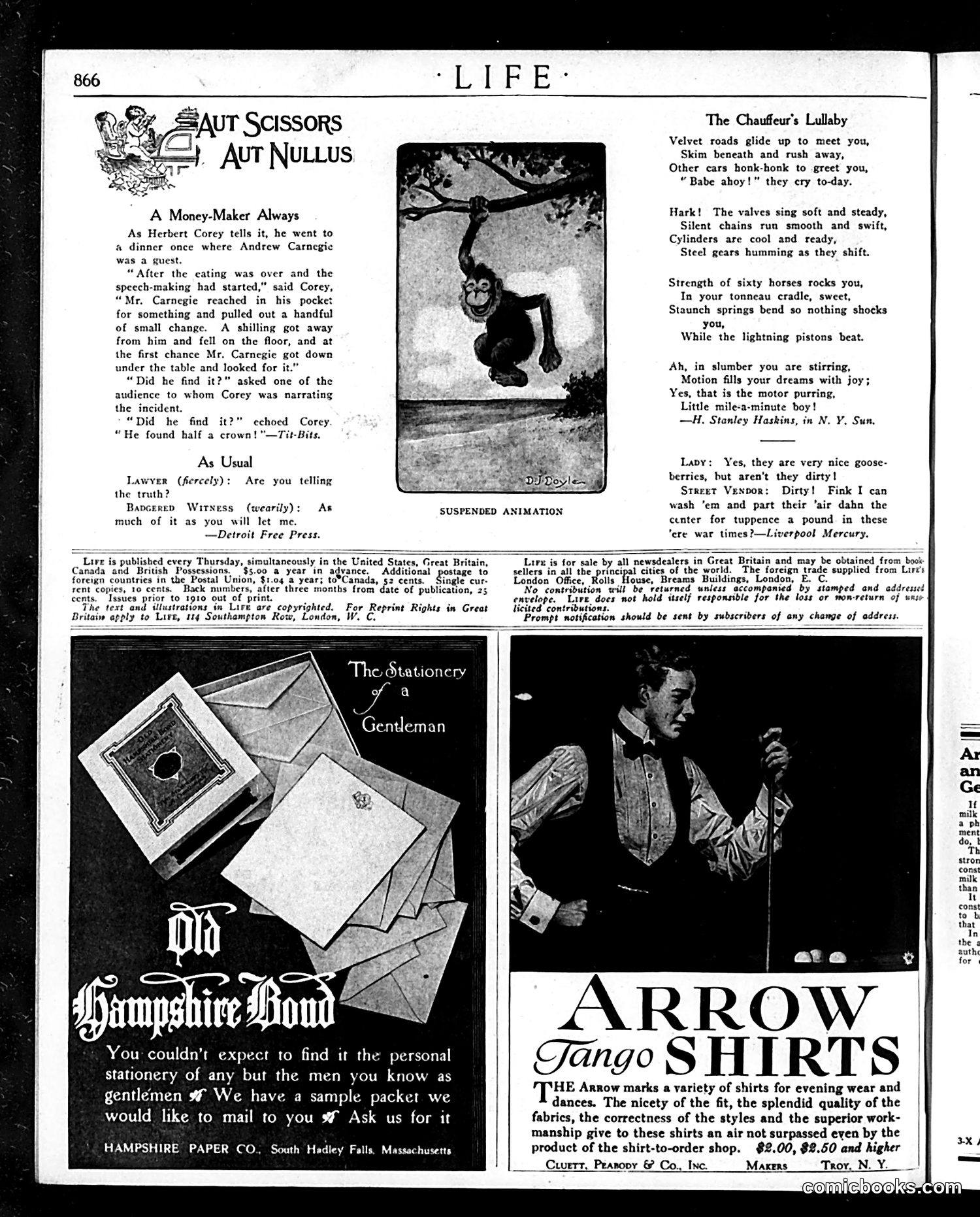
This page from Life magazine (appears to be early 20th century) contains several distinct humor pieces: **"A Money-Maker Always"**: A anecdote about Andrew Carnegie's legendary frugality. The joke is that Carnegie is so obsessed with money that he crawls under a dinner table to retrieve a dropped shilling—finding greater value than expected ("half a crown"). This satirizes Carnegie's famous reputation as a penny-pincher despite vast wealth. **"As Usual"**: A lawyer-witness exchange mocking courtroom dishonesty. The witness admits he tells only "as much of it as you will let me"—a jab at how legal maneuvering prevents truth-telling. **"The Chauffeur's Lullaby"**: A romantic poem about the soothing motion of automobile travel, reflecting early 1900s fascination with motor cars as luxury technology. The page also contains period advertisements for Hampshire Bond stationery and Arrow Tango dress shirts—standard commercial content. The satirical tone targets wealthy industrialists' miserliness and legal system hypocrisy.
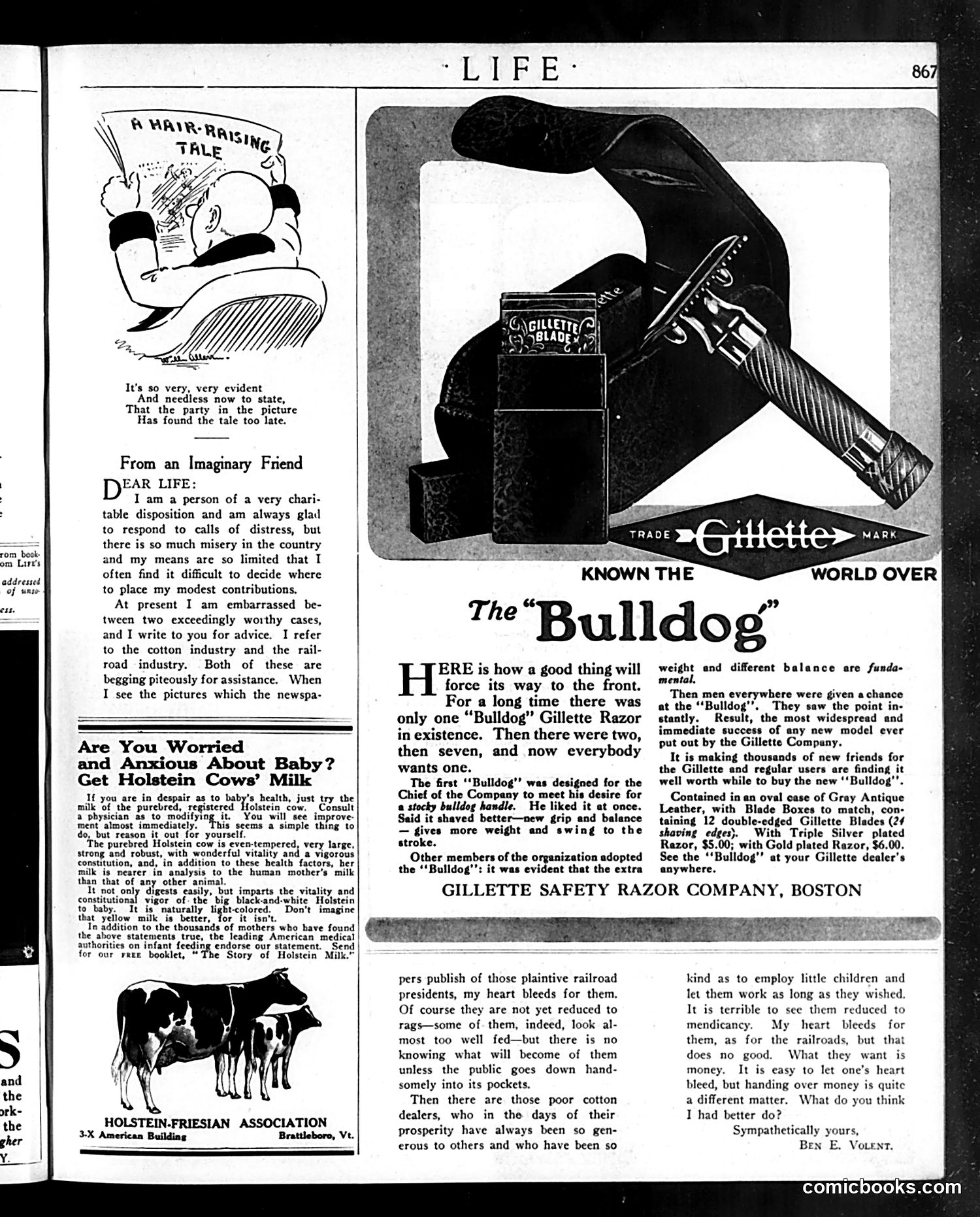
**The cartoon** (upper left) depicts a bald man reading "A Hair-Raising Tale" while having his hair cut—a visual pun on the phrase. The accompanying verse notes the subject has discovered the story too late, already having lost his hair. **The main letter** addresses Life magazine with satirical concern about charitable giving. The writer, claiming charitable impulses, expresses embarrassment choosing between two "worthy causes": the cotton industry and railroads. The satire mocks how these industries—whose executives and owners claim hardship—have historically exploited workers (particularly children in cotton mills) and resisted public regulation. The writer's performative sympathy for industries that show no compassion toward their own workers exposes the hypocrisy of wealthy industrial leaders seeking public assistance while having shown no charity themselves. This reflects Progressive Era criticism of big business.
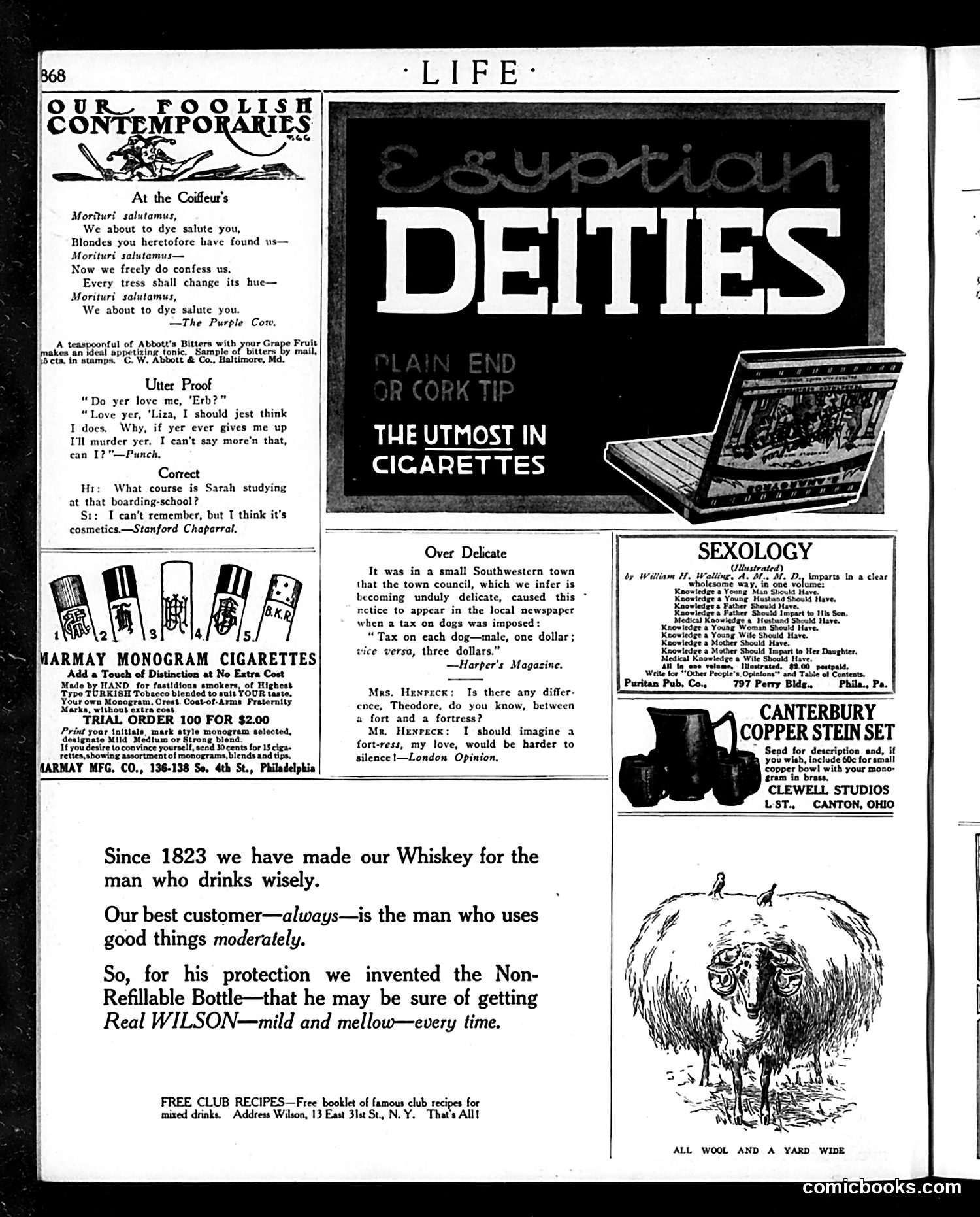
This page mixes humor content with period advertisements. Key satirical pieces: **"Our Foolish Contemporaries"** opens with "Morituri Salutamus" (Latin: "We who are about to die salute you"), a mock-serious poem about blonde women dyeing their hair—satirizing vanity and the era's obsession with hair color as status symbol. **"Over Delicate"** mocks a small-town council's absurdly prudish tax ordinance: charging dogs $1 for males but $3 for females ("vice versa"), apparently to avoid saying "female" directly. The satire targets excessive propriety. **The Fort/Fortress joke** plays on "fort-ress" as literally "harder to silence"—wordplay on marital conflict, likely mocking nagging wives. **Advertisements** include cigarettes, whiskey, and a "Sexology" book—reflecting the era's emerging frankness about sexuality alongside persistent prudishness that the satire highlights. The overall theme: mocking contemporary American hypocrisy, excessive delicacy, and vanity during the Progressive Era.
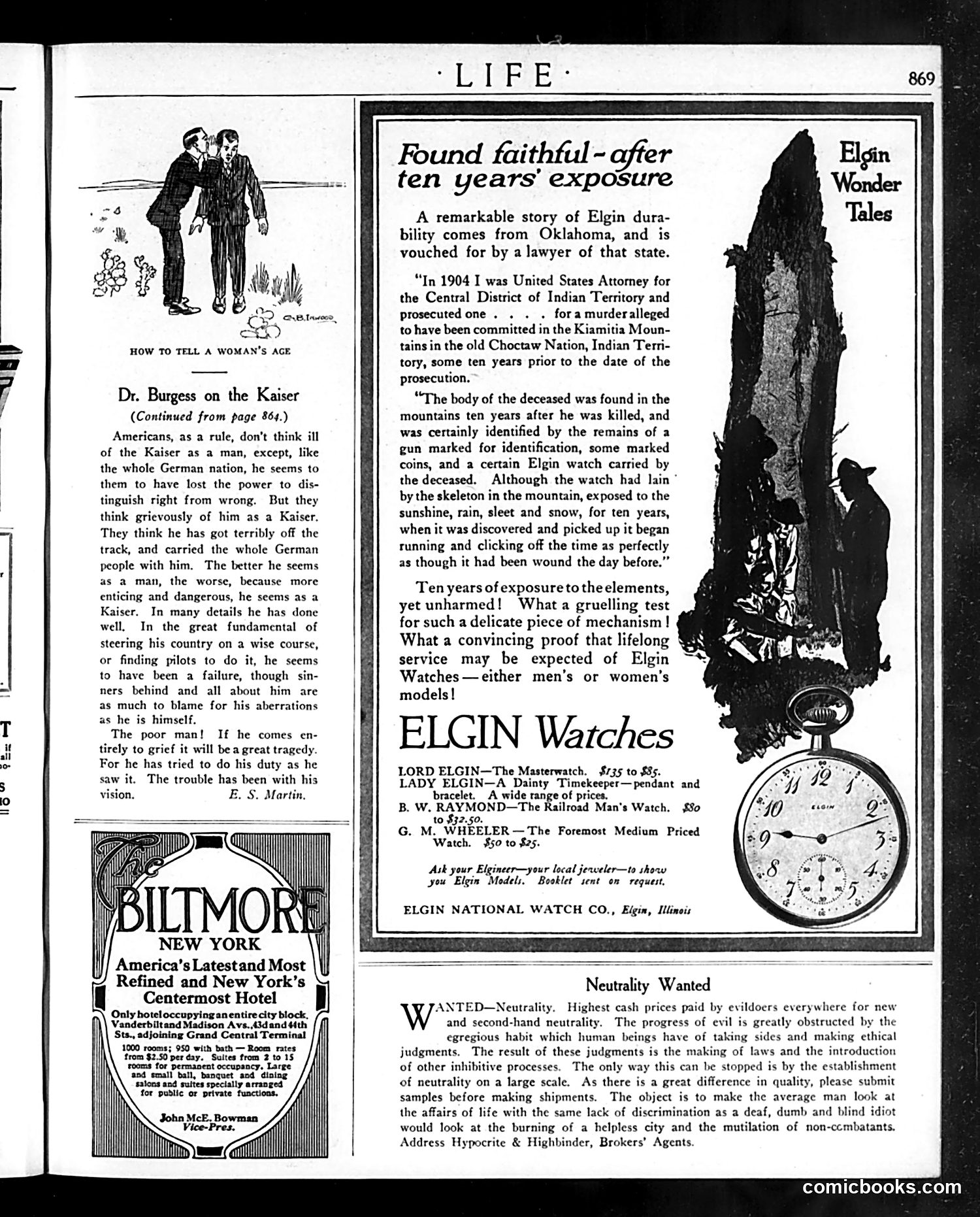
This page contains three distinct sections: **Left column:** A brief editorial comment "Dr. Burgess on the Kaiser" (continued from prior page) offers a nuanced WWI-era critique. It portrays the German Kaiser as a well-intentioned man who has catastrophically failed in his fundamental duty to steer Germany wisely, blaming him more as a leader than as a person. This reflects American public opinion circa 1915-1917—viewing the Kaiser as tragically misguided rather than purely evil. **Center/Right:** An Elgin Watches advertisement uses a dramatic anecdote: a watch allegedly recovered from a skeleton in Oklahoma mountains after ten years of exposure still runs perfectly. The advertisement emphasizes durability and reliable long-term service. **Bottom:** A satirical "Wanted" ad mocking neutrality itself. It sarcastically "seeks" neutrality as a commodity, arguing that moral indifference and refusal to make ethical judgments obstruct justice. This appears to critique American isolationism and those avoiding WWI involvement, suggesting neutrality enables evil. The page primarily comprises advertising with embedded political commentary.
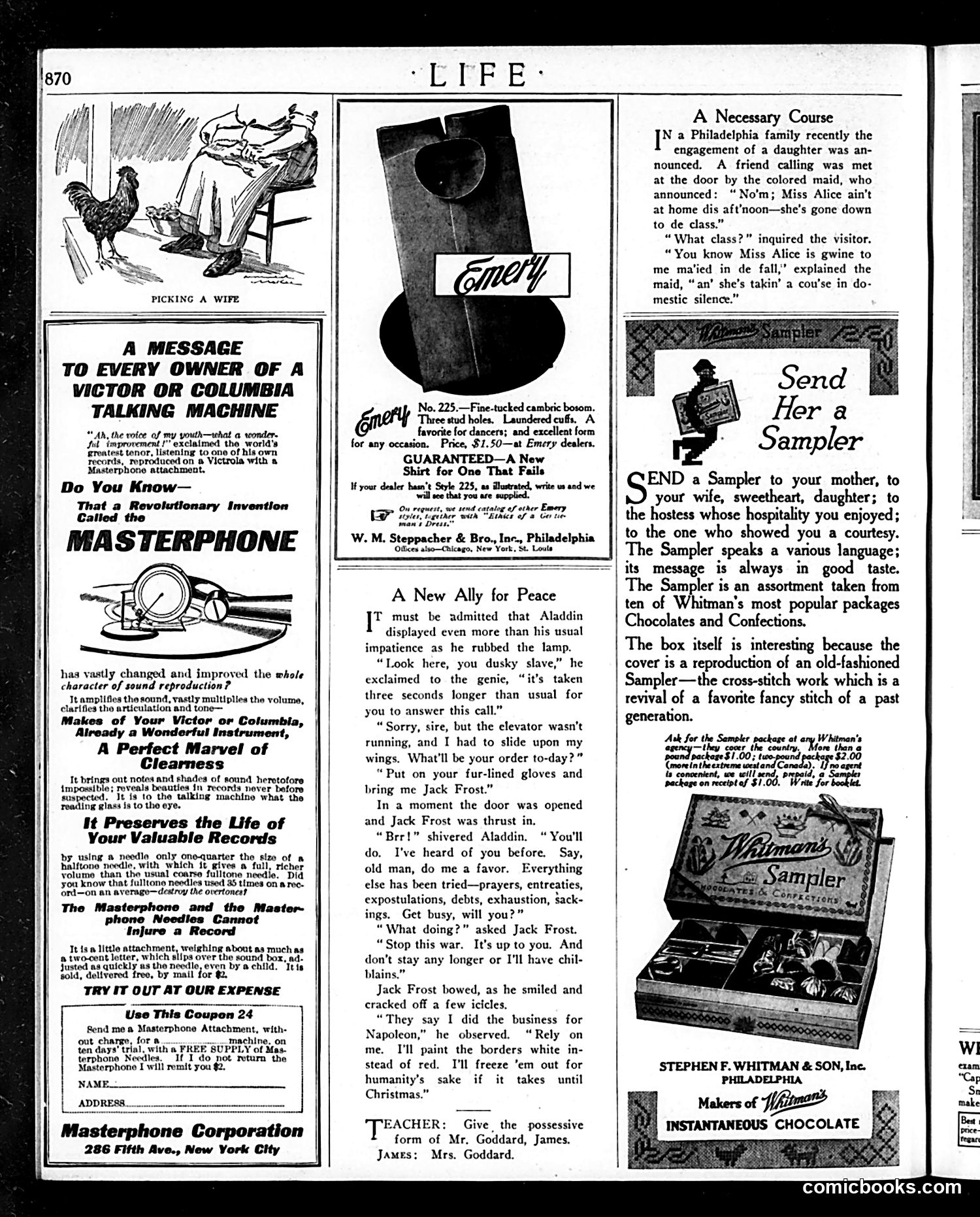
This page is primarily **advertising and light humor**, not political satire. The main cartoon, "A New Ally for Peace," is a whimsical WWI-era joke. Aladdin rubs his magic lamp and summons the genie, who delays responding because he had to "slide upon my wings" (the elevator wasn't working). Aladdin then asks Jack Frost to stop "this war"—referencing the ongoing World War I. Jack Frost agrees, joking that "they say I did the business for Napoleon," implying cold winters defeated Napoleon's armies. The humor is light and fantastical rather than pointed political commentary. The page's bulk comprises product advertisements: the Masterphone (a phonograph attachment), Emery cambric bosom shirts, and Whitman's Sampler chocolates. There's also a brief anecdote about a Philadelphia maid announcing her mistress is taking "a cou'se in domestic silence" before marriage—gentle satire on women's expected subservience in marriage.
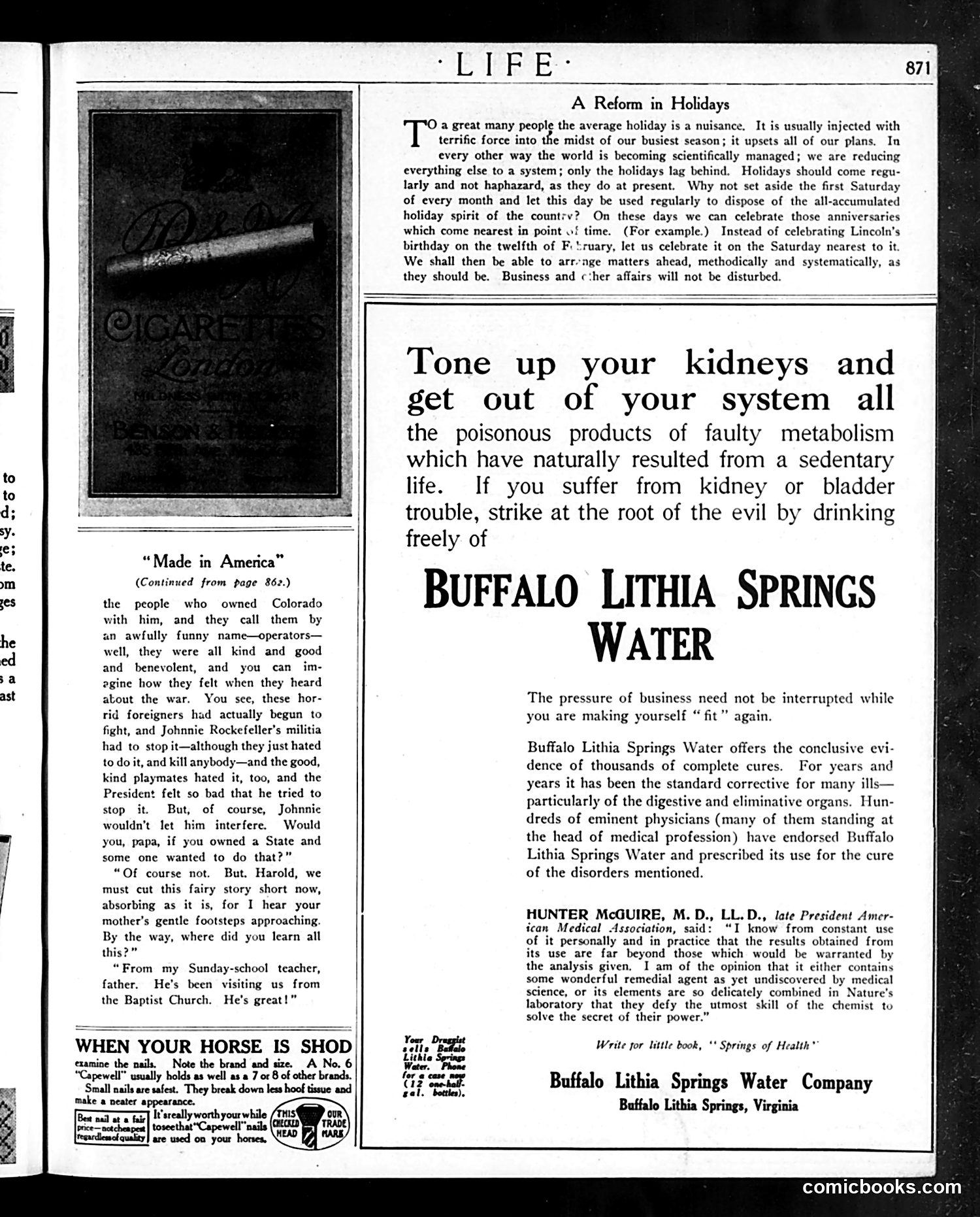
This page contains **two distinct pieces**: a satirical editorial and period advertisements. ## "A Reform in Holidays" Editorial The satire advocates rationalizing America's holiday system by consolidating all celebrations into a single first Saturday each month. Rather than scattered holidays disrupting business, this proposal would allow systematic, advance planning. The example given—celebrating Lincoln's birthday on the *nearest* Saturday rather than February 12—exemplifies this efficiency-obsessed logic. This reflects early 20th-century **Progressive Era** thinking, which sought to apply scientific management to all aspects of society. The satire gently mocks this impulse by taking it to an absurd extreme: treating beloved national commemorations as mere administrative inconveniences. ## Narrative Excerpt: "Made in America" A story fragment depicts a child reciting tales of Rockefeller wealth and industrial power to his father, claiming a Baptist Sunday-school teacher as his source. The irony is biting: religious instruction has become a vehicle for celebrating American industrial titans and their violent suppression of labor unrest. ## Advertisements The remaining space features patent medicine ads (Buffalo Lithia Springs Water, horse shoeing nails)—typical period advertising making dubious health claims.
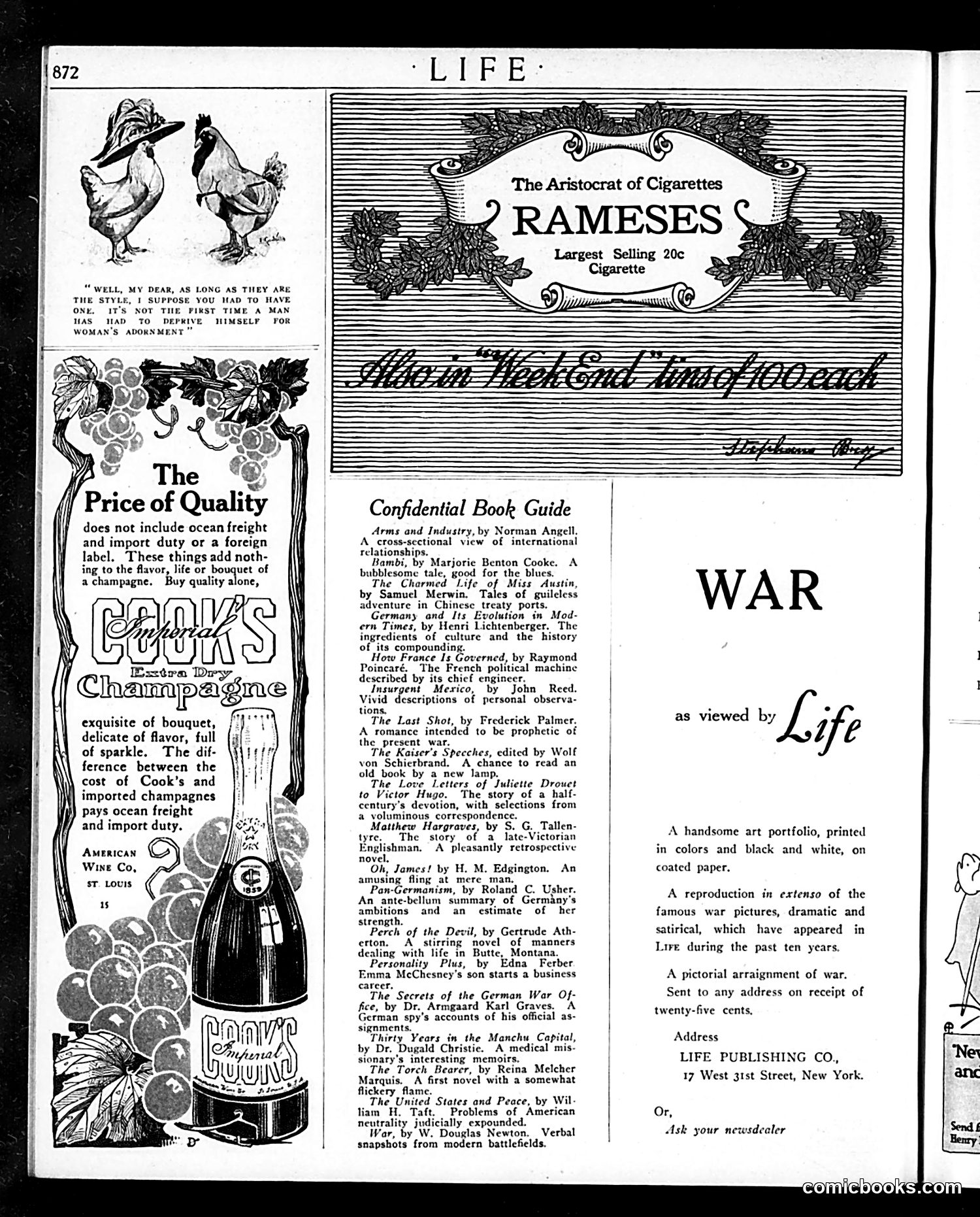
This page combines advertisements with book recommendations relevant to World War I readers. **The Cartoons/Ads:** The left side features two unrelated advertisements: one for Rameses cigarettes (styled as "aristocratic") and another for Cook's champagne, emphasizing quality and imported prestige. **The Main Content - "War as Viewed by Life":** The right side advertises a war portfolio—a collection of dramatic and satirical pictures about WWI that Life magazine had published. It's pitched as both artistic ("handsome art portfolio") and political commentary ("pictorial arraignment of war"), available for 25 cents. **The Book Guide:** The "Confidential Book Guide" lists contemporary war-related and political books, including works by Norman Angell on international relations, John Reed on Mexico, and pieces about German war strategy and American neutrality. These reflect American intellectual debate about the war circa 1914-1917. **Context:** This appears designed for educated, affluent readers interested in understanding the European conflict while America remained officially neutral.
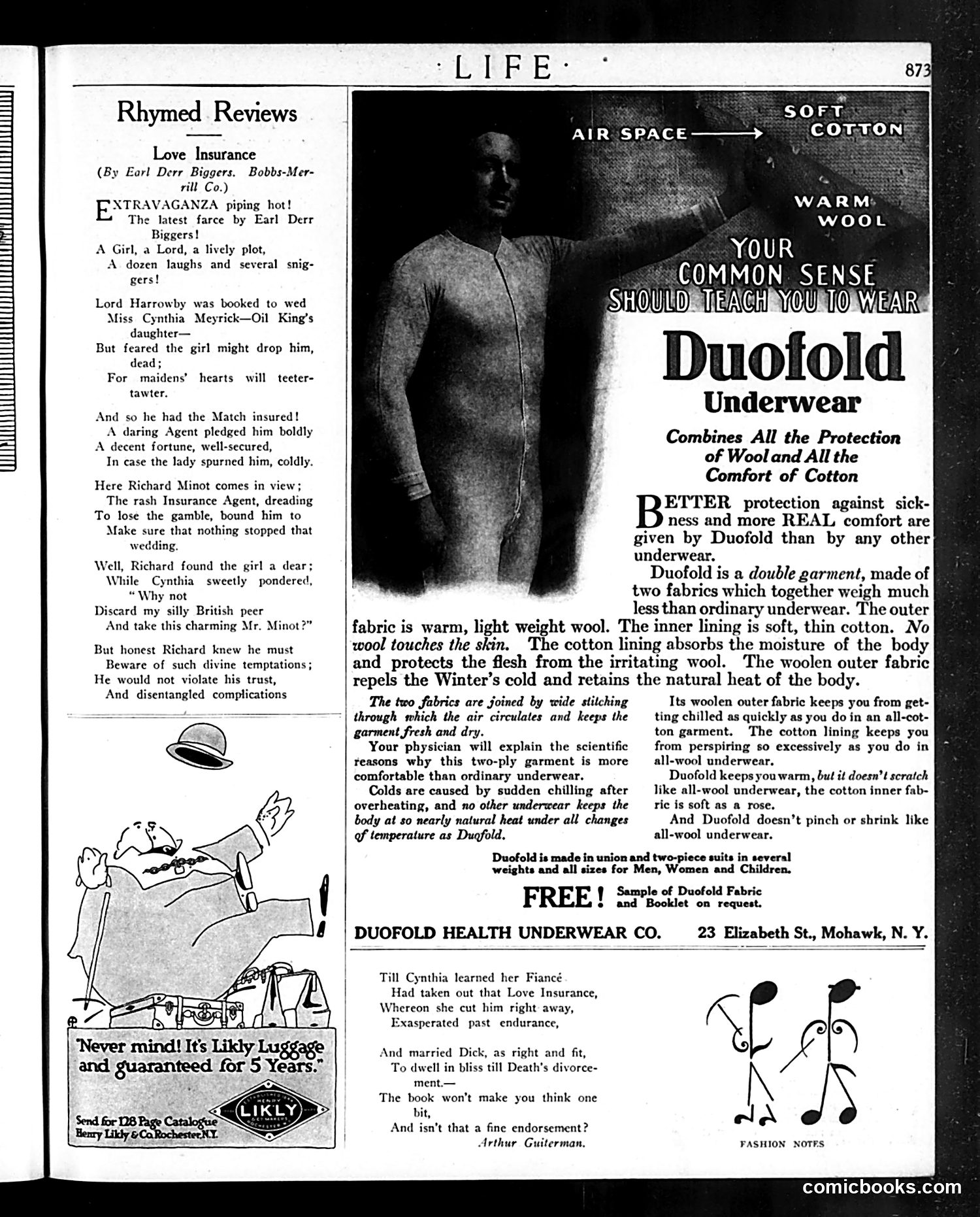
This page contains a book review (left) and a large advertising section (right). The **review** mocks Earl Derr Biggers' new farce novel about Lord Harrowby, who insures his engagement to Miss Cynthia Meyrick against her jilting him. An insurance agent named Richard Minot becomes attracted to Cynthia but honorably resists temptation. When Cynthia discovers the insurance policy, she's insulted and leaves Harrowby for Richard instead. The reviewer (Arthur Guiterman) delivers a backhanded endorsement: the book is mindless entertainment—"won't make you think one bit"—which he presents as its selling point. The **advertisement** for Duofold underwear dominates the right side, featuring a male model and extensive copy explaining the product's wool-cotton hybrid construction as scientifically superior to all-wool alternatives. The ad emphasizes comfort, moisture absorption, and temperature regulation. The small cartoon at bottom-left advertises Likly luggage with a comedic travel scene.
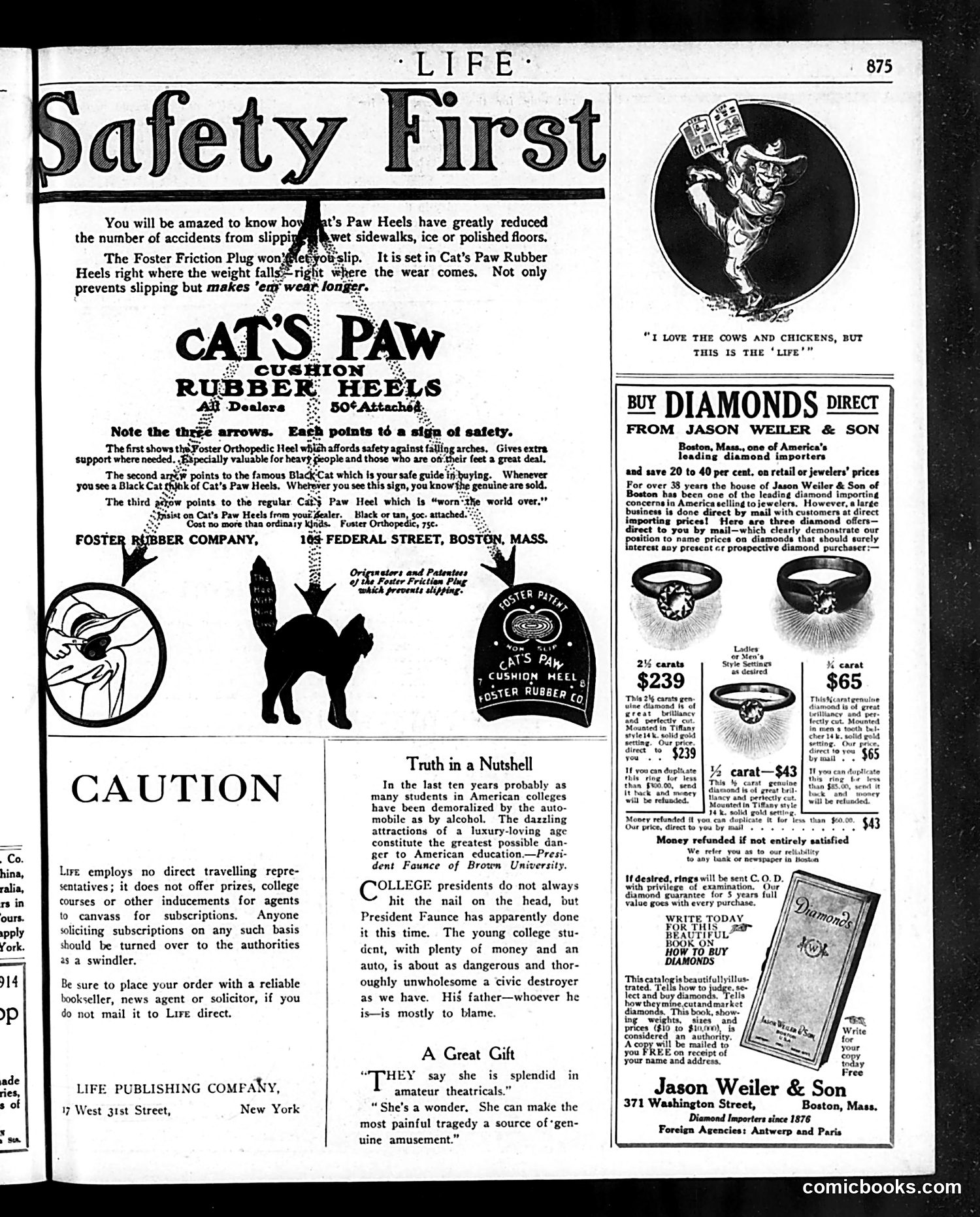
This page is primarily **product advertising** with minimal editorial content. The main feature is an advertisement for **Cat's Paw Rubber Heels**, a safety product claiming to reduce accidents on slippery surfaces. The silhouette of a black cat serves as the brand's trademark and safety symbol. A brief editorial section titled "Truth in a Nutshell" quotes **President Faunce of Brown University**, criticizing how automobiles and wealth corrupt college students—suggesting young men with cars and money become irresponsible "civic destroyers." This reflects early-20th-century anxieties about automobiles as corrupting influences on youth. A small satirical item about amateur theatrics jokes that a woman is "splendid" because she can make tragic plays unintentionally funny. The remainder comprises diamond dealer advertisements (Jason Weiler & Son) and a cautionary notice from Life's publishers warning against subscription scams.
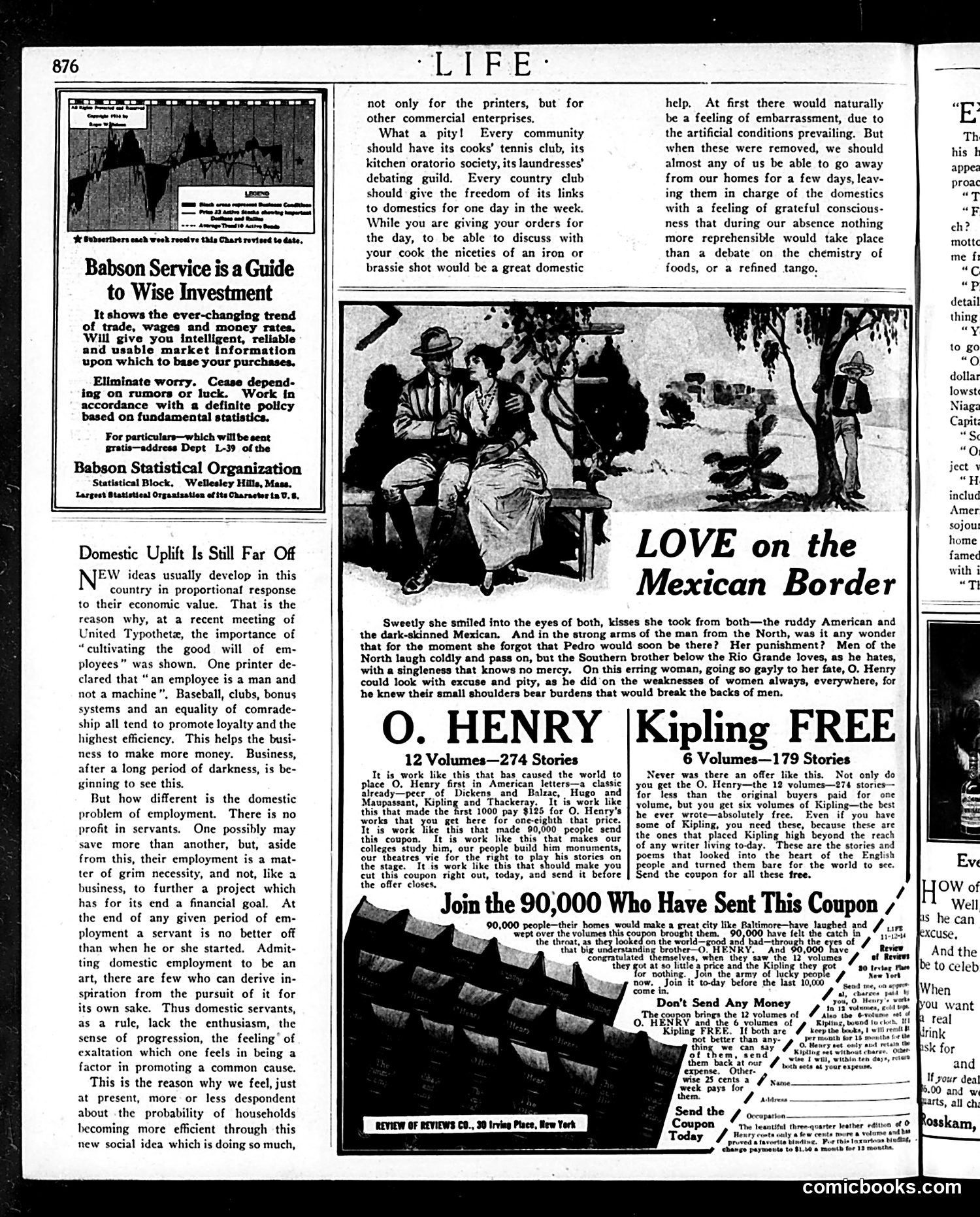
This page contains primarily **advertising and editorial content**, not political satire. The main featured article, "Domestic Uplift Is Still Far Off," discusses employment relations—specifically contrasting how American businesses cultivate employee loyalty through recreation and camaraderie (baseball clubs, bonuses) versus the neglected domestic servant workforce. The author argues servants lack incentive for improvement since their employment offers no financial advancement or sense of progress. The illustrated story "Love on the Mexican Border" appears to be a melodramatic narrative (likely adapted from O. Henry) about a woman romantically involved with both an American and a Mexican man, hinting at tragic consequences. The page also includes advertisements: Babson Statistical Organization (investment guidance) and book club offers for O. Henry and Kipling collections. There is **no political cartoon** on this page—the illustrations accompany narrative stories rather than offering satirical commentary.
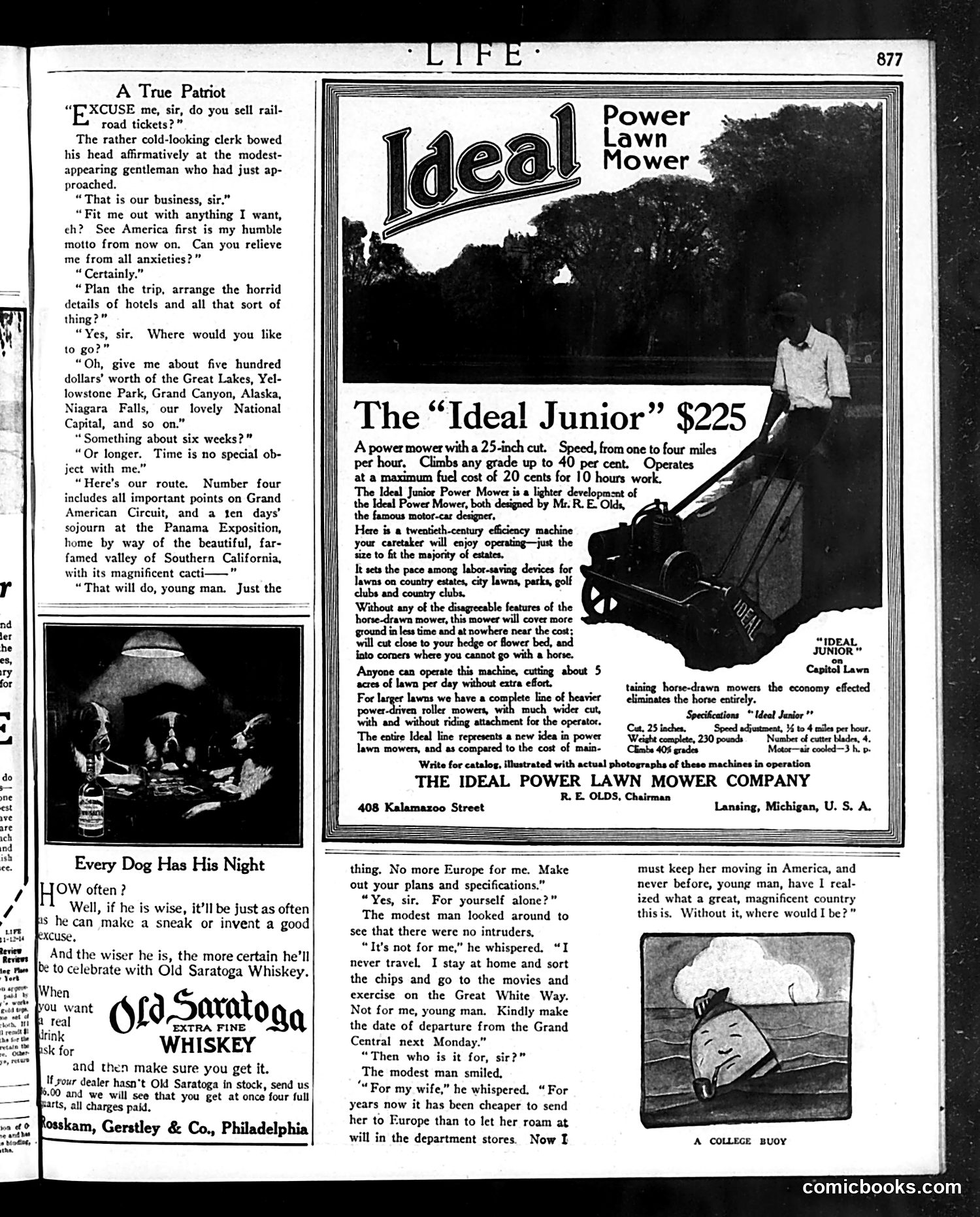
**"A True Patriot" Cartoon:** This satirical story mocks a husband's strategy for managing his wife's spending habits. A modest-appearing man books an expensive six-week domestic tour (Great Lakes, Yellowstone, Grand Canyon, Panama Exposition, California) — not for himself, but to keep his wife traveling and occupied. The joke's premise: sending her on expensive American vacations is cheaper than letting her shop freely in department stores. The satire critiques both excessive female consumerism and the era's marital dynamics, where wives' shopping was portrayed as financially ruinous. **"Every Dog Has His Night":** Whiskey advertisement using a playful double entendre about men sneaking out to drink, presented as acceptable male behavior if done cleverly enough. **"Ideal Junior" Power Mower:** Product advertisement for an early motorized lawn mower designed for estate owners, emphasizing labor-saving benefits and eliminating the need for horse-drawn equipment—targeting wealthy homeowners. The page reflects early 20th-century attitudes toward gender, consumption, and leisure among the affluent class.
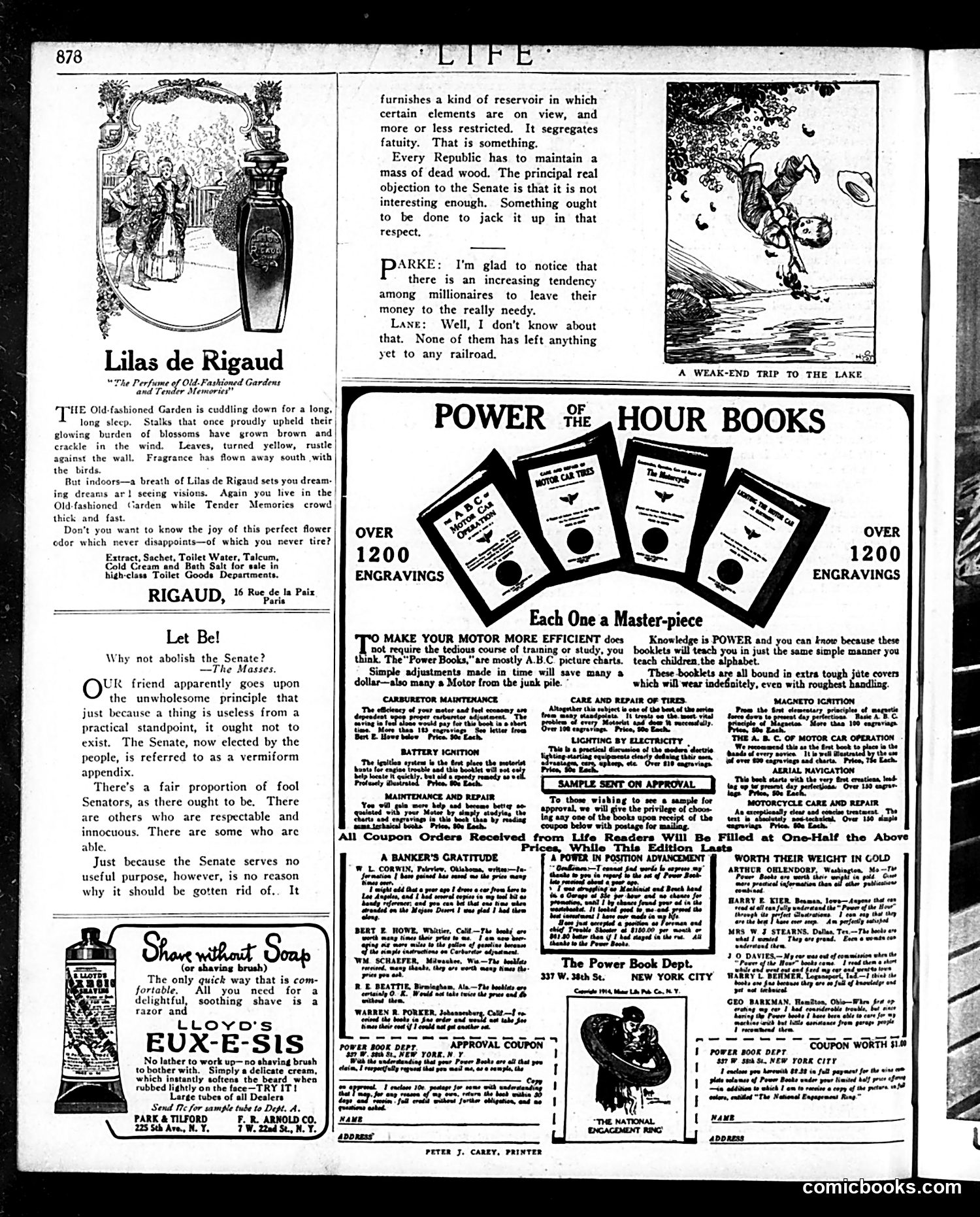
This page contains political satire alongside period advertising. The main commentary appears in "Let Be!" — a critique of the U.S. Senate. The author argues the Senate is useless ("vermiform appendix"), yet paradoxically should not be abolished because it serves as a necessary "reservoir" for incompetent people. The satire suggests the Senate is fundamentally dysfunctional but has become institutionalized. A separate dialogue joke mocks wealthy philanthropy: a character notes millionaires increasingly give to "the really needy," only to be told none have donated to railroads — implying that railroads (a major business concern of the era) are the true "charity cases" of the wealthy. The page is otherwise dominated by advertisements for perfume, razors, and instructional "Power Books" about motor cars — typical of 1910s-era Life magazine content.
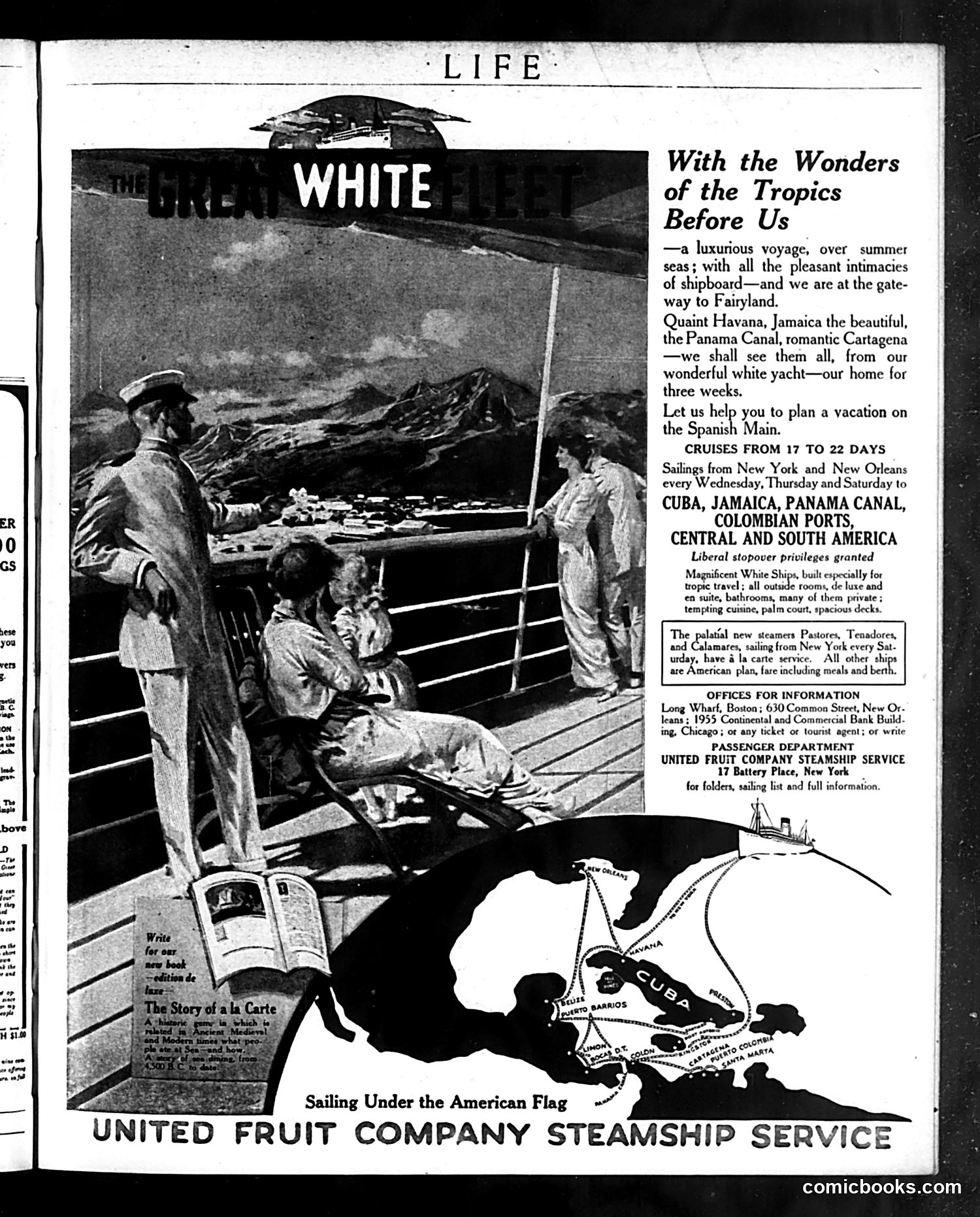
This is primarily an **advertisement**, not a satirical cartoon. It promotes luxury Caribbean cruises operated by the United Fruit Company Steamship Service. The page depicts passengers relaxing on the deck of "the White Ship" viewing tropical scenery—Havana, Jamaica, Panama Canal, and Cartagena. The image romanticizes colonial-era leisure travel, emphasizing comfort ("de luxe rooms," "palm court," "spacious decks") for wealthy American vacationers. **Historical context a modern reader should know:** The United Fruit Company was notorious for its economic and political dominance in Central America and the Caribbean during this era (early-to-mid 20th century), often called the "Banana Wars." While this advertisement presents tropical tourism as innocent pleasure, it reflects the broader American imperial presence in these regions that the company symbolized. The "American Flag" tagline underscores national pride in commercial expansion. There is no obvious satire here—this appears to be straightforward advertising in *Life* magazine.
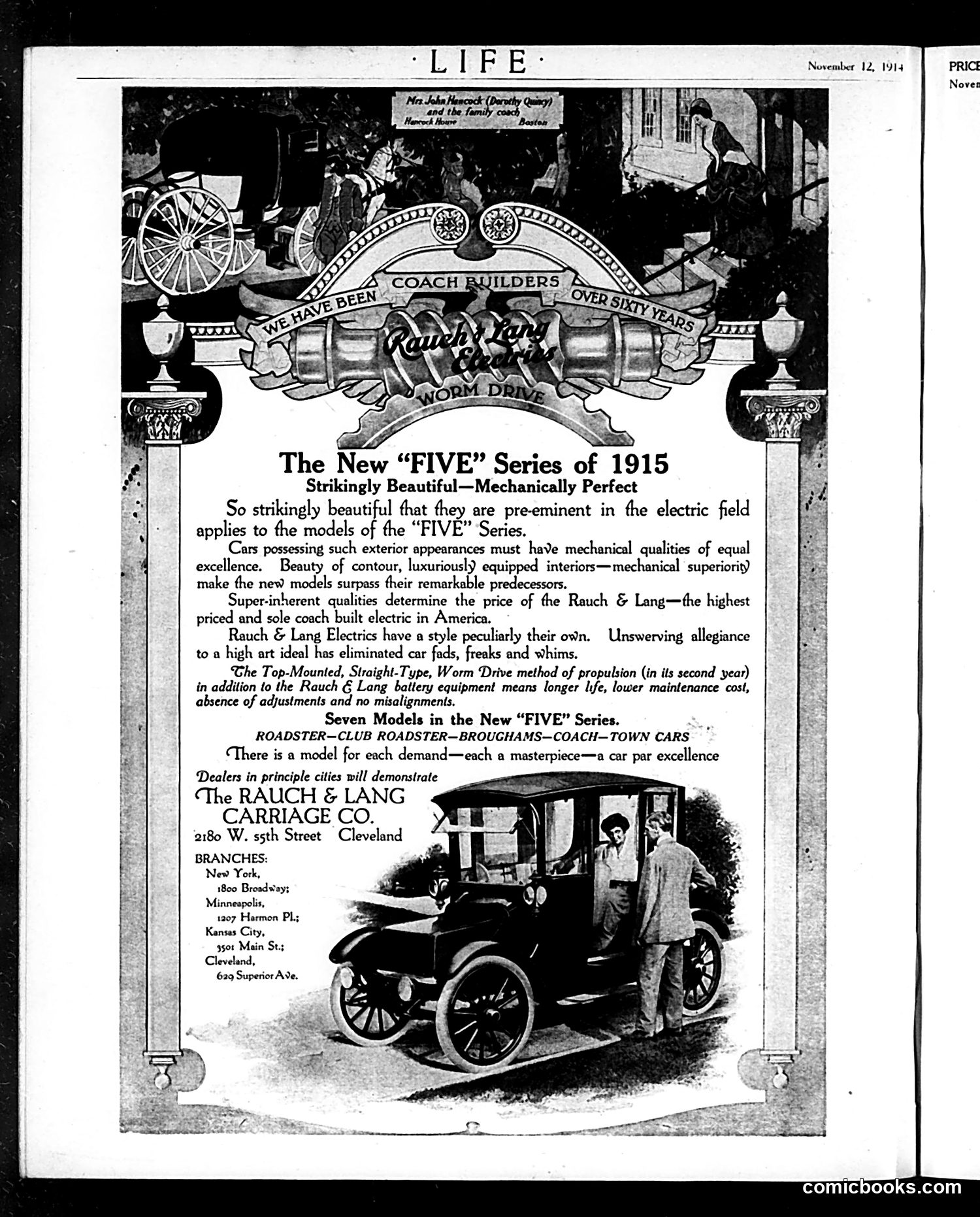
This is **not a cartoon or satirical piece**—it's a straightforward advertisement for the Rauch & Lang Carriage Company's new 1915 electric automobiles. The page promotes their "FIVE" Series of electric cars, emphasizing luxury, mechanical excellence, and design consistency. The ornate header with a worm-drive mechanism illustrates their technical innovation. The company positions these as the "highest priced and sole coach built electric in America," appealing to wealthy buyers who valued beauty and reliability over trendy "fads, freaks and whims." The accompanying image shows a coach-style enclosed automobile with passengers, representing the luxury market segment. Seven models are listed—from roadsters to town cars—each targeting specific customer demands. This reflects the pre-1920s era when electric vehicles were fashionable among the wealthy, before gasoline engines dominated the market.