
Life, 1914-11-12 · page 32 of 48
Life — November 12, 1914 — page 32: what you’re looking at
What you’re looking at
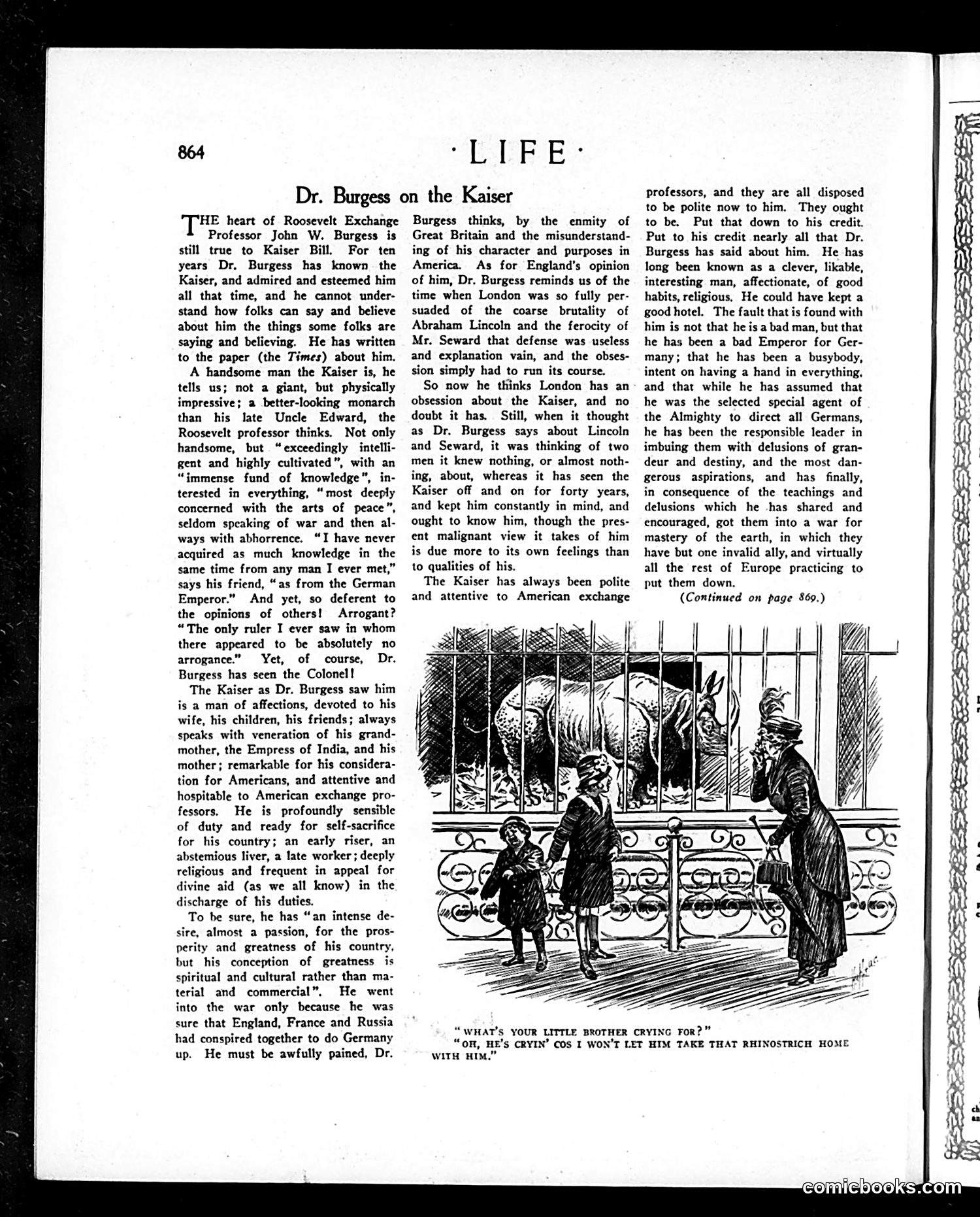
This page satirizes Professor John W. Burgess's defense of Kaiser Wilhelm II in the *New York Times*. The text mockingly catalogs Burgess's praise—the Kaiser as handsome, intelligent, cultured, moral, and kind to American professors—while undermining these claims with cutting irony. The cartoon below illustrates the satire's point: children at a palace window cry over a dead rhinoceros, while below, figures (likely representing diplomats or politicians) reassure them the animal won't be taken away. This darkly depicts German imperial aggression as childish brutality masked by polite excuses. The article's core argument: Burgess mistakes personal charm and courtesy to American academics for evidence of the Kaiser's fitness as a ruler. Life suggests the Kaiser's real problem isn't his manners but his disastrous imperial ambitions—Germany's warmaking itself proves his unfitness, regardless of his politeness to exchange professors or love of "the arts of peace."
📄 Transcribed text from this page (OCR, searchable)
Machine-transcribed from the original scan — historical spelling and the odd misread are preserved.
“ES ERE* Dr. Burgess on the Kaiser TH! heart of Roosevelt Exchange Professor John W. Burgess is still true to Kaiser Bill. For ten years Dr. Burgess has known the Kaiser, and admired and esteemed him all that time, and he cannot under- stand how folks can say and believe about him the things some folks are saying and believing. He has written to the paper (the Times) about him. A handsome man the Kaiser is, he tells us; not a giant, but physically impressive; a better-looking monarch than his late Uncle Edward, the Roosevelt professor thinks. Not only handsome, but “exceedingly intelli- gent and highly cultivated”, with an “immense fund of knowledge”, in- terested in everything, “most deeply concerned with the arts of peace”, seldom speaking of war and then al- ways with abhorrence. “I have never acquired as much knowledge in the same time from any man I ever met,” says his friend, “as from the German Emperor.” And yet, so deferent to Arrogant? the opinions of others! “The only ruler I ever saw in whom there appeared to be absolutely no arrogance.” Yet, of course, Dr. Burgess has seen the Colonel! The Kaiser as Dr. Burgess saw him is a man of affections, devoted to his wife, his children, his friends; always speaks with veneration of his grand- mother, the Empress of India, and his mother; remarkable for his considera- tion for Americans, and attentive and hospitable to American exchange pro- fessors. He is profoundly sensible of duty and ready for self-sacrifice for his country; an early riser, an abstemious liver, a late worker ; deeply religious and frequent in appeal for divine aid (as we all know) in the discharge of his duties. To be sure, he has “an intense de- sire, almost a passion, for the pros- perity and greatness of his country, but his conception of greatness is spiritual and cultural rather than ma- terial and commercial”. He went into the war only because he was sure that England, France and Russia had conspired together to do Germany up. He must be awfully pained, Dr. Burgess thinks, by the enmity of Great Britain and the misunderstand- ing of his character and purposes in America. As for England's opinion of him, Dr. Burgess reminds us of the time when London was so fully per- suaded of the coarse brutality of Abraham Lincoln and the ferocity of Mr. Seward that defense was useless and explanation vain, and the obses- sion simply had to run its course. So now he thinks London has an obsession about the Kaiser, and no doubt it has, Still, when it thought as Dr. Burgess says about Lincoln and Seward, it was thinking of two men it knew nothing, or almost noth- ing, about, whereas it has seen the Kaiser off and on for forty years, and kept him constantly in mind, and ought to know him, though the pres- ent malignant view it takes of him is due more to its own feelings than to qualities of his. The Kaiser has always been polite and attentive to American exchange professors, and they are all disposed to be polite now to him. They ought to be. Put that down to his credit. Put to his credit nearly all that Dr. Burgess has said about him. He has long been known as a clever, likable, interesting man, affectionate, of good habits, religious, He could have kept a good hotel. The fault that is found with him is not that he is a bad man, but that he has been a bad Emperor for Ger- many; that he has been a busybody, intent on having a hand in everything, and that while he has assumed that he was the selected special agent of the Almighty to direct all Germans, he has been the responsible leader in imbuing them with delusions of gran- deur and destiny, and the most dan- gerous aspirations, and has finally, in consequence of the teachings and delusions which he has shared and encouraged, got them into a war for mastery of the earth, in which they have but one invalid ally, and virtually all the rest of Europe practicing to put them down. (Continued on page 869.) “WHAT'S YOUR LITTLE BROTHER CRYING FOR?” “OH, HE'S CRYIN’ COS I WON’T LET HIM TAKE THAT RHINOSTRICH HOME WITH HIM,”