
Life, 1914-11-12 · page 30 of 48
Life — November 12, 1914 — page 30: what you’re looking at
What you’re looking at
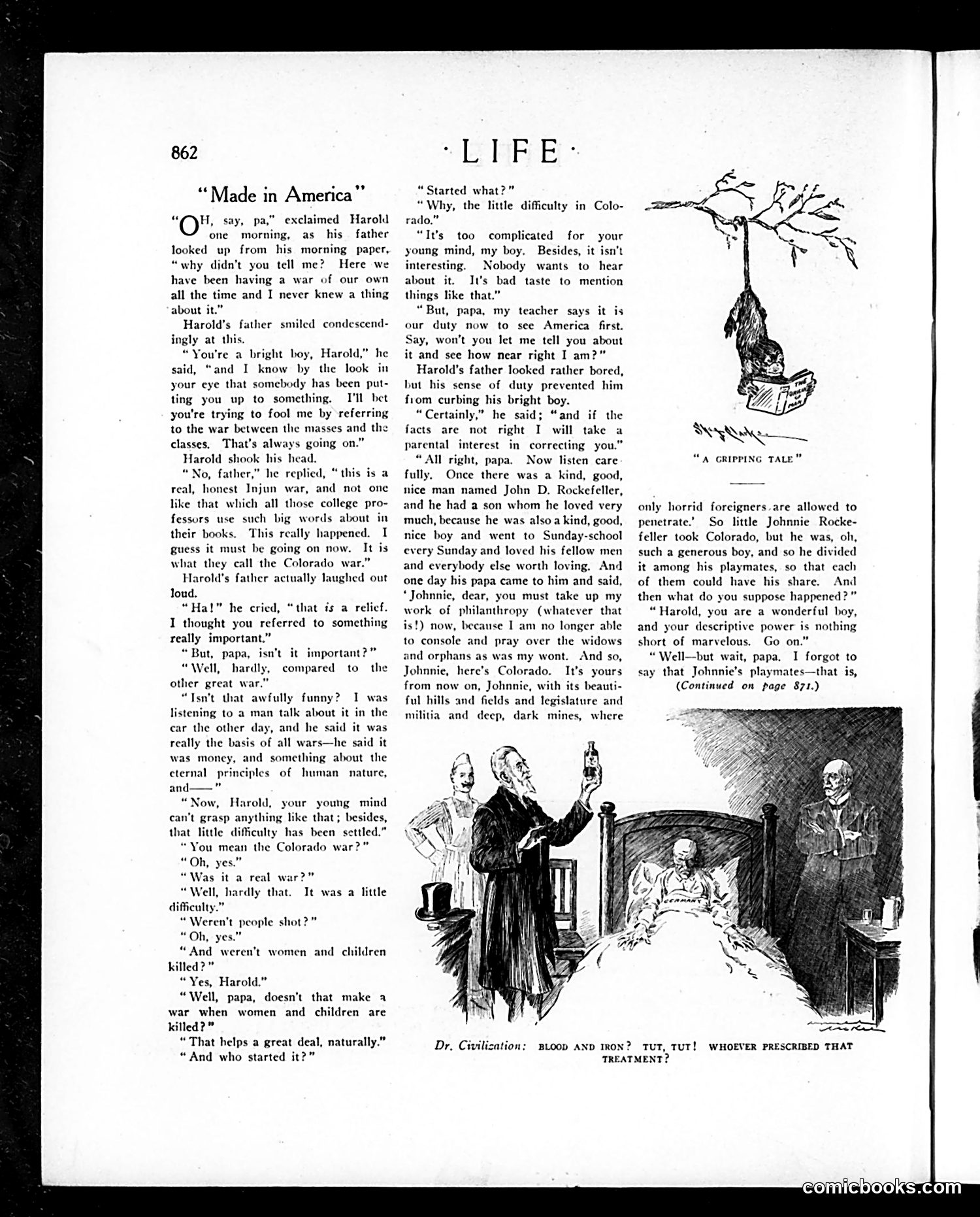
This 1914 *Life* magazine page satirizes American indifference to the Colorado Coal War (1913-1914), a violent labor conflict between coal miners and Rockefeller-owned mines. The dialogue between Harold and his father mocks adult dismissal of the "little difficulty"—despite admitting people, including women and children, were killed. The father calls it unimportant compared to "other great wars," refuses to discuss it as "bad taste," and claims it's "too complicated" for a young mind. The satire cuts sharply: Harold innocently exposes the hypocrisy—if women and children die, isn't that a war? The father has no logical answer. The secondary cartoon shows a doctor prescribing "blood and iron" treatment, likely mocking both Prussian militarism and the violent suppression of the Colorado strikers. The piece criticizes how privileged Americans ignored or minimized a domestic labor massacre while claiming moral authority about global conflicts.
📄 Transcribed text from this page (OCR, searchable)
Machine-transcribed from the original scan — historical spelling and the odd misread are preserved.
862 “Made in America exclaimed Harold Ol sy pa” one morning, as his father looked up from his morning paper, “why didn’t you tell me? Here we have been having a war of our own all the time and I never knew a thing about it.” Harold’s father smiled condescend- ingly at this. “You're a bright boy, Harold,” he said, “and I know by the look in your eye that somebody has been put- ting you up to something. I'll bet you're trying to fool me by referring to the war between the masses and the classes. That's always going on.” Harold shook his head. “No, father,” he replied, “this is a real, honest Injun war, and not one like that which all those college pro- fessors use such big words about in their books. This really happened. 1 guess it must be going on now, It is what they call the Colorado war.” Harold's father actually laughed out loud. “Hal” he cried, “that is a relief. I thought you referred to something really important.” “But, papa, isn’t it important?” “Well, hardly, compared to the other great wai “Isn't that awfully funny? listening to a man talk about it in the car the other day, and he said it was really the basis of all wars—he said it was money, and something about the eternal principles of human nature, and—— “Now, Harold, your young mind can’t grasp anything like that; besides, that little difficulty has been settled.” “You mean the Colorado war?” “Oh, yes.” “Was it a real war?” “Well, hardly that. It was a little difficulty. “Weren't people shot?” “Oh, yes.” “And weren't women and children killed?” “Yes, Harold.” “Well, papa, doesn't that make a war when women and children are killed?” “That helps a great deal, naturally.” “And who started it?” I was “ERE: “Started what?” “Why, the little difficulty in Colo- rado. “It’s too complicated for your young mind, my boy. Besides, it isn’t interesting. Nobody wants to hear about it. It’s bad taste to mention things like that.” “But, papa, my teacher says it is our duty now to see America first. y, won't you let me tell you about it and see how near right I am?” Harold’s father looked rather bored, but his sense of duty prevented him fiom curbing his bright boy. “Certainly,” he said; “and if the facts are not right I will take a parental interest in correcting you.’ “All right, papa. Now listen care fully, Once there was a kind, good, nice man named John D. Rockefeller, and he had a son whom he loved very much, because he was also a kind, good, nice boy and went to Sunday-school every Sunday and loved his fellow men and everybody else worth loving, And one day his papa came to him and said, *Johnnic, dear, you must take up my work of philanthropy (whatever that is!) now, because I am no longer able to console and pray over the widows and orphans as was my wont. And so, Johnnie, here's Colorado. It’s yours from now on, Johnnie, with its beauti- ful hills and fields and legislature and militia and deep, dark mines, where ization; BLOOD AND IRON? ““\ GRIPPING TALE” only horrid foreigners are allowed to penetrate.’ So little Johnnie Rocke- feller took Colorado, but he was, oh, such a generous boy, and so he divided it among his playmates, so that each of them could have his share. And then what do you suppose happened?” “Harold, you are a wonderful boy, and your descriptive power is nothing short of marvelous. Go on.” “Well—but wait, papa. I forgot to say that Johnnie’s playmates—that is, (Continued on page 871.) TUT, TUT! WHOEVER PRESCRIBED THAT TREATMENT?