
Life, 1914-11-12 · page 21 of 48
Life — November 12, 1914 — page 21: what you’re looking at
What you’re looking at
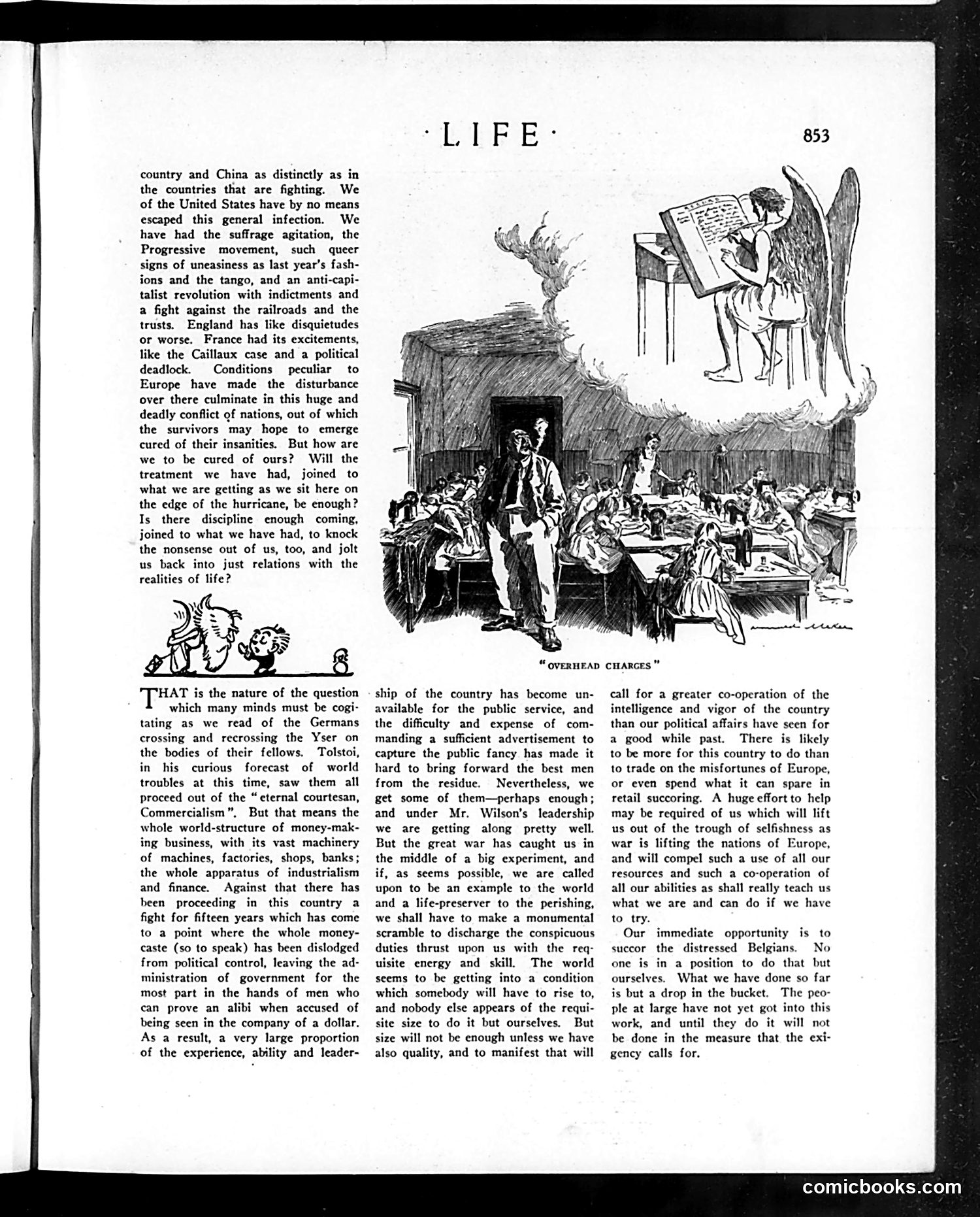
This page critiques American society during World War I (text references the war's ongoing devastation). The cartoon titled "Overhead Charges" depicts a crowded, chaotic scene—likely representing government bureaucracy or business inefficiency, with an angel figure overhead observing the mess below. The accompanying text argues that America has undergone progressive reforms (suffrage, trust-busting) that removed experienced businessmen from public service due to anti-capitalist sentiment. The author contends this "dislodging" of the "money-caste" from political control has left the nation under-equipped in talent and expertise, precisely when World War I demands maximum national capacity and cooperation. The satire's point: America's internal political battles have eliminated valuable leadership just when the country might need to aid Europe and demonstrate moral authority. The cartoon visualizes this ironic cost—the "overhead charges" of ideological reform.
📄 Transcribed text from this page (OCR, searchable)
Machine-transcribed from the original scan — historical spelling and the odd misread are preserved.
country and China as distinctly as in the countries that are fighting. We of the United States have by no means escaped this general infection. We have had the suffrage agitation, the Progressive movement, such queer signs of uneasiness as last year’s fash- ions and the tango, and an anti-capi- talist revolution with indictments and a fight against the railroads and the trusts. England has like disquietudes or worse. France had its excitements, like the Caillaux case and a political deadlock. Conditions peculiar to Europe have made the disturbance over there culminate in this huge and deadly conflict of nations, out of which the survivors may hope to emerge cured of their insanities. But how are we to be cured of ours? Will the treatment we have had, joined to what we are getting as we sit here on the edge of the hurricane, be enough? Is there discipline enough coming, joined to what we have had, to knock the nonsense out of us, too, and jolt us back into just relations with the realities of life? HAT is the nature of the question which many minds must be cogi- tating as we read of the Germans crossing and recrossing the Yser on the bodies of their fellows. Tolstoi, in his curious forecast of world troubles at this time, saw them all proceed out of the “eternal courtesan, Commercialism”, But that means the whole world-structure of money-mak- ing business, with its vast machinery of machines, factories, shops, banks ; the whole apparatus of industrialism and finance. Against that there has been proceeding in this country a fight for fifteen years which has come to a point where the whole money- caste (so to speak) has been dislodged from political control, leaving the ad- ministration of government for the most part in the hands of men who can prove an alibi when accused of being seen in the company of a dollar. As a result, a very large proportion of the experience, ability and leader- “OVERHEAD CHARGES” ship of the country has become un- available for the public service, and the difficulty and expense of com- manding a sufficient advertisement to capture the public fancy has made it hard to bring forward the best men from the residue. Nevertheless, we get some of them—perhaps enough; and under Mr. Wilson’s leadership we are getting along pretty well. But the great war has caught us in the middle of a big experiment, and if, as seems possible, we are called upon to be an example to the world and a life-preserver to the perishing, we shall have to make a monumental scramble to discharge the conspicuous duties thrust upon us with the req- uisite energy and skill. The world seems to be getting into a condition which somebody will have to rise to, and nobody else appears of the requi- site size to do it but ourselves. But size will not be enough unless we have also quality, and to manifest that will call for a greater co-operation of the intelligence and vigor of the country than our political affairs have seen for a good while past. There is likely to be more for this country to do than to trade on the misfortunes of Europe, or even spend what it can spare in retail succoring. A huge effort to help may be required of us which will lift us out of the trough of selfishness as war is lifting the nations of Europe, and will compel such a use of all our resources and such a co-operation of all our abilities as shall really teach us what we are and can do if we have to try. Our immediate opportunity is to succor the distressed Belgians. No one is in a position to do that but ourselves. What we have done so far is but a drop in the bucket. The peo- ple at large have not yet got into this work, and until they do it will not be done in the measure that the exi- gency calls for. comicbooks.com