
A complete issue · 48 pages · 1914
Life — November 5, 1914
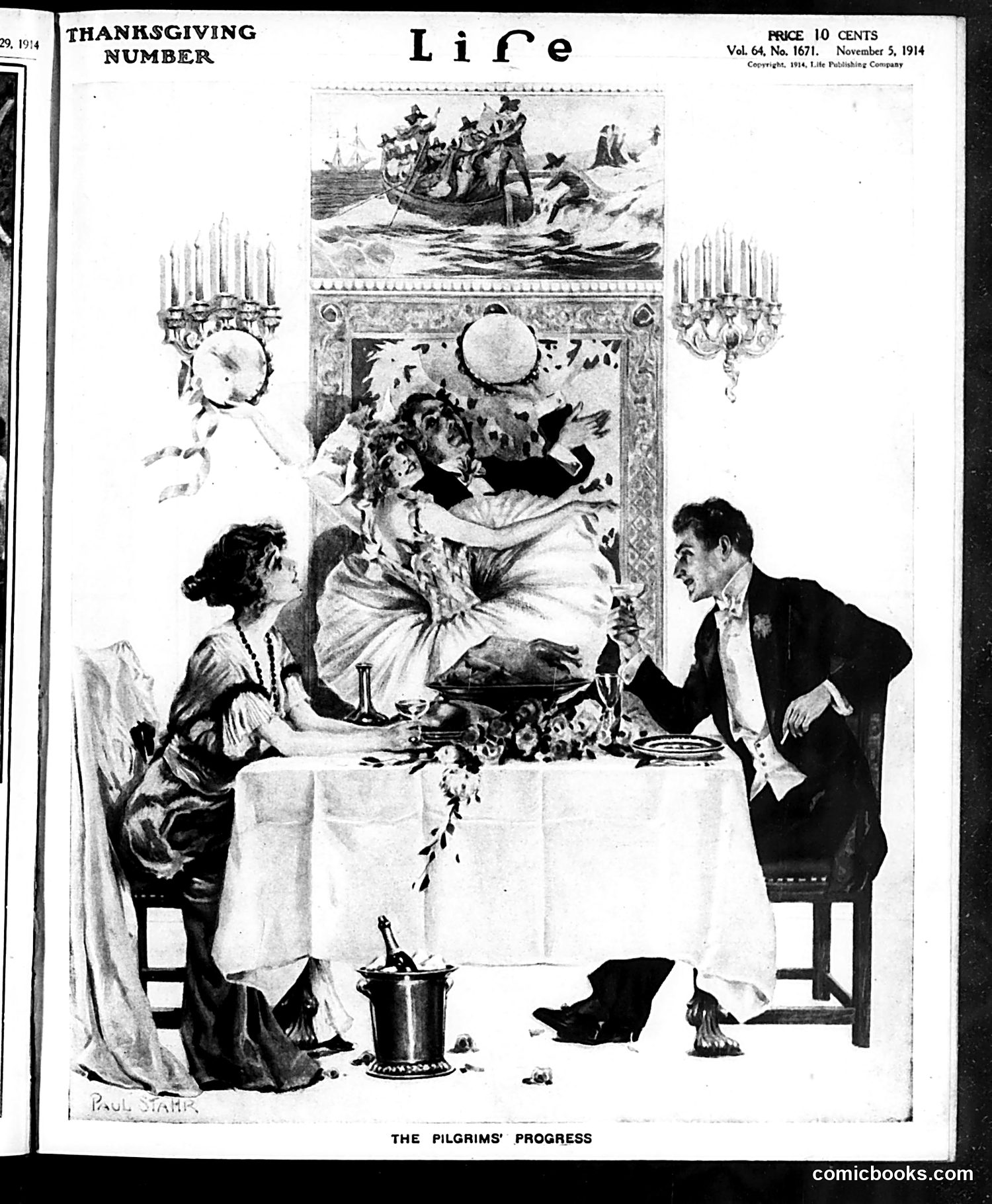
This Thanksgiving cartoon by Paul Starr depicts a well-dressed couple dining formally while chaos erupts above them. The title "The Pilgrims' Progress" references John Bunyan's allegorical work, suggesting a commentary on American progress and values. The illustration appears to contrast genteel domestic comfort (the formal dinner with candelabras) against turbulent historical events unfolding in the background panel—showing what appears to be a shipwreck or maritime disaster, possibly referencing the original Pilgrims' voyage. The satire likely critiques American society in 1914: while citizens enjoy prosperity and refinement, serious troubles—possibly World War I (currently raging in Europe) or other national concerns—are literally happening above their heads, suggesting willful ignorance or disconnection from grave external realities.
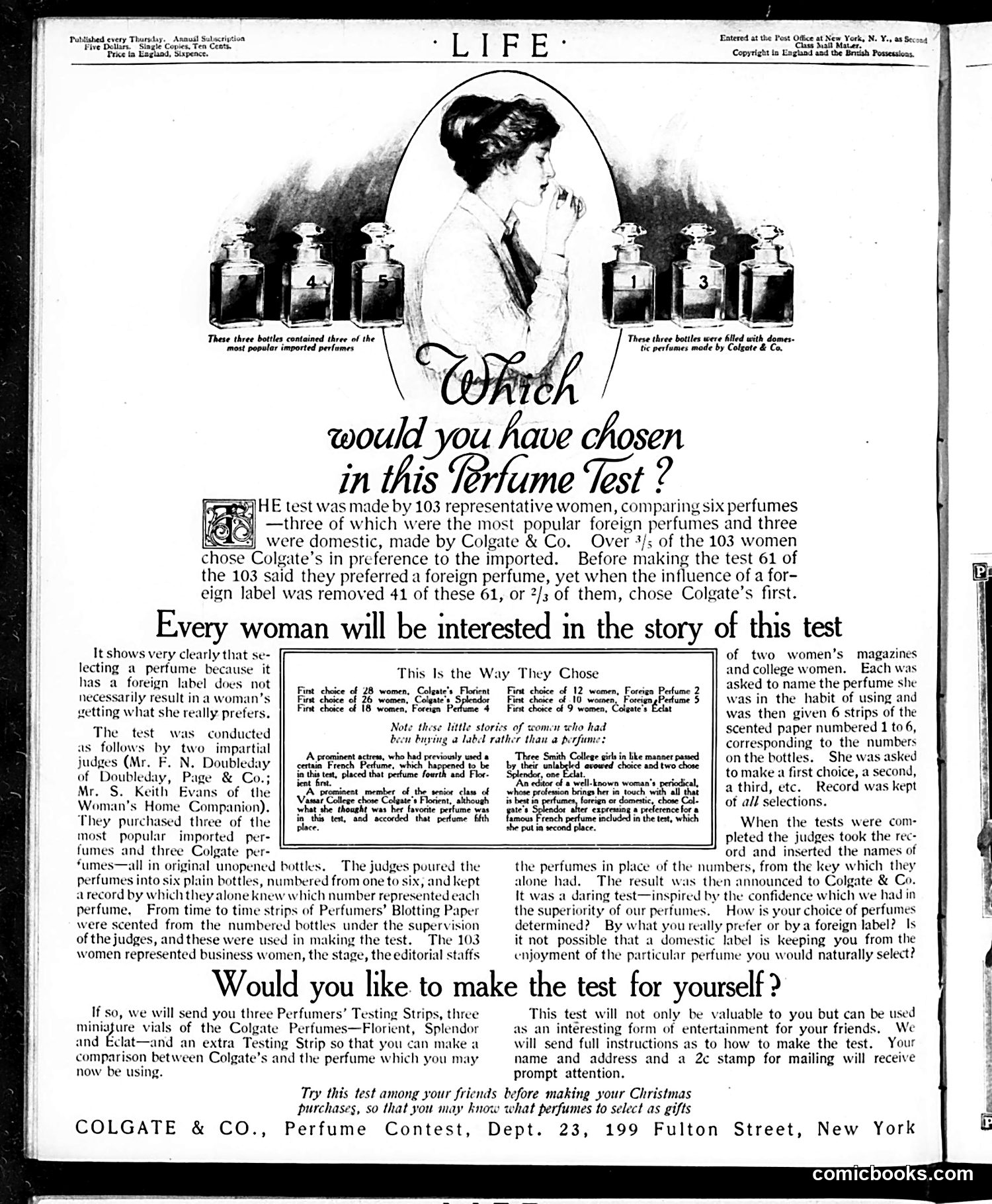
This is **not a satirical cartoon** but rather a **paid advertisement** for Colgate & Co. perfume, disguised as editorial content in Life magazine. The ad presents itself as reporting on a "perfume test" where 103 women compared imported French perfumes against Colgate's domestic product. The claim: over 2/3 chose Colgate's when brand labels were hidden, and 41 of 61 women who initially preferred foreign perfumes switched to Colgate when the origin was concealed. The illustrated woman and perfume bottles frame this as a pseudo-scientific "blind taste test" (or smell test). The ad invites readers to conduct their own test using provided samples. This represents **early 20th-century advertising strategy**: presenting commercial claims as objective consumer research to build credibility and encourage product trials.
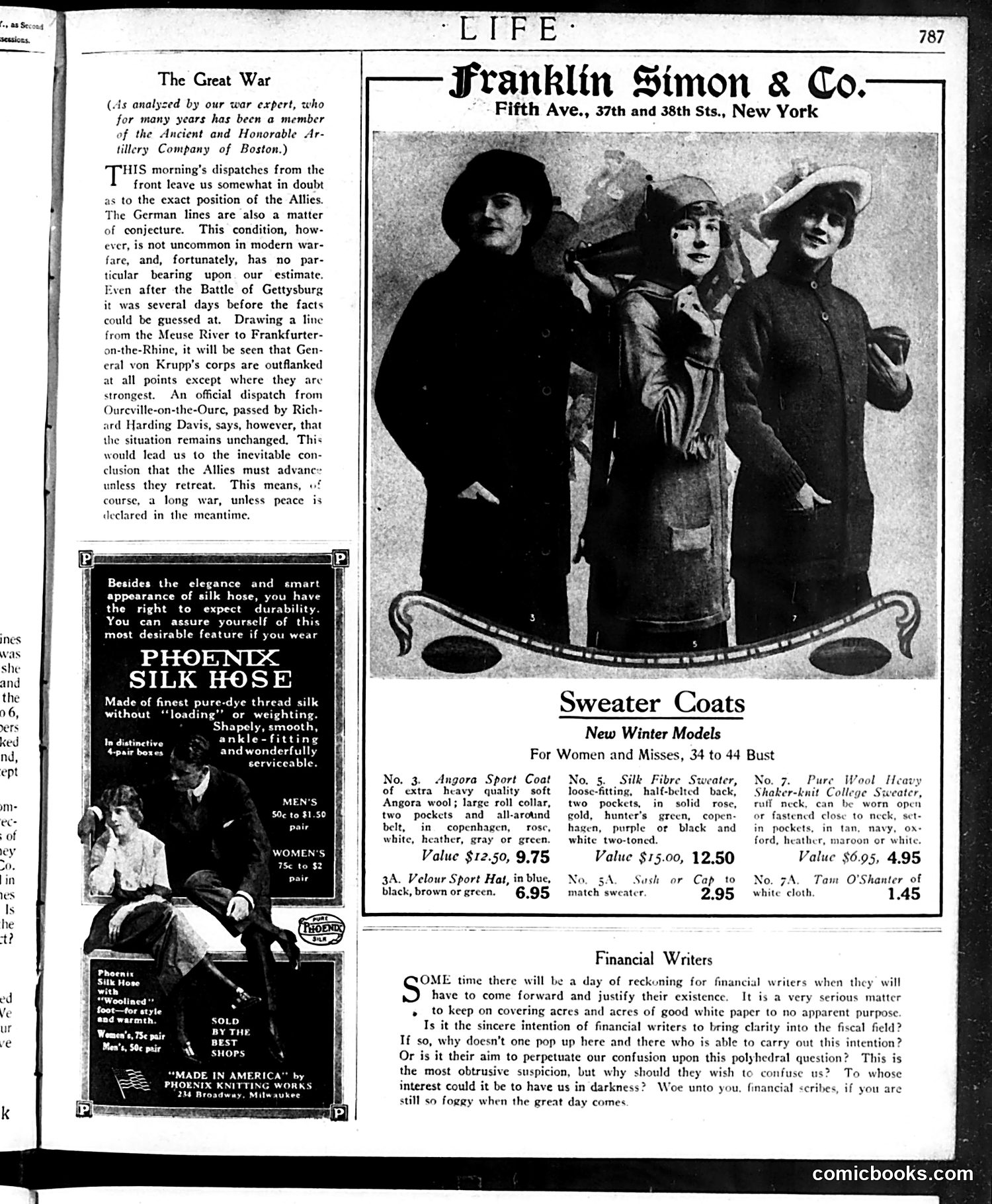
This page is **primarily commercial**, containing three advertisements (Phoenix Silk Hose, Franklin Simon & Co. sweater coats, and Best Shoes) rather than political cartoons or satire. The only editorial content is "The Great War" column discussing WWI's military situation—specifically, uncertainty about Allied and German positions following Gettysburg. The author notes that drawing battle lines from the Meuse River to Frankfurter-on-the-Rhine reveals General von Krupp's corps are outflanked except at their strongest points, concluding the Allies must advance or retreat. The column contains **no caricature or satire**—it's a straightforward military analysis. The sweater coat advertisement features three women in winter fashion, entirely unrelated to war commentary. This is a typical early-WWI-era magazine page mixing news analysis with consumer advertising.
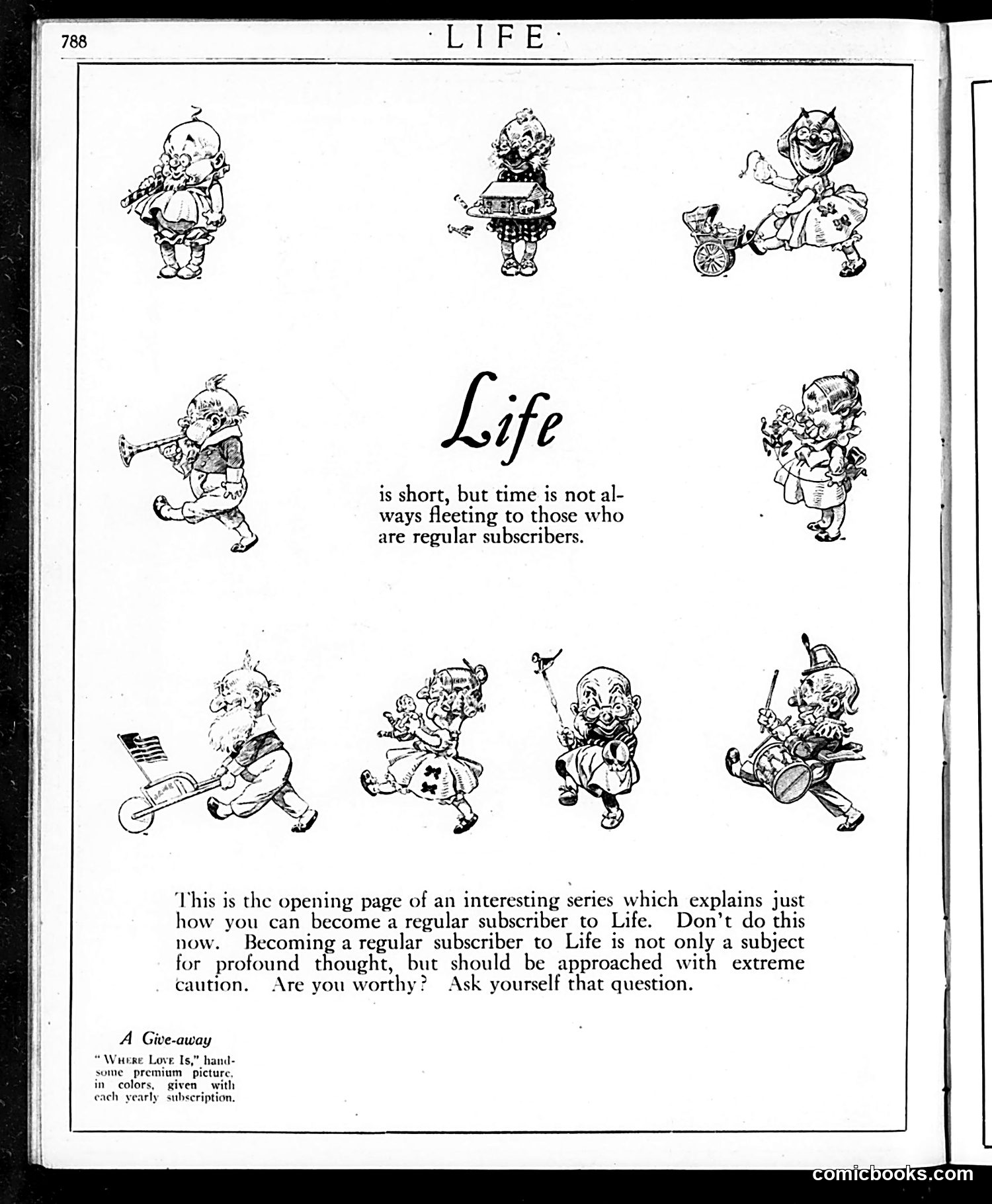
This is a promotional page for *Life* magazine subscriptions, not political satire. The page features nine whimsical illustrations of babies and toddlers engaged in various activities—playing instruments, riding toys, wielding flags and tools. The central message uses gentle humor: "Life is short, but time is not always fleeting to those who are regular subscribers." This is a subscription pitch suggesting that reading *Life* regularly makes time pass more enjoyably. The bottom text addresses potential subscribers directly, asking "Are you worthy?" of regular subscription—a tongue-in-cheek challenge framed as requiring "extreme caution" and "profound thought." The page advertises a give-away: a "Where Love Is" premium picture in colors with yearly subscriptions. This is purely commercial content using cute imagery and light satire to encourage subscriptions.
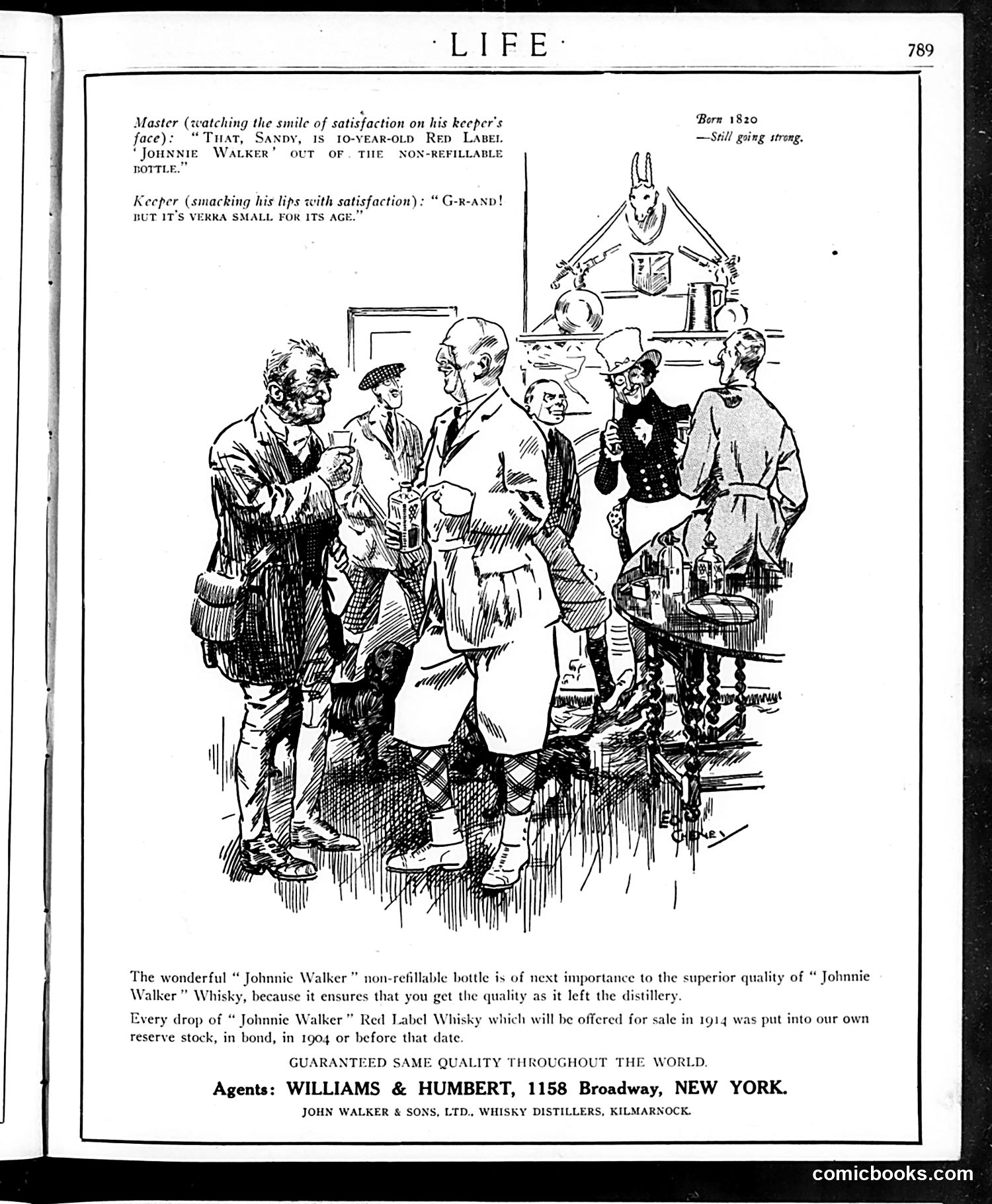
This page is primarily a **whisky advertisement** for Johnnie Walker Red Label, disguised as satirical content. The cartoon depicts what appears to be a tasting or sales gathering where a "Master" and "Keeper" discuss the whisky's quality—the Master praising its age (10 years old), the Keeper affirming its smallness for that age. The accompanying text emphasizes the product's reliability and consistent quality. The caricatured figures represent typical Victorian-era gentleman consumers and merchants. The satire is minimal; this is essentially **commercial advertising using humor** to market Johnnie Walker whisky to American consumers in 1914. The "non-refillable bottle" innovation and reserve stock claims serve as selling points targeting quality-conscious buyers.
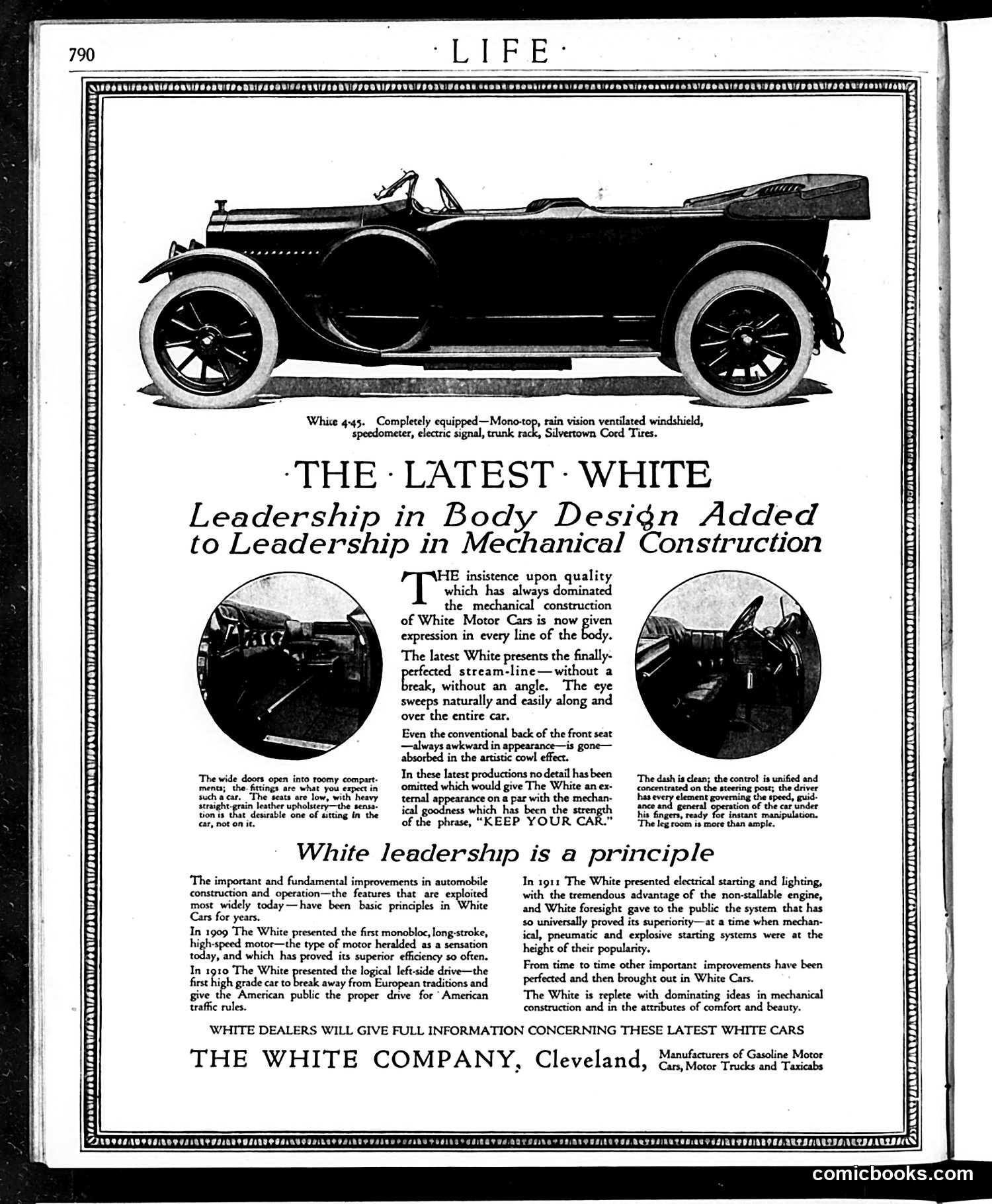
This is **not a cartoon or satirical content**—it's a straightforward automobile advertisement for the White Motor Company of Cleveland. The page features a luxury car model (White #45) with technical specifications and promotional text emphasizing the company's engineering leadership. The advertisement highlights mechanical innovations: electrical starting and lighting (noted as a 1911 advancement), stream-lined body design, and quality construction. Two circular inset photographs show interior mechanical details—the engine compartment and dashboard controls—to demonstrate sophisticated engineering. The copy uses period business language ("leadership is a principle") to position White cars as premium vehicles combining mechanical excellence with aesthetic design. This represents typical early 1920s automotive advertising emphasizing technological innovation and craftsmanship to justify higher prices.
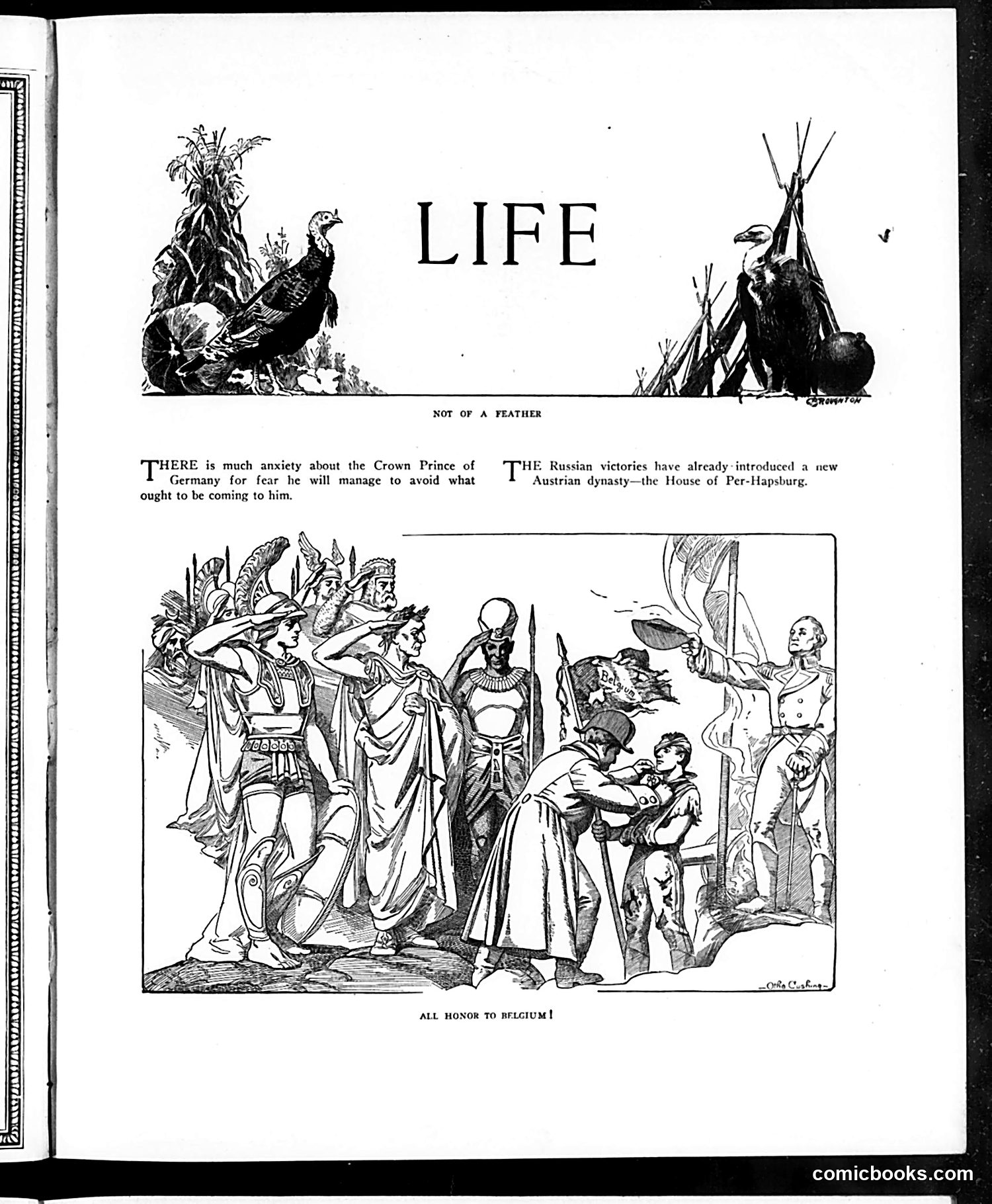
This page contains political commentary on World War I events. The top section warns about anxiety regarding Germany's Crown Prince, fearing undesirable consequences for him—likely referring to military defeat or capture. The main illustration, captioned "All Honor to Belgium!", depicts a classical/allegorical scene showing what appears to be European royalty and military figures encountering Belgian representatives (suggested by the flag). The caption sarcastically praises Belgium, likely referencing Belgium's resistance to German invasion in WWI and the international sympathy it garnered. The brief note about Russian victories introducing "a new Austrian dynasty—the House of Per-Hapsburg" is a dark joke: the Russian military advances threatened to eliminate the existing Austro-Hungarian Hapsburg dynasty through defeat. These pieces reflect American wartime political commentary, likely from 1914-1918.
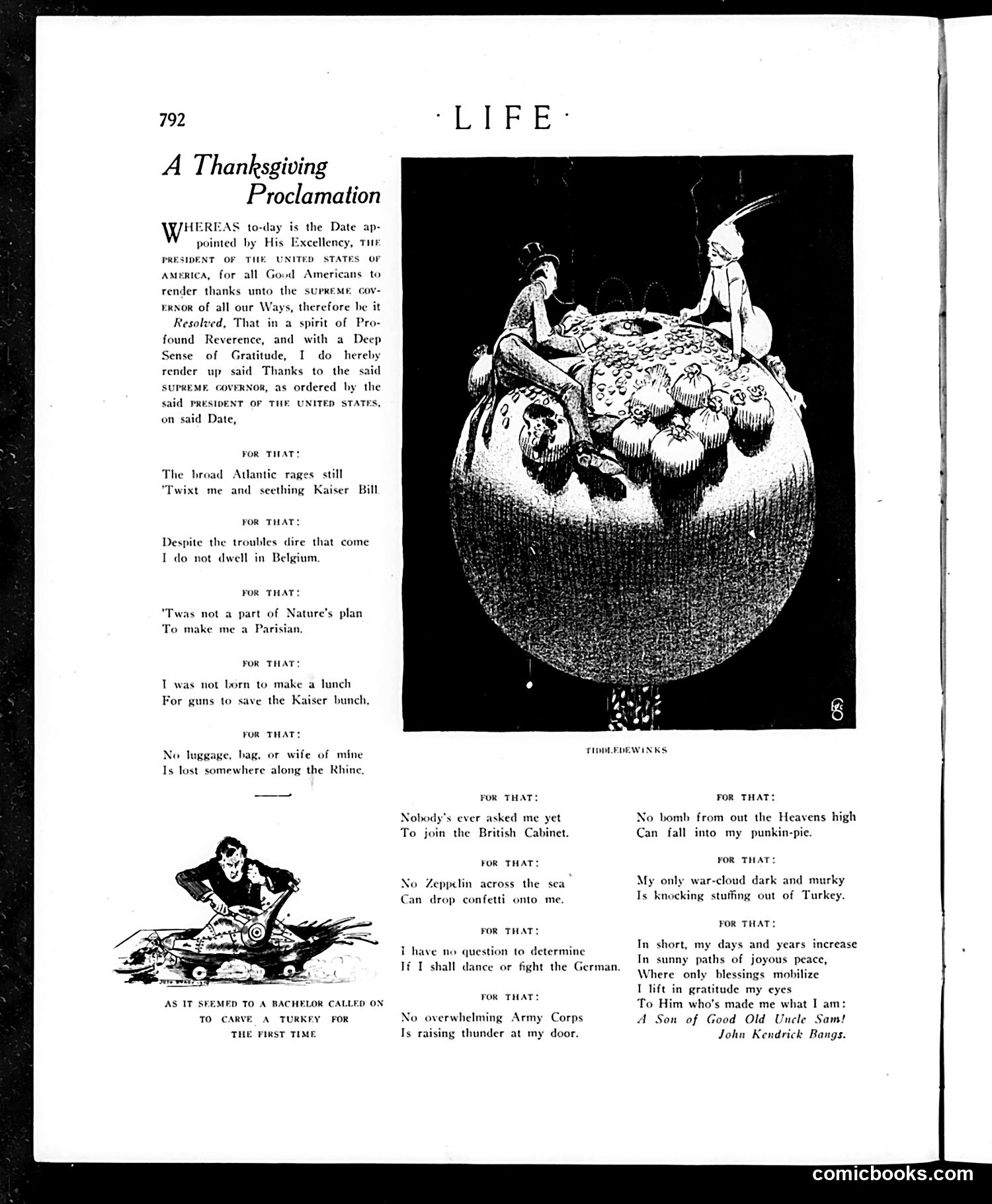
This page satirizes a Thanksgiving proclamation ostensibly from the U.S. President. The central illustration shows two gnome-like figures atop a large globe/world decorated with harvest foods, suggesting global abundance being carved up. The proclamation uses the traditional "WHEREAS" legal format but subverts it with darkly humorous lines about WWI hardships: Atlantic "rages," Kaiser Bill, Belgian troubles, Parisian status, gun manufacturing, lost luggage along the Rhine, and German military threats. Each complaint is followed by "FOR THAT:" — a prayer of gratitude despite these war-related miseries. The bottom cartoon shows someone carving a turkey, captioned as "a bachelor called on to carve a turkey for the first time." The page satirizes American pretensions to gratitude amid WWI chaos and personal wartime frustrations.
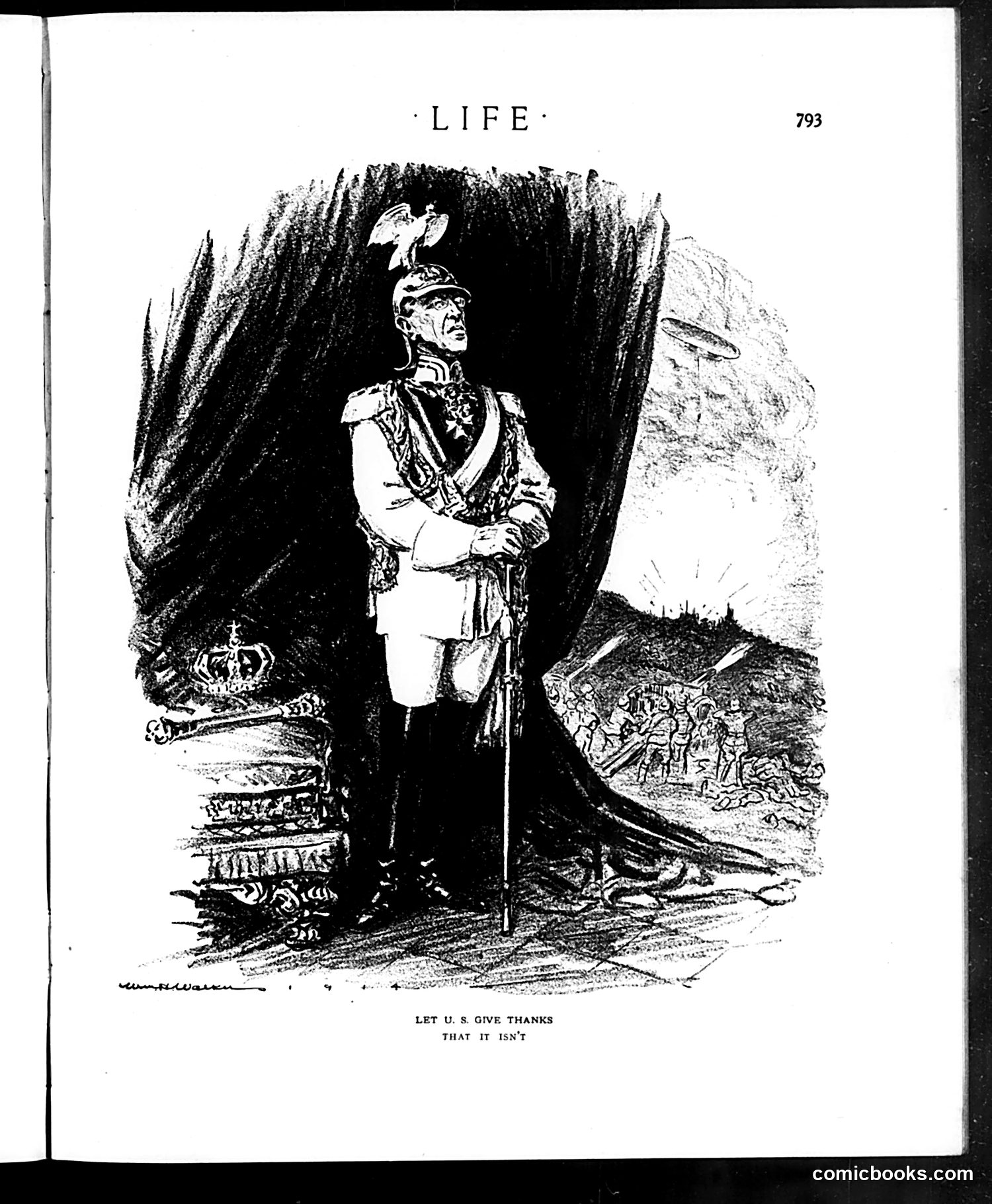
This page from *Life* magazine (page 793) features a satirical cartoon titled "LET U.S. GIVE THANKS THAT IT ISN'T." The image depicts a military figure in formal uniform with medals and regalia, standing in a dramatic pose with an eagle on his helmet. Behind him are military standards and what appears to be troops or a battlefield scene. The figure's posture and elaborate decoration suggest he represents a European military autocrat or authoritarian leader. The caption's cryptic phrasing—suggesting gratitude that "it" (presumably authoritarian militarism or monarchical rule) "isn't" present in America—indicates this is likely American commentary on European militarism, possibly referencing tensions with imperial powers before or during World War I. The cartoon celebrates American democratic values by contrast.
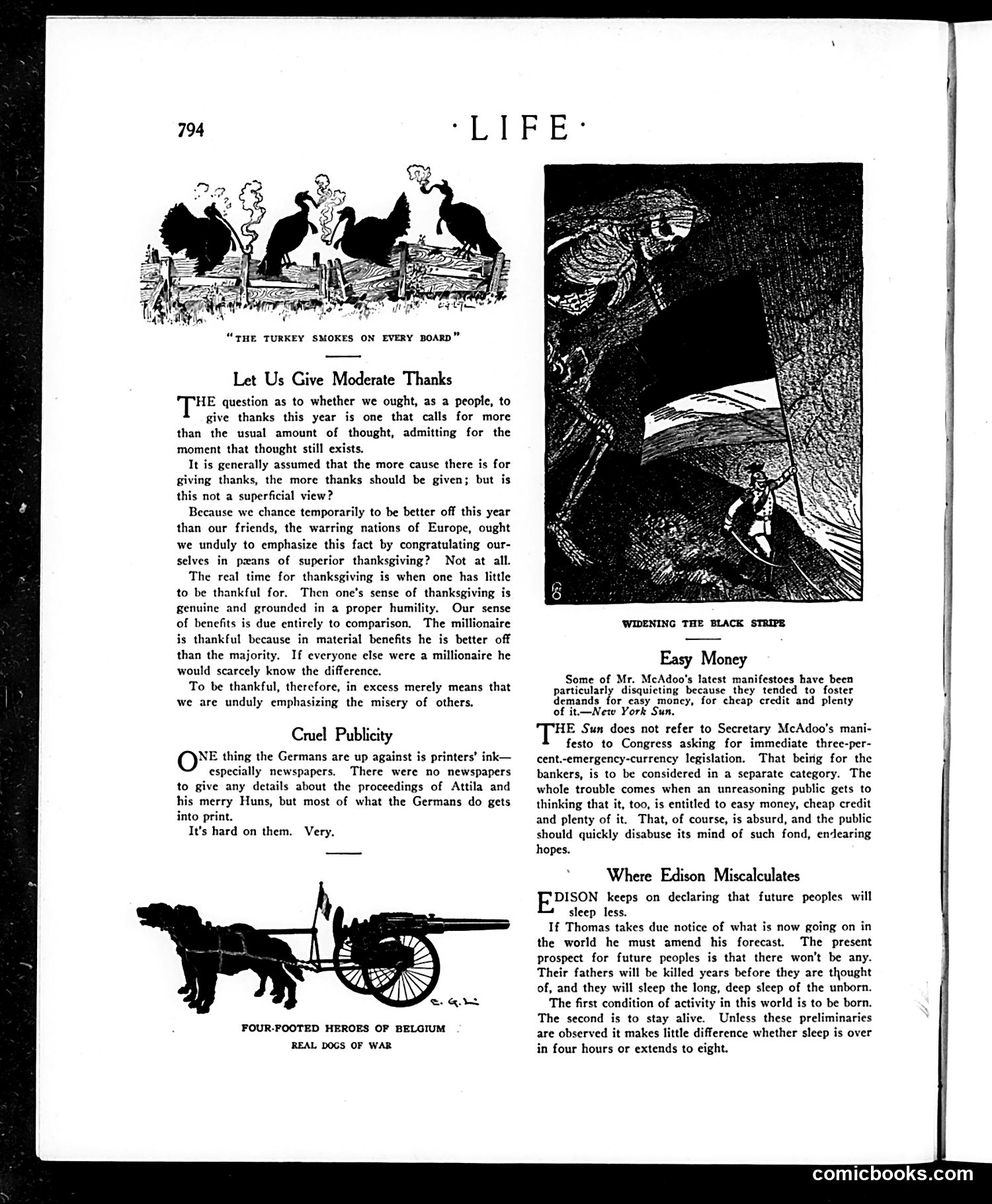
This page contains three distinct satirical pieces: 1. **"The Turkey Smokes on Every Board"** - A cartoon showing turkeys smoking at a fence, likely mocking excessive Thanksgiving consumption or war profiteering. 2. **"Let Us Give Moderate Thanks"** - An editorial arguing against excessive gratitude during wartime (context suggests WWI era based on references to Europe and Germany), asserting that true thankfulness requires genuine hardship, not comparative comfort. 3. **"Four-Footed Heroes of Belgium: Real Dogs of War"** - A cartoon of a dog pulling a cannon, referencing Belgium's actual use of dog-drawn artillery during WWI. 4. **"Easy Money" and "Where Edison Miscalculates"** - Brief commentaries on Secretary McAdoo's financial proposals and Edison's sleep predictions. The page reflects wartime satire questioning American prosperity and optimism amid global conflict.
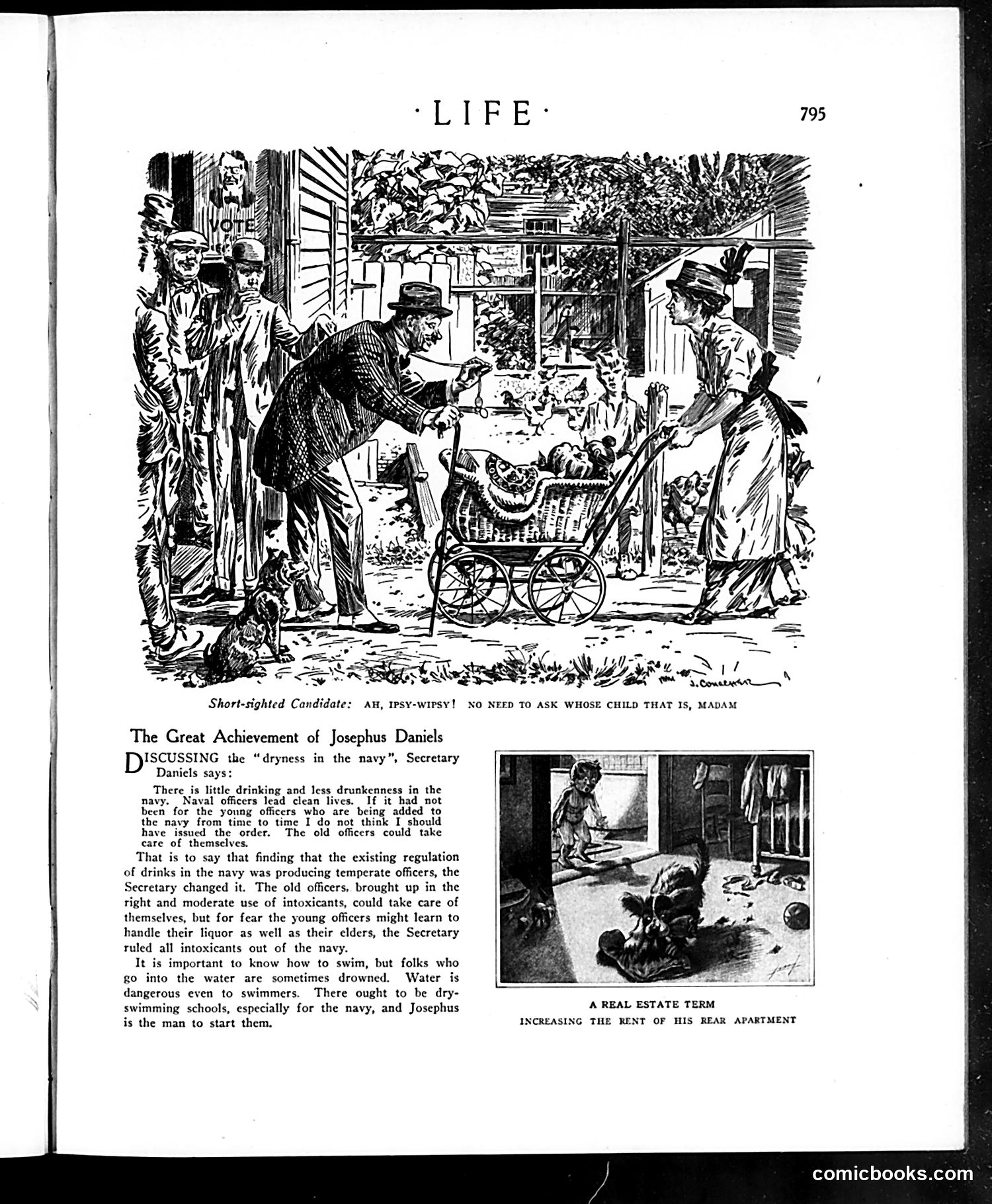
**Top Cartoon:** "Short-sighted Candidate" depicts a political candidate with a baby carriage, apparently unsure which child is his own—a joke about infidelity or illegitimacy among politicians seeking office. **Main Article:** "The Great Achievement of Josephus Daniels" discusses Secretary Daniels's naval policy reducing alcohol consumption. The text explains he banned drinks in the navy, believing this would produce "temperate officers" and prevent young sailors from learning poor drinking habits. The article also mentions establishing swimming schools to prevent drowning. **Bottom Photo:** "A Real Estate Term" shows someone lying on a floor, captioned as "increasing the rent of his rear apartment"—likely a dark humor reference to eviction or financial hardship during tenant disputes.
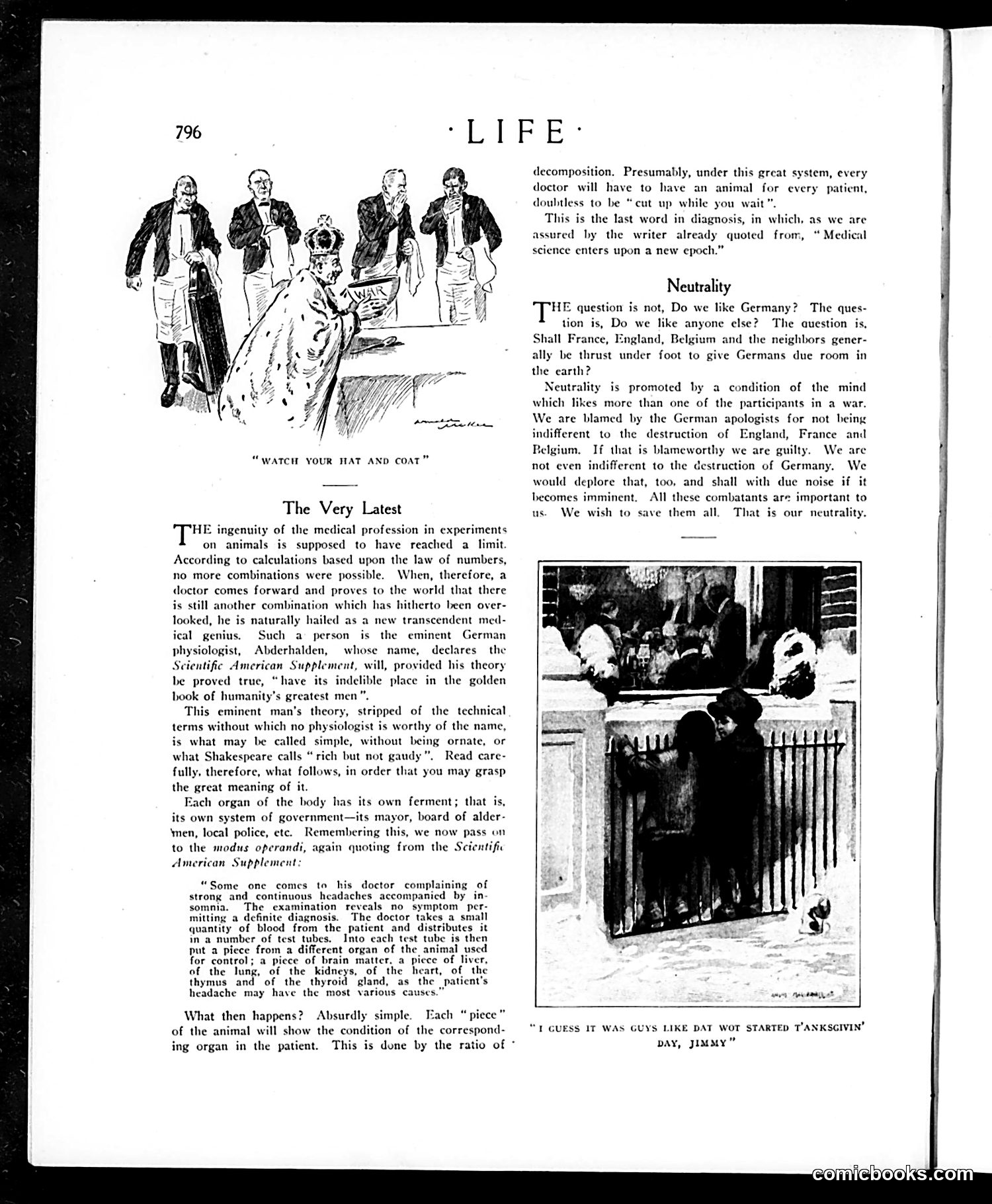
**Top Cartoon ("Watch Your Hat and Coat"):** This cartoon depicts four well-dressed men in medical or professional attire observing a woman being examined or treated. The caption suggests concern about theft or loss of personal belongings—likely satirizing the medical profession's trustworthiness or the chaotic conditions of medical practice during this period. **"The Very Latest" Section:** This article mocks a German physiologist named Alderhalden who claimed to have discovered a revolutionary diagnostic method. The satire ridicules the tendency of medical professionals to promote dubious "new" techniques, suggesting doctors extract animal organs to match patient organs for diagnosis—an absurdly impractical idea presented as cutting-edge science. **Bottom Photo:** A Thanksgiving-themed image with caption about "guys like dat" starting the holiday, likely depicting poor or immigrant families.
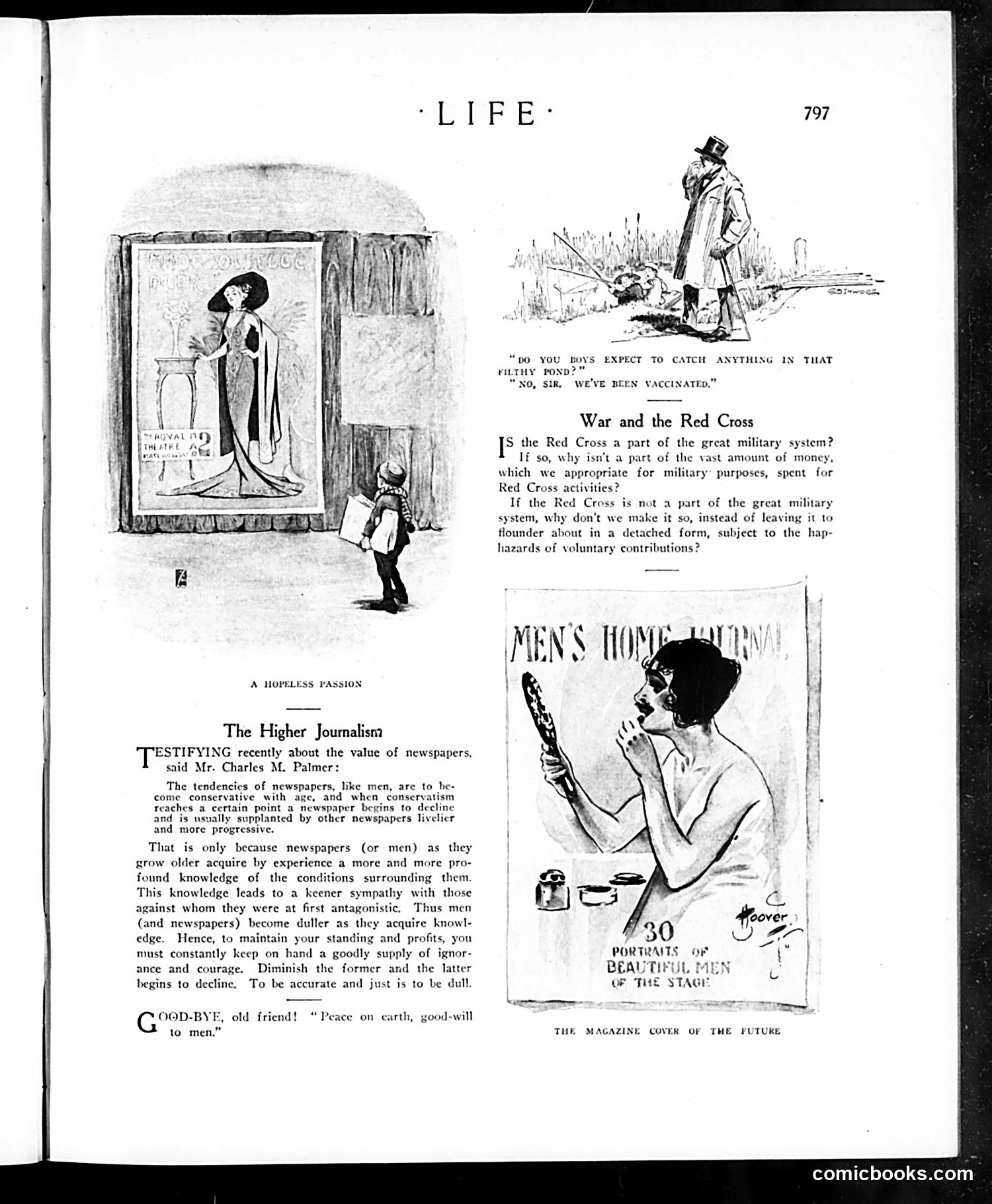
**Top Cartoon ("A Hopeless Passion"):** A well-dressed man gazes longingly at a portrait of an elegant woman displayed in a shop window. The satire suggests unrequited desire for something unattainable—likely a commentary on materialism or social aspiration. **Middle Section ("The Higher Journalism"):** Critical essay arguing that newspapers become more conservative and less truthful as they age and grow profitable. The author claims this happens because older newspapers prioritize profits over accuracy, suggesting institutional corruption of journalistic ideals. **Bottom Illustration:** Advertisement for "Men's Home Journal" featuring "30 Portraits of Beautiful Men of the Stage"—appears to be theatrical/entertainment promotion typical of period magazines. The page combines social satire with media criticism characteristic of Life's editorial approach.
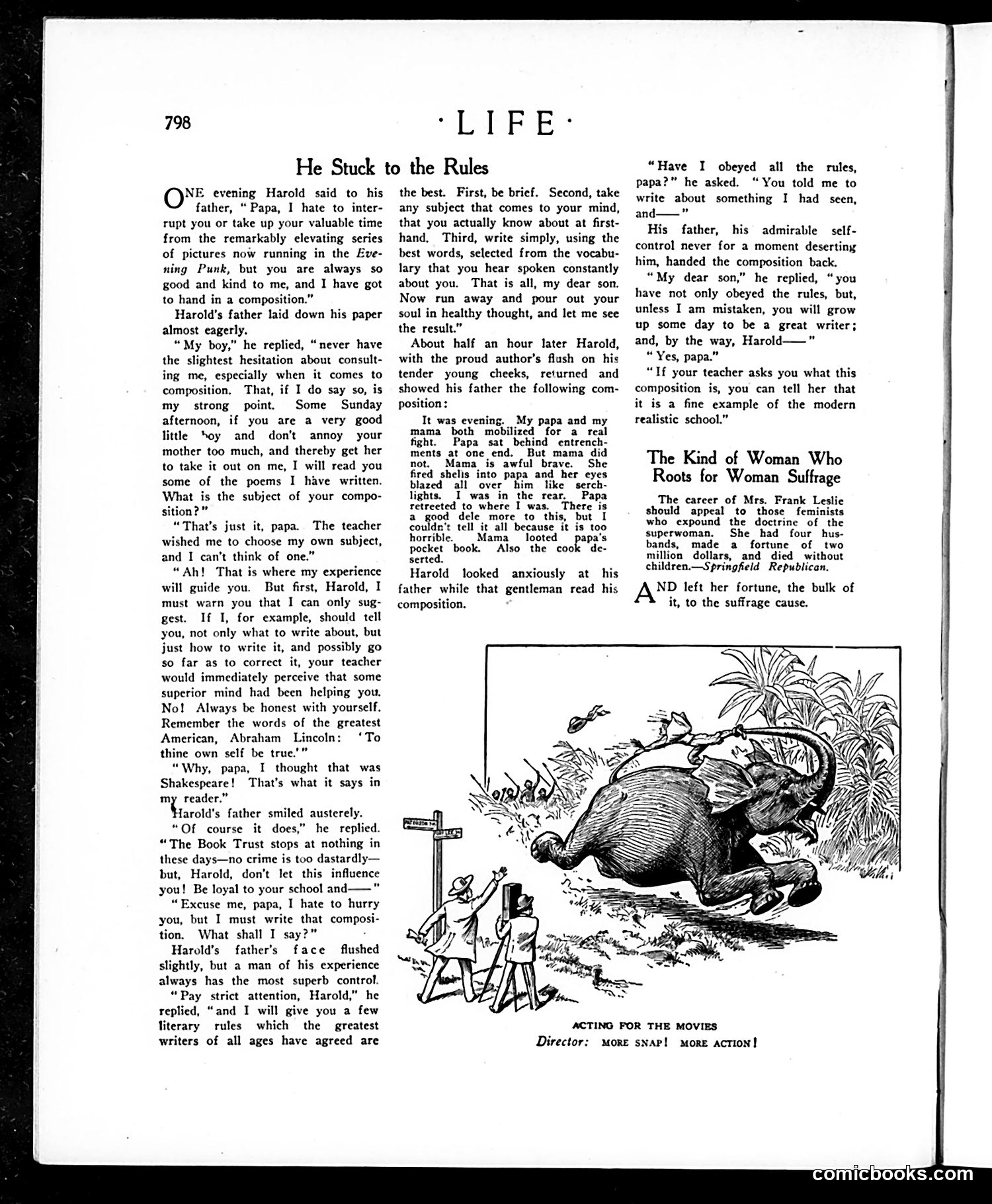
This page contains two distinct pieces: **Main Story ("He Stuck to the Rules"):** A narrative about Harold receiving writing advice from his father. The father emphasizes honesty, simplicity, and following established literary rules—citing Abraham Lincoln's advice to "be true to yourself." The story promotes traditional composition instruction. **Bottom Cartoon ("Acting for the Movies"):** A satirical sketch showing a film director demanding "MORE SNAP! MORE ACTION!" while an actor dramatically throws himself into exaggerated physical performance—apparently into or over a large mechanical crocodile or dinosaur prop. The joke mocks early silent film conventions requiring overwrought acting and spectacle to convey emotion to audiences, contrasting the director's demands with the absurdity of the "action" being performed. The page dates from cinema's silent era, when broad physical comedy dominated.
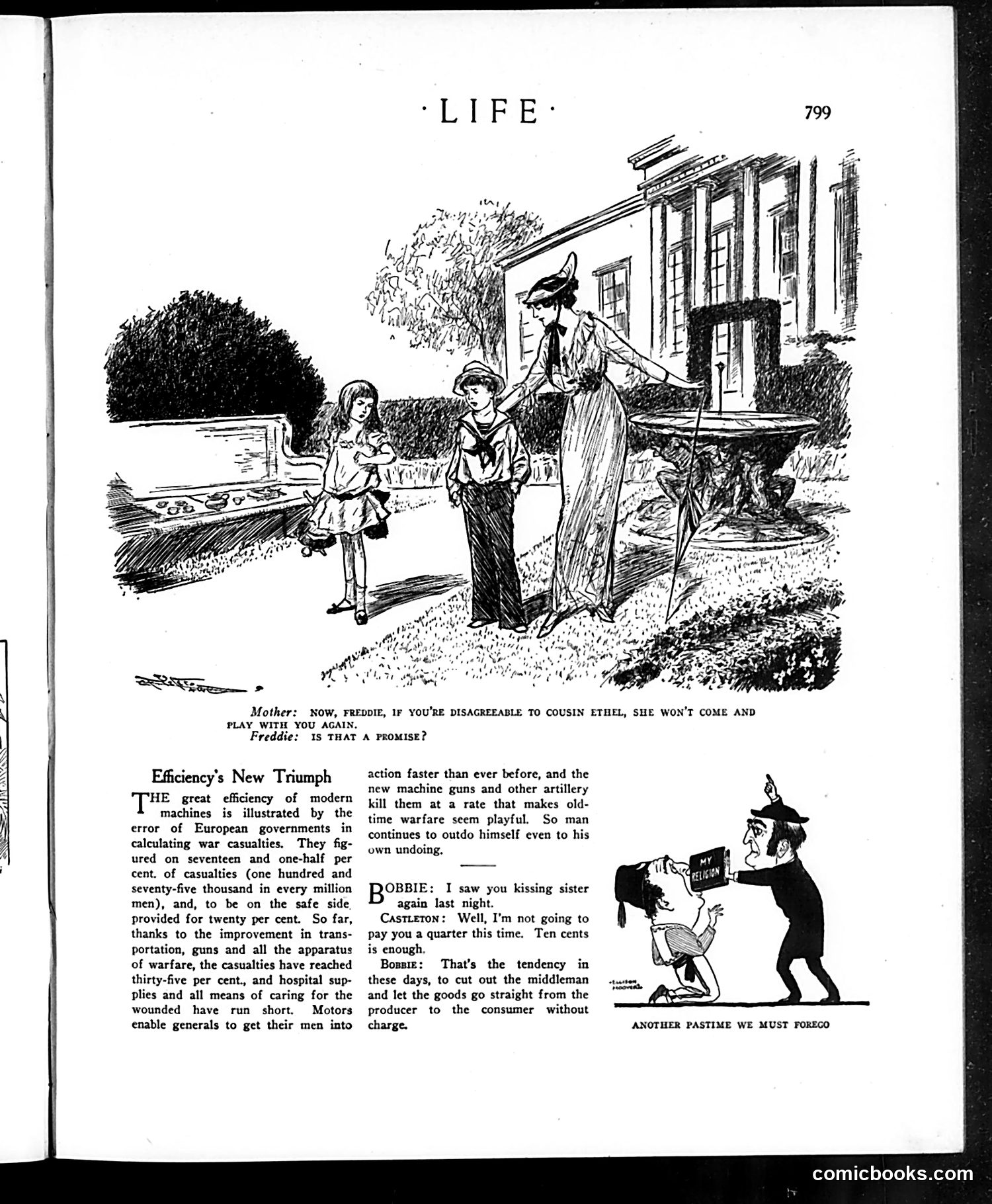
This page contains three separate satirical pieces: **Top cartoon**: A domestic scene where a mother threatens her son Freddie with social consequences (losing his cousin's company) if he misbehaves—a commentary on how social pressure enforces childhood behavior. **"Efficiency's New Triumph"**: Bitter wartime satire. The piece mocks European governments' casualty miscalculations in World War I, noting they predicted 17.5% casualties but actual losses reached 35%. The dark joke: modern "efficiency"—improved transportation, machine guns, artillery—kills soldiers twice as fast as expected. The conclusion ("man continues to outdo himself even to his own undoing") sardonically suggests technological progress paradoxically enables human destruction. **Bottom cartoon**: A blackmail negotiation where a boy ("Bobbie") witnesses romantic contact and attempts extortion. Castleton refuses to pay and cuts the bribe from a quarter to a dime. The caption's ironic economic commentary suggests eliminating intermediaries—here, the blackmailer—allows direct "transaction" between willing parties "without charge." All three pieces cynically observe modern life's absurdities.
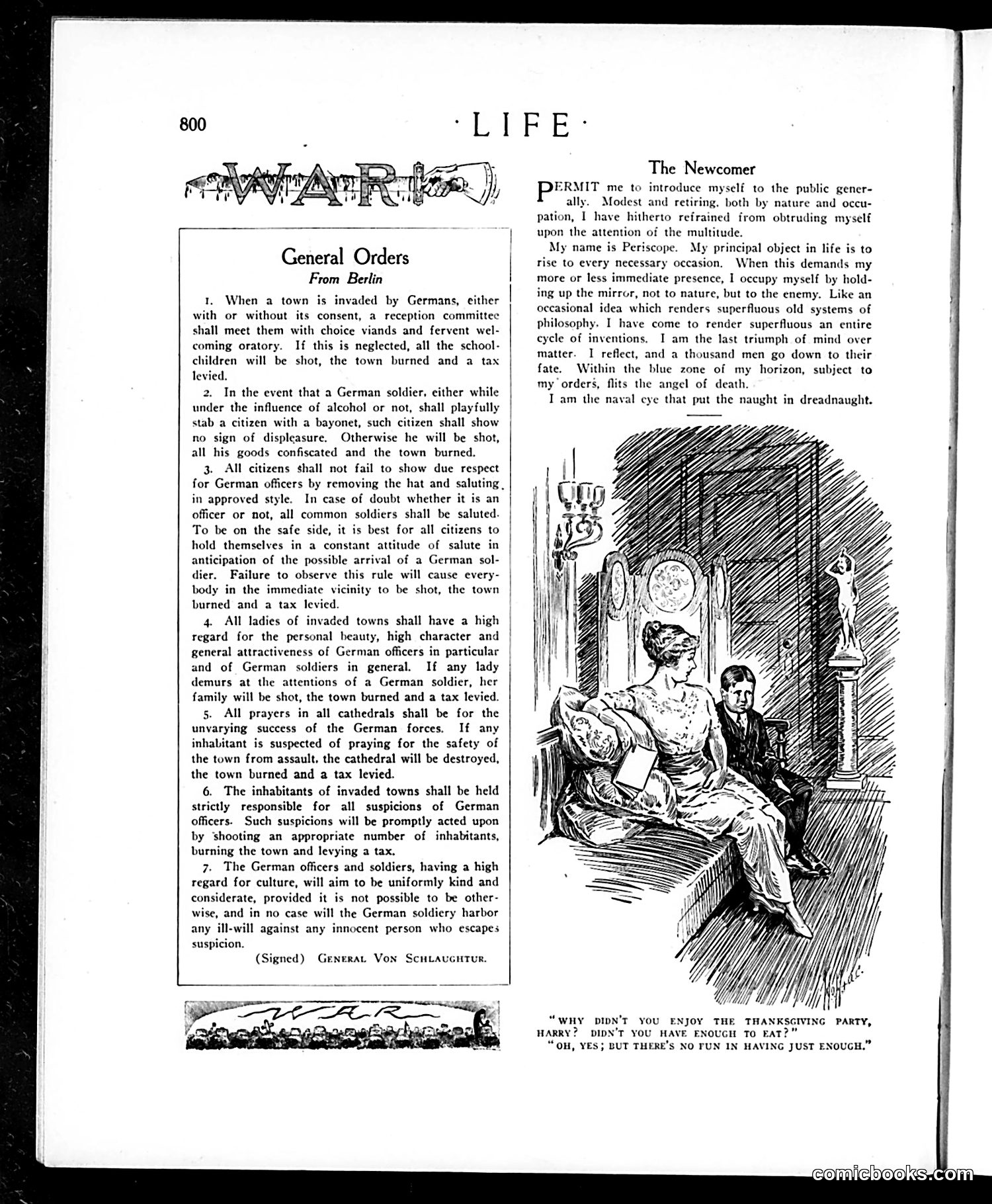
This page satirizes **German military occupation practices** during World War I. The "General Orders from Berlin" mockingly present supposed German regulations as absurdly brutal and contradictory—threatening to burn towns and execute civilians for minor infractions (failing to salute, showing displeasure at bayonet attacks, or praying for town safety). The final order ironically claims Germans harbor "no ill-will" despite the preceding threats. The satire exposes German conduct in invaded territories as tyrannical and terroristic, while the contradictions highlight the hypocrisy of claiming cultural regard while committing atrocities. **"The Newcomer"** personifies the **naval periscope** as a smug new weapon that has made older military technology obsolete. The illustration shows it as a proud figure in a ship's cabin. **The bottom cartoon** uses domestic humor (complaining about insufficient Thanksgiving food) as light relief, unrelated to the war content above. This reflects American WWI-era propaganda demonizing German military behavior.
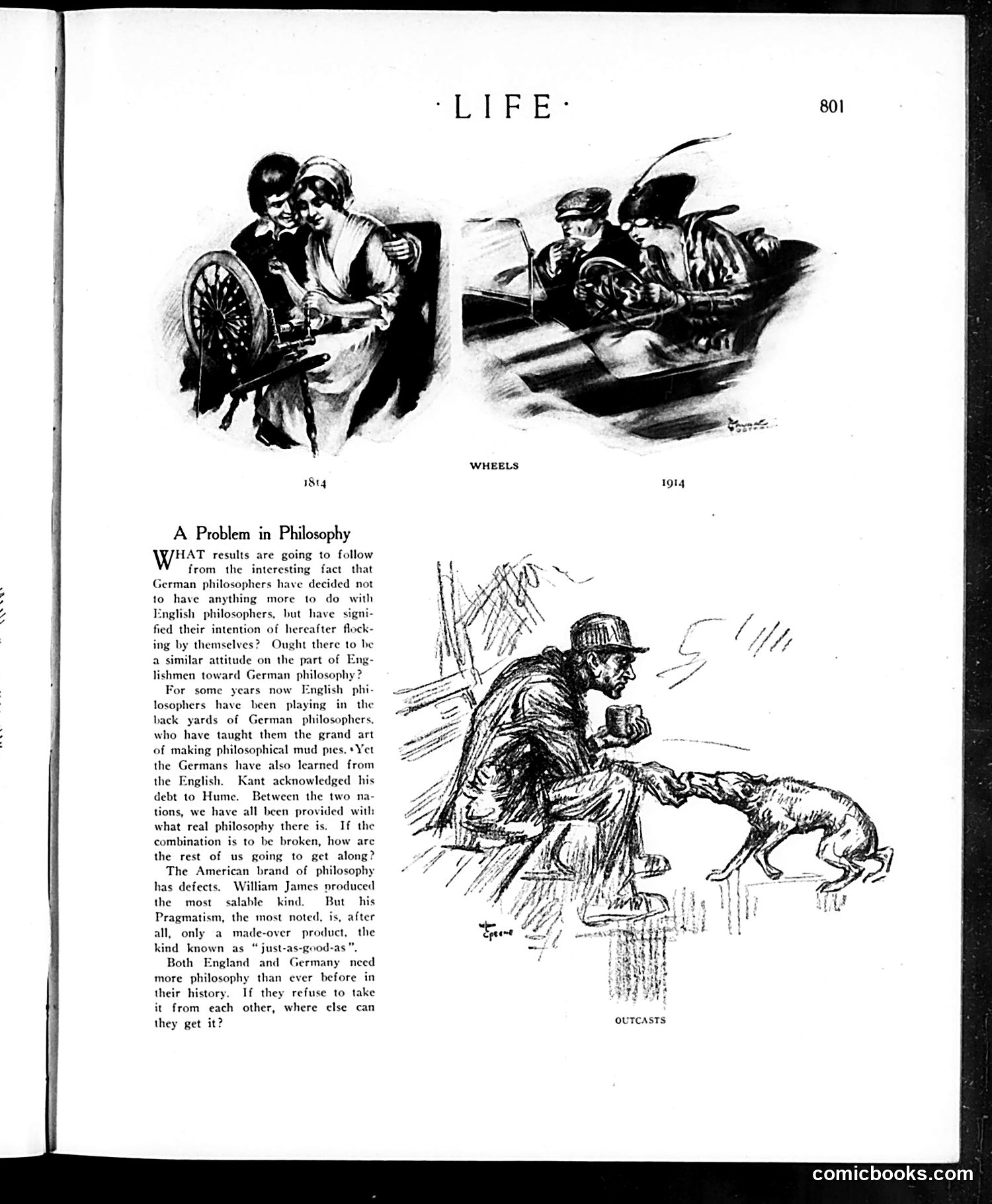
This 1914 *Life* magazine page satirizes the intellectual rift between German and English philosophers during World War I. The article's title, "A Problem in Philosophy," ironically frames a political breakdown as an abstract debate. The text argues that German and English philosophers have decided to cease collaboration—a consequence of the war. The satirical point: both nations have historically enriched each other philosophically (referencing Kant's debt to Hume), so their separation impoverishes intellectual life. The author dismisses American philosophy as derivative ("just-as-good-as"). The illustrations support this theme: "Wheels" (1814 vs. 1914) contrasts horse-drawn transport with motorboats—showing technological progress despite philosophical stagnation. "Outcasts" depicts a homeless man with a dog, representing intellectual figures abandoned by their nations' mutual rejection. The underlying message mocks both countries' wartime nationalism, suggesting that severing philosophical exchange harms everyone, including those (Americans) dependent on European thought.
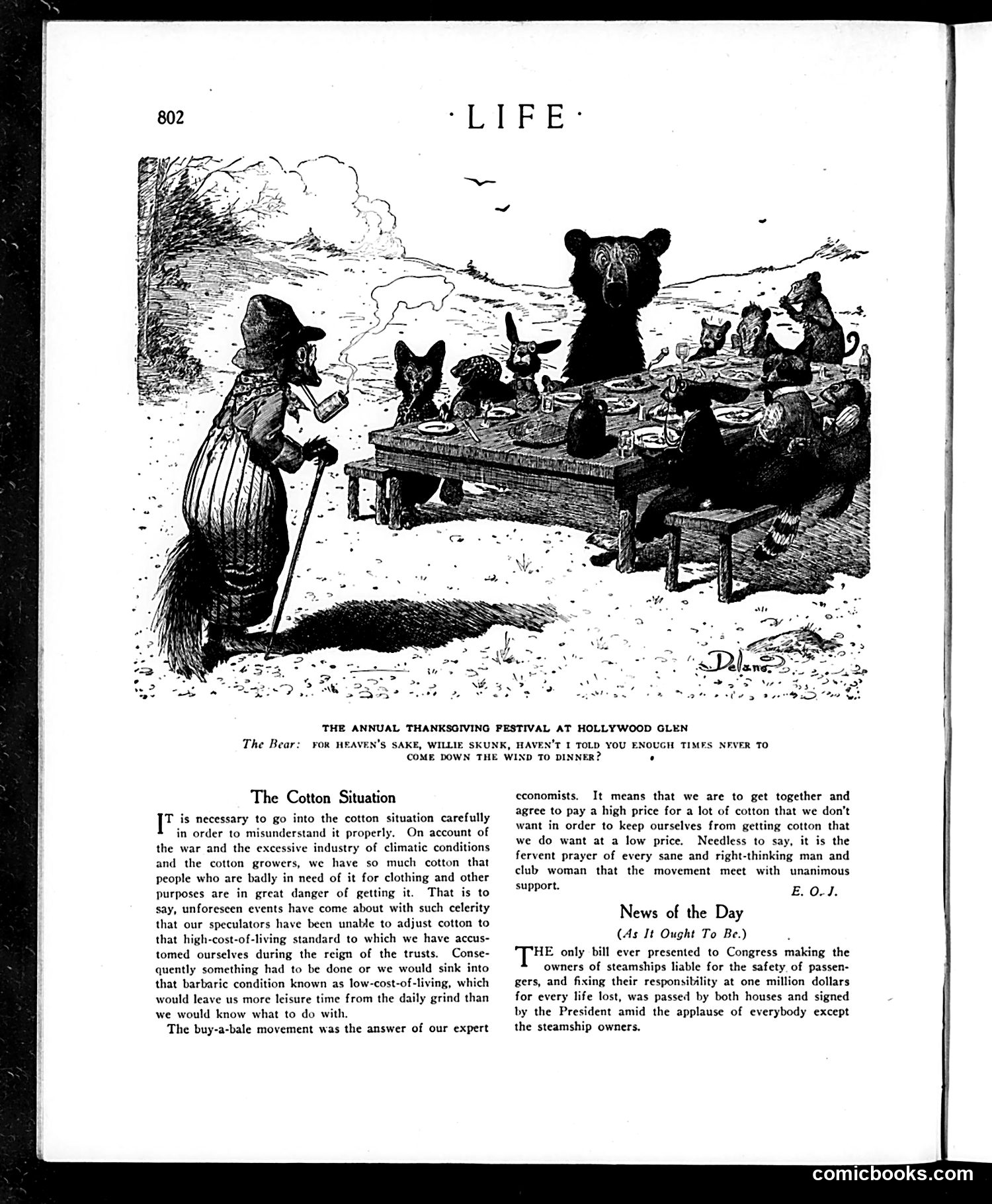
**The Cartoon:** "The Annual Thanksgiving Festival at Hollywood Glen" depicts anthropomorphic animals (a mother skunk scolding her son Willie) at a dinner table. The satire is obscure without knowing the specific Hollywood reference, but the joke appears to mock social pretense—animals imitating human dinner etiquette while the mother warns against bad manners ("come down the wind to dinner" likely refers to unseemly animal behavior). **"The Cotton Situation":** This article satirizes post-WWI economic absurdity. It mocks the "buy-a-bale" movement—where Americans voluntarily agreed to purchase expensive, unwanted cotton to artificially maintain high prices and prevent affordable clothing. The author ridicules this as illogical: paying inflated prices for goods you don't want to avoid cheap goods you do want, framed as patriotic duty for "sane and right-thinking" citizens. **"News of the Day":** Praises Congress for finally holding steamship owners financially liable for passenger safety—a measure opposed only by the shipowners themselves, highlighting corporate resistance to safety regulations. Both items satirize contemporary economic and political failures through irony and absurdist humor.
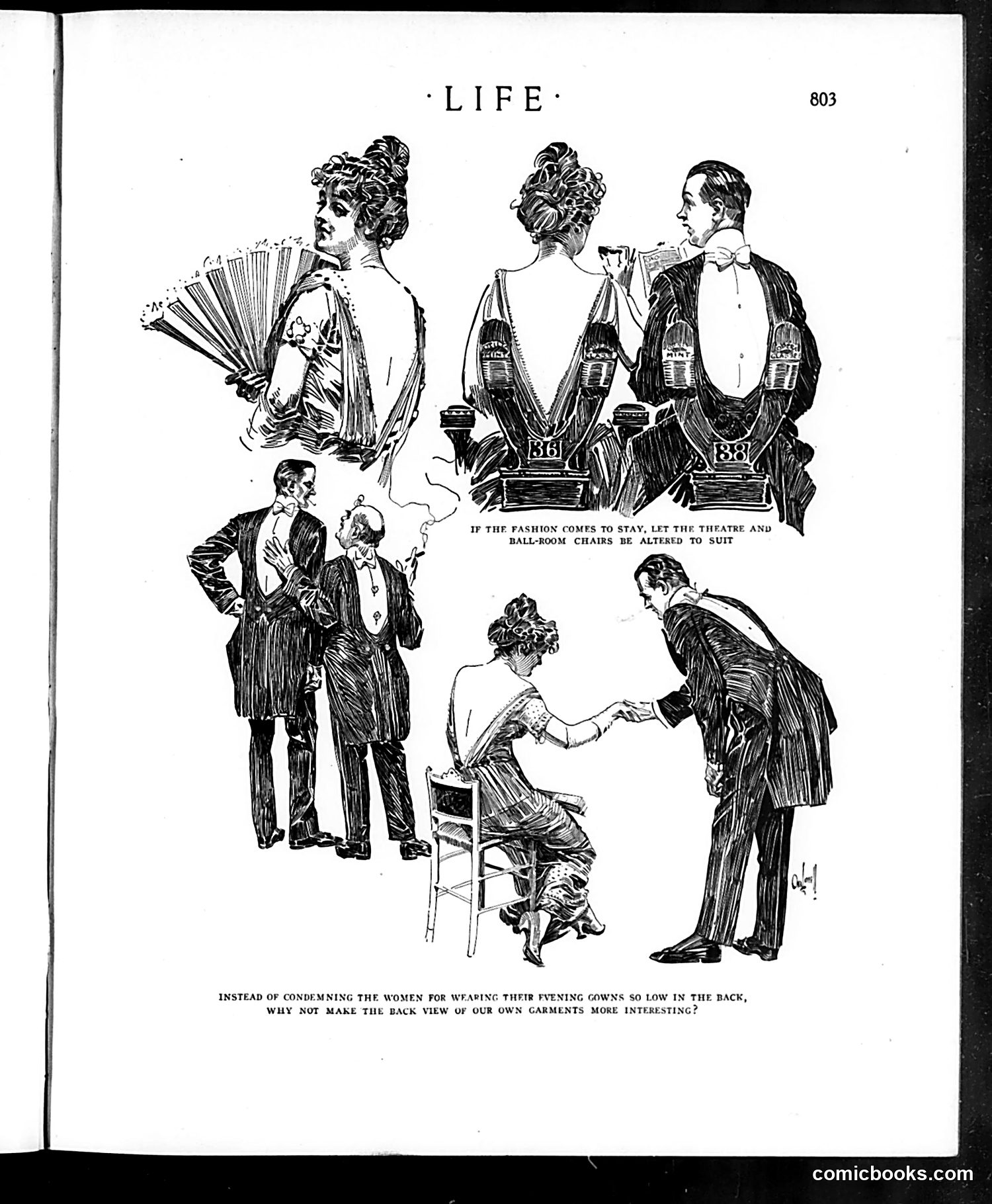
This satirical page from *Life* magazine critiques the double standard in fashion criticism. The upper illustrations show women wearing low-backed evening gowns viewed from behind, while the lower text proposes a humorous counterargument: rather than condemning women for their revealing fashion choices, men should make their own formal wear more visually interesting from behind. The joke mocks both the prudish criticism of women's fashion and male vanity. The suggestion that men should alter their "garments" (formal suits) to be more decorative essentially ridicules the idea that men's plain tailcoats could compete with women's elaborate designs. It's a sarcastic commentary on gender expectations in Edwardian-era fashion and social propriety—simultaneously defending women's fashion choices while mocking masculine fashion conformity.
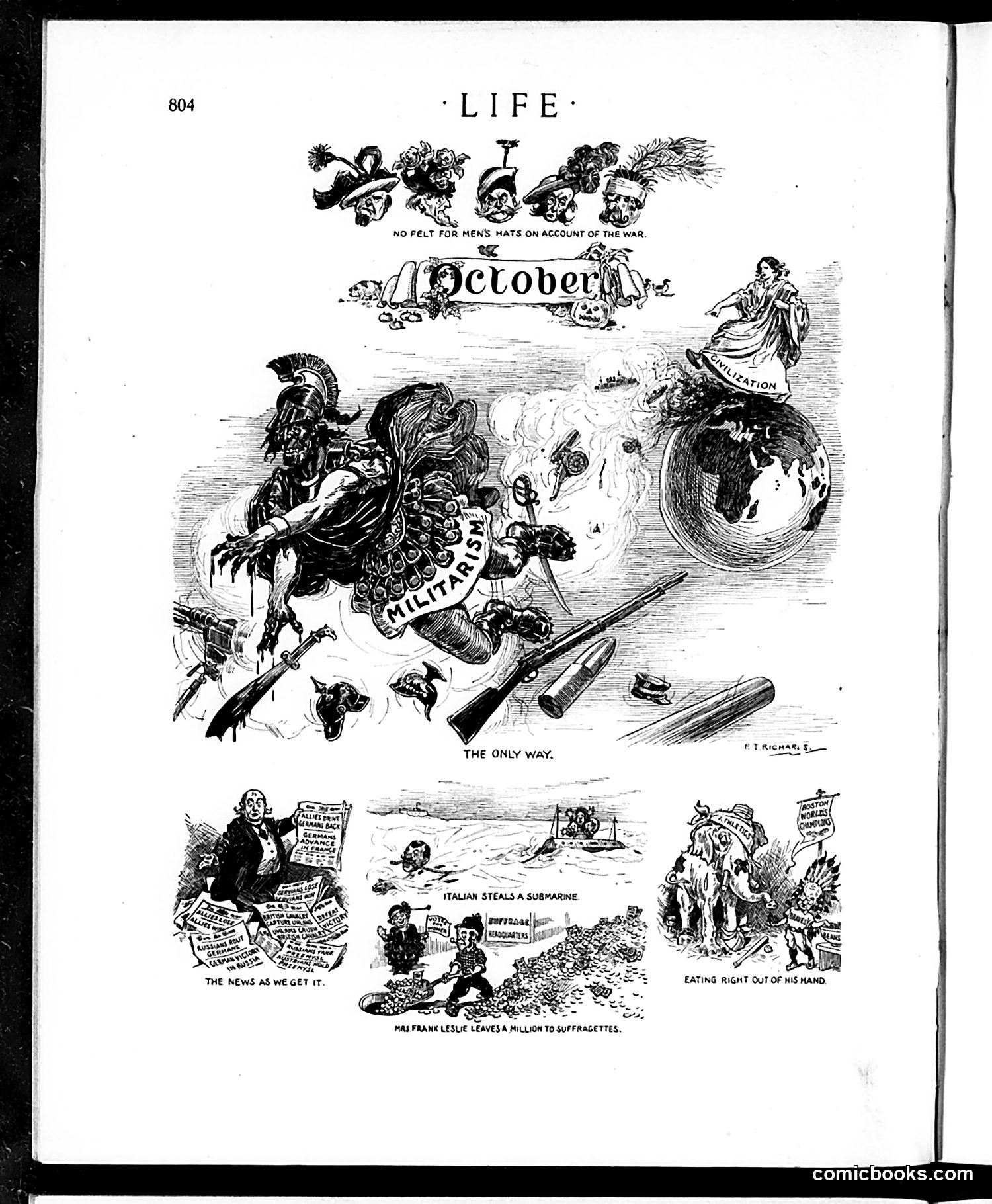
This page presents WWI-era satirical cartoons. The central image shows "Militarism" (a armored warrior on horseback labeled with that word) clashing with "Civilization" (a female figure on a globe). The composition suggests the war as a violent struggle between these forces. Lower panels include: "The News As We Get It" (depicting how wartime information reaches the public), "Italian Steals a Submarine" (referencing military operations), and "Eating Right Out of His Hand" (likely commenting on political manipulation or control). The top note about "no felt for men's hats" references wartime resource rationing. The satirical tone criticizes both military aggression and how civilian populations experience the war through filtered information and hardship. The cartoons express skepticism about official narratives and the human cost of conflict.
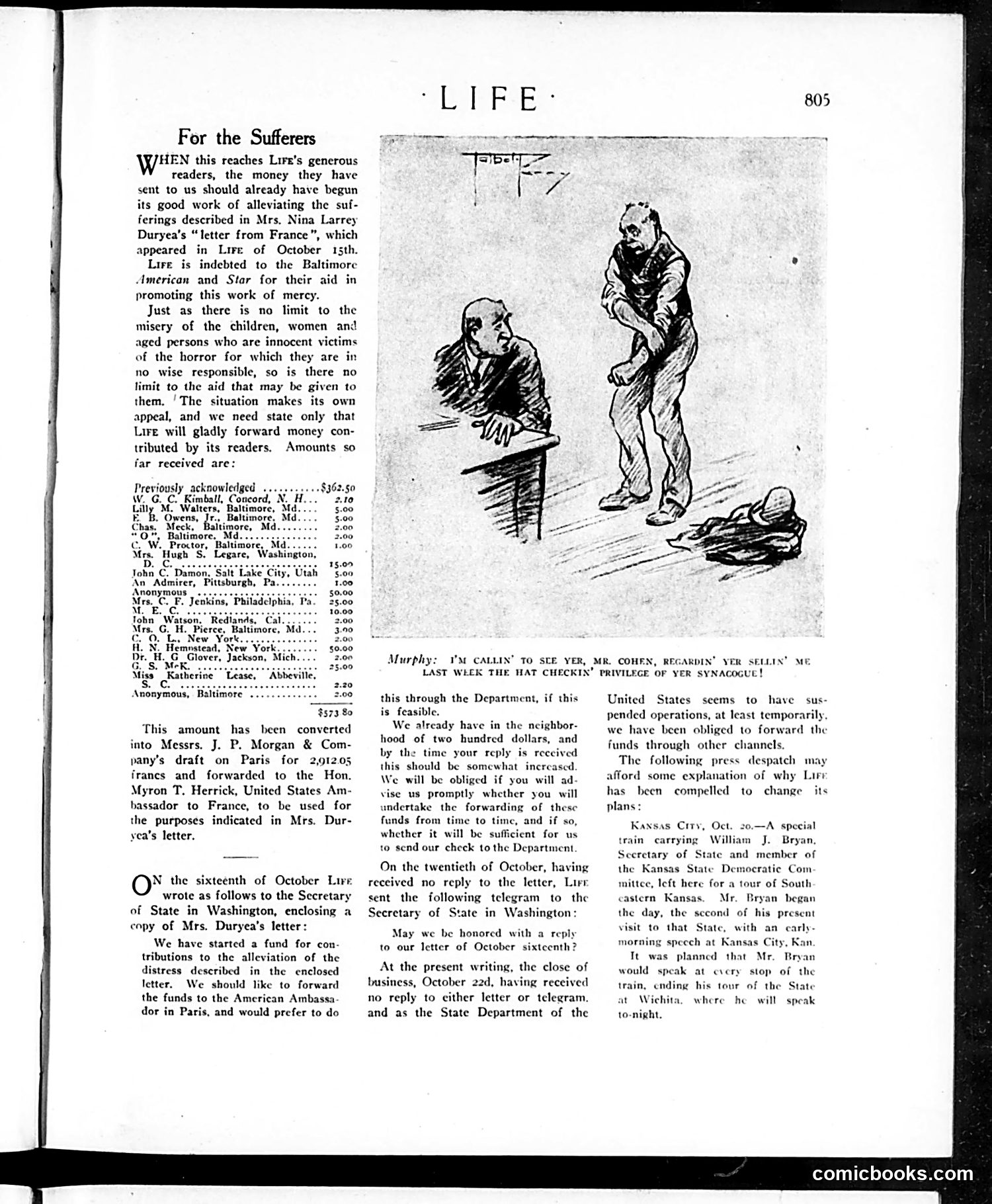
## The Main Cartoon The illustration depicts three impoverished figures—two men and what appears to be a child or small person on the ground. One man sits slumped at a table; another stands nearby. The caption reads: "Murphy: I'M CALLIN' TO SEE YER, MR. COHEN, REGARDIN' YER SELLIN' ME LAST WEEK THE HAT CHECKIN' PRIVILEGE OF YER SYNAGOGUE!" **The Satire:** This appears to mock petty economic desperation during wartime hardship. Murphy, likely an Irish immigrant (indicated by his name and dialect), complains to Cohen (likely Jewish) about being sold a minor privilege—hat-checking at a synagogue—suggesting both communities are so financially strapped they're squeezing revenue from trivial services. The cartoon satirizes how economic necessity forces communities into undignified transactions. ## The Text Content The page primarily documents **Life Magazine's charitable fundraising** for French war victims, citing Mrs. Nina Larrey Duryea's "Letter from France" (October 15th issue). It lists donor contributions totaling $573.80 and discusses forwarding funds through U.S. Ambassador Myron T. Herrick to Paris. The page includes a press dispatch about William J. Bryan's Kansas speaking tour.
This editorial satirizes American anxiety about German immigrants and German-American loyalty during World War I. The opening metaphor compares thinking like a German to a fishing captain thinking like a cod—absurd and impossible. The piece critiques the post-August 1914 shift in American public discourse: previously, Americans debated domestic issues (baseball, suffrage, labor reform); now Germans and "Germanism" dominate every conversation. The author questions whether Americans are reasonably assessing genuine threats or engaging in paranoid stereotyping. Specifically, it challenges whether German-Americans like Herman Ridder (a real newspaper publisher) should be presumed disloyal spies preparing for Kaiser invasion. The satire suggests that wholesale suspicion of German-derived citizens—treating all as unified agents of German state power—represents confused, fearful thinking rather than actual German thinking. The cartoon's message: wartime hysteria can make citizens abandon rational judgment.
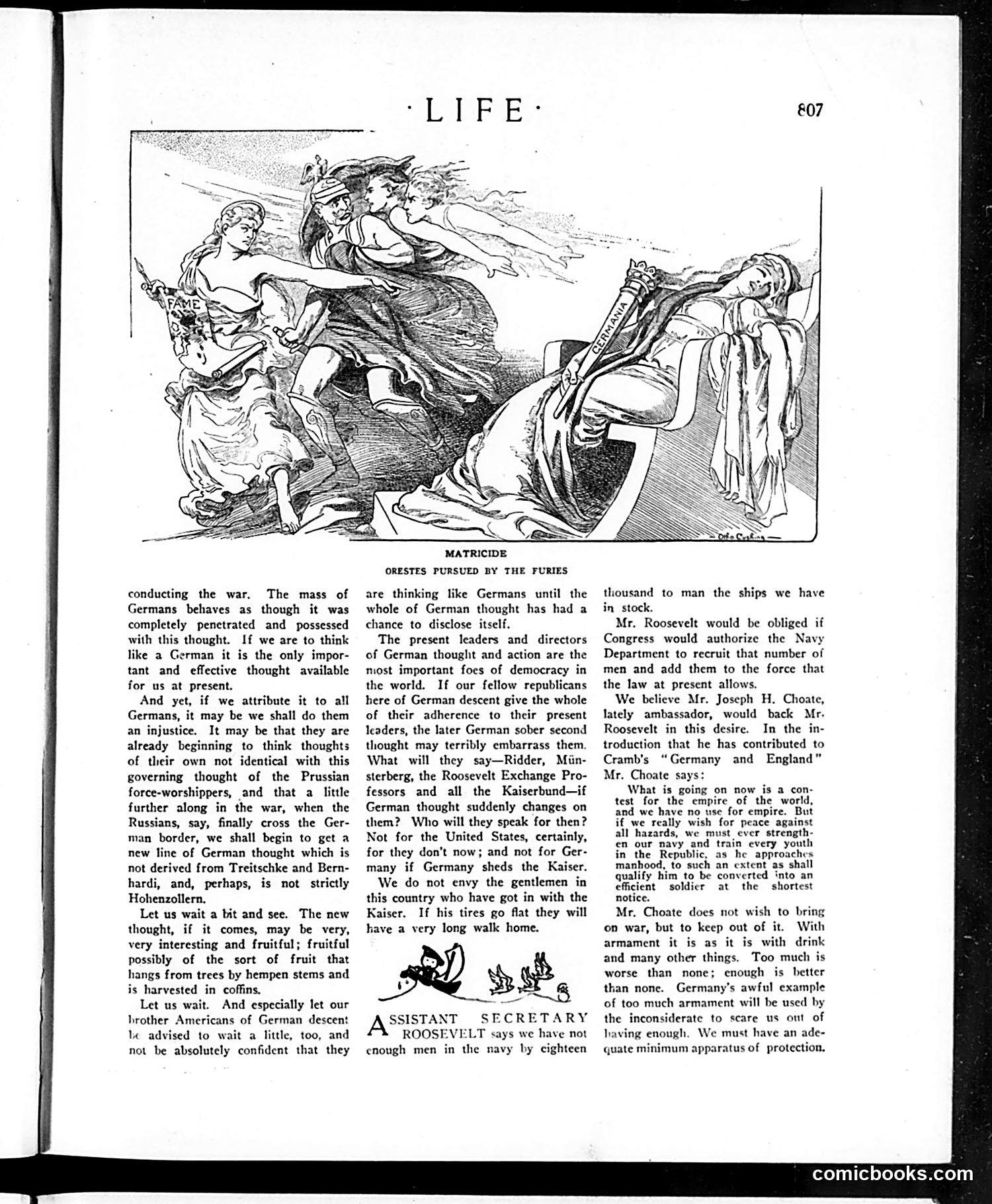
**The Cartoon:** Titled "Matricide: Orestes Pursued by the Furies," the illustration depicts classical Greek figures—Orestes fleeing from the Furies (avenging spirits). This allegorizes Germany's internal conflict: the "matricide" represents Germany's betrayal of its own people, while the Furies symbolize the consequences pursuing German leaders. **Political Context:** Written during WWI, the article addresses German-Americans, warning them against unconditional loyalty to Kaiser-aligned figures like Edmund von Steuben and Hugo Münsterberg. The author argues that German thought isn't monolithic—future German democracy might reject current militaristic leadership. German-Americans who support the Kaiser now risk embarrassment if Germany eventually "sheds the Kaiser." **The Satire:** The piece mocks pro-Kaiser German-Americans as potentially backing the wrong horse. If Germany's government changes post-war, these figures will have "a very long walk home"—they'll find themselves abandoned and discredited, pursued by history's judgment like Orestes by the Furies. The secondary article advocates naval expansion as deterrence against future conflict.
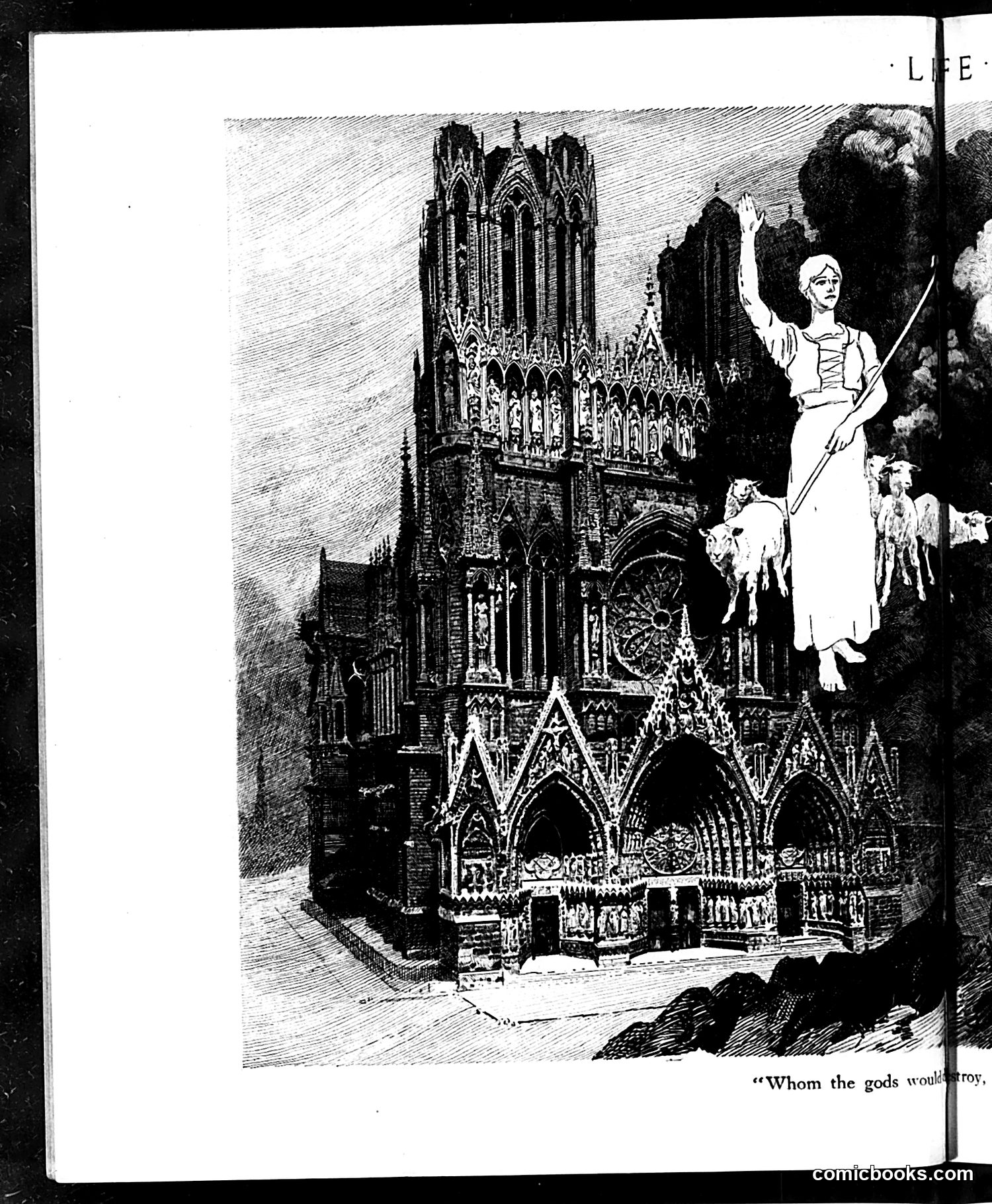
This page from *Life* magazine shows a dramatic illustration of a classical female figure (appearing to represent Liberty or Justice) standing beside a Gothic cathedral, with the caption beginning "Whom the gods would destroy..." The image appears to be a political or social commentary using classical allusions. The phrase "Whom the gods would destroy, they first make mad" is a classical saying suggesting divine punishment for hubris or folly. The juxtaposition of the robed female figure with the ornate cathedral suggests commentary on religious institutions or values. Without additional context or visible publication date, I cannot definitively identify the specific historical event or figure being satirized. The artistic style and magazine format suggest early-to-mid 20th century origin, but the precise satirical target remains unclear from the image alone.
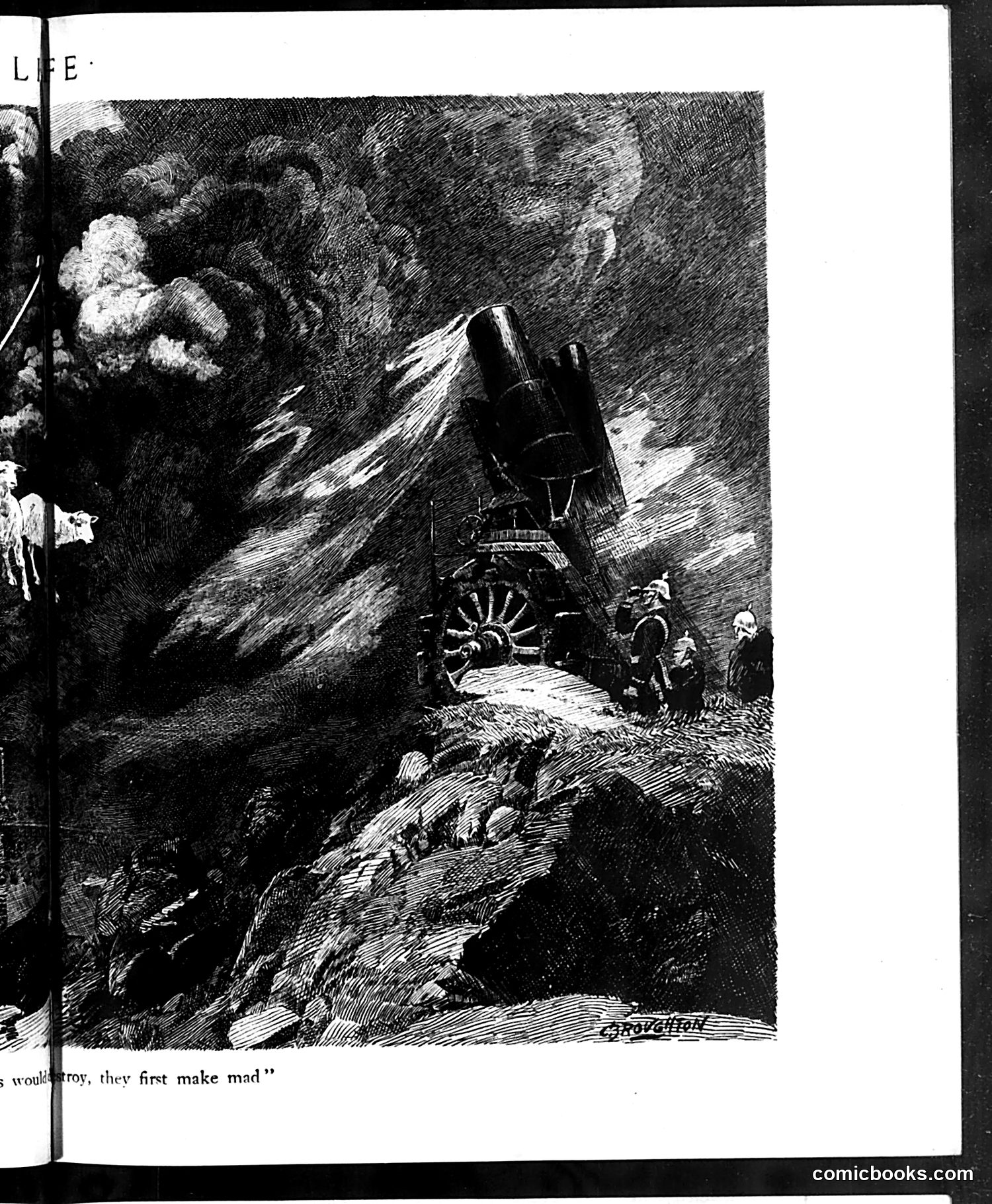
This is a dramatic black-and-white engraving showing an industrial scene with a large steam engine or locomotive on rocky terrain. Small human figures appear dwarfed by the massive machinery and natural landscape. The visible text fragment reads "s would troy, they first make mad"—likely part of a longer quote about destroying something before making it mad (possibly referencing an old saying). The artist's signature appears to read "Cesare" or similar. Without the full caption and publication date, the specific political meaning is unclear, though the imagery suggests satire about industrialization, human vulnerability to technological power, or possibly labor conditions. The engraving style suggests 19th-century publication, but the exact cartoon's message cannot be definitively determined from this partial page.
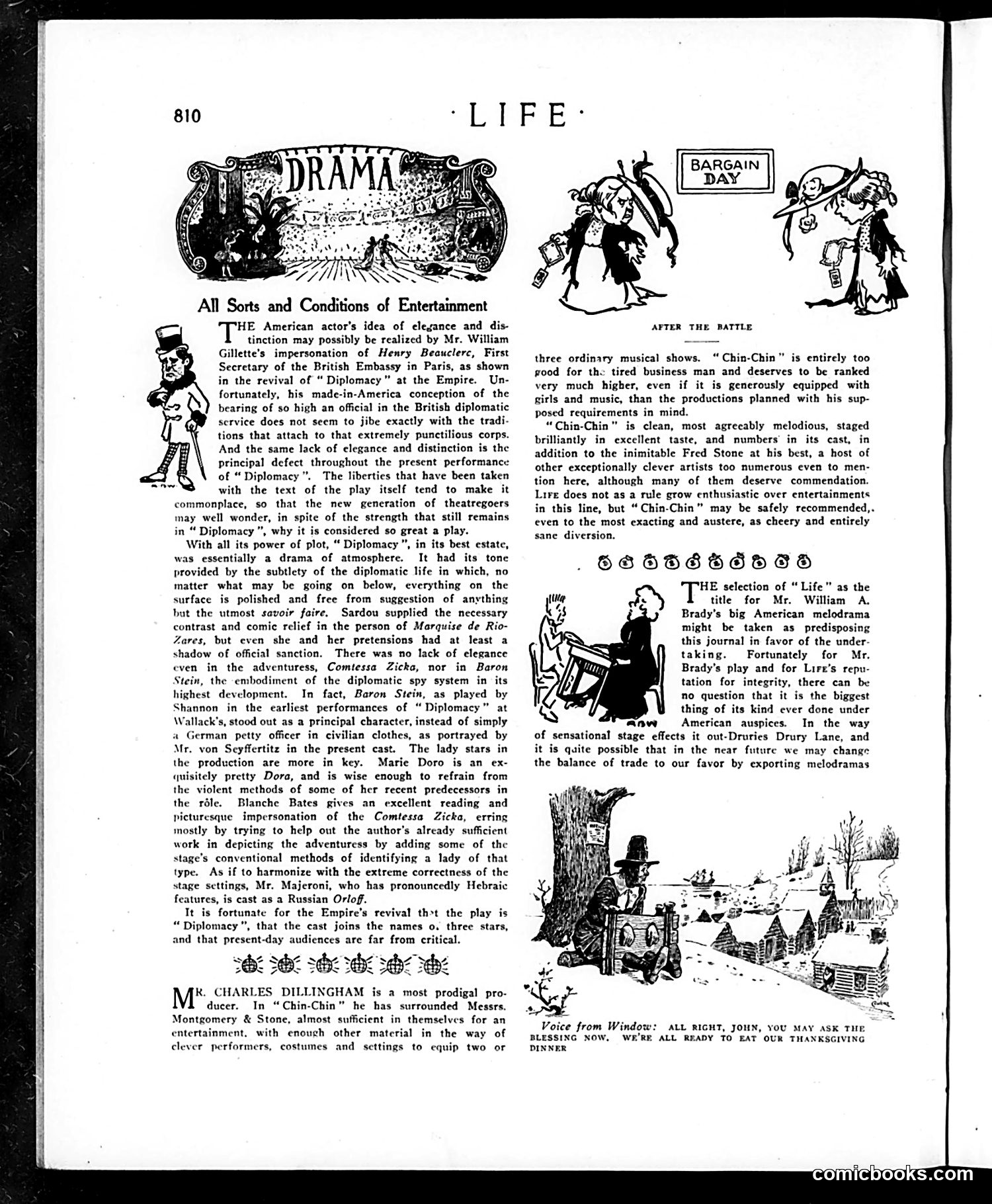
This page reviews theatrical productions, primarily critiquing William Gillette's performance in "Diplomacy" at the Empire Theatre. The review criticizes Gillette's American interpretation of a British diplomat as lacking the refined elegance and polish that should characterize the play's diplomatic milieu. The critic argues the production sacrifices atmospheric sophistication for commonplace entertainment. The page also praises "Chin-Chin," a musical production by Charles Dillingham featuring performers Montgomery and Stone. Unlike the "Diplomacy" review, this one commends the show's cleanliness, melody, staging, and talented cast—suggesting it deserves higher regard than typical "tired business man" entertainment. The cartoons illustrate theatrical scenes: one showing post-performance chaos ("After the Battle"), another depicting a Thanksgiving dinner scene. These visuals complement the reviews' commentary on contemporary American theatre standards and audience expectations circa the 1910s.
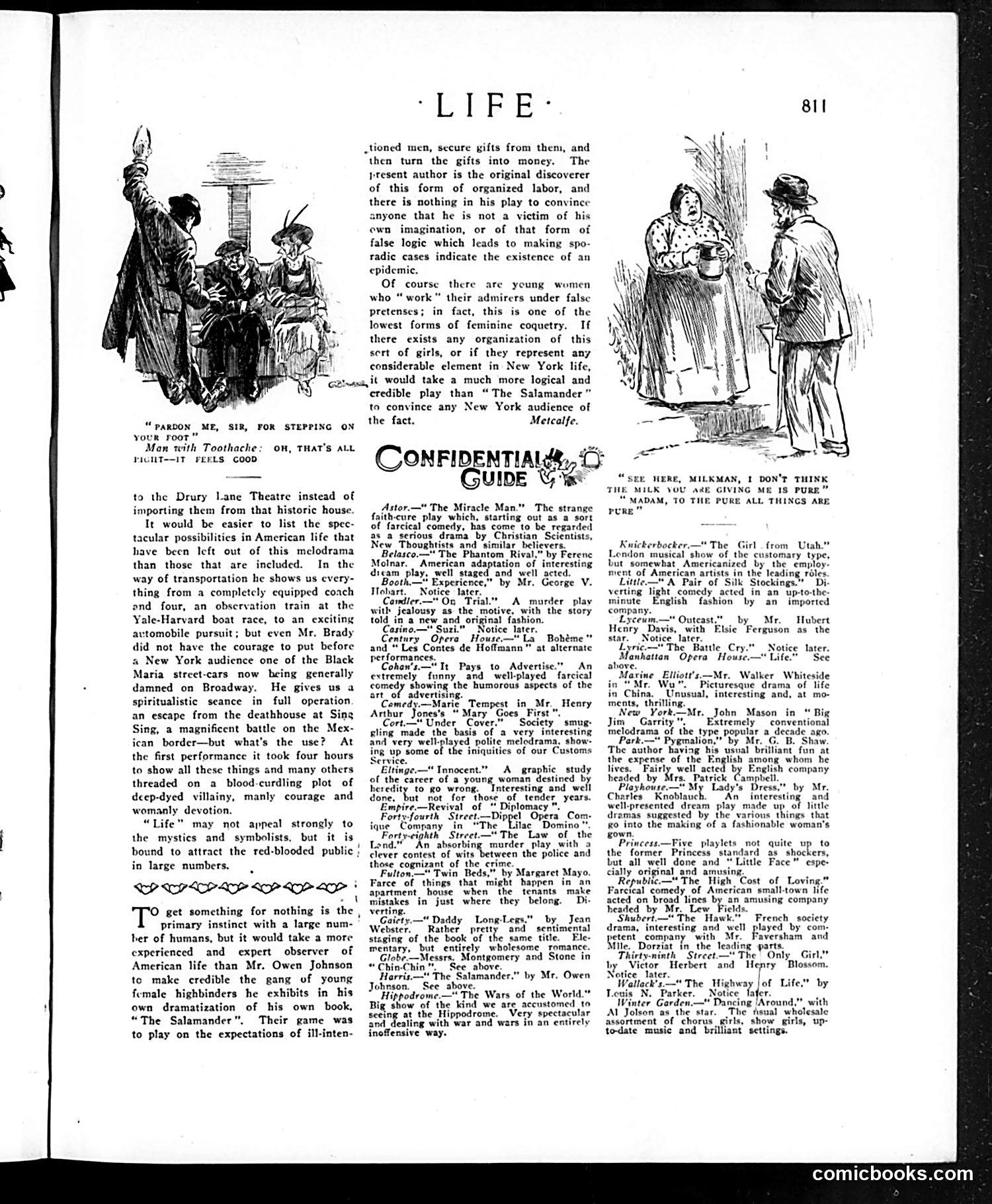
This page contains two cartoon vignettes and theater reviews. The top left shows a man with a toothache saying "that's all right—it feels good" after someone steps on his foot, illustrating the absurd relief a toothache sufferer might feel from distraction. The top right depicts what appears to be a milkman or vendor in casual conversation, likely another humorous street scene. The page's main content critiques two theatrical productions. Owen Johnson's play "The Salamander" is mocked for portraying an allegedly organized gang of young women who manipulate wealthy men into giving them gifts—a con the critic calls implausible. The reviewer suggests Johnson invented this "form of organized labor" and doubts such an operation actually exists in New York society. The piece argues the play fails to convince audiences of this premise through credible storytelling, regardless of whether isolated cases occur.
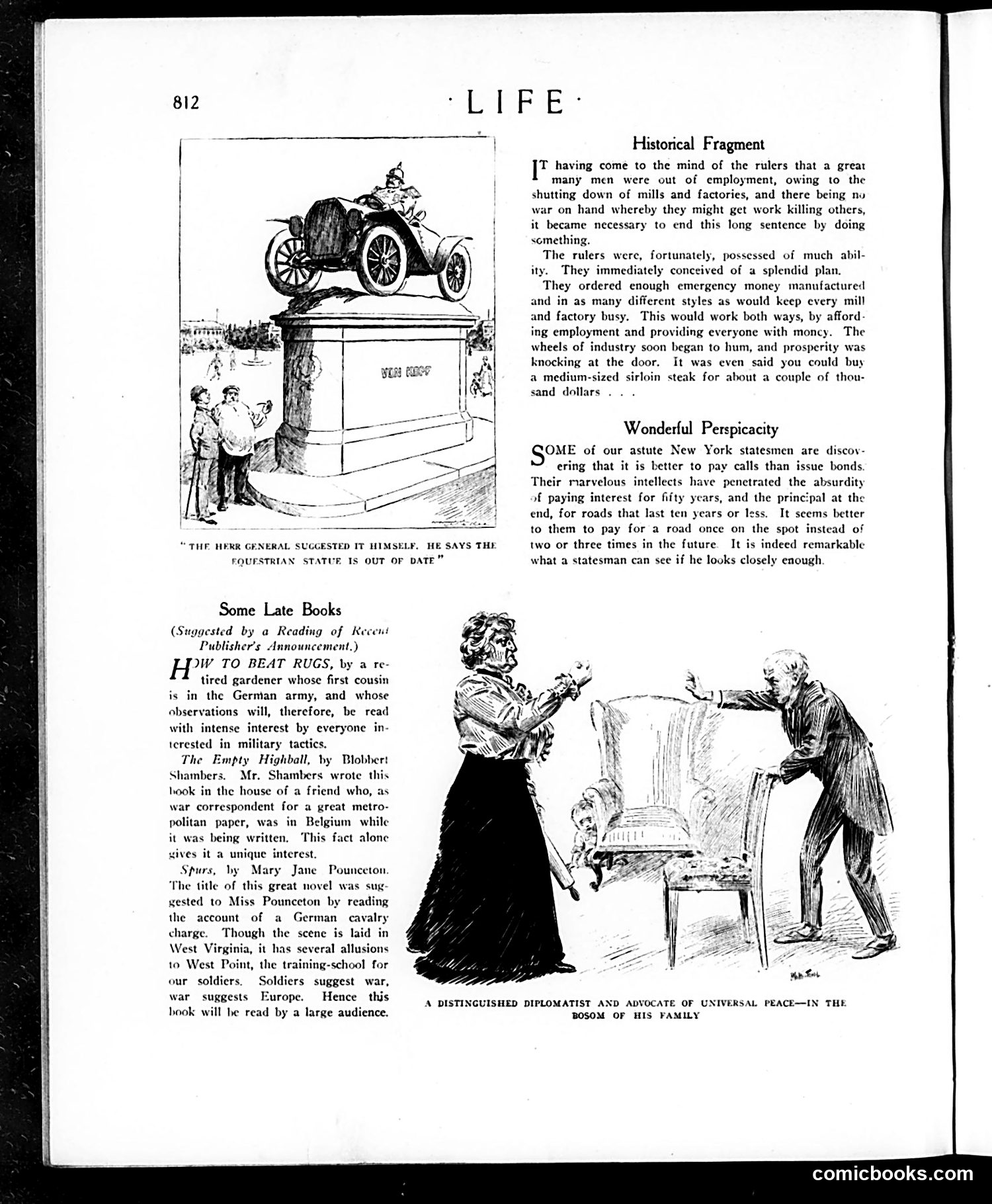
**Top Cartoon**: Shows an equestrian statue being critiqued as "out of date." The caption suggests a German general proposed replacing it—likely satirizing how WWI (then ongoing) influenced American culture and decision-making. The joke is that wartime concerns now dictate even artistic judgments. **"Historical Fragment"**: Satirizes government economic policy during post-war unemployment. Rulers manufacture emergency currency in multiple styles to keep mills busy and stimulate employment—but the absurd punchline reveals hyperinflation: a sirloin steak costs "a couple of thousand dollars." This mocks government spending as a cure-all that merely creates inflation without solving underlying problems. **"Wonderful Perspicacity"**: Ridicules New York politicians for discovering it's cheaper to pay road construction costs upfront rather than pay interest on bonds for decades. The satire suggests these "astute statesmen" are credited for obvious reasoning, implying typical political incompetence. **"Some Late Books"**: Parodies wartime book-marketing where tenuous WWI connections (German cousins, Belgian correspondents, cavalry charges) are hyped to sell mediocre literature to eager war-interested readers.
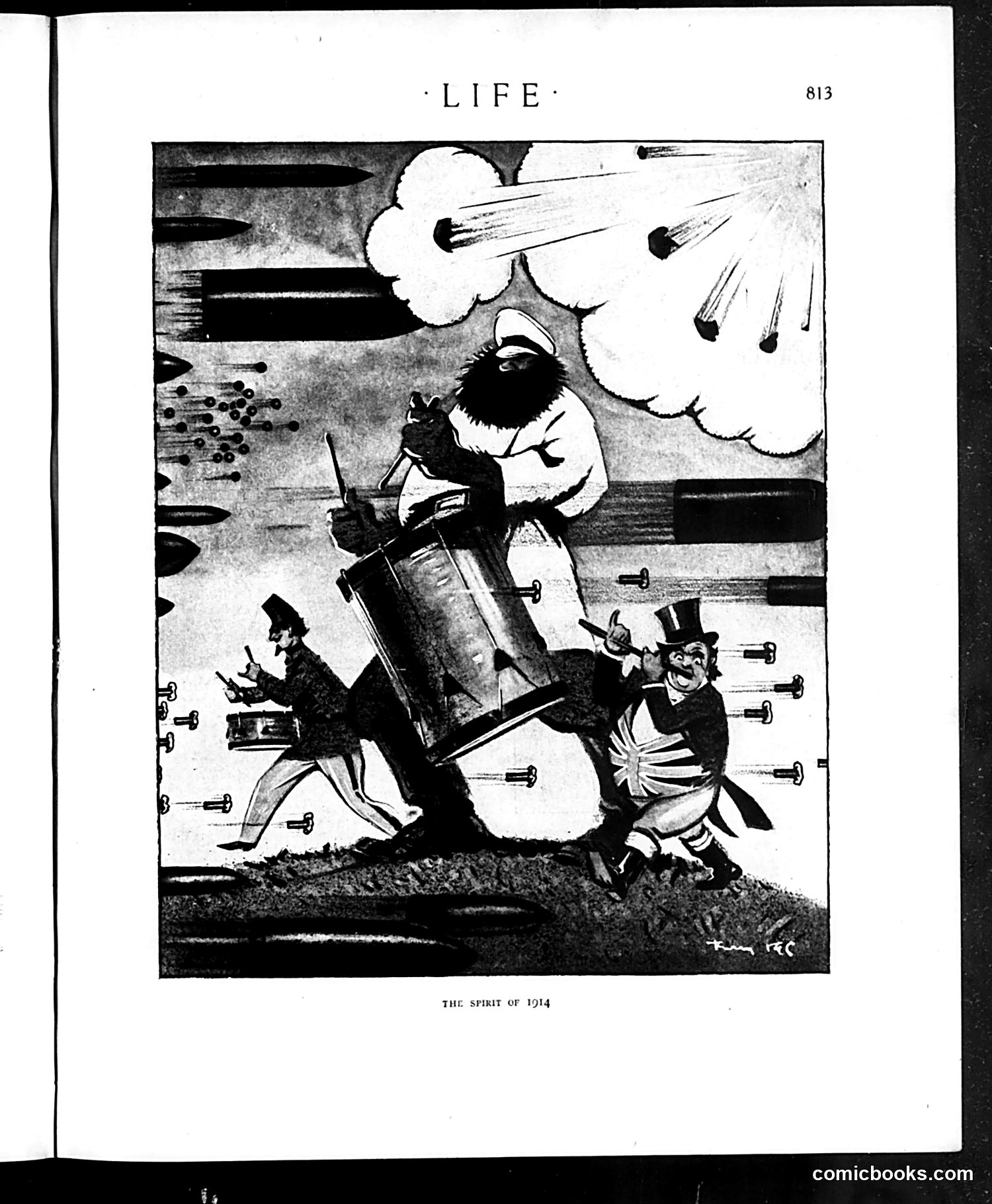
This satirical cartoon depicts the chaos of World War I's opening year. A large bomb or artillery shell dominates the center, operated by two caricatured figures—likely representing warring European powers or their leaders. The bearded figure at top controls the weapon while smaller military figures below (one wearing a top hat, suggesting political leadership) direct operations. The ascending projectiles and explosions filling the sky represent the massive bombardment and destruction of 1914. The cartoon sarcastically titles this devastation "The Spirit of 1914," mocking how nations glorified their war efforts. The artist (signature unclear) criticizes the enthusiastic embrace of industrial-scale warfare and the political leaders' detachment from the actual violence they commanded.
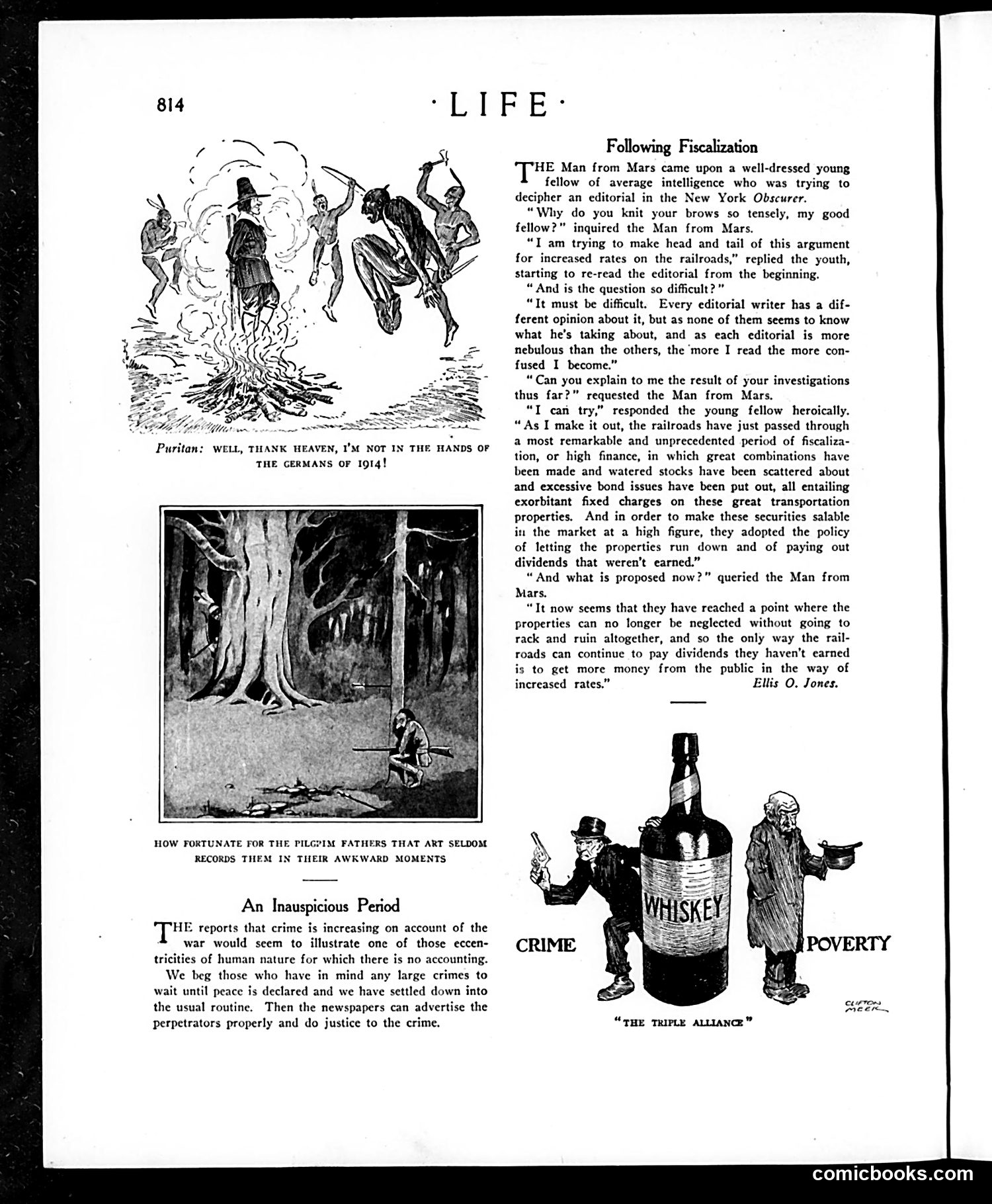
**"Following Fiscalization"** satirizes railroad industry financial manipulation. A Man from Mars (outsider perspective device) questions a young man struggling with newspaper editorials about railroad rate increases. The youth explains that railroads engaged in financial "watering" (inflating stock value), issued excessive bonds, deliberately let infrastructure deteriorate, then demanded public rate increases to pay unearned dividends. The satire targets both the railroads' deceptive practices and newspapers' confusing coverage thereof. **"The Triple Alliance"** depicts a large whiskey bottle flanked by figures labeled Crime and Poverty, suggesting alcohol fuels both social ills—a prohibition-era argument. **"An Inauspicious Period"** ironically requests postponing crime until after peace is declared, so newspapers can properly publicize criminals. This mocks wartime chaos and suggests crime reporting becomes secondary during conflict. All three pieces critique institutional failures: financial corruption, substance abuse, and justice system dysfunction.
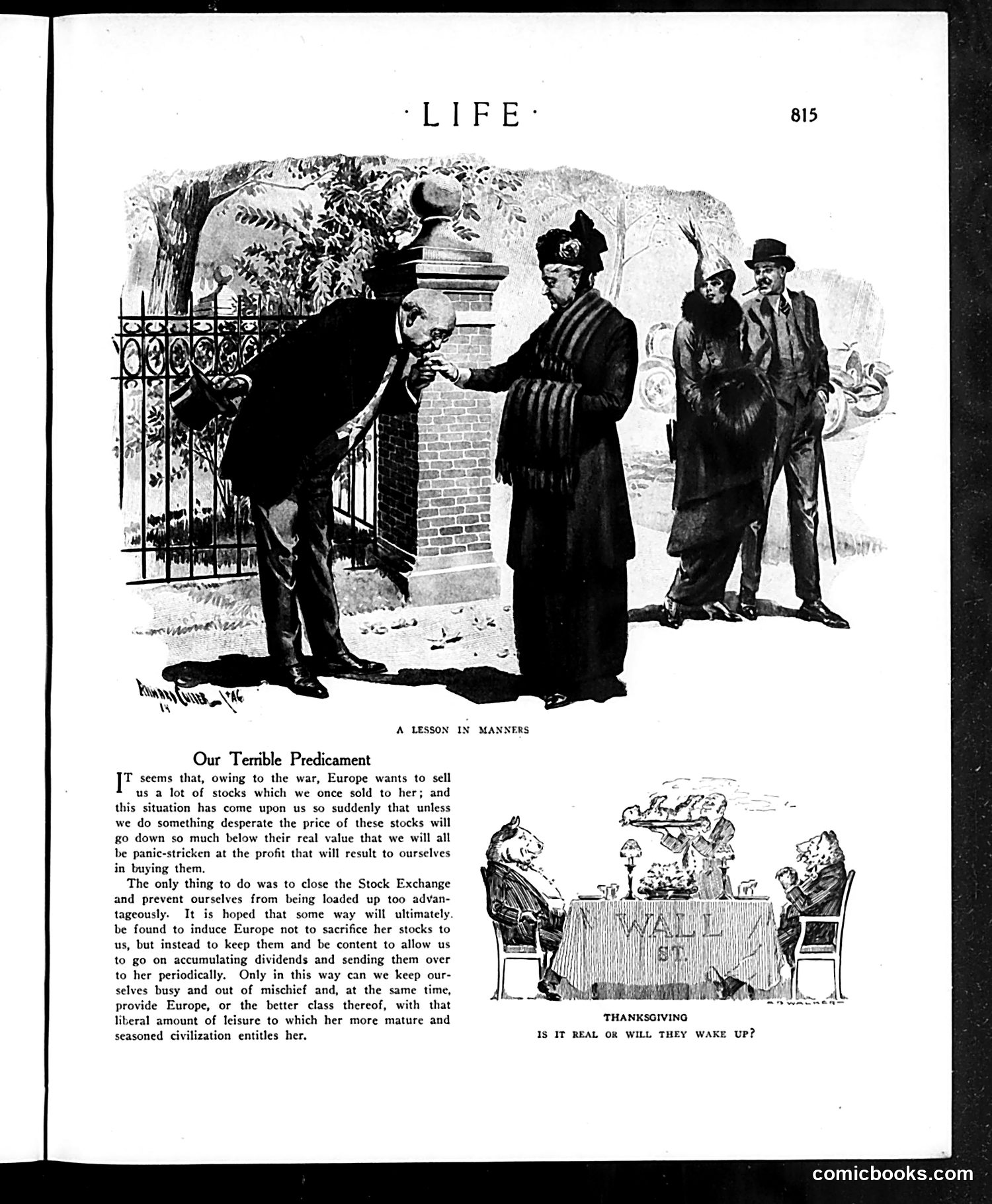
This satirical piece critiques American financial opportunism following World War I. The top cartoon, "A Lesson in Manners," depicts wealthy Americans (in top hats) condescendingly instructing a European figure (likely representing France or Britain) on proper behavior—the visual irony underscores the text's sarcasm. The article mocks America's stock-trading position: Europe, financially desperate after the war, wants to sell American stocks back to the U.S. at depressed prices. Rather than allow American investors to profit excessively from Europe's misfortune, the Stock Exchange closed temporarily. The text sarcastically suggests this prevents Americans from accumulating too much wealth—while pretending to give Europe "leisure" befitting its "mature civilization." The bottom cartoon, "Thanksgiving," suggests Americans may awaken from this financial dream. The satire critiques both American greed and the pretense of moral restraint masking self-interest.
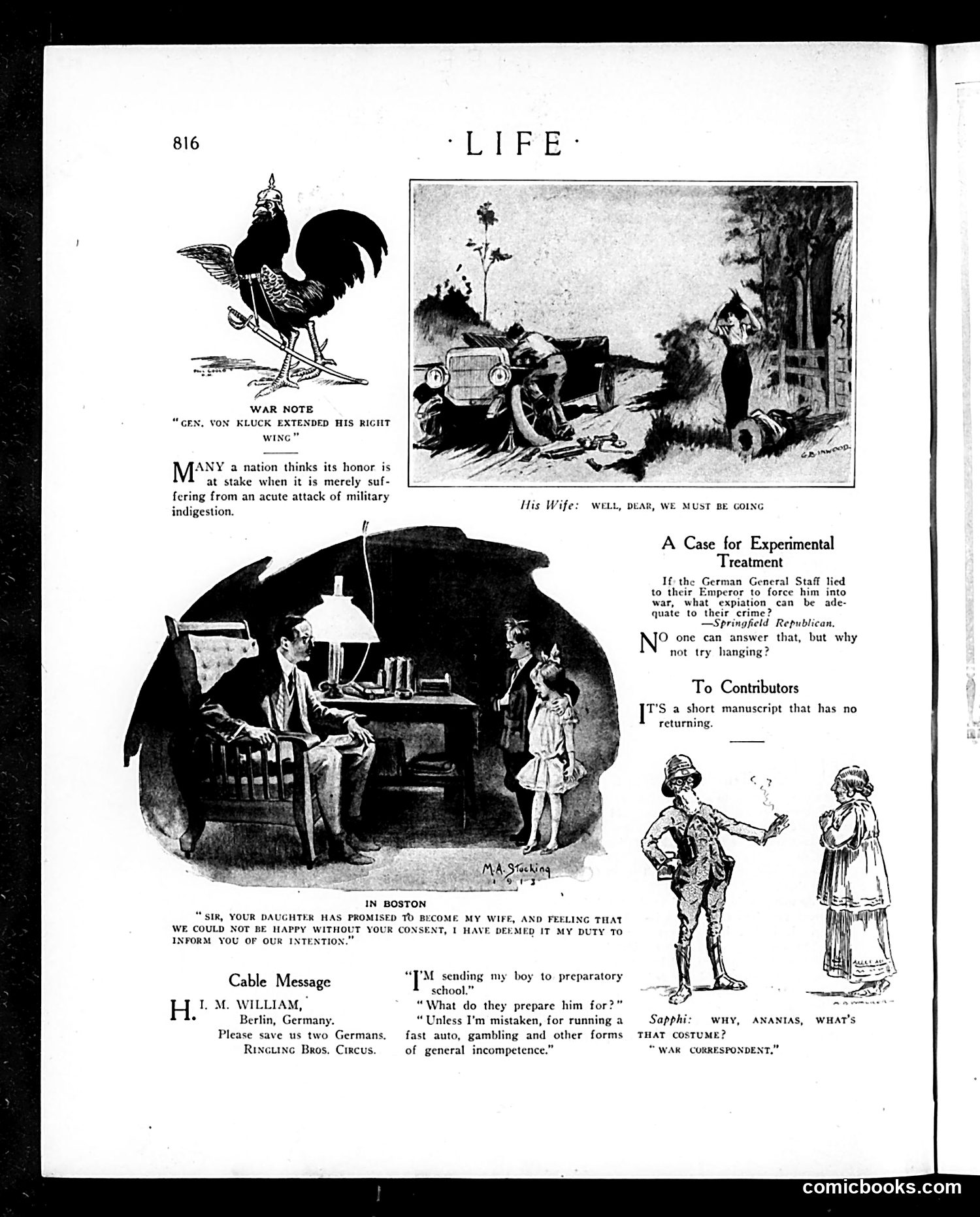
This WWI-era satirical page targets German leadership and wartime absurdities: **Top cartoon**: Gen. von Kluck's "extended right wing" is a double-entendre—referring both to his famous WWI military maneuver and a rooster's anatomy, mocking German military pretensions. **"Case for Experimental Treatment"**: Darkly satirizes the German General Staff's alleged deception of the Kaiser into war, sarcastically suggesting hanging as appropriate punishment. **Boston cartoon**: A suitor formally requests a father's blessing for his daughter's hand—a stuffy convention that becomes ridiculous given the man's character, satirizing outdated formality amid modern chaos. **Cable Message**: Requests saving German circus performers, mocking German militarism's impact even on entertainers. **"Preparatory School"**: Jokes that elite schools prepare boys for automotive recklessness and incompetence rather than actual education—broader American social satire. The page overall ridicules German military leadership, wartime hysteria, and American social pretension during the First World War.
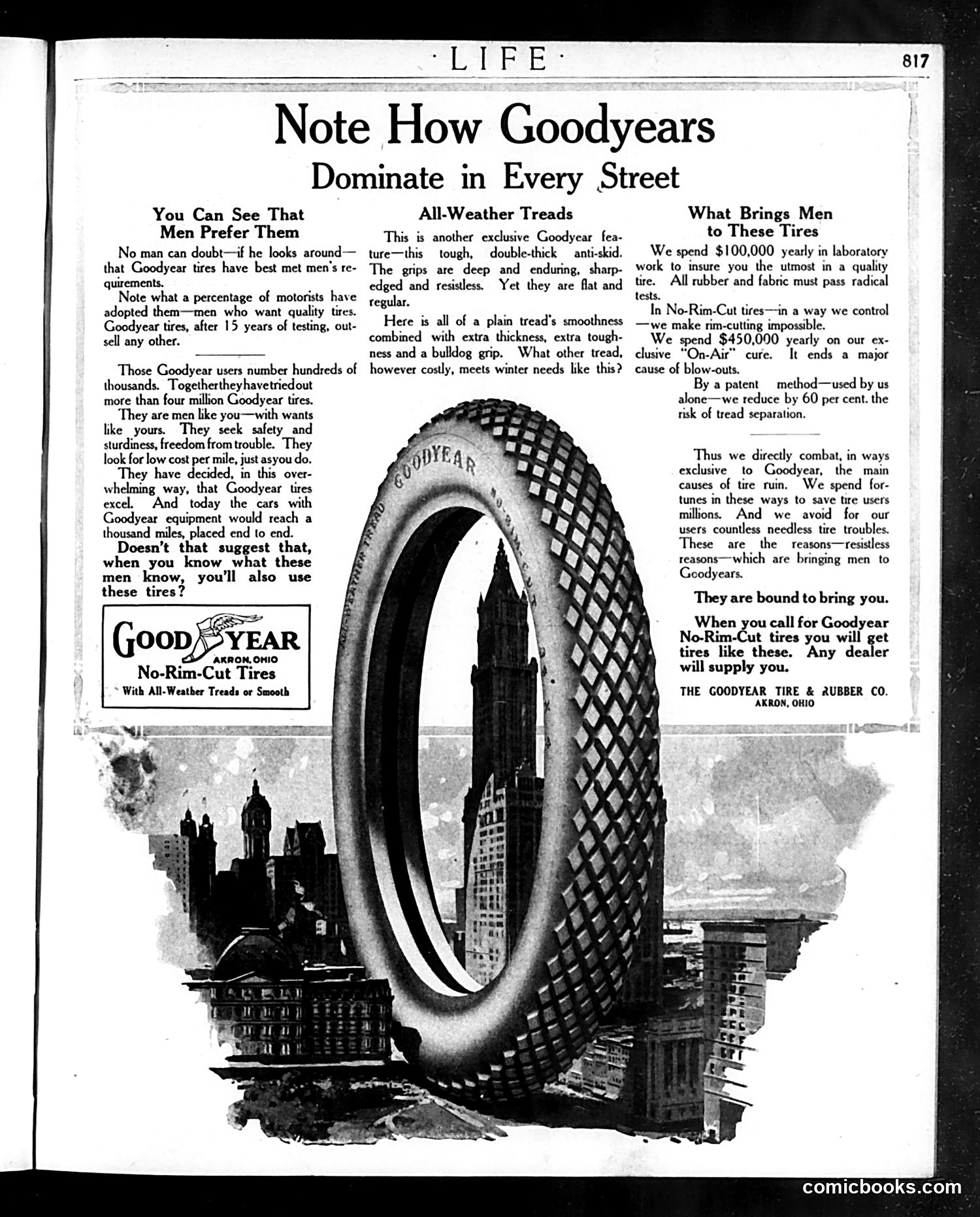
This is a **Goodyear tire advertisement**, not political satire. The page promotes Goodyear's "No-Rim-Cut" tires using early automotive marketing rhetoric. The central image shows a giant tire dominating a cityscape—a visual metaphor claiming Goodyear's market dominance. The text employs persuasive claims typical of 1920s advertising: appeals to male consumer preference, statistics about adoption rates, and assertions of superiority through testing and exclusive patented features (the "On-Air" cure process, rim-cutting prevention). The rhetorical strategy relies on social proof ("men like you" have chosen Goodyear) and appeals to safety and economic value ("low cost per mile"). Technical specifications about tread design and durability are presented as exclusive innovations. No caricatures or satirical figures appear—this is straightforward product promotion from The Goodyear Tire & Rubber Co. of Akron, Ohio. The page reflects pre-Depression American consumer capitalism and the growing automobile industry.
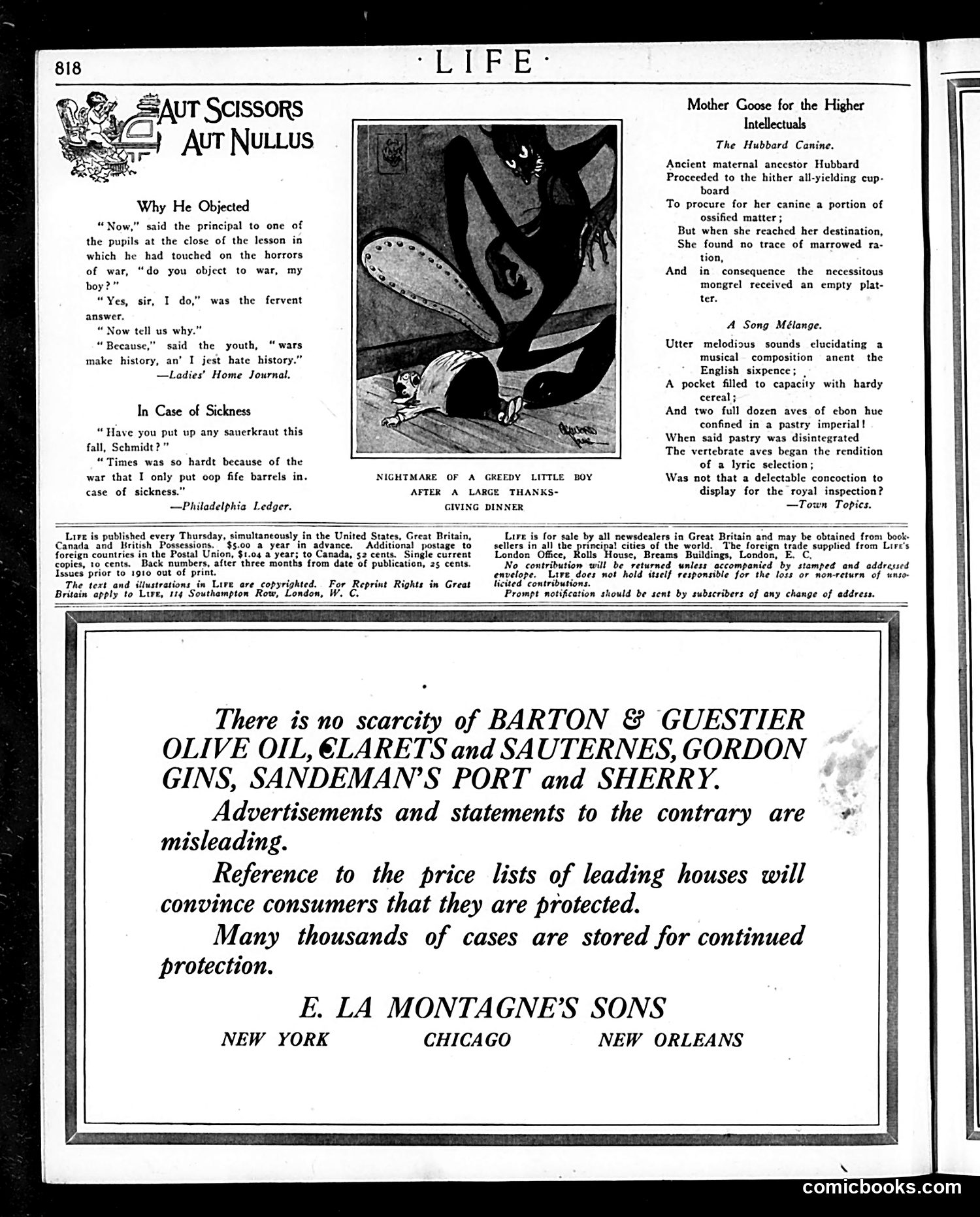
This page contains several short satirical items typical of *Life* magazine's humor section: **"Why He Objected"**: A school joke where a boy objects to war because "wars make history, an' I jest hate history"—satirizing student apathy toward both war and education. **"In Case of Sickness"**: A German-dialect joke about wartime rationing, where someone preserved sauerkraut "fife barrels" as medicine during hard times—mocking both immigrant speech patterns and desperate Depression-era resourcefulness. **"Mother Goose for the Higher Intellectuals"**: Parodies the nursery rhyme "Old Mother Hubbard" in deliberately overwrought, pseudo-intellectual language ("ossified matter," "necessitous mongrel"), satirizing academic pretension. **The cartoon** ("Nightmare of a Greedy Little Boy") depicts a child's nightmare after overeating—straightforward cautionary humor. The page is primarily **advertising** (E. La Montagne's Sons liquor distributor), with the satirical content serving as filler.
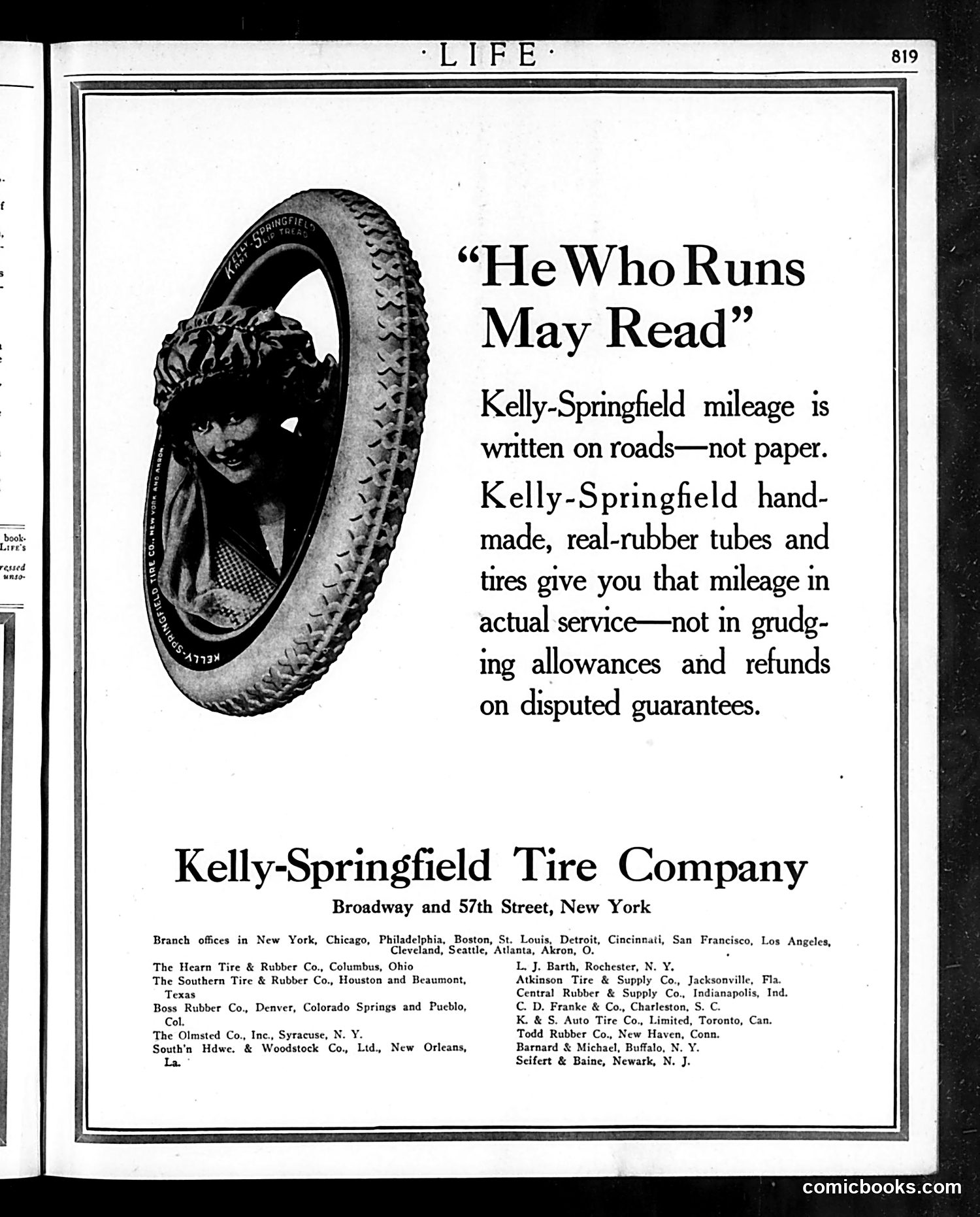
This is a straightforward tire company advertisement, not political satire. The headline "He Who Runs May Read" is a play on the biblical phrase "he who runs may read" (Habakkuk 2:2), suggesting the tire's durability is visible through actual road wear. The ad's central claim targets competitor tire companies: Kelly-Springfield tires prove their mileage through real-world performance ("written on roads"), not through manufacturer allowances or refund disputes on guarantees. The implication is that competitors exaggerate claims or engage in disputes over warranty fulfillment. The image shows a cross-section of a tire with visible tread wear, visually demonstrating the product's durability. The extensive list of branch offices and dealers emphasizes Kelly-Springfield's nationwide presence and distribution network during what appears to be the early automotive era.
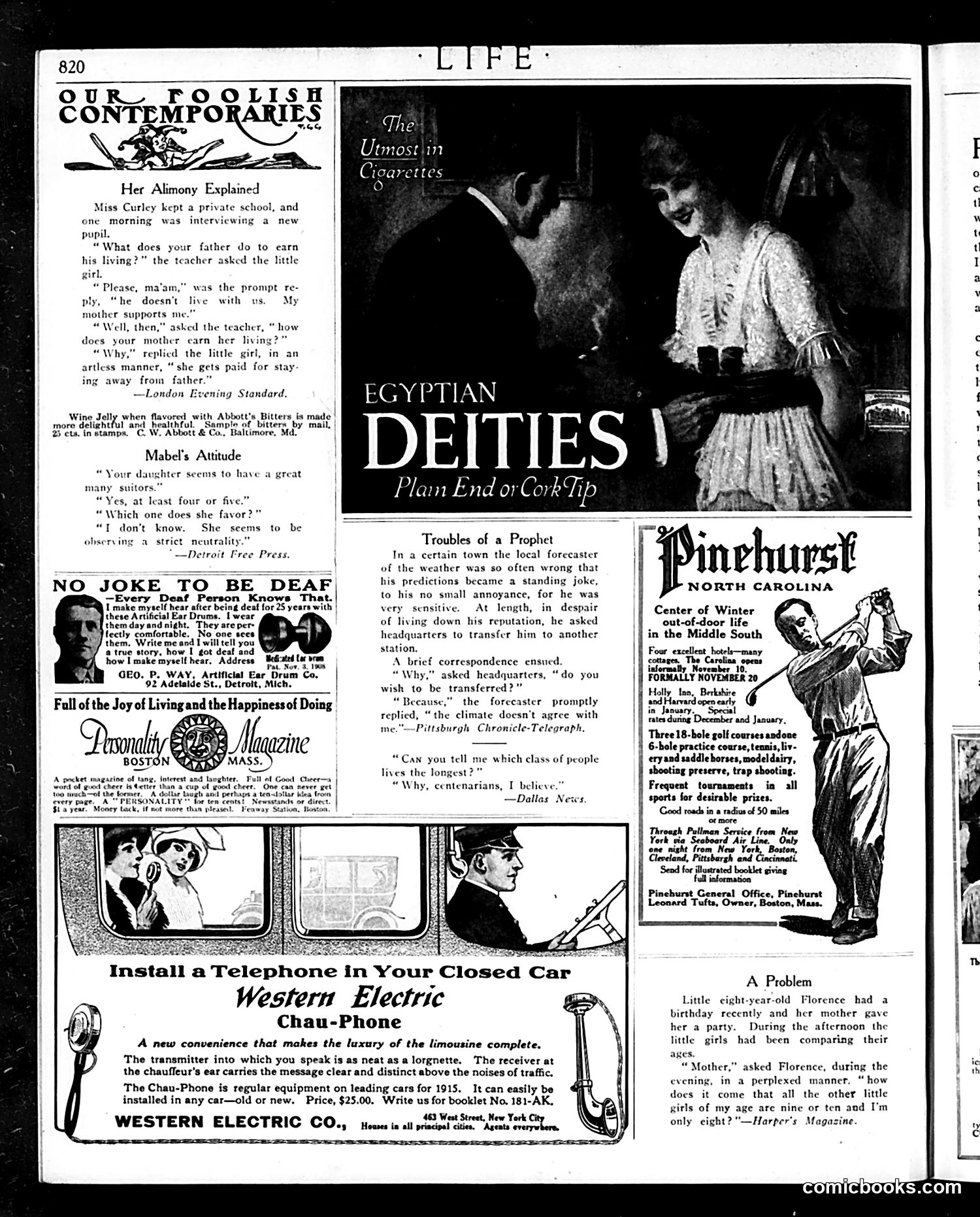
This page from *Life* (a satirical publication) contains several short humorous anecdotes under the heading "Our Foolish Contemporaries," typical of the magazine's satirical format. **Main content:** The page features brief jokes mocking social attitudes of the era. "Her Alimony Explained" satirizes divorce and changing gender roles—a child innocently describes how her mother "gets paid for staying away from father," implicitly criticizing alimony as payment for separation. "Mabel's Attitude" pokes fun at a young woman's romantic indecision, suggesting she's playing suitors against each other. "Troubles of a Prophet" jokes about a weather forecaster so notoriously inaccurate that he requests transfer, blaming the climate rather than his incompetence. The page is primarily **advertising-driven**, with ads for artificial ear drums, personality magazines, Egyptian cigarettes, Western Electric car phones, and Pinehurst resort. These short items reflect early 20th-century middle-class humor about domestic life, divorce, courtship customs, and professional failure—concerns relevant to *Life*'s educated readership.
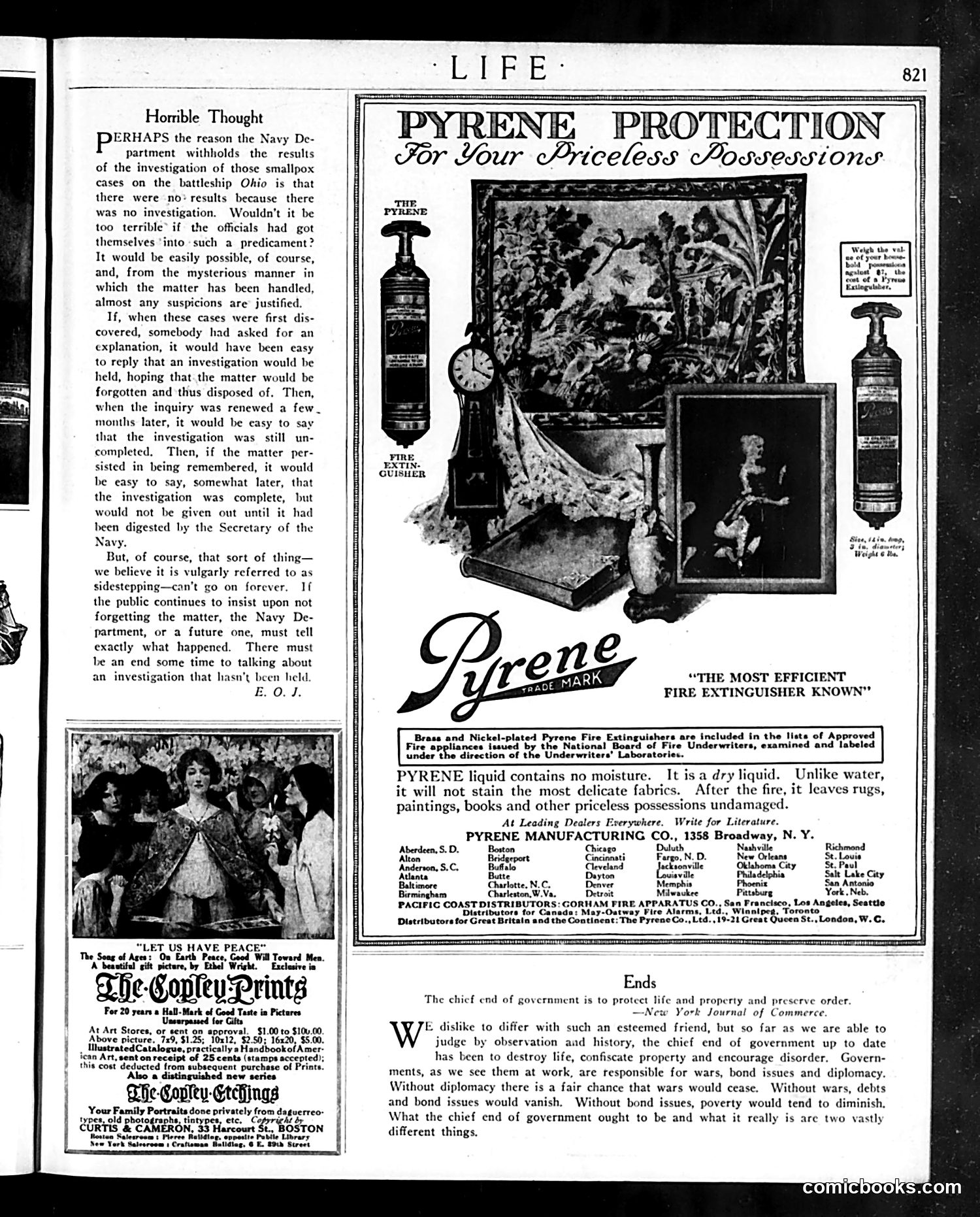
This page contains two distinct elements: **Left Column - "Horrible Thought" Editorial Satire:** A biting critique of U.S. Navy bureaucratic evasion. The piece sarcastically outlines how officials could indefinitely avoid accountability for a smallpox outbreak aboard the USS Ohio by claiming ongoing investigations that never actually occur. It's social commentary on government stonewalling—officials delay, claim continued inquiry, and eventually claim completion without releasing findings. The satire calls out this transparent stalling tactic as unacceptable when citizens demand transparency. **Right Side - Product Advertisement:** A full-page ad for Pyrene fire extinguishers, marketed as protecting "priceless possessions" without water damage. The advertisement includes testimonial imagery and nationwide distributor listings. **Bottom - Editorial Essay "Ends":** A cynical reflection on government's actual versus stated purpose, arguing that governments historically destroy life, confiscate property, and encourage disorder through wars and diplomacy—contradicting the noble ideal that government protects life and property. This complements the Navy scandal critique above.
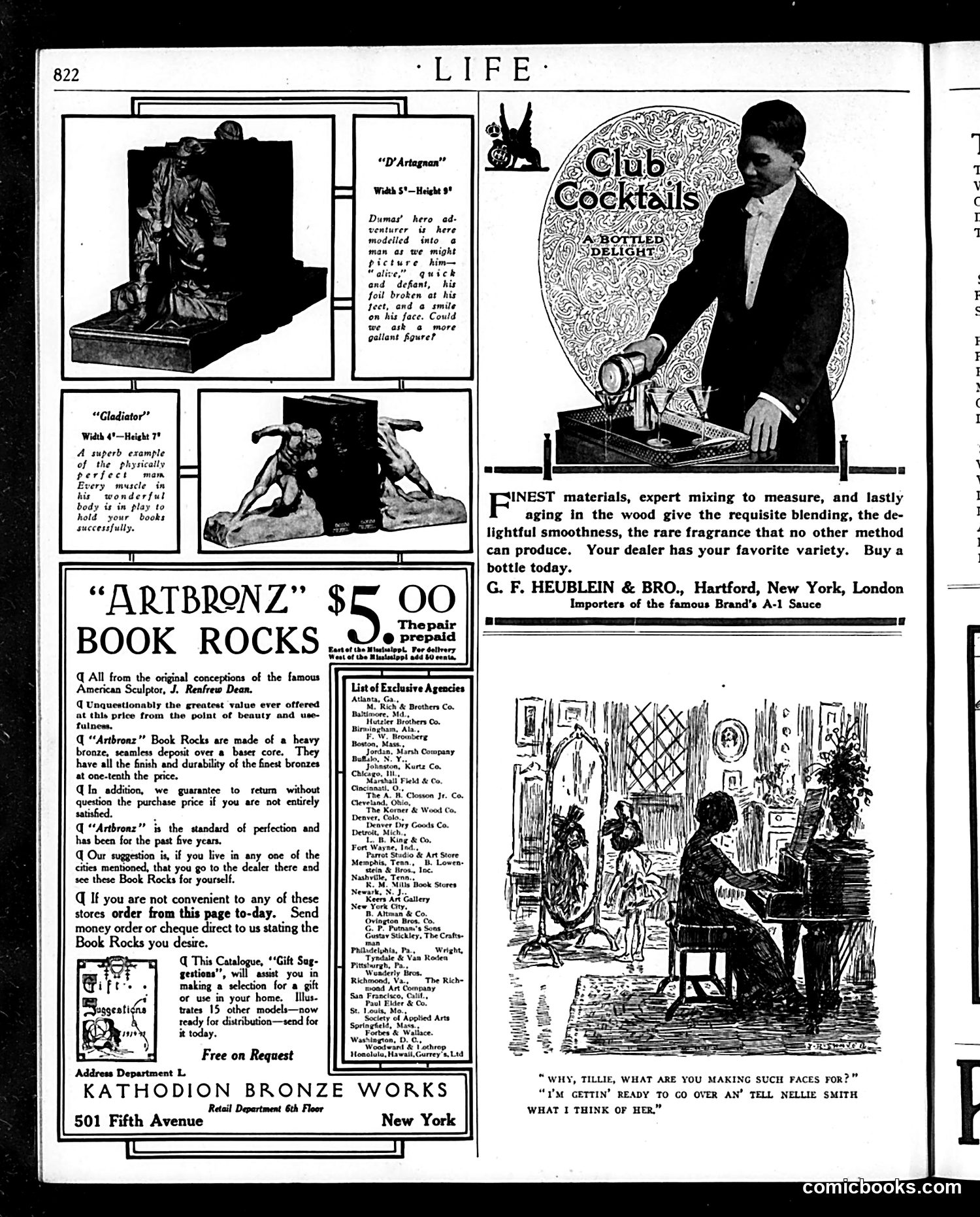
This page is primarily **advertising**, featuring two main product promotions with minimal satirical content. The left side advertises "Artbronz" book rocks—decorative bronze bookends modeled after classical figures like "D'Artagnan" and "The Gladiator." These are marketed as affordable luxury items (bronze at one-tenth the price of solid bronze), targeting middle-class homes seeking cultured décor. The upper right features a **Club Cocktails advertisement** for G.F. Heublein & Bro., emphasizing quality ingredients and aging processes—typical early 20th-century spirits marketing. The small cartoon at bottom right depicts two women gossiping—one ("Tillie") preparing to criticize another ("Nellie Smith") to a third party. This brief comic reflects common social satire about female gossip and neighborhood drama, presenting mild humor about domestic social dynamics without deeper political commentary. The page reflects 1920s consumer culture and gender stereotypes rather than substantive satire.
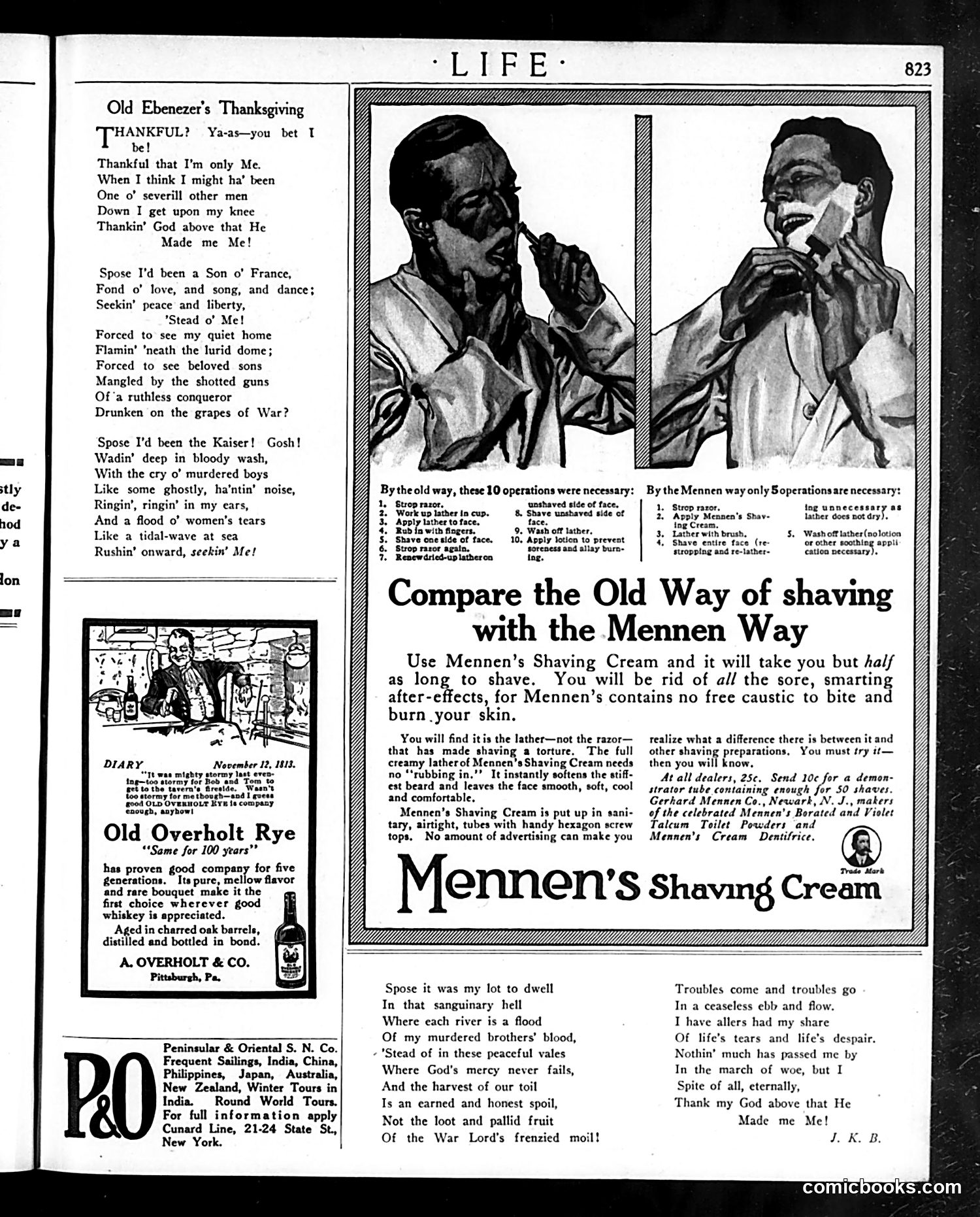
This page from *Life* magazine presents a patriotic poem expressing gratitude for being American rather than French or German during World War I. The speaker, "Old Ebenezer," thanks God he wasn't born a Frenchman (whose homeland faces invasion and whose sons are dying in war) or the Kaiser (haunted by the screams of murdered boys and women's tears). Instead, he's grateful to be an American in "these peaceful vales" untouched by war's devastation. The poem reflects American isolationism and relief at not being directly involved in the European conflict—this was published during WWI when America remained neutral until 1917. The page also contains advertisements for Old Overholt Rye whiskey and Mennen's Shaving Cream, which was typical *Life* magazine content mixing satirical editorial with commercial ads.
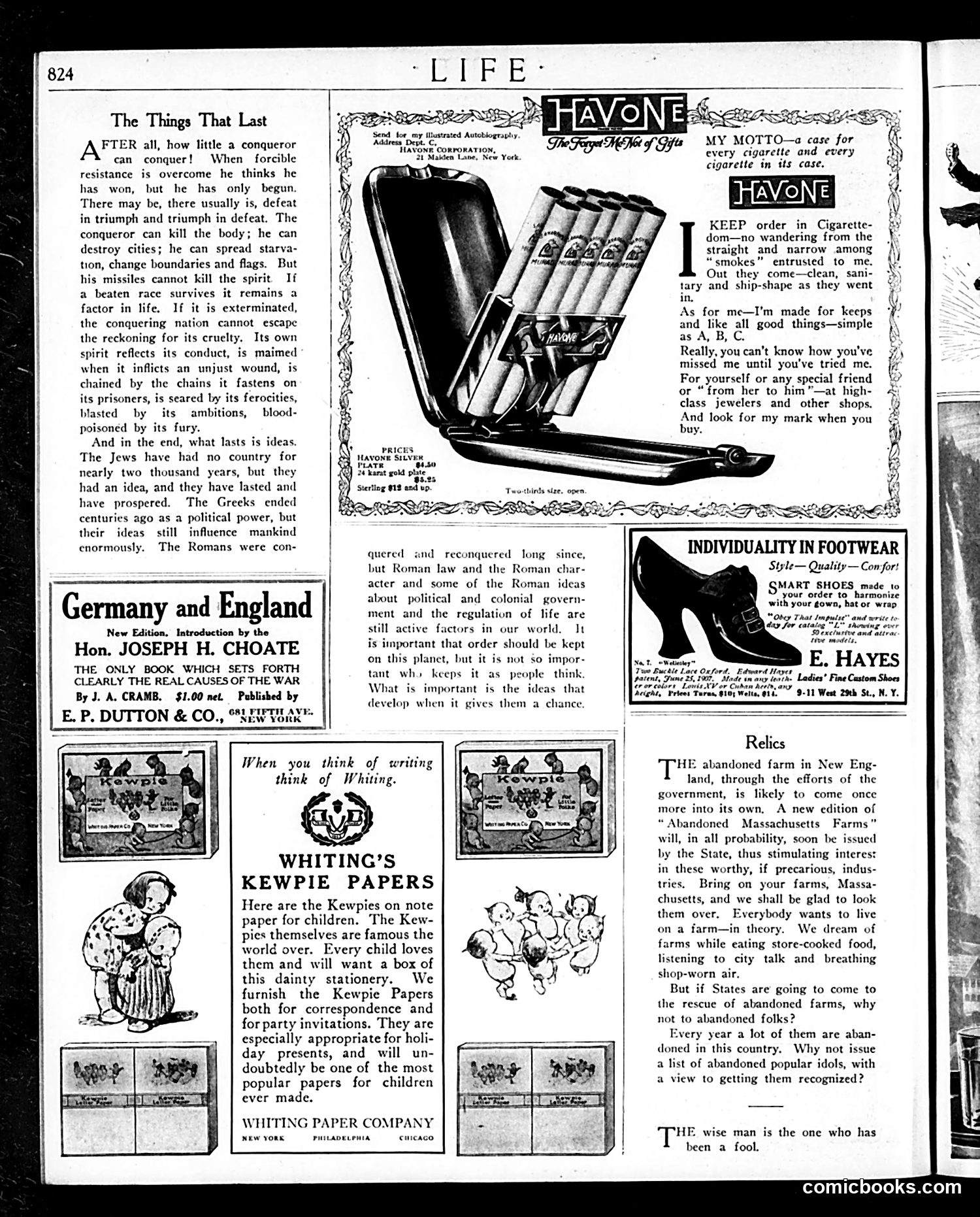
This page is primarily **advertisements and product placement**, with minimal editorial content. The main piece, "The Things That Last," is a philosophical essay arguing that ideas—not military conquest—endure through history. It uses examples of Jews, Greeks, and Romans to suggest that spiritual and intellectual legacies outlast empires. The satire is subtle: the essay's lofty meditation on immortal ideas is immediately surrounded by advertisements for cigarette cases, shoes, stationery, and other consumer goods—arguably undermining the message. There's ironic tension between the claim that "what lasts is ideas" and a page dominated by selling temporary material products. The remaining content consists of straightforward advertisements (Havone cigarettes, E. Hayes shoes, Whiting's Kewpie Papers) and a brief news item about abandoned Massachusetts farms. No political cartoons or caricatures appear on this page.
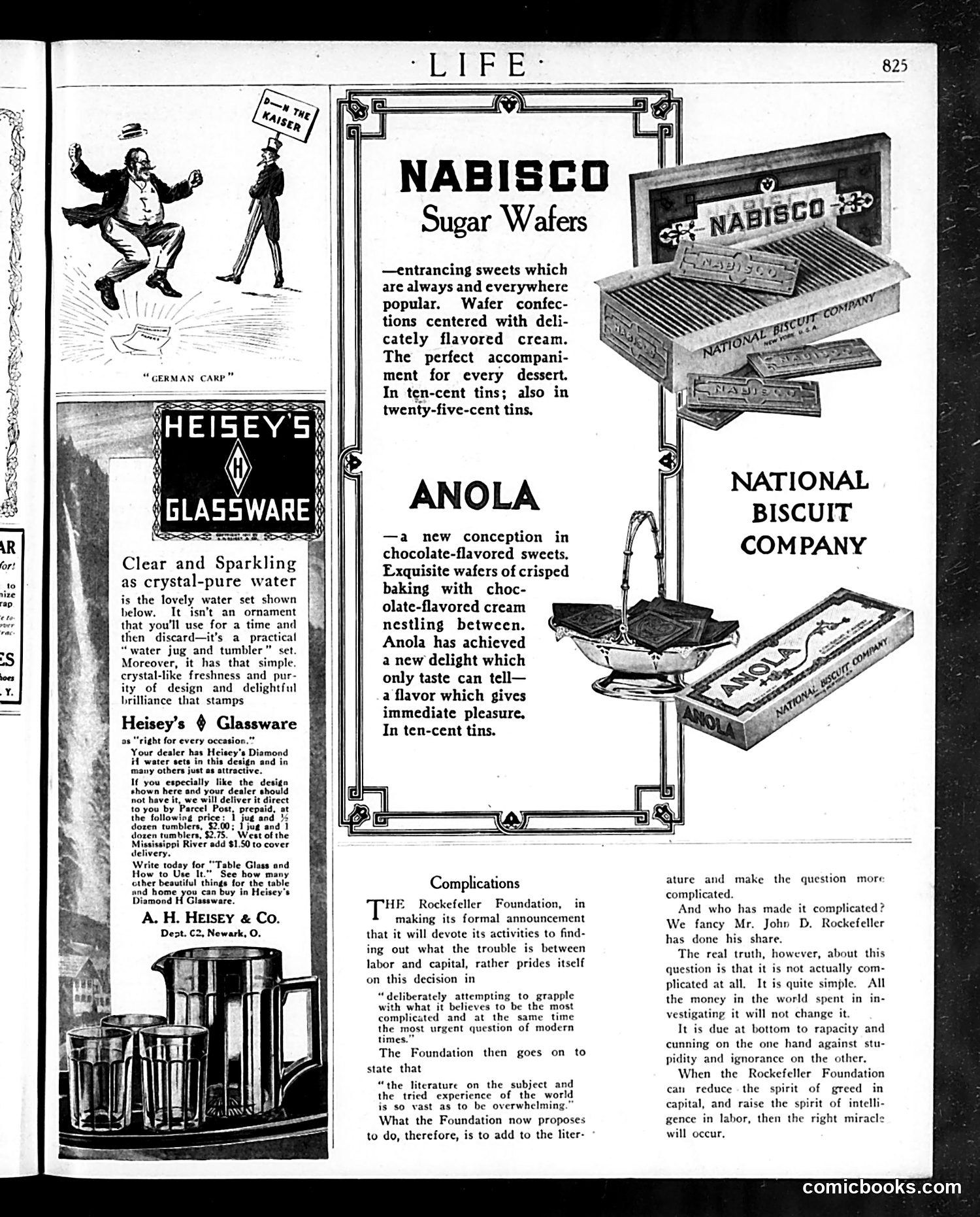
The main content is a satirical editorial titled "Complications" attacking the Rockefeller Foundation's announcement that it will study labor-capital relations. **The Satire:** Life mocks the Foundation's claim to address this "complicated" problem by arguing the issue is actually *simple*—rooted in "rapacity and cunning" versus "stupidity and ignorance." The magazine suggests that the Foundation, led by John D. Rockefeller (the wealthy industrialist), ironically caused many labor problems through his own business practices, yet now claims to study and "solve" them. The satire implies the Foundation will only add complexity and obscure the real issue: that capital exploits labor. **Context:** This reflects early 20th-century skepticism about philanthropic institutions masking capitalist exploitation. The piece suggests wealthy industrialists use foundations to appear concerned while fundamentally avoiding accountability for labor conditions they created. The rest of the page contains period advertisements for glassware, sugar wafers, and biscuits.
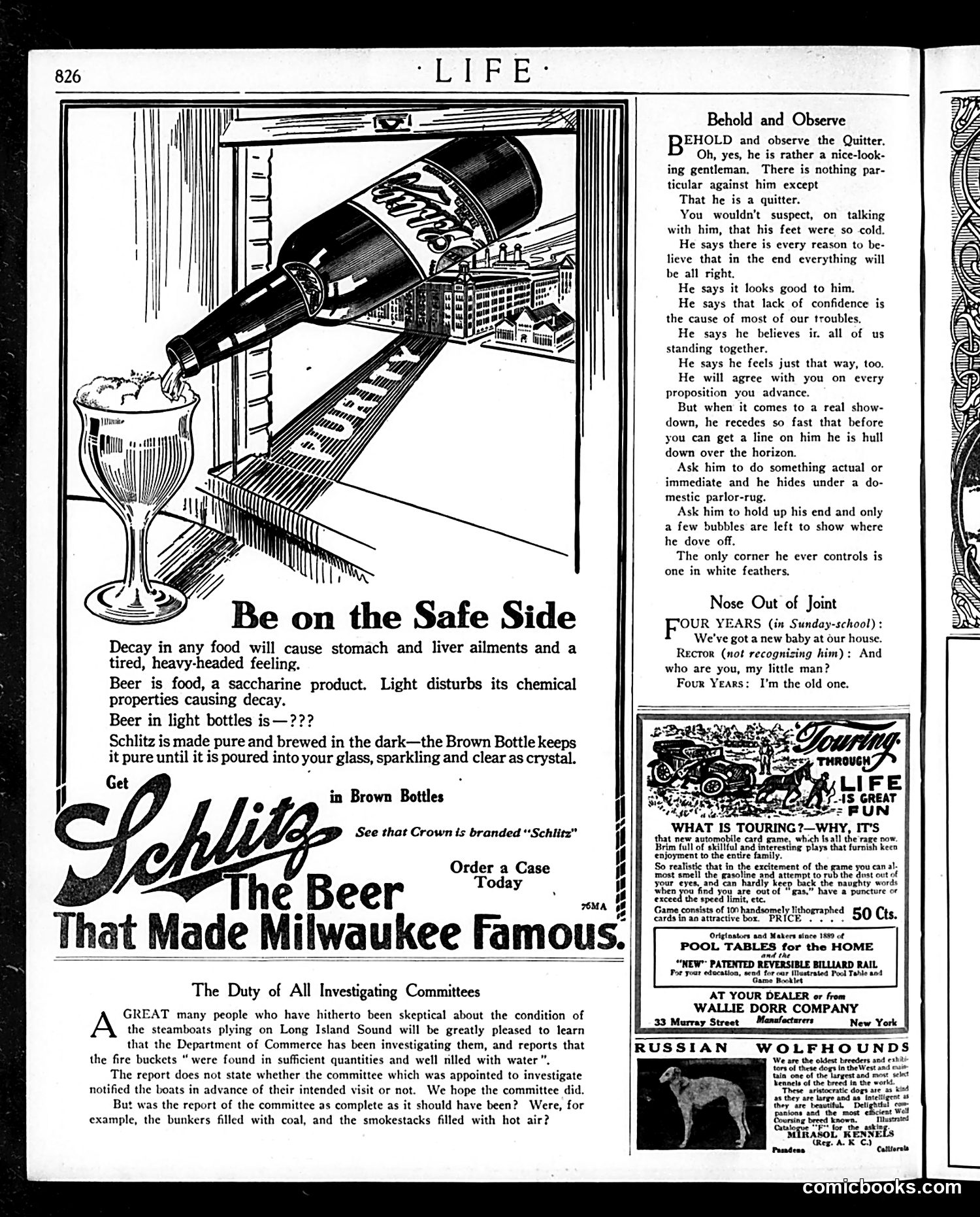
This page combines beer advertising with social satire typical of early 20th-century *Life* magazine. **The Main Cartoon:** "Be on the Safe Side" advertises Schlitz beer in brown bottles, arguing that light exposure causes decay in beer (a real concern of the era). The visual shows a bottle pouring into a glass above a cityscape—a straightforward product ad. **The Satire Below:** "The Duty of All Investigating Committees" mocks government oversight as performative theater. It references steamboat safety inspections on Long Island Sound, sarcastically noting inspectors found fire buckets "well filled with water"—suggesting this bare minimum accomplishment is celebrated while real issues (coal in bunkers, functioning smokestacks) go unchecked. The joke: committees announce trivial findings while ignoring actual safety hazards. **"Behold and Observe"** satirizes the "quitter"—a person who verbally agrees with everything but avoids concrete action, disappearing when real commitment is required. The "white feathers" reference suggests cowardice. The page exemplifies *Life*'s editorial approach: mixing advertisements with pointed social criticism about institutional failures and character flaws.
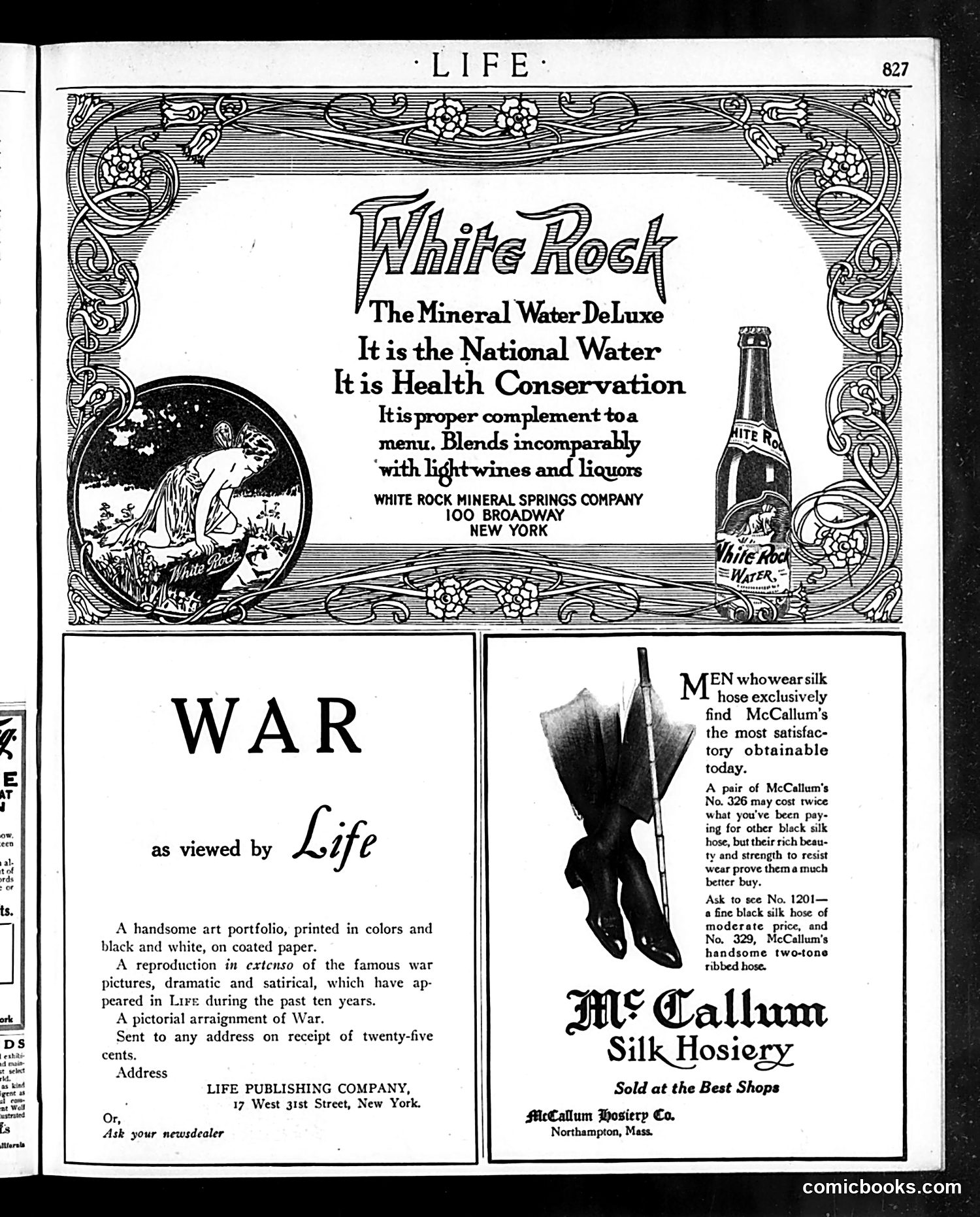
This is a **Life magazine advertising page** (page 827), not a political cartoon. It contains three advertisements: 1. **White Rock Mineral Water** (top)—positioned as a luxurious, health-conscious beverage suitable for serving with meals and light alcohol. 2. **"War as Viewed by Life"** (bottom left)—promoting a mail-order art portfolio compiling Life's satirical and dramatic war illustrations from the past decade. Readers could purchase this collection for 25 cents, suggesting Life had been publishing anti-war or critical commentary on warfare during this period. 3. **McCallum Silk Hosiery** (bottom right)—a product advertisement emphasizing quality and durability of silk stockings. The page reflects early 20th-century American consumer culture and Life's dual identity as both satirical publication and lifestyle magazine for the affluent.
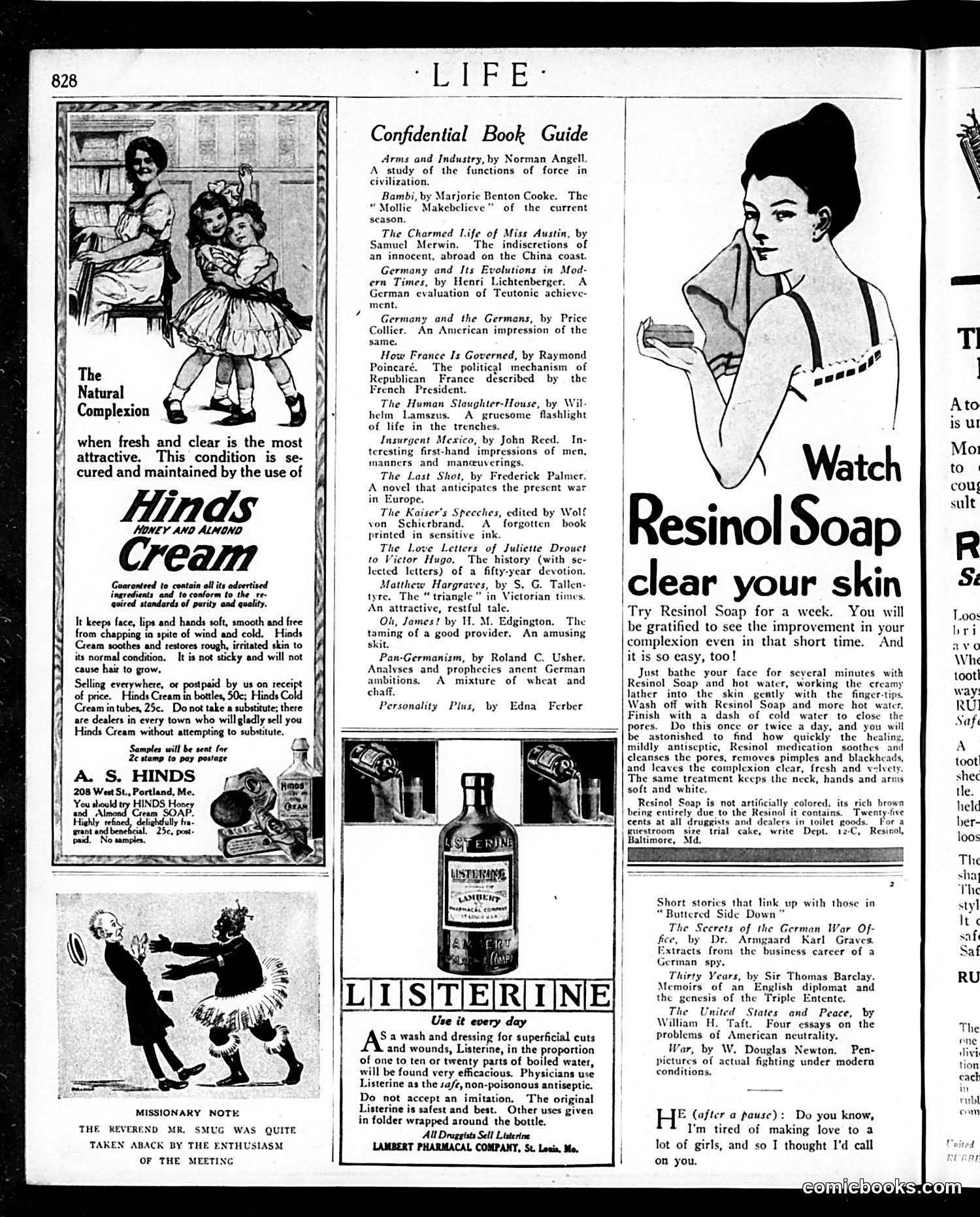
This page is primarily **advertising and book reviews**, not political satire. The "Confidential Book Guide" lists contemporary works, many addressing **World War I tensions**: Angell's study of force, books analyzing Germany's political ambitions and military capability, and Lamszus's gruesome account of trench warfare. The titles reflect anxiety about German militarism and expansionism—timely concerns for American readers. The cartoons are minor decorative elements: a woman with children (promoting Hinds Cream) and a couple in a romantic pose (unrelated to page content). The dominant content is **advertising**: Hinds Honey and Almond Cream and Resinol Soap dominate the layout with typical early-20th-century beauty product pitches—claims of skin improvement through daily washing routines. No political meaning is present; this reflects standard magazine monetization of the era.
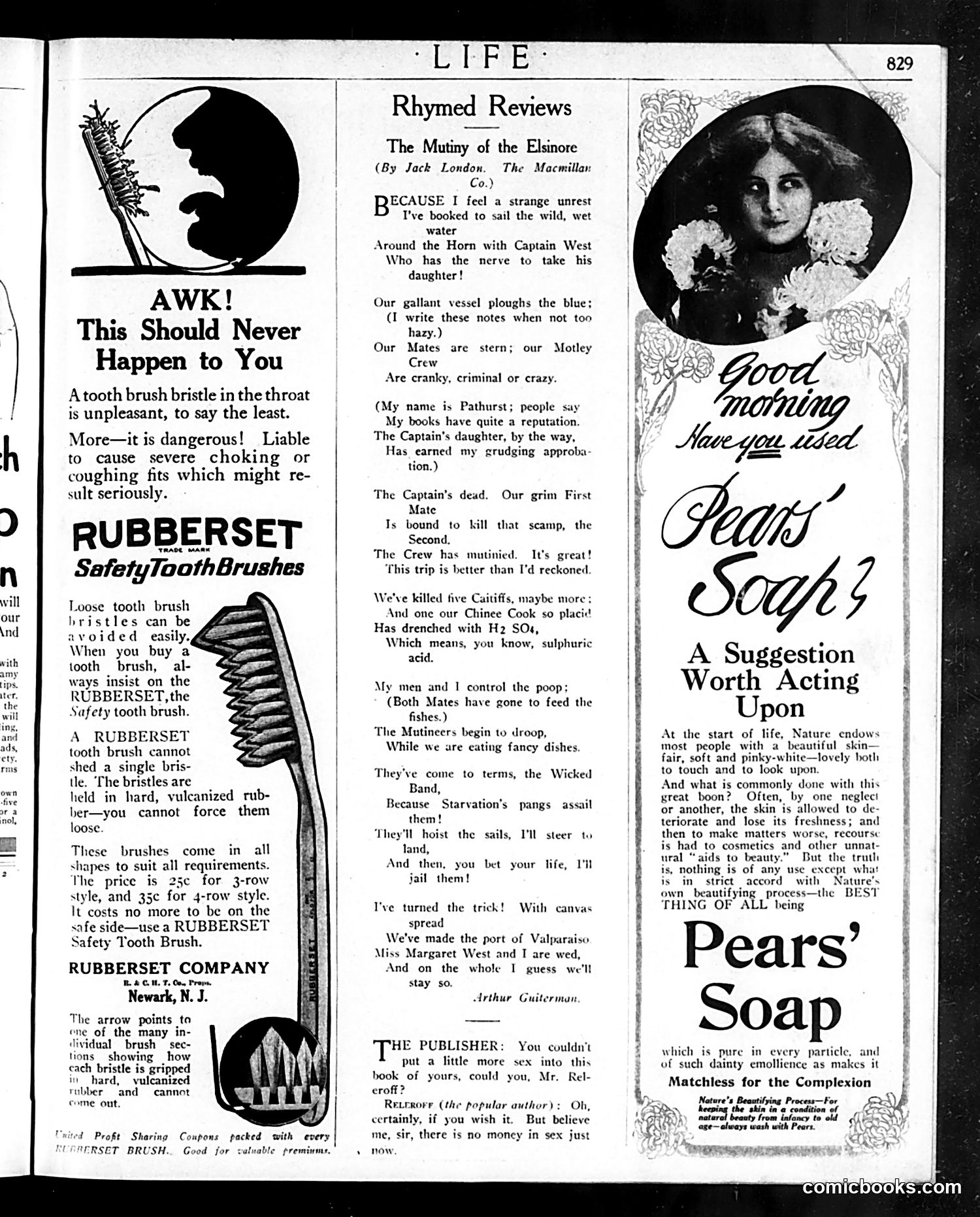
This page contains primarily **advertising and literary review**, not political satire. The main content is a rhymed review of Jack London's *The Mutiny of the Elsinore* by Arthur Guiterman, summarizing the novel's plot: a narrator sailing with Captain West around Cape Horn experiences mutiny, murder, and chaos aboard ship, ultimately marrying the Captain's daughter in Valparaiso. The tone is lighthearted, treating serious events (murder, mutiny, sulfuric acid attacks) as adventure-story entertainment. The page's advertisements are unrelated: Rubberset Safety Toothbrushes (warning against loose bristles causing choking) and Pears' Soap (promoting natural skin beauty). A brief publisher-author exchange jokes about adding sex to books for sales. No political figures or satire are present. This represents typical early 20th-century magazine content mixing literary criticism with consumer advertising.
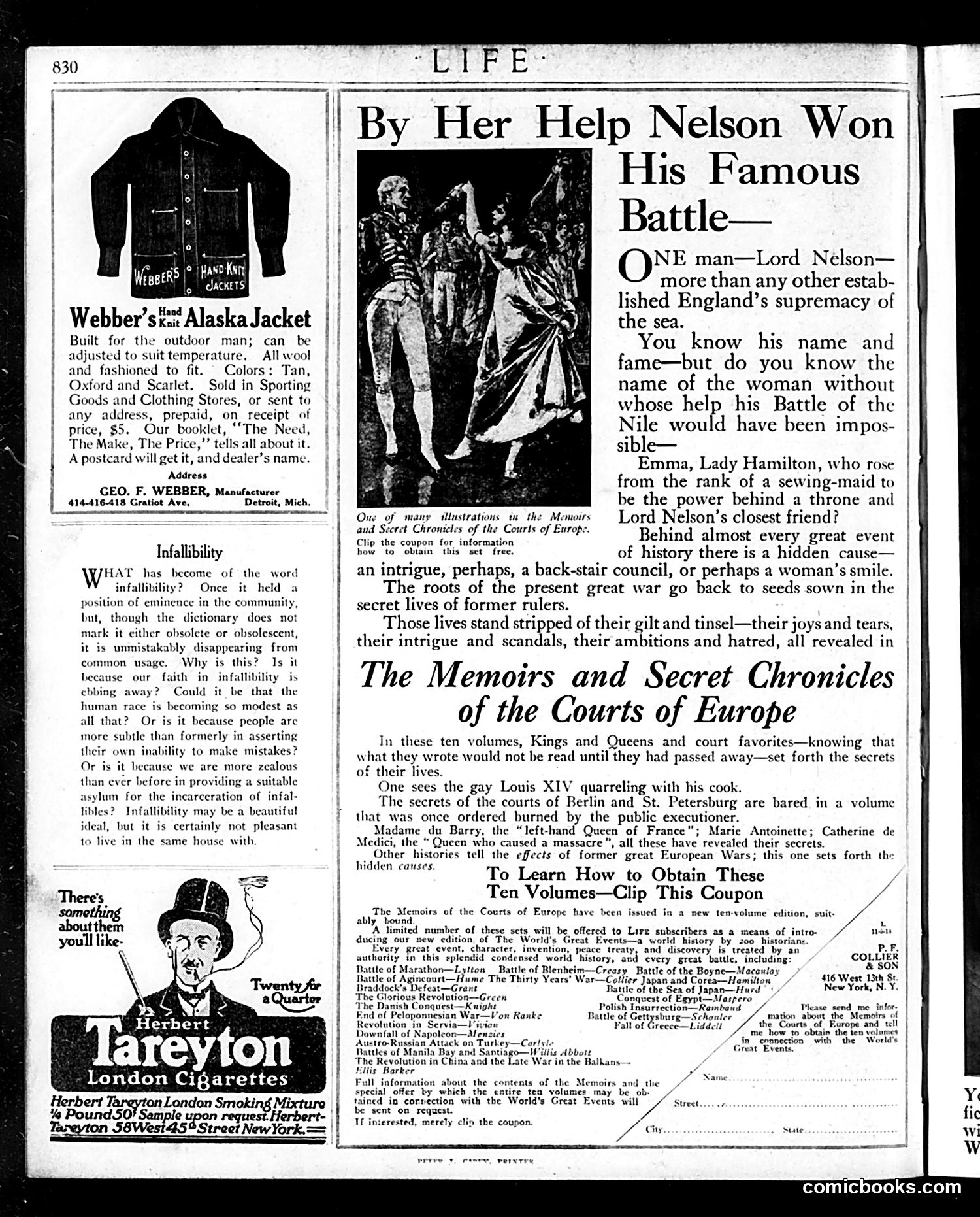
This Life magazine page (page 830) mixes advertising with editorial content promoting a book series. The main feature describes **Emma, Lady Hamilton**, a real historical figure who rose from servant to become the mistress and political advisor of British Admiral Lord Nelson during the Napoleonic Wars. The piece argues that behind major historical events—like Nelson's naval victories—stand hidden influences: "an intrigue, perhaps, a back-stair council, or perhaps a woman's smile." This reflects early-20th-century attitudes about how powerful men were supposedly guided by women's behind-the-scenes manipulation. The adjacent advertisement promotes *The Memoirs and Secret Chronicles of the Courts of Europe*, a ten-volume history book emphasizing scandalous court secrets and personal rivalries of European monarchs—suggesting that wars and politics stemmed from royal intrigues rather than policy or ideology. The page also includes ads for a Webber Alaska Jacket and Herbert Tareyton cigarettes, typical of Life's revenue model.
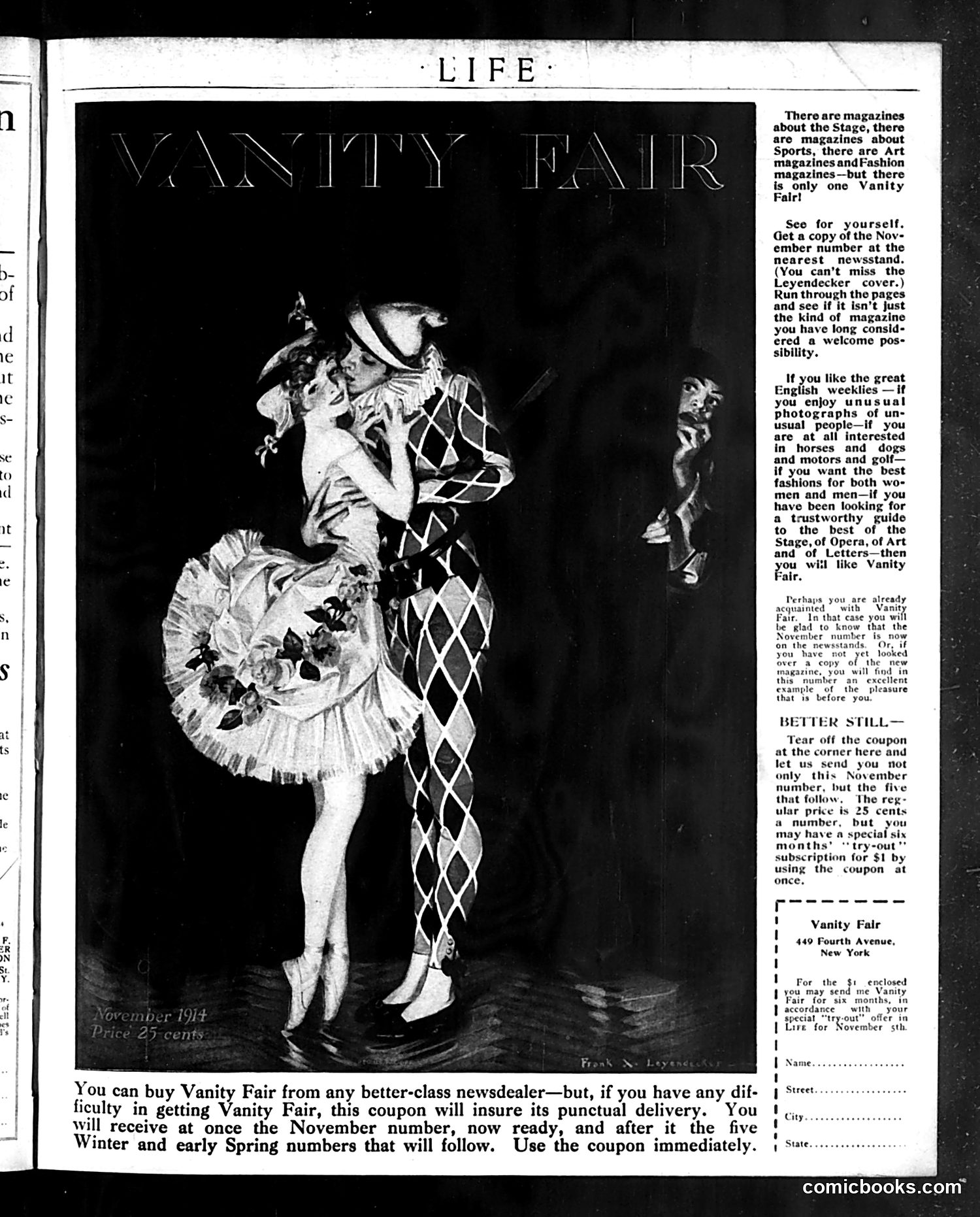
This is primarily a **magazine advertisement**, not political satire. It promotes Vanity Fair's November 1914 issue, featuring a cover illustration by J.C. Leyendecker (a famous commercial artist of the era). The image shows an art deco–styled couple in elegant evening wear—a harlequin-costumed man and a woman in a flowing ball gown—representing the magazine's focus on glamorous society, theater, fashion, and entertainment. The text positions Vanity Fair as superior to competitor magazines by claiming it uniquely covers Stage, Sports, Art, and Fashion comprehensively. It appeals to readers interested in "the great English weeklies," unusual photography, sports, and cultural coverage. The coupon offers a six-month subscription for $1 (roughly $33 today), compared to the regular 25-cent newsstand price—an incentive to subscribe rather than buy individually. This reflects the magazine's status as a high-end publication for affluent, culturally-engaged readers in the pre-WWI era.
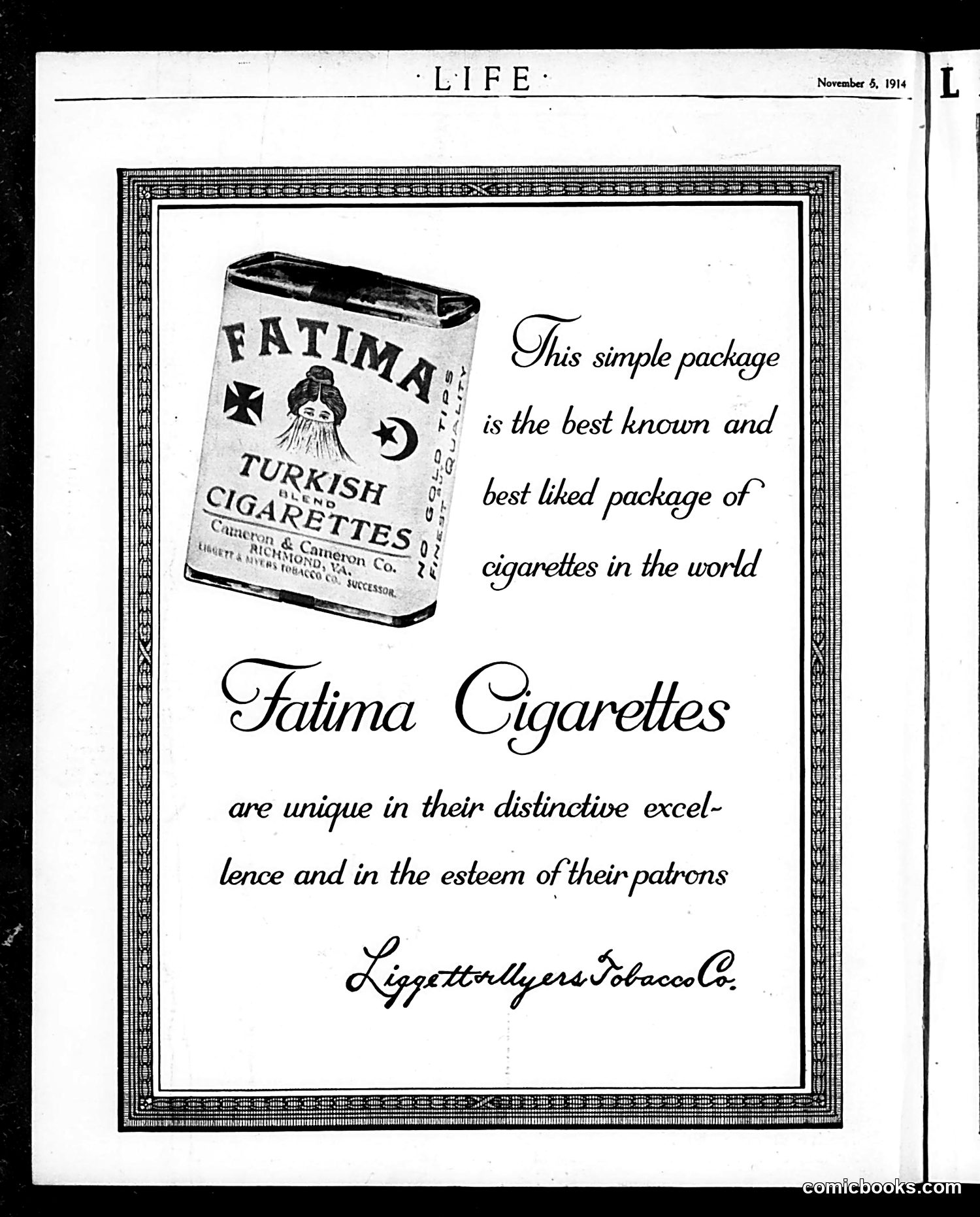
This is a full-page advertisement for Fatima Turkish Cigarettes, not a political cartoon or satire. The ad features the product's distinctive package—a tin with a crescent moon and star (Islamic symbols)—and claims it is "the best known and best liked package of cigarettes in the world." The copy emphasizes the cigarettes' "distinctive excellence" and popularity. The ad is placed in *Life* magazine from November 1914, during World War I. The "Turkish" branding and Islamic imagery were marketing strategies common in early 20th-century cigarette advertising. The manufacturer is listed as Liggett & Myers Tobacco Co. This is straightforward commercial advertising rather than editorial content or satire.