
Life, 1914-11-05 · page 22 of 48
Life — November 5, 1914 — page 22: what you’re looking at
What you’re looking at
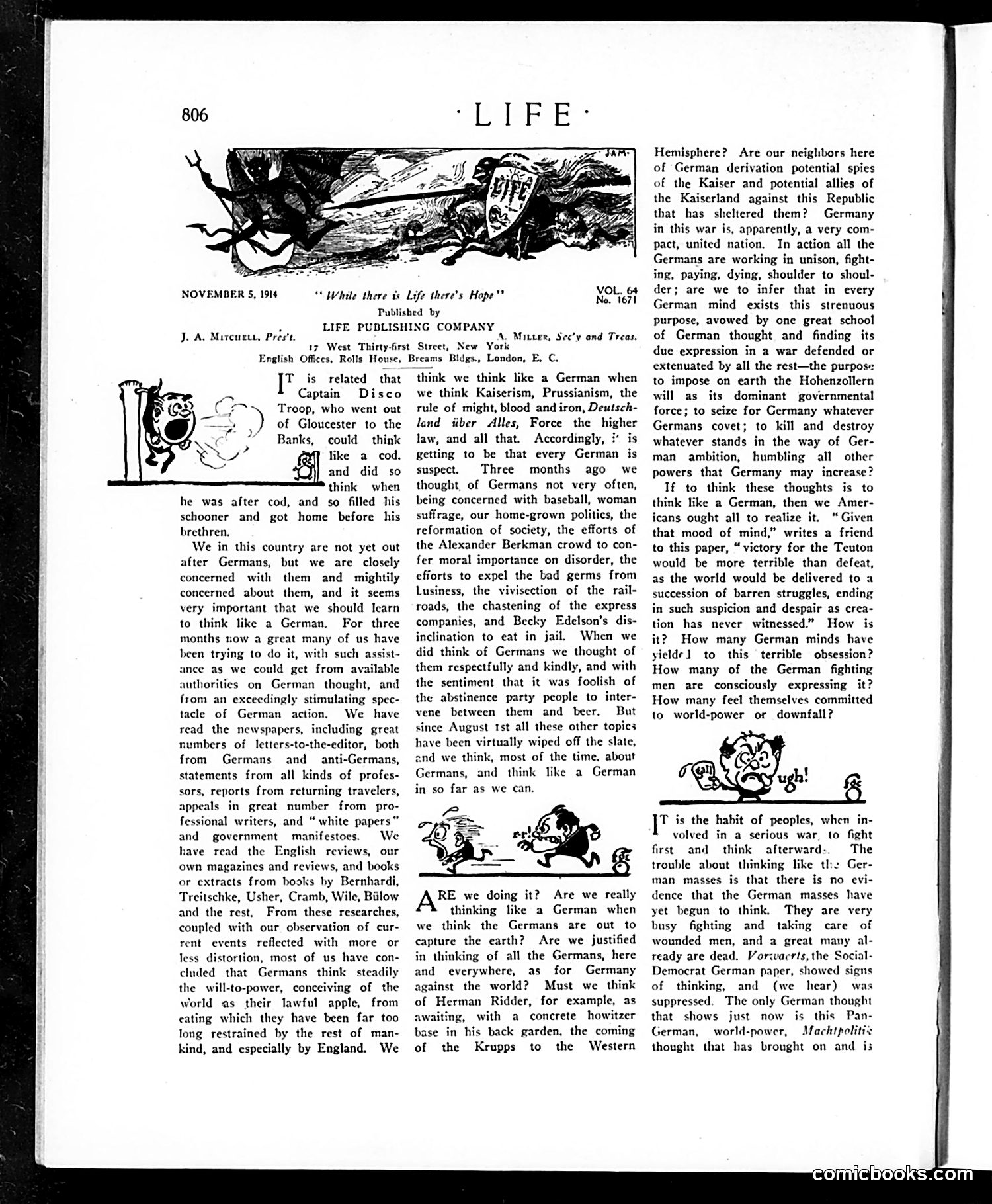
This editorial satirizes American anxiety about German immigrants and German-American loyalty during World War I. The opening metaphor compares thinking like a German to a fishing captain thinking like a cod—absurd and impossible. The piece critiques the post-August 1914 shift in American public discourse: previously, Americans debated domestic issues (baseball, suffrage, labor reform); now Germans and "Germanism" dominate every conversation. The author questions whether Americans are reasonably assessing genuine threats or engaging in paranoid stereotyping. Specifically, it challenges whether German-Americans like Herman Ridder (a real newspaper publisher) should be presumed disloyal spies preparing for Kaiser invasion. The satire suggests that wholesale suspicion of German-derived citizens—treating all as unified agents of German state power—represents confused, fearful thinking rather than actual German thinking. The cartoon's message: wartime hysteria can make citizens abandon rational judgment.
📄 Transcribed text from this page (OCR, searchable)
Machine-transcribed from the original scan — historical spelling and the odd misread are preserved.
NOVEMBER 5, 191¢ “While there ts ife there's Hope"* Published by J. A. Marcuent, Pres't, LIFE PUBLISHING COMPANY: Mutter, Sec’y and Treas, 17 West Thirty-first Street, New York English Offices, Rolls House, Breams Bldgs., London, E. C. that Disco ) Troop, who went out r is related Captain of Gloucester to the Banks, could think like a cod, and did so think = when he was after cod, and so filled his schooner and got home before his brethren, We in this country are not yet out after Germans, but we are closely concerned with them and mightily concerned about them, and it seems very important that we should Icarn to think like a German. For three months now a great many of us have been trying to do it, with such assist- ance as we could get from available authorities on German thought, and from an exceedingly stimulating spec- tacle of German action. We have read the newspapers, including great numbers of letters-to-the-editor, both from Germans and anti-Germans, statements from all kinds of profes- sors, reports from returning travelers, appeals in great number from pro- fessional writers, and “ white papers” and government manifestoes. We have read the English reviews, our own magazines and reviews, and books or extracts from books by Bernhardi, Treitschke, Usher, Cramb, Wile, Billow and the rest. From these researches, coupled with our observation of cur- rent events reflected with more or less distortion, most of us have con- cluded that Germans think steadily the will-to-power, conceiving of the world as their lawful apple, from eating which they have been far too long restrained by the rest of man- kind, and especially by England. We think we think like a German when we think Kaiserism, Prussianism, the rule of might, blood and iron, Deutsch- land iiber Alles, Force the higher law, and all that. Accordingly, #* is getting to be that every German is suspect. Three months ago we thought, of Germans not very often, being concerned with baseball, woman suffrage, our home-grown politics, the reformation of society, the efforts of the Alexander Berkman crowd to con- fer moral importance on disorder, the efforts to expel the bad germs from Lusiness, the vivisection of the rail- roads, the chastening of the express companies, and Becky Edelson’s dis- inclination to eat in jail. When we did think of Germans we thought of them respectfully and kindly, and with the sentiment that it was foolish of the abstinence party people to inter- vene between them and beer. But since August tst all these other topics have been virtually wiped off the slate, and we think, most of the time, about Germans, and think like a German in so far as we can. : 4 RE we doing it? Are we really thinking like a German when we think the Germans are out to capture the earth? Are we justified in thinking of all the Germans, here and everywhere, as for Germany against the world? Must we think of Herman Ridder, for example, as awaiting, with a concrete howitzer base in his back garden, the coming of the Krupps to the Western ert Hemisphere? Are our neighbors here of German derivation potential spies of the Kaiser and potential allies of the Kaiserland against this Republic that has sheltered them? Germany in this war is, apparently, a very com- pact, united nation. In action all the Germans are working in unison, fight- ing, paying, dying, shoulder to shoul- der; are we to infer that in every German mind exists this strenuous purpose, avowed by one great school of German thought and finding its due expression in a war defended or extenuated by all the rest—the purpose to impose on earth the Hohenzollern will as its dominant governmental force; to seize for Germany whatever Germans covet; to kill and destroy whatever stands in the way of Ger- man ambition, humbling all other powers that Germany may increase? If to think these thoughts is to think like a German, then we Amer- icans ought all to realize it. “Given that mood of mind,” writes a friend to this paper, “victory for the Teuton would be more terrible than defeat, as the world would be delivered to a succession of barren struggles, ending in such suspicion and despair as crea- tion has never witnessed.” How is it? How many German minds have yielde1 to this terrible obsession? How many of the German fighting men are consciously expressing it? How many feel themselves committed to world-power or downfall? I" is the habit of peoples, when in- volved in a serious war, to fight first and think afterward-. The trouble about thinking like the Ger- man masses is that there is no evi- dence that the German masses have yet begun to think, They are very busy fighting and taking care of wounded men, and a great many al- ready are dead. Vorwacrts,the Social- Democrat German paper, showed signs of thinking, and (we hear) w: suppressed. The only German thought that shows just now is this Pan- German, world-power, Machtpolitis thought that has brought on and is