
Life, 1914-11-05 · page 28 of 48
Life — November 5, 1914 — page 28: what you’re looking at
What you’re looking at
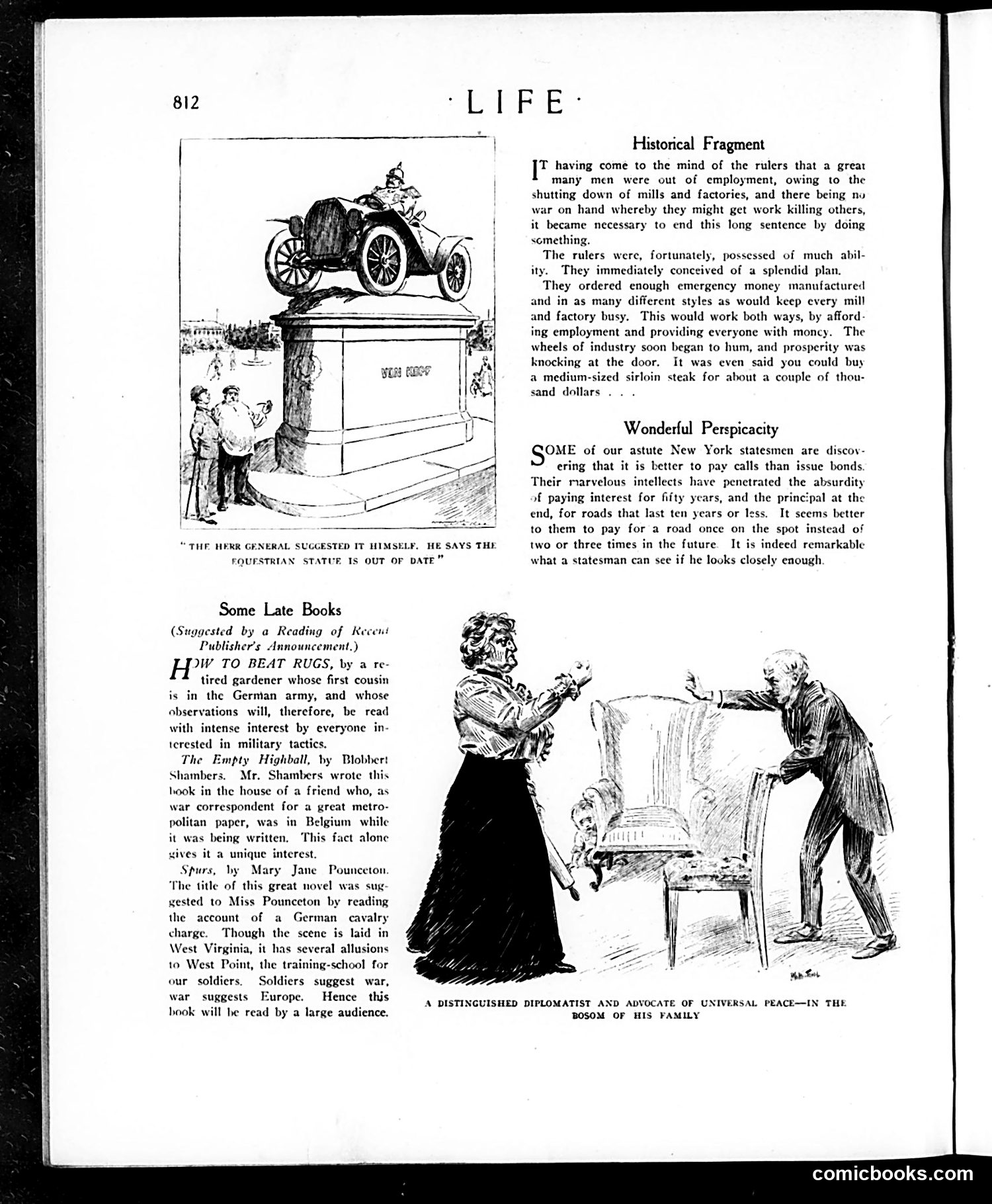
**Top Cartoon**: Shows an equestrian statue being critiqued as "out of date." The caption suggests a German general proposed replacing it—likely satirizing how WWI (then ongoing) influenced American culture and decision-making. The joke is that wartime concerns now dictate even artistic judgments. **"Historical Fragment"**: Satirizes government economic policy during post-war unemployment. Rulers manufacture emergency currency in multiple styles to keep mills busy and stimulate employment—but the absurd punchline reveals hyperinflation: a sirloin steak costs "a couple of thousand dollars." This mocks government spending as a cure-all that merely creates inflation without solving underlying problems. **"Wonderful Perspicacity"**: Ridicules New York politicians for discovering it's cheaper to pay road construction costs upfront rather than pay interest on bonds for decades. The satire suggests these "astute statesmen" are credited for obvious reasoning, implying typical political incompetence. **"Some Late Books"**: Parodies wartime book-marketing where tenuous WWI connections (German cousins, Belgian correspondents, cavalry charges) are hyped to sell mediocre literature to eager war-interested readers.
📄 Transcribed text from this page (OCR, searchable)
Machine-transcribed from the original scan — historical spelling and the odd misread are preserved.
-E TRE: Historical Fragment 'T having come to the mind of the rulers that a great many men were out of employment, owing to the shutting down of mills and factories, and there being nu war on hand whereby they might get work killing others, it became necessary to end this long sentence by doing something. The rulers were, fortunately, possessed of much abil- ity. They immediately conceived of a splendid plan. They ordered enough emergency money manufactured and in as many different styles as would keep every mill and factory busy. This would work both ways, by afford ing employment and providing everyone with moncy. The wheels of industry soon began to hum, and prosperity was knocking at the door. It was even said you could buy a medium-sized sirloin steak for about a couple of thou- sand dollars . Wonderful Perspicacity OME of our astute New York statesmen are discov- ering that it is better to pay calls than issue bonds. Their marvelous intellects have penetrated the absurdity of paying interest for fifty years, and the principal at the end, for roads that last ten years or less. It seems better to them to pay for a road once on the spot instead of “THE HERR GENERAL SUGGESTED IT HIMSELF, HE SAYS THE two or three times in the future. It is indeed remarkable FQUFSTRIAN STATUE IS OUT OF DATE” what a statesman can see if he looks closely enough. Some Late Books (Suggested by a Reading of Recent Publisher's: Announcement.) IW TO BEAT RUGS, by a re- tired gardener whose first cousin is in the German army, and whose observations will, therefore, be read with intense interest by everyone in- terested in military tactics. The Empty Highball, by Bilobbert Shambers. Mr. Shambers wrote this hook in the house of a friend who, as war correspondent for a great metro- politan paper, was in Belgium while it was being written, This fact alone gives it a unique interest. Spurs, by Mary Jane Pounceton. The title of this great novel was suj gested to Miss Pounceton by reading the account of a German cavalry charge. Though the scene is laid in West Virginia, it has several allusions to West Point, the training-school for our soldiers. Soldiers suggest war, war suggests Europe. Hence this A DISTINGUISHED DIPLOMATIST AND ADVOCATE OF UNIVERSAL PEACE—IN THE book will he read by a large audience. BOSOM OF HIS FAMILY comicbooks.com