
Life, 1914-11-05 · page 14 of 48
Life — November 5, 1914 — page 14: what you’re looking at
What you’re looking at
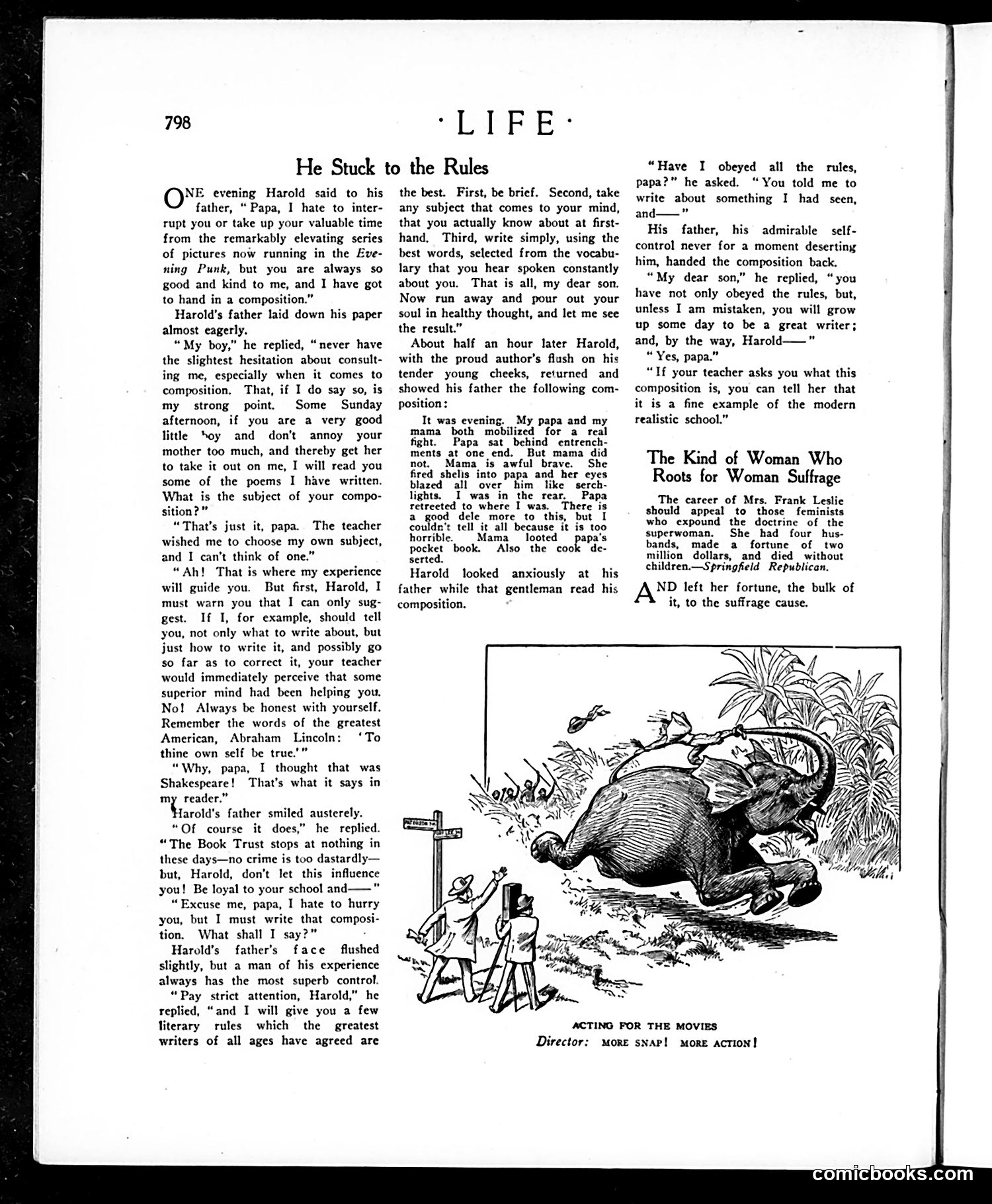
This page contains two distinct pieces: **Main Story ("He Stuck to the Rules"):** A narrative about Harold receiving writing advice from his father. The father emphasizes honesty, simplicity, and following established literary rules—citing Abraham Lincoln's advice to "be true to yourself." The story promotes traditional composition instruction. **Bottom Cartoon ("Acting for the Movies"):** A satirical sketch showing a film director demanding "MORE SNAP! MORE ACTION!" while an actor dramatically throws himself into exaggerated physical performance—apparently into or over a large mechanical crocodile or dinosaur prop. The joke mocks early silent film conventions requiring overwrought acting and spectacle to convey emotion to audiences, contrasting the director's demands with the absurdity of the "action" being performed. The page dates from cinema's silent era, when broad physical comedy dominated.
📄 Transcribed text from this page (OCR, searchable)
Machine-transcribed from the original scan — historical spelling and the odd misread are preserved.
“LAEEE * He Stuck to the Rules O = evening Harold said to his father, “ Papa, I hate to inter- rupt you or take up your valuable time from the remarkably elevating series of pictures now running in the Eve- ning Punk, but you are always so good and kind to me, and I have got to hand in a composition.” Harold’s father laid down his paper almost eagerly. “My boy,” he replied, “never have the slightest hesitation about consult- ing me, especially when it comes to composition, That, if I do say so, is my strong point. Some Sunday afternoon, if you are a very good little Soy and don’t annoy your mother too much, and thereby get her to take it out on me, I will read you some of the poems I have written. What is the subject of your compo- sition?” “That’s just it, papa. The teacher wished me to choose my own subject, and I can’t think of one.” “Ah! That is where my experience will guide you. But first, Harold, I must warn you that I can only sug- gest. If I, for example, should tell you, not only what to write about, but just how to write it, and possibly go so far as to correct it, your teacher would immediately perceive that some superior mind had been helping you. No! Always be honest with yourself. Remember the words of the greatest American, Abraham Lincoln: ‘To thine own self be true.’” “Why, papa, I thought that was Shakespeare! That's what it says in at reader.” larold'’s father smiled austerely. “Of course it does,” he replied. “The Book Trust stops at nothing in these days—no crime is too dastardly— but, Harold, don’t let this influence you! Be loyal to your school and——” “Excuse me, papa, I hate to hurry you, but I must write that composi- tion. What shall I say?” Harold’s father’s face flushed slightly, but a man of his experience always has the most superb control. “Pay strict attention, Harold,” he replied, “and I will give you a few literary rules which the greatest writers of all ages have agreed are the best. First, be brief. Second, take any subject that comes to your mind, that you actually know about at first- hand, Third, write simply, using the best words, selected from the vocabu- lary that you hear spoken constantly about you. That is all, my dear son. Now run away and pour out your soul in healthy thought, and let me see the result.” About half an hour later Harold, with the proud author’s flush on his tender young cheeks, returned and showed his father the following com- position: It was evening. My papa and my mama both mobilized for a real fight. Papa sat behind entrench- ments at one end. But mama did not. Mama is awful brave. She fired shelis into papa and her eyes blazed all over him like serch- lights. I was in the rear. Papa retreeted to where I was. There is a good dele more to this, but I couldn't tell it all because it is too horrible. Mama__ looted apa's pocket book. Also the cook de- serted. Harold looked anxiously at his father while that gentleman read his composition. “Have I obeyed all the rules, papa?” he asked. “You told me to write about something I had seen, and——” His father, his admirable self- control never for a moment deserting him, handed the composition back. “My dear son,” he replied, “you have not only obeyed the rules, but, unless I am mistaken, you will grow up some day to be a great writer; and, by the way, Harold——” “Yes, papa.” “Tf your teacher asks you what this composition is, you can tell her that it is a fine example of the modern realistic school.” The Kind of Woman Who Roots for Woman Suffrage The career of Mrs. Frank Leslie should appeal to those feminists who expound the doctrine of the superwoman. She had four hus- bands, made a fortune of two million dollars, and died without children.—Springfield Republican. A’? left her fortune, the bulk of it, to the suffrage cause. ACTING FOR THE MOVIES Director: MORE SNAP! MORE ACTION!