
Life, 1914-11-05 · page 23 of 48
Life — November 5, 1914 — page 23: what you’re looking at
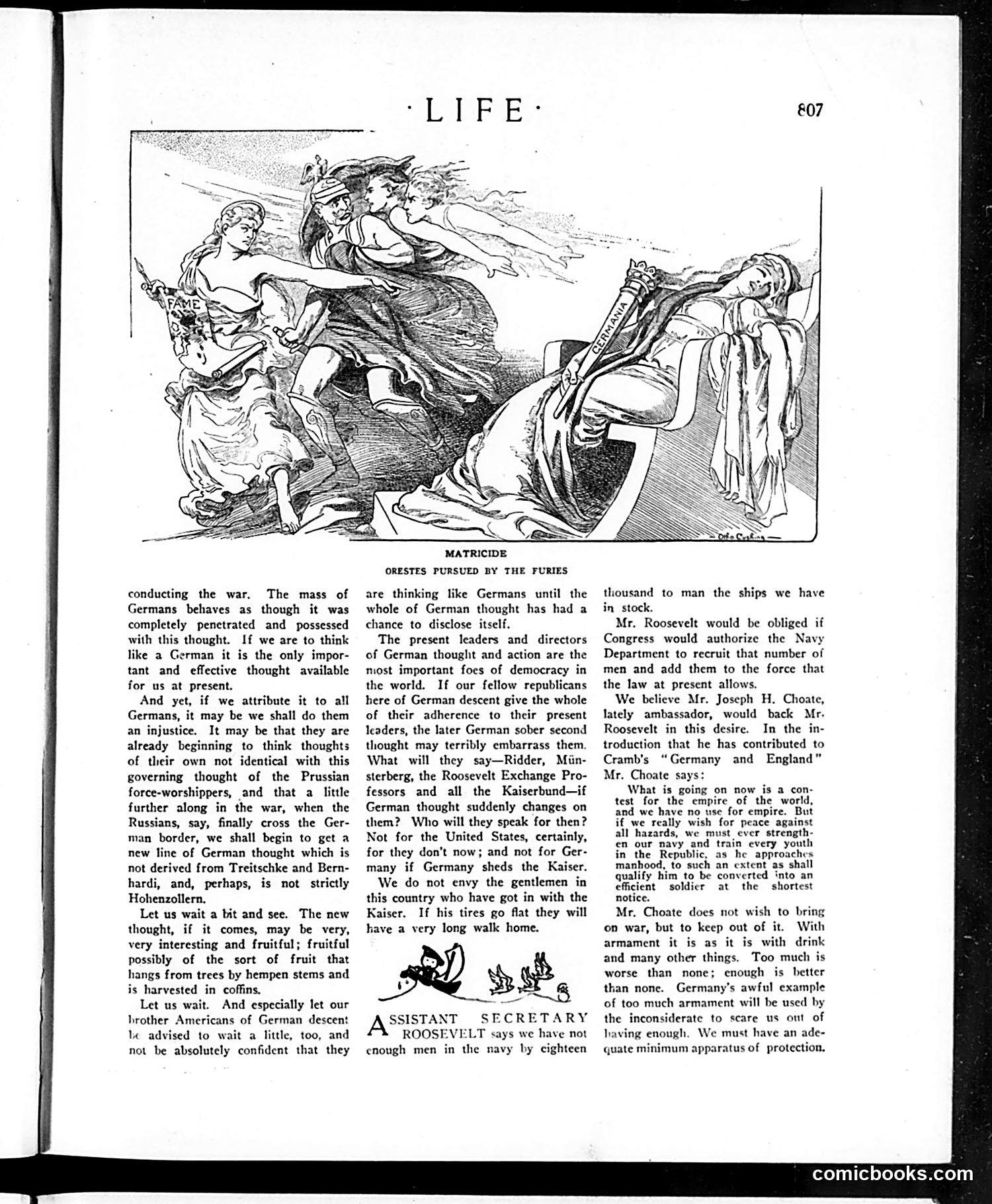
What you’re looking at
**The Cartoon:** Titled "Matricide: Orestes Pursued by the Furies," the illustration depicts classical Greek figures—Orestes fleeing from the Furies (avenging spirits). This allegorizes Germany's internal conflict: the "matricide" represents Germany's betrayal of its own people, while the Furies symbolize the consequences pursuing German leaders. **Political Context:** Written during WWI, the article addresses German-Americans, warning them against unconditional loyalty to Kaiser-aligned figures like Edmund von Steuben and Hugo Münsterberg. The author argues that German thought isn't monolithic—future German democracy might reject current militaristic leadership. German-Americans who support the Kaiser now risk embarrassment if Germany eventually "sheds the Kaiser." **The Satire:** The piece mocks pro-Kaiser German-Americans as potentially backing the wrong horse. If Germany's government changes post-war, these figures will have "a very long walk home"—they'll find themselves abandoned and discredited, pursued by history's judgment like Orestes by the Furies. The secondary article advocates naval expansion as deterrence against future conflict.
📄 Transcribed text from this page (OCR, searchable)
Machine-transcribed from the original scan — historical spelling and the odd misread are preserved.
conducting the war. The mass of Germans behaves as though it was completely penetrated and possessed with this thought. If we are to think like a German it is the only impor- tant and effective thought available for us at present. And yet, if we attribute it to all Germans, it may be we shall do them an injustice. It may be that they are already beginning to think thoughts of their own not identical with this governing thought of the Prussian force-worshippers, and that a little further along in the war, when the Russians, say, finally cross the Ger- man border, we shall begin to get a new line of German thought which is not derived from Treitschke and Bern- hardi, and, perhaps, is not strictly Hohenzollern. Let us wait a bit and see. The new thought, if it comes, may be very, very interesting and fruitful; fruitful possibly of the sort of fruit that hangs from trees by hempen stems and is harvested in coffins. Let us wait. And especially let our brother Americans of German descent lx advised to wait a little, too, and not be absolutely confident that they MATRICIDE ORESTES PURSUED BY THE FURIES are thinking like Germans until the whole of German thought has had a chance to disclose itself. The present leaders and directors of German thought and action are the most important foes of democracy in the world. If our fellow republicans here of German descent give the whole of their adherence to their present leaders, the later German sober second thought may terribly embarrass them. What will they say—Ridder, Miin- sterberg, the Roosevelt Exchange Pro- fessors and all the Kaiserbund—if German thought suddenly changes on them? Who will they speak for then? Not for the United States, certainly, for they don’t now; and not for Ger- many if Germany sheds the Kaiser. We do not envy the gentlemen in this country who have got in with the Kaiser. If his tires go flat they will have a very long walk home. Se yeh, SSISTANT SECRETARY ROOSEVELT says we have not enough men in the navy by cighteen thousand to man the ships we have in stock. Mr. Roosevelt would be obliged if Congress would authorize the Navy Department to recruit that number of men and add them to the force that the law at present allows. We believe Mr. Joseph H. Choate, lately ambassador, would back Mr. Roosevelt in this desire. In the in- troduction that he has contributed to Cramb’s “Germany and England” Mr. Choate says: What is going on now is a con- test for the empire of the world, and we have no use for empire. But if we really wish for peace against all hazards, we must ever strength- en our navy and train every youth in the Republic, as he approaches manhood, to such an extent as shall qualify him to be converted into an efficient soldier at the shortest notice. Mr. Choate does not wish to bring on war, but to keep out of it. With armament it is as it is with drink and many other things. Too much is worse than none; cnough is better than none. Germany’s awful example of too much armament will be used by the inconsiderate to scare us ont of having enough. We must have an ade- quate minimum apparatus of protection. comicbooks.com