
Life, 1914-11-05 · page 26 of 48
Life — November 5, 1914 — page 26: what you’re looking at
What you’re looking at
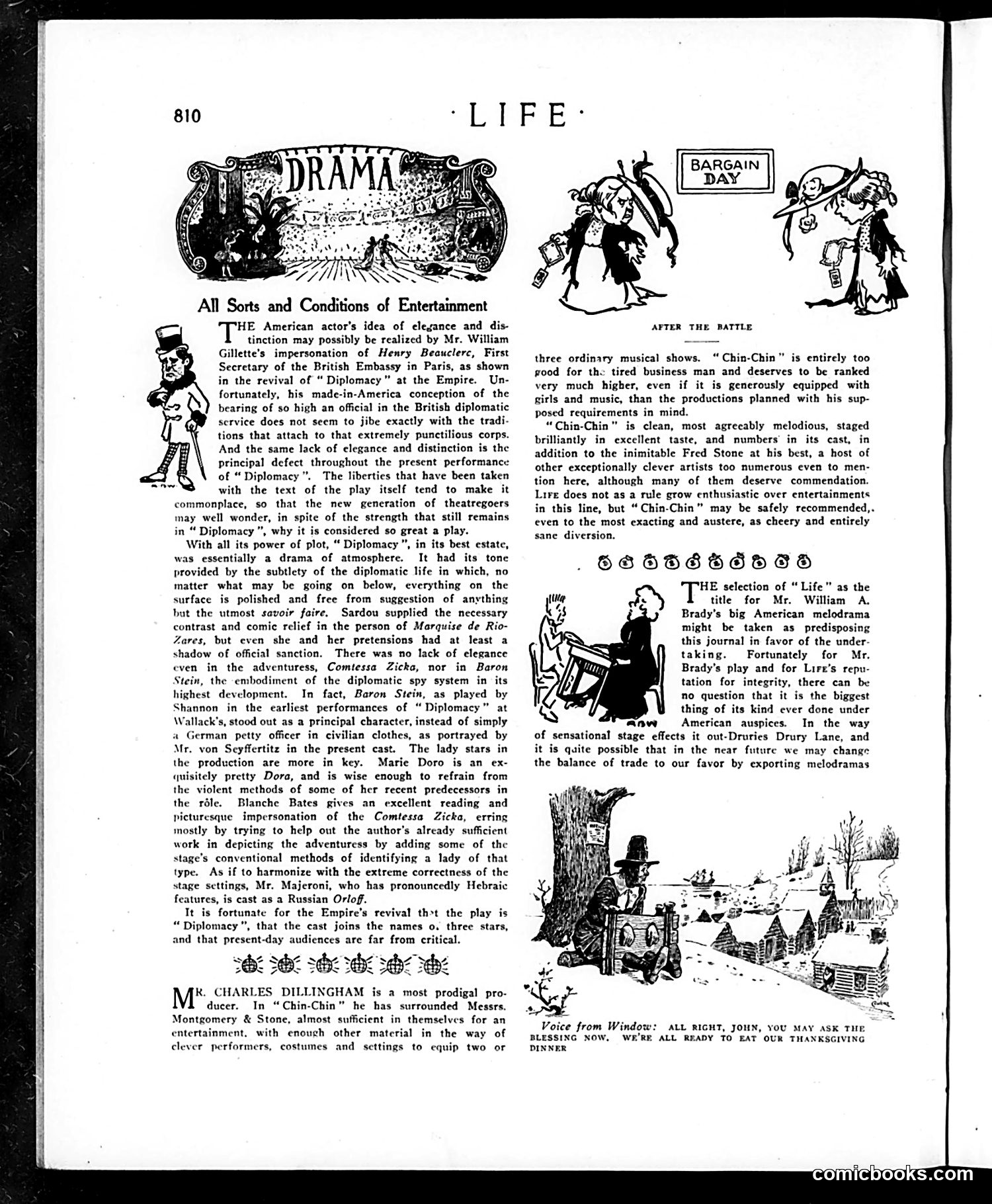
This page reviews theatrical productions, primarily critiquing William Gillette's performance in "Diplomacy" at the Empire Theatre. The review criticizes Gillette's American interpretation of a British diplomat as lacking the refined elegance and polish that should characterize the play's diplomatic milieu. The critic argues the production sacrifices atmospheric sophistication for commonplace entertainment. The page also praises "Chin-Chin," a musical production by Charles Dillingham featuring performers Montgomery and Stone. Unlike the "Diplomacy" review, this one commends the show's cleanliness, melody, staging, and talented cast—suggesting it deserves higher regard than typical "tired business man" entertainment. The cartoons illustrate theatrical scenes: one showing post-performance chaos ("After the Battle"), another depicting a Thanksgiving dinner scene. These visuals complement the reviews' commentary on contemporary American theatre standards and audience expectations circa the 1910s.
📄 Transcribed text from this page (OCR, searchable)
Machine-transcribed from the original scan — historical spelling and the odd misread are preserved.
All Sorts and Conditions of Entertainment HE American actor's idea of elegance and dis- tinction may possibly be realized by Mr. William Gillette’s impersonation of Henry Beauclerc, First Secretary of the British Embassy in Paris, as shown in the revival of “ Diplomacy” at the Empire. Un- fortunately, his made-in-America conception of the bearing of so high an official in the British diplomatic service does not seem to jibe exactly with the tradi- tions that attach to that extremely punctilious corps. And the same lack of elegance and distinction is the principal defect throughout the present performance of “Diplomacy”. The liberties that have been taken with the text of the play itself tend to make it commonplace, so that the new generation of theatregoers may well wonder, spite of the strength that still remains in “ Diplomacy ", why it is considered so great a play. With all its power of plot, “ Diplomacy”, in its best estate, was essentially a drama of atmosphere. It had its tone provided by the subtlety of the diplomatic life in which, no matter what may be going on below, everything on the surface is polished and free from suggestion of anything but the utmost savoir faire. Sardou supplied the necessary contrast and comic relief in the person of Marquise de Rio- Zares, but even she and her pretensions had at least a shadow of official sanction. There was no lack of elegance even in the adventuress, Comtessa Zicka, nor in Baron Stein, the embodiment of the diplomatic spy system in its highest development. In fact, Baron Stein, as played by Shannon in the earliest performances of “ Diplomacy” at Wallack’s, stood out as a principal character, instead of simply «a German petty officer in civilian clothes, as portrayed by Mr. von Seyffertitz in the present cast. The lady stars in the production are more in key. Marie Doro is an ex- quisitely pretty Dora, and is wise enough to refrain from the violent methods of some of her recent predecessors in the réle. Blanche Bates gives an excellent reading and picturesque impersonation of the Comtessa Zicka, erring mostly by trying to help out the author's already sufficient work in depicting the adventuress by adding some of the stage’s conventional methods of identifying a lady of that type. As if to harmonize with the extreme correctness of the stage settings, Mr. Majeroni, who has pronouncedly Hebraic features, is cast as a Russian Orloff. It is fortunate for the Empire’s revival thot the play is “Diplomacy”, that the cast joins the names o. three stars, and that present-day audiences are far from critical. ght S 6 see y os, 2 eye RBS FBS RS RS A, CS M* CHARLES DILLINGHAM is a most prodigal pro- ducer. In “Chin-Chin” he bas surrounded Messrs. Montgomery & Stone, almost sufficient in themselves for an entertainment, with enough other material in the way of clever performers, costumes and settings to equip two or three ordinary musical shows. “ Chin-Chin” is entirely too good for the tired business man and deserves to be ranked very much higher, even if it is generously equipped with girls and music, than the productions planned with his sup- posed requirements in mind. “Chin-Chin" is clean, most agrecably melodious, staged brilliantly in excellent taste, and numbers in its cast, in addition to the inimitable Fred Stone at his best, a host of other exceptionally clever artists too numerous even to men- tion here, although many of them deserve commendation. Lire does not as a rule grow enthusiastic over entertainments in this line, but “Chin-Chin” may be safely recommended,. even to the most exacting and austere, as cheery and entirely sane diversion. [ORG MORORORCRORORORO) HE selection of “ Life” as the title for Mr. William A. Brady's big American melodrama might be taken as predisposing this journal in favor of the under- taking. Fortunately for Mr. Brady's play and for Lire’s repu- tation for integrity, there can be no question that it is the biggest thing of its kind ever done under American auspices. In the way of sensational stage effects it out-Druries Drury Lane, and it is quite possible that in the near future we may change the balance of trade to our favor by exporting melodramas Voice from Window: Att RIGHT, JOUN, YoU MAY ASK THE. BLES! now, DINNER WR'RE ALL READY TO EAT OUR THANKSGIVING