
Life, 1914-11-05 · page 27 of 48
Life — November 5, 1914 — page 27: what you’re looking at
What you’re looking at
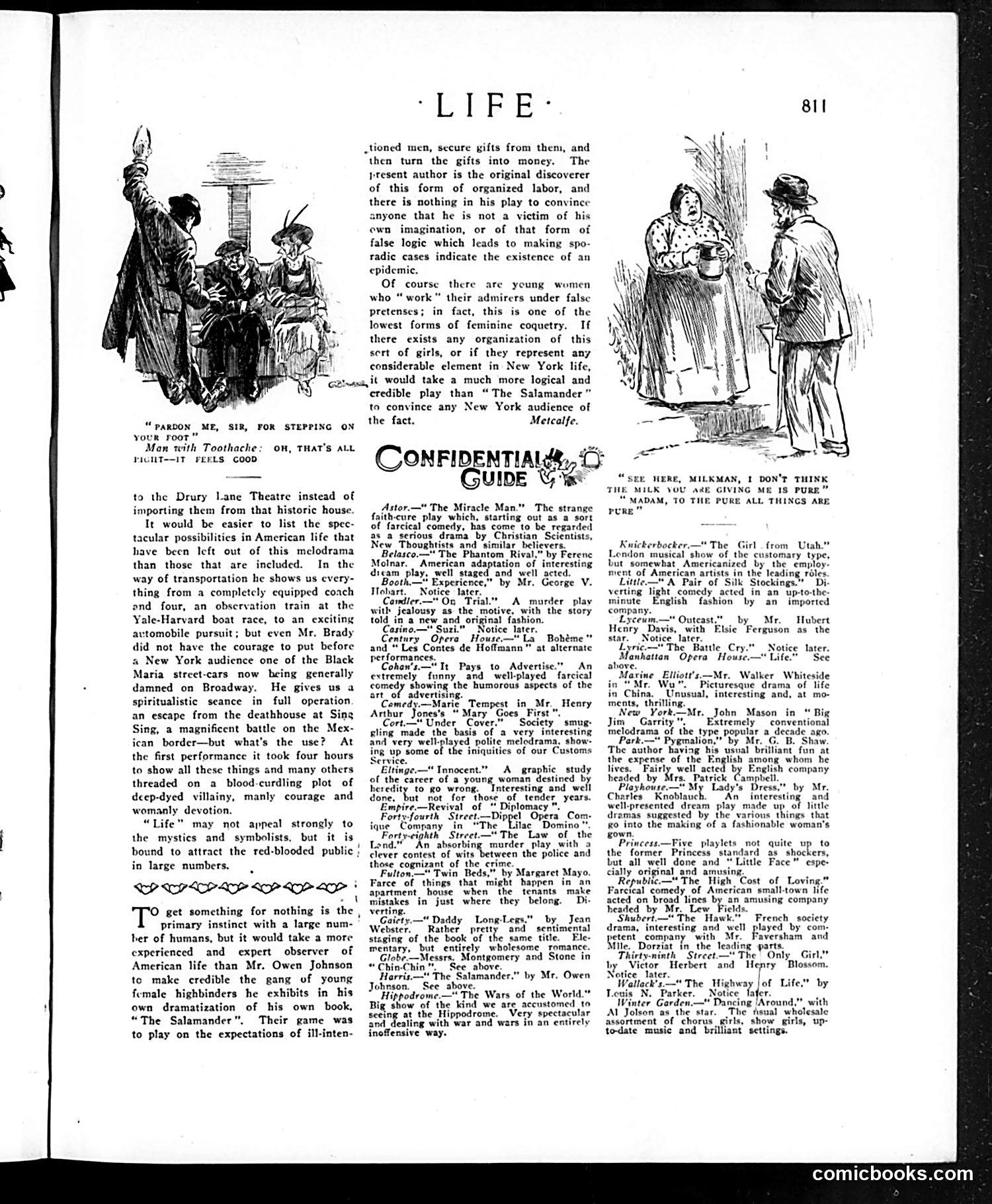
This page contains two cartoon vignettes and theater reviews. The top left shows a man with a toothache saying "that's all right—it feels good" after someone steps on his foot, illustrating the absurd relief a toothache sufferer might feel from distraction. The top right depicts what appears to be a milkman or vendor in casual conversation, likely another humorous street scene. The page's main content critiques two theatrical productions. Owen Johnson's play "The Salamander" is mocked for portraying an allegedly organized gang of young women who manipulate wealthy men into giving them gifts—a con the critic calls implausible. The reviewer suggests Johnson invented this "form of organized labor" and doubts such an operation actually exists in New York society. The piece argues the play fails to convince audiences of this premise through credible storytelling, regardless of whether isolated cases occur.
📄 Transcribed text from this page (OCR, searchable)
Machine-transcribed from the original scan — historical spelling and the odd misread are preserved.
i a “PARDON ME, SIR, FOR STEPPING ON your Foor" Man with Toothache: OM, THAT'S ALL NGHT-—-IT FEELS GOOD to the Drury lane Theatre instead of importing them from that historic house. It would be easier to list the spec- tacular possibilitics in American life that have been left out of this melodrama than those that are included. In the way of transportation he shows us every- thing from a completely equipped coach ond four, an observation train at the Yale-Harvard boat race, to an exciting automobile pursuit; but even Mr. Brady did not have the courage to put before «x New York audience one of the Black Maria street-cars now being generally damned on Broadway. He gives us a spiritualistic seance in full operation. an escape from the deathhouse at Sing Sing, a magnificent battle on the Mex- ican border—but what's the use? At the first performance it took four hours to show all these things and many others threaded on a blood-curdling plot of dcep-dyed villainy, manly courage and womanly devotion. “Life” may not appeal strongly to the mystics and symbolists, but it is bound to attract the red-blooded public | in large numbers. T° get something for nothing is the , primary instinct with a large num- ber of humans, but it would take a more experienced and expert observer of American life than Mr. Owen Johnson to make credible the gang of young female highbinders he exhibits in his own dramatization of his own book, “The Salamander”. Their game was to play on the expectations of ill-inten- “EPP E* tioned men, secure gifts from them, and then turn the gifts into money. The present author is the original discoverer of this form of organized labor, and there is nothing in his play to convince anyone that he is not a victim of his ewn imagination, or of that form of false logic which leads to making spo- radic cases indicate the existence of an epidemic. Of course there are young women who “work” their admirers under false pretenses; in fact, this is one of the lowest forms of feminine coquetry. If there exists any organization of this sert of girls, or if they represent any considerable element in New York life, it would take a much more logical and credible play than “The Salamander” to convince any New York audience of the fact. Metcalfe. ONFIDENTIAL4 C GUIDE & Astor.—" The Miracle Man.” The strange faith-cure play which, starting out as a sort of farcical comedy, has come to be regarded as a serious drama by Christian Scientists, New Thoughtists and similar believers. Belasco.— The Phantom Rival,” by Ferenc Molnar. American adaptation of interesting dicam play ell staged and well acted. Booth. perience,” by Mr. George V- Hobart. Notice later. Camdler.—" Or Trial. A murder play with jealousy as the motive, with the story told in a new and original fashion. Casino.—"* Suzi.’ Notice later. Century Opera House. La Bohéme” and "Les Contes de Hoffmann ” at alternate it Pays to Advertise.” An extremely funny and well-played farcical comedy showing the humorous aspects of the advertising. rie Tempest in Mr. Henry nes's “Mary Goes First”. -—" Under Cover.” Society | smug- sling made the basis of a very interesting and very welliplayed polite melodrama, show~ ing up some of the iniquities of our Customs Servic Eltinge.—" Innocent.” A__ graphic study of the career of a young woman destined by heredity to go wrong. Interesting and well done. but not for those of tender years. Empire.—Revival_ of“ Diplomacy ”. Forty-fourth Street.—Dippel Opera Com- ique Company in “The Lilac Domino”. Forty-eighth Street.—" The Law of the Lond.” An absorbing murder play with 3 clever contest of wits between the police and those cognizant of the crime. Fulton.—" Twin Beds,” by Margaret Mayo. Farce of things that might happen in an apartment house when the tenants make mistakes in just where they belong. Di- verting. Gaicty.—" Daddy _Long-Le by Jean Webster. Rather pretty and _ sentimental staging of the book of the same title. Ele- mentary, but entirely wholesome romance. ssrs, Montgomery and Stone in by Mr. Owen Johnson. See above. is Hippodrome.—" The Wars of the World.” Big show of the kind we are accustomed to seeing at the Hippodrome. Very spectacular and dealing with war and wars in an entirely inoffensive way. ee WERE, MILKMAN, I DON’T THINK THE MILK YOU age GIVING ME 1S PURER” MADAM, TO THE PURE ALL THINGS ARE PURE” Knickerbocker —" The Girl from Utah." Lendon musical show of the customary type, Lut somewhat Americanized by the employ: ment of American artists in the leading roles. Little —" A Pair of Silk Stockings.” Di- verting light comedy acted in an up-to-the. minute English fashion by an imported company. Lyceum.— Outeast.” by Mr. Hubert Henry Davis, with Elsie Ferguson as the star. Notice’ later. Lyric.—" The Battle Cry." Notice later. Manhattan Opera House.— Life.” See Mr. Walker Whiteside ieturesque drama of life China. Unusual, interesting and, at mo- ments, thrilling _New York.—Mr. John Mason in “ Big Jim | Garrity". Extremely conventional melodrama of the type popular a decade ago. Park.—* Pygmalion,” by Mr. G. B. Shaw. The author having his usual brilliant fun at the expense of the English among whom he lives, Fairly well acted by English company beaded by Mrs. Patrick mpbell. Playhouse. My Lady's Dress,” by Mr. Charles ‘Knoblauch. An interesting and well-presented dream play made up of little dramas suggested by the various things that go into the making of a fashionable woman's iowa Princess.—' playlets mot quite up to the former Princess standard as. shockers, but all well done and “Little Face” espe- cially original and amusing. Republic.—* The High Cost of Loving.” Farcical comedy of American small-town life acted on broad lines by an amusing company headed by Mr. Lew Fields. Shubert.—* The Hawk.” French. socic drama, interesting and well played by co: Yetent company “with Mr. Faversham and Mile. Dorziat {n_the leading parts. Thirty-ninth Street.—* The Only_ Girl,” by. Victor “Herbert and Hepry” ‘Blossom. Notice later. | Wellack’s—" The Highway |of Life.” by Louis N. Parker. Notice fafer. Winter Garden.—" Dancing ‘Around,” with Al Jolson as the star. The fisual wholesale assortment of chorus girls, show girls, up- to-date music and brilliant settings. comicbooks.com