
A complete issue · 48 pages · 1914
Life — September 3, 1914
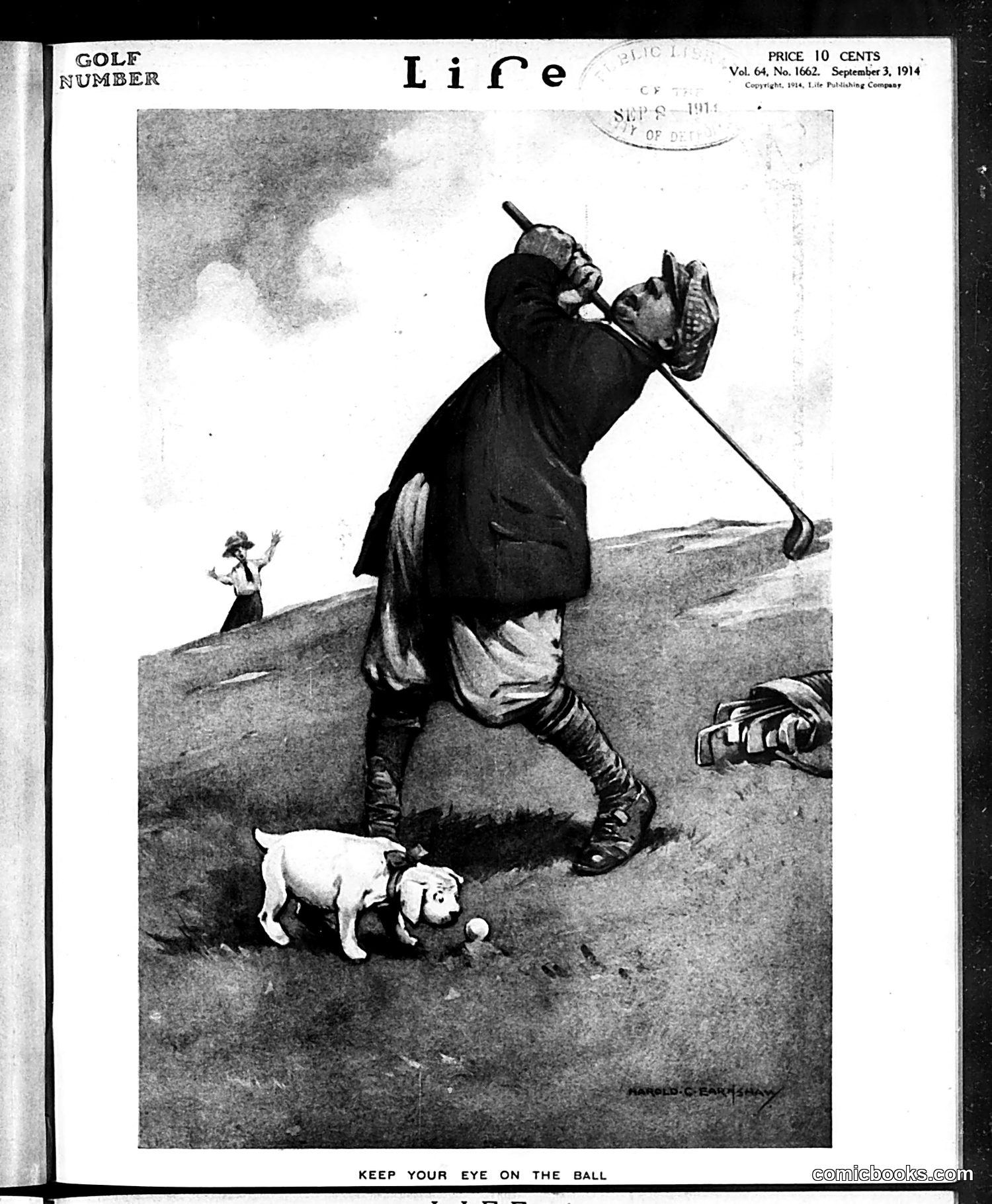
This is a humorous golf illustration titled "Keep Your Eye on the Ball." The cartoon depicts an exaggerated golfer in mid-swing, with a small dog positioned directly in front of the ball—creating an obvious hazard. A caddy watches anxiously in the background. The satire plays on a common golfing instruction: "keep your eye on the ball." The joke is literal and physical—the golfer must keep his eye on the ball while avoiding hitting the dog, creating an impossible situation that mocks both the cliché advice and the absurdity of golfing obstacles. This appears to be a standalone golf humor piece typical of Life's early 20th-century content, rather than political satire tied to specific events or figures.
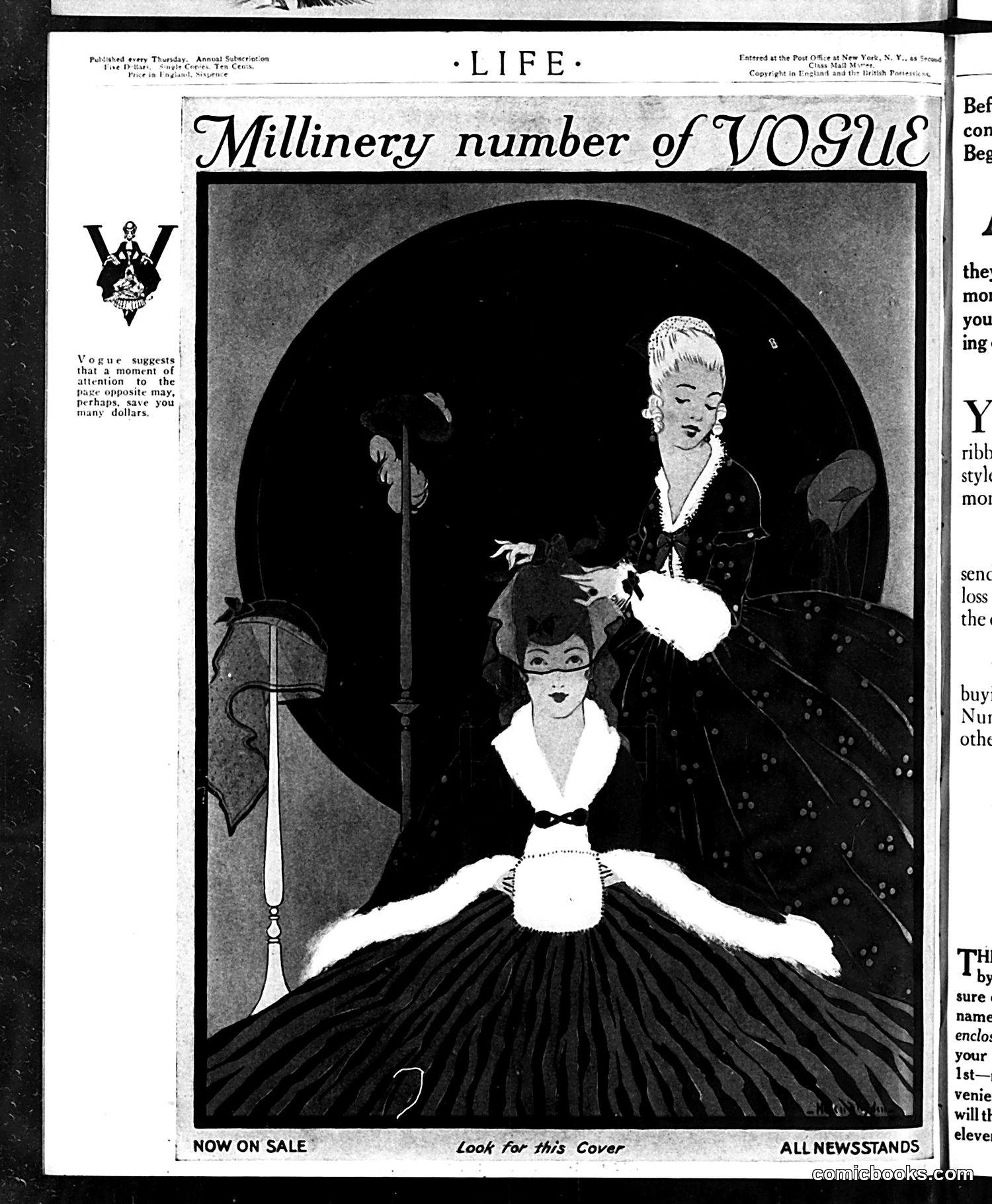
This is a satirical advertisement for Life magazine's millinery (hat) issue, parodying high-fashion Vogue magazine. The illustration shows three elegantly dressed women displaying elaborate hats and accessories in an Art Deco style typical of the 1920s-30s era. The satire lies in Life's mocking presentation of expensive fashion trends. The accompanying text—"Vogue suggests that a moment of attention to the peculiarity of the hat may, perhaps, save you many dollars"—ironically suggests that paying attention to fashionable hat details could somehow save money, when in fact fashion magazines typically *encourage* expensive purchases. This reflects Life's role as a humor magazine that satirized consumer culture and upper-class pretension through exaggerated depictions of fashion trends.
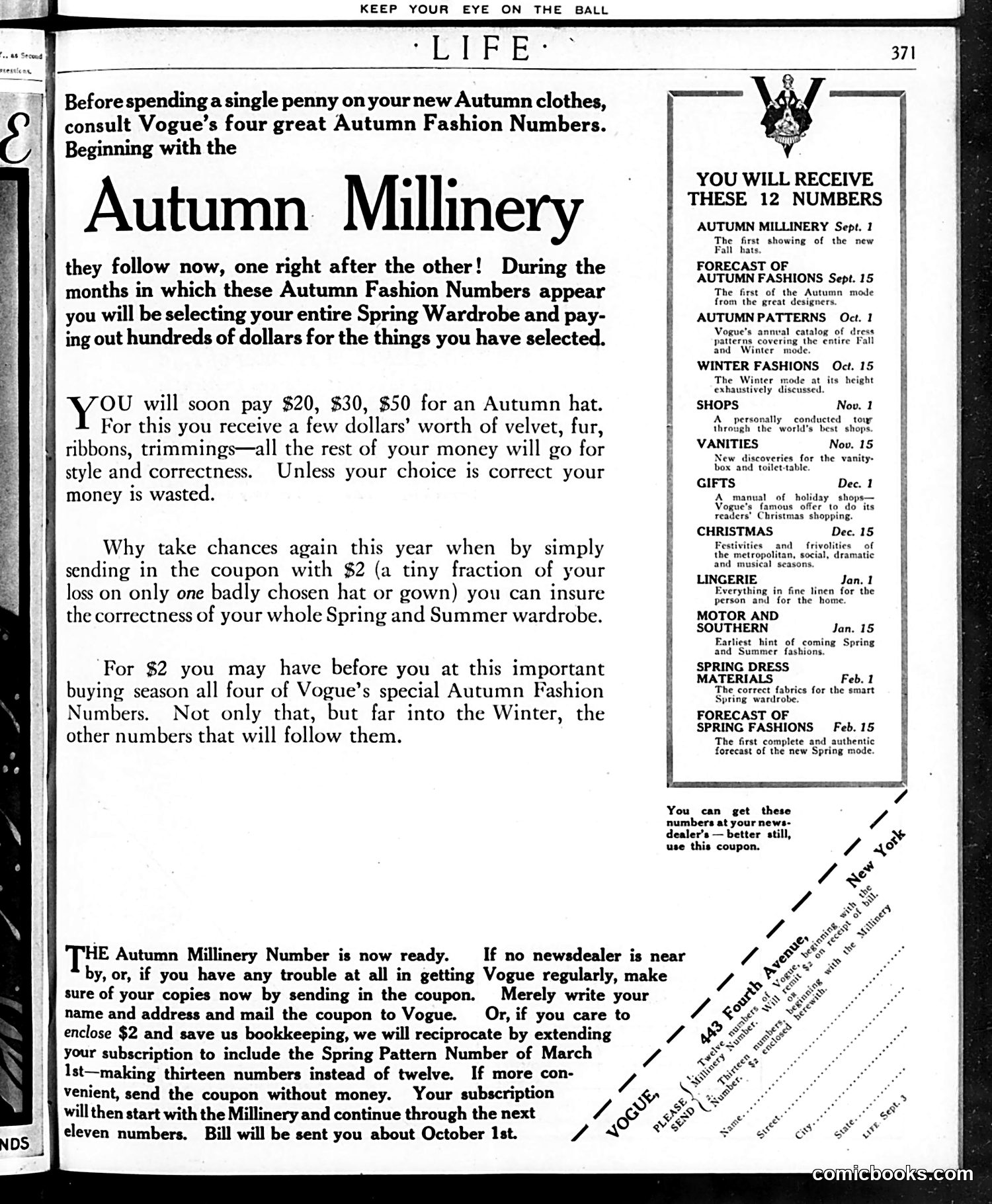
This page is **primarily advertising, not satire or political commentary**. It's a Vogue magazine subscription promotion disguised as editorial content in *Life* magazine. The ad promotes Vogue's four seasonal fashion issues, emphasizing that readers should subscribe ($2) to receive all twelve annual numbers rather than risk making poor clothing choices by shopping without guidance. The language uses gentle persuasion—suggesting that spending $20-50 on a hat without professional fashion advice is wasteful, but $2 for Vogue's guidance ensures "correctness" of one's entire wardrobe. The "satire" is mild: it pokes fun at fashion anxiety and overspending, but ultimately serves as a sales pitch. The coupon at bottom right is the ad's primary purpose.
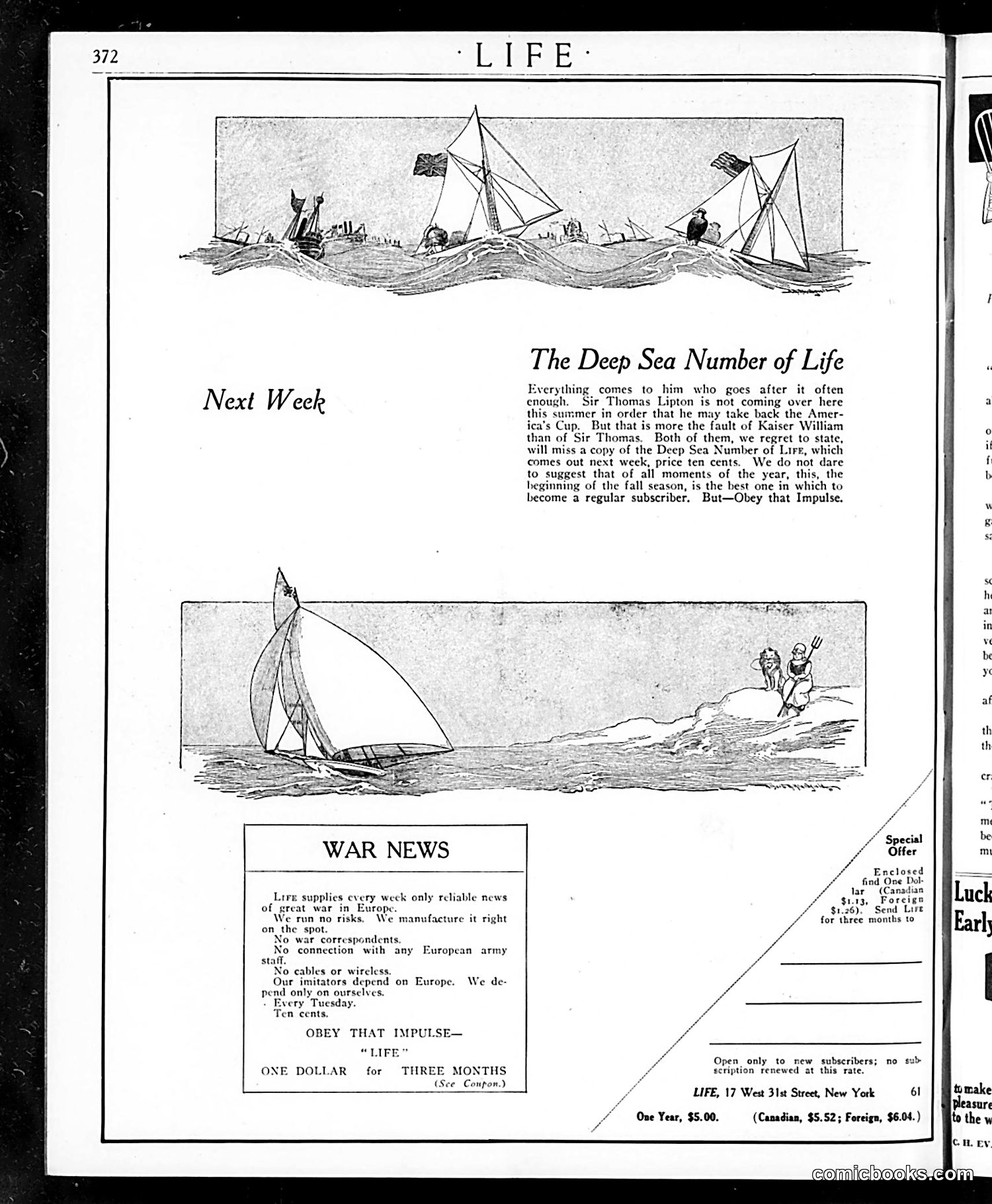
This page contains two maritime illustrations and subscription advertising rather than political satire. **Top section:** Announces "The Deep Sea Number of Life" coming next week for ten cents. The text mentions Sir Thomas Lipton and Kaiser William, referencing a dispute over the America's Cup (a yacht racing competition). The magazine regrets Lipton won't visit America that summer due to this disagreement, but encourages readers to subscribe. **Bottom illustration:** Shows a single sailboat with two figures on shore, appearing to be unrelated genre art rather than commentary. **Lower section:** "War News" advertisement emphasizes Life's reliable European war coverage, with no correspondents connected to armies and independent news sources. The page is primarily promotional rather than satirical.
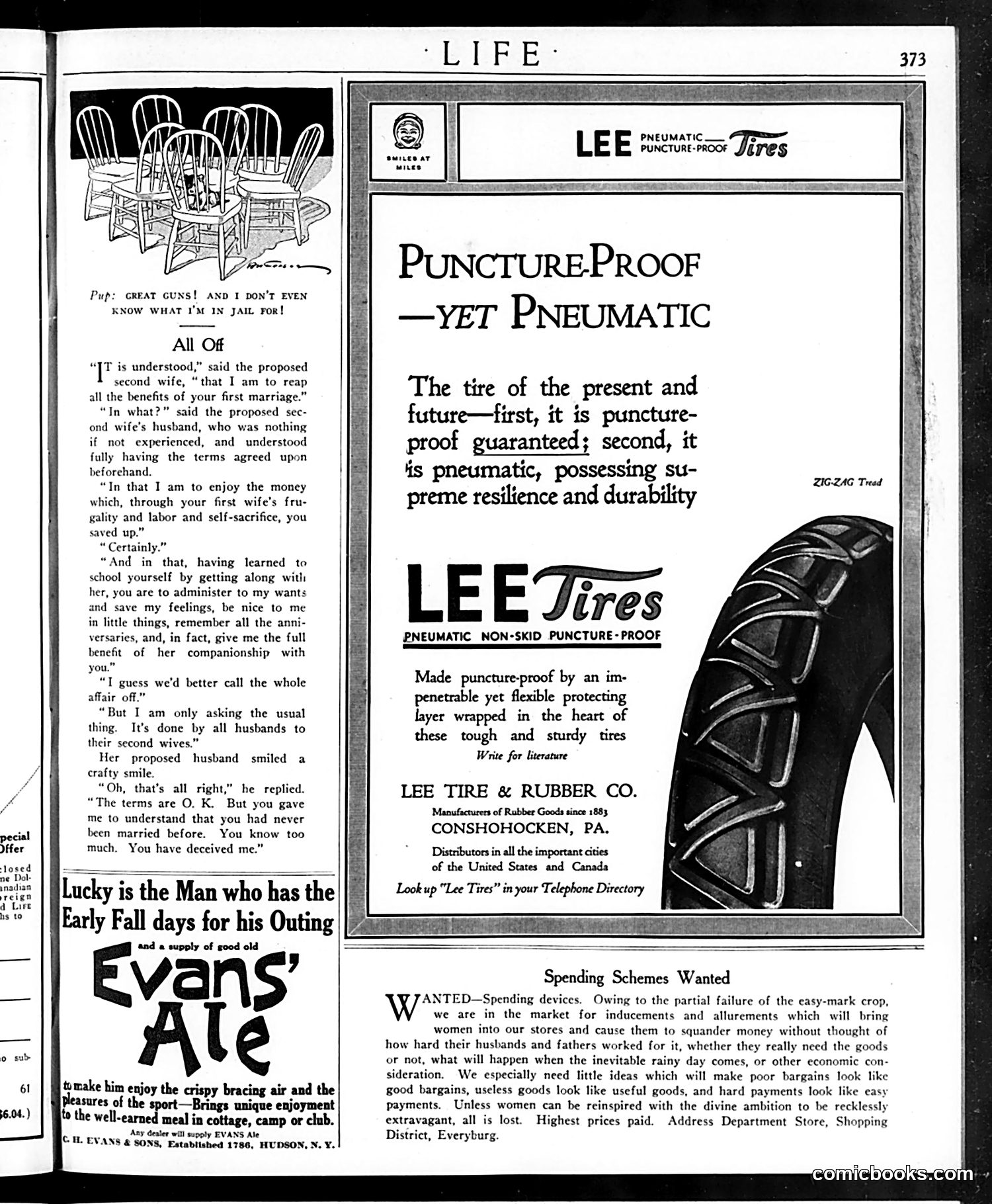
This page is primarily **advertising and advice columns**, not political satire. The cartoon at top-left depicts a man in jail, captioned "Great guns! And I don't even know what I'm in jail for!" It illustrates the accompanying story "All Of It," which concerns marital economics—specifically a proposed second marriage arrangement where the new wife would manage the first wife's money. The major advertisement promotes **Lee Pneumatic Puncture-Proof Tires**, emphasizing durability and safety features. Below that, an advice column titled "Spending Schemes Wanted" solicits reader ideas for household goods and payment plans that appear practical but are actually "hard payments" disguising unnecessary purchases. The page reflects early 20th-century consumer culture and marriage property conventions, with no clear political commentary.

This page is **primarily an advertisement**, not satirical content. It promotes White Trucks manufactured by The White Company of Cleveland. The ad highlights that Standard Oil Company of New York recently purchased nine White 3-ton trucks, bringing their total fleet to 166 White trucks. The text emphasizes that major American oil companies "have always been firm believers in motor truck transportation" and have tested various truck types, but predominantly chose White vehicles. The advertisement claims over 270 White trucks operate for America's leading oil companies, positioning White as the preferred commercial vehicle manufacturer by quantity and value. The image shows a detailed technical drawing of a Standard Oil Company tanker truck—essentially product documentation rather than satire or cartoon commentary.
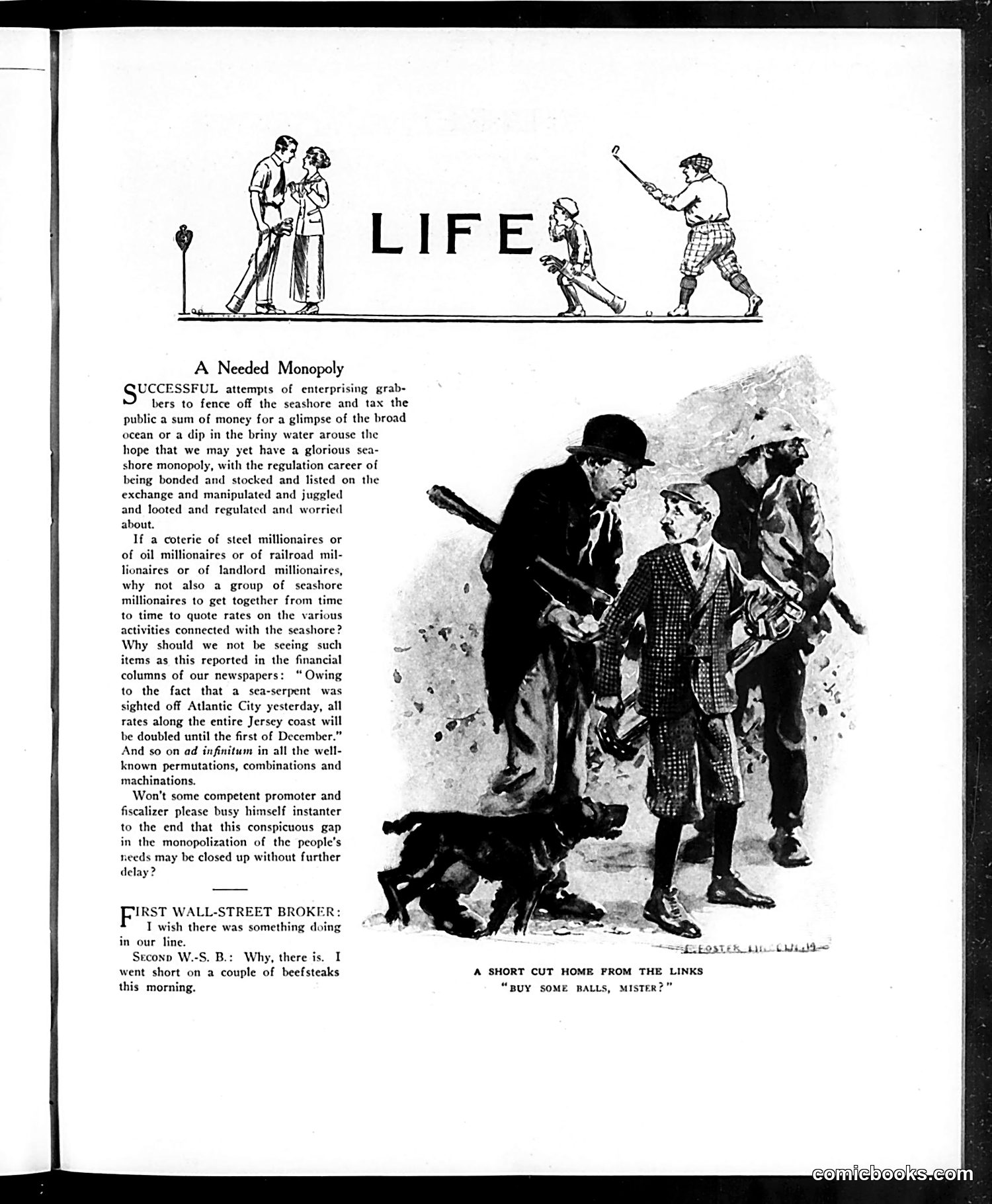
This article satirizes wealthy industrialists' control of American commerce. The author argues that if steel, oil, and railroad magnates can monopolize their industries, why not create a "seashore monopoly"—allowing wealthy businessmen to collectively control beach access and charge the public for ocean views. The accompanying cartoon depicts working-class men attempting to enjoy a day at the beach (golf, family time) while being solicited by a man hawking golf balls—illustrating how commercialization invades even leisure spaces. The dialogue between Wall Street brokers suggests frustration that profit opportunities exist everywhere *except* their own markets. The satire critiques both unchecked monopolistic practices and the absurd notion that everything—even nature—should be commodified for wealthy interests.
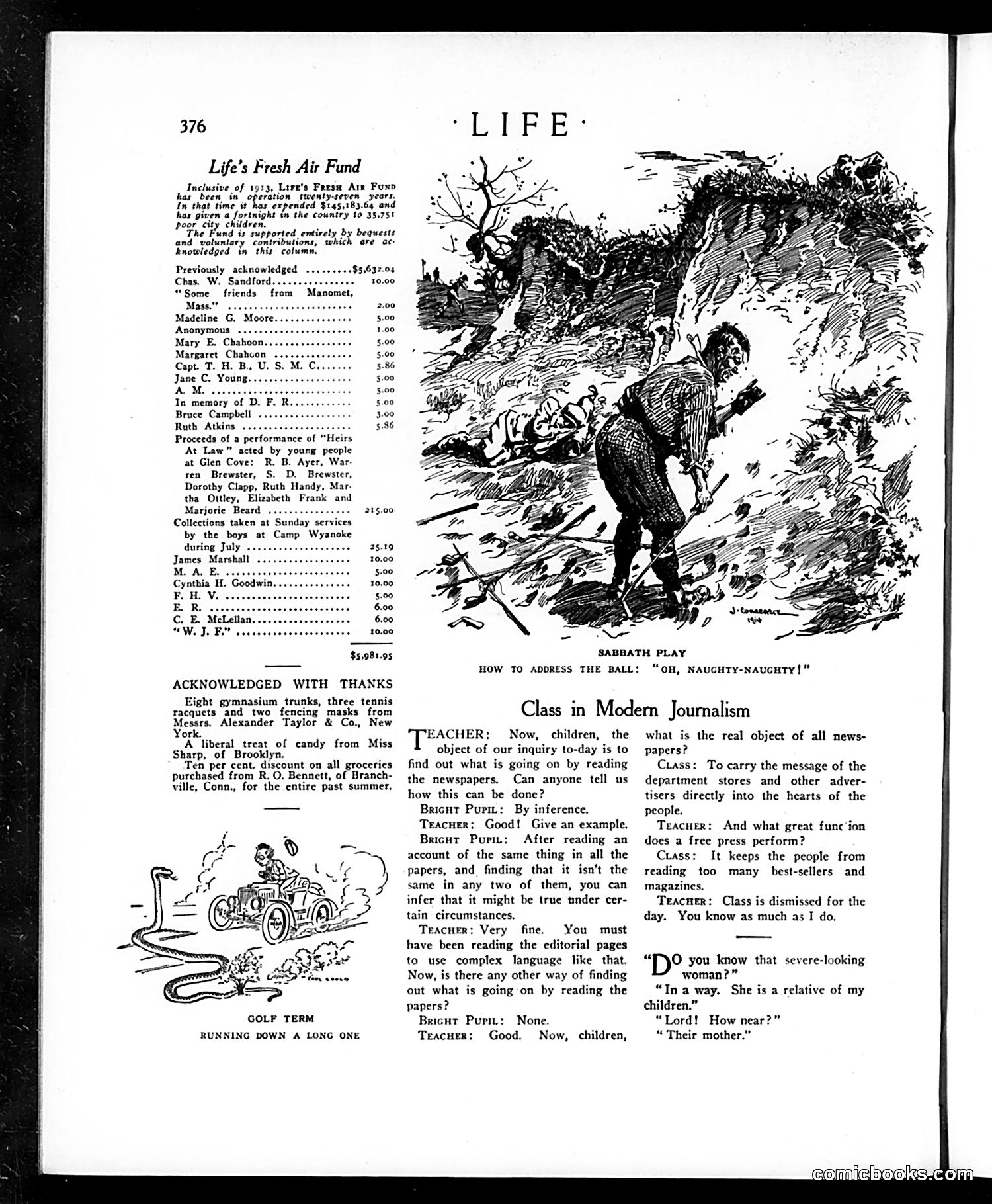
This page contains three distinct elements: 1. **"Life's Fresh Air Fund"** - A fundraising list acknowledging donations to send children to camp, reflecting early 20th-century charitable work for urban youth welfare. 2. **"Sabbath Play" cartoon** - Shows children playing roughly outdoors with the caption "Oh, Naughty-Naughty!" The satire appears to mock adult disapproval of children's boisterous, uninhibited play on Sundays or rest days. 3. **"Class in Modern Journalism"** - A dialogue between teacher and bright pupils discussing how newspapers report identical stories differently, satirizing journalistic bias and the unreliability of press accounts. The final joke plays on social proximity/class distinctions. The cartoons reflect Progressive Era concerns about education, media credibility, and children's welfare.
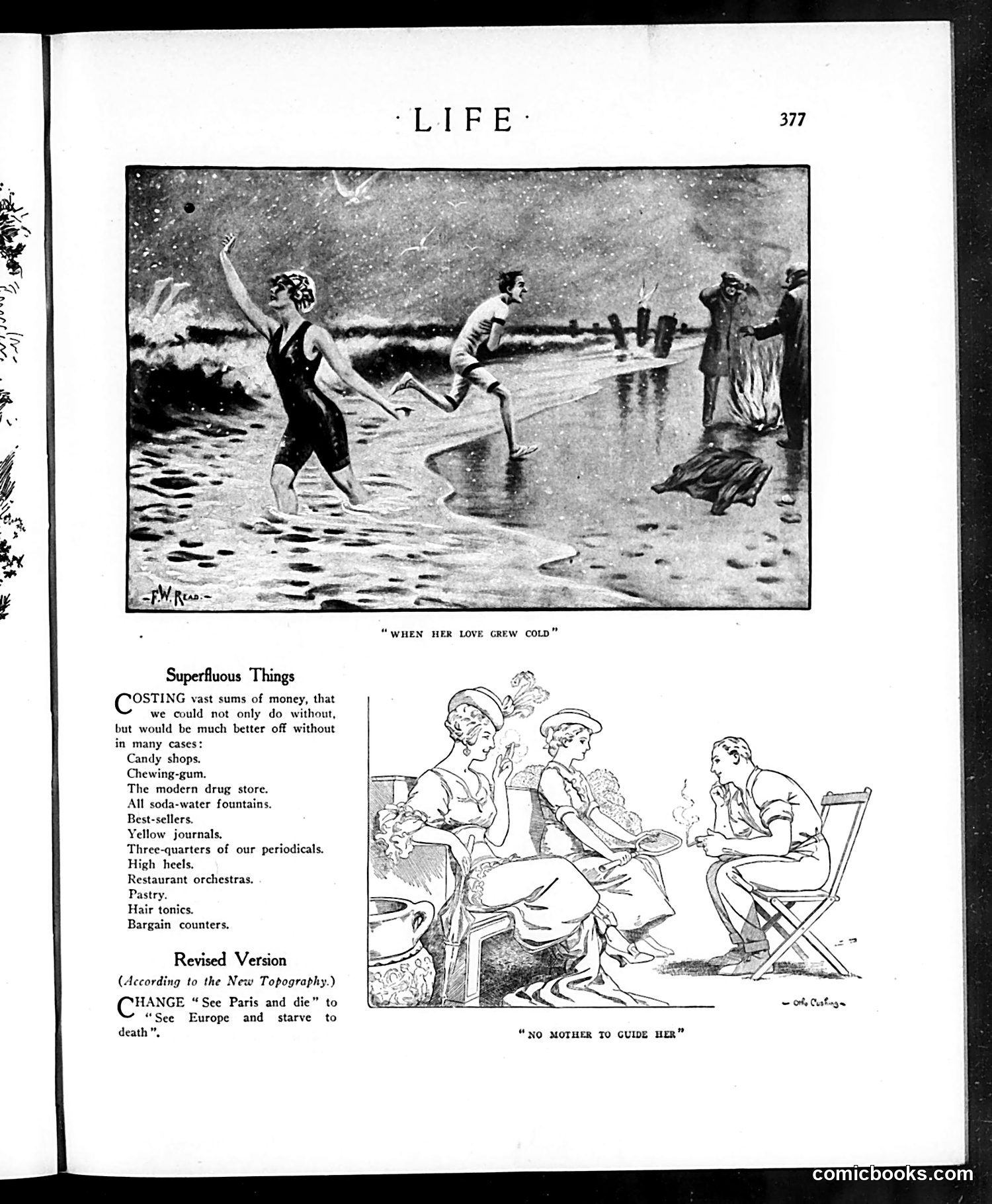
This *Life* magazine page contains two satirical pieces mocking consumer excess and travel clichés. **Top image** ("When Her Love Grew Cold"): A beach scene showing a woman leaving a man in the water while socialites observe—likely depicting romantic disappointment or infidelity. **Bottom section** ("Superfluous Things"): Lists items Americans wastefully spend money on—candy shops, drugstores, periodicals, restaurant orchestras, hair tonics, etc. The satire criticizes consumer culture's frivolous spending habits. **"Revised Version"** mocks the famous travel motto "See Paris and die" by rewriting it as "See Europe and starve to death"—suggesting European travel is economically ruinous, likely referencing post-WWI economic hardship or the cost of leisure travel for Americans. The lower cartoon ("So Mother to Guide Her") depicts socialites at leisure, reinforcing themes of idle wealth and modern women's independence from parental oversight.
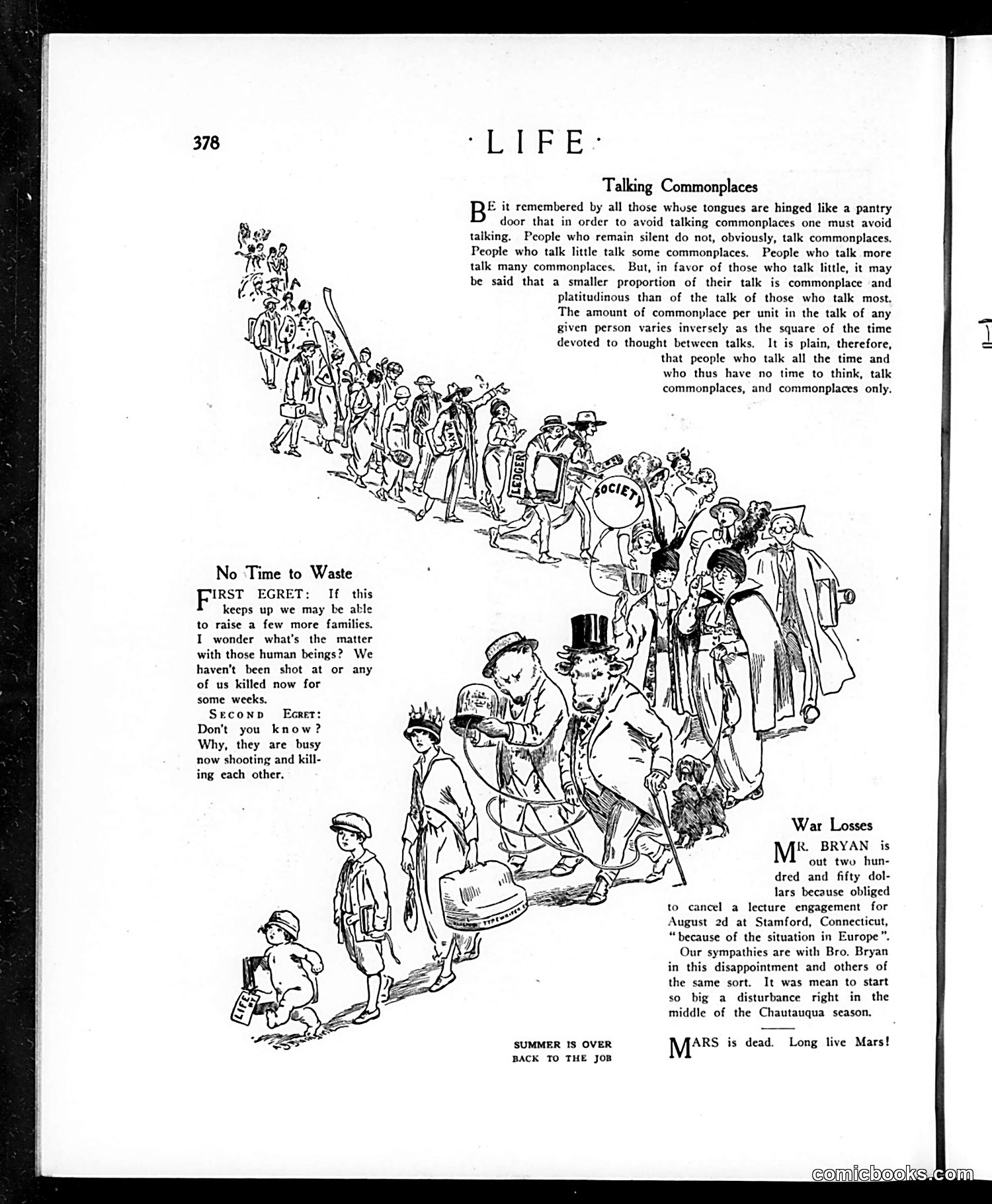
This page contains three separate satirical pieces from Life magazine during World War I: **"Talking Commonplaces"** mocks people who talk constantly but think little—they fill time with trivial chatter rather than substantive conversation. **"No Time to Waste"** presents a dialogue between two characters debating whether war casualties justify canceling social engagements, illustrating the disconnect between home-front society concerns and wartime realities. **"War Losses"** reports that Mr. Bryan (likely William Jennings Bryan) lost $250 canceling an August lecture in Connecticut due to "the situation in Europe"—satirizing how even public figures' schedules were disrupted by the war. **"Mars is dead. Long live Mars!"** serves as a closing comment on summer's end and returning to normalcy. The central illustration depicts a long procession of society figures labeled "Society," suggesting the leisured classes marching together, possibly critiquing their detachment from wartime concerns.
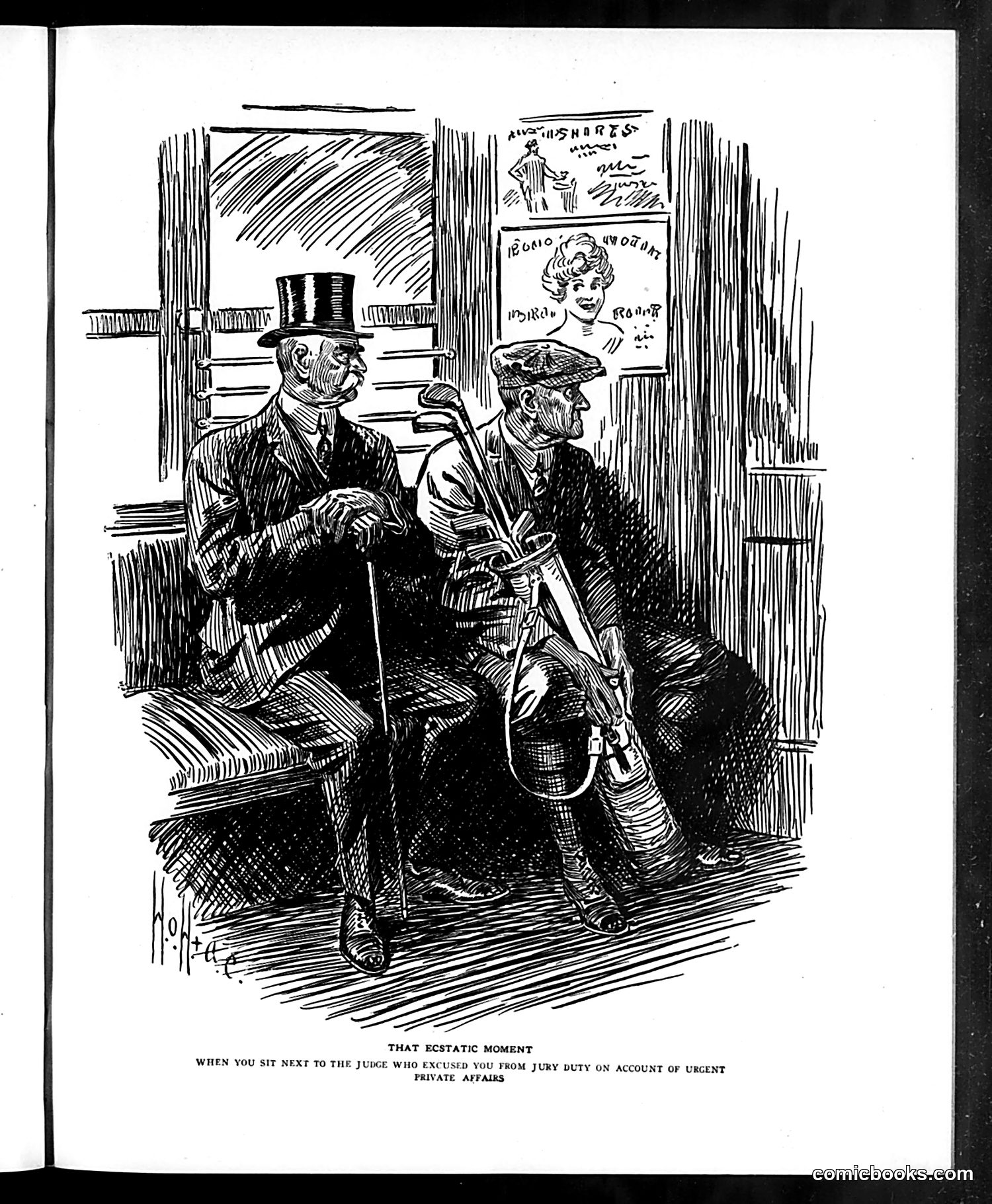
This satirical cartoon depicts two men sitting together, captioned "THAT ECSTATIC MOMENT: WHEN YOU SIT NEXT TO THE JUDGE WHO EXCUSED YOU FROM JURY DUTY ON ACCOUNT OF URGENT PRIVATE AFFAIRS." The cartoon mocks the awkwardness of encountering a judge socially after being excused from jury duty under dubious circumstances. The implication is that the man claimed urgent personal business to avoid civic duty, and now faces uncomfortable proximity to the very judge who accepted his excuse. The exaggerated facial expressions and body language convey the tension and embarrassment of the encounter. The cartoon satirizes both jury duty avoidance and the social discomfort of such chance meetings, suggesting hypocrisy in citing "urgent private affairs" as justification for shirking civic responsibility.
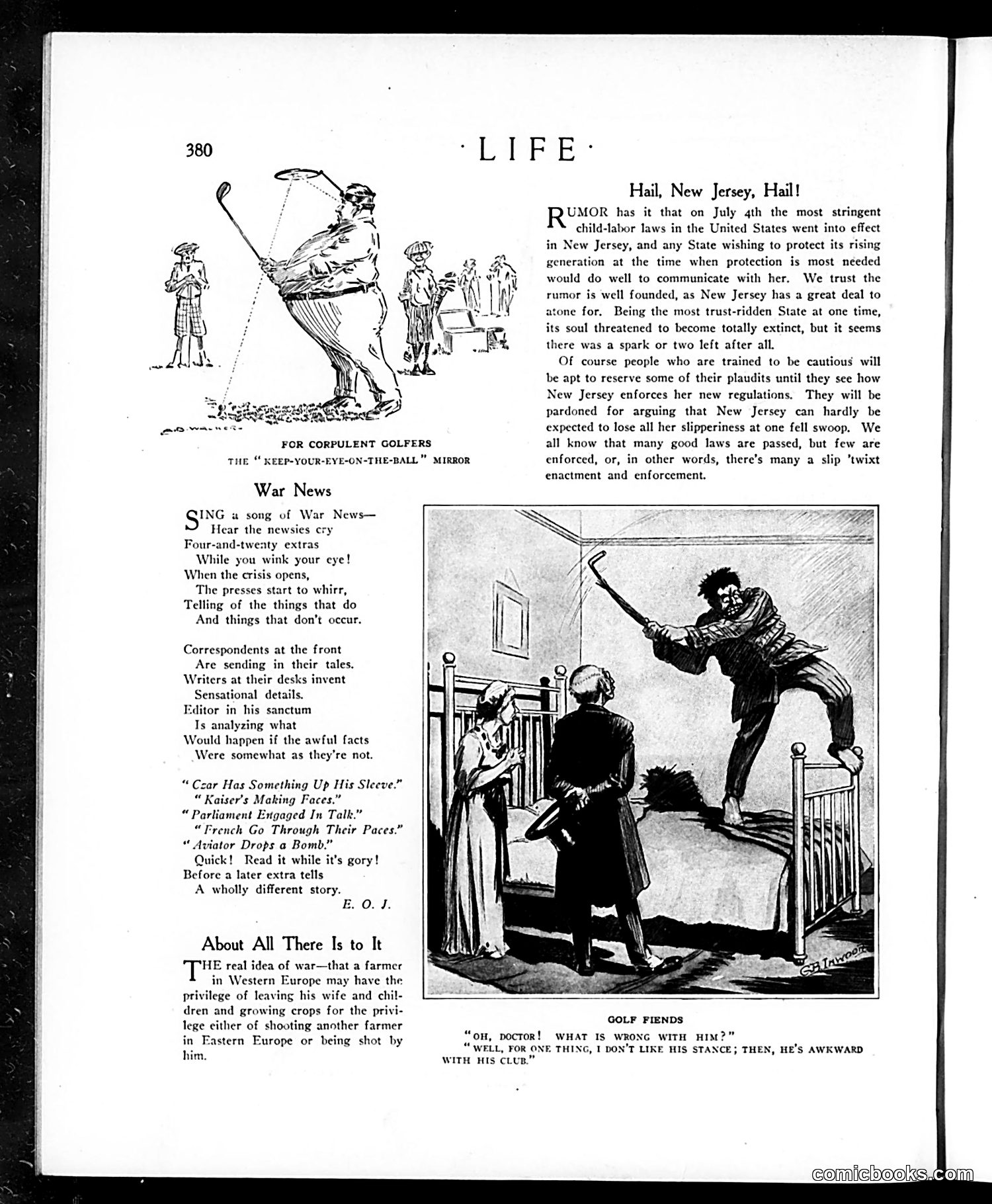
**Top Cartoon ("For Corpulent Golfers"):** Shows a rotund golfer using a curved mirror device to see the ball, since his belly obstructs his view. This is a straightforward joke about overweight men attempting golf—no political content, just body-humor satire. **"Golf Friends" Cartoon:** A doctor examines a patient while another man watches, commenting on the patient's awkward golf stance. The humor relies on a doctor diagnosing a golfing problem rather than a medical one—gentle satire of how golf obsesses certain social classes. **Text Sections:** Include war commentary and New Jersey child-labor law discussion. The content satirizes news media sensationalism and debates about labor regulation enforcement.
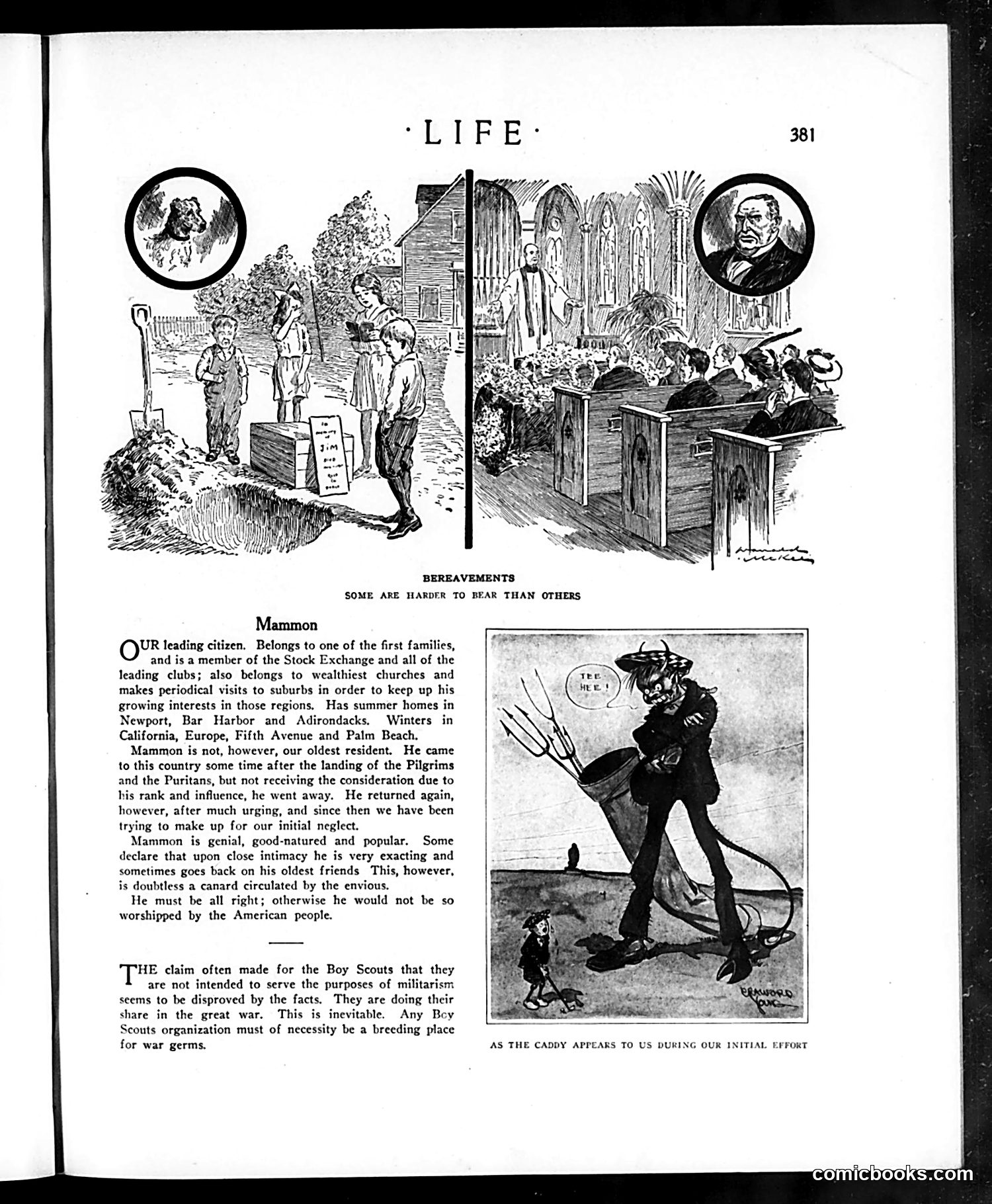
This page satirizes **Mammon** (wealth/materialism personified). The top illustration contrasts two scenes: a graveyard burial on the left with children and simple surroundings, versus a grand church interior on the right filled with wealthy mourners. The caption reads "BEREAVEMENT: SOME ARE HARDER TO BEAR THAN OTHERS"—mocking how the rich display elaborate public grief while the poor grieve quietly. The accompanying text describes a wealthy "leading citizen" named Mammon who cycles between neglecting and courting society depending on his influence needs. The satire targets his hypocrisy and social climbing. The lower section addresses **Boy Scouts**, defending them against claims they promote militarism, arguing such organizations are naturally hierarchical. The cartoon critiques wealth-based social hierarchies and performative mourning among the affluent.
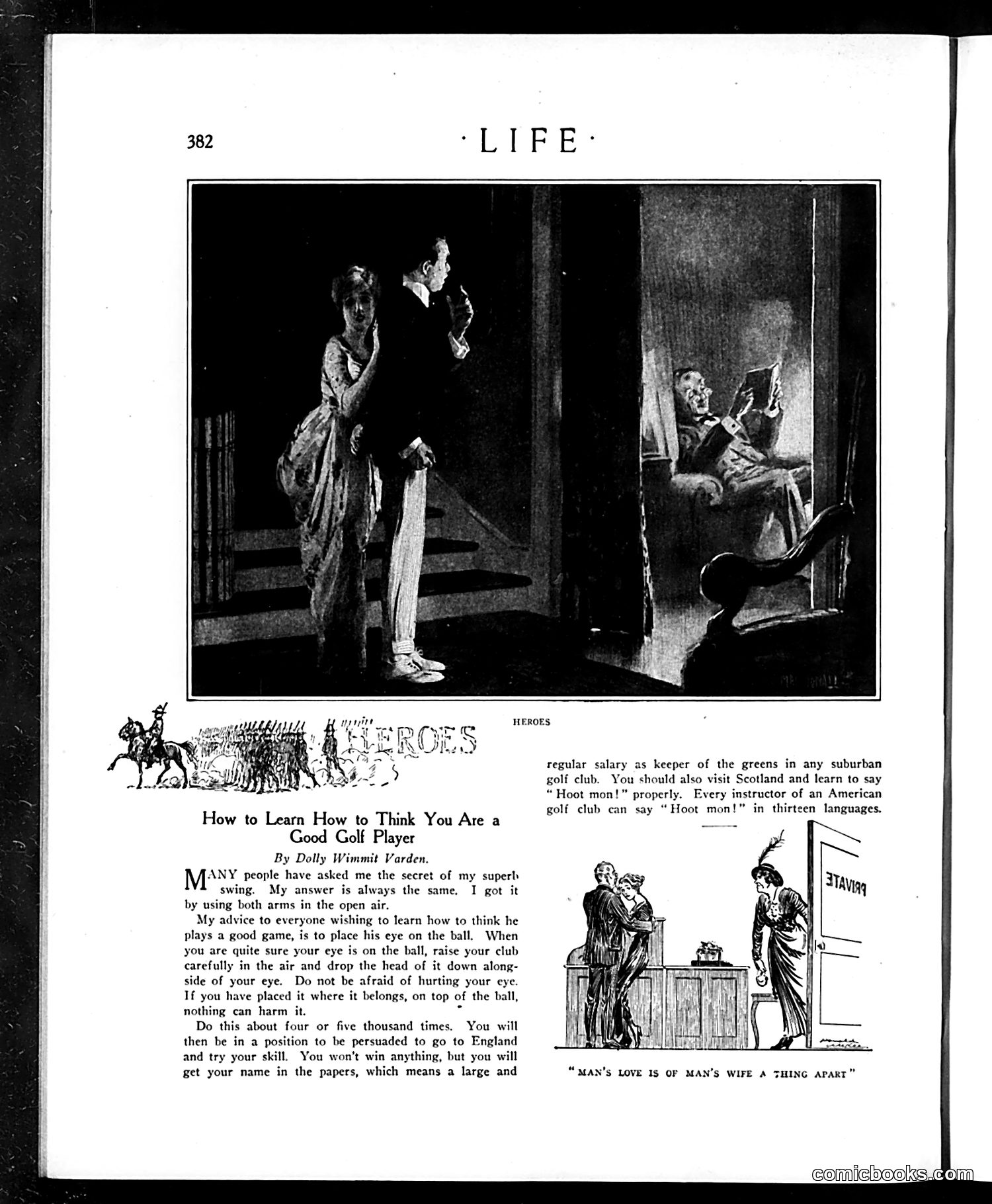
This page contains two distinct pieces: **Main Article**: "How to Learn to Think You Are a Good Golf Player" by Dolly Hemmit Varden offers humorous golf advice. The author suggests focusing intently on the ball and practicing repeatedly (4,000-5,000 times) to eventually earn recognition and newspaper coverage. **Cartoon**: The bottom illustration, captioned "Man's Love is of Man's Wife a Thing Apart," depicts a domestic scene where a woman confronts a man reading in what appears to be a study or bedroom. The satire critiques how married men prioritize leisure activities (reading/hobbies) over spousal attention—a common domestic comedy theme suggesting marital indifference or neglect. Both items humorously mock male behavior and priorities in early 20th-century American life.
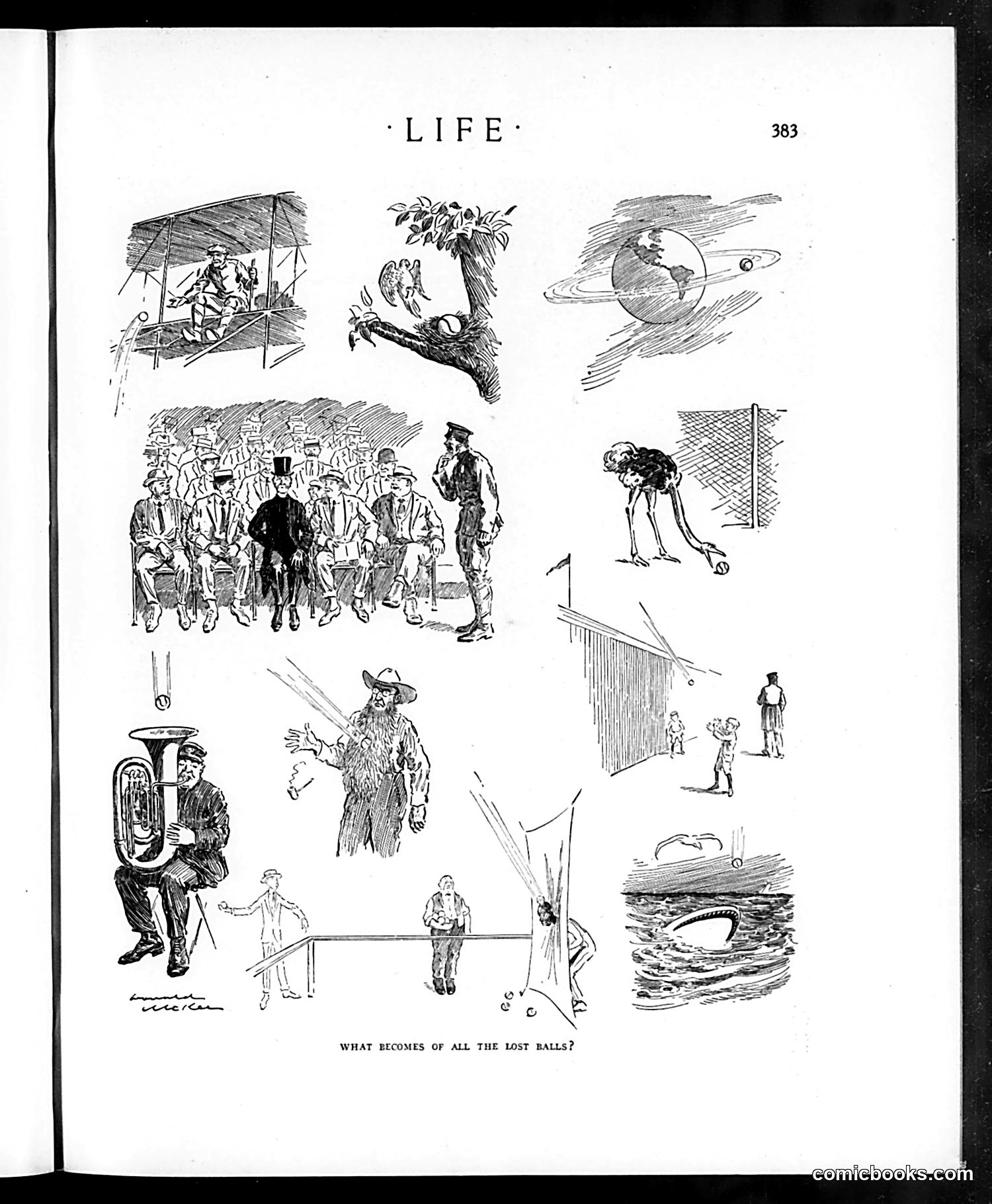
This is a humorous illustrated essay exploring the fate of sports balls lost during games. The cartoons depict various absurd and fantastical destinations: balls traveling to distant planets, ending up in tree branches, disappearing into water hazards and bridges, being swallowed by crocodiles, and mysteriously vanishing into the earth. The page also includes domestic scenarios—balls retrieved by street musicians and appearing in concert halls. The central crowd scene appears to show balls being auctioned or distributed en masse, perhaps suggesting they accumulate somewhere. This is lighthearted visual humor typical of *Life* magazine's satirical style, playing on the universal frustration of lost sports equipment by imagining increasingly improbable explanations for their disappearance. The tone is whimsical rather than political.
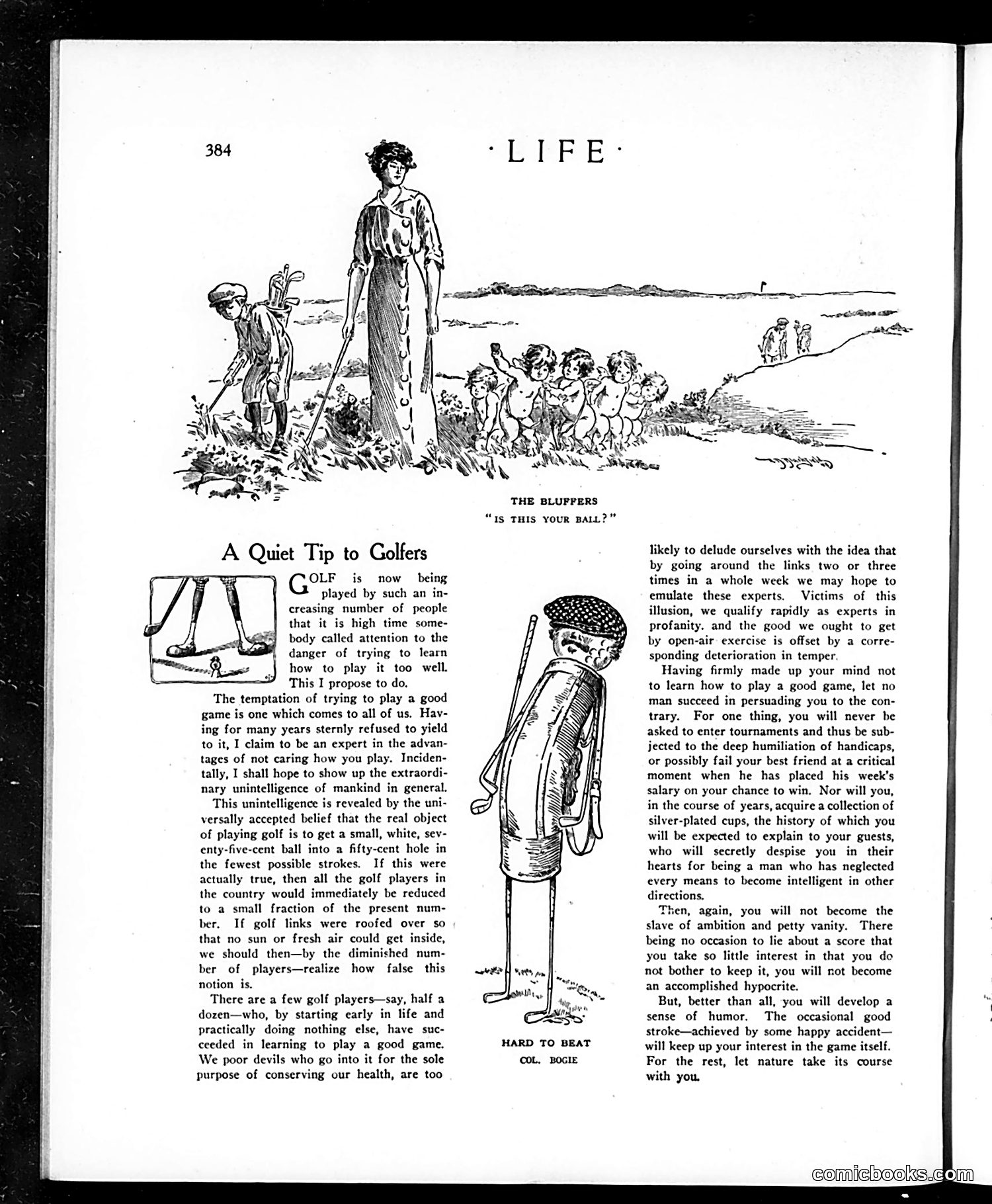
This satirical article mocks the growing obsession with golf among early 20th-century Americans. The author argues paradoxically that golfers *should not* try to play well, since the sport's true appeal is outdoor recreation and social activity, not competitive skill. The cartoons illustrate two points: "The Bluffers" shows someone questioning whether a ball is actually yours—poking fun at casual players who don't take the game seriously. "Hard to Beat" (Colonel Bogie) depicts a golfer struggling comically with his clubs. The article's real satire targets human vanity: ambitious golfers become slaves to competition, accumulate meaningless silver cups, and develop hypocrisy by lying about scores. The author suggests that accepting mediocrity preserves humor and health benefits. The piece reflects period anxieties about golf's explosive popularity among the middle and upper classes, treating the sport as revealing broader character flaws in pursuit of status.
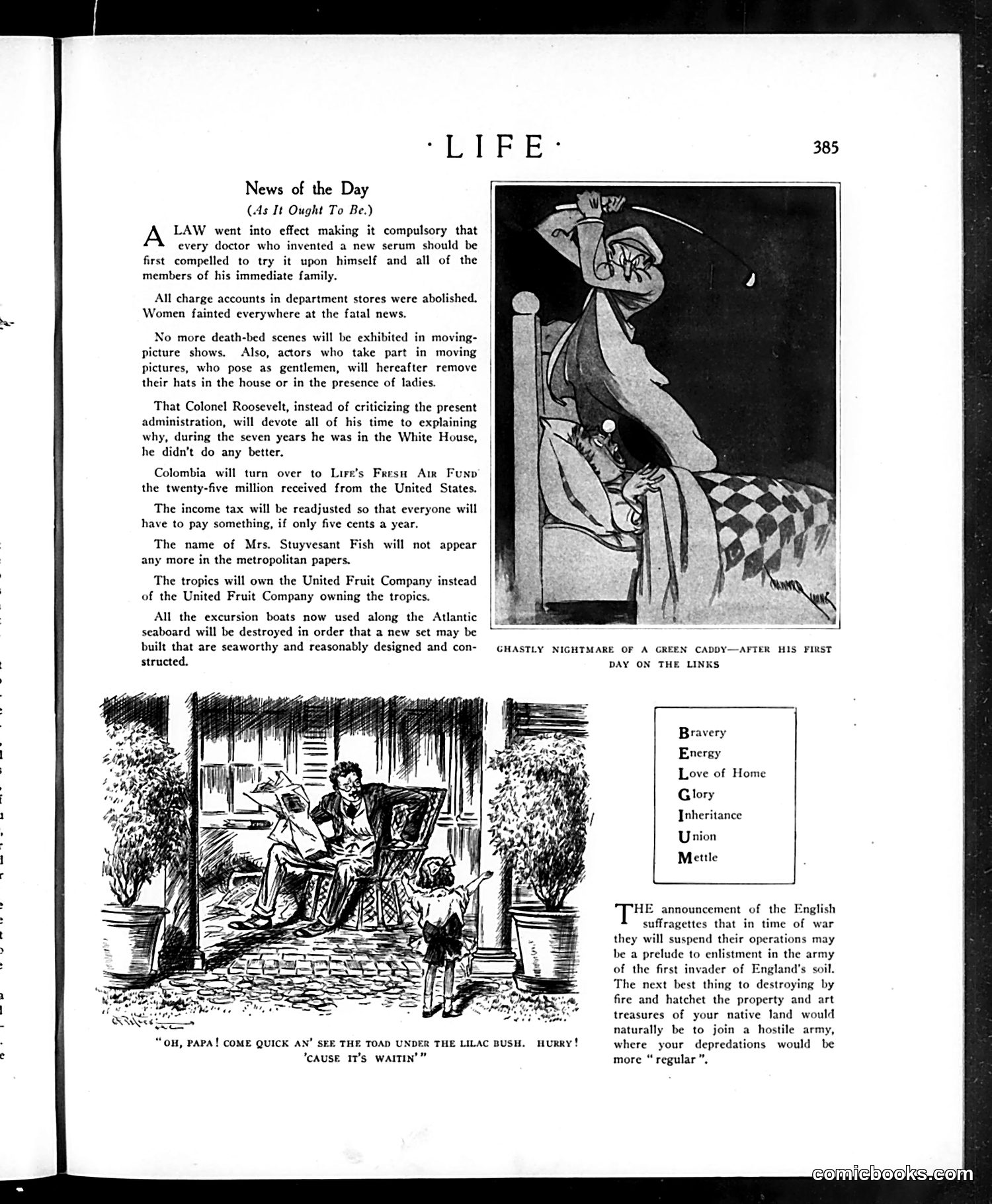
This "News of the Day (As It Ought To Be)" section satirizes contemporary issues through imagined legislation and reversals. **Upper content** mocks: - Medical ethics (doctors testing serums on themselves) - Consumer culture (abolishing store credit, causing women to faint) - Film censorship and gentlemanly conduct - Theodore Roosevelt's post-presidency criticism of current administration - Corporate exploitation (United Fruit Company's imperial dominance) - Income taxes and society gossip columns **The cartoon** depicts a frightened golfer's nightmare—likely mocking the emerging golf culture among wealthy Americans as absurd and dangerous. **Lower text** sarcastically attacks English suffragettes, suggesting their WWI suspension of militant activism implies they'd support invading armies. This reflects anti-suffrage sentiment, framing women's rights activism as unpatriotic extremism rather than legitimate political protest. The page uses humor to critique wealth inequality, corporate power, social pretension, and opposition to women's suffrage—typical Progressive Era concerns for Life magazine's educated readership.
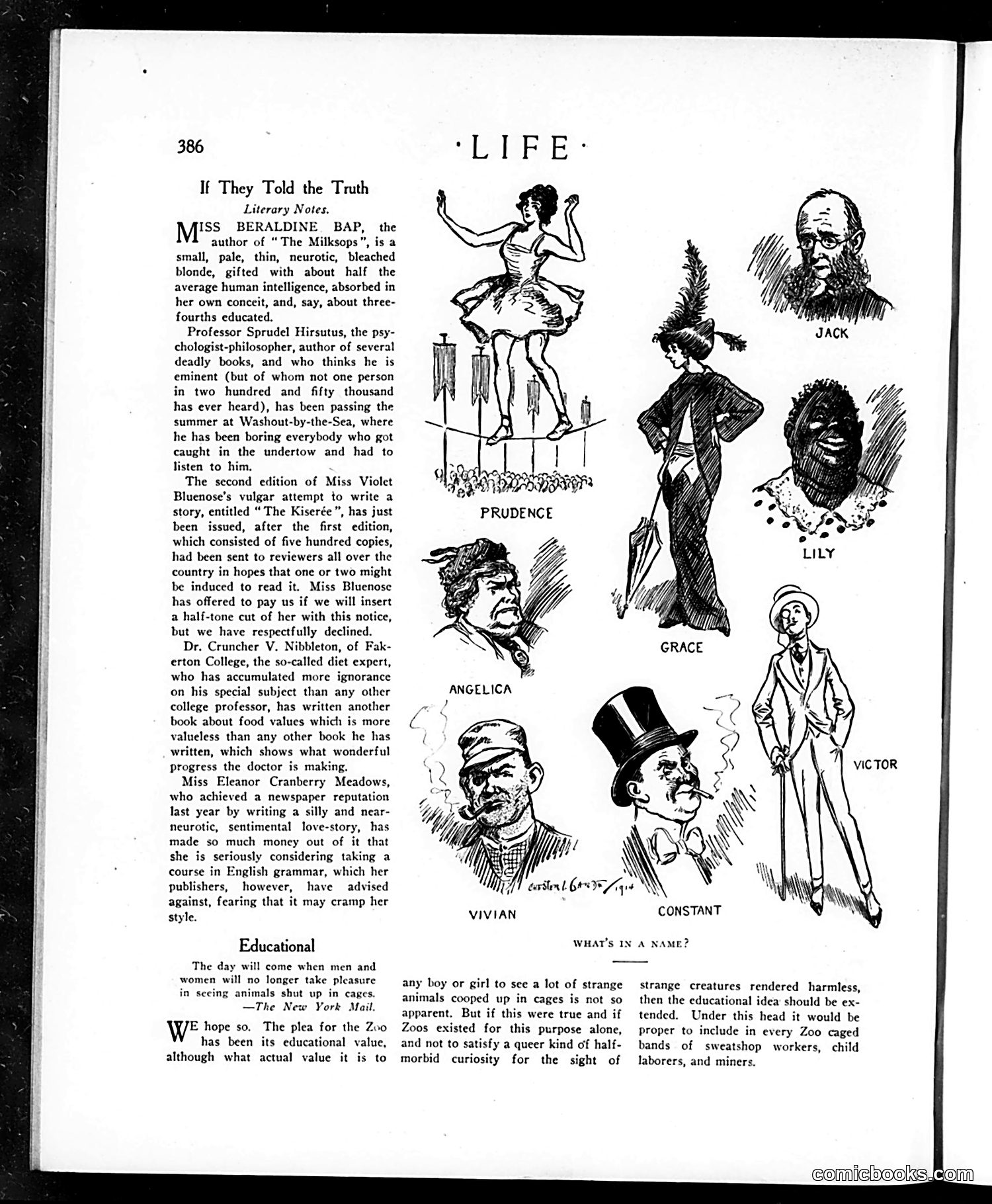
This page contains two satirical sections mocking contemporary literary and cultural figures. **Literary Notes**: Life offers brutally honest "descriptions" of minor authors and academics—calling one author neurotic and half-intelligent, another professor boring and unknown, a diet expert ignorant, and a successful female author so uneducated she needs grammar lessons. The satire targets vanity publishing, obscure academics with inflated self-importance, and female writers who achieve commercial success without literary merit. **Educational/Zoo Section**: Life sarcastically argues that if zoos claim educational value, they should also cage "sweatshop workers, child laborers, and miners" for public viewing. This biting social critique exposes the hypocrisy of treating human exploitation as acceptable while displaying caged animals for entertainment—suggesting America's working poor are treated worse than zoo animals. The illustrations labeled with virtues ("Prudence," "Grace," "Victor") contrast the refined names with grotesque caricatures, reinforcing the "truth-telling" theme that appearances deceive.
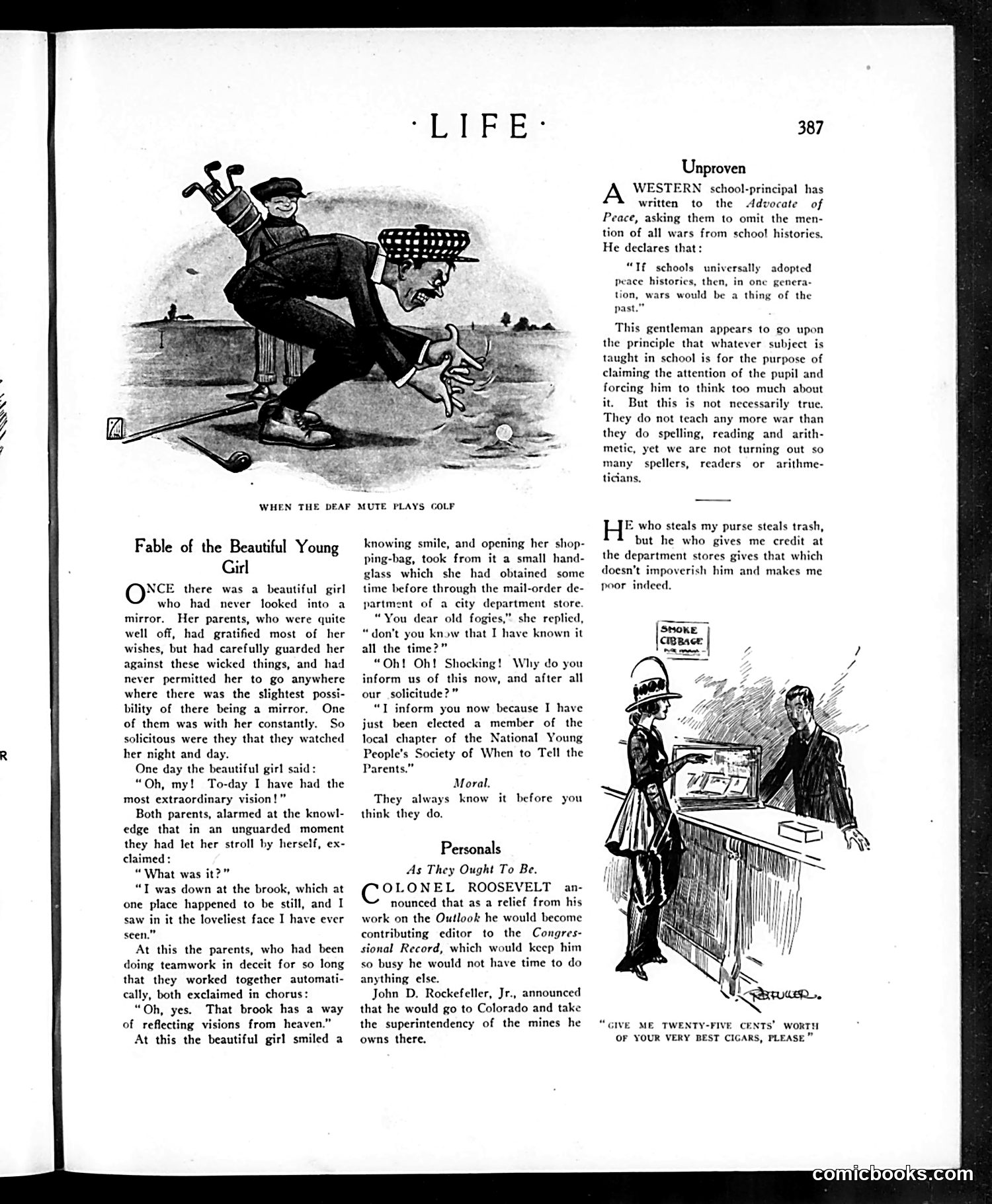
**"When the Deaf Mute Plays Golf"** (top cartoon): A visual joke showing a golfer in an exaggerated mid-swing pose with golf clubs flying. The humor relies on the absurdist title—the contradiction between being deaf-mute (unable to hear or speak) and playing golf, a sport requiring no special communication, creates the punchline through unexpected juxtaposition. **"Fable of the Beautiful Young Girl"**: A moral tale satirizing overprotective parenting. Parents shield their daughter from mirrors, claiming ignorance about her appearance, but she discovers her own reflection in a brook. The girl's punchline—joining "The National Young People's Society of When to Tell the Parents"—mocks generational dishonesty and suggests young people are savvy to adult deception. The moral: youth know the truth despite parental pretense. **"Personals" section**: Light satirical notes about Colonel Theodore Roosevelt and John D. Rockefeller Jr., humorously suggesting they'll become so busy with new editorial/mining roles that they'll have "no time to do anything else"—poking fun at their prominence and workaholic tendencies.
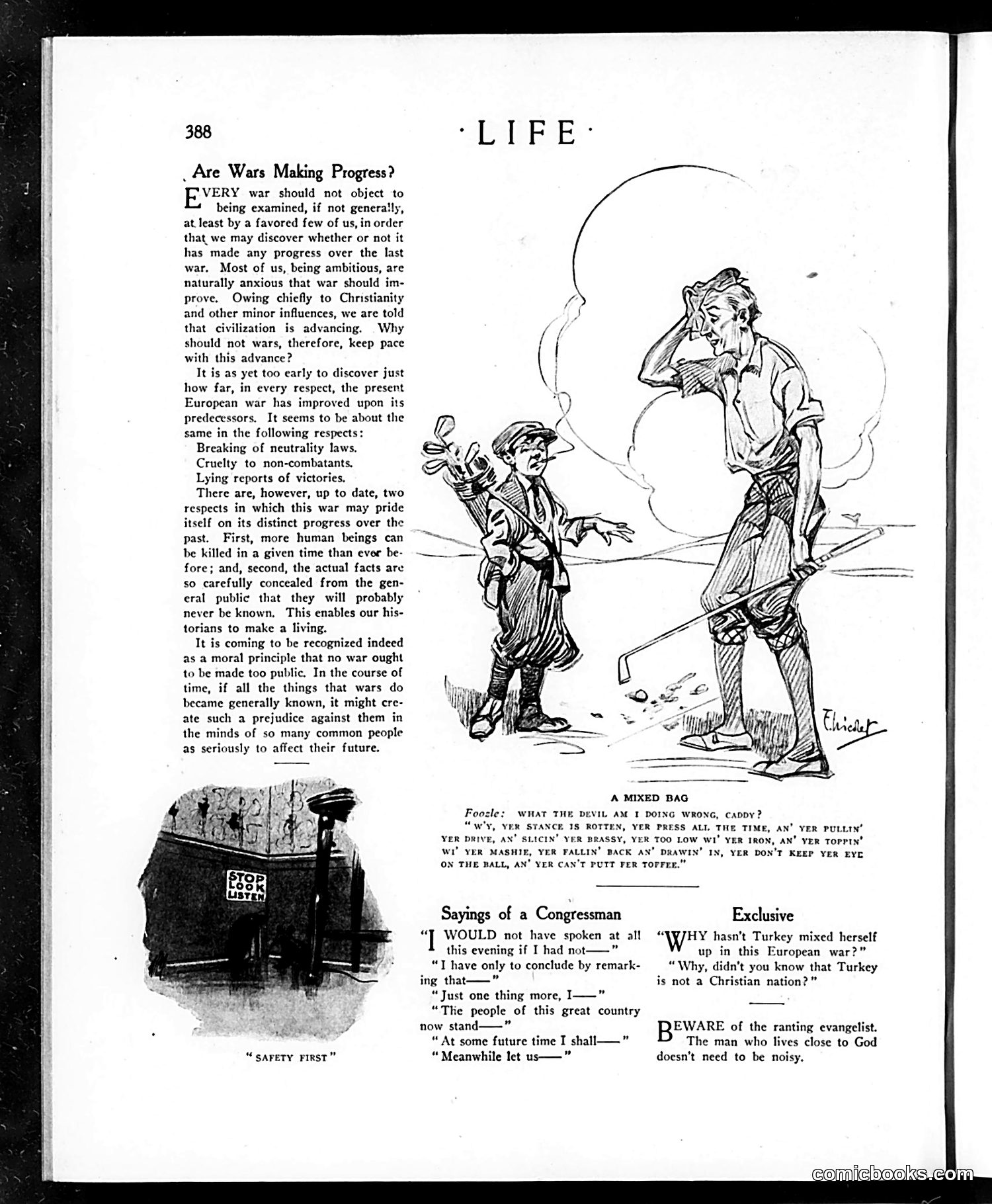
This page satirizes World War I through multiple pieces. The main essay "Are Wars Making Progress?" uses sardonic logic to argue that while civilization supposedly advances, wars remain morally unchanged—except in two respects: more people can be killed efficiently, and facts are concealed from the public so effectively that "historians" can fabricate narratives with impunity. The satire targets both military brutality and propaganda suppression. "A Mixed Bag" cartoon depicts a golf instructor berating a student, using golf terminology as metaphor for war's incompetence—suggesting military leadership bundles every strategic element. The "Sayings of a Congressman" mockingly presents a politician's empty rhetoric, while the "Exclusive" section satirizes religious hypocrisy, specifically evangelical support for war despite Christianity's peaceful teachings. The Turkey reference likely alludes to Ottoman entry into WWI (1914) and debates about Christian versus non-Christian nations' involvement.
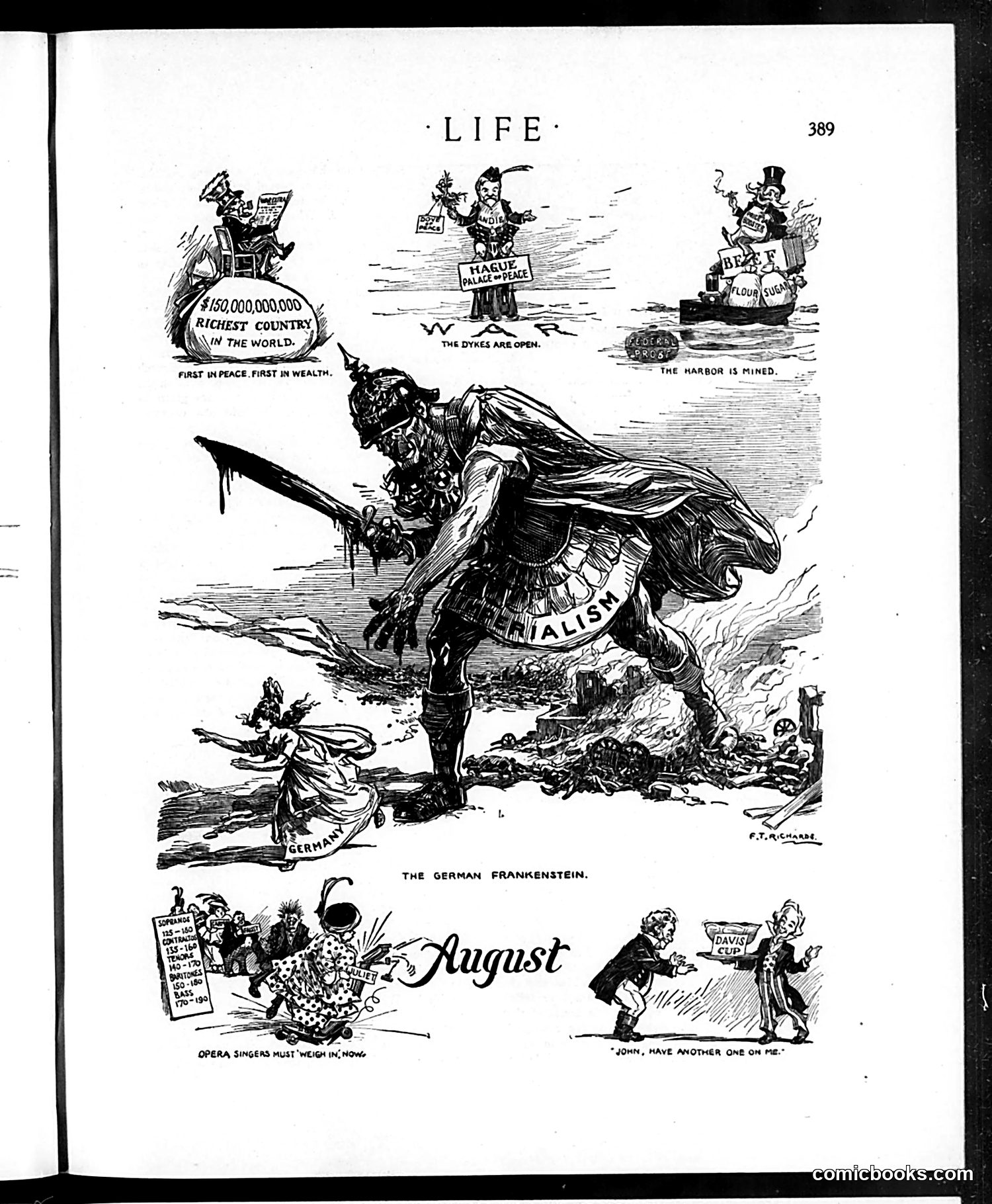
This page satirizes early 20th-century concerns, primarily targeting Germany as a dangerous force ("The German Frankenstein"—a monster created and now uncontrollable). The central figure appears to be militarism or aggression personified, wielding a sword over fallen figures labeled "Germany" and "Alsalism." The upper vignettes mock American wealth and political complacency: one shows the "richest country in the world" oblivious to danger; another depicts open borders/dykes; a third shows a vulnerable harbor. The bottom cartoons offer lighter social commentary: opera singers must meet weight requirements, and a domestic scene plays on drinking culture ("Have another one on me"). The overall message combines warnings about external threats with satirical jabs at American society's internal contradictions and distractions.
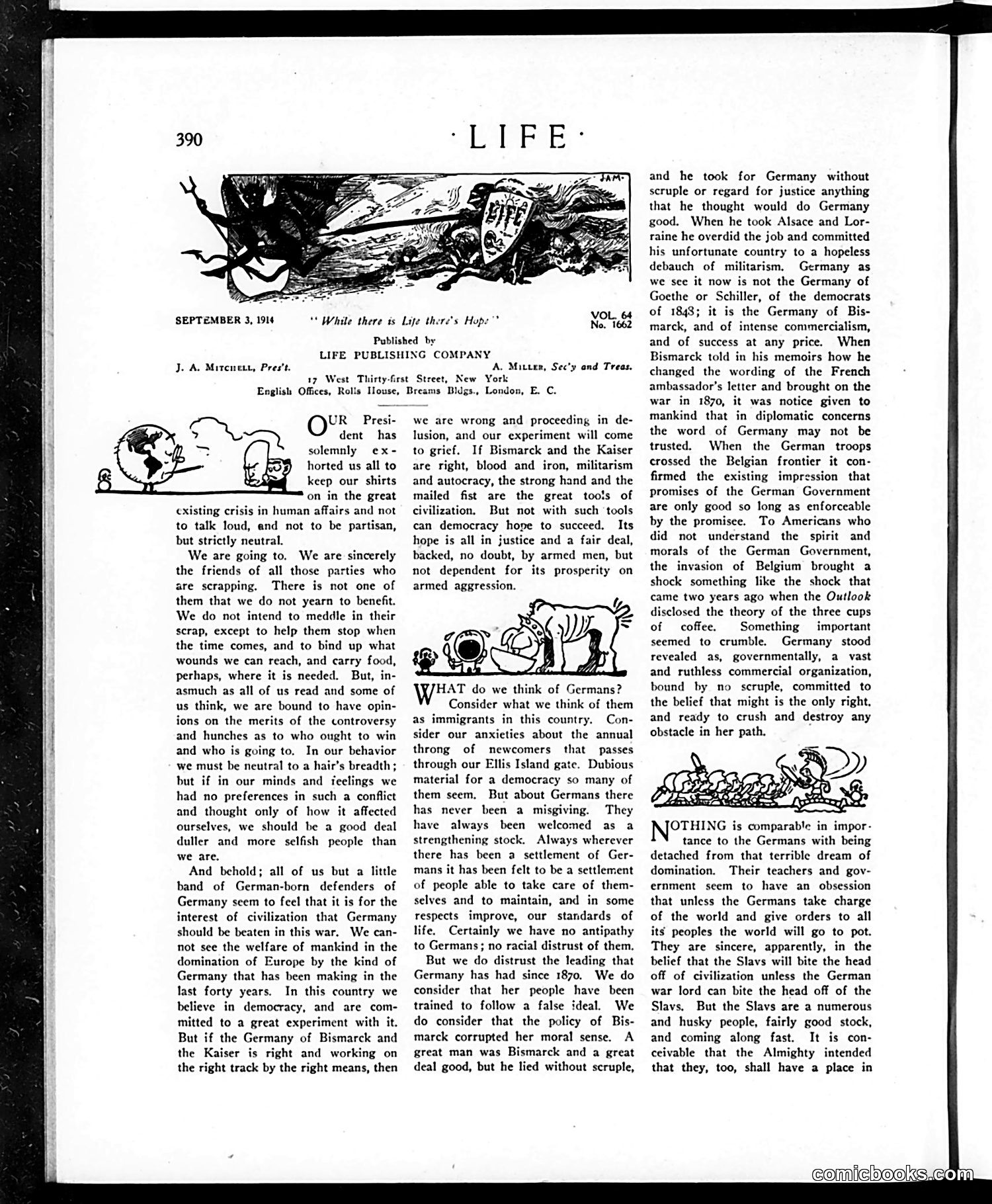
This editorial page addresses American neutrality in World War I (just begun) while arguing that intellectual honesty requires forming judgments about the conflict's merits. The cartoons—crude sketches of figures appearing distressed or conflicted—visually reinforce the tension between maintaining official neutrality and having private opinions. The text distinguishes between Germans as immigrants (whom Americans respect as hardworking settlers) and Germany's government under Bismarck's legacy, which the author criticizes for pursuing "blood and iron" militarism and territorial conquest without moral scruple. The piece argues democracy and autocracy are fundamentally incompatible systems, making Germany's dominance incompatible with civilization. The author asserts Americans *can* remain behaviorally neutral while morally preferring an Allied victory, positioning this as intellectually honest rather than partisan bias.
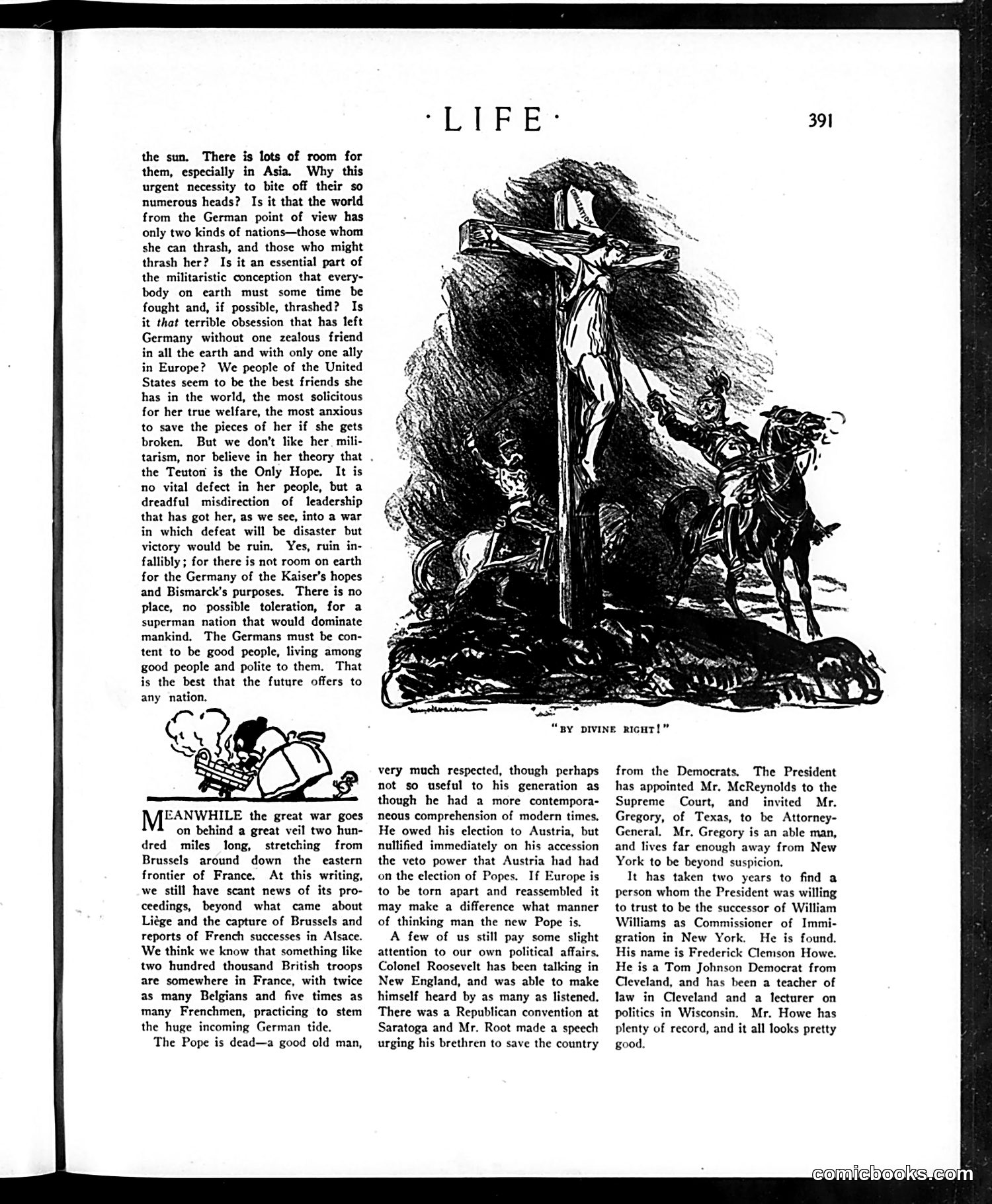
The main cartoon, titled "By Divine Right!," depicts a crucified Christ figure overlooking a battlefield scene—likely referencing World War I, which the text confirms is ongoing "behind a great veil" along the France-Belgium frontier. The accompanying editorial argues against German militarism and the doctrine of Teutonic superiority. It criticizes Germany's belief that it alone deserves dominance ("the Teuton is the Only Hope"), warning that such ideology has isolated Germany diplomatically and will lead to ruin rather than victory. The author expresses American sympathy for Germany's people while rejecting its leadership's militaristic philosophy. The cartoon's juxtaposition of Christian sacrifice with warfare suggests the moral bankruptcy of Germany's militaristic "divine right" ideology—presenting it as blasphemous contradiction. The page also covers domestic American politics, including Roosevelt's speeches and presidential appointments, indicating this is from 1914, early in WWI.
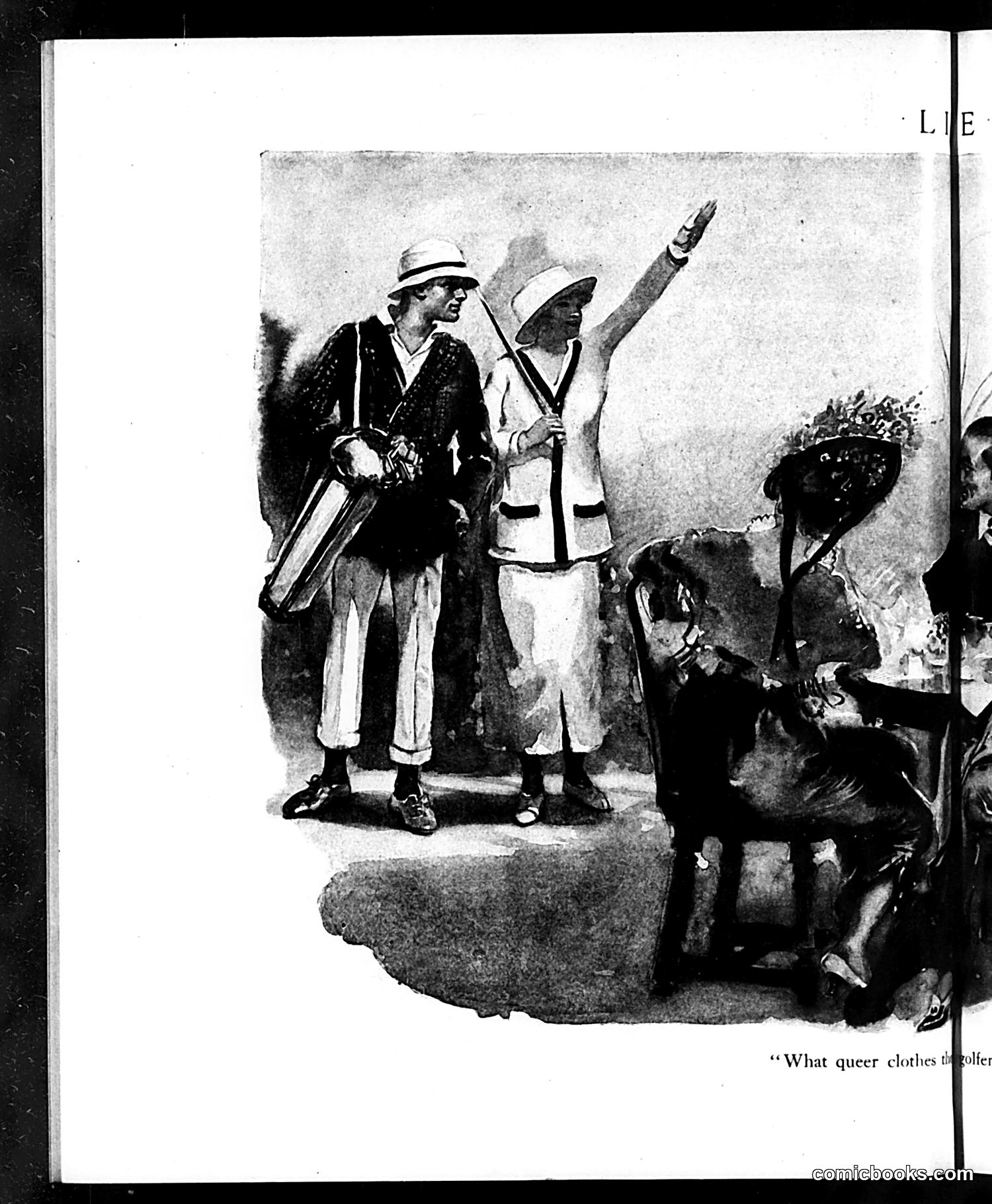
This appears to be a satirical cartoon from *Life* magazine depicting two figures in unusual attire standing elevated before seated observers. The figure on the left carries what appears to be a large cylindrical object, while the figure on the right has one arm raised in a gesturing pose. Both wear hats and distinctive clothing. The partial caption reads: "What queer clothes th[ey]..." suggesting the satire centers on mocking the unusual or foreign appearance of these figures. Without the complete caption or date, I cannot definitively identify who these figures represent or what specific political/social event is being referenced. The style suggests early-to-mid 20th century. The satire likely targets fashion, foreigners, or a specific contemporary news event, but the specifics remain unclear from this fragment.
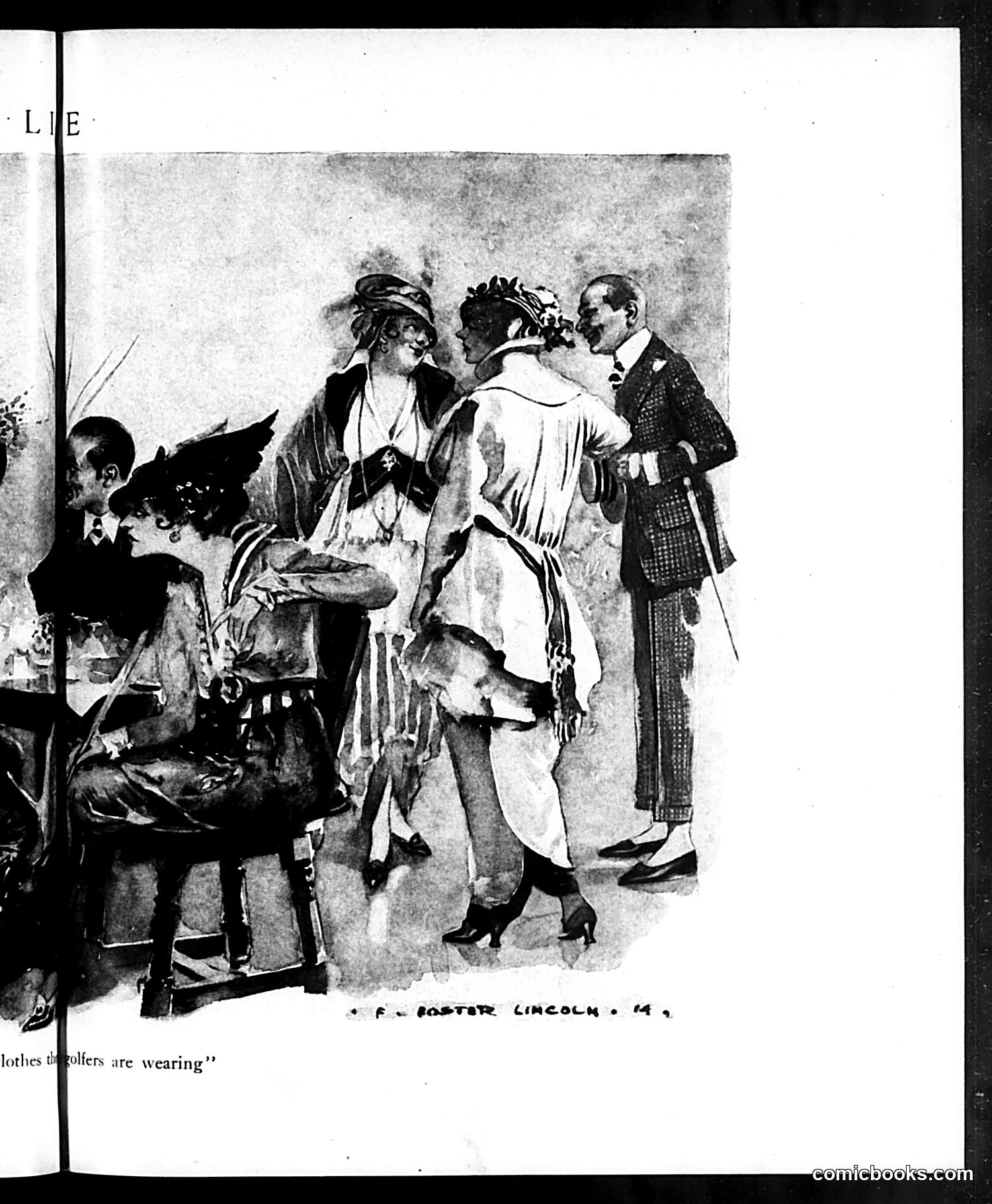
This appears to be a satirical illustration from *Life* magazine depicting a social scene, likely from the early 1900s based on the clothing styles. The caption "olfers are wearing" (likely "Golfers are wearing") suggests commentary on fashionable attire within high society. The image shows well-dressed figures in conversation—women in elaborate hats and coats, men in formal suits. The credit mentions "CASTOR LINCOLN," though the exact context remains unclear. The satire likely mocks the pretentious fashion choices or social behaviors of the golfing set, a leisure activity associated with wealthy Americans. However, without the complete caption or additional context, the specific target of ridicule cannot be definitively determined. The illustration style is characteristic of early *Life* magazine social commentary.
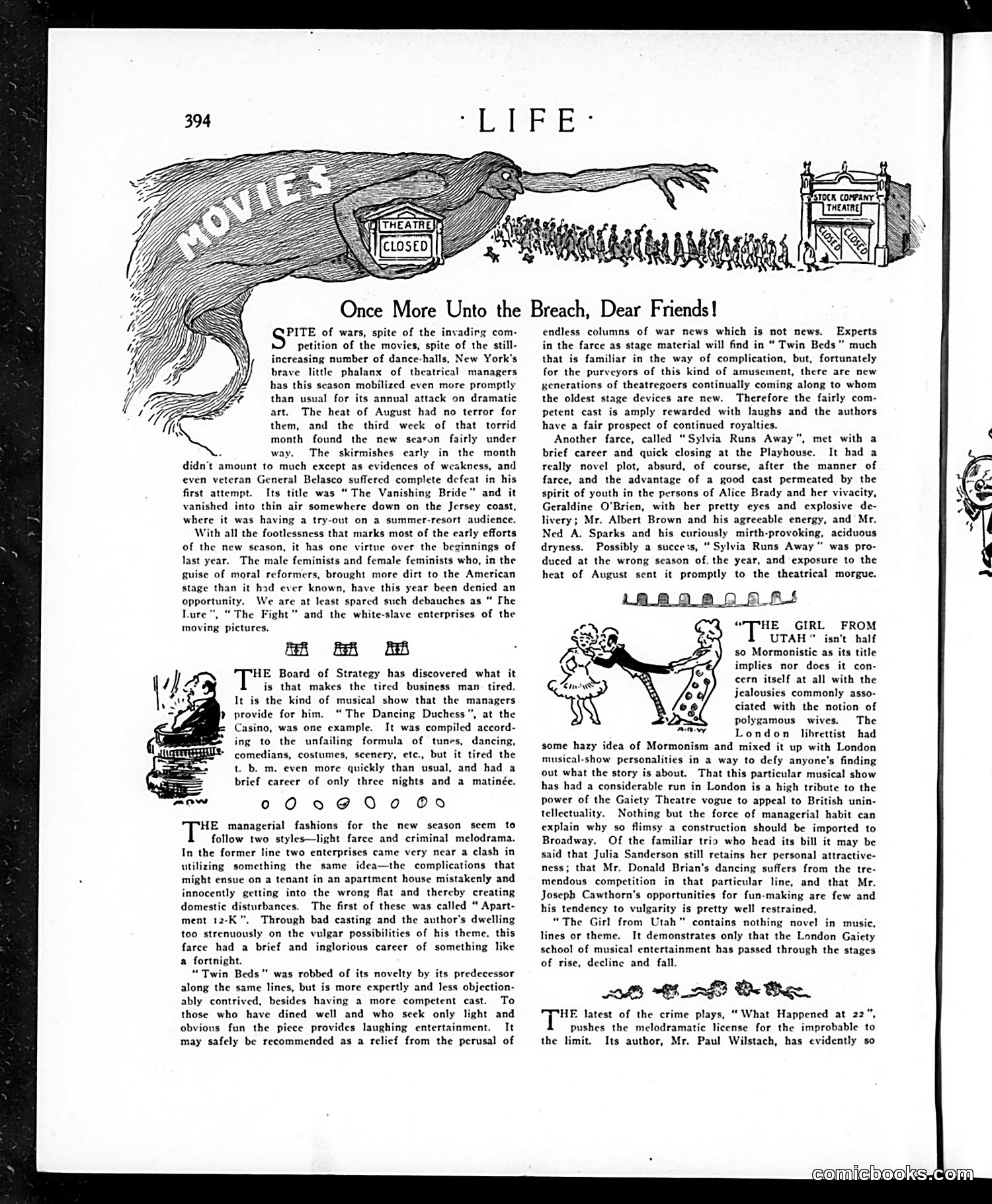
This Life magazine page critiques the New York theatrical season's opening, framed as a military campaign ("Once More Unto the Breach"). The satirist mocks theatrical managers for their formulaic approaches despite competition from movies and dance halls. Key targets include: **The plays themselves**: Farces like "Apartment 12-K" and "Twin Beds" rely on tired, repeated plot devices (tenants entering wrong apartments) that only work because new generations of theatergoers haven't seen them before—a cutting observation about theatrical mediocrity. **Audience demographics**: The "tired business man" (tb.m.) is repeatedly mentioned as the target demographic, suggesting Broadway caters to exhausted professionals seeking mindless entertainment rather than genuine art. **Social progress**: The author notes approvingly that morality-crusading reformers haven't successfully pressured theaters this season, unlike previous years when controversial shows like "The Lure" faced attacks. The winged figure illustration represents theatre itself—somewhat diminished, pointing toward competing "Stock Company Theatre" establishments, symbolizing Broadway's declining cultural dominance.
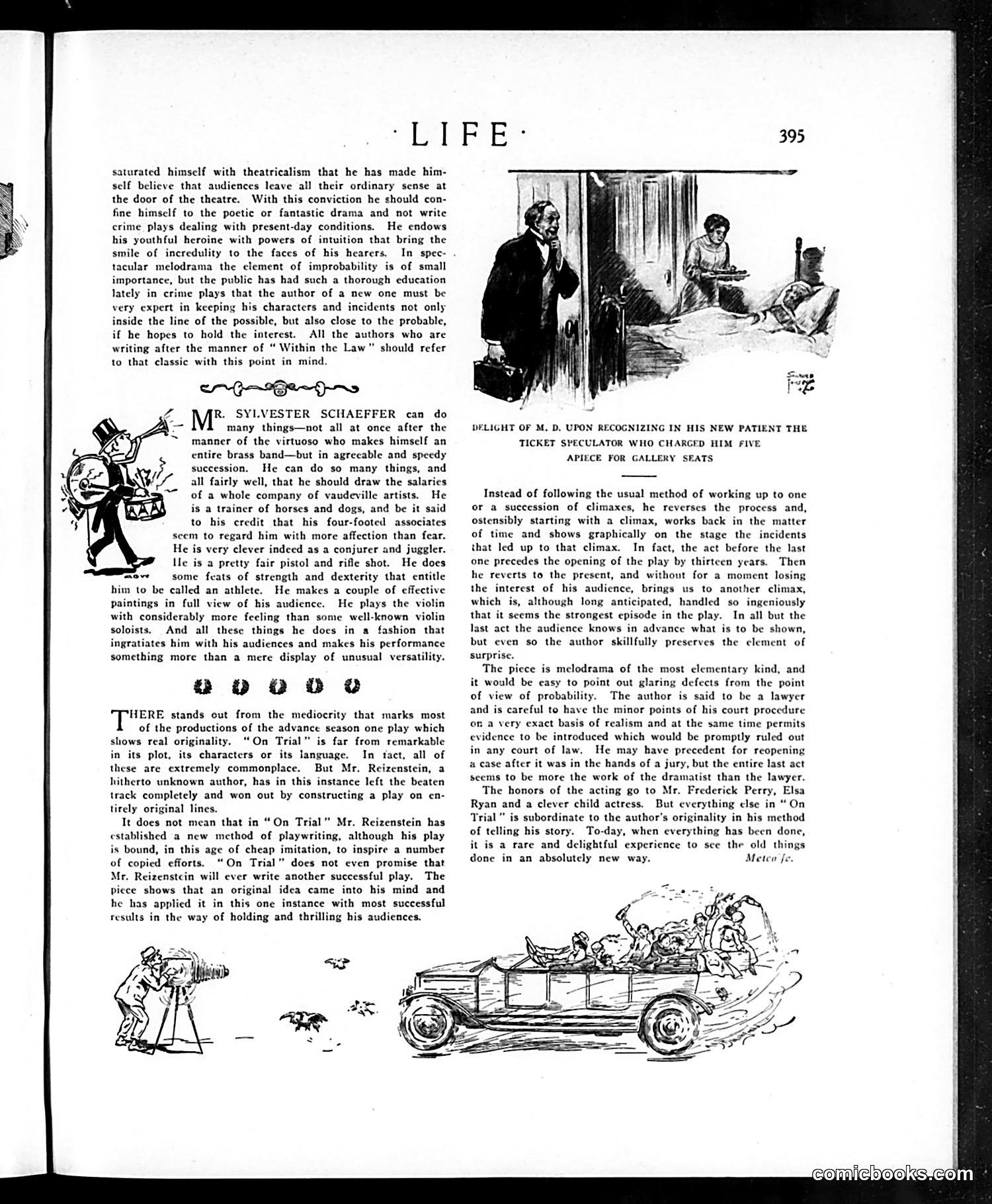
This Life magazine page (p. 395) discusses theatrical criticism and notable performers of the era. **Main Content:** - Critiques of contemporary playwrights, particularly those imitating "Within the Law," arguing crime plays require realistic, probable plots to hold audiences educated by recent theatre. - Praise for Mr. Sylvester Schaeffer as a vaudeville performer—a multi-talented entertainer skilled at training animals, conjuring, juggling, shooting, painting, and violin-playing. - Discussion of playwright Mr. Reizenstein's play "On Trial," which reverses conventional dramatic structure by starting with a climax and working backward thirteen years, then returning to present events. **The Cartoons:** - Top: A doctor recognizing a ticket scalper who previously overcharged him—depicting revenge humor. - Bottom: An overloaded automobile—likely satirizing contemporary car culture or traffic absurdities. The page emphasizes theatre criticism and vaudeville entertainment, reflecting early 20th-century American popular culture priorities.
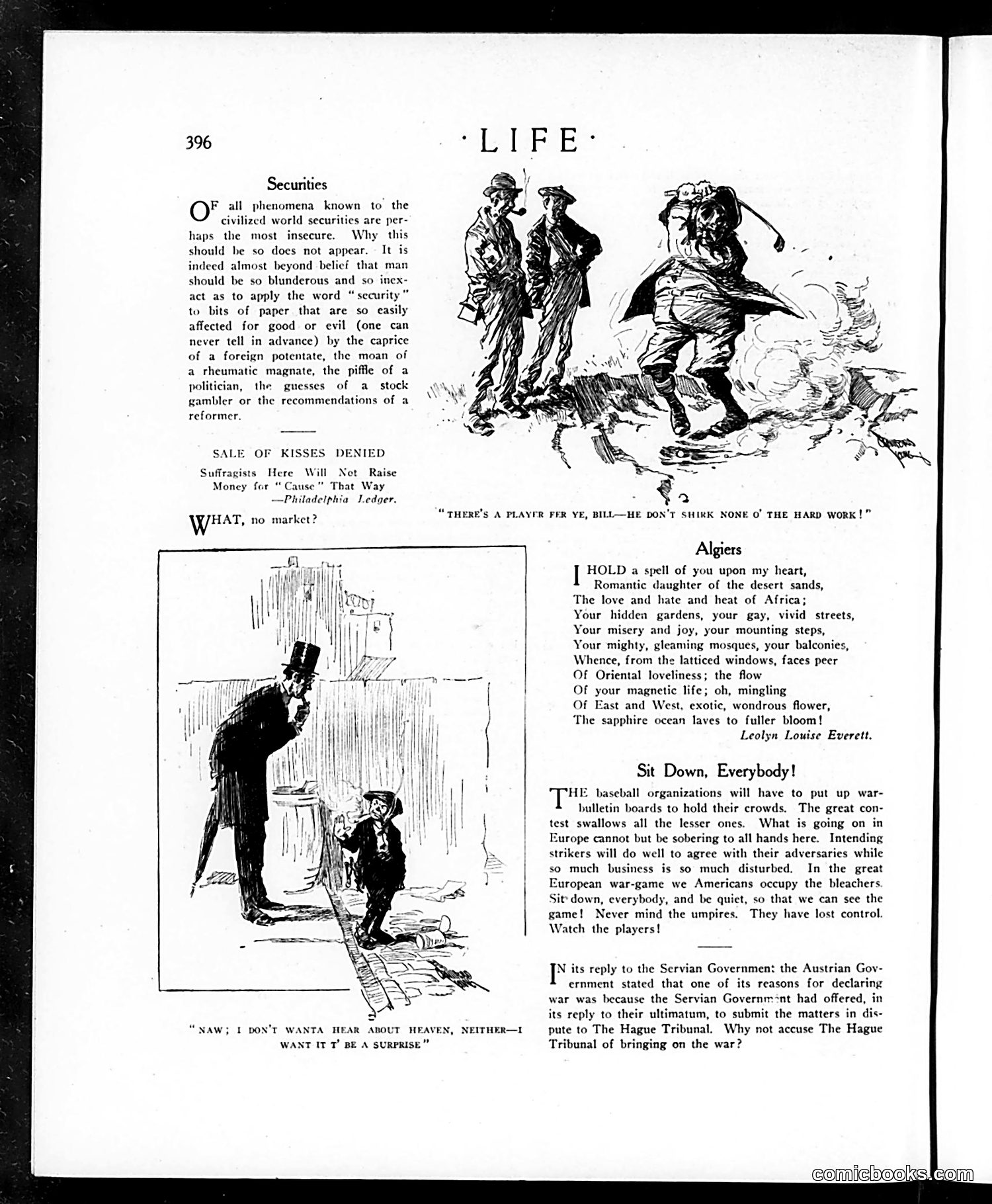
**"Securities" editorial**: Satirizes stock market investments as paradoxically insecure despite their name. The piece mocks how paper securities are vulnerable to unpredictable factors—foreign leaders' whims, wealthy magnates' health problems, politicians' incompetence, and stock gamblers' speculation. **Left cartoon**: A tall man in formal dress (appears to be a wealthy investor or broker) towers over a small boy, captioned "SAW; I DON'T WANTA HEAR ABOUT HEAVEN, NEITHER—I WANT IT T' BE A SURPRISE." This likely satirizes how investors blindly avoid learning about their investments' true conditions, preferring ignorant optimism. **Right illustration**: Depicts a golf player, captioned about not shirking "hard work"—possibly mocking wealthy men's leisure activities as frivolous distractions from serious business matters. **"Sit Down, Everybody!"**: References World War I (the "great European war"), urging Americans to remain neutral spectators rather than get involved, treating the conflict like a baseball game. The page reflects pre-U.S. entry WWI anxieties about war, financial instability, and public distraction.
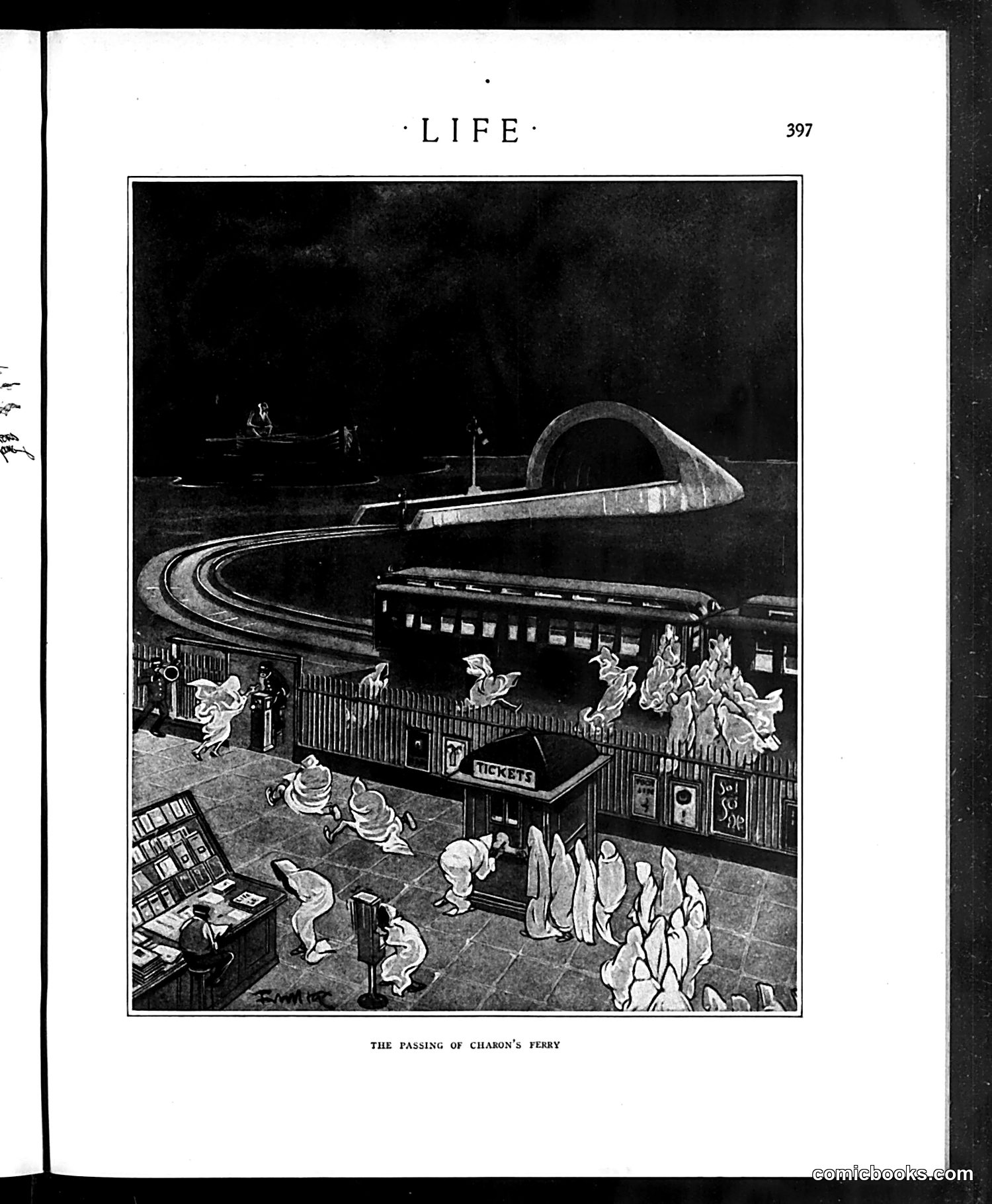
This satirical illustration depicts the afterlife's ferry service being modernized. In classical mythology, Charon ferries souls across the River Styx to the underworld. The cartoon shows his traditional boat replaced by a contemporary passenger train and ticket booth, with souls (depicted as ghostly figures) queuing and boarding. The satire critiques modern industrialization and commercialization, suggesting that even ancient, sacred traditions are being replaced by contemporary transportation and ticketing systems. The orderly queue of spirits and formal "TICKETS" booth represent the mechanization of what was once mythologically significant. This reflects early-to-mid 20th century anxieties about how modern capitalism and industry were transforming all aspects of society, including cultural and spiritual traditions.
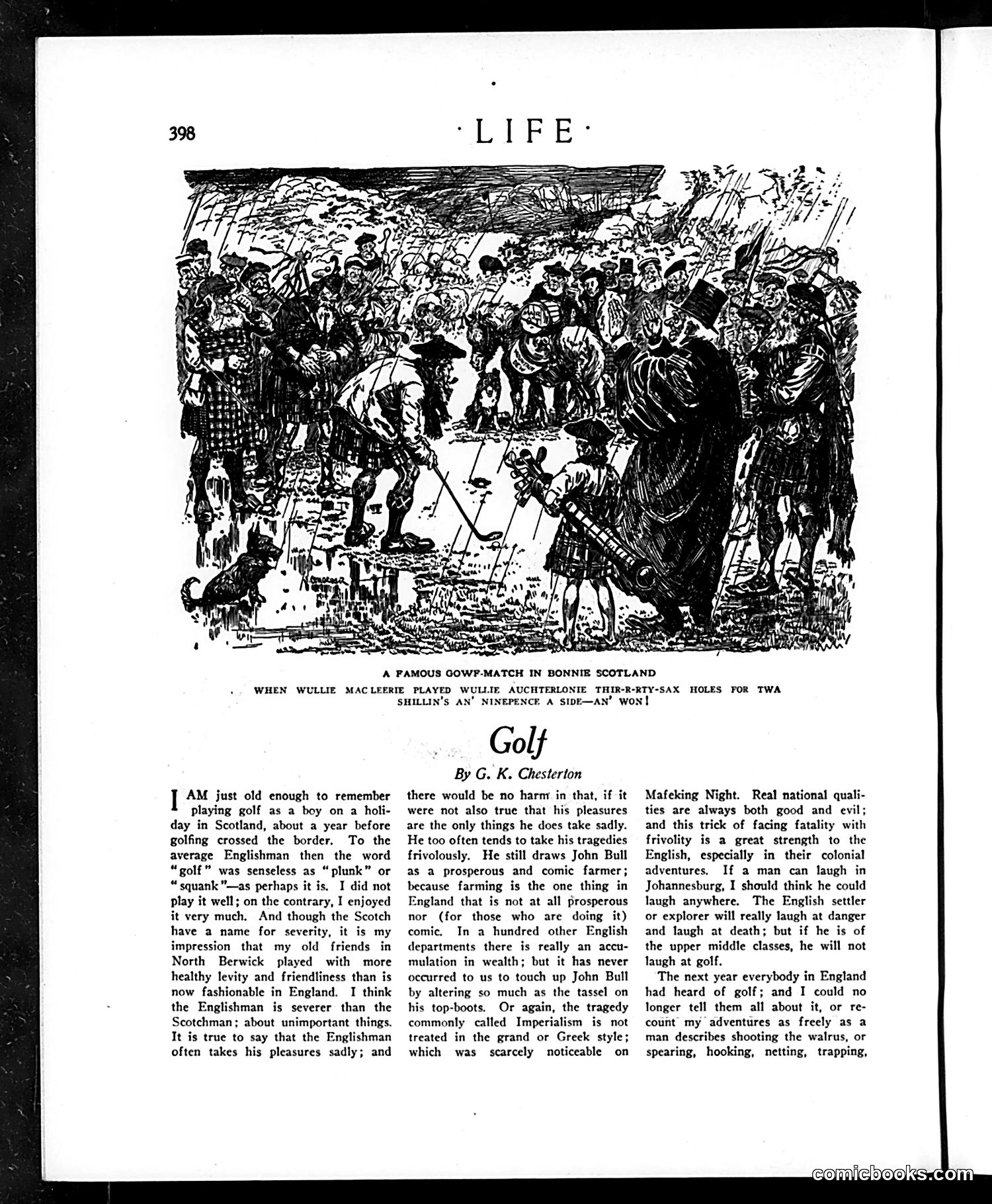
This page combines a satirical cartoon with G.K. Chesterton's essay on golf. The illustration depicts a rowdy Scottish golf match—"A Famous Gowf-Match in Bonnie Scotland"—featuring exaggerated Scottish characters (indicated by the phonetic spelling "Wullie Macleerie" and "Auchterlonie") playing with boisterous informality. Chesterton's accompanying essay contrasts Scottish and English temperaments regarding golf and national character. He argues that Scots play golf with healthy levity and friendliness, while Englishmen take their leisure—and themselves—too seriously. More broadly, he satirizes English behavior: they comically depict farmers (John Bull) while actual farming struggles, yet treat serious imperial tragedies with frivolity rather than appropriate gravity. The cartoon illustrates Chesterton's point about Scottish informality, showing golf as a communal, lighthearted pursuit rather than the stern, competitive endeavor it became fashionable in England.
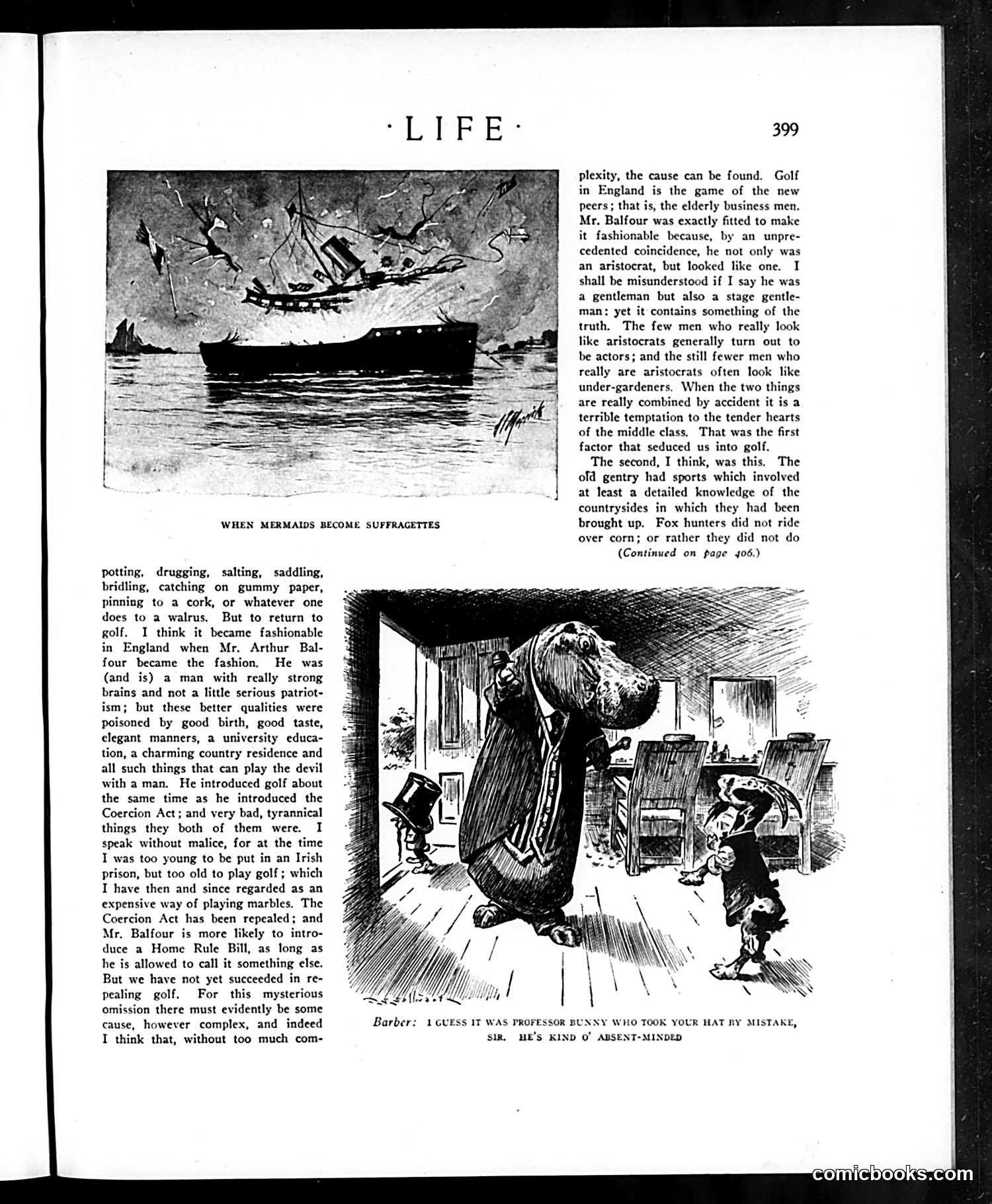
This page contains a satirical essay on golf's rise in English society, attributed to Arthur Balfour's influence as a fashionable statesman. The author argues Balfour—an aristocrat who *looked* like an aristocrat—made golf fashionable among the middle class by accident. The essay criticizes Balfour's other policies, notably the "Coercion Act" (Irish repression), lumping golf and tyranny together as his twin legacies. **The cartoon** (captioned "When Mermaids Become Suffragettes") shows a barber apologizing to a customer for a mix-up involving "Professor Bunny," depicted as an absent-minded academic. The joke appears to satirize absent-minded intellectuals, though the suffragette reference in the title suggests this may be commenting on contemporary women's rights activism—likely implying reformers are as scatterbrained as the professor. The page mixes political critique with gentle mockery of social pretension and academic types.
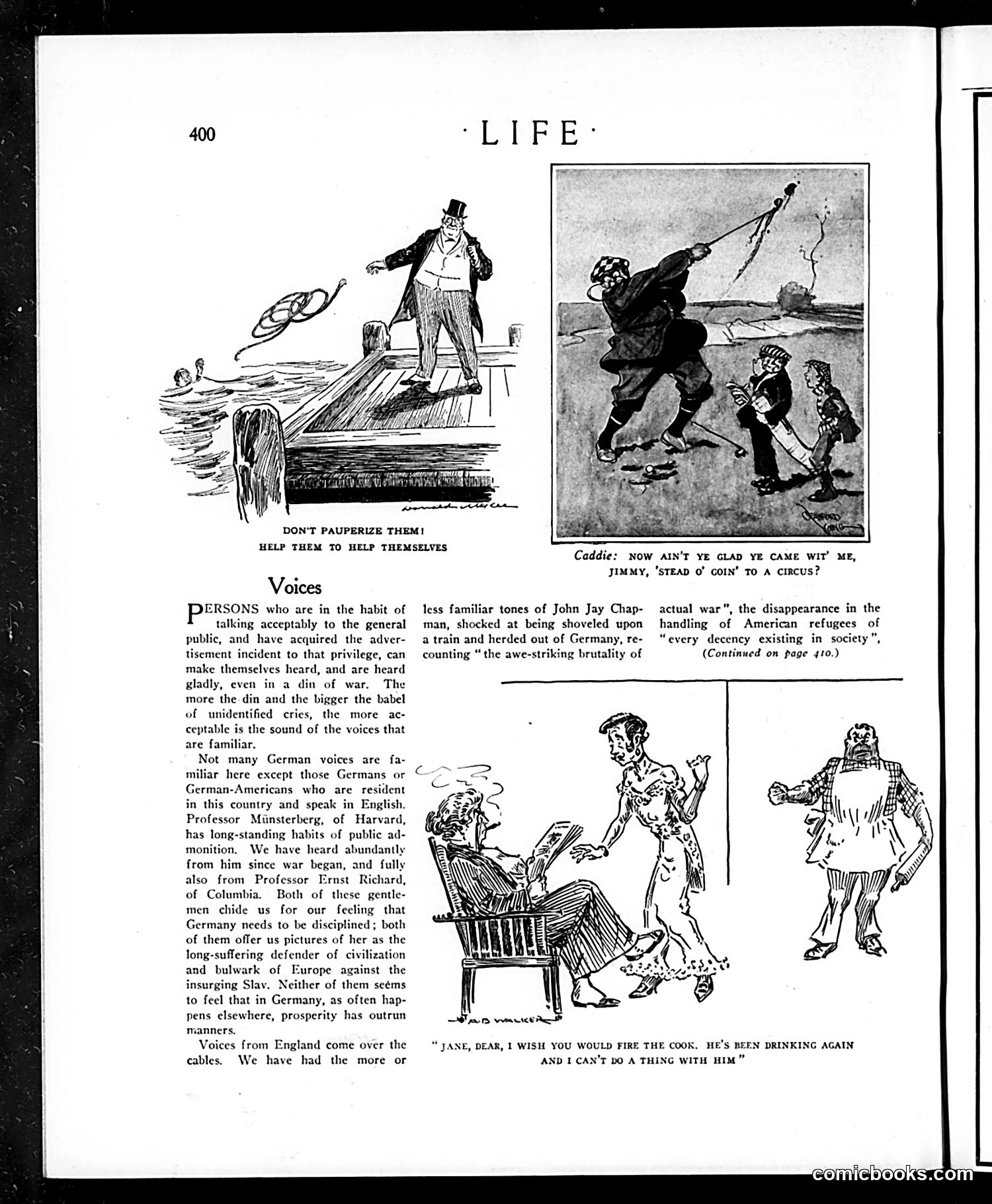
This page contains commentary on wartime rhetoric and three cartoons satirizing different aspects of WWI-era American life. **"Voices" Article:** The editorial discusses how certain German-American academics—specifically naming Professor Münsterberg (Harvard) and Professor Ernst Richard (Columbia)—publicly defend Germany's conduct in the war. The author critiques their portrayal of Germany as a "long-suffering defender of civilization" against Slavic threats, suggesting their prosperity-driven nation lacks proper manners. The piece also references John Jay Chapman, an English voice commenting on German brutality toward American refugees. **Cartoons:** 1. **Top left:** "Don't Pauperize Them"—a gentleman directs swimmers, emphasizing self-reliance over charity. 2. **Top right:** A child questions why they came to a circus instead of experiencing actual war conditions with an adult. 3. **Bottom:** A domestic scene where a man complains about firing a drinking cook, depicting household management frustrations during wartime disruption. The page reflects wartime divisions between German-American sympathizers and Allied supporters, alongside humor about civilian life's persistent mundane problems amid global conflict.
This page is primarily a corporate advertisement, not satire or political commentary. Kelly-Springfield Tire Co. uses *Life* magazine to announce that while other rubber companies are raising prices due to WWI-driven crude rubber shortages in Europe, they will instead pass savings to customers. The company claims the price increase is temporary and caused by the war's disruption of commerce. They justify maintaining supplies by noting their high-quality output requires properly seasoned raw materials. The announcement includes branch office locations across the U.S. and affiliated dealers. There is no cartoon or satirical content visible—this is straightforward corporate messaging presenting the company as ethically superior to competitors exploiting market conditions.
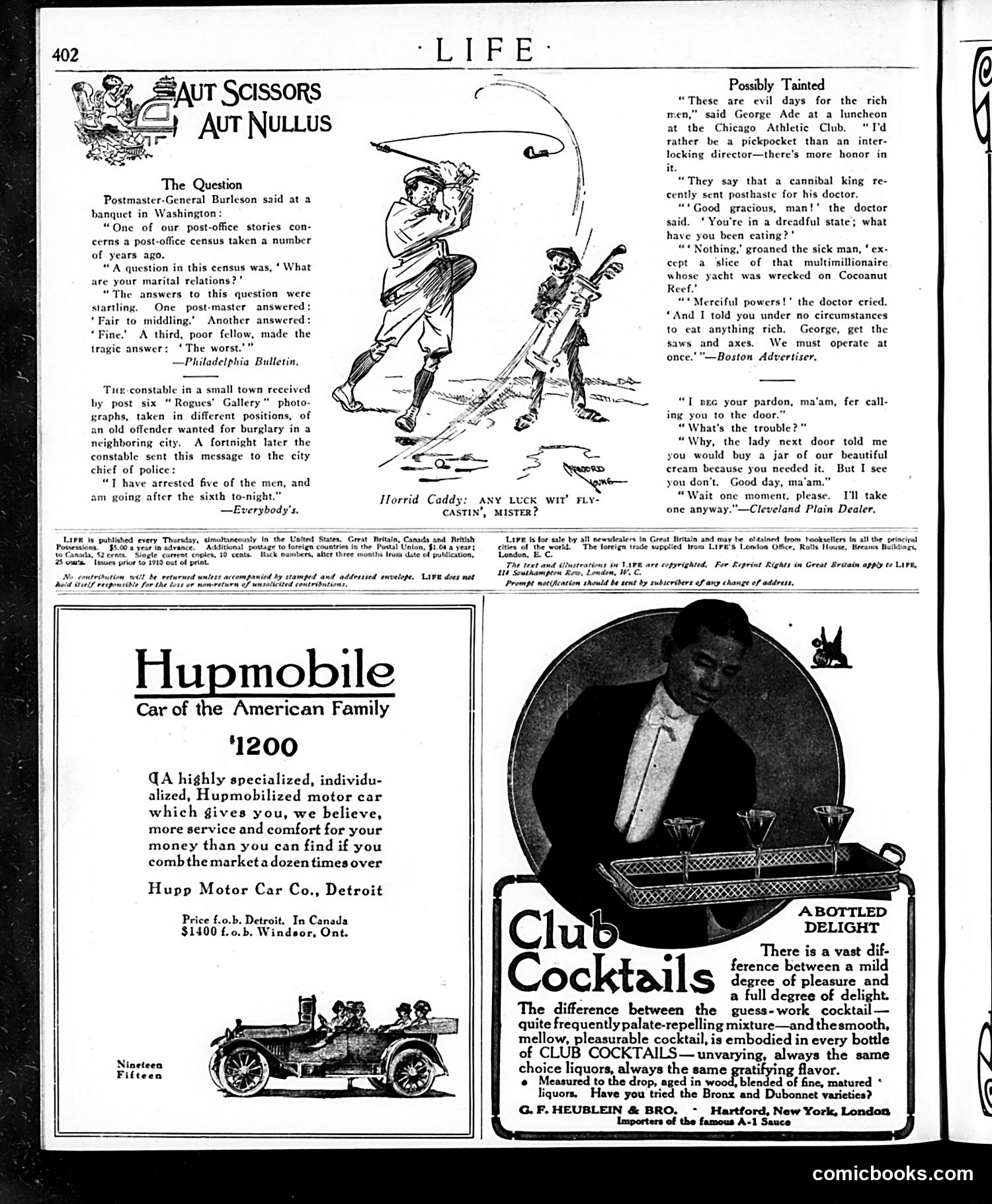
This page features satirical commentary on wealth and class from early 20th-century America. The main cartoon, "Horrid Caddy: Any Luck Wit' Castin', Mister?" depicts a young caddy (golf assistant) watching a wealthy man fish, mocking upper-class leisure pursuits. The accompanying text includes three humorous anecdotes critiquing the rich: George Ade's quip that pickpockets have "more honor" than interlocking directors (corporate board members); a dark joke about a cannibal king becoming ill from eating a wealthy yacht-wreck survivor; and a post-office census revealing marital unhappiness among civil servants. These pieces represent *Life* magazine's trademark satire targeting wealth inequality, corporate corruption, and hypocrisy among the affluent during the Progressive Era. The humor relies on inversion—suggesting the poor (pickpockets, cannibals) are morally superior to the rich. The page also contains period advertisements for the Hupmobile automobile and Club Cocktails, typical of the magazine's commercial content.
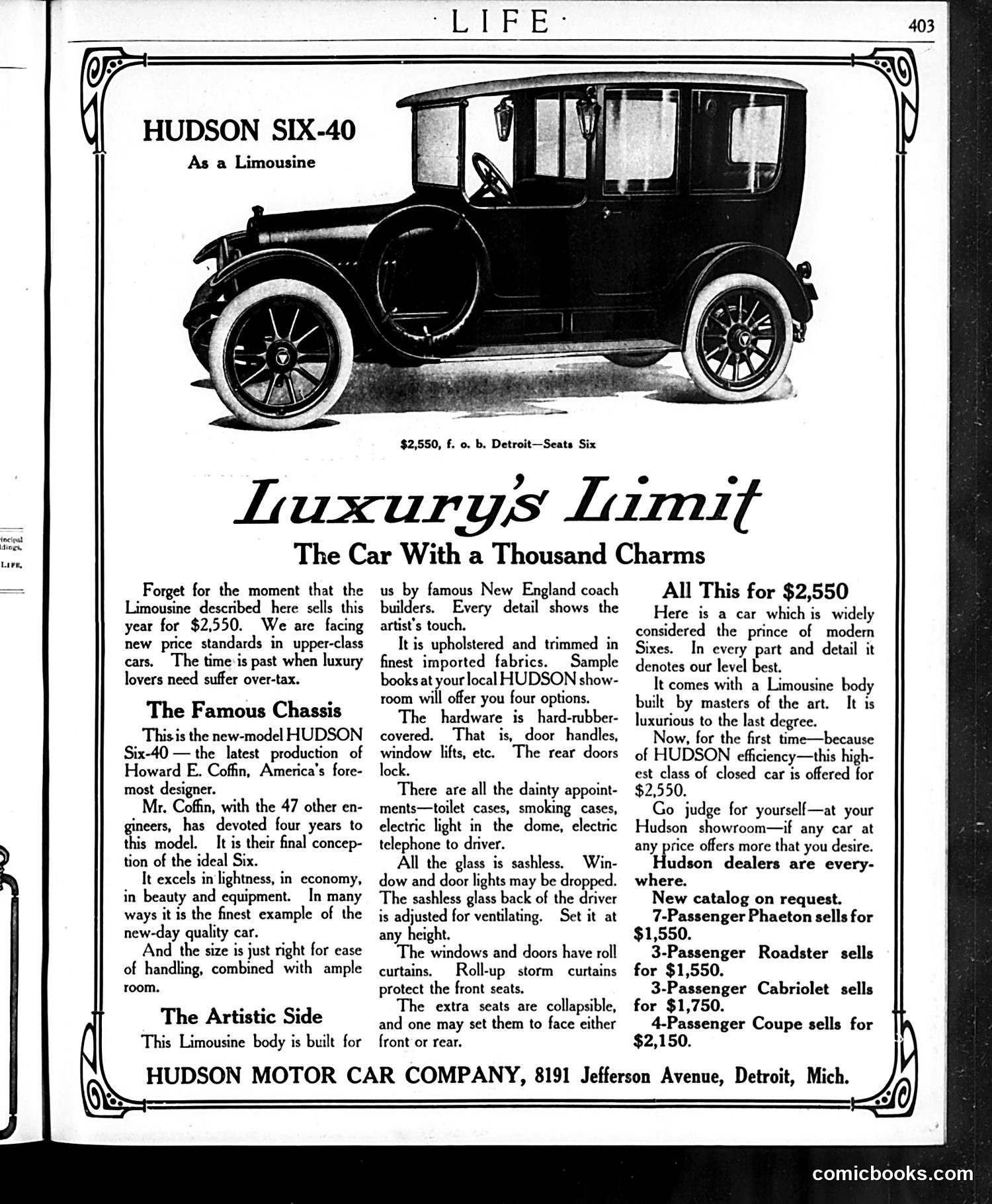
This is **not a cartoon or satire** — it's a full-page automobile advertisement from Life magazine for the Hudson Six-40 limousine. The ad promotes a luxury closed automobile priced at $2,550 (f.o.b. Detroit), positioning it as an affordable entry point to high-class motoring. Key selling points include: - Engineering by Howard E. Coffin, described as "America's foremost designer" - A chassis developed over four years by 47 engineers - Luxurious appointments: imported fabrics, electric lights, telephone to driver, collapsible jump seats - New manufacturing efficiency allowing luxury at a lower price point The headline "Luxury's Limit: The Car With a Thousand Charms" emphasizes accessible luxury — the idea that one can now afford premium features without excessive cost. The ad addresses economic anxieties of the era ("The time is past when luxury lovers need suffer over-tax"), suggesting this car democratizes what was previously only for the wealthy. This appears to be early 1900s-era automotive advertising, reflecting the American auto industry's growth and competitive positioning of the Hudson brand.
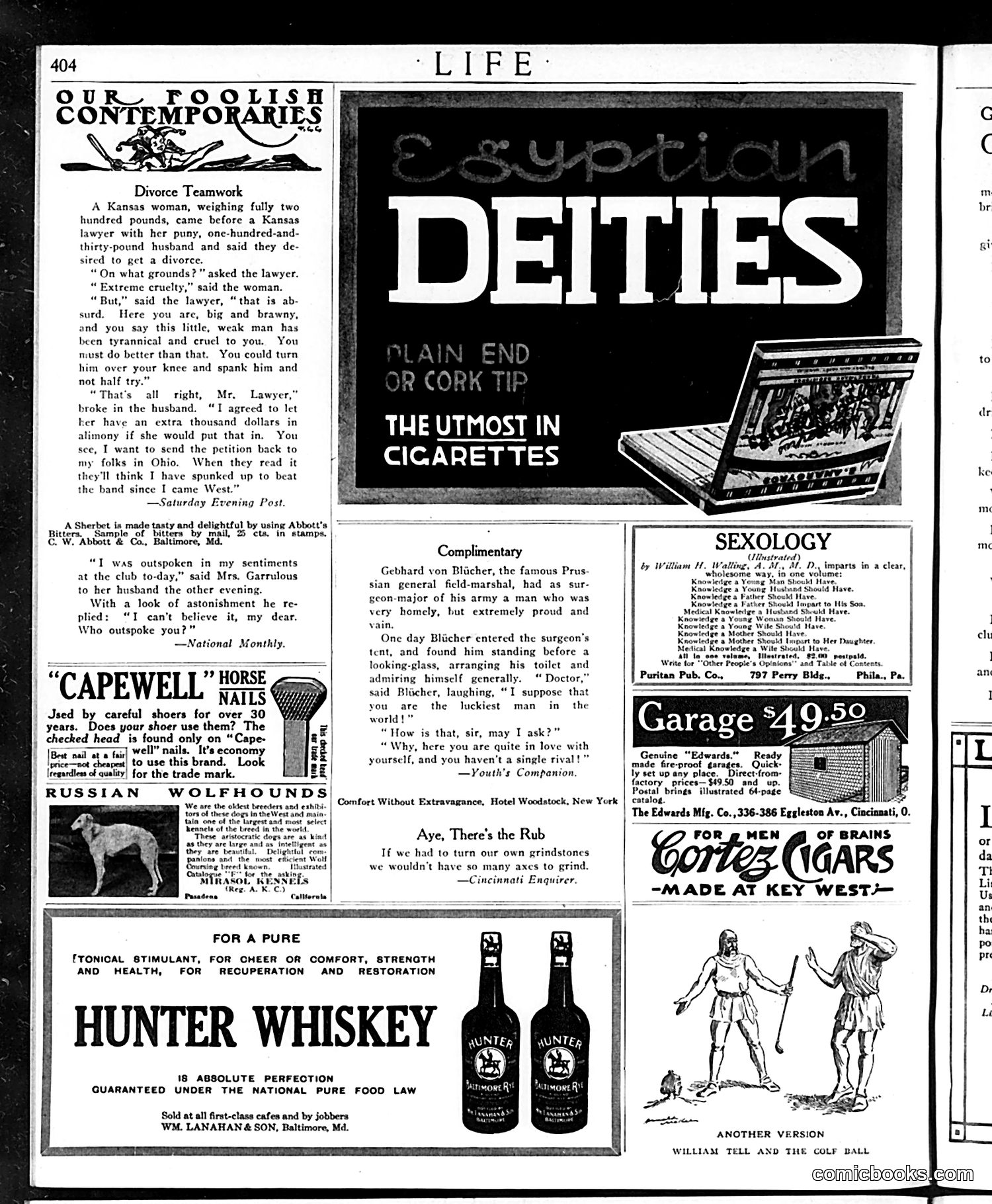
This page is primarily **advertising**, with brief satirical humor pieces interspersed. ## Main Content: **"Divorce Teamwork"** satirizes marital dynamics: a large Kansas woman claims her tiny husband was "cruel," but the lawyer points out the absurdity—she's physically dominant. The husband reveals he *paid* her to include "spanking" claims in the divorce petition so people back home will think him tough. The joke mocks both the couple's dishonesty and period assumptions about masculine authority. **"Complimentary"** (brief anecdote) jokes about a Prussian general's vanity: a surgeon-major arranges his appearance admiringly before a mirror. When General Blicher mockingly suggests he's vain, the surgeon quips that the general—who clearly loves himself—lacks a rival. The humor targets military pomposity. **"Aye, There's the Rub"** offers a brief quip about grinding grindstones versus axes—essentially idle complaint-making. The page is dominated by product advertisements: Dempties cigarettes, Hunter Whiskey, Capewell horse nails, a garage kit, and Cortez cigars.
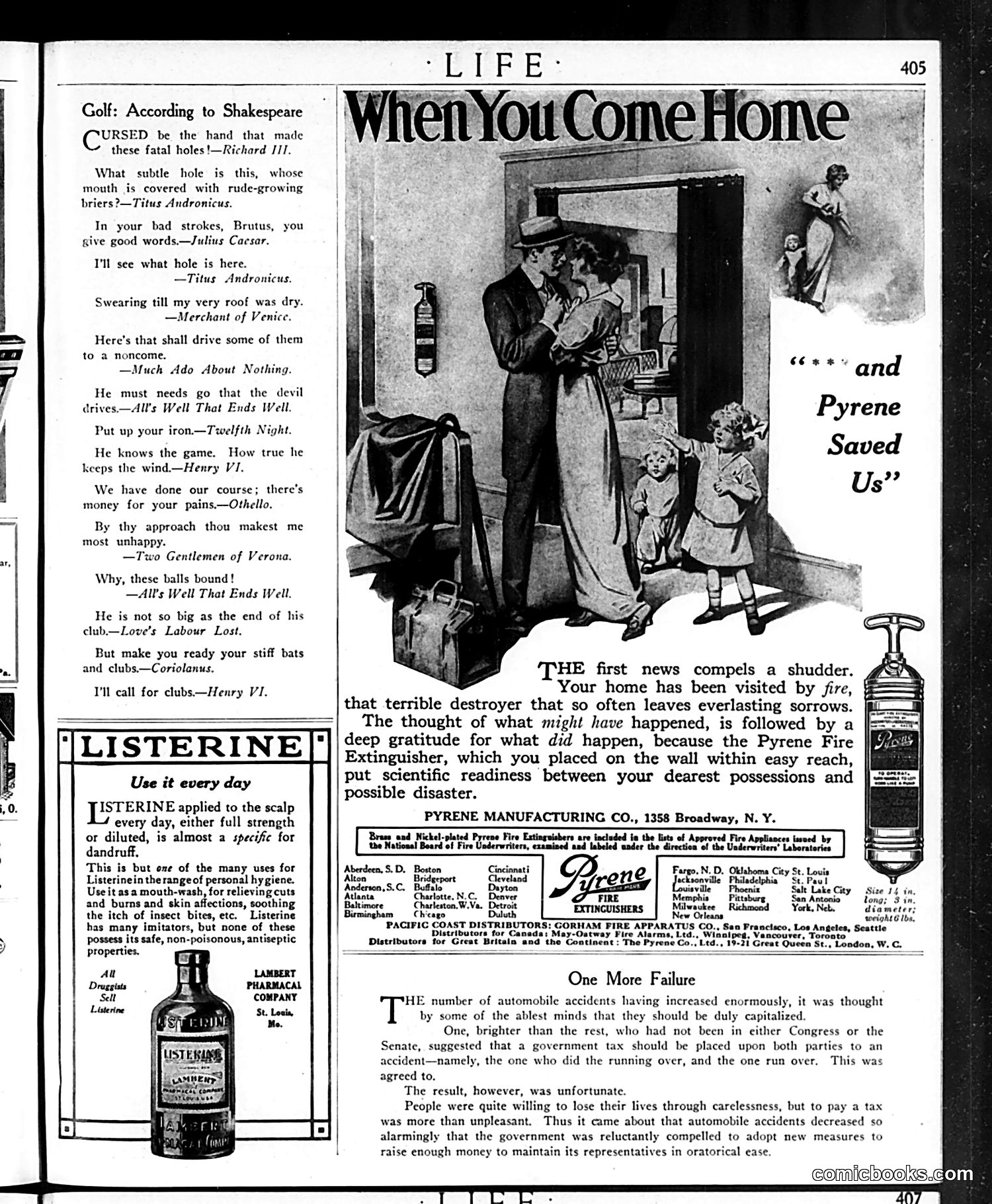
This page contains two distinct pieces of satire: **"Golf" Section (Left):** A humorous compilation of Shakespeare quotations recontextualized as golf commentary. Lines about "holes," "strokes," "balls," and "clubs" from various plays are presented as if discussing the sport, exploiting the double meanings in Shakespeare's language. **"When You Come Home" (Center/Right):** A Pyrene Fire Extinguisher advertisement disguised as satirical commentary. The image shows a family narrowly avoiding house fire disaster. The accompanying text praises their preparedness while subtly mocking middle-class anxiety about home safety risks. **"One More Failure" (Bottom):** Satire on government taxation policy. It describes an absurd failed experiment: officials proposed taxing *both* parties in automobile accidents (hit-and-run driver *and* victim) to capitalize on accidents. The plan backfired—people avoided accidents to escape taxes, reducing revenue, forcing the government to seek new funding schemes. This mocks legislative overreach and the perverse incentives created by poorly designed policy.
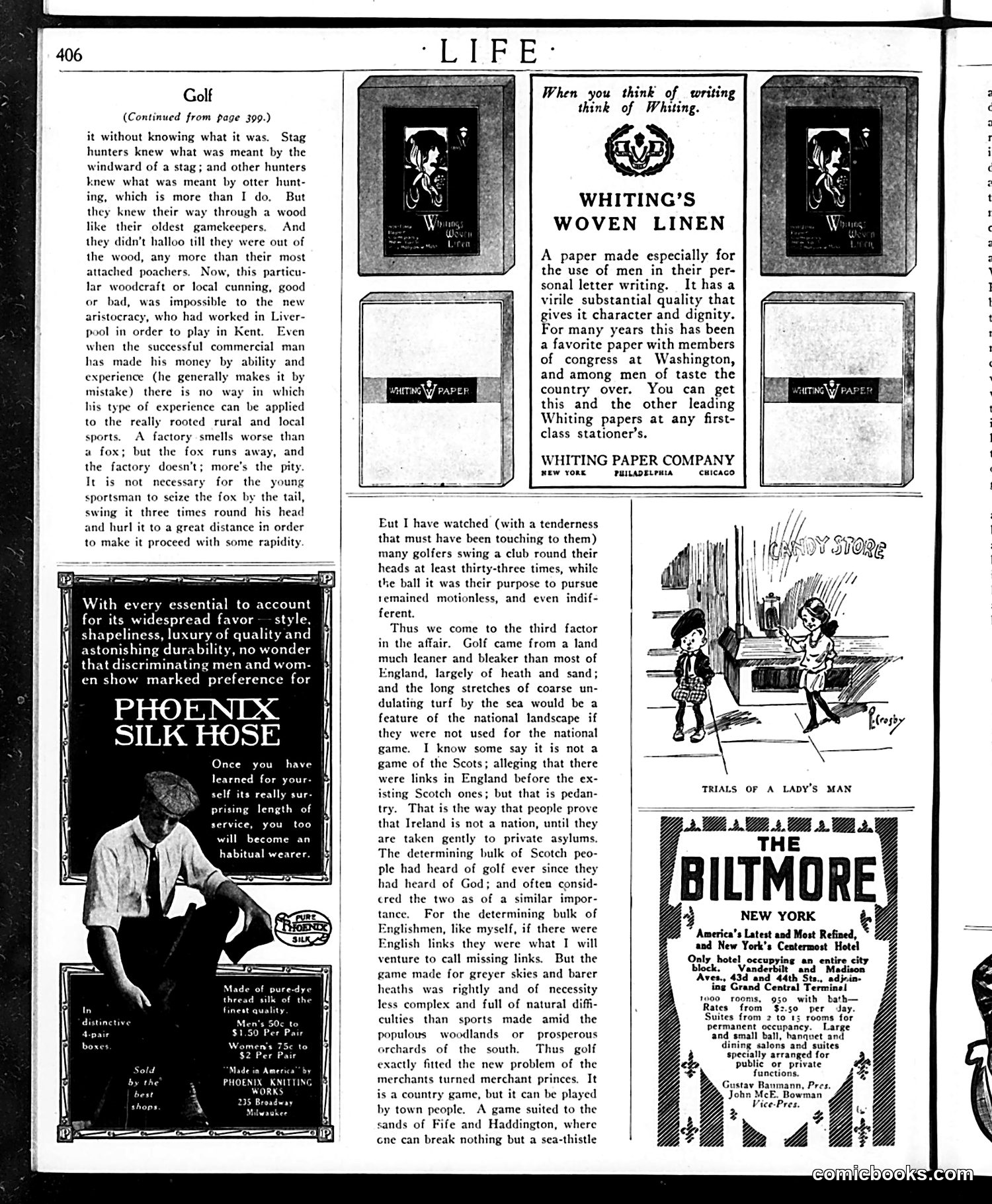
The small cartoon titled "TRIALS OF A LADY'S MAN" (credited to "Cessy") depicts a domestic scene: a man entering what appears to be a store or shop while a woman stands inside, seemingly confronting him. The visual joke likely plays on the social awkwardness of a man being "caught" shopping or in a public space with a woman, suggesting either infidelity concerns or embarrassing domestic situations. The surrounding text is a lengthy essay on golf's origins and social significance, discussing how the sport developed differently in Scotland versus England based on geography and class distinctions. The page is primarily advertising (Phoenix Silk Hose, Whiting's Woven Linen, and the Biltmore Hotel), with the cartoon serving as light satirical commentary on contemporary social manners and gender relations rather than direct political commentary.
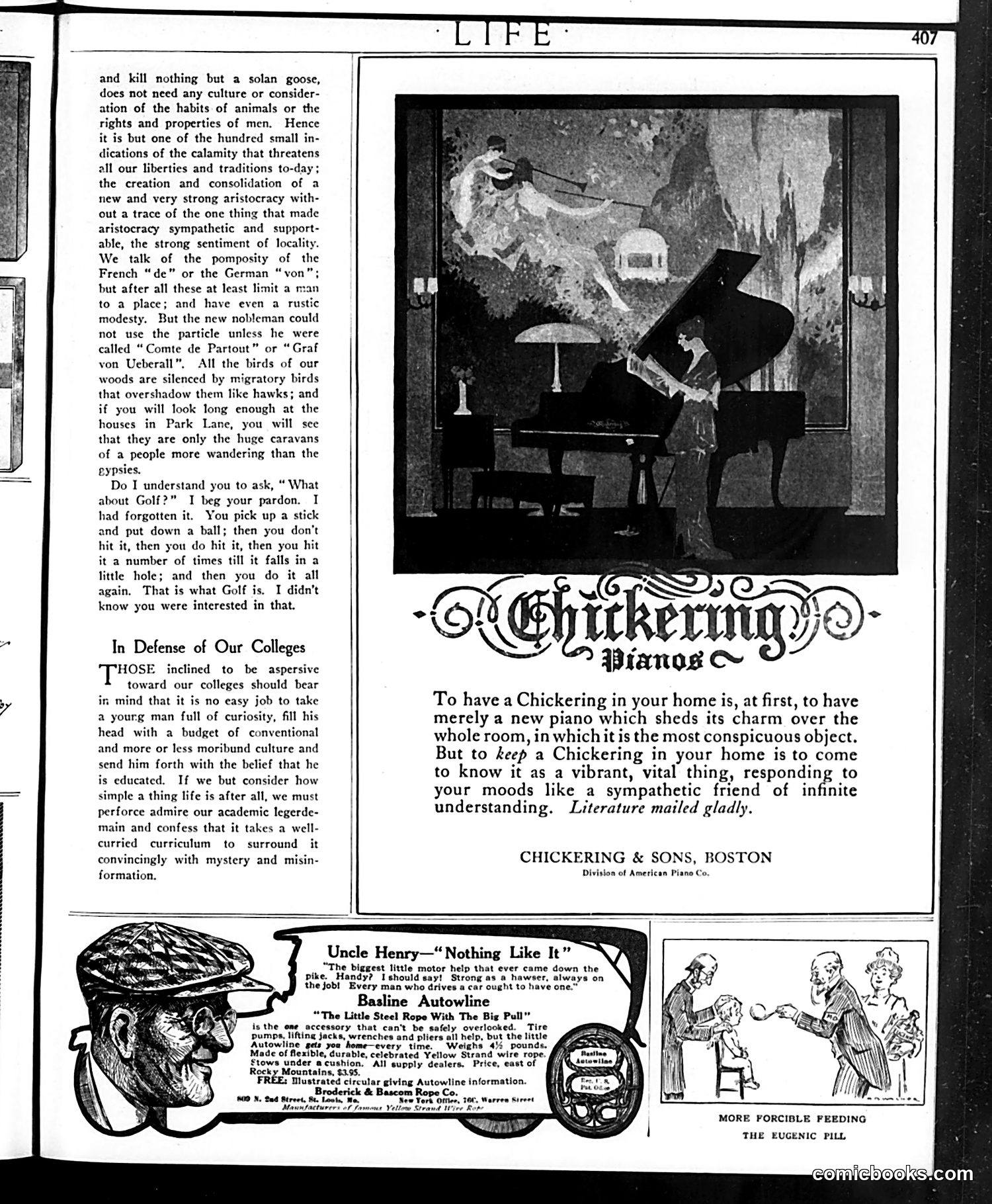
This page contains satirical commentary and advertisements typical of early 20th-century *Life* magazine. **Main Text Satire**: The left column attacks the emerging wealthy class ("new aristocracy") who lack the traditional ties to place and locality that historically limited aristocratic power. The author uses cutting humor—coining phrases like "Comte de Partout" (Count Everywhere)—to mock rootless plutocrats. The golf passage is deliberately dismissive satire, mocking the sport as pointless repetition. **"In Defense of Our Colleges"** defends higher education against critics, ironically praising colleges' ability to dress up simple life-truths in complex "mystery and misinformation." **Advertisements**: Include Chickering Pianos (positioning the instrument as emotionally responsive), Basline Autowiline (a steel rope for automobiles), and "The Eugenic Pill" (bottom right), the last being a darkly titled cartoon about forced feeding—likely satirizing eugenics pseudoscience popular at the time. The page reflects early 1900s anxieties about class mobility, education, and emerging scientific movements.
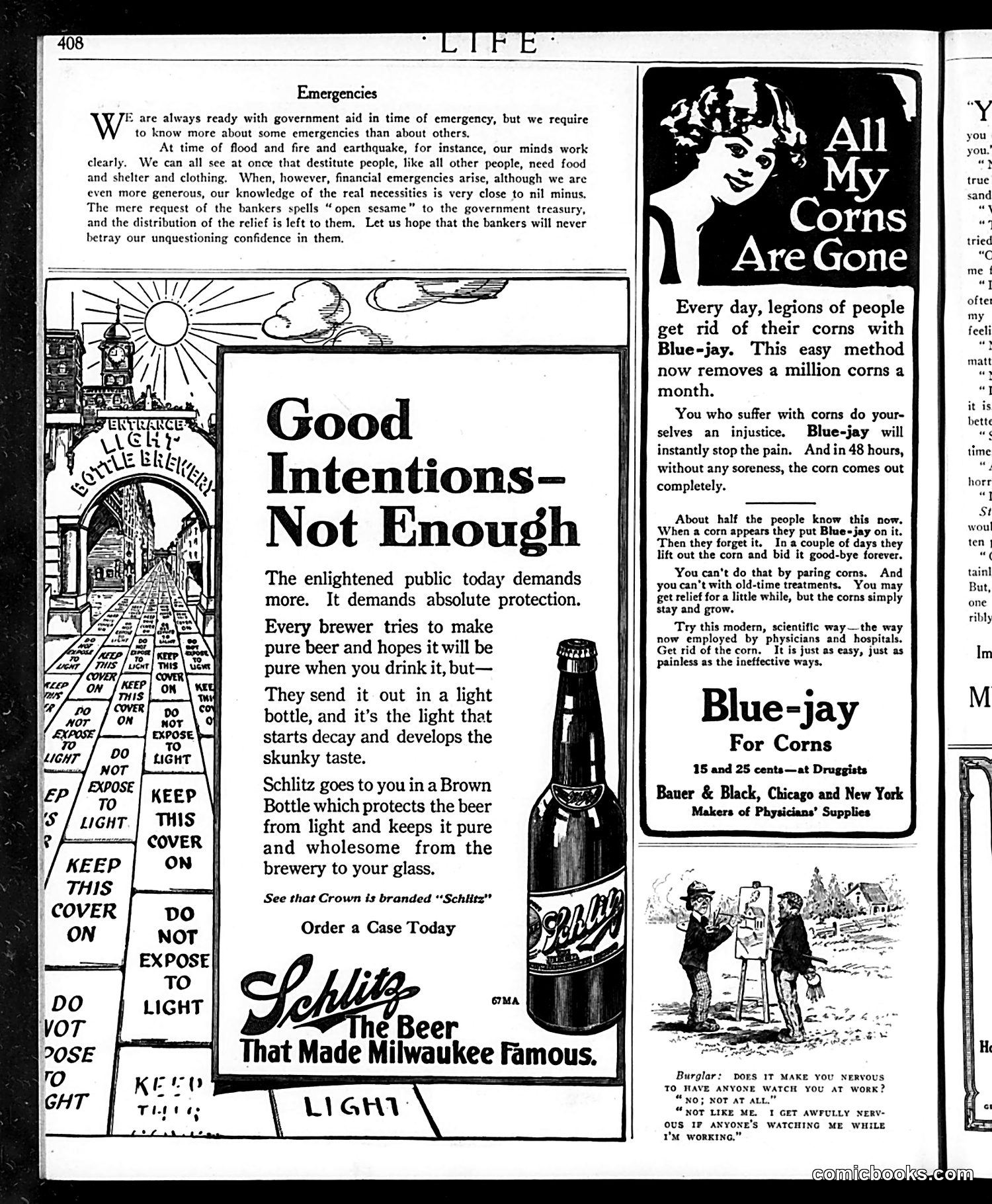
This page contains two distinct elements: **editorial satire and advertisements**. **The Editorial Cartoon ("Good Intentions—Not Enough"):** Criticizes breweries for inadequate protective practices. The illustration shows a brewery interior with repeated warnings about light exposure. The satire argues that while brewers intend to produce pure beer, their use of light bottles defeats this purpose—light causes decay and "skunky taste." Schlitz beer is promoted as the solution, using brown bottles for proper protection. This reflects early 20th-century consumer advocacy concerns about product quality control. **The Advertisements:** Include Blue-jay corn remover (claiming to eliminate corns painlessly in 48 hours) and a small cartoon joke about a burglar who gets nervous when watched while working. **Historical Context:** This page exemplifies how Life magazine blended social criticism with commercial advertising. The beer editorial likely responds to Progressive Era concerns about food and beverage safety, predating modern FDA regulations. The advertisements reflect period medical practices and consumer goods marketing typical of the 1910s-1920s.
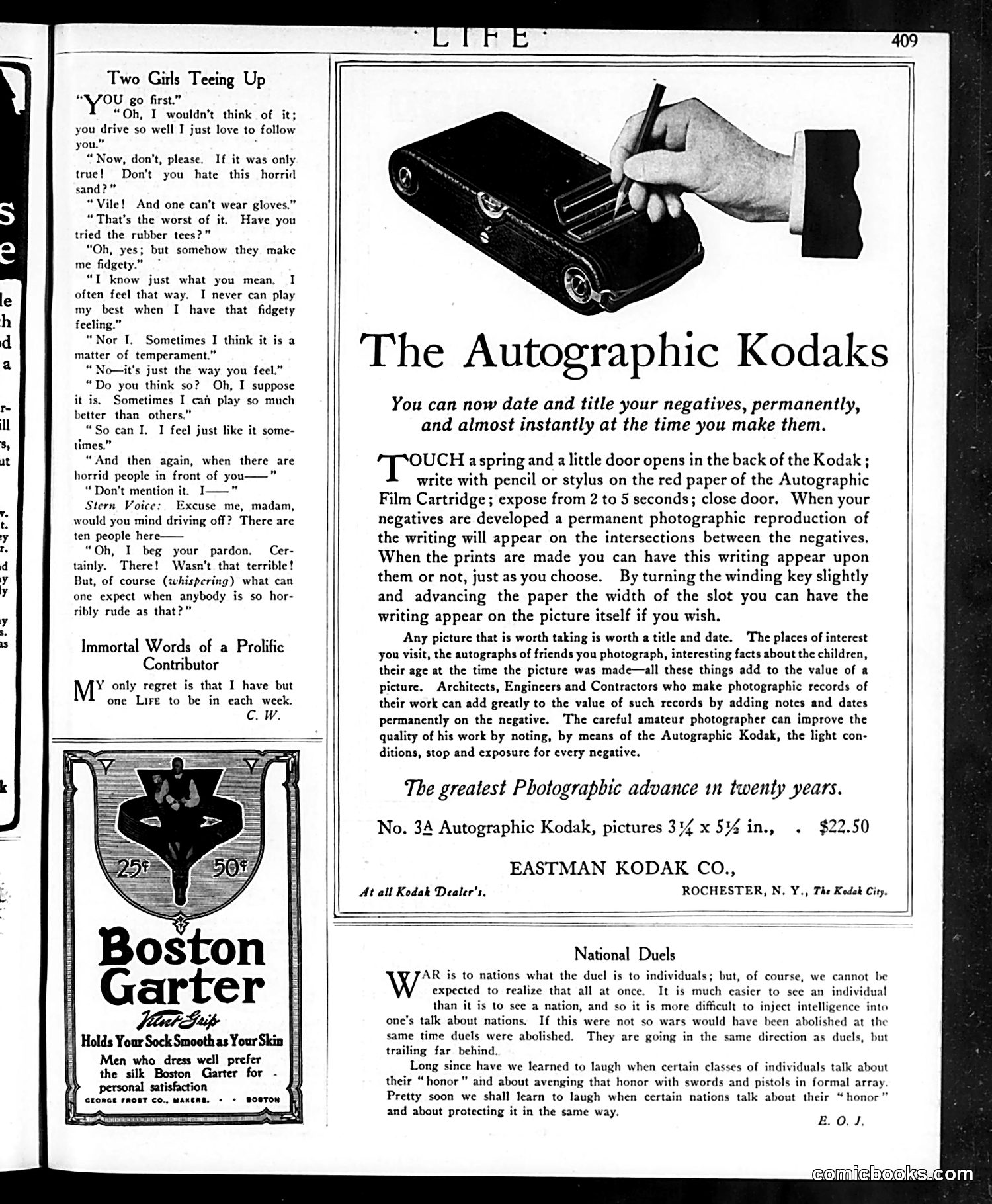
**"Two Girls Teeing Up"** (left column): A satirical dialogue between two women golfers discussing their complaints—the sand, gloves, rubber tees, temperament—in elaborate, self-absorbed detail. A stern male voice interrupts, pointing out ten people waiting behind them. The women then dismiss him as "horribly rude." The joke mocks upper-class women's obliviousness to their own inconsideration and their tendency to rationalize selfishness as sensitivity. **"The Autographic Kodaks"** (right): A product advertisement for Kodak cameras featuring a technical innovation allowing users to write dates and notes on negatives. The ad targets professionals (architects, engineers) and amateur photographers documenting family moments. **"National Duels"** (bottom): A brief satirical essay comparing warfare to individual dueling. The author argues that just as society has abandoned dueling as barbaric, nations should eventually abandon war over "honor." The piece criticizes nationalistic rhetoric justifying conflict.
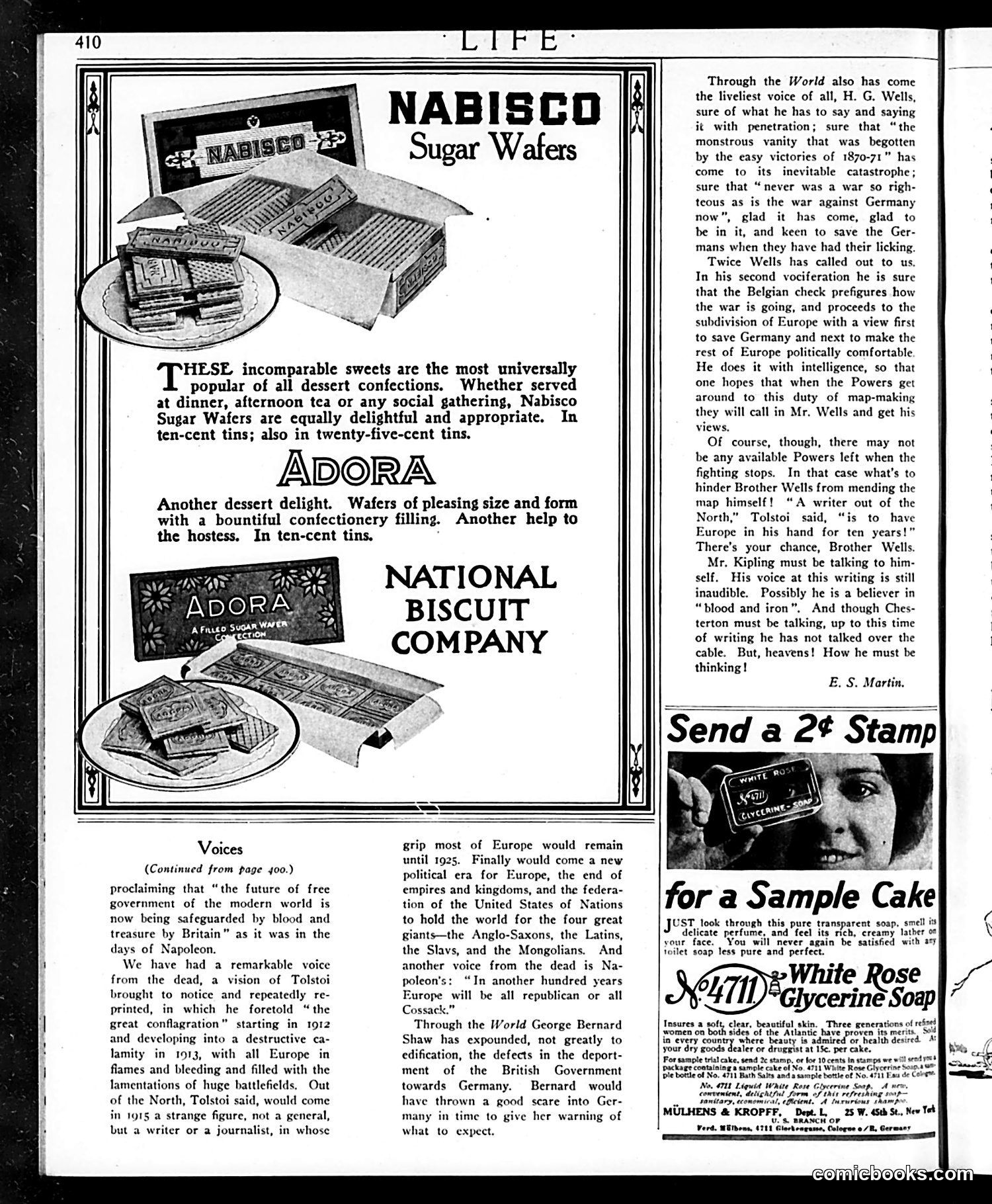
This page is primarily **advertising** for biscuits and soap, but includes a substantial article titled "Voices" by E.S. Martin discussing prominent public intellectuals' views on World War I. The text references **H.G. Wells, George Bernard Shaw, Tolstoy, Kipling, and Chesterton**—major literary figures—commenting on the war. The article quotes Tolstoy's apparent prophecy that a writer/journalist from the North would reshape European politics, then sardonically suggests Wells might be that figure, given that actual politicians may not survive to redraw the map. The satire mocks how these celebrated writers publicly opine about geopolitics while offering conflicting advice (Wells wants to save Germany *after* defeating it; Shaw criticizes British conduct). The author implies their grand pronouncements are somewhat absurd given the war's actual chaos. The advertisements are period-typical: Nabisco Sugar Wafers, Adora wafers, and White Rose glycerin soap occupy the left column—utterly disconnected from the war discussion, reflecting how magazines balanced serious content with commerce.
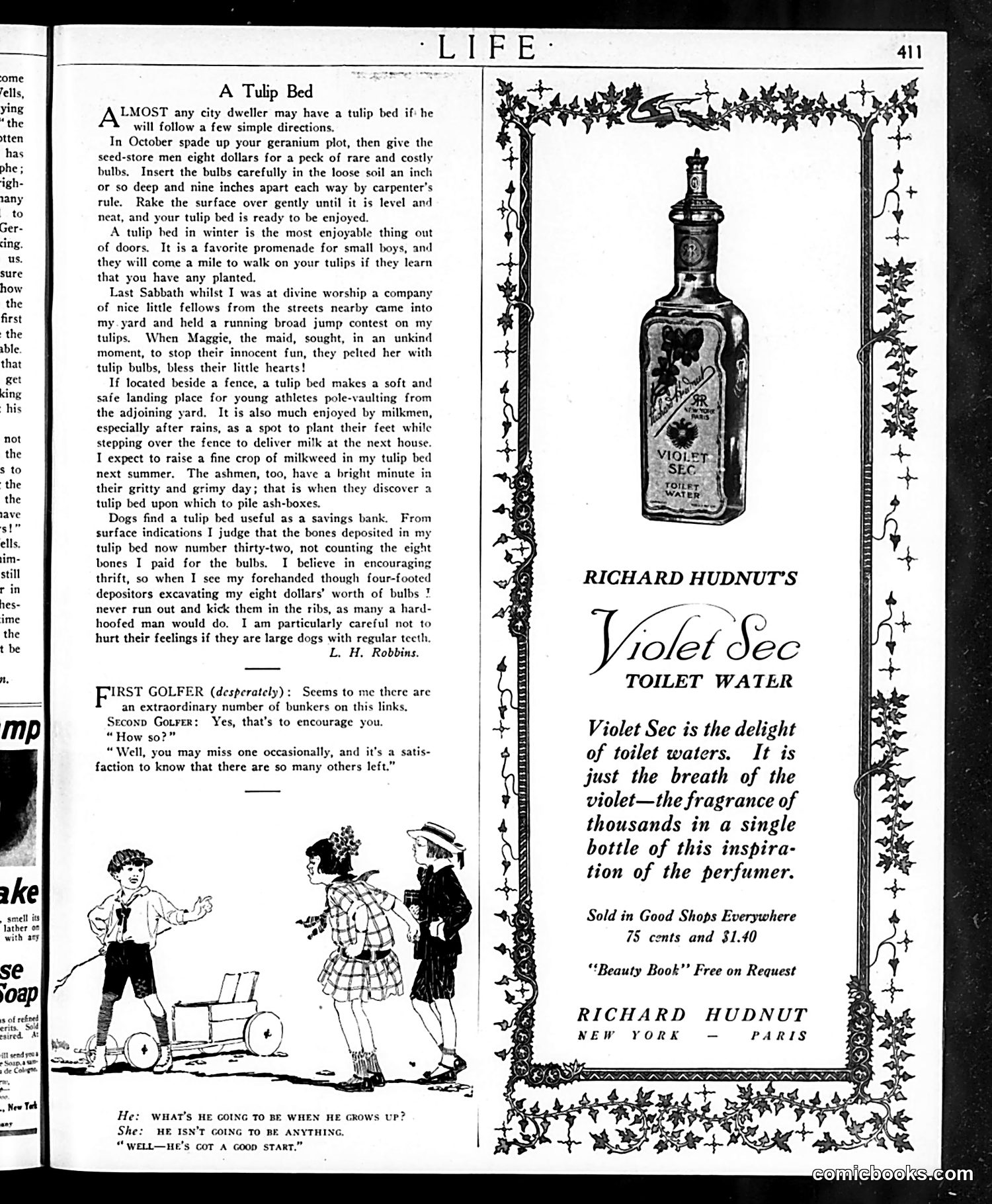
This Life magazine page contains humorous essays and a joke, plus advertising. **"A Tulip Bed"** by L. H. Robbins is satirical commentary on urban gardening. The author describes planting expensive tulip bulbs, only to have them destroyed by neighborhood children playing, delivery workers stepping on them, dogs digging for bones, and ash collectors dumping debris. The joke is that city living makes maintaining a decorative garden nearly impossible—the "civilized" pastime is constantly sabotaged by ordinary urban activity and people indifferent to property. **The Golf Joke** relies on self-deprecating humor: a poor golfer finds comfort that many bunkers exist, so missing one occasionally feels less embarrassing. **The "What's He Going To Be?" joke** mocks a child's apparent lack of prospects or ambition ("he isn't going to be anything"), yet the speaker still considers this "a good start"—dark humor about low expectations. **The Violet Sec advertisement** promotes Richard Hudnut perfume at 75 cents and $1.40, positioned as luxury goods.
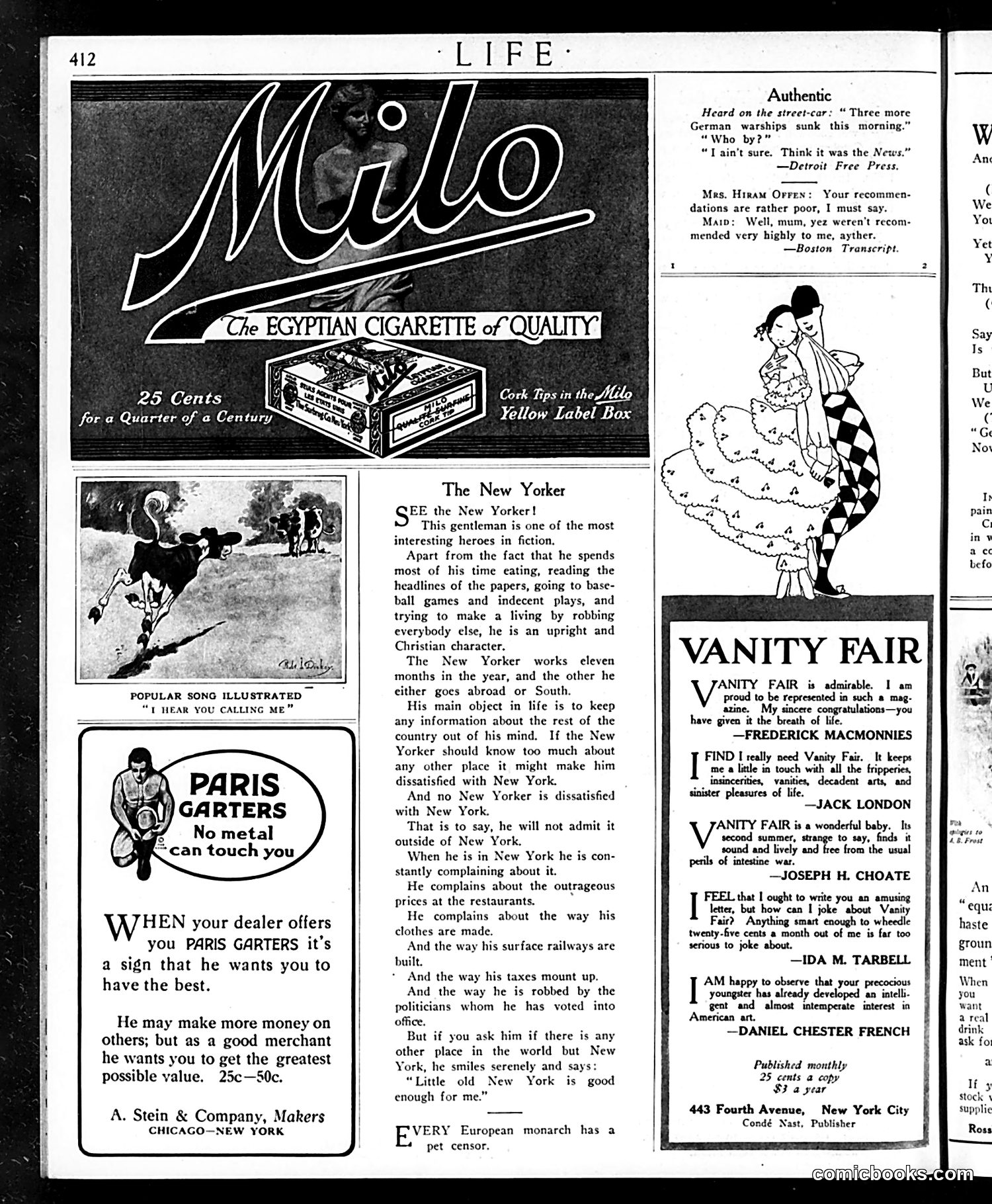
This page mixes **advertisements with satirical content** about American urban culture. ## The Satire: "The New Yorker" The central essay mockingly describes a stereotypical New York City resident as a hypocrite: someone who constantly complains about NYC's restaurants, transportation, taxes, and corrupt politicians—*while* refusing to admit New York has flaws to outsiders. He insists "Little old New York is good enough for me" despite his constant griping. The satire targets **provincial insularity and self-deceptive civic pride**. ## Advertisements The page features ads for **Paris Garters** (men's suspenders) and **Milo cigarettes**, typical consumer products of the era. ## "Vanity Fair" Testimonials The right side collects endorsements from notable figures (Frederick MacMonnies, Jack London, Joseph H. Choate, Ida M. Tarbell, Daniel Chester French) praising Condé Nast's new *Vanity Fair* magazine, positioned as sophisticated and culturally important. The page reflects early 1900s American consumer culture and reflects on urban versus provincial American identity.
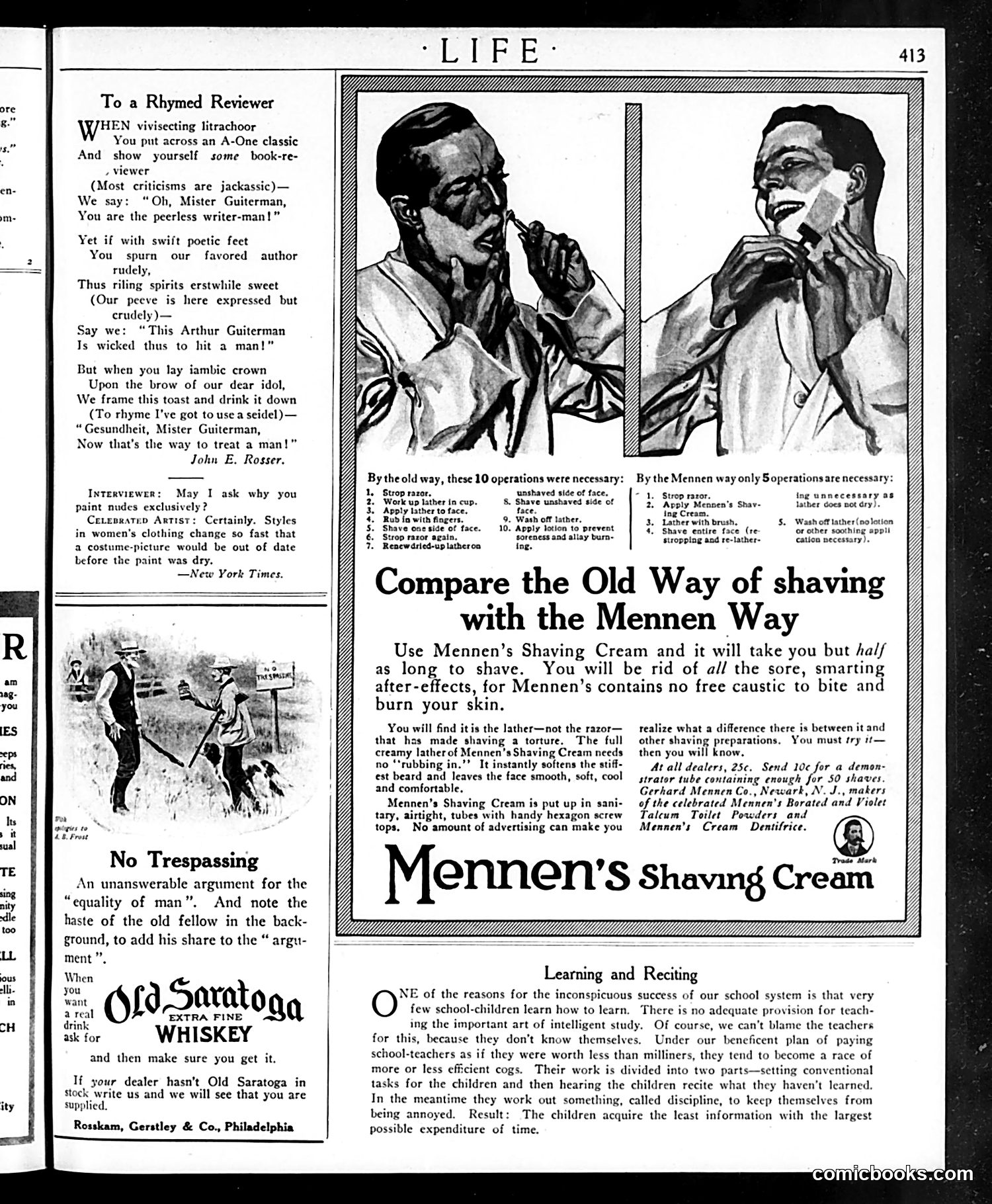
This page contains primarily **advertisements** alongside minor editorial content. The dominant feature is a large **Mennen's Shaving Cream ad** comparing "old way" (10 steps) versus "Mennen way" (5 steps) of shaving, illustrated with two caricatured male faces. The ad emphasizes speed and gentleness, claiming Mennen's contains no caustic ingredients that cause irritation. Below are smaller pieces: a poem "To a Rhymed Reviewer" praising critic Arthur Guiterman; a brief joke about an artist painting only nudes because fashion changes too quickly; a cartoon titled "No Trespassing" showing two men at a fence (appears to reference workplace or social equality); and an Old Saratoga Whiskey advertisement. The page concludes with an article criticizing American schools for not teaching students *how* to learn, arguing teachers are underpaid and overworked. The content reflects early-20th-century concerns about education and gender equality.
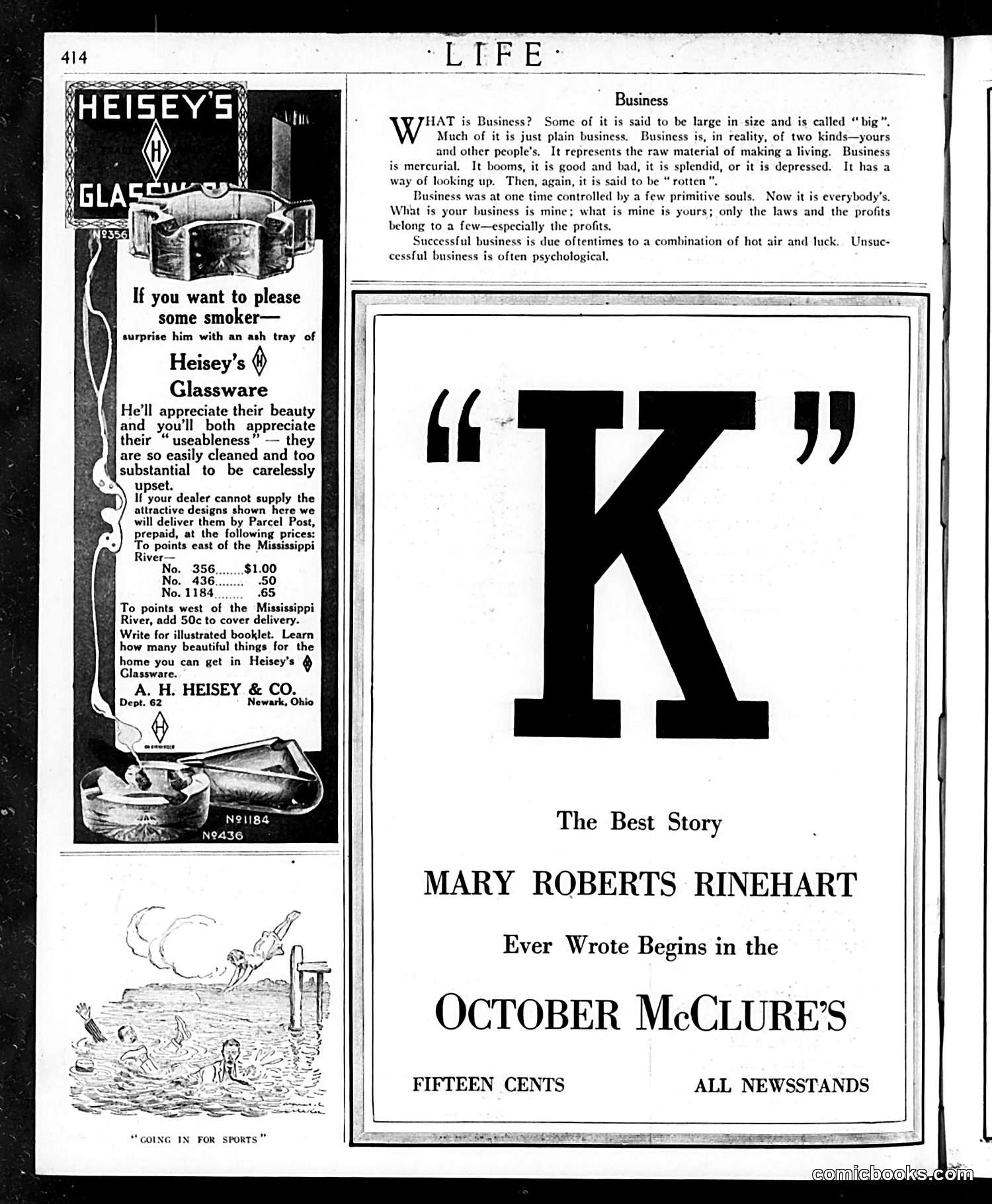
This page from *Life* magazine is primarily **advertising and promotional content** rather than satirical commentary. The left side features a **Heisey & Co. glassware advertisement** promoting ashtrays as gifts for smokers, with pricing and mail-order information for different regions. The main content area contains a **short essay on Business** that offers cynical, satirical observations typical of *Life*'s tone: Business is described as mercurial, sometimes "rotten," controlled by "a few primitive souls," and dependent on "hot air and luck." The piece uses humor to critique how business operates—noting that what's yours is actually everyone's, but profits belong to "a few." Below that is a **book advertisement** promoting Mary Roberts Rinehart's latest story in *October McClure's* magazine (15 cents). The cartoon at bottom left, captioned "Going in for Sports," appears to show people in water but is too small to interpret clearly. Overall, this is a typical magazine page mixing editorial content, satire, and paid advertising.
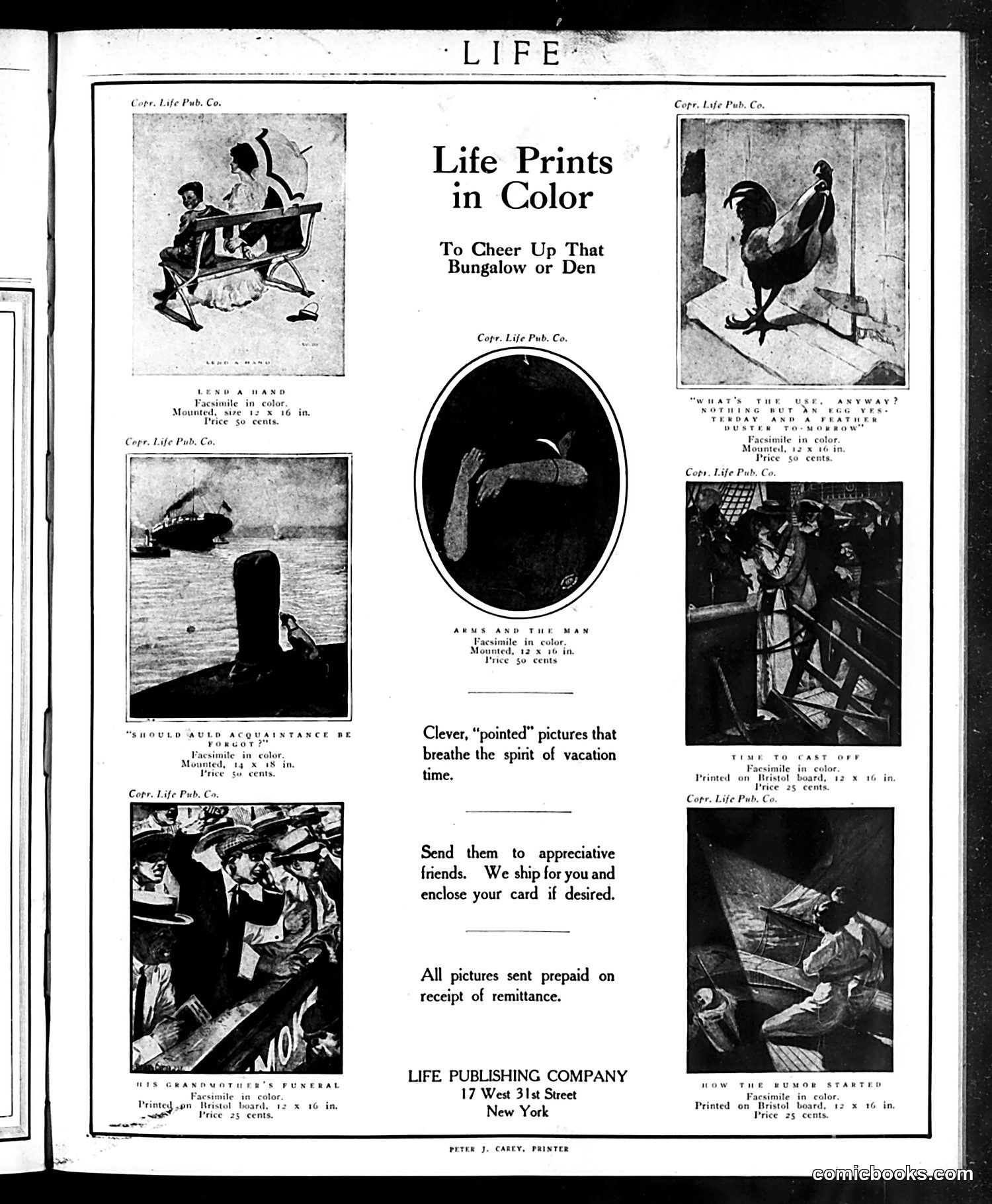
This is an advertisement for Life Publishing Company's colored prints available for home decoration. The page showcases six satirical cartoon prints depicting humorous domestic and social scenes—including a couple in a rowboat, a rooster, people at a ship's railing, a funeral procession, and what appears to be social gatherings. The ad targets middle-class homeowners ("That Bungalow or Den"), marketing these prints as affordable vacation-themed humor to brighten living spaces. Priced at 25-50 cents, they're positioned as gift-worthy items to send to friends. The prints appear to be light domestic comedy rather than serious political satire—jokes about romance, animals, social embarrassment, and gossip that would appeal to early 20th-century popular taste. The "pointed pictures that breathe the spirit of vacation time" suggests gentle, escapist humor for a domestic audience.
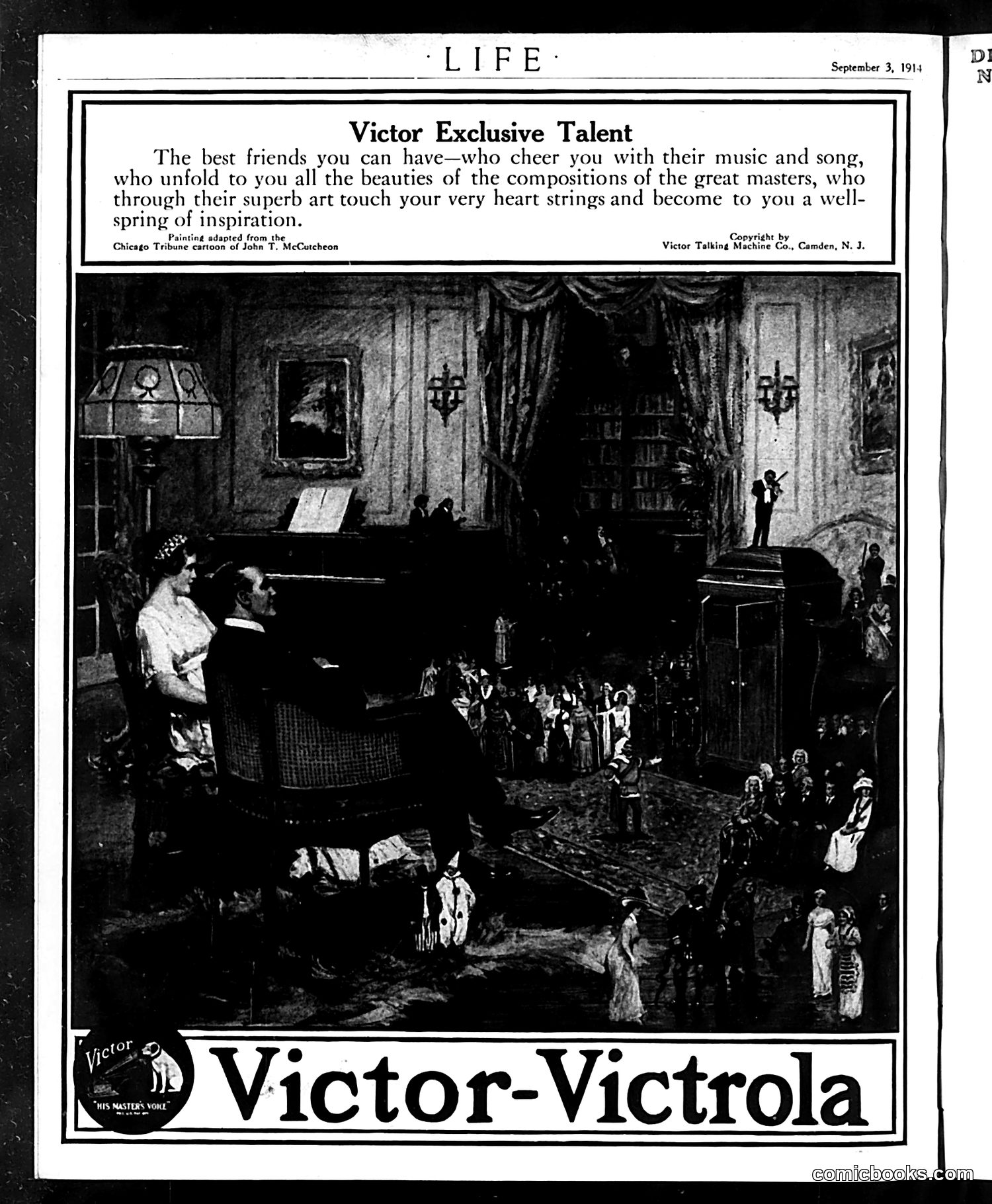
This is a **Victor Victrola advertisement**, not political satire. It depicts an idealized domestic scene where a well-dressed couple listens to classical music from a Victor phonograph while tiny figures—representing musical performers or the "great masters"—emerge from the machine and perform in their parlor. The advertisement's message uses romantic imagery to sell the Victrola as a source of cultural refinement and emotional uplift. The poetic text promises that recorded music provides friendship, inspiration, and access to "compositions of the great masters"—positioning the phonograph as a gateway to high culture for middle-class homes. The imagery reflects early 20th-century marketing that equated phonograph ownership with sophistication and taste. There is no political critique visible—this is commercial promotion appearing in *Life* magazine's advertising section.