
Life, 1914-09-03 · page 26 of 48
Life — September 3, 1914 — page 26: what you’re looking at
What you’re looking at
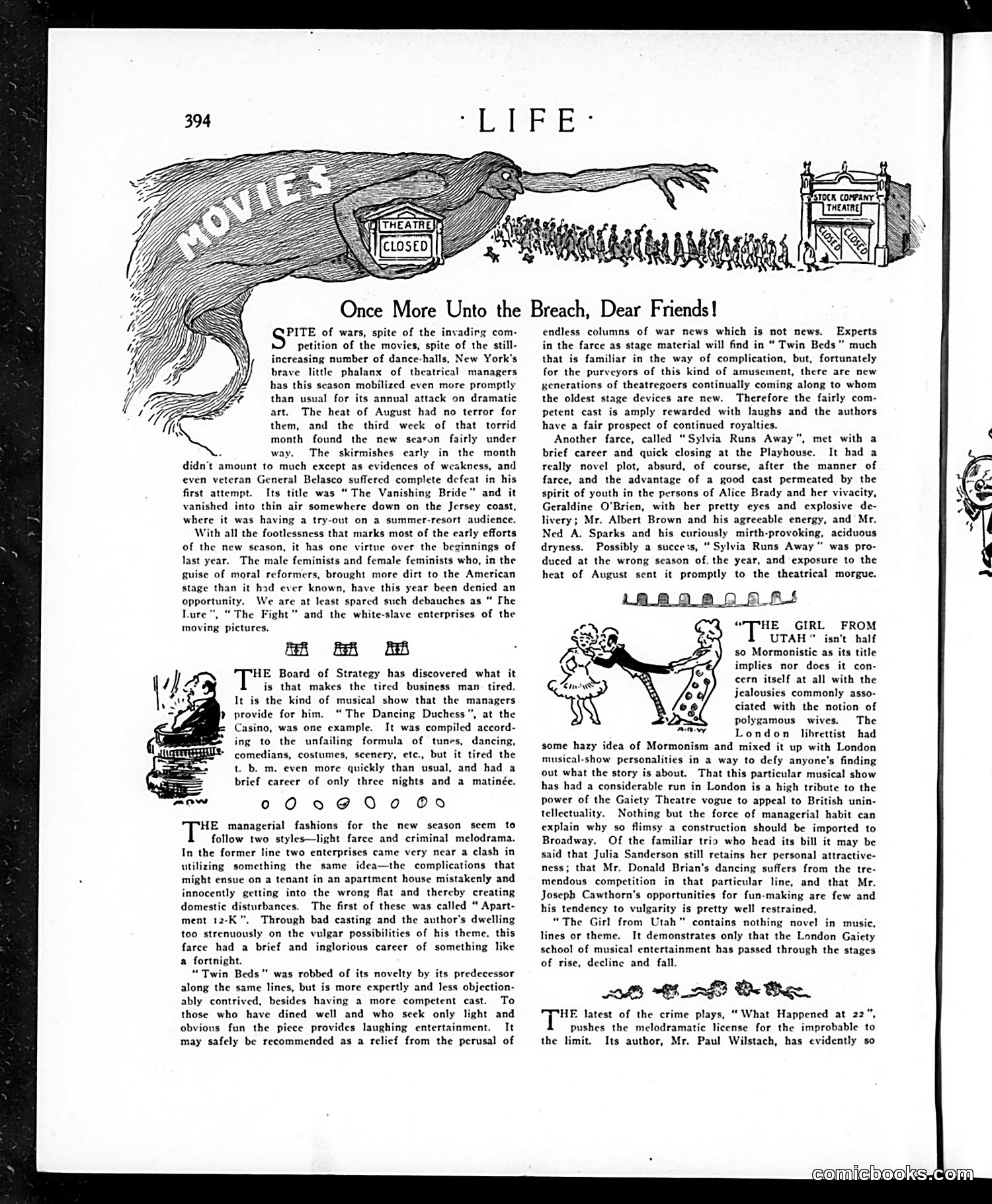
This Life magazine page critiques the New York theatrical season's opening, framed as a military campaign ("Once More Unto the Breach"). The satirist mocks theatrical managers for their formulaic approaches despite competition from movies and dance halls. Key targets include: **The plays themselves**: Farces like "Apartment 12-K" and "Twin Beds" rely on tired, repeated plot devices (tenants entering wrong apartments) that only work because new generations of theatergoers haven't seen them before—a cutting observation about theatrical mediocrity. **Audience demographics**: The "tired business man" (tb.m.) is repeatedly mentioned as the target demographic, suggesting Broadway caters to exhausted professionals seeking mindless entertainment rather than genuine art. **Social progress**: The author notes approvingly that morality-crusading reformers haven't successfully pressured theaters this season, unlike previous years when controversial shows like "The Lure" faced attacks. The winged figure illustration represents theatre itself—somewhat diminished, pointing toward competing "Stock Company Theatre" establishments, symbolizing Broadway's declining cultural dominance.
📄 Transcribed text from this page (OCR, searchable)
Machine-transcribed from the original scan — historical spelling and the odd misread are preserved.
Once More Unto the Breach, Dear Friends! PITE of wars, spite of the invadirg com- petition of the movies, spite of the still- increasing number of dance-halls, New York's brave little phalanx of theatrical managers has this season mobilized even more promptly than usual for its annual attack on dramatic art. The heat of August had no terror for A them, and the third week of that torrid oe month found the new seaton fairly under x way. The skirmishes carly in the month didn’t amount to much except as evidences of weakness, and even veteran General Belasco suffered complete defeat in his first attempt. Its title was “The Vanishing Bride” and it vanished into thin air somewhere down on the Jersey coast, where it was having a try-out on a summer-resort audience. With all the footlessness that marks most of the early efforts of the new scason, it has one virtue over the beginnings of last year. The male feminists and female feminists who, in the guise of moral reformers, brought more dirt to the American stage than it had ever known, have this year been denied an opportunity. We are at least sparcd such debauches as “ The Lure", “The Fight” and the white-slave enterprises of the moving pictures. AR mA RA HE Board of Strategy has discovered what it is that makes the tired business man. tired. It is the kind of musical show that the managers provide for him. “The Dancing Duchess”, at the Casino, was one example. It was compiled accord- ing to the unfailing formula of tunes, dancing, comedians, costumes, scenery, ete., but it tired the tb. m. even more quickly than usual, and had a brief career of only three nights and a matinée. 0090908000 09 HE managerial fashions for the new season scem to follow two styles—light farce and criminal melodrama. In the former line two enterprises came very near a clash in utilizing something the same idea—the complications that might ensue on a tenant in an apartment house mistakenly and innocently getting into the wrong flat and thereby creating domestic disturbances. The first of these was called “ Apart- ment 12-K". Through bad casting and the author's dwelling too strenuously on the vulgar possibilities of his theme, this farce had a brief and inglorious career of something like a fortnight. “Twin Beds" was robbed of its novelty by its predecessor along the same lines, but is more expertly and less objection ably contrived, besides having a more competent cast. To those who have dined well and who seek only light and obvious fun the piece provides laughing entertainment. It may safely be recommended as a relief from the perusal of aow endless columns of war news which is not news. Experts in the farce as stage material will find in “ Twin Beds" much that is familiar in the way of complication, but, fortunately for the purveyors of this kind of amusement, there are new generations of theatregoers continually coming along to whom the oldest stage devices are new. Therefore the fairly com- petent cast is amply rewarded with laughs and the authors have a fair prospect of continued royalties. Another farce, called “Sylvia Runs Away”, met with a brief career and quick closing at the Playhouse. It had a really novel plot, absurd, of course, after the manner of farce, and the advantage of a good cast permeated by the spirit of youth in the persons of Alice Brady and her vivacity, Geraldine O'Brien, with her pretty eyes and explosive de- livery; Mr. Albert Brown and his agreeable energy, and Mr. Ned A. Sparks and his curiously mirth-provoking, aciduous dryness. Possibly a success, “ Sylvia Runs Away” was pro- duced at the wrong season of. the year, and exposure to the heat of August sent it promptly to the theatrical morgue. “"CHE GIRL FROM UTAH ” isn't half so Mormonistic as its title implies nor does it con- cern itself at all with the jealousies commonly asso- ciated with the notion of polygamous wives. The London librettist had some hazy idea of Mormonism and mixed it up with London musical-show personalities in a way to defy anyone's finding out what the story is about. That this particular musical show has had a considerable run in London is a high tribute to the power of the Gaiety Theatre vogue to appeal to British unin- tellectuality. Nothing but the force of managerial habit can explain why so flimsy a construction should be imported to Broadway. Of the familiar trio who head its bill it may be said that Julia Sanderson still retains her personal attractive- ness; that Mr. Donald Brian's dancing suffers from the tre- mendous competition in that particular line, and that Mr. Joseph Cawthorn’s opportunities for fun-making are few and his tendency to vulgarity is pretty well restrained, “The Girl from Utah” contains nothing novel in music, lines or theme. It demonstrates only that the London Gaiety school of musical entertainment has passed through the stages of rise, decline and fall. AO EA De Bree. HE latest of the crime plays, “ What Happened at 22”, pushes the melodramatic license for the improbable to the limit. Its author, Mr. Paul Wilstach, has evidently so