
Life, 1914-09-03 · page 22 of 48
Life — September 3, 1914 — page 22: what you’re looking at
What you’re looking at
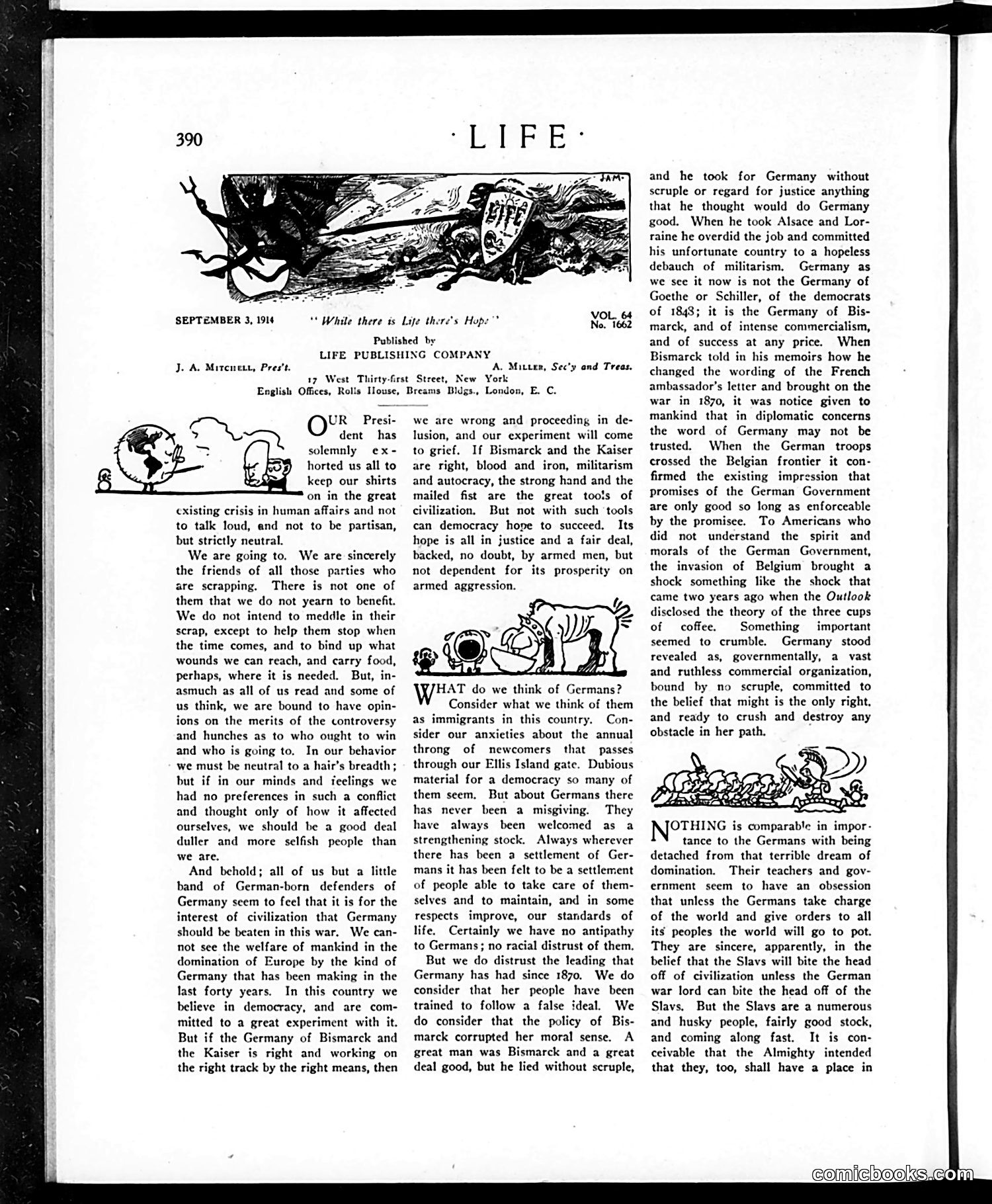
This editorial page addresses American neutrality in World War I (just begun) while arguing that intellectual honesty requires forming judgments about the conflict's merits. The cartoons—crude sketches of figures appearing distressed or conflicted—visually reinforce the tension between maintaining official neutrality and having private opinions. The text distinguishes between Germans as immigrants (whom Americans respect as hardworking settlers) and Germany's government under Bismarck's legacy, which the author criticizes for pursuing "blood and iron" militarism and territorial conquest without moral scruple. The piece argues democracy and autocracy are fundamentally incompatible systems, making Germany's dominance incompatible with civilization. The author asserts Americans *can* remain behaviorally neutral while morally preferring an Allied victory, positioning this as intellectually honest rather than partisan bias.
📄 Transcribed text from this page (OCR, searchable)
Machine-transcribed from the original scan — historical spelling and the odd misread are preserved.
SEPTEMBER 3, 1914 “While there is Life there's Hope No, 1662 Published by LIFE PUBLISHING COMPANY J. A. Mitcnete, Pres’t. A. Mitten, Sec'y and Treas. 17 West Thisty-first Street, New York English Offices, Rolls House, Breams Bldgs., London, E. C. UR Presi- dent has solemnly ex- horted us all to keep our shirts on in the great existing crisis in human affairs and not to talk loud, and not to be partisan, but strictly neutral. We are going to, We are sincerely the friends of all those parties who are scrapping. There is not one of them that we do not yearn to benefit. We do not intend to meddle in their scrap, except to help them stop when the time comes, and to bind up what wounds we can reach, and carry food, perhaps, where it is needed. But, in- asmuch as all of us read and some of us think, we are bound to have opin- ions on the merits of the controversy and hunches as to who ought to win and who is going to. In our behavior we must be neutral to a hair’s breadth ; but if in our minds and feelings we had no preferences in such a conflict and thought only of how it affected ourselves, we should be a good deal duller and more selfish people than we are. And behold; all of us but a little band of German-born defenders of Germany seem to feel that it is for the interest of civilization that Germany should be beaten in this war. We can- not see the welfare of mankind in the domination of Europe by the kind of Germany that has been making in the last forty years. In this country we believe in democracy, and are com- mitted to a great experiment with it. But if the Germany of Bismarck and the Kaiser is right and working on the right track by the right means, then we are wrong and proceedin lusion, and our experiment will come to grief. If Bismarck and the Kaiser are right, blood and iron, militarism and autocracy, the strong hand and the mailed fist are the great too!s of civilization, But not with such ‘tools can democracy hope to succeed. Its hope is all in justice and a fair deal, backed, no doubt, by armed men, but not dependent for its prosperity on armed aggression. HAT do we think of Germans? Consider what we think of them as immigrants in this country. Con- sider our anxieties about the annual throng of newcomers that passes through our Ellis Island gate. Dubious material for a democracy so many of them seem, But about Germans there has never been a misgiving. They have always been welcomed as a strengthening stock. Always wherever there has been a settlement of Ger- mans it has been felt to be a settlement of people able to take care of them- selves and to maintain, and in some respects improve, our standards of life. Certainly we have no antipathy to Germans; no racial distrust of them. But we do distrust the leading that Germany has had since 1870, We do consider that her people have been trained to follow a false ideal. We do consider that the policy of Bis- marck corrupted her moral sense. A great man was Bismarck and a great deal good, but he lied without scruple, and he took for Germany without scruple or regard for justice anything that he thought would do Germany good. When he took Alsace and Lor- raine he overdid the job and committed his unfortunate country to a hopeless debauch of militarism, Germany as we see it now is not the Germany of Goethe or Schiller, of the democrats of 1848; it is the Germany of Bis- marck, and of intense commercialism, and of success at any price. When Bismarck told in his memoirs how he changed the wording of the French ambassador’s letter and brought on the war in 1870, it was notice given to mankind that in diplomatic concerns the word of Germany may not be trusted. When the German troops crossed the Belgian frontier it con- firmed the existing impression that promises of the German Government are only good so long as enforceable by the promisee. To Americans who did not understand the spirit and morals of the German Government, the invasion of Belgium brought a shock something like the shock that came two years ago when the Outlook disclosed the theory of the three cups of coffee. Something important seemed to crumble. Germany stood revealed as, governmentally, a vast and ruthless commercial organization, bound by no scruple, committed to the belief that might is the only right, and ready to crush and destroy any obstacle in her path. : OTHING is comparable in impor- tance to the Germans with being detached from that terrible dream of domination. Their teachers and gov- ernment seem to have an obsession that unless the Germans take charge of the world and give orders to all its peoples the world will go to pot. They are sincere, apparently, in the belief that the Slavs will bite the head off of civilization unless the German war lord can bite the head off of the Slavs. But the Slavs are a numerous and husky people, fairly good stock, and coming along fast. It is con- ceivable that the Almighty intended that they, too, shall have a place in