
Life, 1914-09-03 · page 27 of 48
Life — September 3, 1914 — page 27: what you’re looking at
What you’re looking at
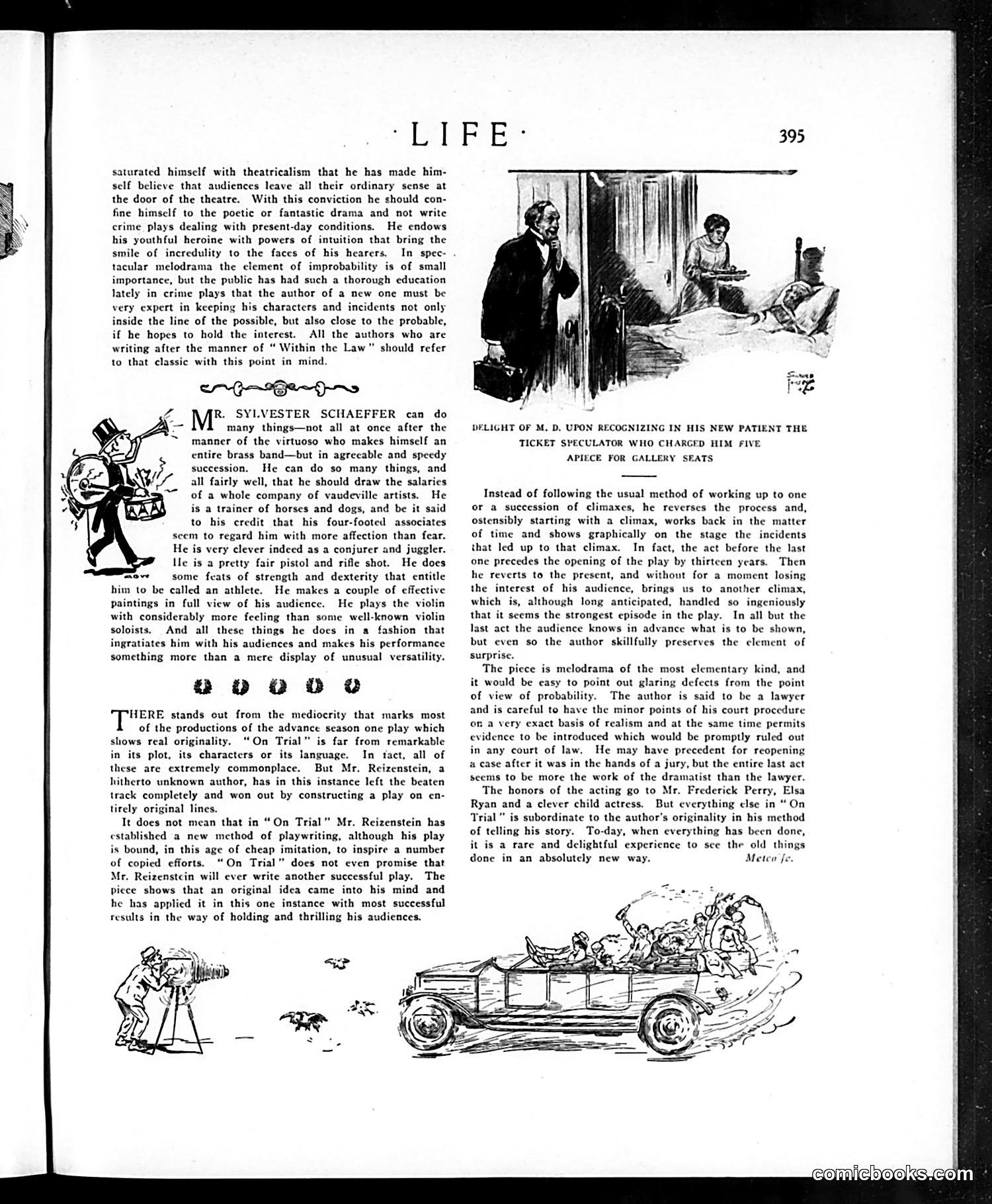
This Life magazine page (p. 395) discusses theatrical criticism and notable performers of the era. **Main Content:** - Critiques of contemporary playwrights, particularly those imitating "Within the Law," arguing crime plays require realistic, probable plots to hold audiences educated by recent theatre. - Praise for Mr. Sylvester Schaeffer as a vaudeville performer—a multi-talented entertainer skilled at training animals, conjuring, juggling, shooting, painting, and violin-playing. - Discussion of playwright Mr. Reizenstein's play "On Trial," which reverses conventional dramatic structure by starting with a climax and working backward thirteen years, then returning to present events. **The Cartoons:** - Top: A doctor recognizing a ticket scalper who previously overcharged him—depicting revenge humor. - Bottom: An overloaded automobile—likely satirizing contemporary car culture or traffic absurdities. The page emphasizes theatre criticism and vaudeville entertainment, reflecting early 20th-century American popular culture priorities.
📄 Transcribed text from this page (OCR, searchable)
Machine-transcribed from the original scan — historical spelling and the odd misread are preserved.
EES saturated himself with theatricalism that he has made him- self believe that audiences leave all their ordinary sense at the door of the theatre. With this conviction he should con- fine himself to the poetic or fantastic drama and not write crime plays dealing with present-day conditions. He endows his youthful heroine with powers of intuition that bring the smile of incredulity to the faces of his hearers. In spec- tacular melodrama the clement of improbability is of small importance, but the public has had such a thorough education lately in crime plays that the author of a new one must be very expert in keeping his characters and incidents not only inside the line of the possible, but also close to the probable, if he hopes to hold the interest. All the authors who are writing after the manner of “ Within the Law” should refer to that classic with this point in mind. eG Ge R. SYLVESTER SCHAEFFER can do many things—not all at once after the manner of the virtuoso who makes himself an entire brass band—but in agreeable and speedy succession. He can do so many things, and all fairly well, that he should draw the salaries of a whole company of vaudeville artists. He is a trainer of horses and dogs, and be it said to his credit that his four-footed associates seem to regard him with more affection than fear. He is very clever indeed as a conjurer and juggler. He is a pretty fair pistol and rifle shot. He does some feats of strength and dexterity that entitle him to be called an athlete. He makes a couple of effective paintings in full view of his audience. He plays the violin with considerably more feeling than some well-known violin soloists. And all these things he does in a fashion that ingratiates him with his audiences and makes his performance something more than a mere display of unusual versatility. @o 0 8 @ HERE stands out from the mediocrity that marks most of the productions of the advance season one play which shows real originality. “On Trial” is far from remarkable i plot, its characters or its language. In tact, all of But Mr. Reizenstein, a move these are extremely commonplace. hitherto unknown author, has in this instance left the beaten track completely and won out by constructing a play on en- tirely original lines. It does not mean that in “On Trial” Mr. Reizenstein has established a new method of playwriting, although his play is bound, in this age of cheap imitation, to inspire a number of copied efforts. “On Trial” does not even promise that Mr. Reizenstcin will ever write another successful play. The picce shows that an original idea came into his mind and he has applied it in this one instance with most successful results in the way of holding and thrilling his audiences. DELIGHT OF M, D, UPON RECOGNIZING IN HIS NEW PATIENT THE TICKET SPECULATOR WHO CHARGED HIM FIVE APIECE FOR GALLERY SEATS Instead of following the usual method of working up to one or a succession of climaxes, he reverses the process and, ostensibly starting with a climax, works back in the matter of time and shows graphically on the stage the incidents that led up to that climax. In fact, the act before the last one precedes the opening of the play by thirteen years. Then he reverts to the present, and without for a moment losing the interest of his audience, brings us to another climax, which is, although long anticipated, handled so ingeniously that it seems the strongest episode in the play. In all but the last act the audience knows in advance what is to be shown, but even so the author skillfully preserves the clement of surprise, The piece is melodrama of the most elementary kind, and it would be easy to point out glaring defects from the point of view of probability. The author is said to be a lawyer and is careful to have the minor points of his court procedure on a very exact basis of realism and at the same time permits evidence to be introduced which would be promptly ruled out in any court of law. He may have precedent for reopening a case after it was in the hands of a jury, but the entire last act seems to be more the work of the dramatist than the lawyer. The honors of the acting go to Mr. Frederick Perry, Elsa Ryan and a clever child actress. But everything else in “On Trial” is subordinate to the author's originality in his method of telling his story. To-day, when everything has been done, it is a rare and delightful experience to sce the old things done in an absolutely new way.