
Life, 1914-09-03 · page 16 of 48
Life — September 3, 1914 — page 16: what you’re looking at
What you’re looking at
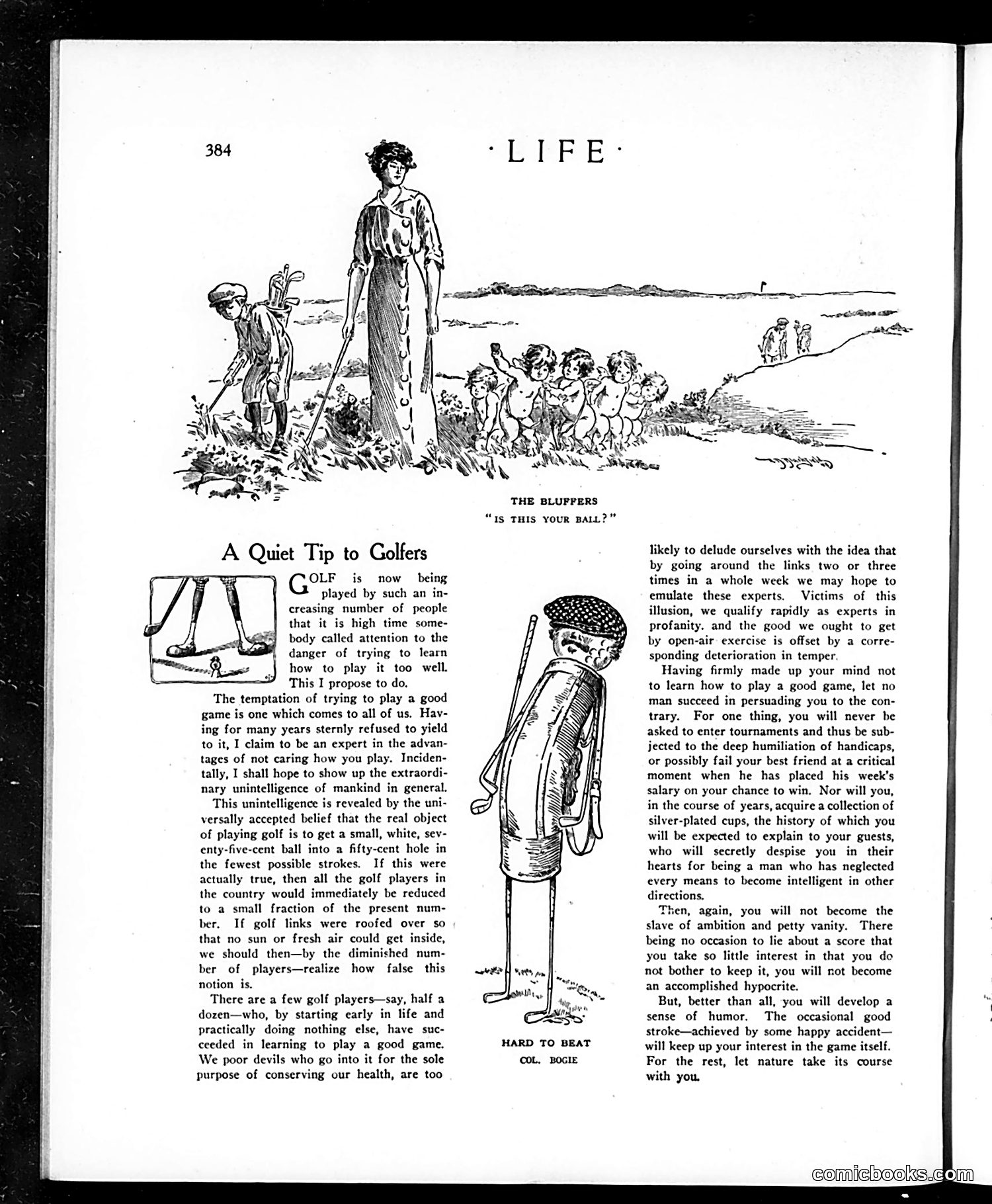
This satirical article mocks the growing obsession with golf among early 20th-century Americans. The author argues paradoxically that golfers *should not* try to play well, since the sport's true appeal is outdoor recreation and social activity, not competitive skill. The cartoons illustrate two points: "The Bluffers" shows someone questioning whether a ball is actually yours—poking fun at casual players who don't take the game seriously. "Hard to Beat" (Colonel Bogie) depicts a golfer struggling comically with his clubs. The article's real satire targets human vanity: ambitious golfers become slaves to competition, accumulate meaningless silver cups, and develop hypocrisy by lying about scores. The author suggests that accepting mediocrity preserves humor and health benefits. The piece reflects period anxieties about golf's explosive popularity among the middle and upper classes, treating the sport as revealing broader character flaws in pursuit of status.
📄 Transcribed text from this page (OCR, searchable)
Machine-transcribed from the original scan — historical spelling and the odd misread are preserved.
A Quiet Tip to Golfers OLF is now being played by such an in- creasing number of people that it is high time some- body called attention to the danger of trying to learn how to play it too well. This I propose to do, The temptation of trying to play a good game is one which comes to all of us. Hav- ing for many years sternly refused to yield to it, I claim to be an expert in the advan- tages of not caring how you play. Inciden- tally, I shall hope to show up the extraordi- nary unintelligence of mankind in general. This unintelligence is revealed by the uni- versally accepted belief that the real object of playing golf is to get a small, white, sev- enty-five-cent ball into a fifty-cent hole in the fewest possible strokes. If this were actually true, then all the golf players in the country would immediately be reduced to a small fraction of the present num- ber. If golf links were roofed over so that no sun or fresh air could get inside, we should then—by the diminished num- ber of players—realize how false this notion is. There are a few golf players—say, half a dozen—who, by starting early in life and practically doing nothing else, have suc- ceeded in learning to play a good game. We poor devils who go into it for the sole purpose of conserving our health, are too THE BLUFFERS “Is THIS YOUR BALL?” HARD TO BEAT COL, BOGIE likely to delude ourselves with the idea that by going around the links two or three times in a whole week we may hope to emulate these experts. Victims of this illusion, we qualify rapidly as experts in profanity. and the good we ought to get by open-air exercise is offset by a corre- sponding deterioration in temper. Having firmly made up your mind not to learn how to play a good game, let no man succeed in persuading you to the con- trary. For one thing, you will never be asked to enter tournaments and thus be sub- jected to the deep humiliation of handicaps, or possibly fail your best friend at a critical moment when he has placed his week's salary on your chance to win. Nor will you, in the course of years, acquire a collection of silver-plated cups, the history of which you will be expected to explain to your guests, who will secretly despise you in their hearts for being a man who has neglected every means to become intelligent in other directions, Then, again, you will not become the slave of ambition and petty vanity. There being no occasion to lie about a score that you take so little interest in that you do not bother to keep it, you will not become an accomplished hypocrite. But, better than all, you will develop a sense of humor. The occasional good stroke—achieved by some happy accident— will keep up your interest in the game itself. For the rest, let nature take its course with you, comichooks.cem