
Life, 1914-09-03 · page 32 of 48
Life — September 3, 1914 — page 32: what you’re looking at
What you’re looking at
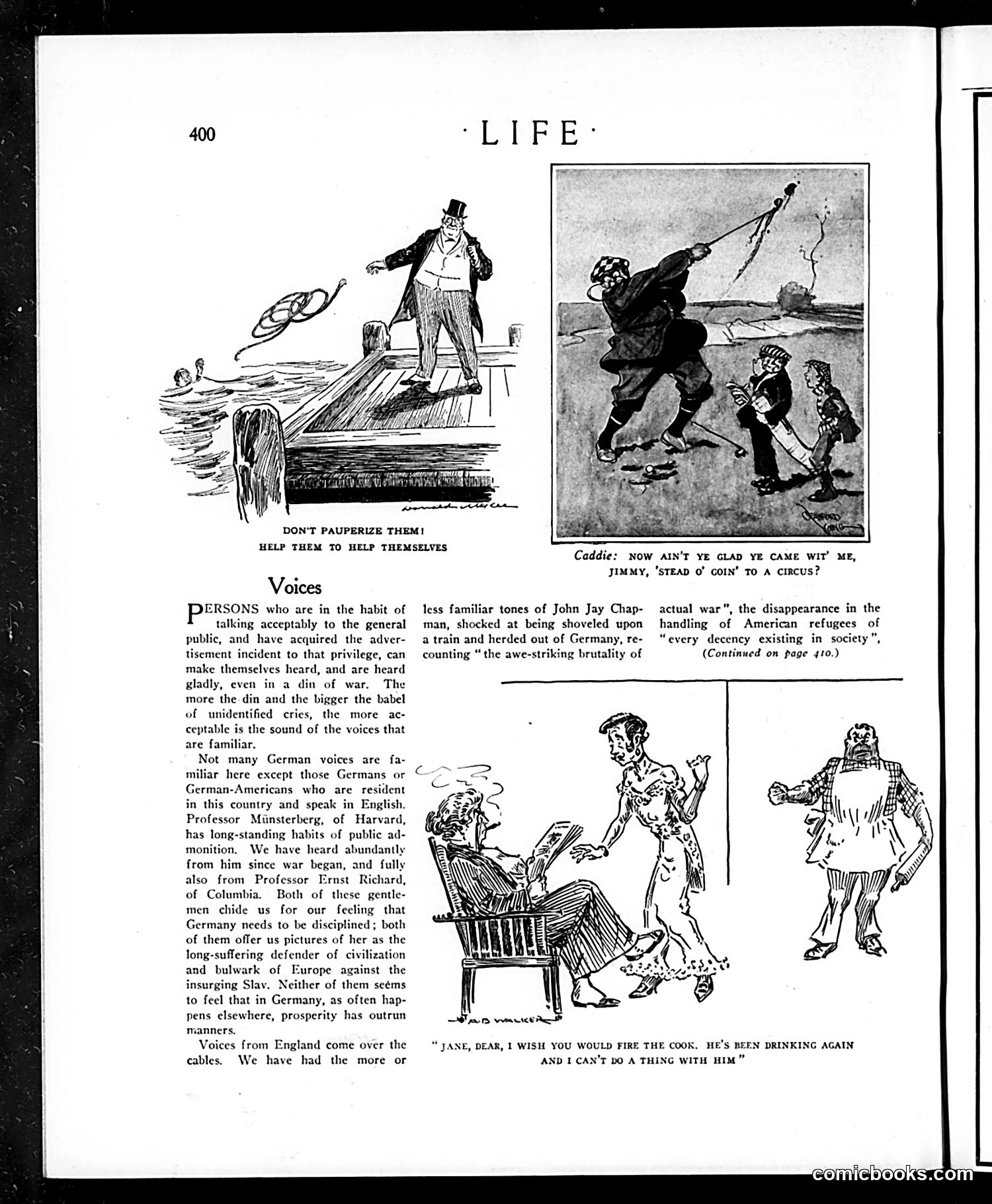
This page contains commentary on wartime rhetoric and three cartoons satirizing different aspects of WWI-era American life. **"Voices" Article:** The editorial discusses how certain German-American academics—specifically naming Professor Münsterberg (Harvard) and Professor Ernst Richard (Columbia)—publicly defend Germany's conduct in the war. The author critiques their portrayal of Germany as a "long-suffering defender of civilization" against Slavic threats, suggesting their prosperity-driven nation lacks proper manners. The piece also references John Jay Chapman, an English voice commenting on German brutality toward American refugees. **Cartoons:** 1. **Top left:** "Don't Pauperize Them"—a gentleman directs swimmers, emphasizing self-reliance over charity. 2. **Top right:** A child questions why they came to a circus instead of experiencing actual war conditions with an adult. 3. **Bottom:** A domestic scene where a man complains about firing a drinking cook, depicting household management frustrations during wartime disruption. The page reflects wartime divisions between German-American sympathizers and Allied supporters, alongside humor about civilian life's persistent mundane problems amid global conflict.
📄 Transcribed text from this page (OCR, searchable)
Machine-transcribed from the original scan — historical spelling and the odd misread are preserved.
DON'T PAUPERIZE THEM! HELP THEM TO HELP THEMSELVES Voices ERSONS who are in the habit of talking acceptably to the general public, and have acquired the adver- tisement incident to that privilege, can make themselves heard, and are heard gladly, even in a din of war. The more the din and the bigger the babel of unidentified cries, the more ac- ceptable is the sound of the voices that are familiar, Not many German voices are fa- miliar here except those Germans or German-Americans who are resident in this country and speak in English. Professor Miinsterberg, of Harvard, has long-standing habits of public ad- monition. We have heard abundantly from him since war began, and fully also from Professor Ernst Richard, of Columbia. Both of these gentle- men chide us for our feeling that Germany needs to be disciplined; both of them offer us pictures of her as the long-suffering defender of civilization and bulwark of Europe against the insurging Slav. Neither of them seéms to feel that in Germany, as often hap- pens elsewhere, prosperity has outrun manners. Voices from England come over the cables. We have had the more or Caddie: NOW AIN'T YE GLAD YE CAME WIT’ ME, JIMMY, "STEAD 0’ GOIN’ TO A CIRCUS? less familiar tones of John Jay Chap- man, shocked at being shoveled upon a train and herded out of Germany, re- counting “the awe-striking brutality of actual war”, the disappearance in the handling of American refugees of “every decency existing in society”, (Continued on page 410.) “ JANE, DEAR, 1 WISH YOU WOULD FIRE THE COOK. HE'S BEEN DRINKING AGAIN AND I CAN'T DO A THING WITH HIM”