
Life, 1914-09-03 · page 19 of 48
Life — September 3, 1914 — page 19: what you’re looking at
What you’re looking at
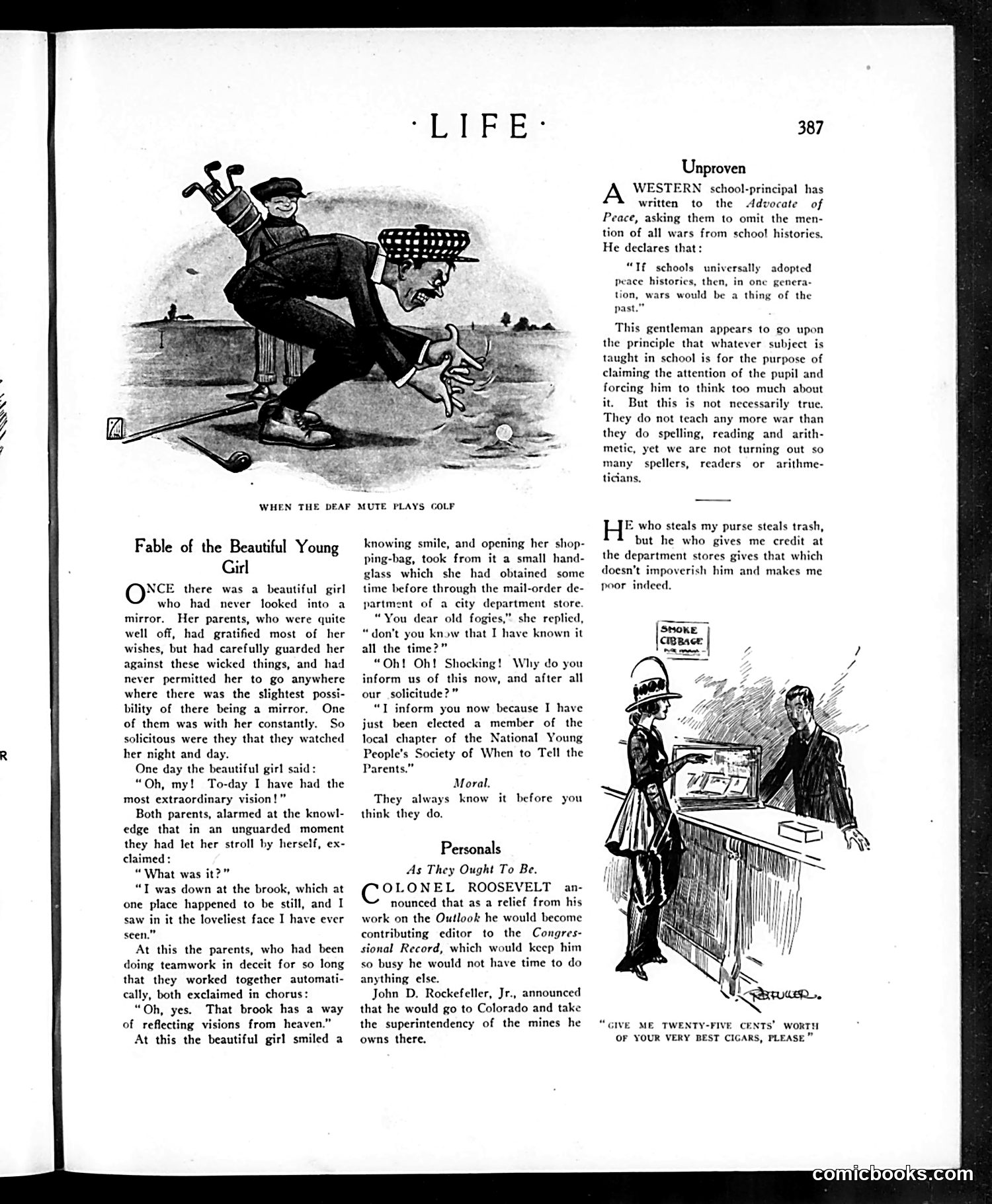
**"When the Deaf Mute Plays Golf"** (top cartoon): A visual joke showing a golfer in an exaggerated mid-swing pose with golf clubs flying. The humor relies on the absurdist title—the contradiction between being deaf-mute (unable to hear or speak) and playing golf, a sport requiring no special communication, creates the punchline through unexpected juxtaposition. **"Fable of the Beautiful Young Girl"**: A moral tale satirizing overprotective parenting. Parents shield their daughter from mirrors, claiming ignorance about her appearance, but she discovers her own reflection in a brook. The girl's punchline—joining "The National Young People's Society of When to Tell the Parents"—mocks generational dishonesty and suggests young people are savvy to adult deception. The moral: youth know the truth despite parental pretense. **"Personals" section**: Light satirical notes about Colonel Theodore Roosevelt and John D. Rockefeller Jr., humorously suggesting they'll become so busy with new editorial/mining roles that they'll have "no time to do anything else"—poking fun at their prominence and workaholic tendencies.
📄 Transcribed text from this page (OCR, searchable)
Machine-transcribed from the original scan — historical spelling and the odd misread are preserved.
a a WHEN THE DEAF MUTE PLAYS GOLF Fable of the Beautiful Young Girl ONCE there was a beautiful girl who had never looked into a mirror. Her parents, who were quite well off, had gratified most of her wishes, but had carefully guarded her against these wicked things, and had never permitted her to go anywhere where there was the slightest possi- bility of there being a mirror. One of them was with her constantly. So solicitous were they that they watched her night and day. One day the beautiful girl said: “Oh, my! To-day I have had the most extraordinary vision!” Both parents, alarmed at the knowl- edge that in an unguarded moment they had let her stroll by herself, ex- claimed: “What was it?” “T was down at the brook, which at one place happened to be still, and I saw in it the loveliest face I have ever seen.” At this the parents, who had been doing teamwork in deceit for so long that they worked together automati- cally, both exclaimed in chorus: “Oh, yes. That brook has a way of reflecting visions from heaven.” At this the beautiful girl smiled a knowing smile, and opening her shop- ping-bag, took from it a small hand- glass which she had obtained some time before through the mail-order de- partment of a city department store. “You dear old fogies,” she replied, “don't you know that I have known it all the time?” “Oh! Oh! Shocking! Why do you inform us of this now, and after all our solicitude?” “I inform you now because I have just been elected a member of the local chapter of the National Young People’s Society of When to Tell the Parents.” Moral. They always know it before you think they do. Personals As They Ought To Be. OLONEL ROOSEVELT an- nounced that as a relief from his work on the Outlook he would become contributing edi to the Congres- sional Record, which would keep him so busy he would not have time to do anything else. John D. Rockefeller, Jr., announced that he would go to Colorado and take the superintendency of the mines he owns there, 387 Unproven WESTERN school-principal has written to the Advocate of Peace, asking them to omit the men- tion of all wars from schoot histories. He declares that: “If schools universally adopted peace histories, then, in one genera- tion, wars would be a thing of the past.” This gentleman appears to go upon the principle that whatever subject is taught in school is for the purpose of claiming the attention of the pupil and forcing him to think too much about it. But this is not necessarily true. They do not teach any more war than they do spelling, reading and arith- metic, yet we are not turning out so many spellers, readers or arithme- ticians, HEF who steals my purse steals trash, but he who gives me credit at the department stores gives that which doesn’t impoverish him and makes me poor indeed,