
A complete issue · 45 pages · 1914
Life — June 25, 1914
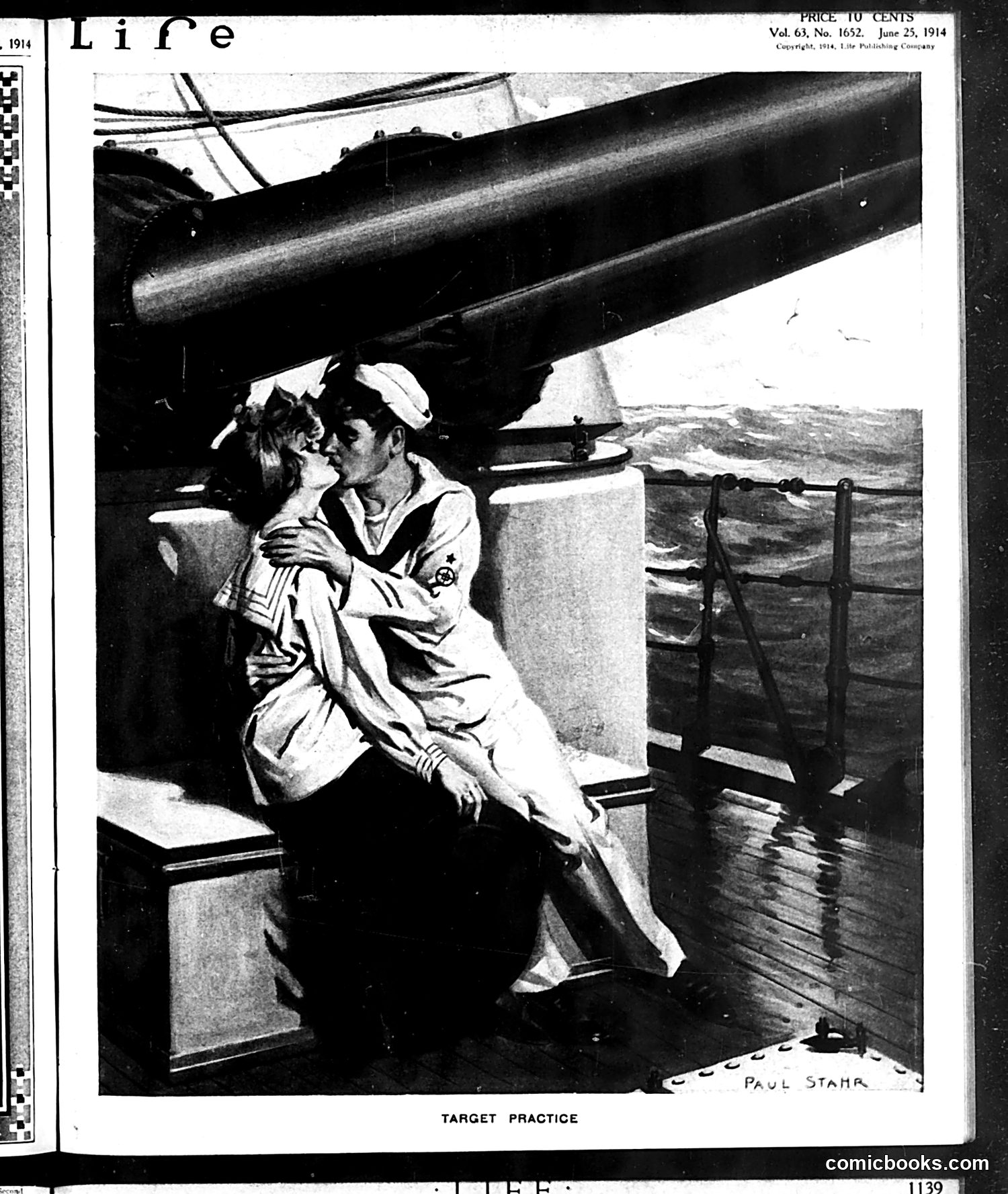
This June 1914 *Life* magazine page shows a romantic scene titled "Target Practice" featuring two figures in naval uniforms aboard what appears to be a warship, positioned beneath a large gun turret with ocean visible in the background. The image likely plays on double meaning: the official military "target practice" involving the ship's weaponry contrasts with the implicit romantic "target" — the couple's embrace. The sailor's uniform and naval setting suggest this is satirizing military life or romance in the context of early 20th-century naval service. The timing (June 1914, weeks before World War I) may carry additional significance, though the cartoon appears primarily humorous rather than explicitly political. The artist is credited as Paul Stahr.
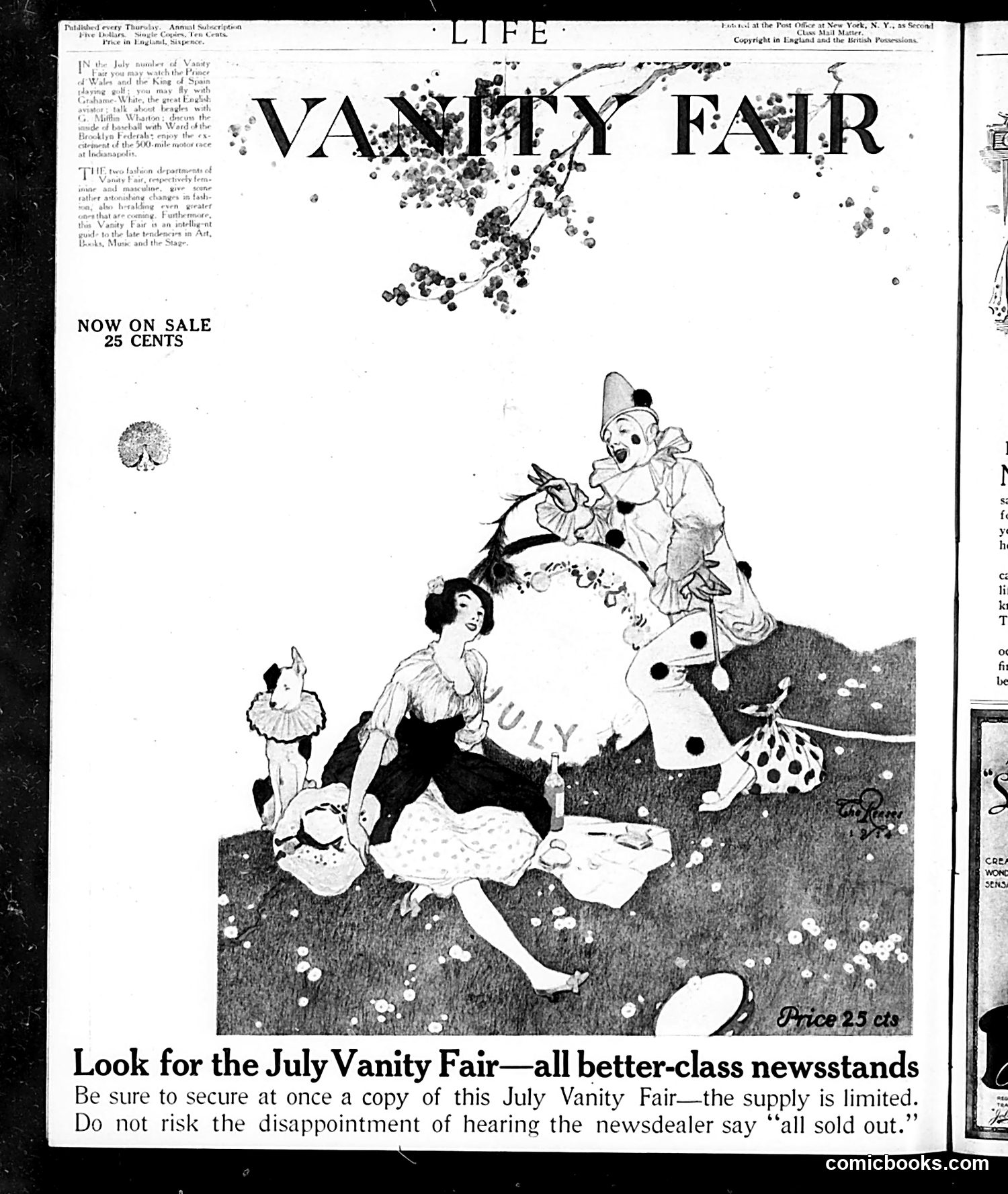
This is primarily a **magazine advertisement** rather than political satire. The cover promotes Vanity Fair's July issue, priced at 25 cents, available at newsstands. The illustration depicts a **whimsical summer picnic scene**: a woman in fashionable dress sits with two costumed figures—appearing to be a clown and another performer. The setting suggests leisure and entertainment, likely referencing the circus or theatrical performances popular in early 20th-century America. The satire appears mild: the advertisement humorously urges readers to buy immediately, warning that "supply is limited" and cautioning against hearing the newsdealer say "all sold out"—a playful sales tactic rather than social commentary. This reflects Vanity Fair's identity as a humor and lifestyle magazine targeting better-class readers interested in entertainment and fashion.
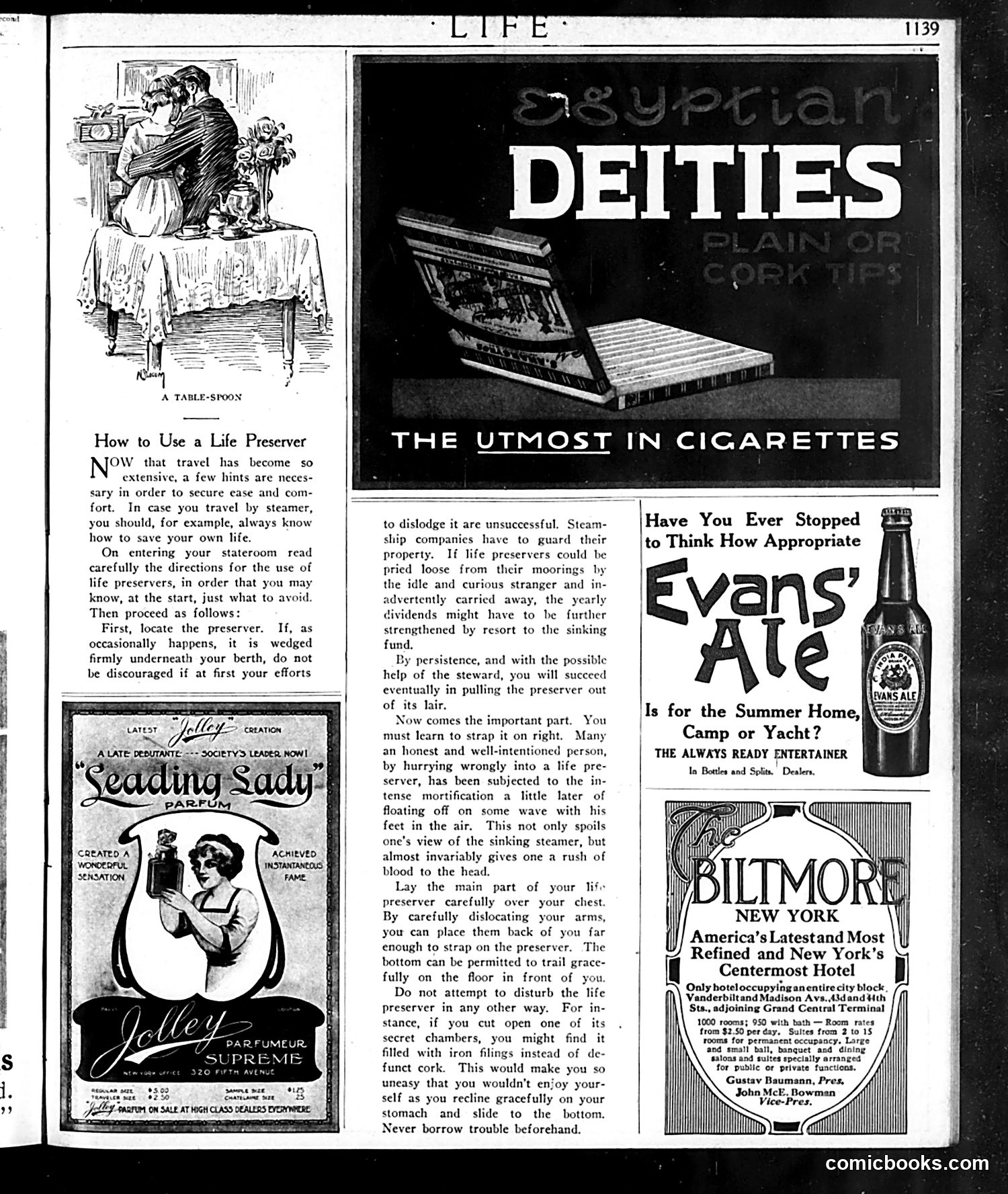
This page is primarily **advertising content** from an early 20th-century Life magazine, not political satire. The main cartoon, "A Table-Spoon," depicts a humorous domestic scene of a man and woman at a table—likely a joke about dining etiquette or marital dynamics, though the specific humor is unclear without additional context. The article "How to Use a Life Preserver" offers practical (and satirical) advice for ship travel, humorously treating life preservers as comedy material rather than serious safety equipment—typical of Life's irreverent tone. The remainder consists entirely of **period advertisements**: Jolley perfume, Deities cigarettes, Evans' Ale, and the Biltmore Hotel. These ads reflect early 1900s consumer culture and luxury goods marketing.
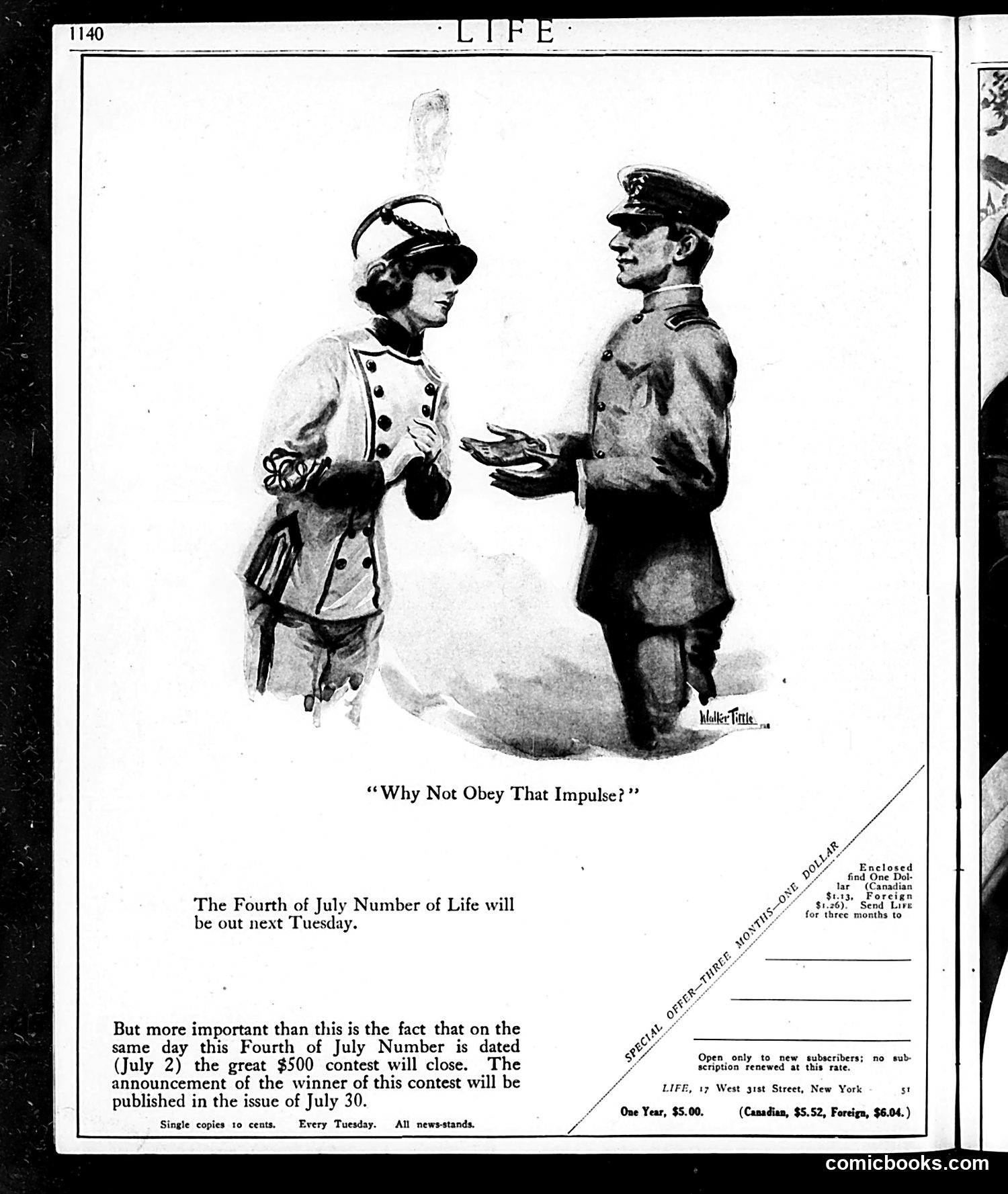
This page features a satirical cartoon titled "Why Not Obey That Impulse?" depicting two military officers in WWI-era uniforms engaged in conversation. The cartoon's meaning remains somewhat unclear without additional context, though the title suggests ironic commentary on military obedience or discipline. The figure on the left wears an ornate double-breasted uniform with a distinctive feathered hat, while the figure on the right wears a standard military jacket. The satire likely critiques either specific military leadership, wartime decisions, or the tension between impulse and duty during the war period. The page primarily announces Life magazine's upcoming Fourth of July issue and a $500 contest closing that day, with subscription information. The cartoon's specific political target cannot be definitively identified from the image alone.
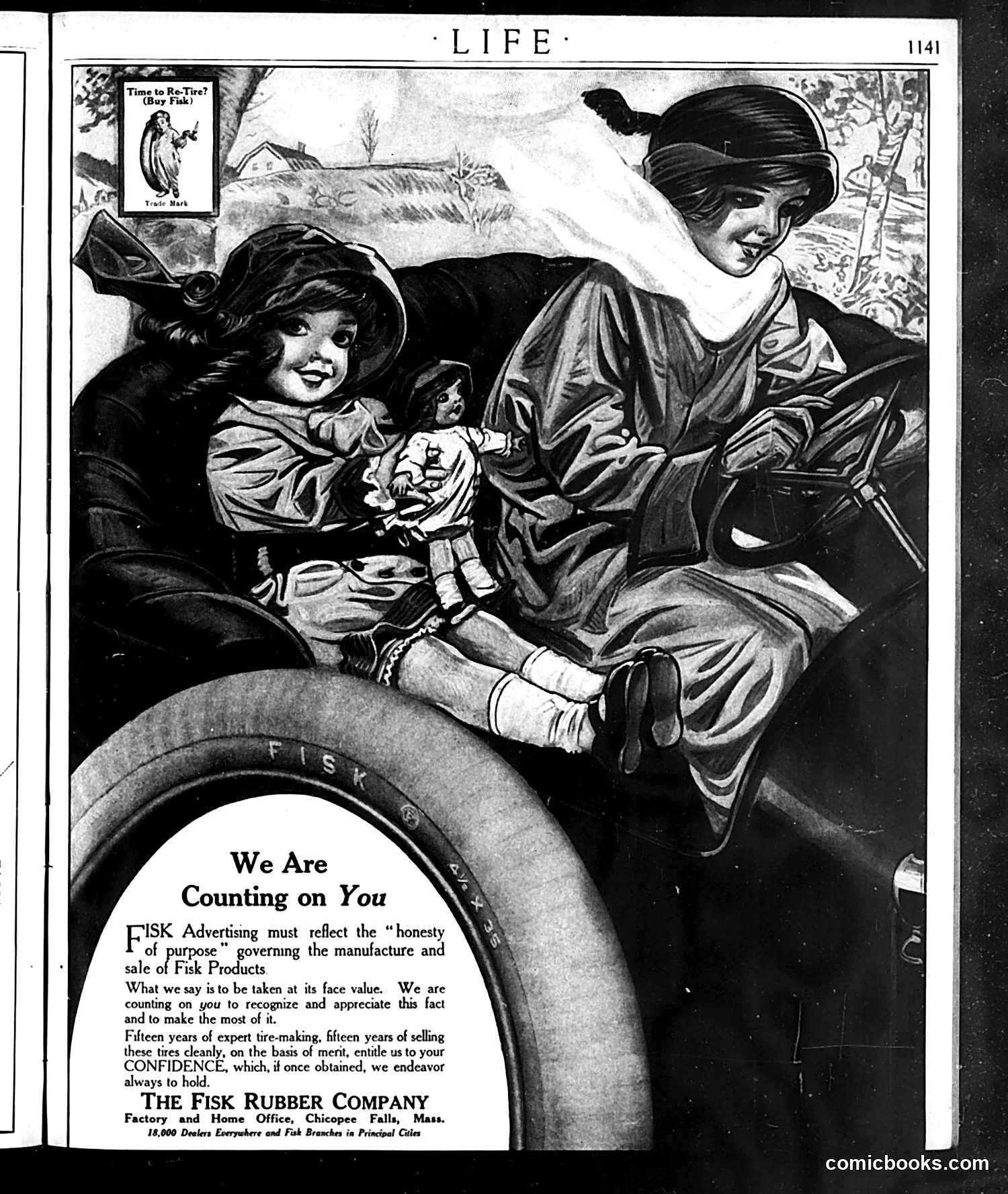
This is primarily a **Fisk Rubber Company advertisement**, not political satire. The main image shows two well-dressed women in a car with a child, promoting tire reliability. The company emphasizes "honesty of purpose" and claims fifteen years of tire-making expertise, positioning their product as trustworthy. The small inset cartoon titled "Time to Re-Tire? (Buy Fisk)" depicts a train conductor or porter figure—likely a period racial caricature—serving as a visual pun on "re-tire." This type of imagery was common in early 20th-century advertising but reflects deeply offensive stereotyping practices of that era. The advertisement targets middle-class consumers, particularly families, emphasizing safety and confidence in their tires.
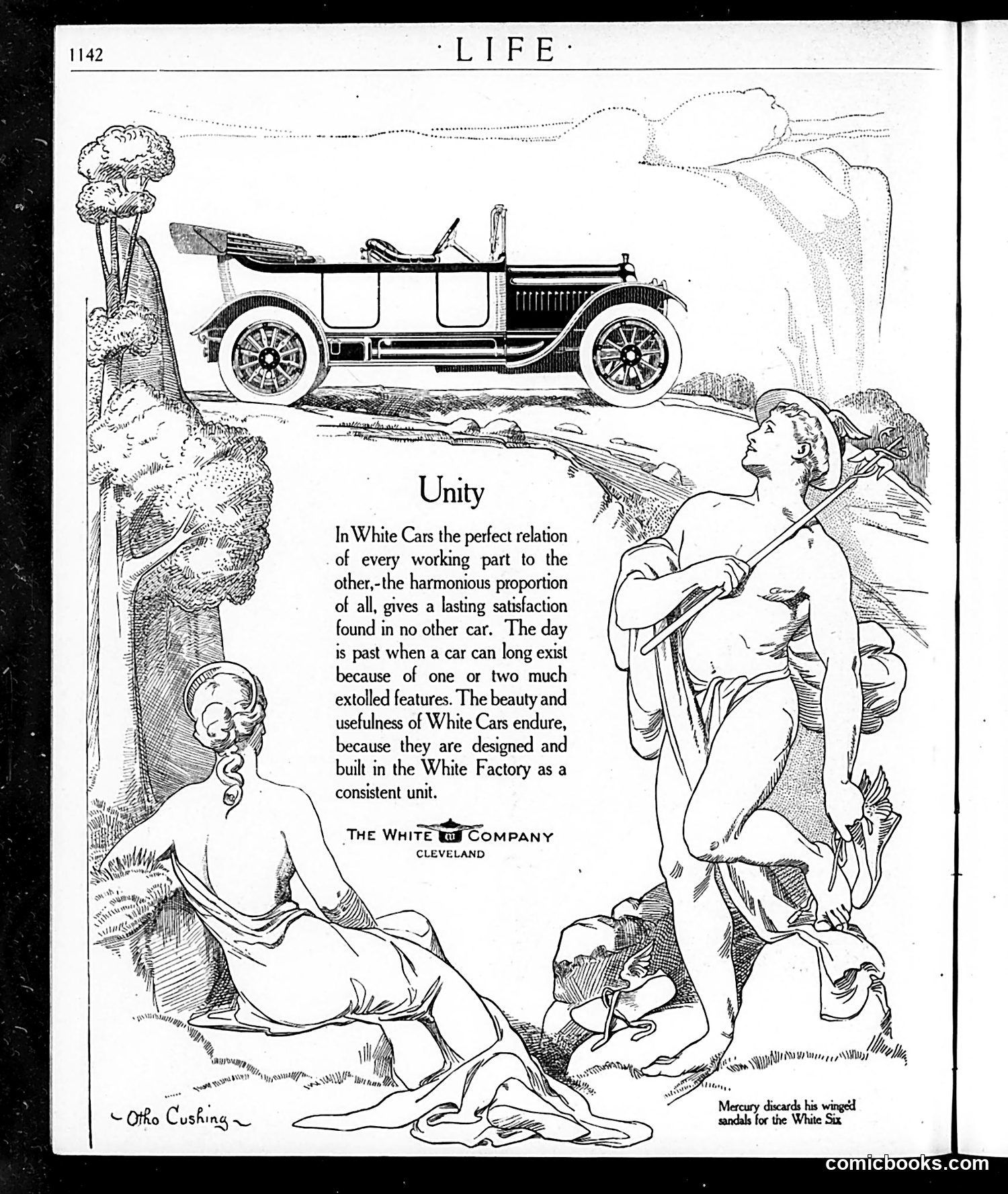
This is primarily a **White automobile company advertisement**, not political satire. The page shows a White Six motorcar displayed prominently at top. The decorative illustration features classical female figures (nymphs or allegorical muses) surrounding the vehicle. The caption credits artist **Otho Cushing** and references "Mercury discards his winged sandals for the White Six"—a classical allusion suggesting the car's superior speed and modernity. The advertisement's headline "Unity" emphasizes that White Cars feature harmonious engineering design. The text argues that White automobiles achieve lasting satisfaction through consistent, integrated manufacturing at the "White Factory" in Cleveland. This represents typical early automotive advertising strategy: associating products with classical elegance and reliability to appeal to wealthy consumers during the automobile industry's early growth period.
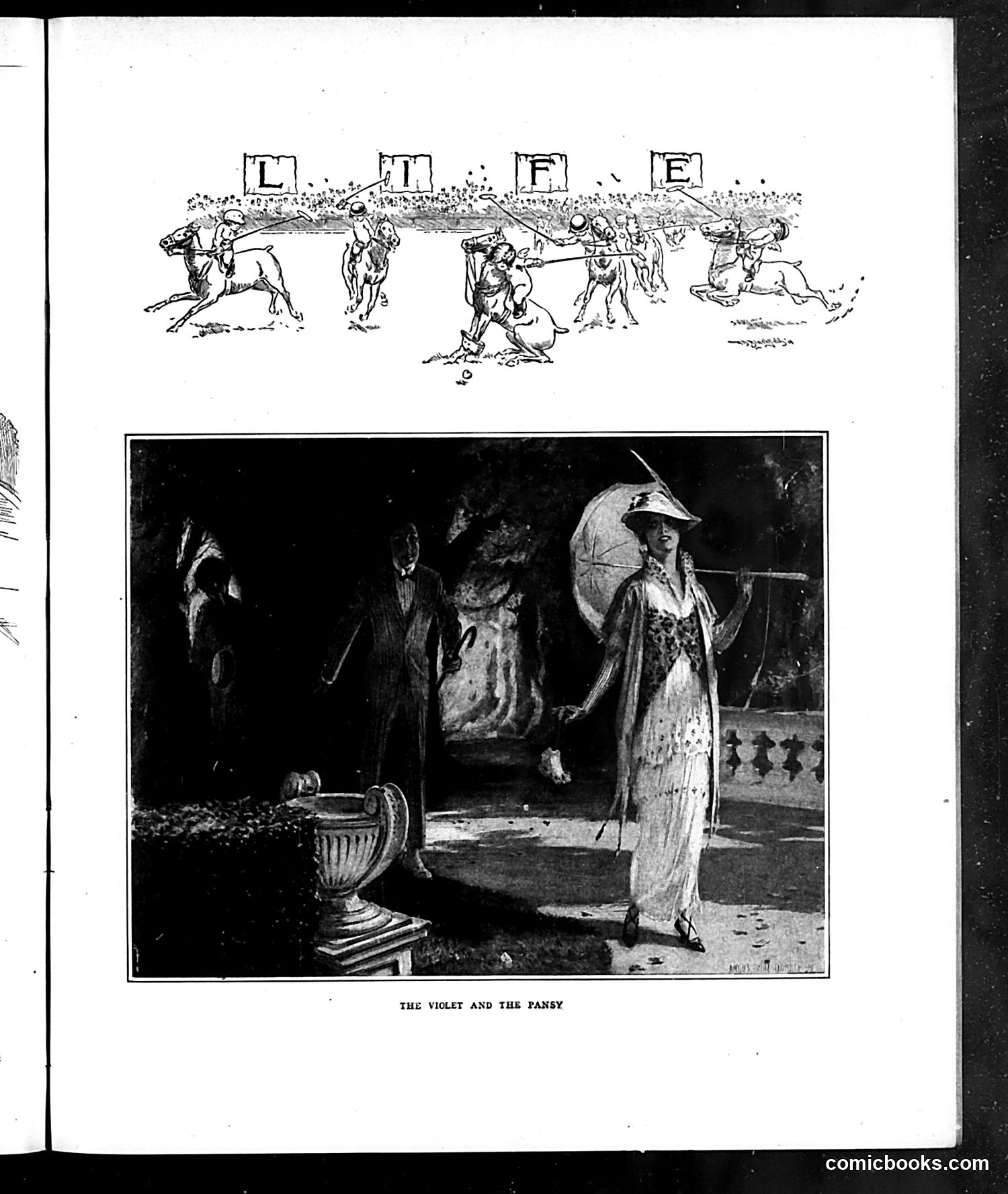
The top illustration shows a polo match (letters L, I, F, E marking positions). The bottom photograph depicts a fashionable woman in an elegant white gown holding a parasol, standing in what appears to be a garden setting with classical urns and other figures in the background. The title "The Violet and the Pansy" pairs these two images as visual commentary. The polo match likely represents energetic, masculine activity, while the refined woman embodies delicate femininity. This appears to be satirizing contrasts between society's gender expectations—active sport versus passive ornamentation. The wordplay on flower names ("violet" and "pansy") may contain period-specific social commentary, though the specific satirical target remains unclear without additional context.
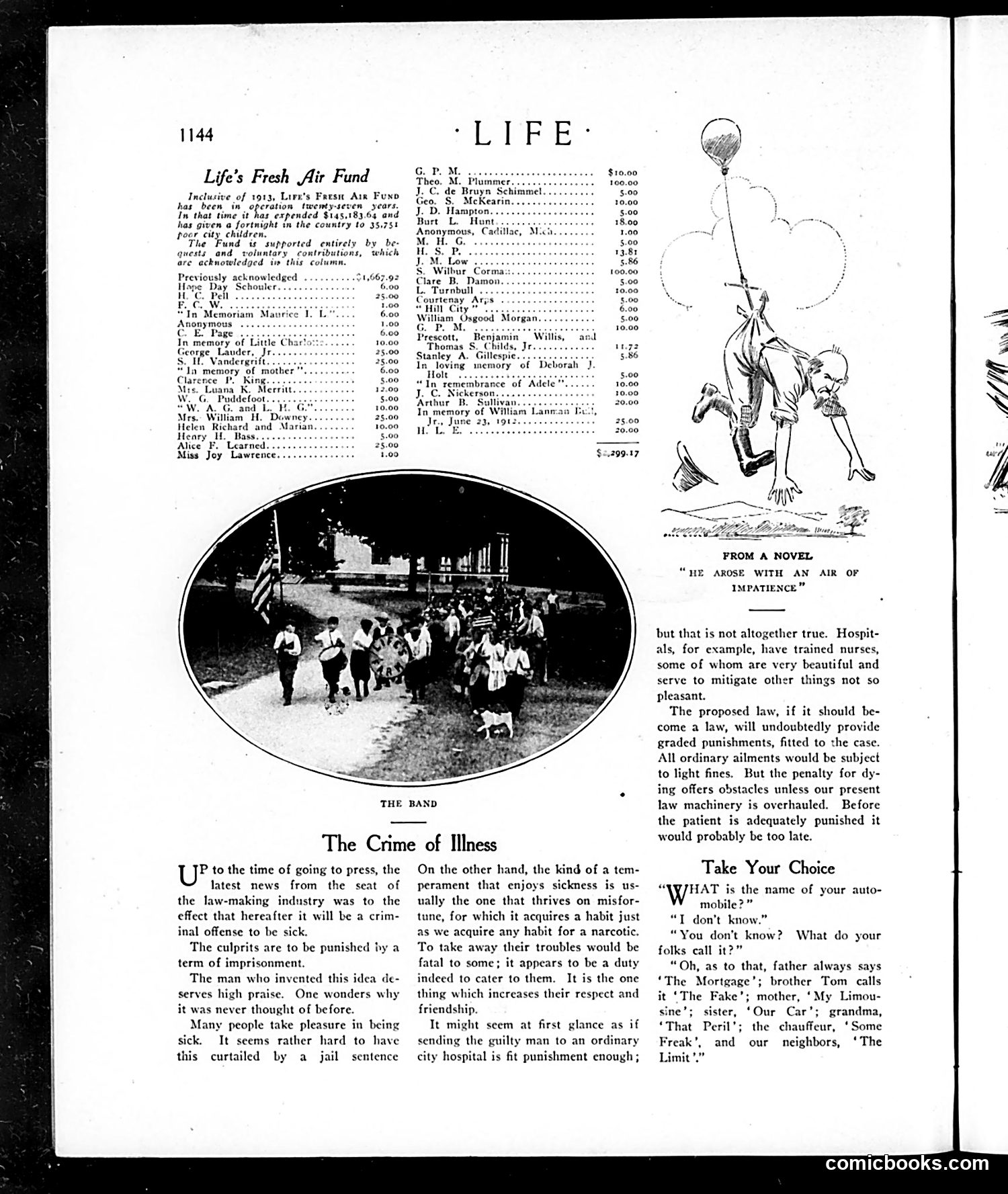
This page contains two distinct elements: **Left side:** A photograph labeled "THE BAND" showing a large outdoor gathering with an American flag, appearing to document a public event or celebration. **Main article:** "The Crime of Illness" discusses proposed legislation to punish sick people with imprisonment. The satirical argument critiques this harsh approach, noting that while hospitals employ trained nurses to help patients, the proposed law would impose "graded punishments" for ordinary ailments and severe penalties for malingering. **Right side:** A cartoon illustration (captioned "HE AROSE WITH AN AIR OF IMPATIENCE") and a section titled "Take Your Choice" humorously listing various nicknames Americans give their automobiles—"The Mortgage," "The Fake," "Some Freak," etc.—satirizing consumer culture and car ownership's financial burden on families.
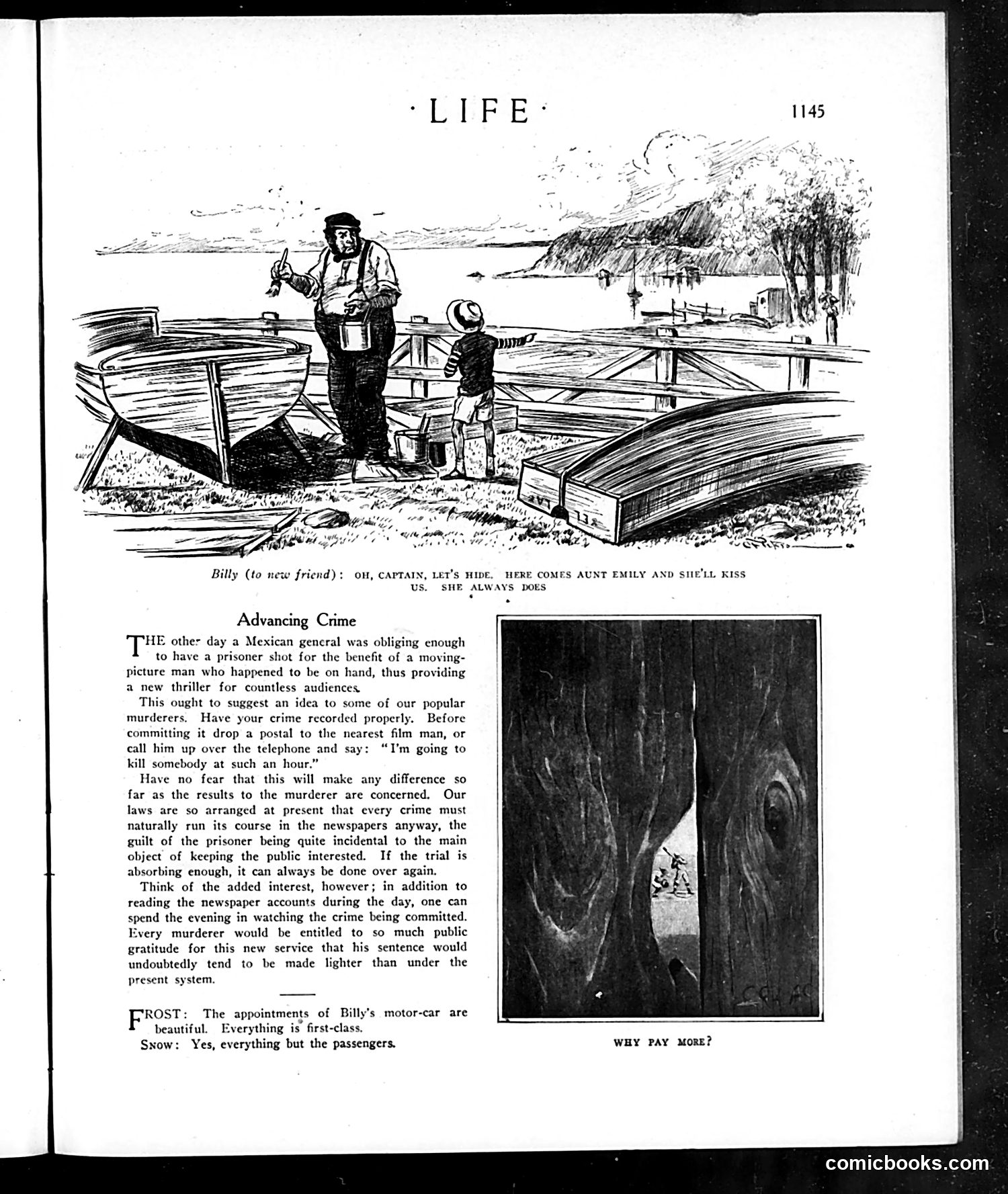
**The Top Cartoon** depicts a fishing scene with two figures and boats. A man says to a boy: "Oh, Captain, let's hide. Here comes Aunt Emily and she'll kiss us. She always does." This is a simple domestic humor joke about avoiding unwanted affection from a relative. **"Advancing Crime"** is a satirical essay criticizing the publicity given to murders. The author sarcastically suggests murderers should advertise their crimes to film companies or newspapers beforehand, since extensive media coverage already occurs anyway. He mocks how trial outcomes become secondary to public entertainment value, arguing that criminals receive undeserved gratitude for providing sensational news stories. **The bottom joke** between Frost and Snow satirizes luxury car appointments: one praises Billy's motor-car quality; the other quips that everything is first-class "but the passengers."
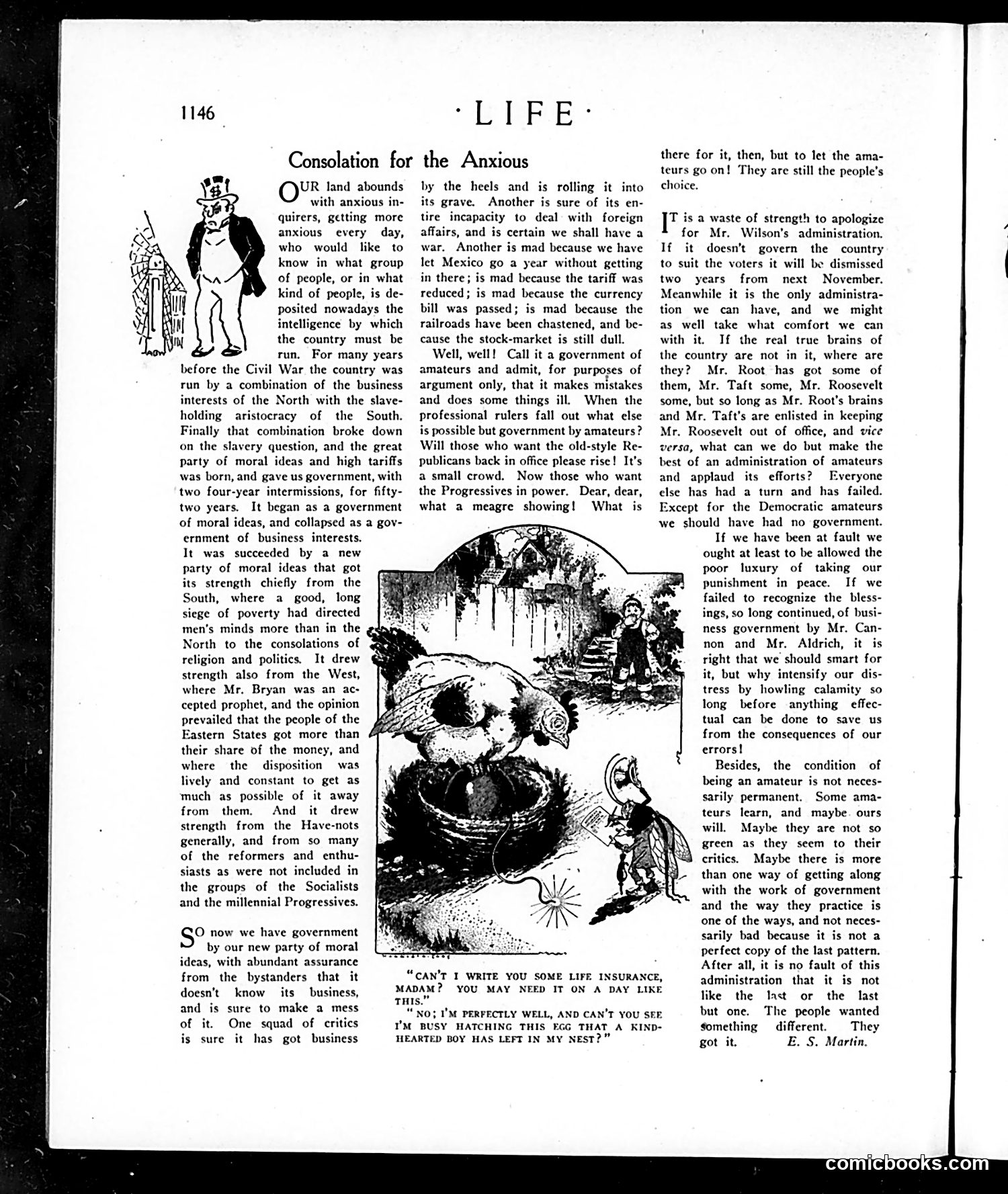
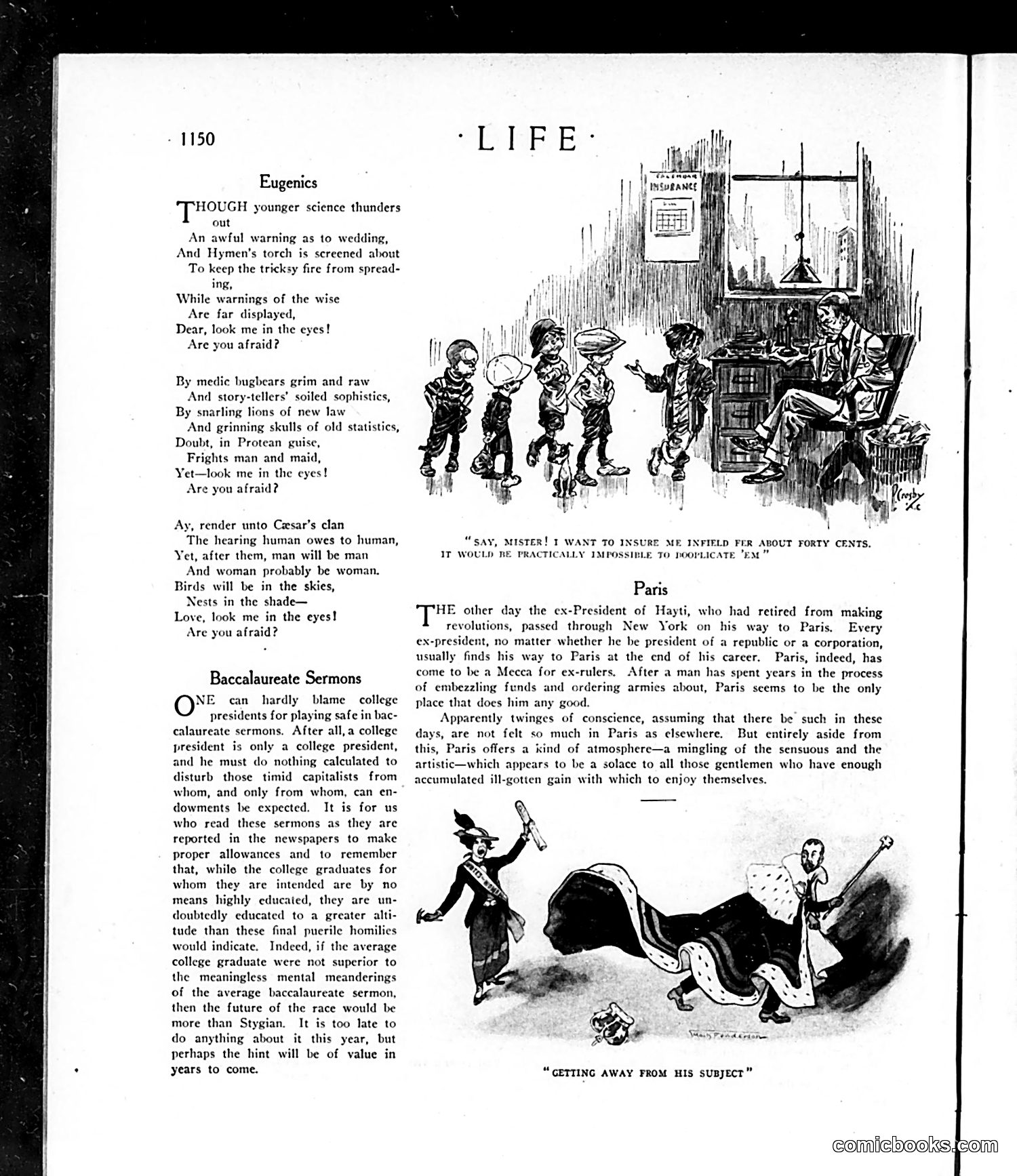
This editorial page critiques the Wilson administration's amateur governance. The text argues the government is run by inexperienced idealists rather than skilled professionals, citing failures on tariffs, currency, Mexico policy, and the stock market. The central cartoon depicts a woman telling a man: "Can't I write you some life insurance, Madam? You may need it on a day like this" while he responds he's too busy hatching eggs to be bothered—suggesting the administration is distracted by impractical concerns while citizens face real economic dangers. The satire mocks Wilson's moral idealism as incompetent management, contrasting his administration unfavorably with previous Republican leadership and Democratic amateurs in Congress.
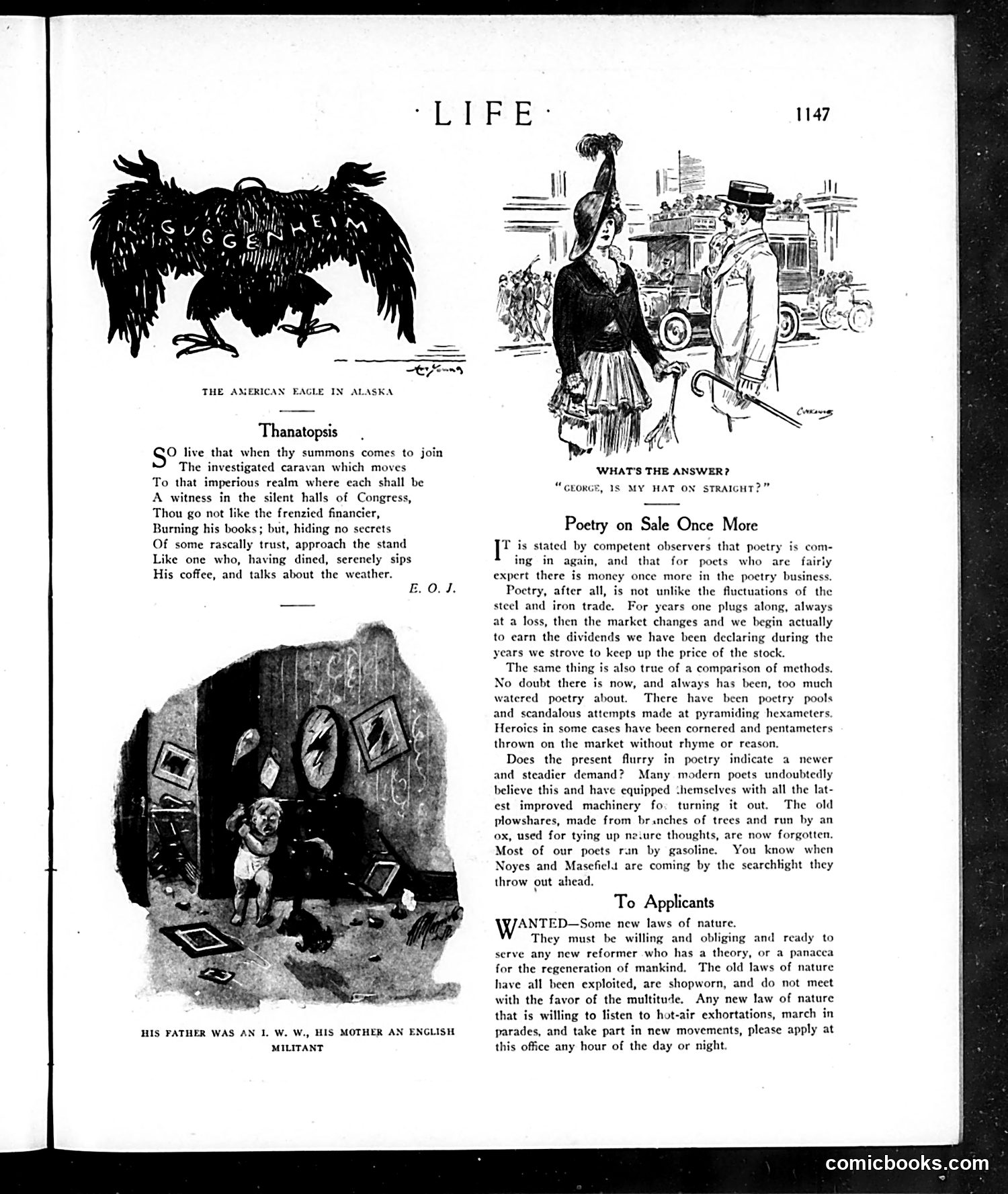
This page contains three distinct satirical pieces: 1. **"The American Eagle in Alaska"** (top left): A cartoon showing a scruffy, disheveled eagle labeled "SUGGEST HEAIM" (possibly "SUGGEST HELM" or a pun on "suggest" vs. leadership). The joke likely mocks Alaska's governance or American imperial pretensions there. 2. **"What's the Answer?" (top right)**: A cartoon of a woman asking a man about his hat being "on straight" at what appears to be a social gathering. This is likely satirizing upper-class vanity or social pretension. 3. **"Poetry on Sale Once More"** (main article): A humorous commentary comparing poetry publishing to financial markets—poets struggle initially, then suddenly profit. It mocks modernist poets using mechanical imagery and suggests they've become commercialized. The page exemplifies *Life's* satirical style targeting both politics and contemporary culture.
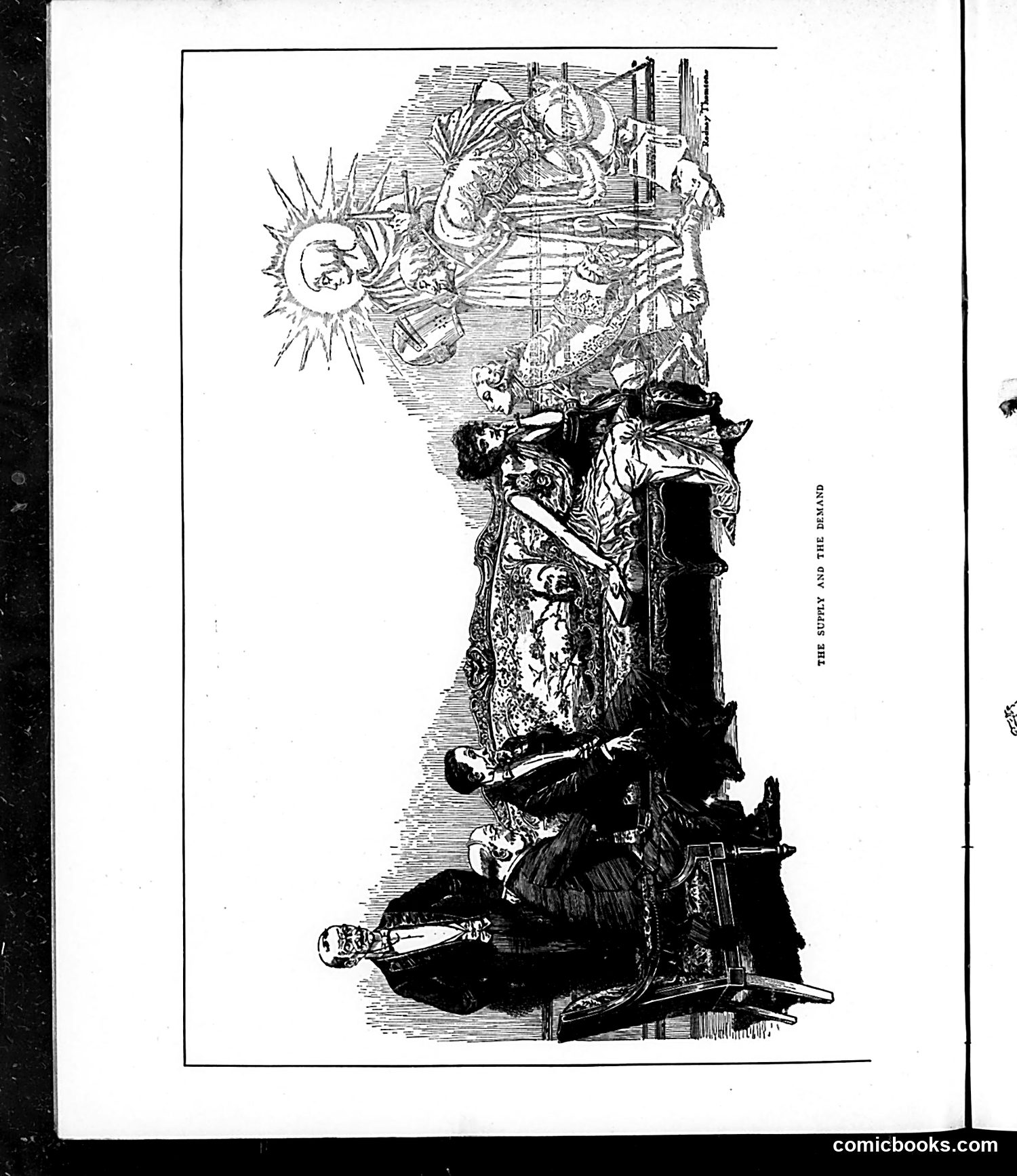
This appears to be a satirical illustration from *Life* magazine showing a contrasting pair. The caption "THE SLEEPY AND THE DREAMY" suggests commentary on two different character types or political figures. At the bottom sits a drowsy, heavily-built man in formal dress, appearing sluggish or inattentive. Above him rises an elaborate, dreamlike vision filled with fantastical imagery—celestial bodies, elaborate architectural structures, and ornate decorative elements. The satire likely critiques the difference between someone's actual capabilities or character (the "sleepy" figure below) versus their inflated self-image or aspirations (the "dreamy" vision above). Without identifying the specific individuals depicted, the cartoon uses this visual contrast to mock disconnection between reality and pretension—a common *Life* magazine theme of the era.
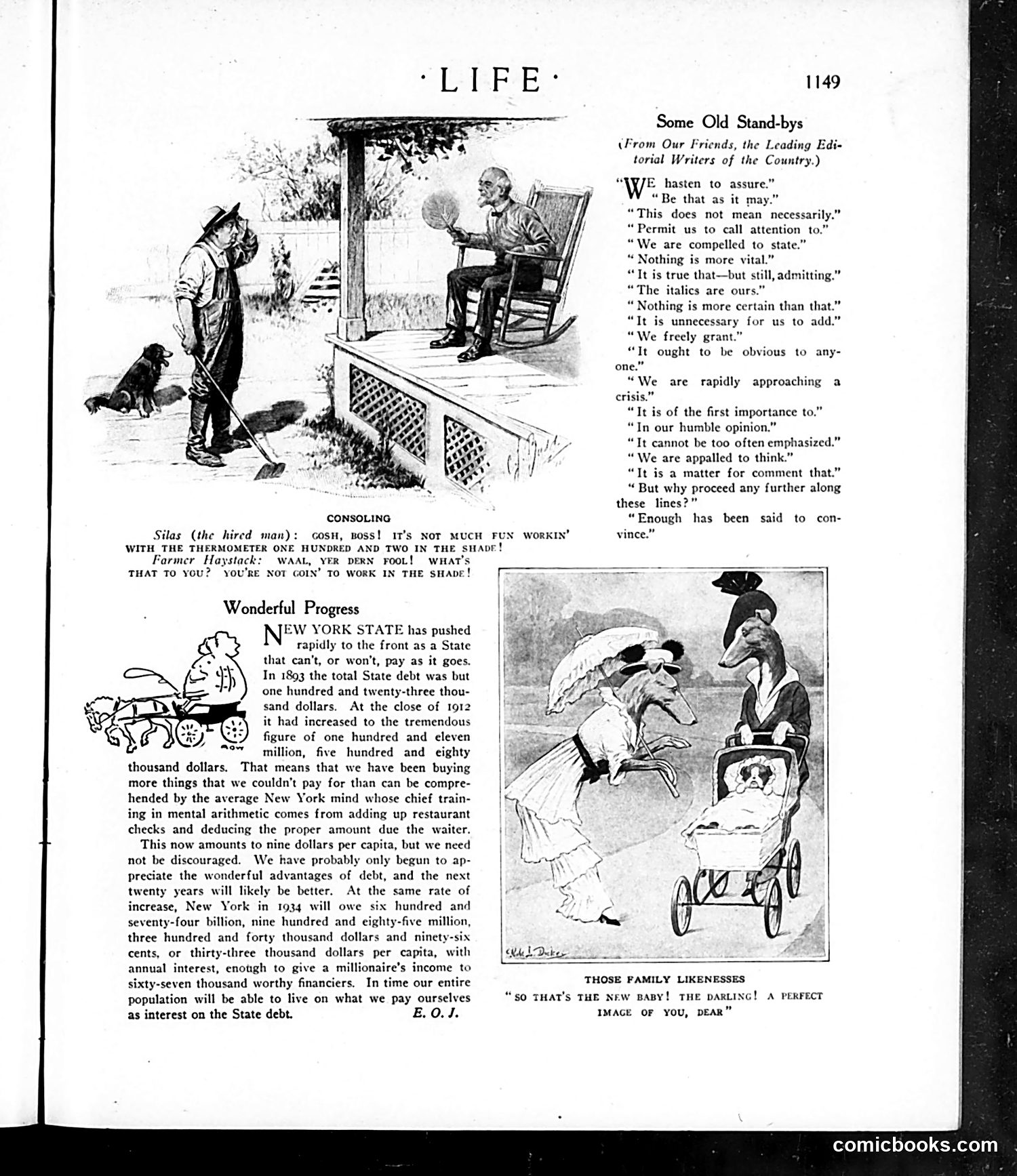
**"Consoling"** (top cartoon): A hired man complains to his former employer about working in the shade during 102-degree heat. The joke contrasts the employer's dismissive comfort (sitting in a rocking chair) with the laborer's physical hardship. It satirizes class indifference to workers' suffering. **"Wonderful Progress"** (article): This critiques New York State's rapidly increasing debt, which rose from $123,000 in 1893 to $111,500,000 by 1912. The author warns that at this rate, the state will owe $674 billion by 1934, leaving citizens paying only interest on the debt. It's sarcastic commentary on government fiscal irresponsibility and unsustainable spending. **"Those Family Likenesses"** (bottom cartoon): A woman shows her new baby carriage to a friend, claiming the baby is "a perfect image of you, dear"—likely satirizing insincere flattery or awkward social conventions around babies.
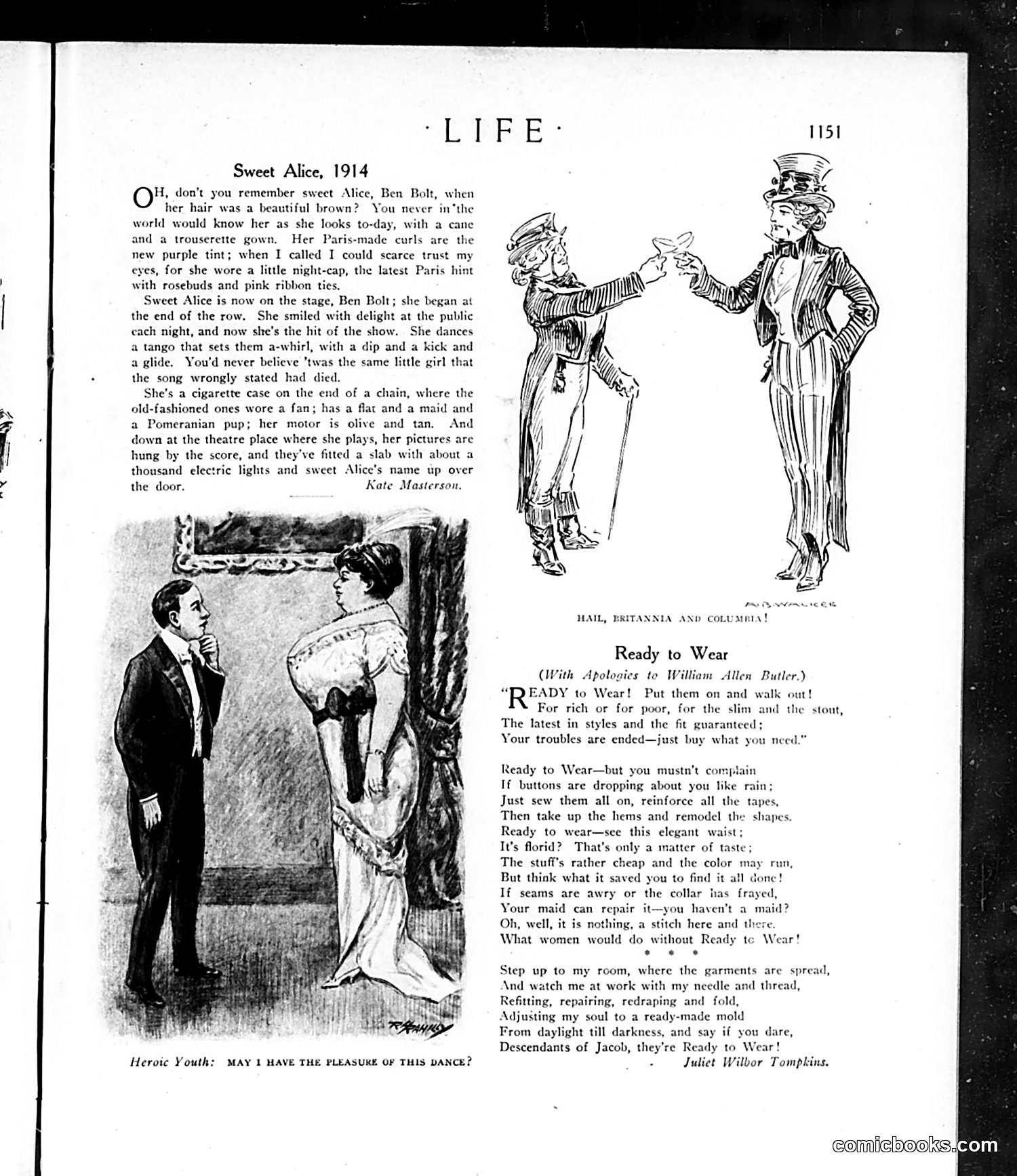
**"Sweet Alice, 1914"** satirizes the "New Woman" of 1914—specifically, the transformation of a modest girl into a modern actress/performer. The piece mocks contemporary fashion trends (purple-tinted curls, "trouserette gown," cigarette cases on chains, automobiles) and the bohemian lifestyle associated with stage women. The reference to "Ben Bolt" (a sentimental 19th-century song) emphasizes how unrecognizable modern women have become—the implication being satirical criticism of women's changing social roles and appearance. **"Ready to Wear"** (with apologies to William Allen Butler, author of "Nothing to Wear") critiques cheap, mass-produced clothing marketed to women. The poem's joke: ready-made garments advertise convenience but require extensive repairs, alterations, and needlework—negating the promised time-savings. It satirizes both shoddy manufacturing and the exploitation of women's unpaid domestic labor. The "descendants of Jacob" reference implies Jewish immigrant garment manufacturers. Both pieces express ambivalent anxiety about women's modernization and commercialization in early 1910s America.
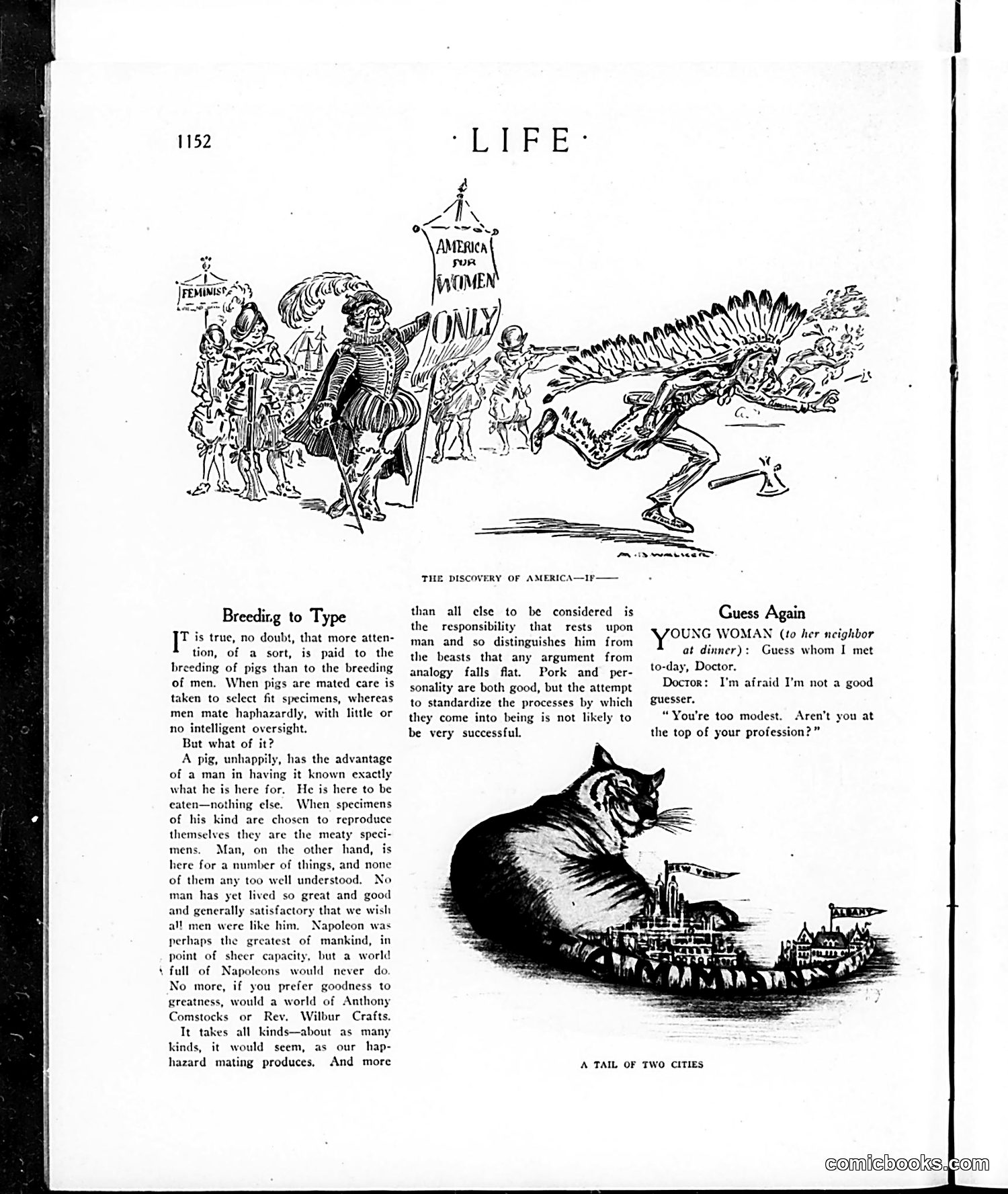
**Top Cartoon:** "The Discovery of America—If" satirizes early feminist and women's suffrage movements. The figure on horseback carries a banner reading "America for Women Only," flanked by supporters holding a "Feminist" sign. A grotesque dragon-like creature represents masculine resistance or patriarchal society being displaced. This mocks the notion of female-dominated America as absurdly inverted. **"Breeding to Type" Essay:** Argues against eugenics by contrasting pig-breeding (purposeful, single-use) with human breeding (complex, multifaceted). References Anthony Comstock (anti-obscenity crusader) and Rev. Wilbur Crafts to illustrate that even "great" men shouldn't be universally replicated. Critiques deterministic social engineering. **"Guess Again" Joke:** A woman assumes a doctor's professional eminence makes him good at guessing. The humor suggests doctors, despite expertise in medicine, possess no special social perception—a mild jab at professional pretension.
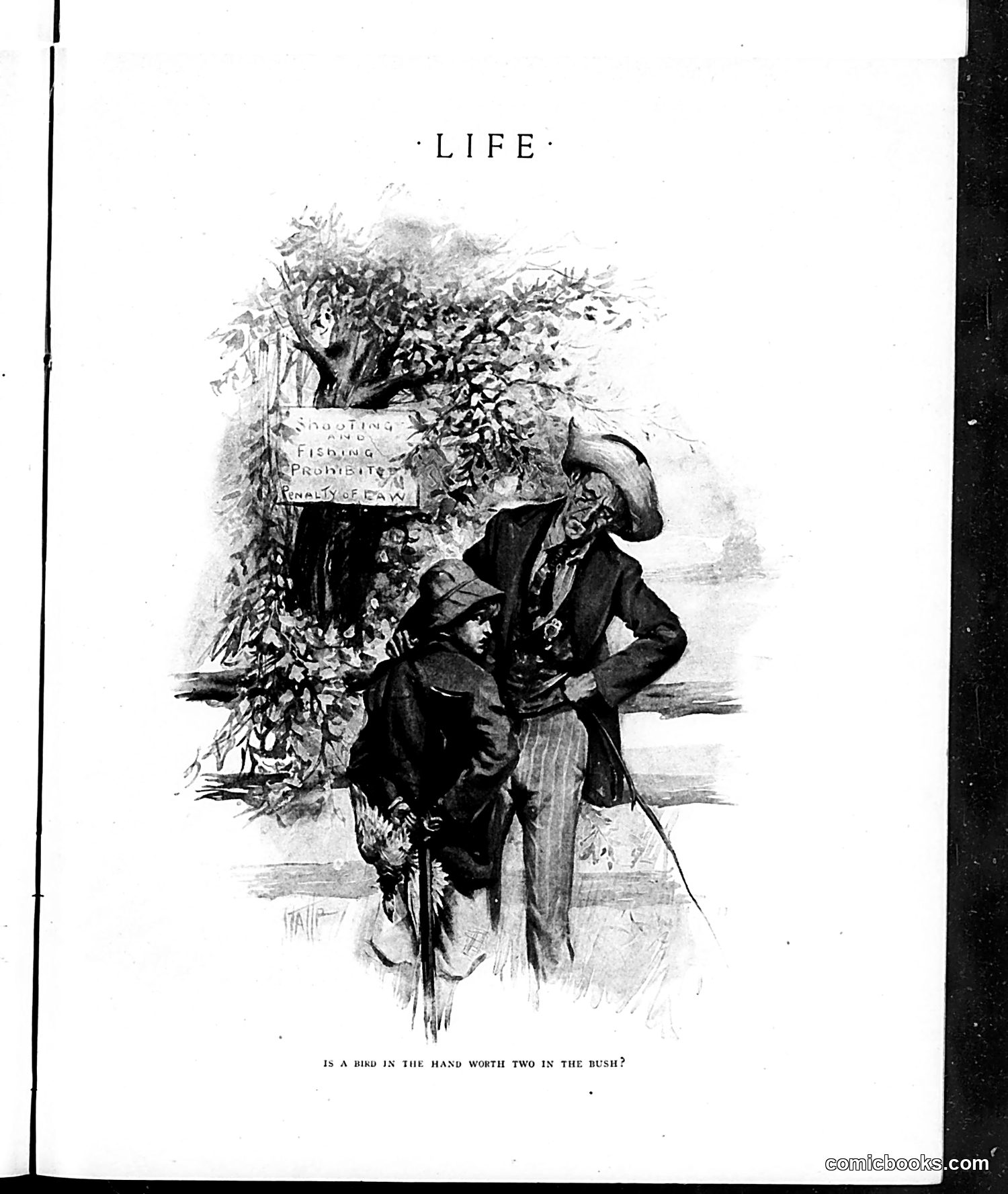
This is a section titled "LIFE" featuring a sketch of two figures examining a tree with a sign reading "SHOOTING AND FISHING PROHIBITED / ROADS OF LAW." The cartoon illustrates the proverb "A bird in the hand worth two in the bush?" through a political satire. Two men—appearing to be officials or law enforcers based on their formal attire and hats—stand before vegetation marked with prohibitory signs. The composition suggests tension between desire (the birds/game in the bush) and legal restriction (the posted signs). The satire critiques either enforcement of conservation laws, hunting regulations, or the tension between individual liberty and governmental restrictions. Without additional context identifying the specific figures, the cartoon appears to comment on whether people will accept legal limitations when tempted by available resources.
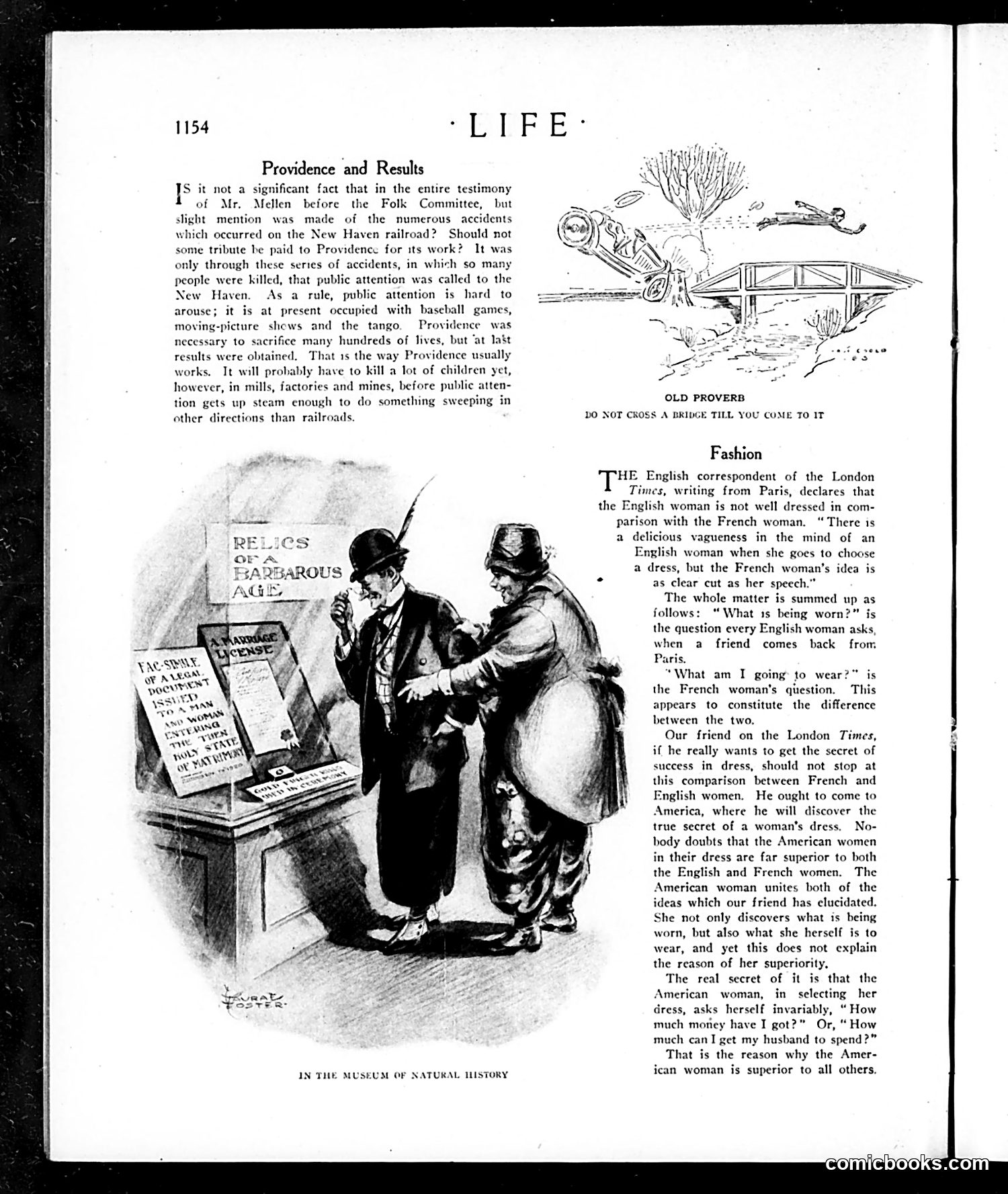
## "In the Museum of Natural History" (Left Cartoon) This sketch satirizes public indifference and the morbid spectacle of danger. Two well-dressed gentlemen examine relics in a museum labeled "Relics of a Barbarous Age"—but the display case actually contains warnings about railroad accidents: "Facsimile of a Legal Document" and notices about railway dangers. The joke: society treats railroad safety warnings as historical curiosities rather than urgent problems. The cartoon mocks how Americans ignore public hazards until forced to pay attention. ## "Providence and Results" (Text) The accompanying article sarcastically suggests that Providence (divine intervention) uses mass death—particularly on the New Haven railroad—to force public attention to reform. It bitterly notes that Americans ignore serious issues (railroads, factory safety) until tragedies mount. Only accidents generating headlines provoke action. The satire criticizes both public apathy and a system requiring body counts to motivate change. ## "Fashion" (Right Section) A lighter piece comparing English, French, and American women's approach to dress: English women ask "What is being worn?"; French women ask "What shall I wear?"; American women ask "How much money do I have?"—making materialism the source of American style superiority. It's gentle satire on American consumerism.
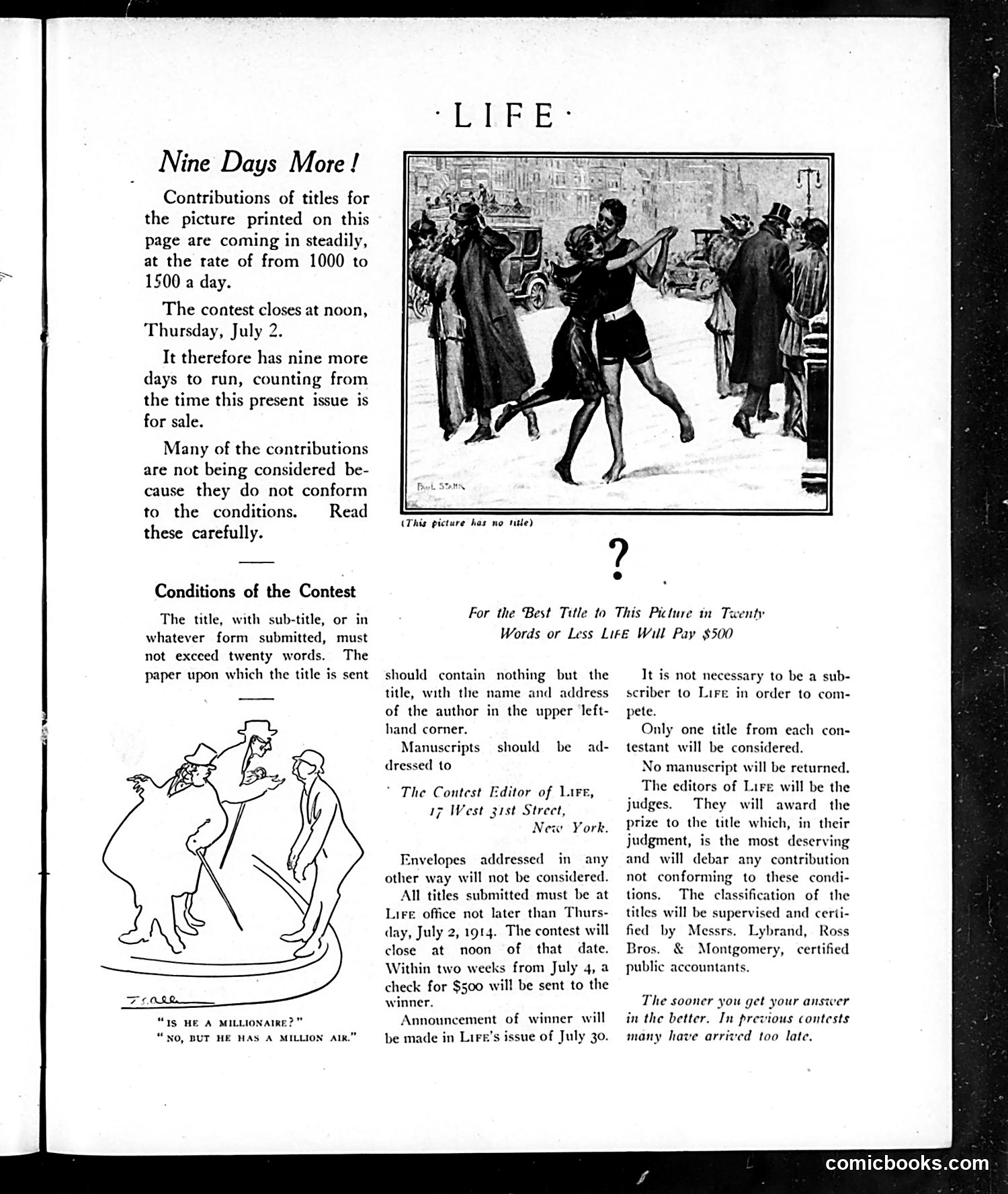
This page announces a $500 contest for readers to submit witty titles for the accompanying illustration. The image shows a woman in scanty attire dancing or performing in a street scene surrounded by onlookers in early 1900s dress and automobiles. The cartoon below—captioned "Is he a millionaire?" / "No, but he has a million air"—is a pun about a man with an affected or pretentious demeanor (putting on "airs"), playing on class anxieties of the era. The contest solicits titles in twenty words or less, with entries due by July 2, 1914. Life's editors (with certified public accounting oversight) will judge submissions, awarding the prize to the "most deserving" title. The urgent tone and mention that previous contests received late entries suggests this was a popular reader-engagement strategy for the satirical magazine.
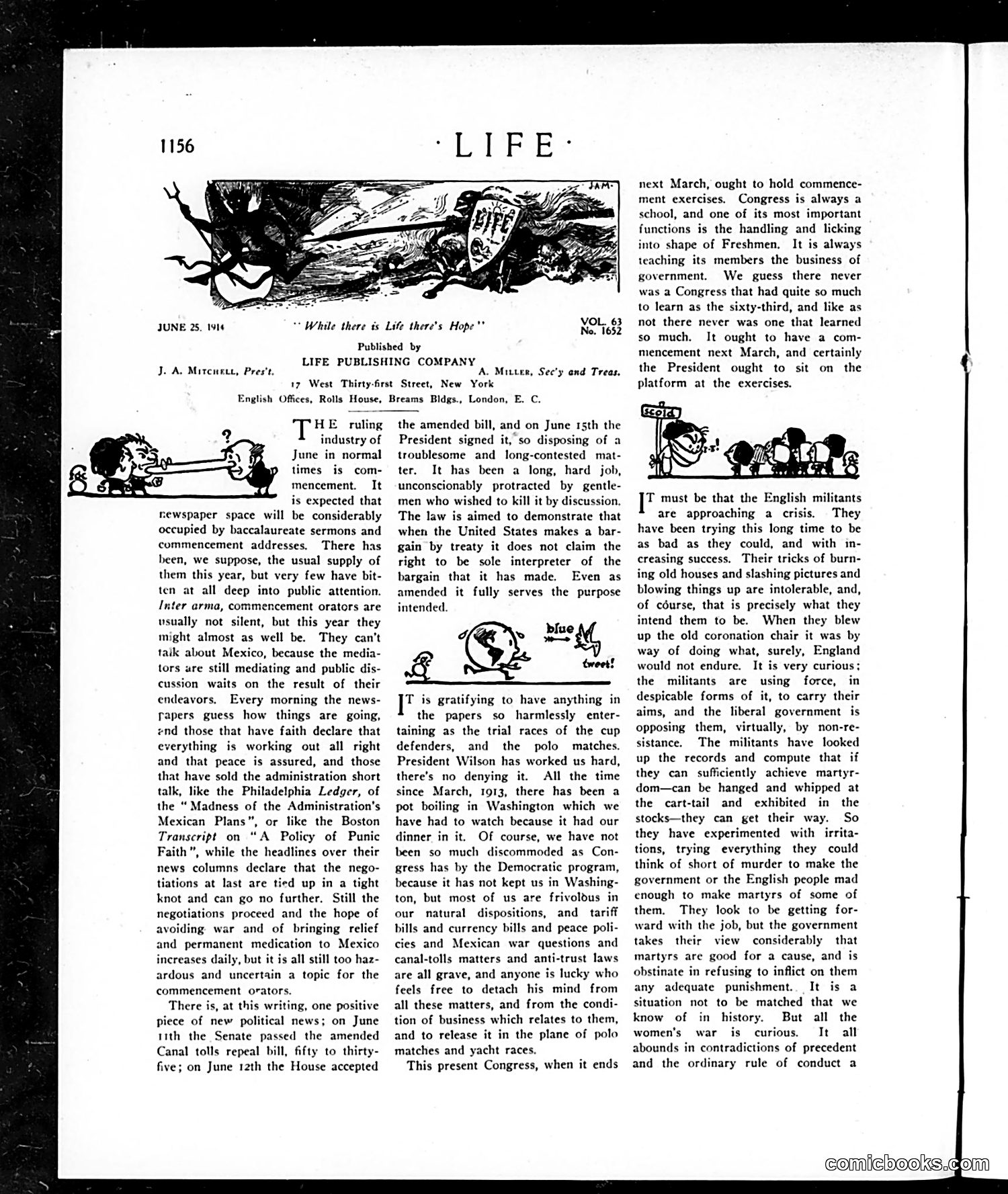
This page contains editorial commentary on current American political issues rather than traditional editorial cartoons. The main cartoon at the top—showing a skeletal or death-like figure—illustrates the masthead's motto "While there is Life there's Hope." The text discusses three pressing issues: 1. **Mexican mediation**: Commencement speakers cannot discuss Mexico because negotiations remain uncertain and ongoing. 2. **Canal tolls repeal**: The Senate and House recently passed legislation clarifying that the U.S. honors treaty obligations fairly, rejecting the notion that America can unilaterally interpret agreements. 3. **Congressional fatigue**: The author suggests Congress—particularly the 63rd Congress—has been heavily worked by President Wilson's Democratic agenda since 1913, dealing with tariffs, currency, Mexican affairs, and trust laws. The piece uses mild satire, joking that Congress itself needs "commencement exercises" to learn proper governance, suggesting the current legislative body is inexperienced and overtaxed.
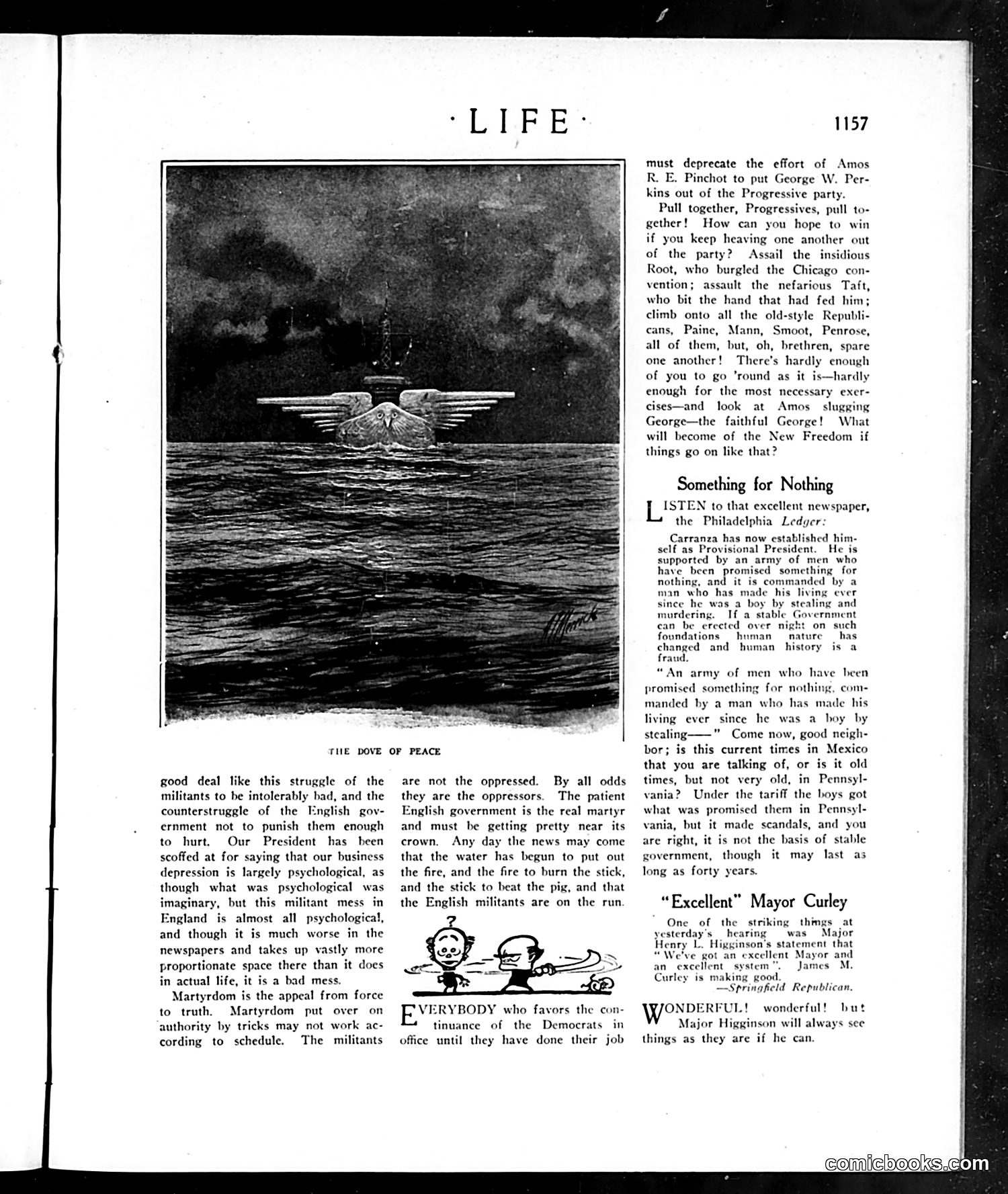
**"The Dove of Peace"** illustrates British suffragettes' militant campaign through a drowning dove image. The text criticizes their tactics as psychological manipulation rather than legitimate protest, arguing the suffragettes are oppressors (not oppressed) and the English government is the actual "martyr" enduring their disruptions. **"Something for Nothing"** mocks Mexican political instability under Carranza's leadership, sarcastically suggesting his army of thieves and murderers cannot build stable government—then pivots to expose American hypocrisy: Pennsylvania's own corrupt politicians (operating under tariff protections) made identical "something-for-nothing" promises yet remain tolerated. **"Excellent Mayor Curley"** quotes Boston businessman Henry Higginson's praise of Mayor James Curley as "excellent," which Life treats as naively optimistic or deliberately blind approval of a mediocre administration. All three sections employ bitter irony to critique governmental incompetence and corruption across three contexts: Britain, Mexico, and America.
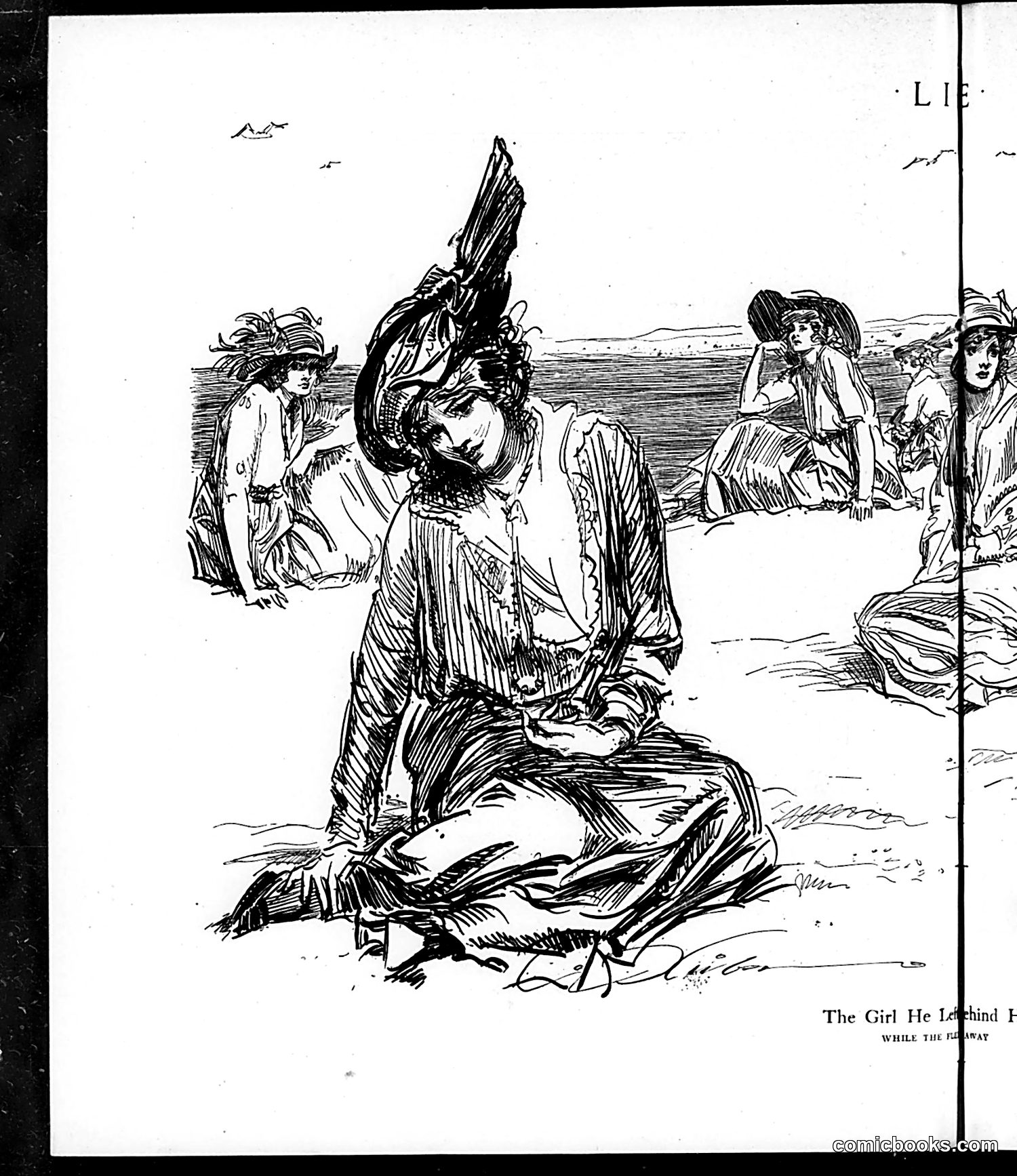
This illustration depicts a beach scene with a central female figure in elegant Edwardian dress striking a dramatic pose while reclining on the sand. Several other fashionably dressed women observe from the background. The caption reads "The Girl He Left Behind F[or]" and continues "WHILE THE [FARAWAY]" (text cut off). The satire appears to target romantic melodrama and theatrical behavior—specifically mocking the exaggerated emotionalism of a woman abandoned by her lover. Her overwrought posture and elaborate costume suggest she's performing distress for an audience rather than genuinely suffering. The other onlookers reinforce this sense of performative drama. This likely satirizes both contemporary sentimental popular fiction and women's theatrical displays of emotion during the Edwardian era, reflecting period attitudes about female performativity and romanticism.
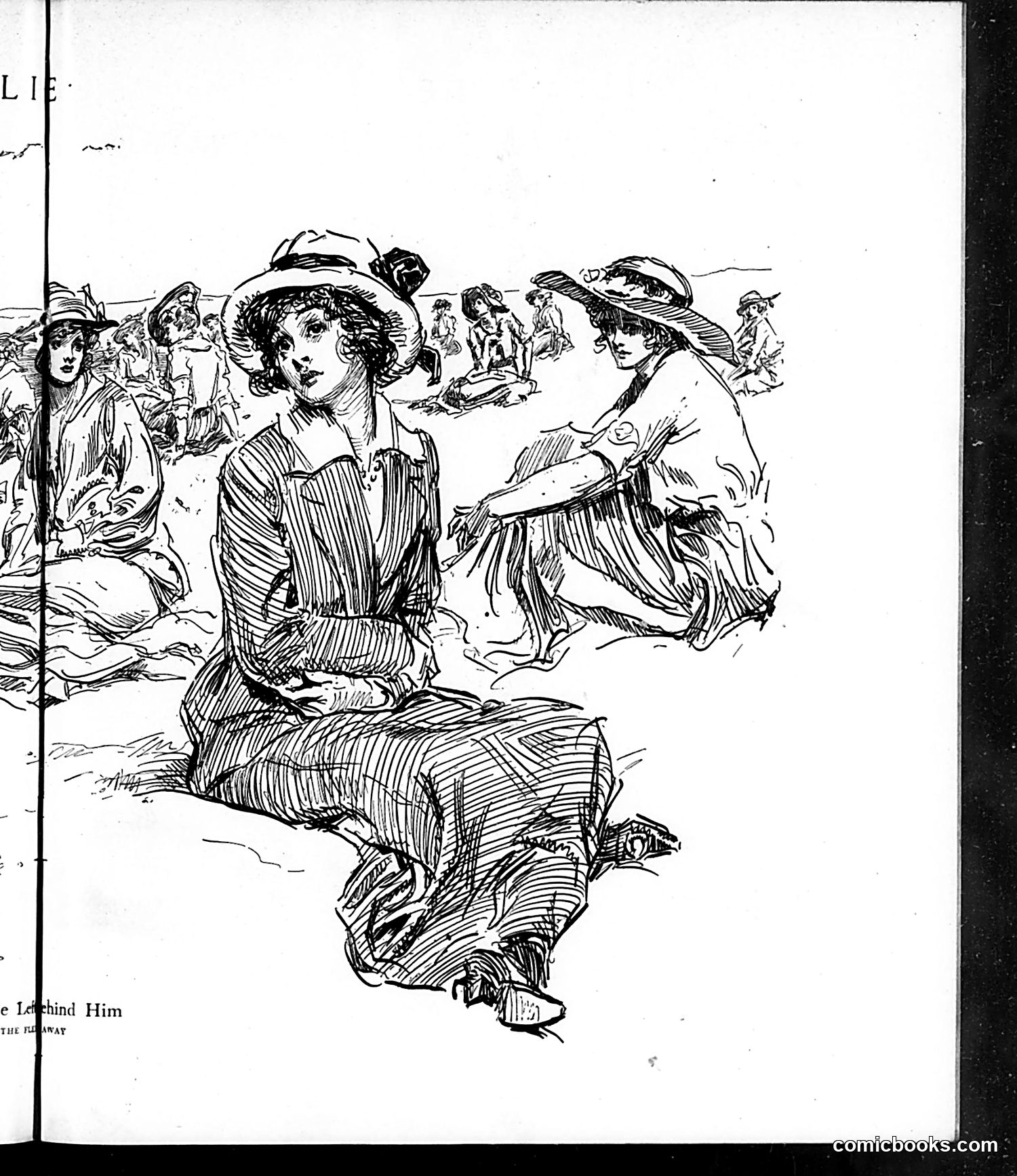
This page appears to be from *Life* magazine and shows a sketch titled "Behind Him" (visible at bottom left). The image depicts women in early 20th-century beach attire (long dresses, wide-brimmed hats) seated and conversing on a beach, with additional figures visible in the background. The satirical point likely concerns **women's fashion and social behavior at beaches** during this era—a period when beach culture was becoming more popular and women's clothing was gradually becoming less restrictive. The "Behind Him" title suggests commentary on how women positioned themselves socially or physically, possibly satirizing courtship dynamics, social hierarchies among beachgoers, or the contradictions between restrictive Victorian fashion and the casual beach setting. Without additional context or visible artist signature, the specific social critique remains unclear.
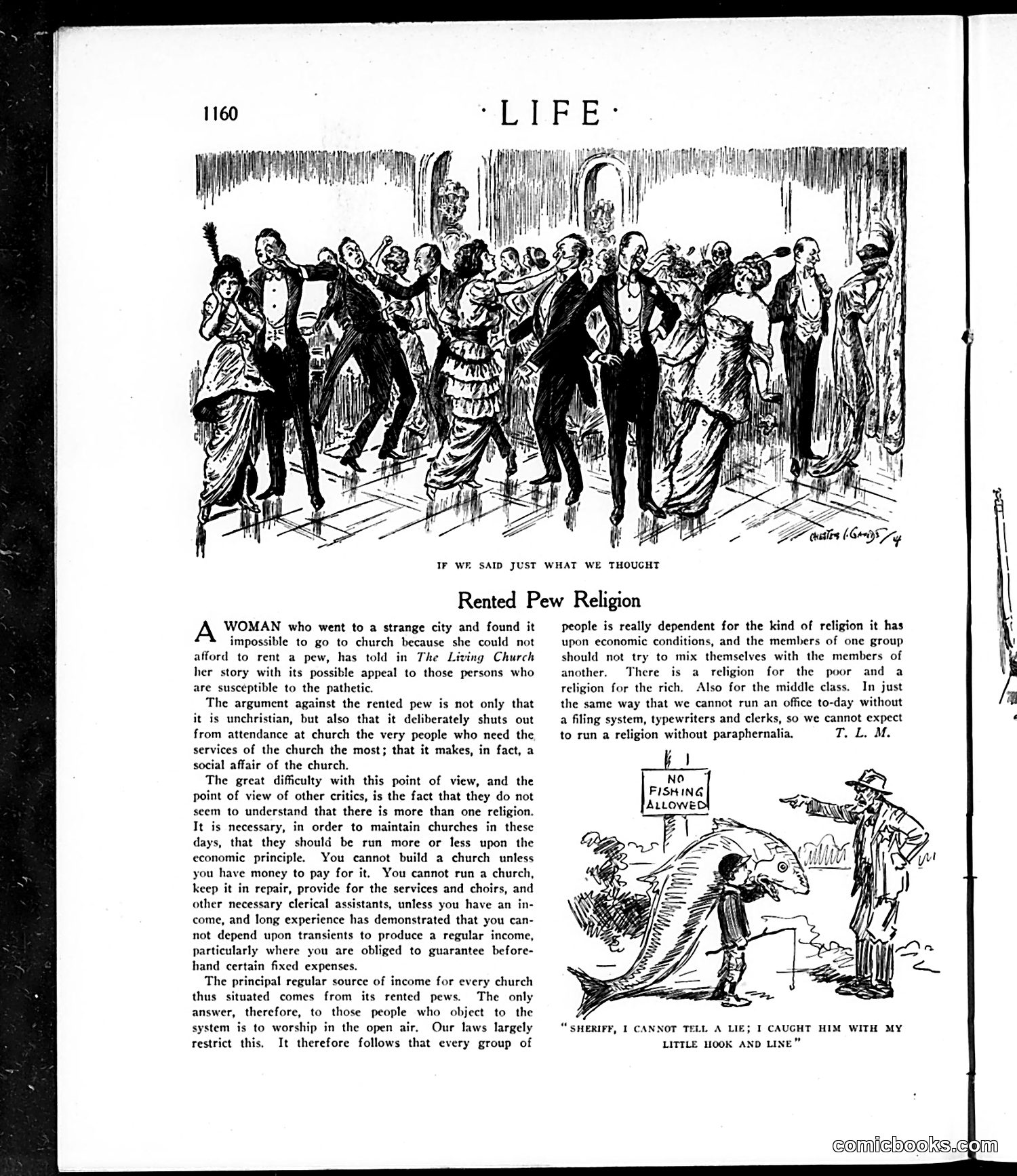
This satirical piece critiques the practice of churches charging rental fees for pews (bench seating), which excluded poor people from worship. **The Main Argument:** The article presents the church's economic justification—that buildings and clergy require funding, so pew rentals are necessary—but does so sarcastically. The author (T.L.M.) equates running a church to operating an office, implying this commodification corrupts religion's spiritual mission. **The Core Satire:** By treating religion as mere "paraphernalia" requiring "filing systems" and "typewriters," the piece mocks the contradiction of Christian churches claiming to serve the poor while financially excluding them. The title "Rented Pew Religion" captures the hypocrisy: a faith built on charity becomes a business model. **The Lower Cartoon:** A humorous aside about a fisherman caught illegally fishing—unrelated to the main critique but illustrating the magazine's satirical tone. The piece attacks institutional Christianity's class divisions during an era when American churches genuinely restricted seating by economic status.
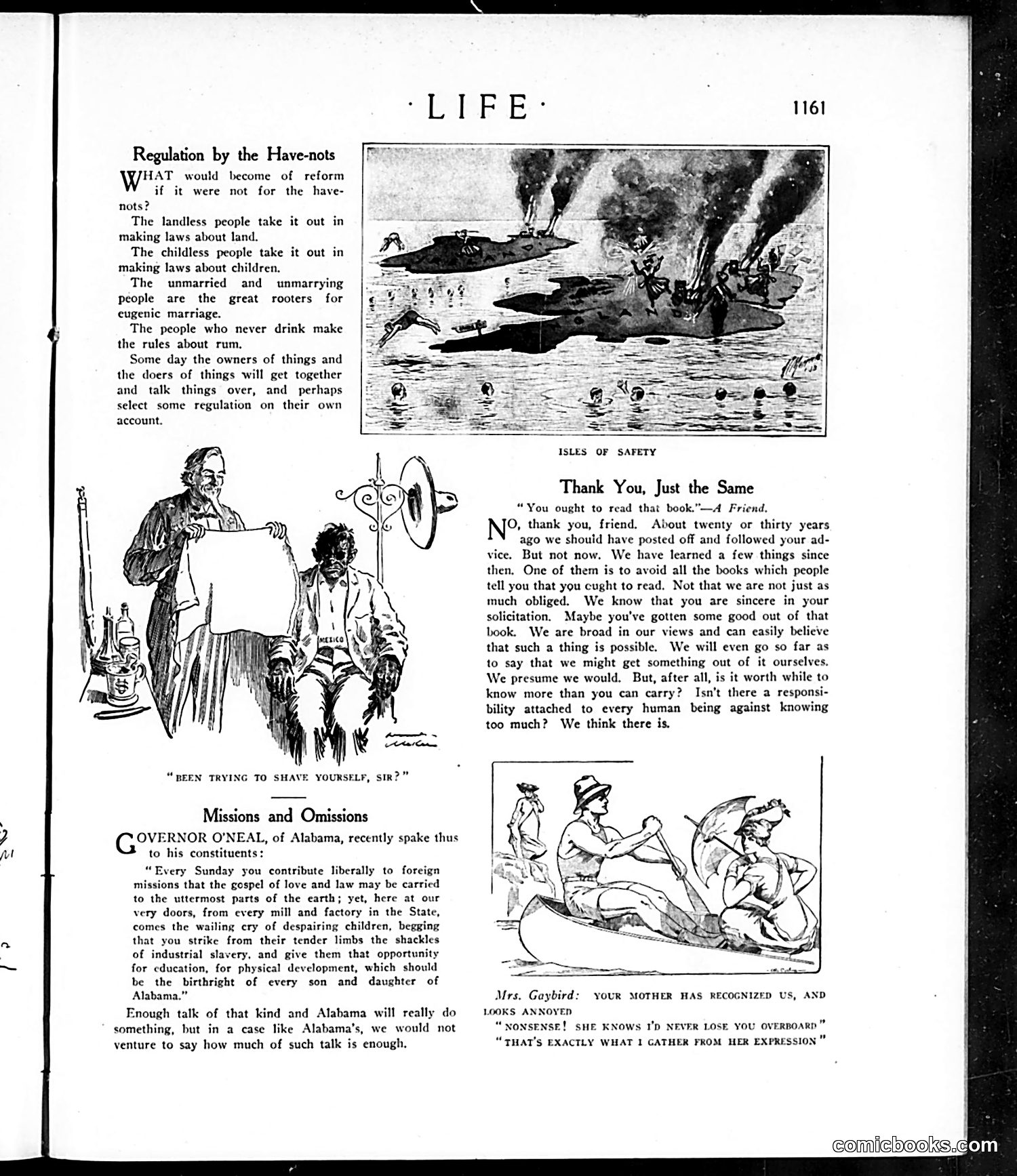
This page contains social and political satire typical of early 20th-century Life magazine. **"Regulation by the Have-nots"** critiques hypocrisy in lawmaking: those without land make land laws, the childless make child laws, non-drinkers regulate alcohol, and unmarried people champion eugenics. The satire suggests that people regulate what they lack rather than what they understand, and that actual property owners should negotiate rules themselves. **"Missions and Omissions"** quotes Alabama Governor O'Neal highlighting the contradiction between contributing to foreign missionary work while ignoring child labor exploitation in local mills and factories—a pointed critique of misplaced charitable priorities. **"Thank You, Just the Same"** humorously advises against reading books people recommend, suggesting overaccumulation of knowledge creates responsibility one shouldn't bear. **The bottom cartoon** depicts a boating scene where Mrs. Gaybird's mother has recognized an eloping couple, her expression revealing disapproval—the joke being the woman reads the mother's face as threatening to throw them overboard. All content mocks social hypocrisy, class attitudes, and conventional morality of the era.
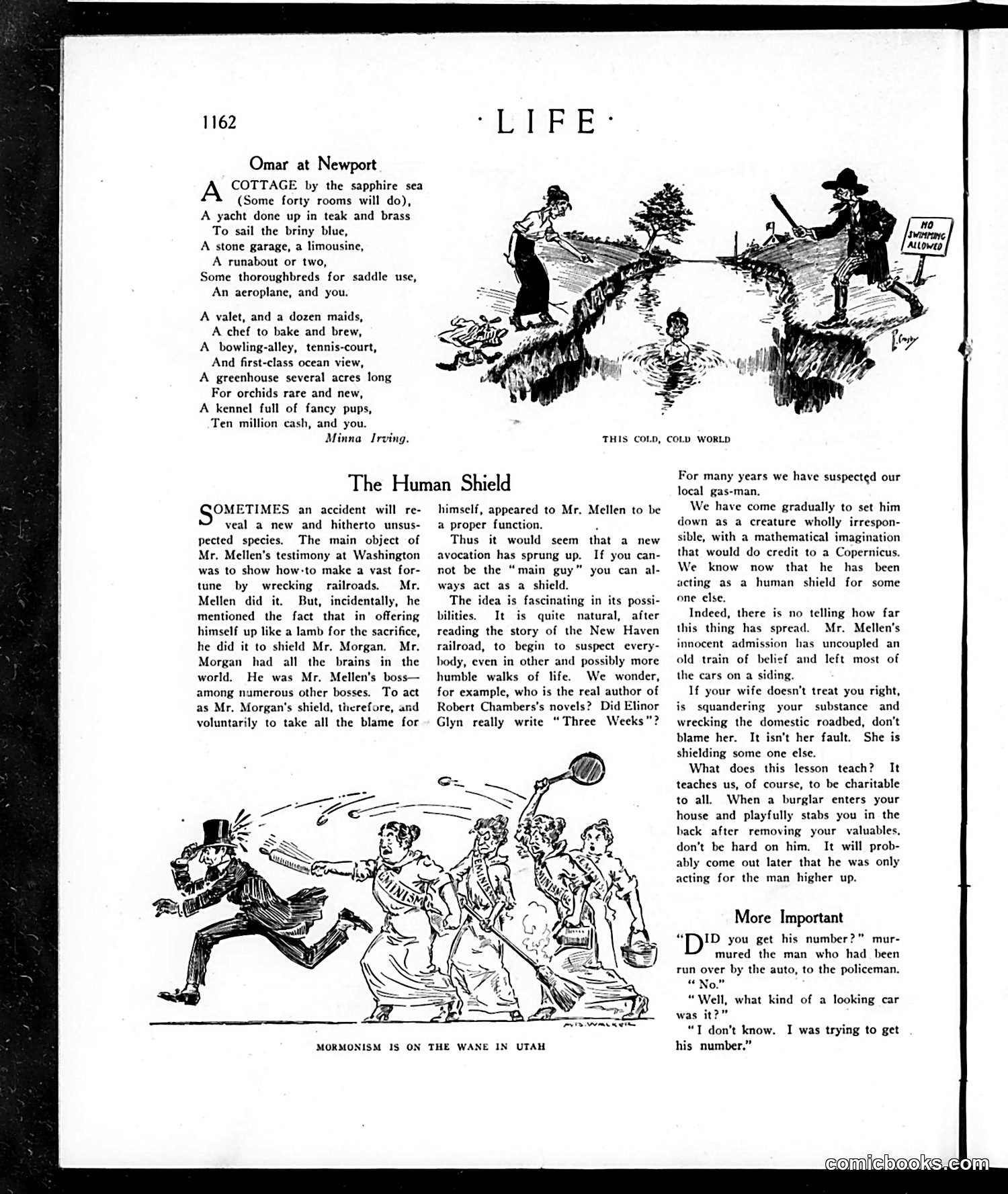
This page contains two distinct satirical pieces: **"Omar at Newport"** (poem by Minna Irving): A tongue-in-cheek catalog of extravagant wealthy lifestyle essentials—mansions, yachts, servants, thoroughbreds, and millions in cash. The repetition mocks the conspicuous consumption of Newport's ultra-rich elite. **"The Human Shield"** (main article): Satirizes railroad executive Charles Mellen's testimony before Congress regarding the New Haven Railroad scandal. Mellen allegedly shielded his boss J.P. Morgan from blame for fraudulent railroad wrecking schemes. The article extends this concept absurdly—suggesting anyone taking blame might be "shielding" someone higher up (dishonest gas-men, unfaithful wives, burglars). It's dark satire on corporate corruption and scapegoating, where underlings absorb responsibility while powerful men escape consequences. The accompanying cartoon shows a well-dressed man being pursued by multiple figures carrying shields. The page satirizes Gilded Age excess and corporate malfeasance through exaggeration and ironic extension of logic.
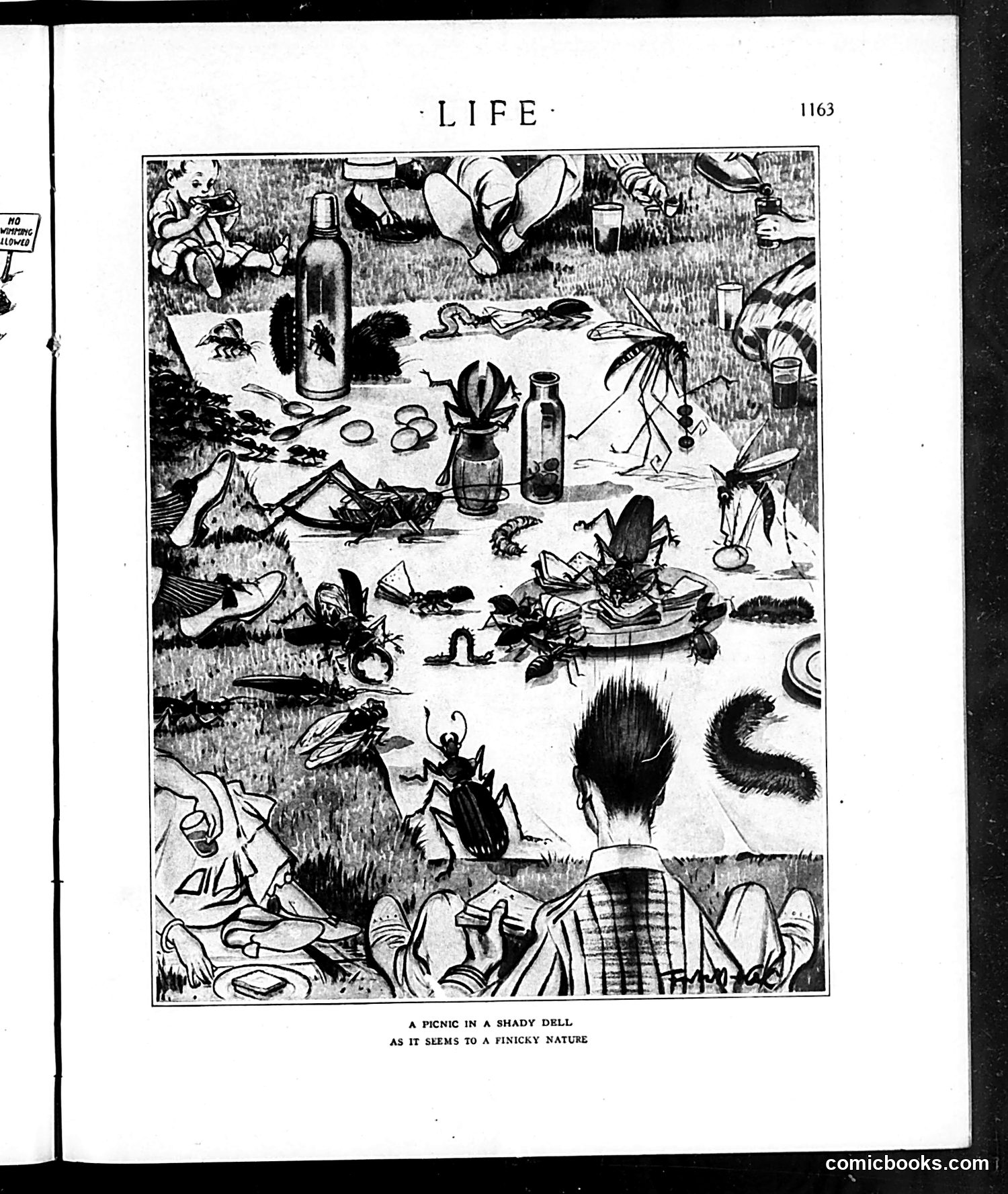
This is a humorous illustration showing a picnic scene from the perspective of someone with a sensitive or squeamish nature. The cartoon depicts what appears to be an ordinary outdoor meal, but it's been reimagined as a chaotic nightmare populated by insects, bugs, and other creatures. The satire targets "finicky" or fastidious people—those overly concerned with cleanliness and hygiene. What should be a pleasant pastoral scene becomes grotesque through their anxious imagination: insects swarm over food and bottles, creatures multiply unnaturally, and the natural world transforms into something disgusting and invasive. The humor relies on exaggeration of germaphobic attitudes, presenting the fastidious person's fear of nature as comically paranoid. It's a gentle social satire about excessive worry over contamination during outdoor dining.
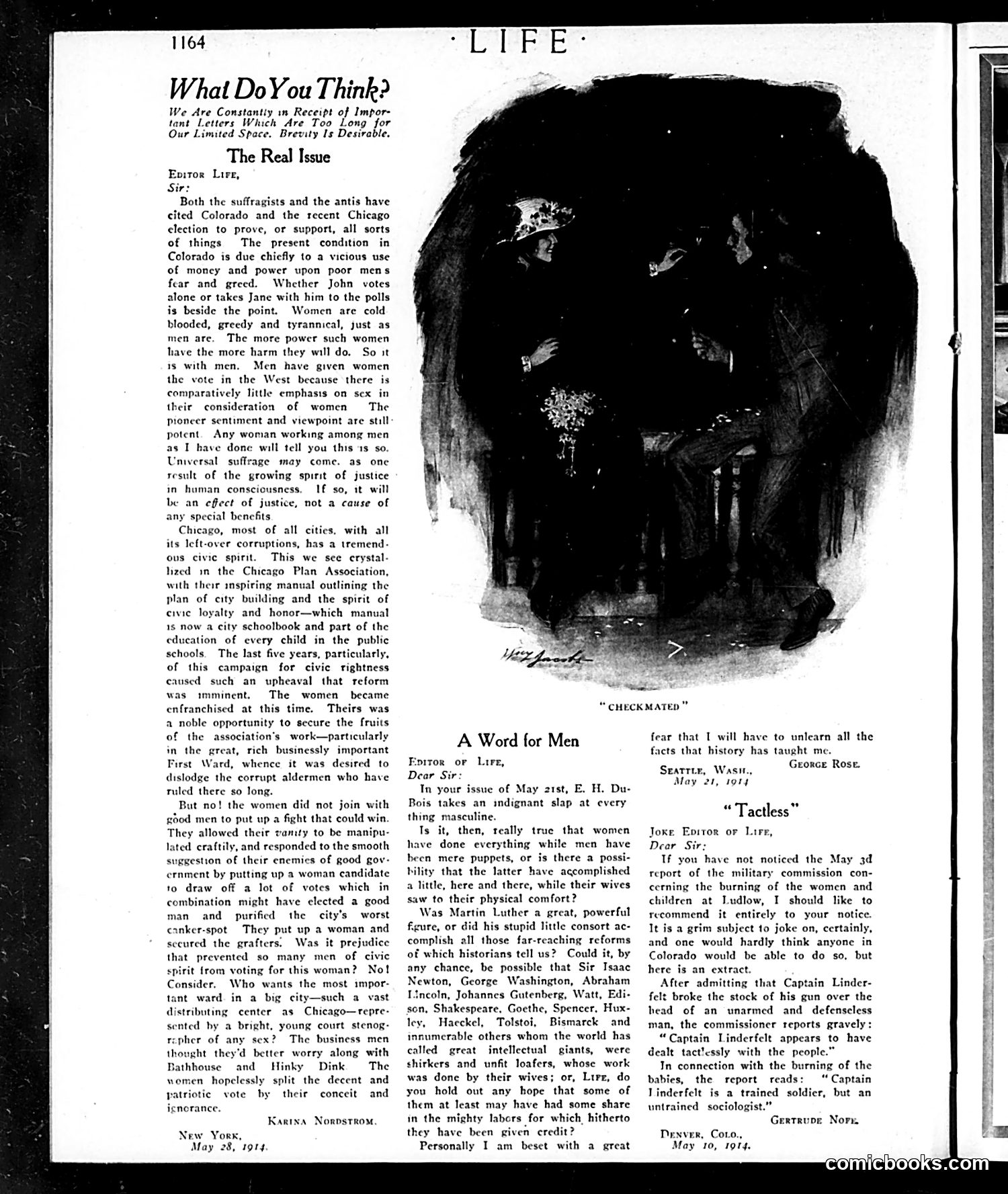
This is a **readers' letters section** from Life magazine's political commentary pages. The cartoon "Checkmate" (a dramatic dark portrait) accompanies these three published letters debating **women's suffrage** — a major contested issue of 1914. The letters reveal the heated suffrage debate: Karina Nordstrom argues women voters in Chicago failed civic reform by fielding a female candidate who split the reform vote, suggesting women lack political judgment. A male respondent (George Rose, Seattle) counters that men have accomplished history's greatest achievements while women merely provided "physical comfort." Another letter ("Tactless," Jobe) sarcastically critiques anti-suffrage sentiment. The page illustrates how **suffrage wasn't simply "for" or "against" women** — opponents made diverse arguments: that women were corruptible, tactically incompetent, or unnecessary to progress. Life published these contrasting views to satirize the absurdity of anti-suffrage reasoning while claiming neutrality.
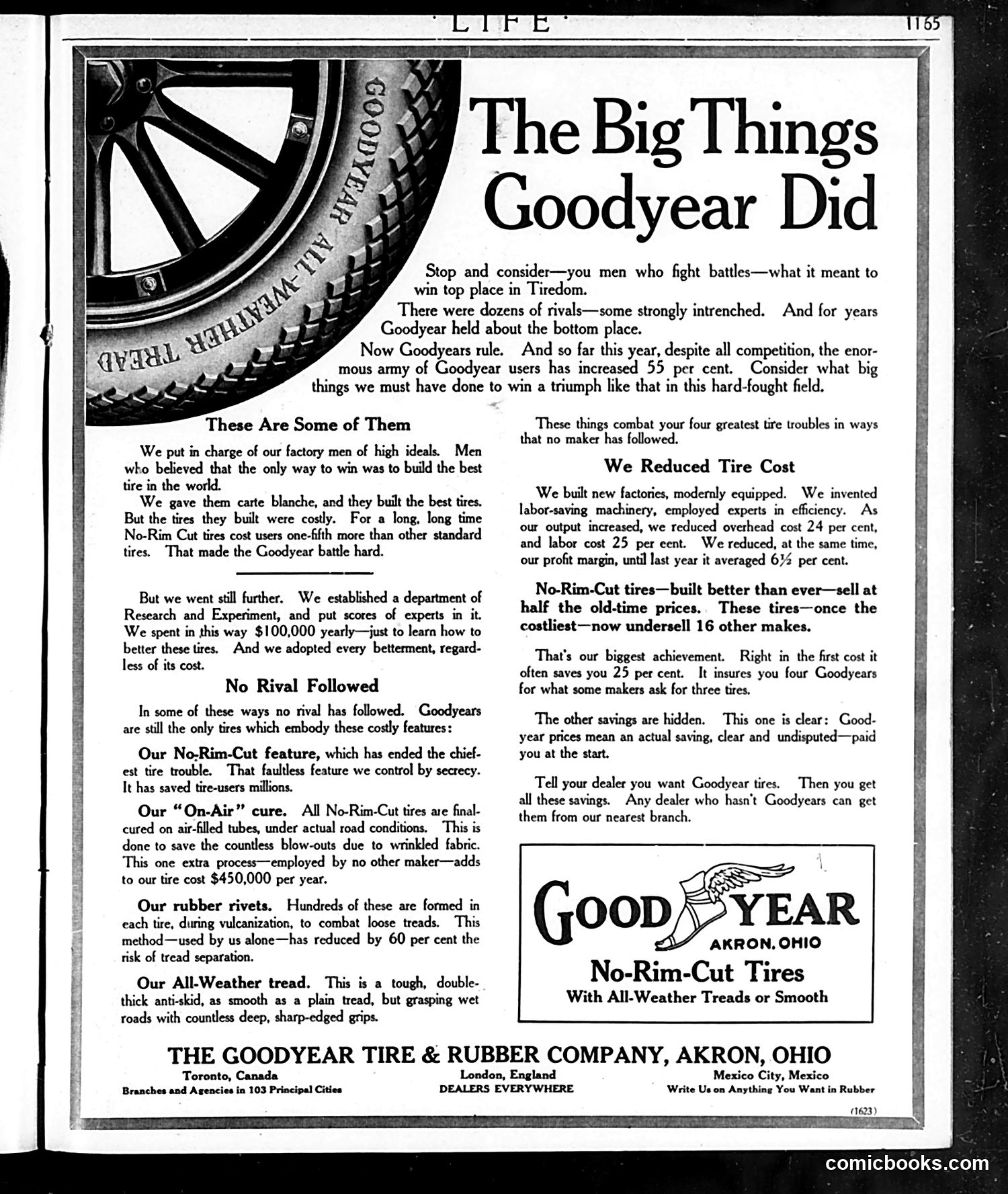
This is **not satirical content** — it's a straightforward Goodyear Tire & Rubber Company advertisement from Life magazine. There are no political cartoons or caricatures to analyze. The ad uses military/competitive metaphor ("fight battles," "hard-fought field," "No Rival Followed") to frame Goodyear's business dominance in tire manufacturing. The company claims it rose from last place to market leader through superior engineering, R&D investment ($100,000 annually), and proprietary features (No-Rim-Cut, On-Air curing, rubber rivets). The key sales pitch: despite building higher-quality tires, Goodyear reduced prices to undercut 16 competitors, offering tires "once the costliest—now undersell" others at 25% savings. The ad emphasizes this isn't hidden profit-cutting but genuine innovation reducing manufacturing costs (overhead down 24%, labor 25%). This represents early industrial-era marketing: positioning corporate success as virtuous investment in product quality and consumer benefit rather than pure profit motive.
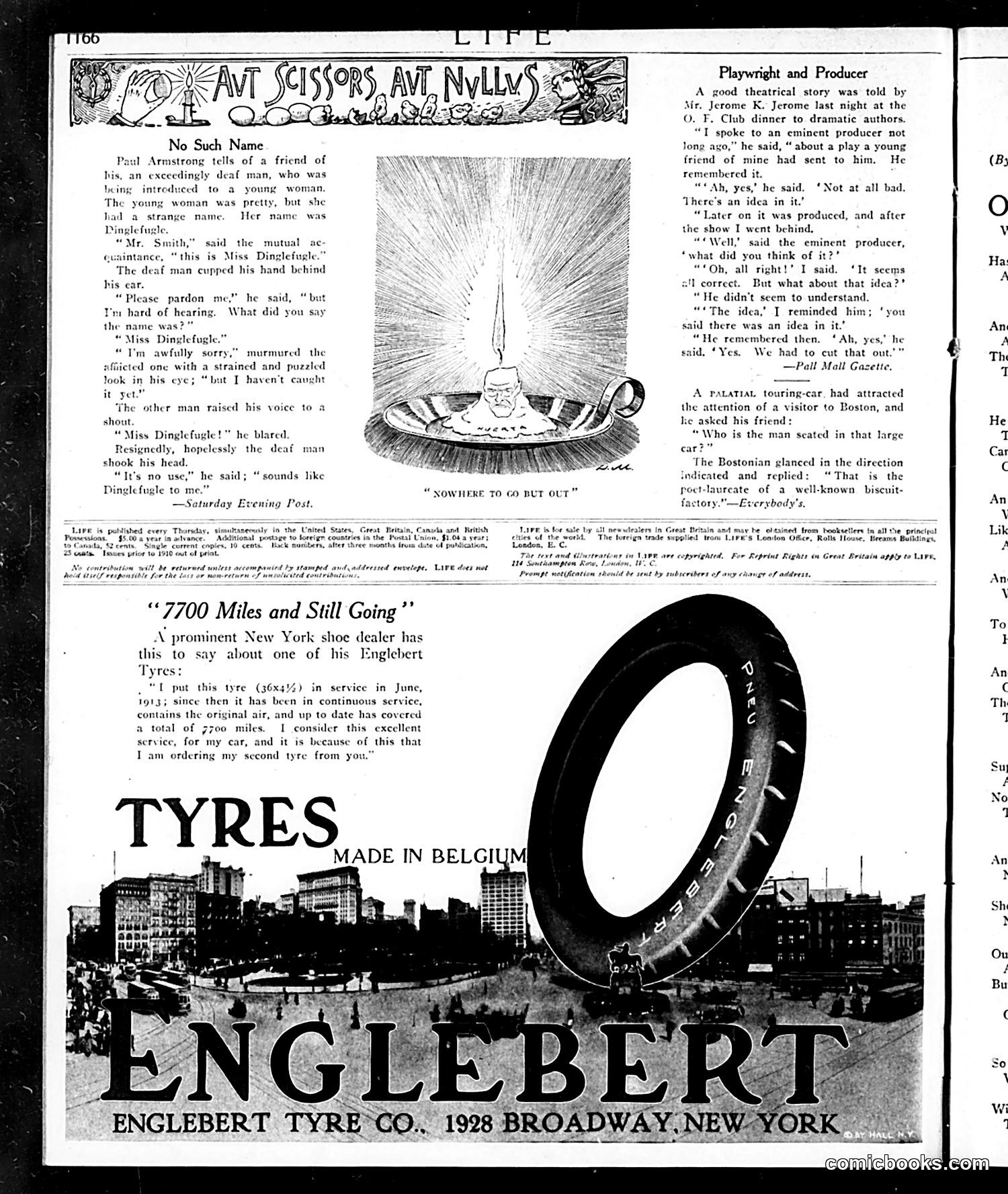
This page contains three separate humor pieces from Life magazine: 1. **"No Such Name"** (top left): A joke about a deaf man repeatedly failing to hear an unusual woman's name ("Dinglefugle"). The humor relies on the premise that some names are so unfamiliar they're literally unbelievable—even when shouted, the deaf man assumes he's mishearing. 2. **"Playwright and Producer"** (top right): A satirical anecdote by Jerome K. Jerome about theatrical pretension. A producer claims credit for an "idea" in a play, but when confronted after opening night, admits they had to *cut* that very idea from the finished show—exposing the producer as a fraud who doesn't understand his own production. 3. **Englebert Tyres Advertisement** (bottom): Not satire, but a testimonial ad featuring a New York shoe dealer praising a Belgian tire that allegedly lasted 7,700 miles since 1913 while retaining "original air." The page is primarily **advertising-driven content mixed with light social satire**—typical of Life's format as a humor magazine.
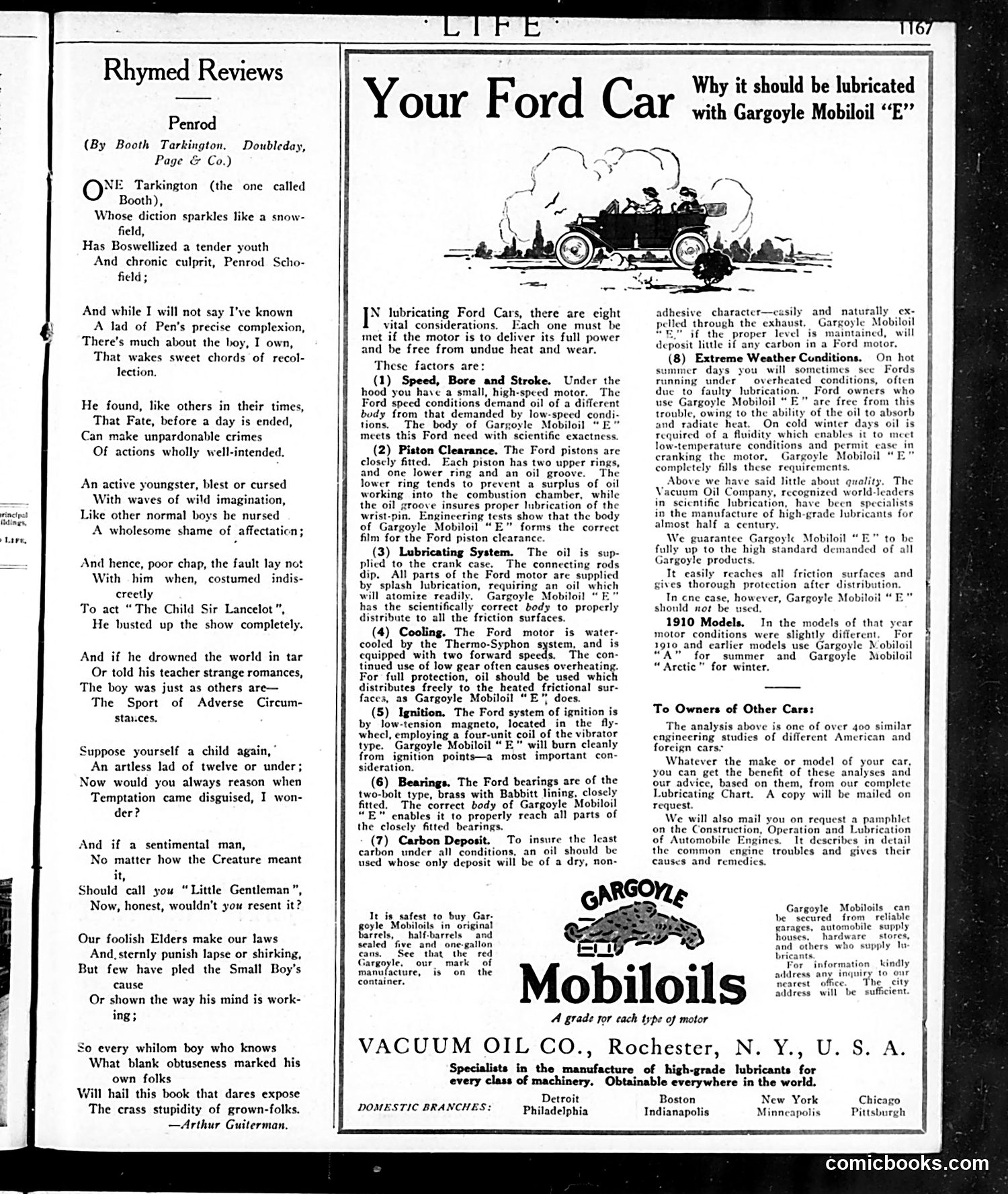
This Life magazine page contains two unrelated items: **Left side:** A poem by Arthur Guiterman reviewing Booth Tarkington's novel *Penrod*. The review praises the book for sympathetically portraying a mischievous boy, arguing that adults unfairly judge children without understanding how their minds work. The poem defends boyish behavior as natural rather than malicious—a boy in costume accidentally ruins a show, or tells tall tales to his teacher, but these are normal childhood impulses, not character flaws. **Right side:** An advertisement for Gargoyle Mobiloil "E" lubricating oil, specifically formulated for Ford automobiles. The ad lists eight technical considerations for Ford engine lubrication in dense, specialized language—piston clearance, cooling systems, ignition points, etc. The juxtaposition is purely commercial; there's no satirical connection between the literary review and the oil advertisement.
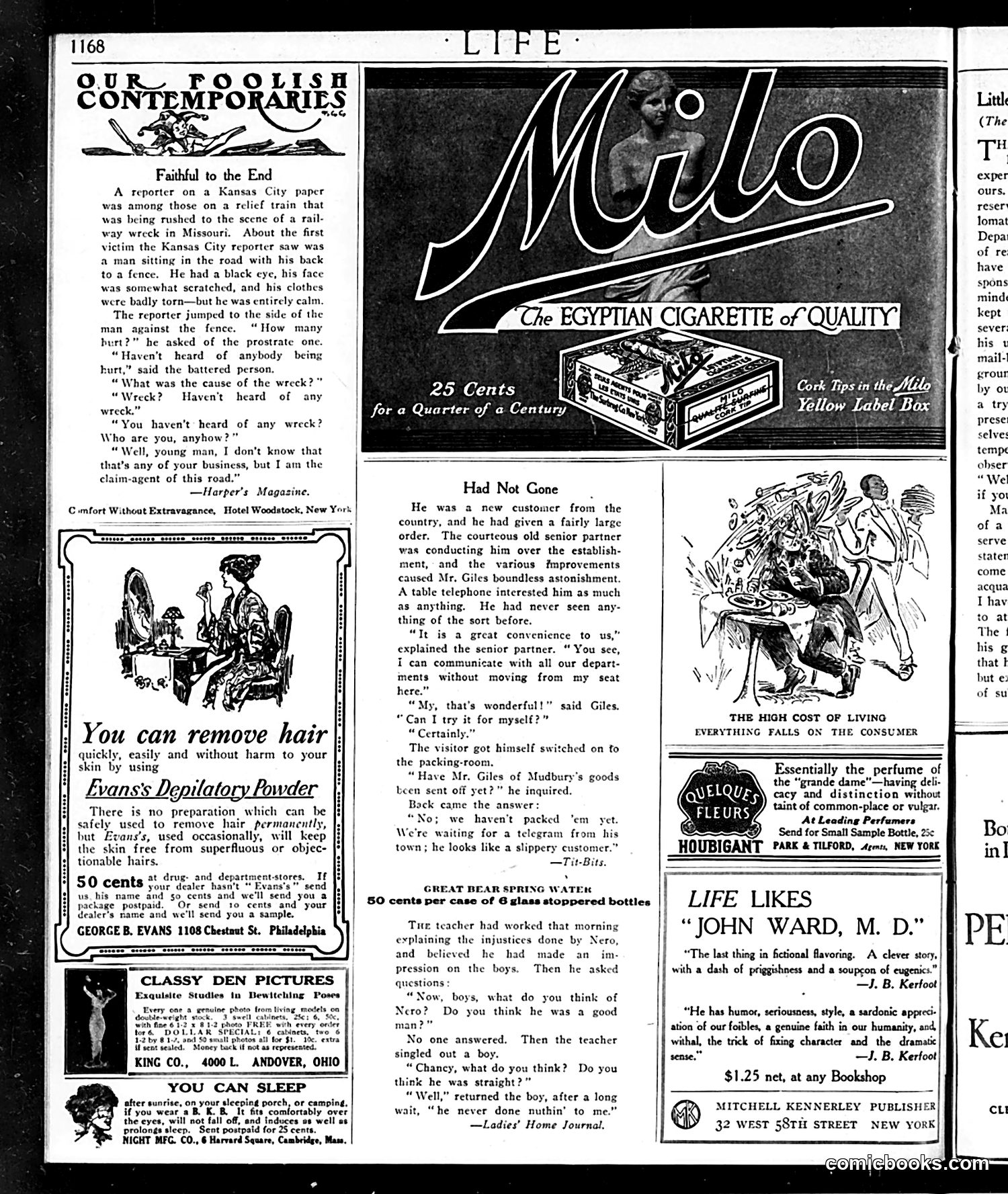
This page from *Life* magazine contains satirical stories and advertisements typical of early 20th-century American humor. The main content includes: **"Faithful to the End"** (top left): A humorous anecdote from *Harper's Magazine* about a Kansas City newspaper reporter interviewing a railroad wreck victim. The joke relies on the victim's apparent obliviousness—he claims ignorance of the wreck itself, then reveals he's the railroad's claim-agent, satirizing insurance company indifference to disaster. **"Had Not Gone"**: A brief comedy piece about a country visitor named Giles marveling at a telephone in a business office, then accidentally calling the packing room while trying to test it. The humor stems from the visitor's technological naïveté. The page is primarily **advertisements** for consumer products (Milo cigarettes, Evans's Depilatory Powder, perfume, spring water) interspersed with these short humorous pieces—a typical *Life* magazine layout of the era. The publication mixed satire with commercial content to appeal to middle-class readers.
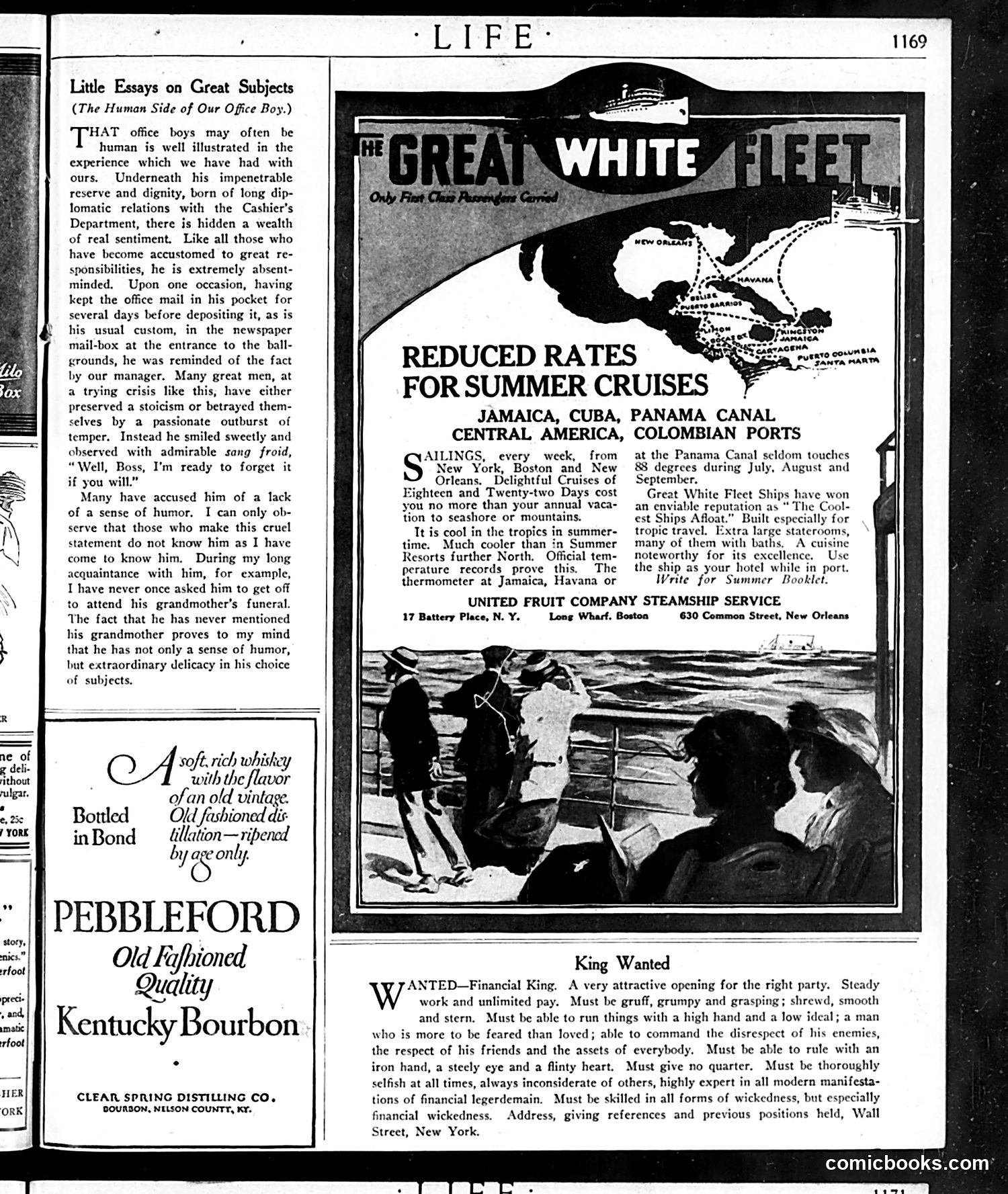
This page mixes editorial content with advertisements, lacking coherent cartoon satire in the modern sense. The left column's "Little Essays" humorously describes an office boy's absent-mindedness and emotional restraint, presented as admirable stoicism—a gentle workplace comedy. The centerpiece advertises the "Great White Fleet" cruise ships offering summer voyages to Jamaica, Cuba, and Panama at reduced rates. The accompanying illustration shows passengers aboard ship. Below, a "King Wanted" classified ad satirizes ruthless business ambition by explicitly seeking someone greedy, intimidating, and unscrupulous—a tycoon willing to dominate and deceive. This appears to mock the era's industrial robber-baron mentality, though whether genuinely or approvingly remains unclear from context alone. The page also includes period liquor advertisements (whiskey, bourbon). Overall, this is primarily a commercial publication with light humor rather than sharp political satire.
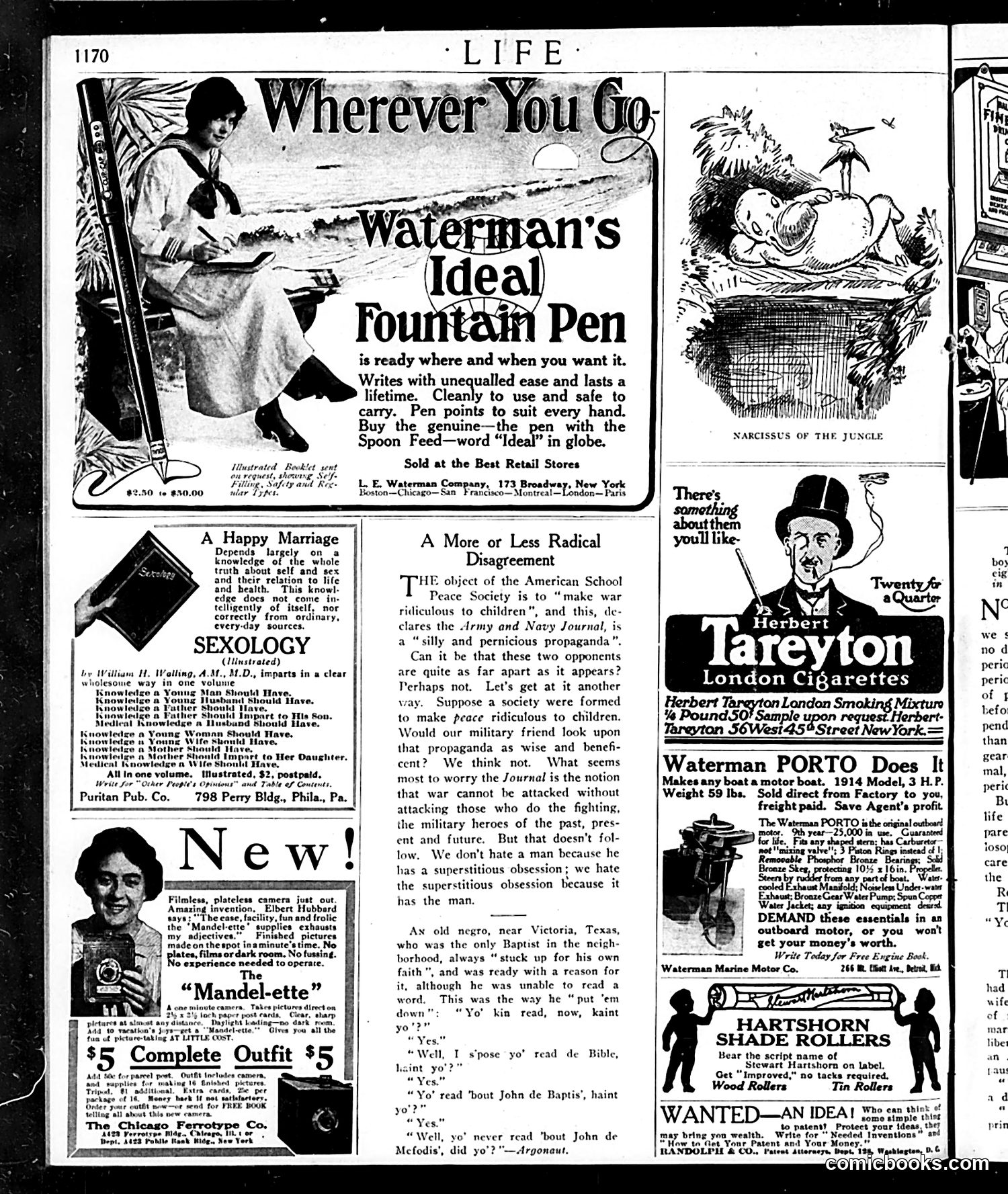
This page is **primarily advertisements** with one notable editorial content piece. **Main Editorial Content:** The article "A More or Less Radical Disagreement" discusses a debate between the American School Peace Society (which aims to make war seem ridiculous to children) and the Army and Navy Journal (which calls this "silly and pernicious propaganda"). Life's editorial stance argues both sides may not be as far apart as they appear—one can oppose war without hating soldiers. The piece concludes with a humorous anecdote about an illiterate Black Baptist man defending his faith by claiming ignorance of competing denominations, using dialect humor typical of the era. **Advertisements:** The page features various period products: Waterman fountain pens, the "Mandel-ette" camera, sexology books, Herbert Tareyton cigarettes, Waterman outboard motors, and Hartshorn shade rollers. These ads reflect early-1900s consumer goods and social attitudes, including frank discussion of sexual education. The content reflects early 20th-century American debates about pacifism, militarism, and consumer culture.
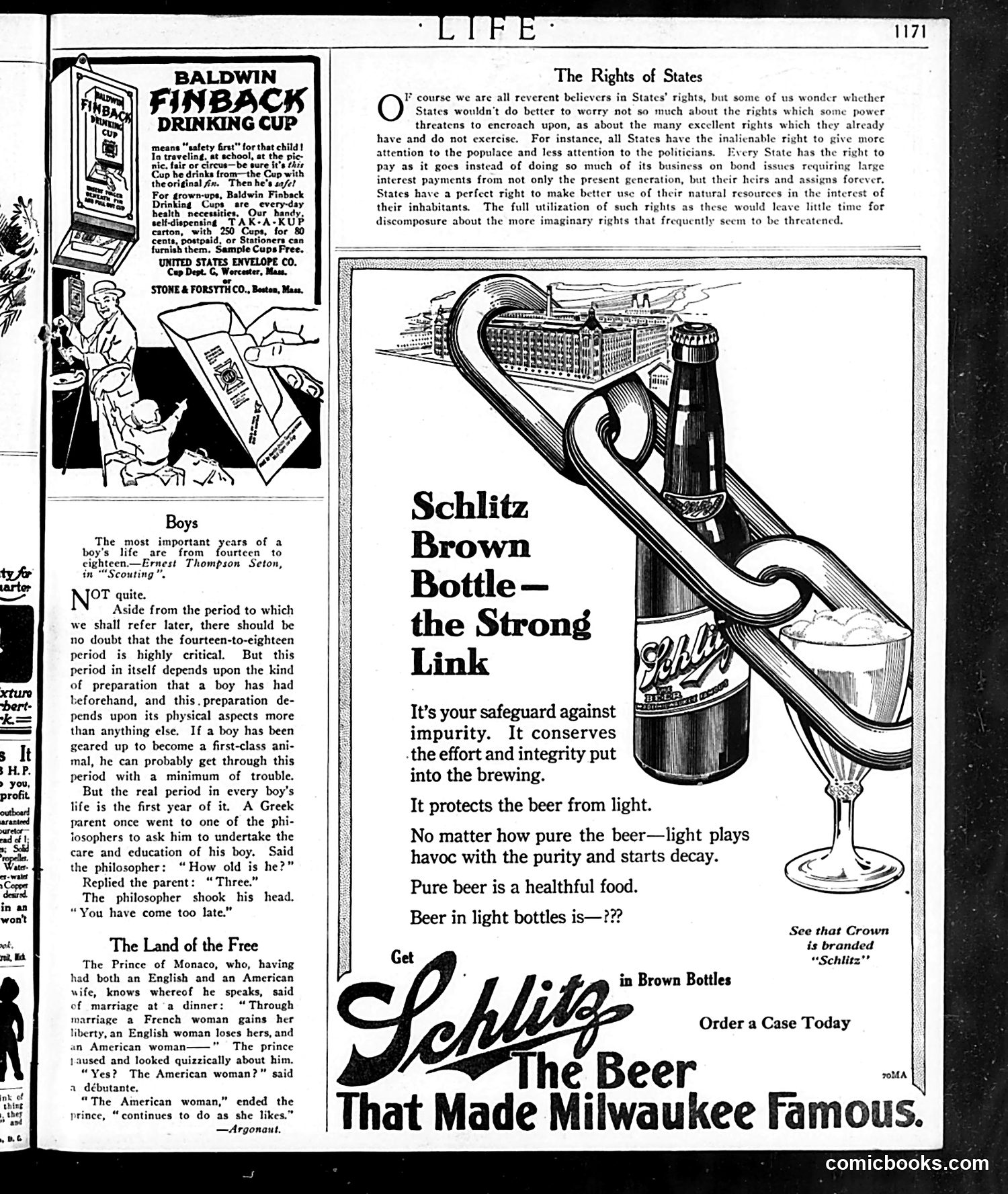
This page contains a satirical editorial essay and beer advertisement. **The Editorial Essay:** "The Rights of States" critiques states' rights rhetoric by arguing that states already possess excellent rights they *fail to exercise*—such as investing in public welfare, budgeting responsibly without bond debt, and developing natural resources for inhabitants' benefit. The satire suggests that political emphasis on "imaginary rights" being threatened distracts from states' actual obligation to use their existing powers for citizens' wellbeing. It's a progressive-era critique of conservative federalism rhetoric. **The Schlitz Advertisement:** Promotes brown bottles as superior to clear ones, claiming they protect beer from light-induced decay. The ad claims "pure beer is a healthful food," reflecting early-20th-century marketing that positioned beer as nutritious. The lighthouse imagery suggests reliability and safe passage. **The "Boys" Section:** Philosophical musings on child development, arguing early childhood preparation matters more than adolescent years.
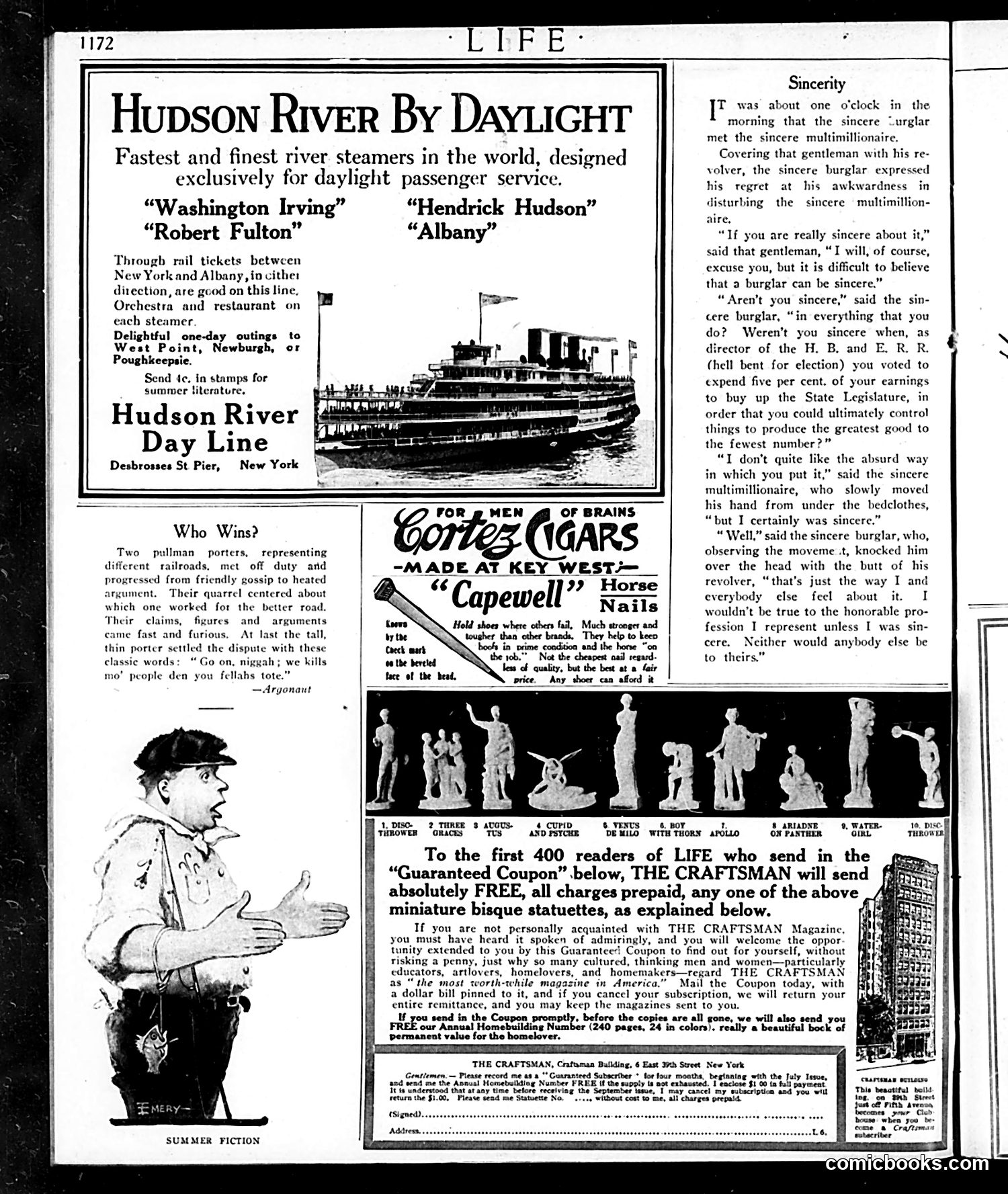
This page contains three distinct elements: **Hudson River Steamship Advertisement**: Promotional copy for luxury daylight passenger steamers named after American historical figures (Washington Irving, Robert Fulton, etc.), offering service between New York and Albany with amenities like orchestras and restaurants. **"Who Wins?" Cartoon**: A brief anecdote about two Pullman porters debating which railroad employer is superior, settling their dispute with a racial slur ("Go on, niggah; we kills mo' people den you fellahs tote"). The joke relies on self-deprecating stereotyping common to early 20th-century "humor." **"Sincerity" Story**: A satirical narrative contrasting a burglar and a wealthy railroad director (implied H.B. & E.R.R. executive). The burglar accuses the businessman of hypocrisy—voting to bribe legislators while claiming sincerity—suggesting both are equally amoral. The burglar's violence is presented as logically consistent with his worldview. **Overall**: The page reflects Progressive-era social criticism mixed with casual racial humor typical of *Life* magazine's satirical approach to industrial-era corruption and class conflict.
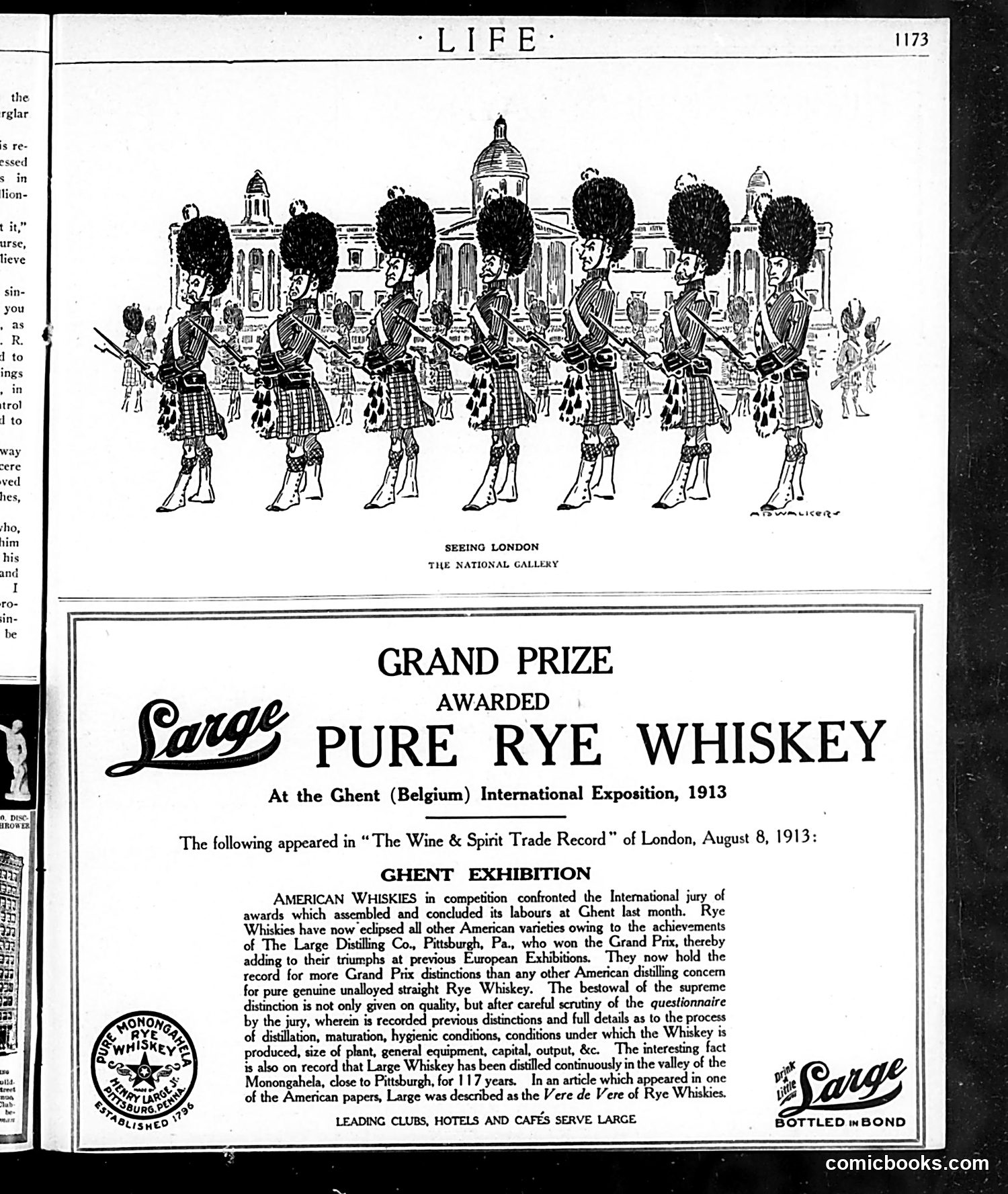
**Top Cartoon**: "Seeing London—The National Gallery" depicts Scottish bagpipers marching in formation before a neoclassical building. The joke satirizes tourist culture: visitors to London's famous art museum are distracted by or more impressed by marching bands and pageantry than actual art. This mocks shallow tourism and British spectacle over substance. **Bottom Section**: This is primarily **advertising**, not satire. Large Distilling Co. (Pittsburgh) announces winning the Grand Prix for rye whiskey at the 1913 Ghent International Exposition, citing 117 years of continuous production in Monongahela Valley. The ad boasts the award judges examined distillation methods, hygiene, and equipment—not just taste. The phrase "Vere de Vere of Rye Whiskies" is a humorous literary reference suggesting aristocratic pedigree. The advertisement targets upscale establishments ("leading clubs, hotels and cafes").
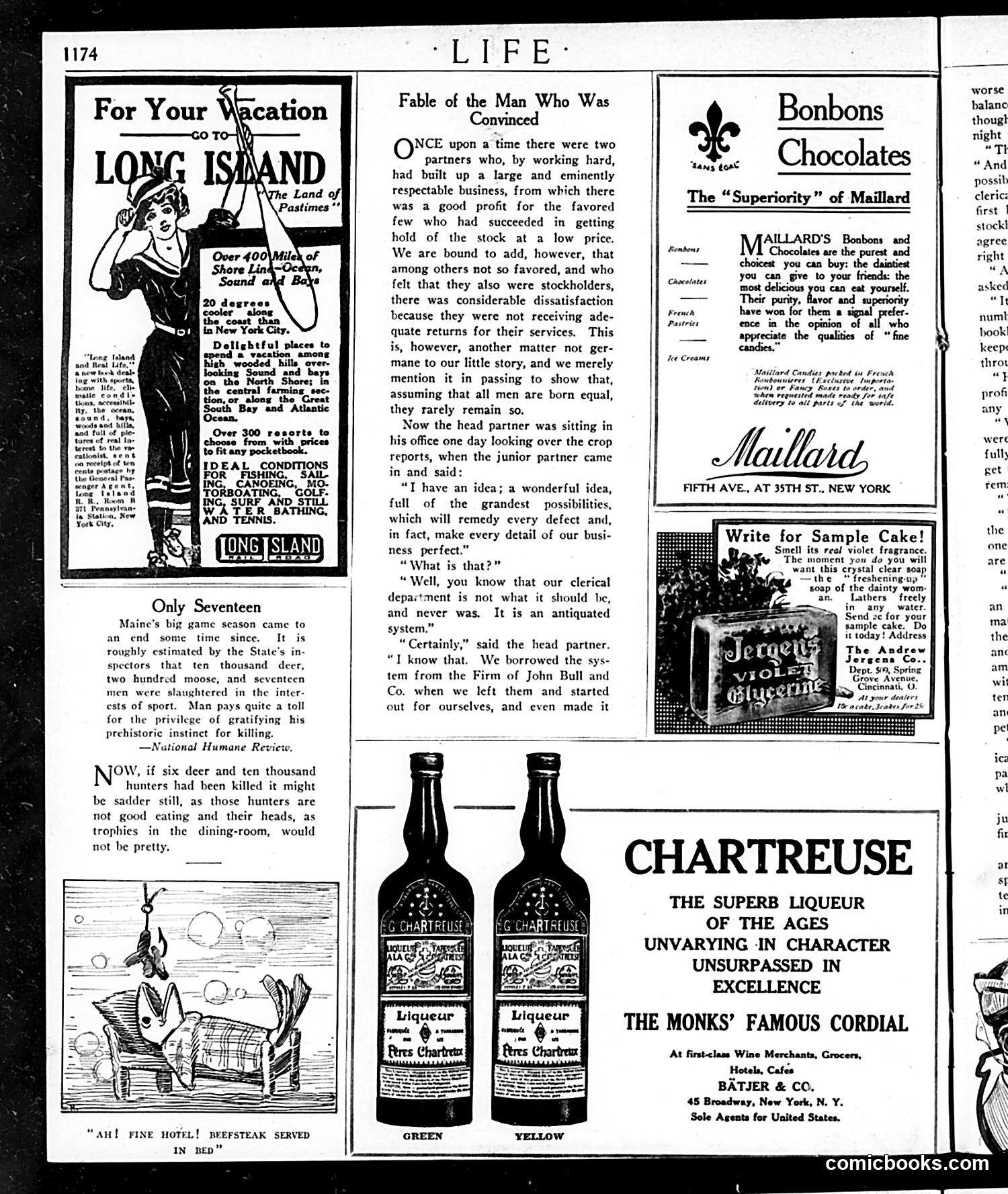
**Main Content: "Fable of the Man Who Was Convinced"** This satirical fable critiques outdated corporate management systems. Two business partners built a profitable company, but junior stockholders receive inadequate returns. The junior partner proposes modernizing the "antiquated" clerical department. The head partner dismisses this, revealing he copied their entire system from "the Firm of John Bull and Co." — a transparent reference to British business practices. **The Satire's Point:** The joke targets American businesses slavishly imitating British methods without innovation or adaptation. By having the head partner refuse modernization while defending a borrowed system, the author mocks stubborn executives clinging to outdated practices simply because they originate from prestigious British sources. The title "Fable of the Man Who Was Convinced" suggests ironic resignation — the partner will likely remain unconvinced despite obvious need for change. **Context:** This reflects early 20th-century American anxiety about business competitiveness and the tension between respecting British traditions versus embracing modern efficiency. The page is otherwise dominated by period advertisements for Long Island tourism, Maillard chocolates, and Chartreuse liqueur.
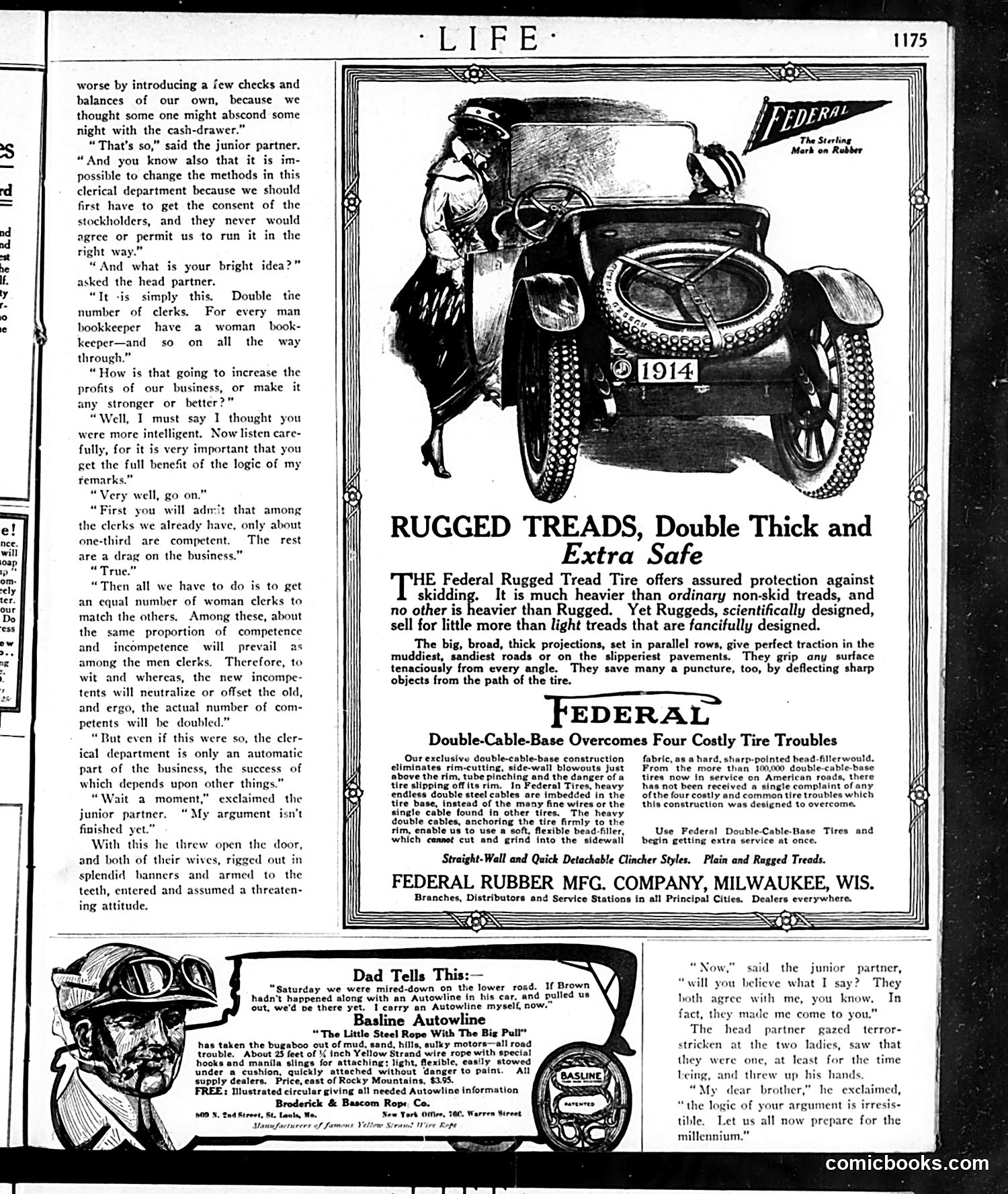
This page is primarily **advertising**, not satire or political commentary. The main content features two tire advertisements for Federal Rubber Manufacturing Company (Milwaukee). The top ad promotes "Rugged Treads" tires, emphasizing their thickness and safety against skidding. The lower ad highlights Federal's "Double-Cable-Base" tire construction, claiming it prevents four common tire problems: rim-cutting, blowouts, tube pinching, and tire slippage. Both ads use period-typical marketing language about durability and reliability for early automobiles (note the 1914 date visible on the vehicle illustration). The small narrative vignette on the left side of the page—about business partners debating clerical staff—appears to be unrelated satirical fiction, not connected to the advertisements. The page reflects early 20th-century automotive commerce and concerns about tire quality during the era of rapidly expanding automobile use.
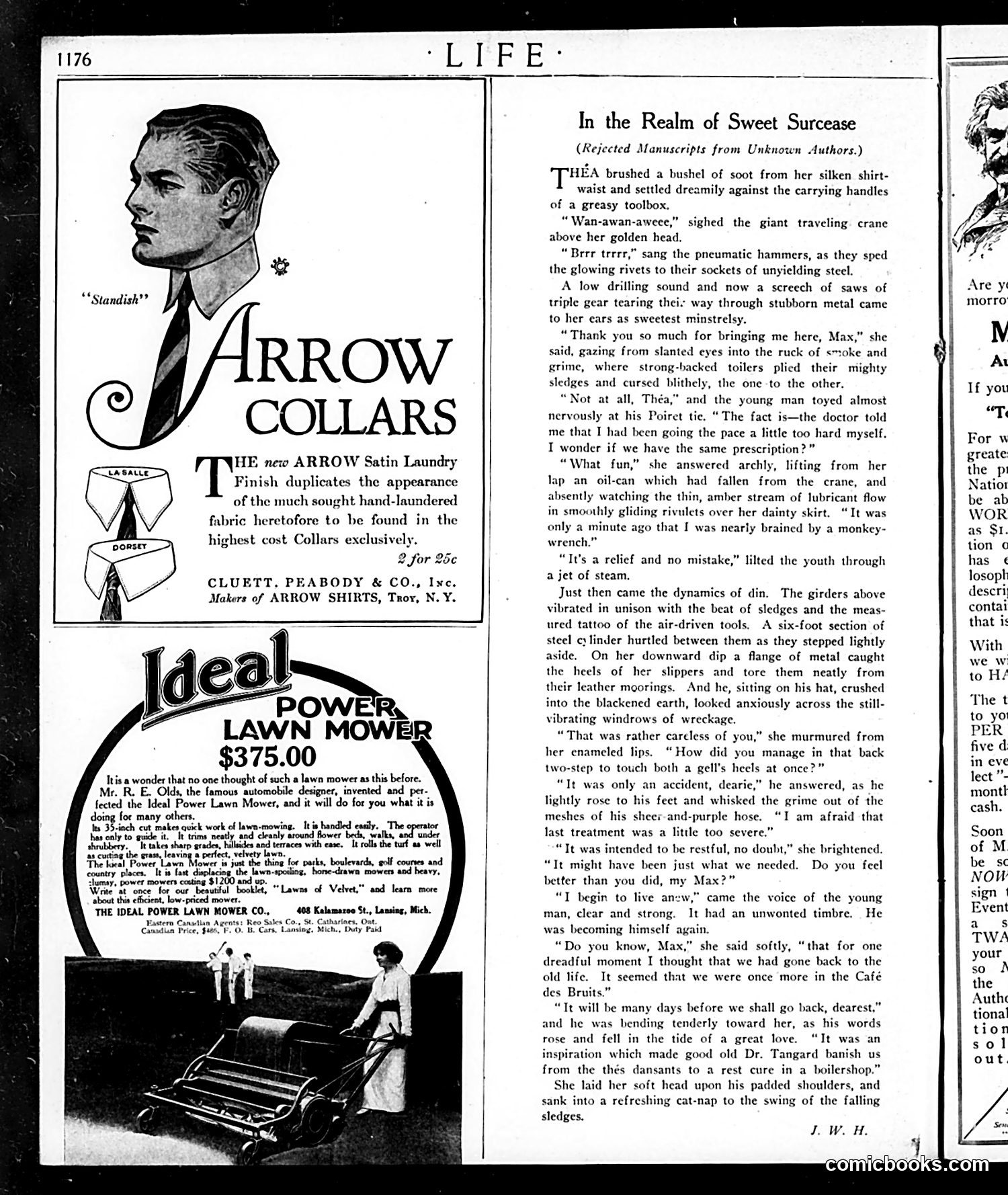
This page presents a rejected short story mocking romantic melodrama set in an industrial factory. The narrative depicts a wealthy young woman ("Thea") and man ("Max") finding romance amid grimy machinery and dangerous conditions—positioning manual labor as picturesque and spiritually restorative rather than exploitative. The satire targets early 20th-century sentimental literature's absurd romanticization of working-class industrial life. The detailed descriptions of riveting, cranes, and metal-cutting are presented as "sweetest minstrelsy" to the privileged couple, who view the dangerous environment (nearly struck by a wrench) as quaint backdrop for their romance. Their casual endangerment and the workers' casual cursing underscore the story's oblivious tone. The piece parodies how contemporary fiction often sanitized or aestheticized harsh industrial realities for middle-class audiences, rendering genuine danger and labor invisible through romanticization.
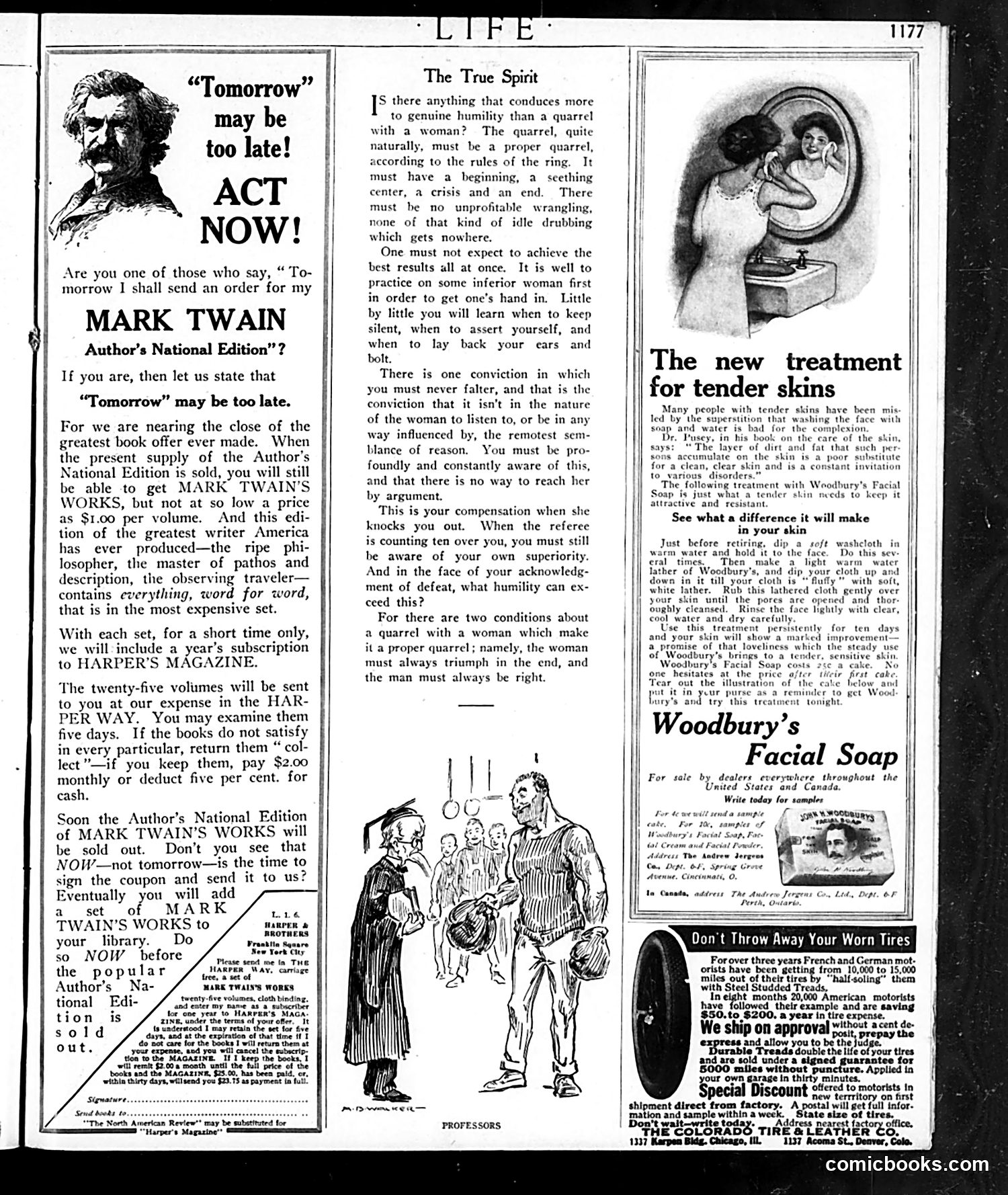
This page combines advertising with satirical content. The left side aggressively promotes Mark Twain's "Author's National Edition"—a 25-volume set sold by subscription at $1.00 per volume. The urgency ("Tomorrow may be too late!") and sales pitch dominate the advertisement. The center feature, "The True Spirit," is satirical commentary on marital quarrels. Written in mock-serious tone, it advises men that quarreling with women provides "genuine humility"—but only if conducted by "rules of the ring" (boxing metaphor). The satire's point: the piece humorously suggests women are inherently illogical ("no way to reach her by argument") while paradoxically insisting men maintain superiority even in defeat. This reflects early 20th-century gender attitudes the magazine gently mocks. The right side features advertising for Woodbury's Facial Soap and tire retreading services—typical contemporary consumer products. The cartoon labeled "PROFESSORS" (bottom center) appears to show academic figures but lacks clear context from this excerpt.
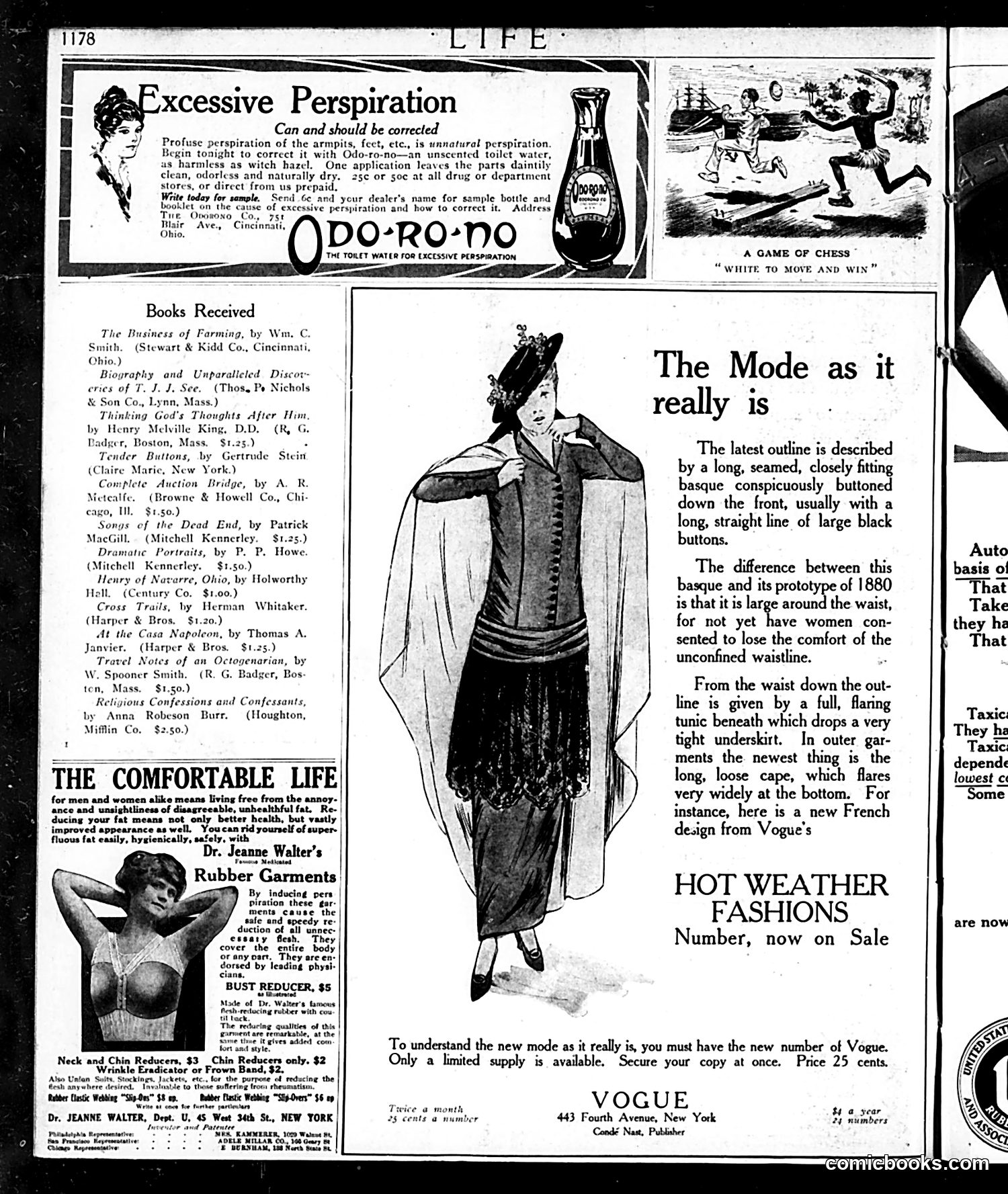
This page is primarily **advertising and fashion content** rather than political satire. The dominant elements are: 1. **Odo-Ro-No advertisement** (top left): Promotes a toilet water to reduce excessive perspiration—a common health/hygiene concern of the era. 2. **Dr. Jeanne Walter's reducing garments** (bottom left): Rubber corsets and wrinkle erasers marketed to women for weight reduction and anti-aging, reflecting period obsessions with reshaping the body. 3. **Vogue fashion feature** (center/right): Describes 1910s-era women's fashion—fitted basques with buttons, full flaring tunics, and loose capes—while noting women still resisted fully confined waistlines for comfort. 4. **Small chess puzzle** (top right): Unrelated filler content. 5. **Books received section** (left): Standard literary listings including Gertrude Stein's *Tender Buttons*. The page reflects early 20th-century consumer culture: beauty standards, female fashion evolution, and the marketing of body-modification products to women.
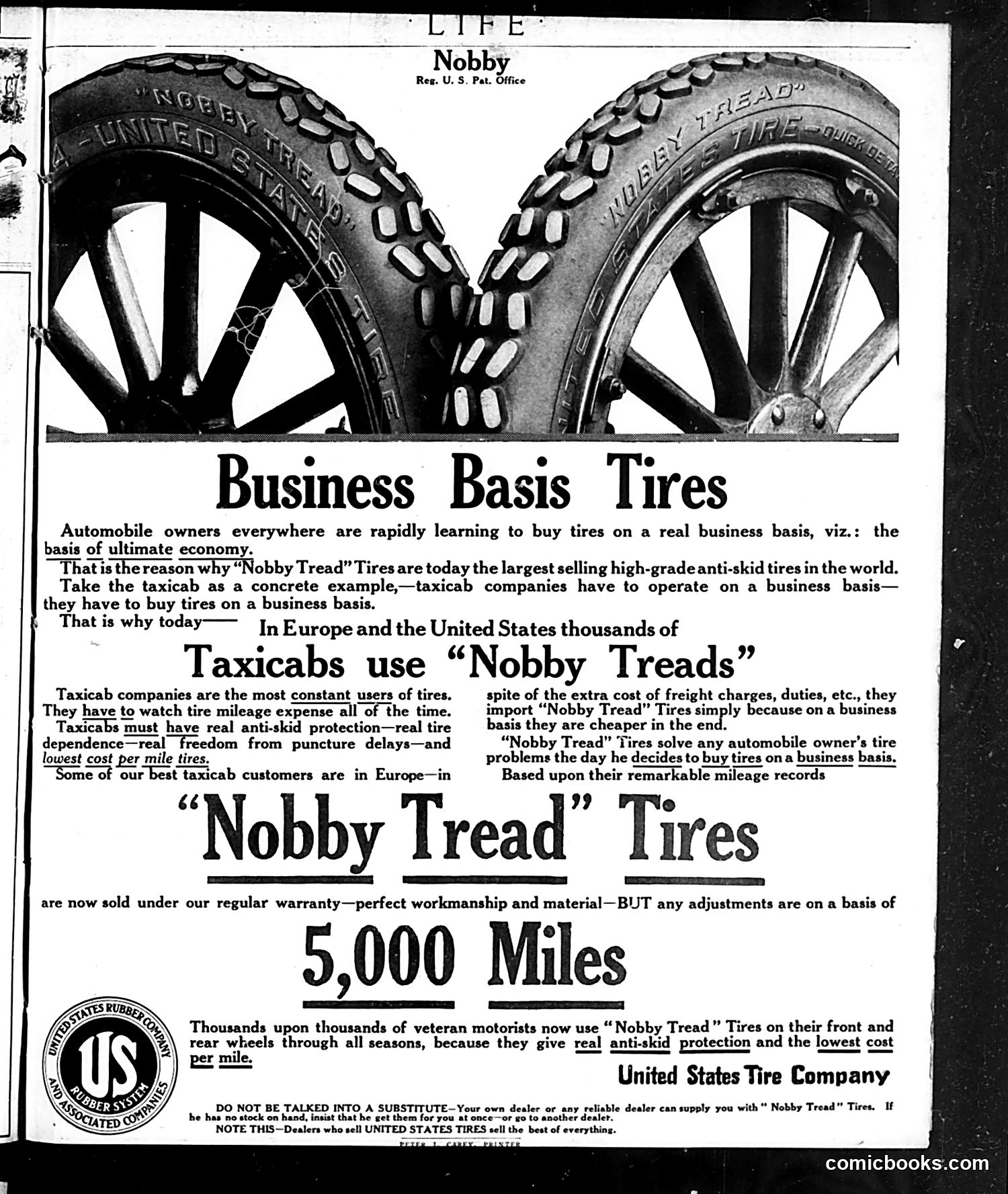
This is **a full-page advertisement**, not a satirical cartoon. It promotes "Nobby Tread" tires made by United States Tire Company. The page features two photographs of tires mounted on wheels at the top, showing the tread pattern. The advertisement argues that automobile owners—especially taxicab companies operating on tight profit margins—should buy tires based on "ultimate economy" and cost-per-mile rather than initial price. The pitch emphasizes that taxicabs worldwide use Nobby Treads because they offer anti-skid protection, durability, and lowest lifetime cost, even though European importers pay extra freight charges. The warranty covers 5,000 miles of use. A U.S. Rubber Company seal appears, signaling corporate legitimacy. The closing warns against cheap substitutes and insists readers buy only from authorized dealers. This reflects early 20th-century tire industry competition and the emergence of data-driven purchasing arguments in American advertising.
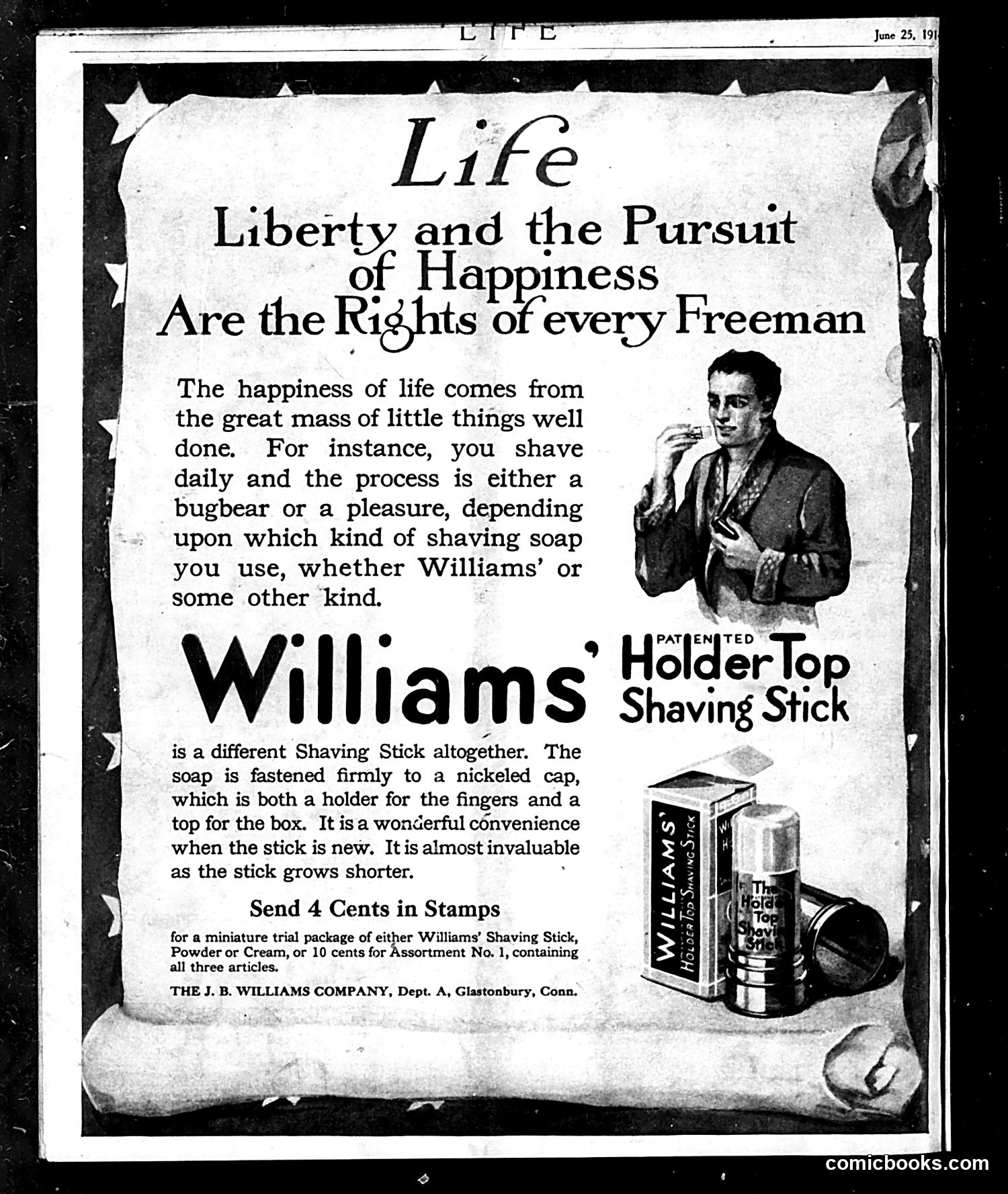
This is primarily a **product advertisement**, not political satire. It appears in *Life* magazine (June 25, 191[2]), using patriotic rhetoric ironically to sell shaving soap. The ad opens with the Declaration of Independence preamble ("Life, Liberty and the Pursuit of Happiness"), then pivots to argue that daily happiness depends on choosing the right shaving soap—specifically Williams' Holder Top Shaving Stick. The humor is in the **grandiose equation**: fundamental American freedoms are equated with a minor consumer choice. The accompanying image shows a man applying the product. The pitch emphasizes the patented holder-cap design, which serves both as a finger grip and box lid, becoming "almost invaluable as the stick grows shorter"—a practical detail meant to justify the product's superiority. This represents **early 20th-century advertising strategy**: wrapping commercial products in patriotic language to appeal to American values, using gentle satire to make the product memorable.
I can see this is a heavily degraded black and white image from what appears to be a historical publication, with "comicbooks.com" visible at the bottom. However, the image quality is too poor for me to reliably discern any cartoon figures, text, caricatures, or satirical content. The page appears almost entirely black with only scattered light marks and artifacts visible. To provide accurate analysis per your instructions, I would need a clearer version of this page. I cannot identify specific political figures, references, or the satirical point without being able to see the actual cartoon or readable text content.