
Life, 1914-06-25 · page 28 of 45
Life — June 25, 1914 — page 28: what you’re looking at
What you’re looking at
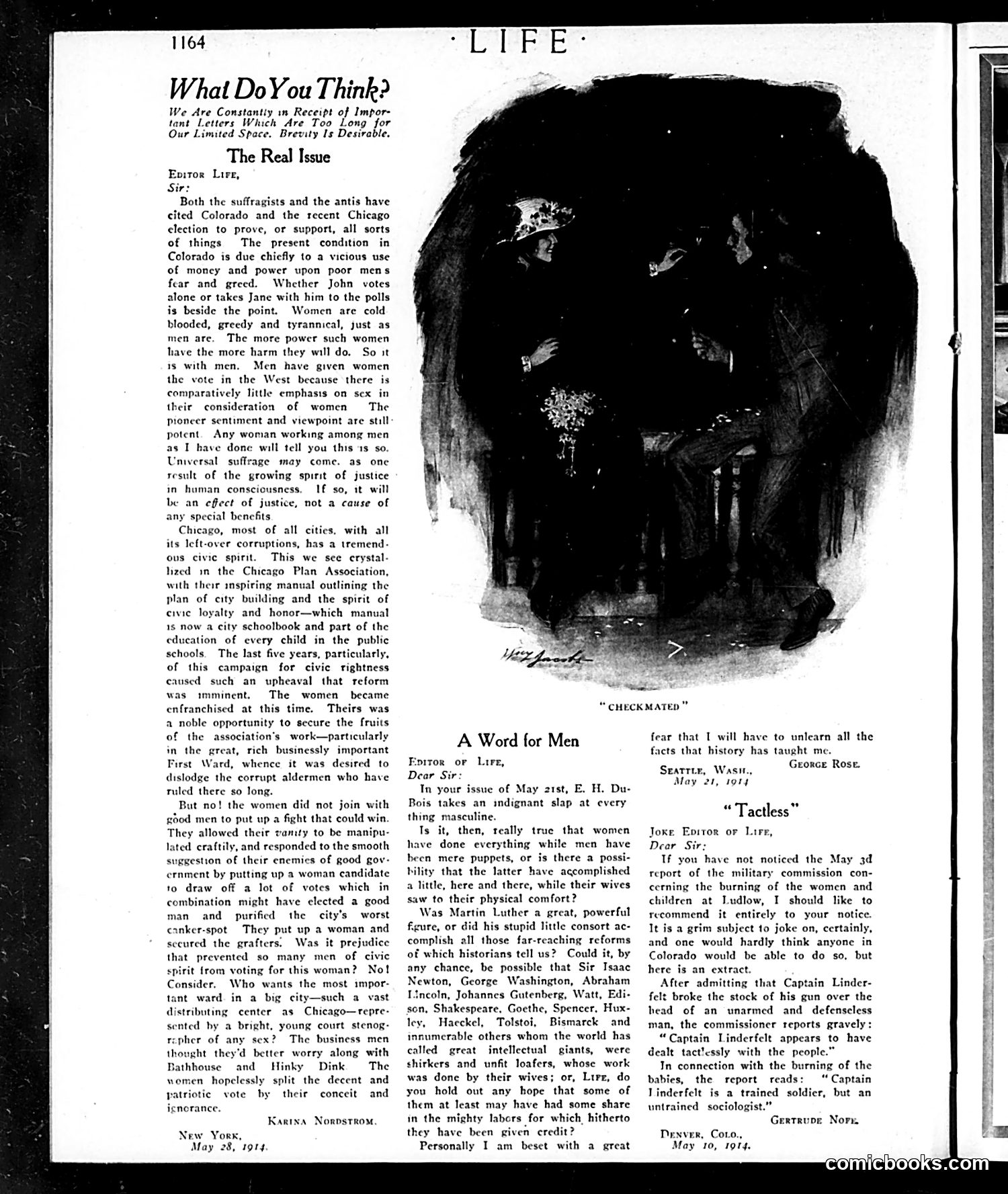
This is a **readers' letters section** from Life magazine's political commentary pages. The cartoon "Checkmate" (a dramatic dark portrait) accompanies these three published letters debating **women's suffrage** — a major contested issue of 1914. The letters reveal the heated suffrage debate: Karina Nordstrom argues women voters in Chicago failed civic reform by fielding a female candidate who split the reform vote, suggesting women lack political judgment. A male respondent (George Rose, Seattle) counters that men have accomplished history's greatest achievements while women merely provided "physical comfort." Another letter ("Tactless," Jobe) sarcastically critiques anti-suffrage sentiment. The page illustrates how **suffrage wasn't simply "for" or "against" women** — opponents made diverse arguments: that women were corruptible, tactically incompetent, or unnecessary to progress. Life published these contrasting views to satirize the absurdity of anti-suffrage reasoning while claiming neutrality.
📄 Transcribed text from this page (OCR, searchable)
Machine-transcribed from the original scan — historical spelling and the odd misread are preserved.
1164 What DoYou Think? We Are Constantiy in Receipt of Impor- tant Letters Which Are Too Long for Our Limited Space. Brevity Is Desirable. The Real Issue Evitor Lire, Sir: Both the suffragists and the antis have cited Colorado and the recent Chicago election to prove, or support, all sorts of things The present condition in Colorado is due chiefly to a vicious use of moncy and power upon poor mens fear and greed. Whether John votes alone or takes Jane with him to the polls is beside the point. Women are cold blooded, greedy and tyrannical, just as men are. The more power such women have the more harm they will do. So it 18 with men. Men have given women the vote in the West because there is comparatively little emphasis on sex in their consideration of women The Pioncer sentiment and viewpoint are still potent. Any woman working among men as I have done will tell you this 1s so. Universal suffrage may come. as one result of the growing spirit of justice in human consciousness. If so, it will be an effect of justice, not a cause of any special benefits Chicago, most of all cities, with all its left-over corruptions, has a tremend- ous civic spirit. This we see erystal- hzed in the Chicago Plan Association, with their inspiring manual outlining the plan of city building and the spirit of civic loyalty and honor—which manual 1s now a city schoolbook and part of the education of every child in the public schools. The last five years, particularly, of this campaign for civic rightness caused such an upheaval that reform was imminent. The women became enfranchised at this time. Theirs was a noble opportunity to secure the fruits of the association's work—particularly in the great, rich businessly important First Ward, whence it was desired to dislodge the corrupt aldermen who have tuled there so long. But no! the women did not join with good men to put up a fight that could win. They allowed their vamity to be manipu- lated craftily, and responded to the smooth suggestion of their enemies of good gov- ernment by putting up a woman candidate to draw off a lot of votes which in combination might have elected a good man and purified the city’s worst canker-spot They put up a woman and secured the grafters. Was it prejudice that prevented so many men of civic spirit from voting for this woman? Nol! Consider. Who wants the most impor- tant ward. in a big city—such a vast distributing center as Chicago—repre- sented by a bright, young court stenog- ropher of any sex? The business men thought they'd better worry along with Bathhouse and Hinky Dink The women hopelessly split the decent and patriotic vote by theit conceit and ignorance. Karina Norpstrom, New York, May 28, 1914. A Word for Men Epitor or Lire, Dear Sir: In your issue of May 21st, E. H. Du- Bois takes an indignant slap at every thing masculine. Is it, then, really true that women have done everything while men have been mere puppets, or is there a possi- bility that the latter have accomplished a little, here and there, while their wives saw to their physical comfort? Was Martin Luther a great, powerful figure, or did his stupid little consort ac- complish all those far-reaching reforms of which historians tell us? Could it, by any chance, be possible that Sir Isaac Newton, George Washington, Abraham Lincoln, Johannes Gutenberg, Watt, Edi son, Shakespeare, Goethe, Spencer, Hux- ley, Haeckel, Tolstoi, Bismarck and innumerable others whom the world has called great intellectual giants, were thirkers and unfit loafers, whose work was done by their wives; or, Lire, do you hold out any hope that some of them at least may have had some share in the mighty labors for which hitherto they have been given credit? Personally I am beset wii cK MATED" fear that I will have to unlearn all the facts that history has taught me. Seatrir, Wasi, saieaioia May 21, 1914 “Tactless” Joxe Epiror or Lire, Dear Sir: If you have not noticed the May 3d report of the military commission con- cerning the burning of the women and children at Ludlow, I should like to recommend it entirely to your notice. It is a grim subject to joke on, certainly, and one would hardly think anyone in Colorado would be able to do so, but here is an extract. After admitting that Captain Linder- felt broke the stock of his gun over the head of an unarmed and defenscless man, the commissioner reports gravely: “Captain Linderfelt appears to have dealt tact'essly with the people.” Jn connection with the burning of the babies, the report reads: “Captain linderfelt is a trained soldicr, but an untrained sociologist.” Gertrupe Norr Denver, Coro., May 10, 1914. ais ate EL