
Life, 1914-06-25 · page 18 of 45
Life — June 25, 1914 — page 18: what you’re looking at
What you’re looking at
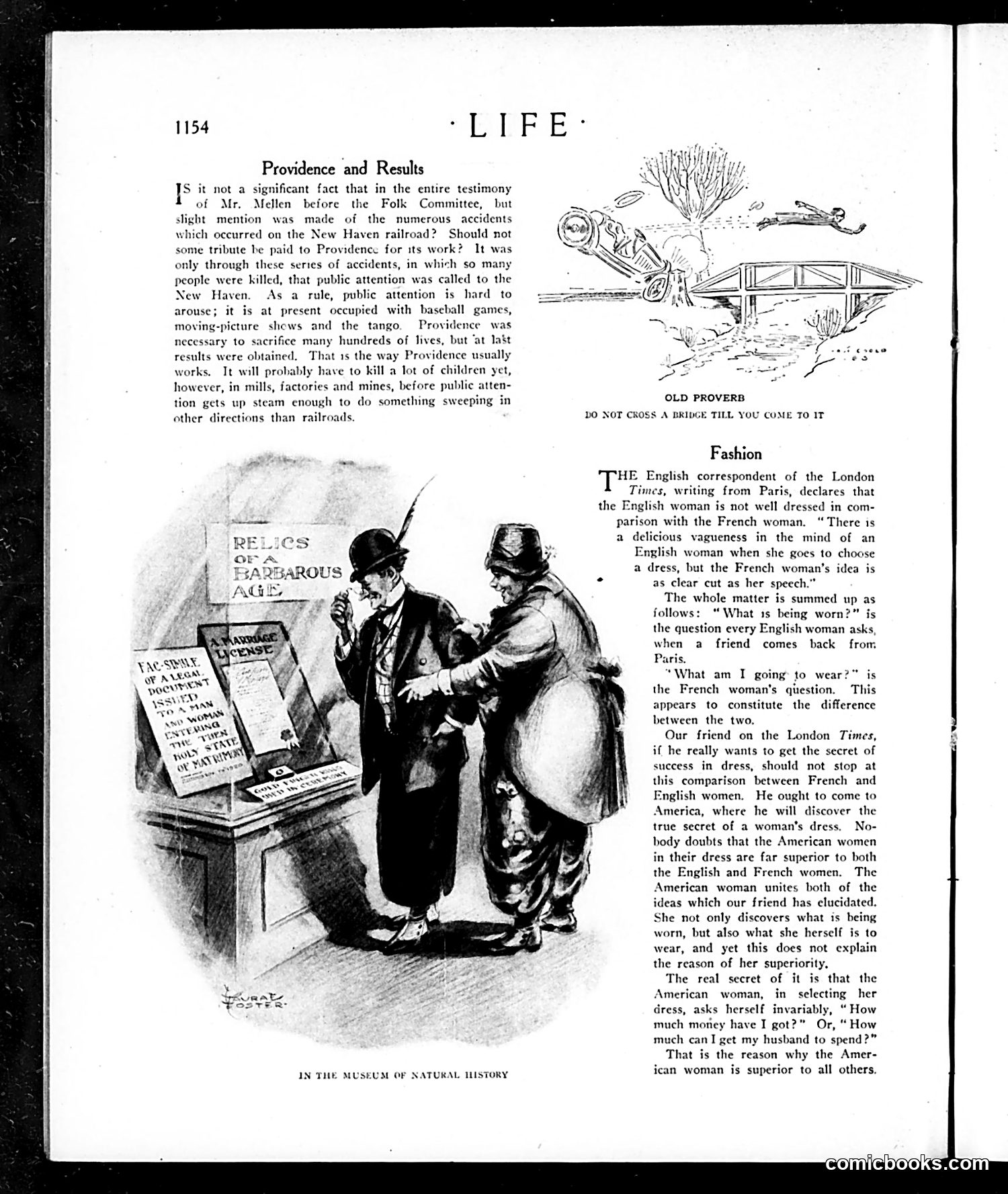
## "In the Museum of Natural History" (Left Cartoon) This sketch satirizes public indifference and the morbid spectacle of danger. Two well-dressed gentlemen examine relics in a museum labeled "Relics of a Barbarous Age"—but the display case actually contains warnings about railroad accidents: "Facsimile of a Legal Document" and notices about railway dangers. The joke: society treats railroad safety warnings as historical curiosities rather than urgent problems. The cartoon mocks how Americans ignore public hazards until forced to pay attention. ## "Providence and Results" (Text) The accompanying article sarcastically suggests that Providence (divine intervention) uses mass death—particularly on the New Haven railroad—to force public attention to reform. It bitterly notes that Americans ignore serious issues (railroads, factory safety) until tragedies mount. Only accidents generating headlines provoke action. The satire criticizes both public apathy and a system requiring body counts to motivate change. ## "Fashion" (Right Section) A lighter piece comparing English, French, and American women's approach to dress: English women ask "What is being worn?"; French women ask "What shall I wear?"; American women ask "How much money do I have?"—making materialism the source of American style superiority. It's gentle satire on American consumerism.
📄 Transcribed text from this page (OCR, searchable)
Machine-transcribed from the original scan — historical spelling and the odd misread are preserved.
RIF EB Providence and Results |S it not a significant fact that in the entire testimony of Mr. Mellen before the Folk Committee, but slight mention was made of the numerous accidents which occurred on the New Haven railroad? Should not some tribute be paid to Providence for its wor! It was only through these series of accidents, in which so many people were killed, that public attention was called to the New Haven. As a rule, public attention is hard to arouse; it is at present occupied with baseball games, moving-picture shows and the tango. Providence was necessary to sacrifice many hundreds of lives, but ‘at last results were obtained, That 1s the way Providence usually works. It will probably have to kill a lot of children yet, however, in mills, factories and mines, before public atten- tion gets up steam enough to do something sweeping in OLD PROVERB other directions than railroads. DO NOT CROSS A BRIDGE TILL YOU COME To IT Fashion "PEE English correspondent of the London Times, writing from Paris, declares that the English woman is not well dressed in com- uso f parison with the French woman. “There is RELI a delicious vagueness in the mind of an English woman when she goes to choose a dress, but the French woman's idea is as clear cut as her speech.” The whole matter is summed up as follows: “What 1s being worn?” is the question every English woman asks, when a friend comes back from Paris. “What am I going to wear?” is the French woman's question. This appears to constitute the difference between the two. Our friend on the London Times, if he really wants to get the secret of success in dress, should not stop at this comparison between French and English women. He ought to come to America, where he will discover the true secret of a woman's dress, No- body doubts that the American women in their dress are far superior to both the English and French women. The American woman unites both of the ideas which our friend has elucidated. She not only discovers what is being worn, but also what she herself is to wear, and yet this does not explain the reason of her superiority, The real secret of it is that the American woman, in selecting her Gress, asks herself invariably, “How much money have I got?” Or, “ How much can I get my husband to spend?” That is the reason why the Amer- ican woman is superior to all others, or A IN THE MUSEUM OF NATURAL ILISTORY