
Life, 1914-06-25 · page 24 of 45
Life — June 25, 1914 — page 24: what you’re looking at
What you’re looking at
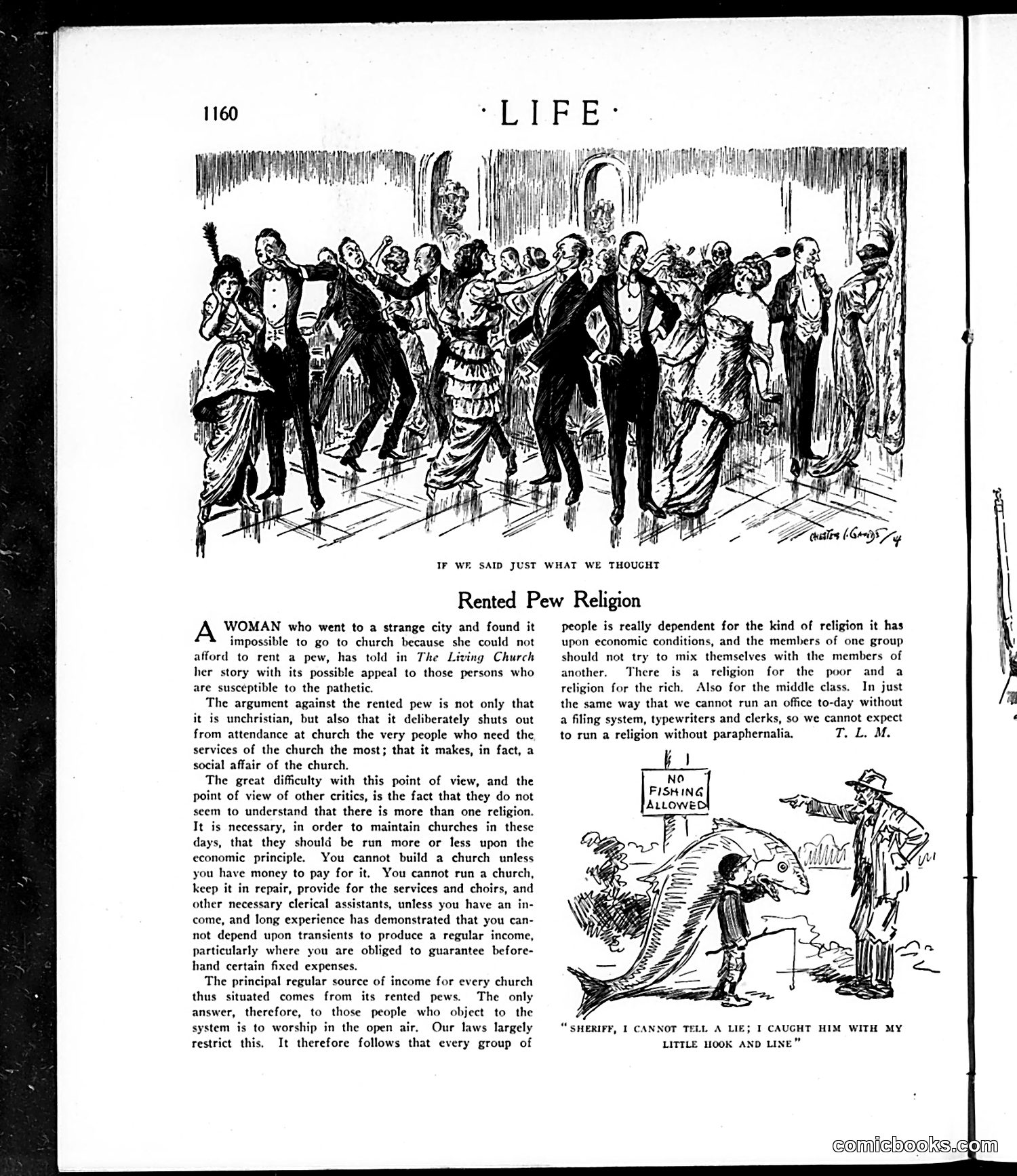
This satirical piece critiques the practice of churches charging rental fees for pews (bench seating), which excluded poor people from worship. **The Main Argument:** The article presents the church's economic justification—that buildings and clergy require funding, so pew rentals are necessary—but does so sarcastically. The author (T.L.M.) equates running a church to operating an office, implying this commodification corrupts religion's spiritual mission. **The Core Satire:** By treating religion as mere "paraphernalia" requiring "filing systems" and "typewriters," the piece mocks the contradiction of Christian churches claiming to serve the poor while financially excluding them. The title "Rented Pew Religion" captures the hypocrisy: a faith built on charity becomes a business model. **The Lower Cartoon:** A humorous aside about a fisherman caught illegally fishing—unrelated to the main critique but illustrating the magazine's satirical tone. The piece attacks institutional Christianity's class divisions during an era when American churches genuinely restricted seating by economic status.
📄 Transcribed text from this page (OCR, searchable)
Machine-transcribed from the original scan — historical spelling and the odd misread are preserved.
IF WE SAID JUST WHAT WE THOUGHT Rented Pew Religion A WOMAN who went to a strange city and found it impossible to go to church because she could not afford to rent a pew, has told in The Living Church her story with its possible appeal to those persons who are susceptible to the pathetic. The argument against the rented pew is not only that it is unchristian, but also that it deliberately shuts out from attendance at church the very people who need the, services of the church the most; that it makes, in fact, a social affair of the church. The great difficulty with this point of view, and the point of view of other critics, is the fact that they do not seem to understand that there is more than one religion. It is necessary, in order to maintain churches in these days, that they should be run more or less upon the economic principle. You cannot build a church unless you have money to pay for it. You cannot run a church, keep it in repair, provide for the services and choirs, and other necessary clerical assistants, unless you have an in- come, and long experience has demonstrated that you can- not depend upon transients to produce a regular income, particularly where you are obliged to guarantee before- hand certain fixed expenses. The principal regular source of income for every church thus situated comes from its rented pews. The only answer, therefore, to those people who object to the system is to worship in the open air. Our laws largely restrict this, It therefore follows that every group of people is really dependent for the kind of religion it has upon economic conditions, and the members of one group should not try to mix themselves with the members of another. There is a religion for the poor and a religion for the rich, Also for the middle class. In just the same way that we cannot run an office to-day without a filing system, typewriters and clerks, so we cannot expect to run a religion without paraphernalia. T. L. M. CAUGHT HIM WITH MY “SHERIFF, I CANNOT TELL A LI LITTLE HOOK AND LIN comichooks.com