
Life, 1914-06-25 · page 25 of 45
Life — June 25, 1914 — page 25: what you’re looking at
What you’re looking at
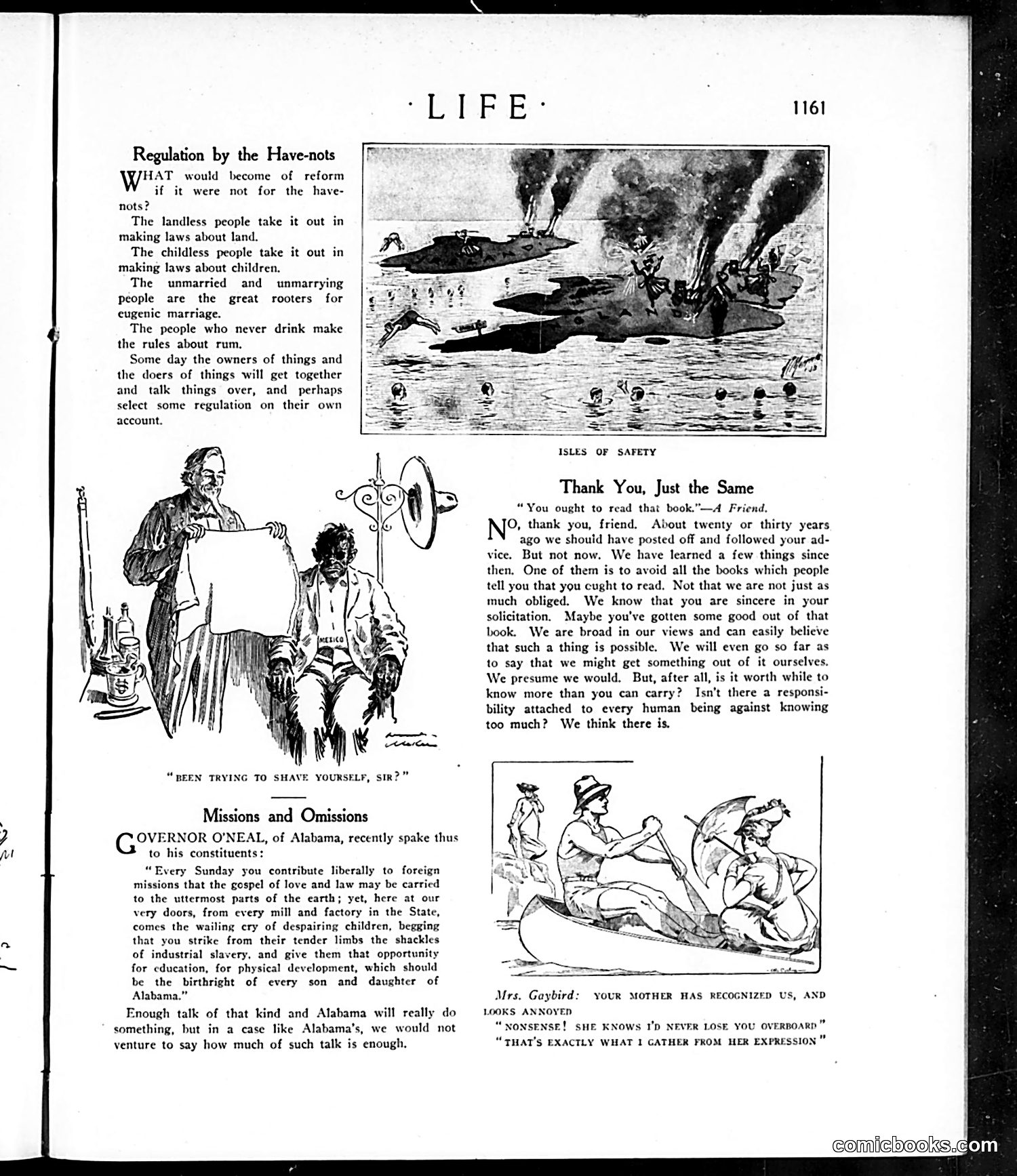
This page contains social and political satire typical of early 20th-century Life magazine. **"Regulation by the Have-nots"** critiques hypocrisy in lawmaking: those without land make land laws, the childless make child laws, non-drinkers regulate alcohol, and unmarried people champion eugenics. The satire suggests that people regulate what they lack rather than what they understand, and that actual property owners should negotiate rules themselves. **"Missions and Omissions"** quotes Alabama Governor O'Neal highlighting the contradiction between contributing to foreign missionary work while ignoring child labor exploitation in local mills and factories—a pointed critique of misplaced charitable priorities. **"Thank You, Just the Same"** humorously advises against reading books people recommend, suggesting overaccumulation of knowledge creates responsibility one shouldn't bear. **The bottom cartoon** depicts a boating scene where Mrs. Gaybird's mother has recognized an eloping couple, her expression revealing disapproval—the joke being the woman reads the mother's face as threatening to throw them overboard. All content mocks social hypocrisy, class attitudes, and conventional morality of the era.
📄 Transcribed text from this page (OCR, searchable)
Machine-transcribed from the original scan — historical spelling and the odd misread are preserved.
Regulation by the Have-nots HAT if it nots? The landless people take it out in making laws about land. The childless people take it out in making laws about children. The unmarried and unmarrying people are the great rooters for eugenic marriage. The people who never drink make the rules about rum. Some day the owners of things and the doers of things will get together and talk things over, and perhaps select some regulation on their own account. become of reform for the have- would were not “BREEN TRYING TO SHAVE YOURSELF, SIR?” Missions and Omissions OVERNOR O'NEAL, of Alabama, recently spake thus to his constituents: “Every Sunday you contribute liberally to foreign missions that the gospel of love and law may be carried to the uttermost parts of the earth; yet, here at our very doors, from every mill and factory in the State, comes the wailing cry of despairing children, begging that you strike from their tender limbs the shackles of industrial slavery, and give them that opportunity for education, for physical development, which should be the birthright of every son and daughter of Alabama.” Enough talk of that kind and Alabama will really do something, but in a case like Alabama’s, we would not venture to say how much of such talk is enough, ISLES OF SAFETY Thank You, Just the Same “You ought to read that book."—A Friend. 'O, thank you, friend. About twenty or thirty years ago we should have posted off and followed your ad- vice. But not now. We have learned a few things since then, One of them is to avoid all the books which people tell you that you cught to read. Not that we are not just as much obliged. We know that you are sincere in your solicitation. Maybe you've gotten some good out of that book. We are broad in our views and can easily believe that such a thing is possible. We will even go so far as to say that we might get something out of it ourselves. We presume we would. But, after all, is it worth while to know more than you can carry? Isn't there a responsi- bility attached to every human being against knowing too much? We think there is. Mrs. Gaybird: YyouR MOTHER HAS RECOGNIZED US, AN! NNOYED ! SHE KNOWS I'D NEVER LOSE YOU OVERBOARD “THAT'S EXACTLY WHAT I GATHER FROM HER EXPRESSION comichooks.cein