
Life, 1914-06-25 · page 26 of 45
Life — June 25, 1914 — page 26: what you’re looking at
What you’re looking at
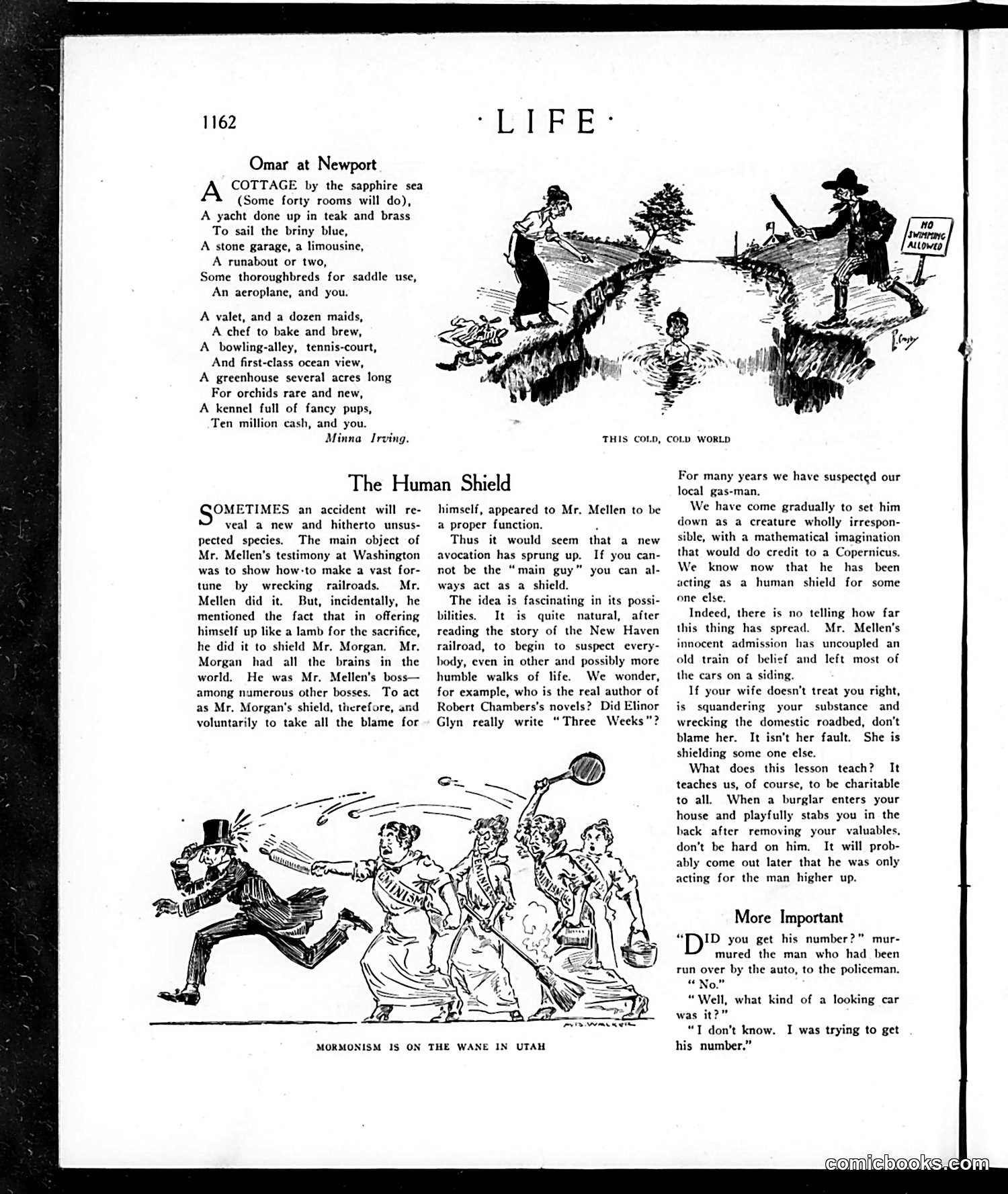
This page contains two distinct satirical pieces: **"Omar at Newport"** (poem by Minna Irving): A tongue-in-cheek catalog of extravagant wealthy lifestyle essentials—mansions, yachts, servants, thoroughbreds, and millions in cash. The repetition mocks the conspicuous consumption of Newport's ultra-rich elite. **"The Human Shield"** (main article): Satirizes railroad executive Charles Mellen's testimony before Congress regarding the New Haven Railroad scandal. Mellen allegedly shielded his boss J.P. Morgan from blame for fraudulent railroad wrecking schemes. The article extends this concept absurdly—suggesting anyone taking blame might be "shielding" someone higher up (dishonest gas-men, unfaithful wives, burglars). It's dark satire on corporate corruption and scapegoating, where underlings absorb responsibility while powerful men escape consequences. The accompanying cartoon shows a well-dressed man being pursued by multiple figures carrying shields. The page satirizes Gilded Age excess and corporate malfeasance through exaggeration and ironic extension of logic.
📄 Transcribed text from this page (OCR, searchable)
Machine-transcribed from the original scan — historical spelling and the odd misread are preserved.
1162 Omar at Newport A COTTAGE by the sapphire sea (Some forty rooms will do), A yacht done up in teak and brass To sail the briny blue, A stone garage, a limousine, A runabout or two, Some thoroughbreds for saddle use, An aeroplane, and you. A valet, and a dozen maids, A chef to bake and brew, A bowling-alley, tennis-court, And first-class ocean view, A greenhouse several acres long For orchids rare and new, A kennel full of fancy pups, Ten million cash, and you. Minna Irving. THIS COLD, COLD WORLD The Human Shield OMETIMES an accident will re- veal a new and hitherto unsus- pected species. The main object of Mr. Mellen’s testimony at Washington was to show how-to make a vast for- tune by wrecking railroads. Mr. Mellen did it. But, incidentally, he mentioned the fact that in offering himself up like a lamb for the sacrifice, he did it to shield Mr. Morgan. Mr. Morgan had all the brains in the world. He was Mr. Mellen’s boss— among numerous other bosses. To act as Mr, Morgan's shield, therefore, and voluntarily to take all the blame for himself, appeared to Mr. Mellen to be a proper function. . Thus it would seem that a new avocation has sprung up. If you can- not be the “main guy” you can al- ways act as a shield. The idea is fascinating in its possi- bilities. It is quite natural, after reading the story of the New Haven railroad, to begin to suspect every- body, even in other and possibly more humble walks of life. We wonder, for example, who is the real author of Robert Chambers’s novels? Did Elinor Glyn really write “Three Weeks"? MORMONISM 1S ON THE WANE IN UTAH For many years we have suspected our local gas-man. We have come gradually to set him down as a creature wholly irrespon- sible, with a mathematical imagination that would do credit to a Copernicus. We know now that he has been acting as a human shield for some one else, Indeed, there is no telling how far this thing has spread. Mr. Mellen’s innocent admission has uncoupled an old train of belief and left most of the cars on a siding. If your wife doesn’t treat you right, is squandering your substance and wrecking the domestic roadbed, don't blame her. It isn’t her fault. She is shielding some one else. What does this lesson teach? It teaches us, of course, to be charitable to all. When a burglar enters your house and playfully stabs you in the back after removing your valuables, don’t be hard on him. It will prob- ably come out later that he was only acting for the man higher up. More Important “DP you get his number?” mur- mured the man who had been run over by the auto, to the policeman, “No.” “Well, what kind of a looking car was it?” “T don’t know. his number.” I was trying to get