
Life, 1914-06-25 · page 20 of 45
Life — June 25, 1914 — page 20: what you’re looking at
What you’re looking at
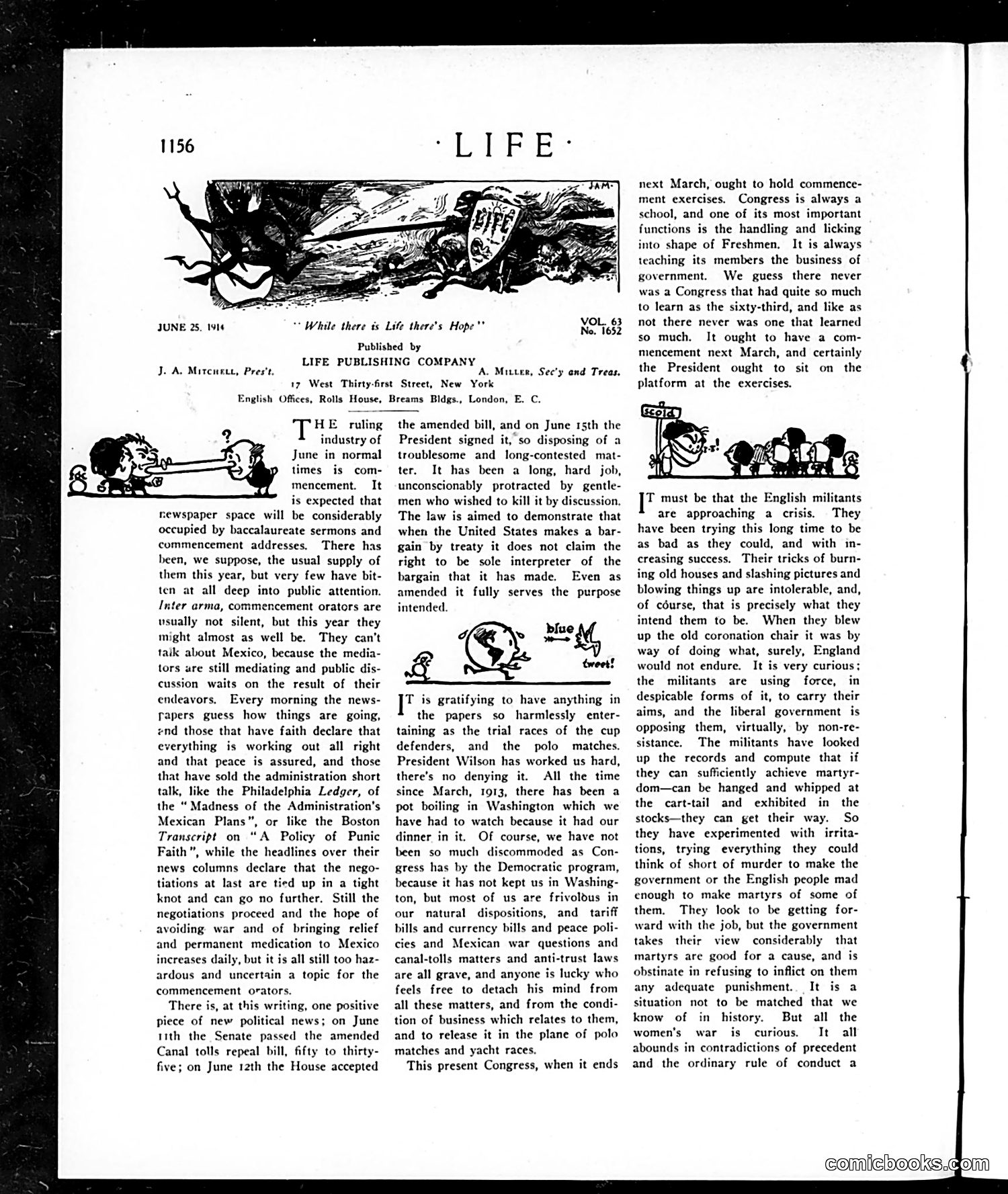
This page contains editorial commentary on current American political issues rather than traditional editorial cartoons. The main cartoon at the top—showing a skeletal or death-like figure—illustrates the masthead's motto "While there is Life there's Hope." The text discusses three pressing issues: 1. **Mexican mediation**: Commencement speakers cannot discuss Mexico because negotiations remain uncertain and ongoing. 2. **Canal tolls repeal**: The Senate and House recently passed legislation clarifying that the U.S. honors treaty obligations fairly, rejecting the notion that America can unilaterally interpret agreements. 3. **Congressional fatigue**: The author suggests Congress—particularly the 63rd Congress—has been heavily worked by President Wilson's Democratic agenda since 1913, dealing with tariffs, currency, Mexican affairs, and trust laws. The piece uses mild satire, joking that Congress itself needs "commencement exercises" to learn proper governance, suggesting the current legislative body is inexperienced and overtaxed.
📄 Transcribed text from this page (OCR, searchable)
Machine-transcribed from the original scan — historical spelling and the odd misread are preserved.
JUNE 25. 1916 “While there ts Life there's Hope’ Published by LIFE PUBLISHING COMPANY J. A. Mircette, Pres't. A. Minter, Sec’y and Treas, 17 West Thirty-first Street, New York English Offices, Rolls House, Breams Bldgs., London, E. C. HE ruling industry of June in normal times is com- mencement. It is expected that newspaper space will be considerably occupied by baccalaureate sermons and commencement addresses. There has heen, we suppose, the usual supply of them this year, but very few have bit- ten at all deep into public attention. Inter arma, commencement orators are usually not silent, but this year they might almost as well be. They can’t talk about Mexico, because the media- tors ure still mediating and public dis- cussion waits on the result of their endeavors, Every morning the news- Tapers guess how things are going, end those that have faith declare that everything is working out all right and that peace is assured, and those that have sold the administration short talk, like the Philadelphia Ledger, of the “ Madness of the Administration's Mexican Plans”, or like the Boston Transcript on “A Policy of Punic Faith”, while the headlines over their news columns declare that the nego- tiations at last are tied up in a tight knot and can go no further. Still the negotiations proceed and the hope of avoiding war and of bringing relief and permanent medication to Mexico increases daily, but it is all still too haz- ardous and uncertain a topic for the commencement orators. There is, at this writing, one positive piece of new political news; on June 11th the Senate passed the amended Canal tolls repeal bill, fifty to thirty- five; on June 12th the House accepted the amended bill, and on June 15th the President signed it, so disposing of a troublesome and long-contested mat- ter. It has been a long, hard job, unconscionably protracted by gentle- men who wished to kill it by discussion, The law is aimed to demonstrate that when the United States makes a bar- gain by treaty it does not claim the right to be sole interpreter of the bargain that it has made. Even as amended it fully serves the purpose intended. og » blue MG Goes. T is gratifying to have anything in the papers so harmlessly enter- taining as the trial races of the cup defenders, and the polo matches. President Wilson has worked us hard, there's no denying it. All the time since March, 1913, there has been a pot boiling in Washington which we have had to watch because it had our dinner in it. Of course, we have not been so much discommoded as Con- gress has by the Democratic program, because it has not kept us in Washing- ton, but most of us are frivoldus in our natural dispositions, and_ tariff bills and currency bills and peace poli- cies and Mexican war questions and canal-tolls matters and anti-trust laws are all grave, and anyone is lucky who feels free to detach his mind from all these matters, and from the condi- tion of business which relates to them, and to release it in the plane of polo matches and yacht races. This present Congress, when it ends next March, ought to hold commence- ment exercises. Congress is always a school, and one of its most important functions is the handling and licking into shape of Freshmen, It is always teaching its members the business of government. We guess there never was a Congress that had quite so much to learn as the sixty-third, and like as not there never was one that learned so much. It ought to have a com- mencement next March, and certainly the President ought to sit on the platform at the exercises. T must be that the English militants are approaching a crisis. They have been trying this long time to be as bad as they could, and with in- creasing success. Their tricks of burn- ing old houses and slashing pictures and blowing things up are intolerable, and, of céurse, that is precisely what they intend them to be. When they blew up the old coronation chair it was by way of doing what, surely, England would not endure. It is very curious; the militants are using force, in despicable forms of it, to carry their aims, and the liberal government is opposing them, virtually, by non-re- sistance. The militants have looked up the records and compute that if they can sufficiently achieve martyr- dom—can be hanged and whipped at the cart-tail and exhibited in the stocks—they can get their way. So they have experimented with irrita- tions, trying everything they could think of short of murder to make the government or the English people mad enough to make martyrs of some of them. They look to be getting for- ward with the job, but the government takes their view considerably that martyrs are good for a cause, and is obstinate in refusing to inflict on them any adequate punishment. It is a situation not to be matched that we know of in history. But all the women’s war is curious. It all abounds in contradictions of precedent and the ordinary rule of conduct a comichooks.gom