
A complete issue · 44 pages · 1914
Life — February 12, 1914
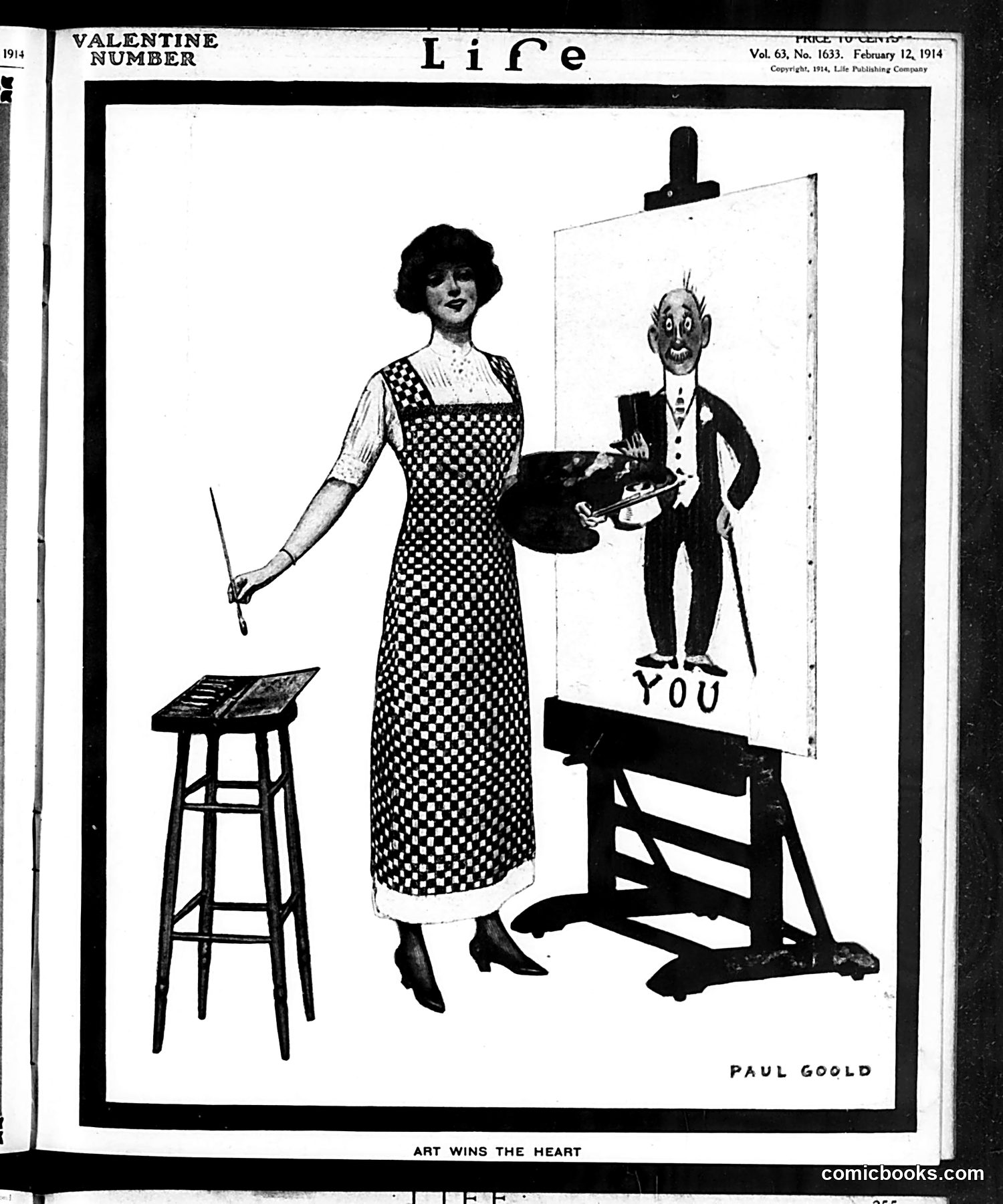
This Valentine's Day cartoon by Paul Gould depicts a woman artist painting a caricatured male figure labeled "YOU" on an easel. She holds a paintbrush and palette, positioned as if she's literally creating or manipulating her subject. The satire appears to play on the romantic notion that artistic talent—particularly a woman's artistic ability—can "win the heart" of a man. The exaggerated, grotesque quality of the painted male figure suggests the joke: that even unflattering artistic representation can be presented as romantic flattery or seduction through the power of art itself. The composition uses the Valentine's theme to humorously comment on artistic pretension and courtship during the early 20th century.
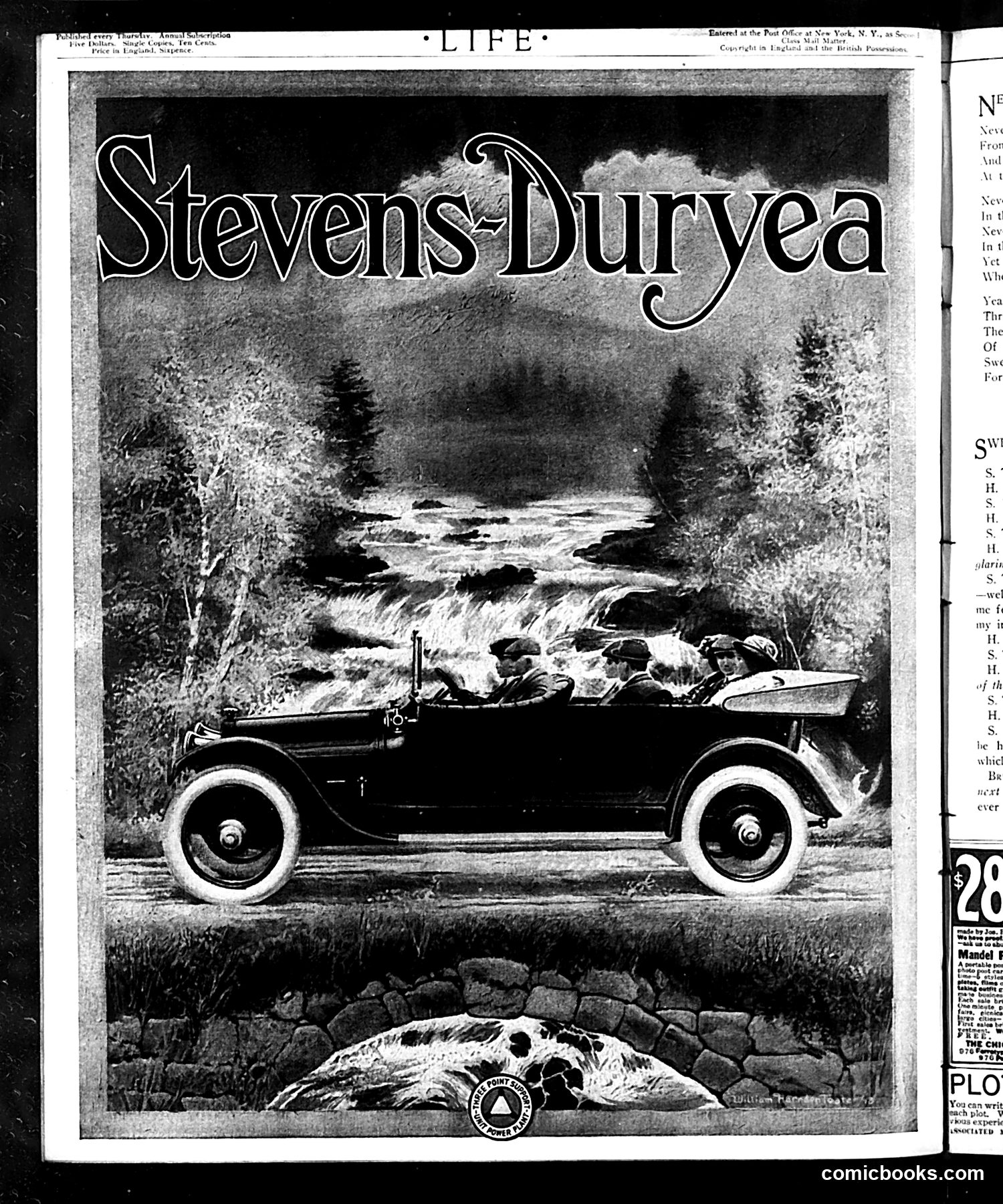
This is a **automobile advertisement**, not political satire. The image shows a Stevens-Duryea motor car positioned in a scenic landscape with a waterfall and forest. Three figures sit in the vehicle, apparently enjoying an outdoor recreational drive. The advertisement uses romantic imagery typical of early 20th-century car marketing—nature, leisure, and adventure—to appeal to wealthy consumers. The ornate typography and composition suggest this appeared in *Life* magazine's advertising section. The price "$28" visible on the right appears to reference the magazine cost or a related product, not the vehicle itself. This represents early automotive marketing that emphasized lifestyle and escape rather than mechanical specifications.
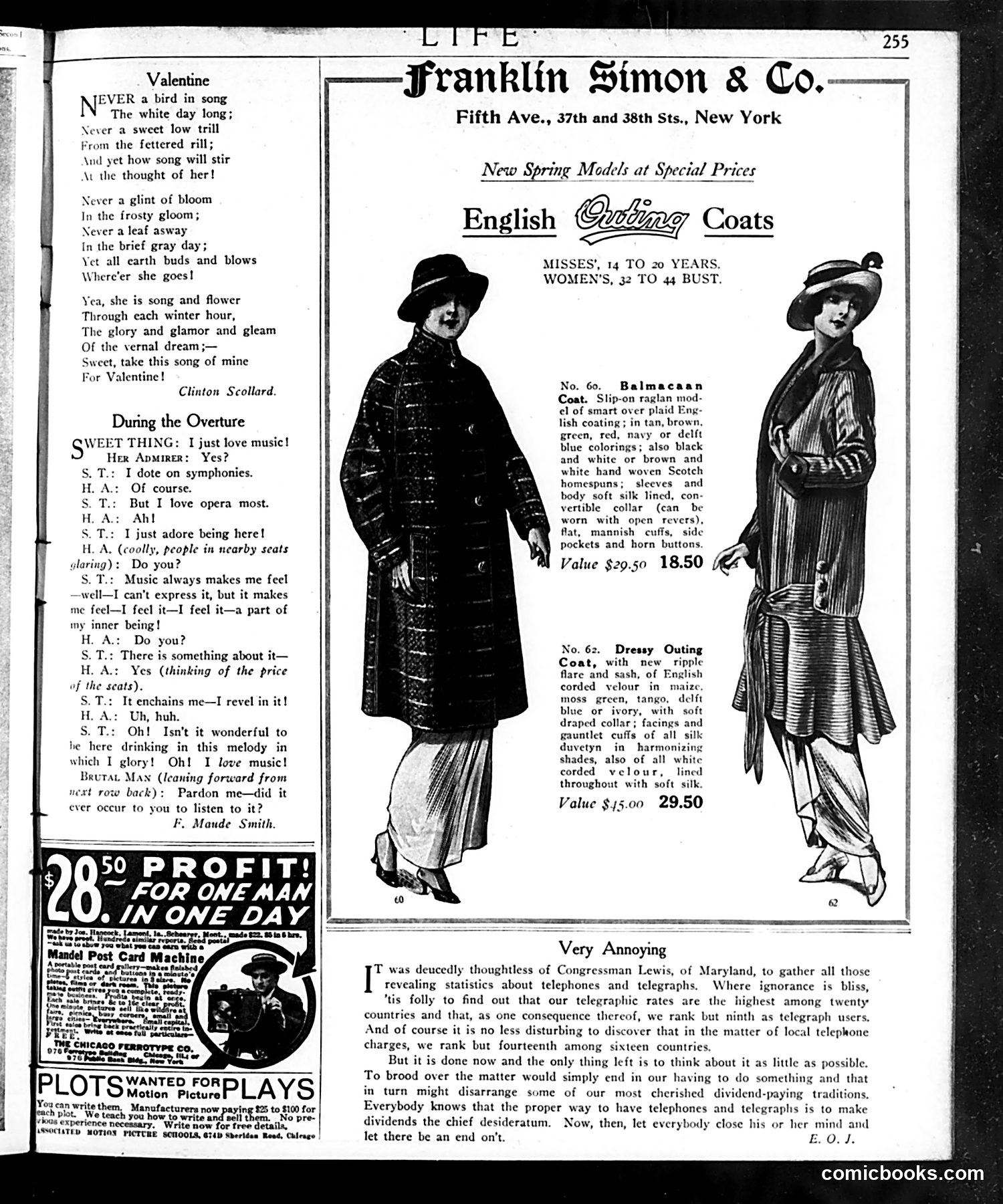
This page is primarily **commercial advertising** rather than satirical content. The main feature is a Franklin Simon & Co. advertisement for women's coats, showing two models in fashionable English "Outing Coats" typical of the early 20th century. The left column contains a romantic poem titled "Valentine" by Clinton Stellard, unrelated to satire, along with a humorous dialogue titled "During the Overture" about opera patrons—gentle social comedy rather than political satire. Below are advertisements for a postal card machine and calls for actors in motion pictures—standard commercial notices. The only substantive editorial content is a brief article titled "Very Annoying," which critiques Congressman Lewis of Maryland for gathering statistics about telephones and telegraphs, mocking such bureaucratic busywork. This represents mild political humor rather than sharp satire.
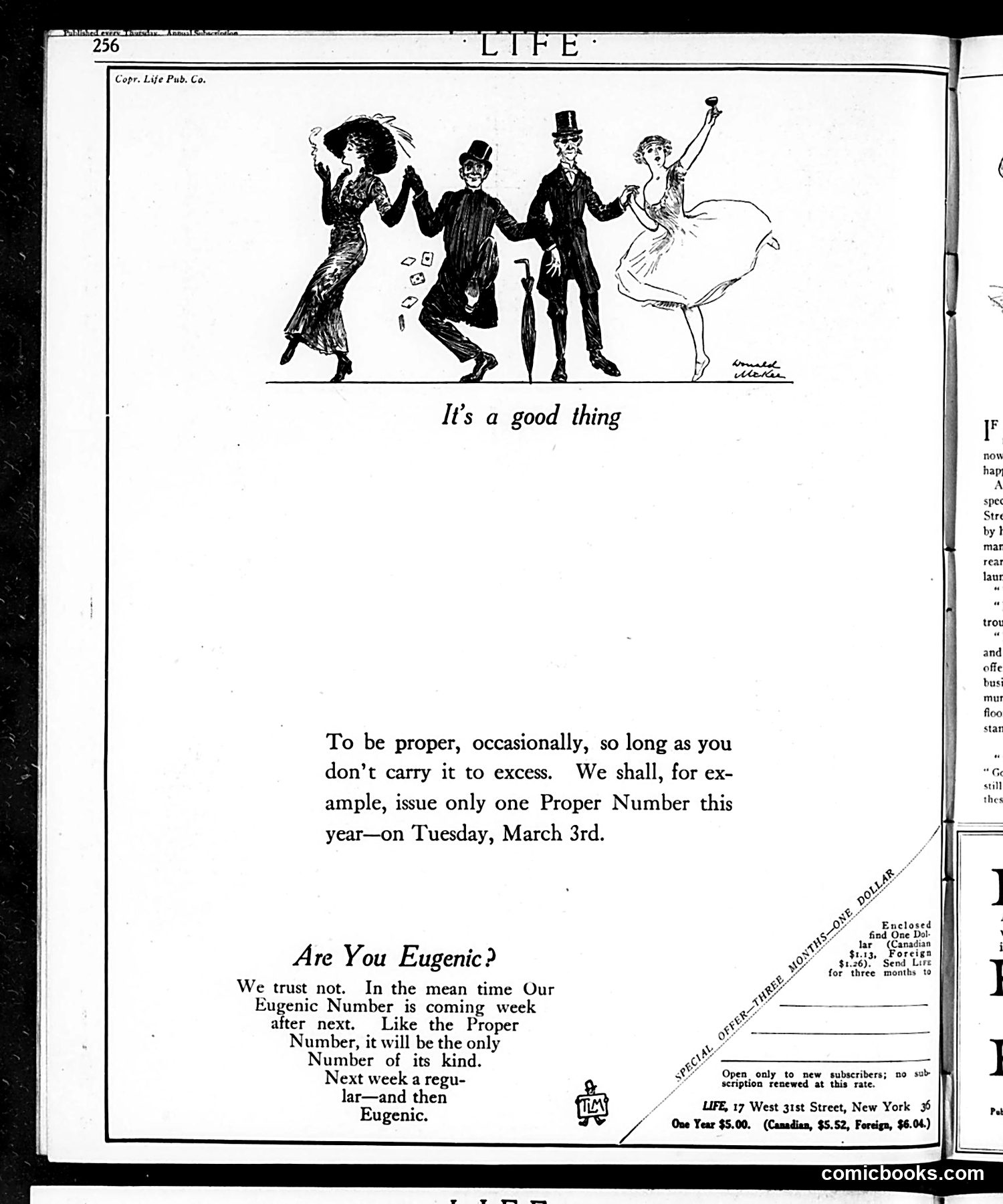
This 1910s *Life* magazine page satirizes social propriety and behavioral excess. The cartoon "It's a good thing" depicts four figures in formal dress dancing uninhibitedly—celebrating that one can occasionally be improper without excess. The accompanying text announces a special "Proper Number" issue (March 3rd), establishing the joke's framework: *Life* will publish only one such conservative issue yearly, implying the magazine typically embraces impropriety and satire. The section "Are You Eugenic?" references the then-popular eugenics movement. The magazine playfully promises an upcoming "Eugenic Number"—the only one of its kind—mocking both eugenic pseudoscience and the magazine's irreverent editorial stance. The humor relies on readers' familiarity with contemporary social debates about propriety, science, and progressive versus conservative values.
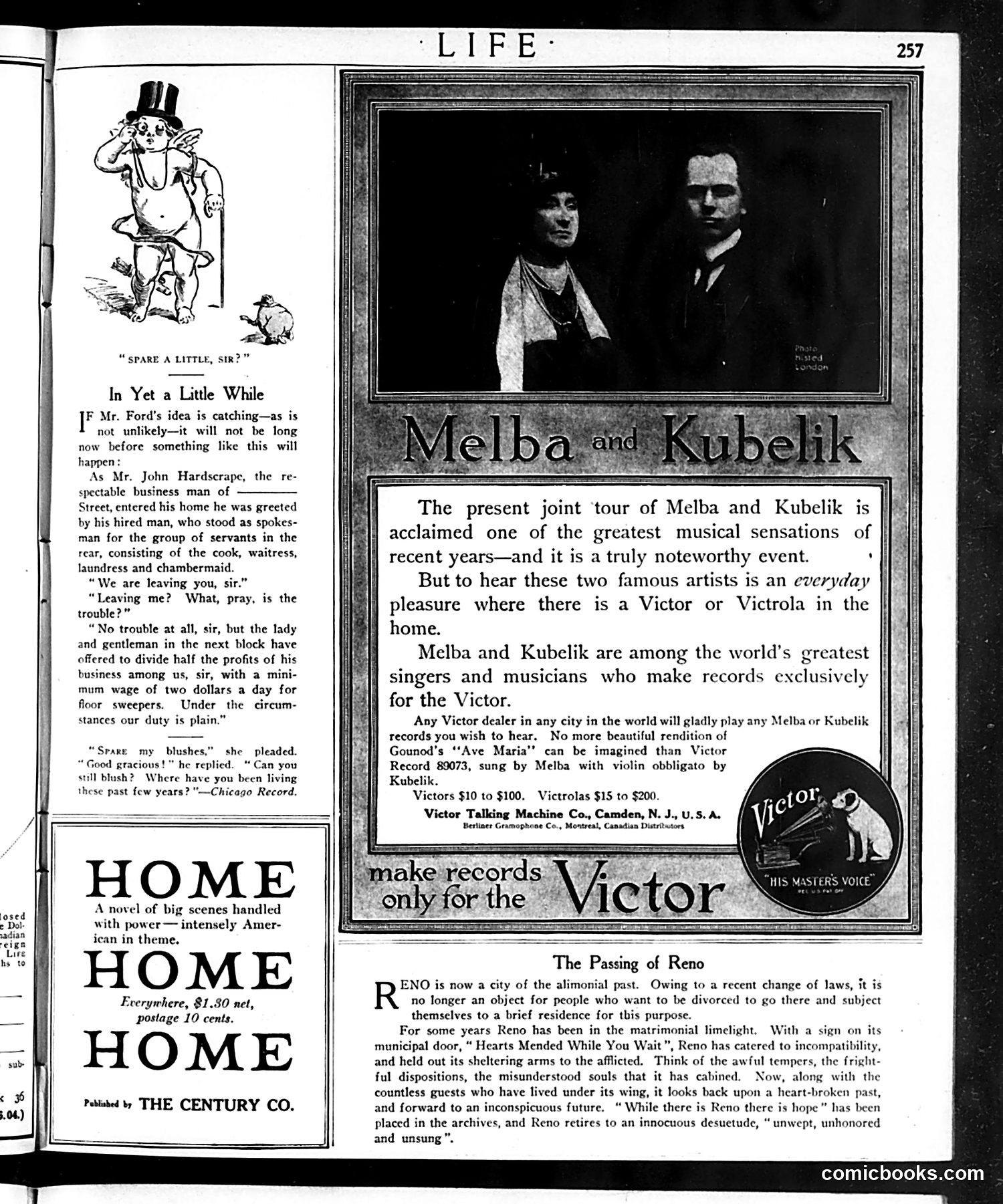
**Left side cartoon:** A cherub labeled "Spare a Little, Sir?" depicts wealth inequality humor. The accompanying story "In Yet a Little While" satirizes Mr. John Hardscrape, a wealthy businessman, who's confronted by servants requesting wage increases. The joke hinges on the employer's stingy resistance despite his obvious wealth—a common early 20th-century class commentary. **Right side:** An advertisement for Melba and Kubelik's joint musical tour, featuring their photograph. These were world-famous opera singers of the era. The ad emphasizes their Victor Records exclusivity, positioning recorded music as an accessible luxury for homes with gramophones. **Bottom:** "The Passing of Reno" discusses Nevada's divorce laws becoming stricter, referencing Reno's reputation as a divorce destination.
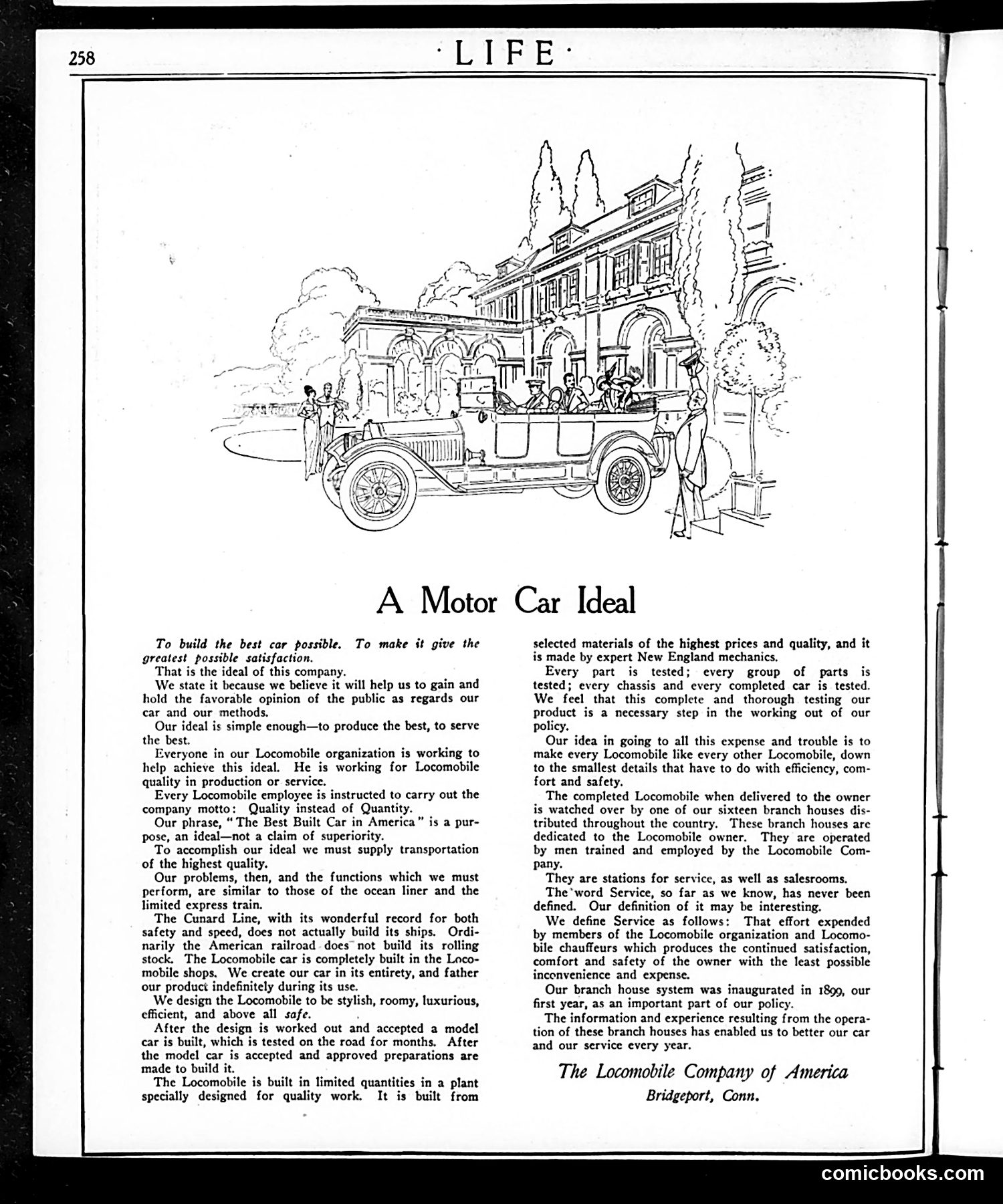
This is **not satire or a political cartoon**, but rather a straightforward **advertisement** for the Locomotive Company of America (Bridgeport, Connecticut). The illustration depicts an early automobile filled with passengers outside an elegant mansion, emphasizing luxury and social status. The accompanying text outlines the company's manufacturing philosophy: quality materials, rigorous testing of every component, and consistency across all units. The ad's "ideal" centers on producing reliable, well-crafted automobiles through expert New England mechanics and systematic quality control—a sales pitch emphasizing that their cars match competitors' standards in every detail. This represents early automotive marketing, appealing to wealthy consumers by stressing craftsmanship and reliability during the automobile industry's formative period.
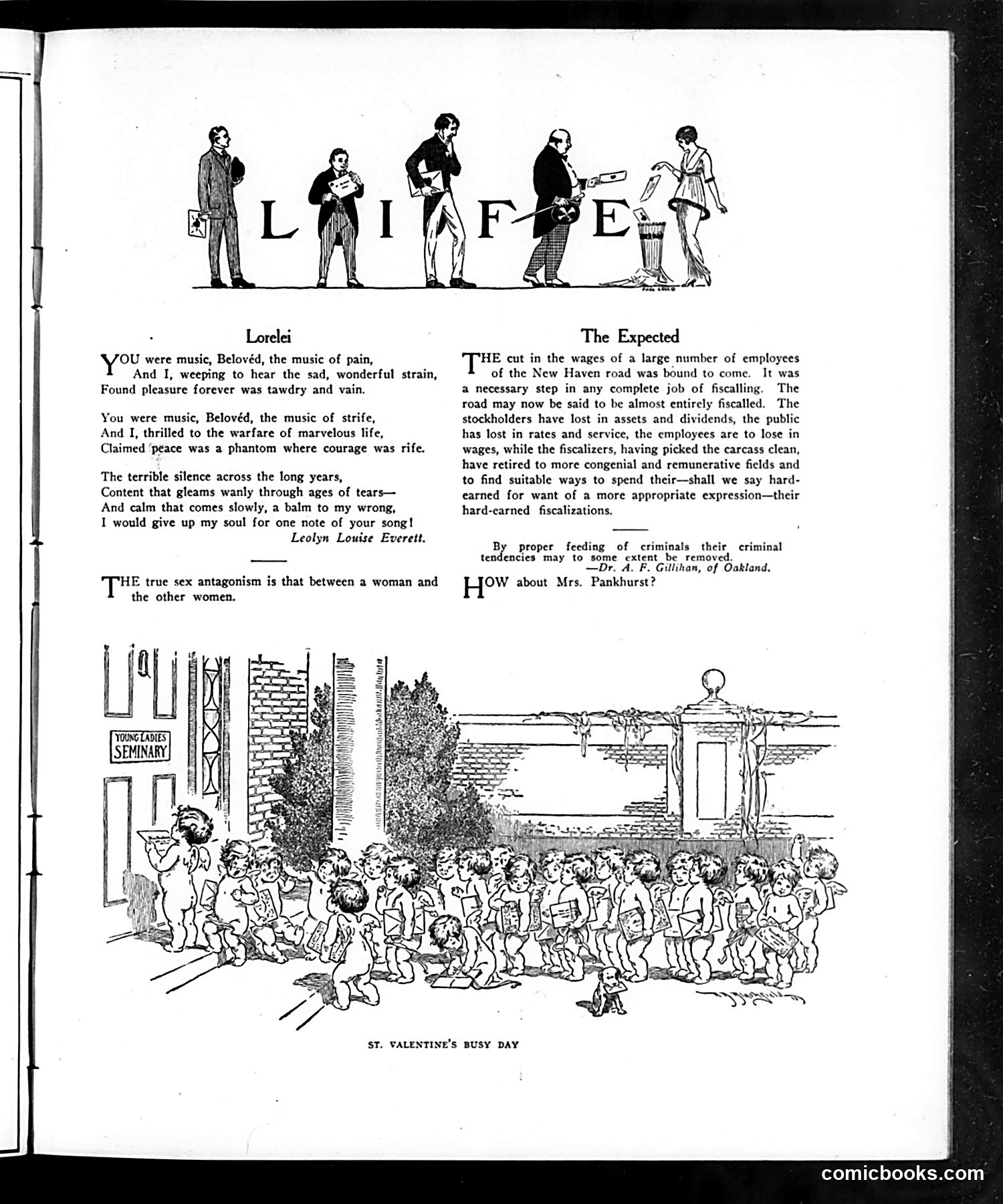
This page contains social commentary from an era of labor unrest. **"Lorelei"** is a poem by Leolyn Louise Everett mourning lost beauty and peace, contrasting with discord and strife. **"The Expected"** discusses wage cuts at the New Haven railroad—a timely reference to actual labor disputes. It critiques how stockholders and executives escaped consequences while workers lost wages and jobs, sarcastically calling fiscalizations "hard-earned." **"St. Valentine's Busy Day"** cartoon depicts cherubs (Cupids) crowding outside a "Young Ladies Seminary," satirizing Valentine's Day commercialism and youthful romance. A quote about "sex antagonism between women" appears unrelated to surrounding content—possibly commentary on gender dynamics of the era. The overall tone is critical of corporate decisions affecting workers during what appears to be an economic downturn.
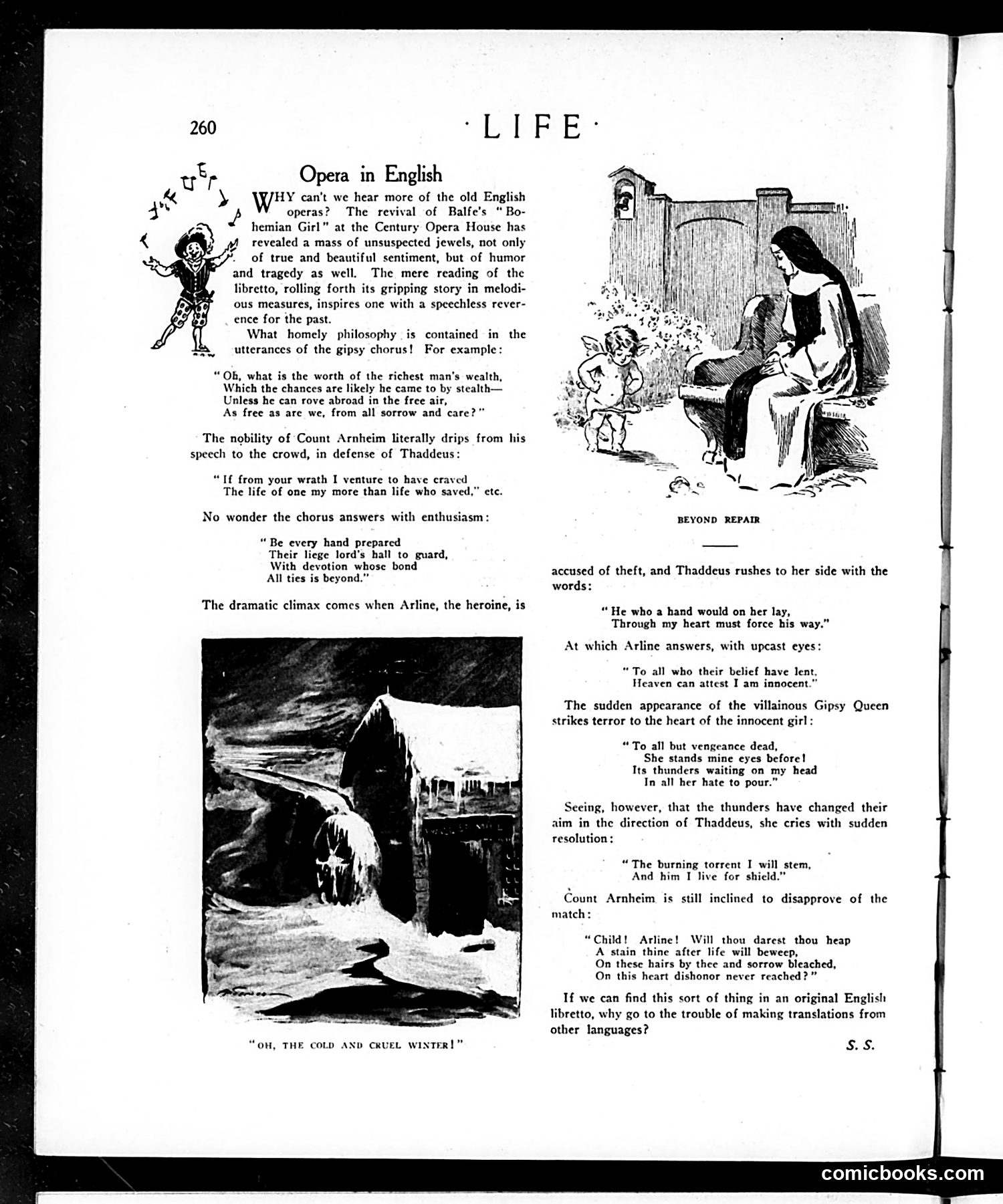
This page discusses a revival of Balfe's "Bohemian Girl," an old English opera performed at the Century Opera House. The article praises the opera's sentimental and humorous qualities, quoting philosophical lines from the libretto about wealth and freedom. The illustrations show scenes from the opera: a domestic moment between characters (top right), and a dramatic winter scene labeled "OH, THE COLD AND CRUEL WINTER!" (bottom left). The text describes plot points involving characters named Arline (the heroine), Thaddeus, and the "Gipsy Queen," discussing their dialogue and dramatic conflicts. The article concludes by advocating for performing original English operas rather than translating foreign works. The author is signed "S.S."
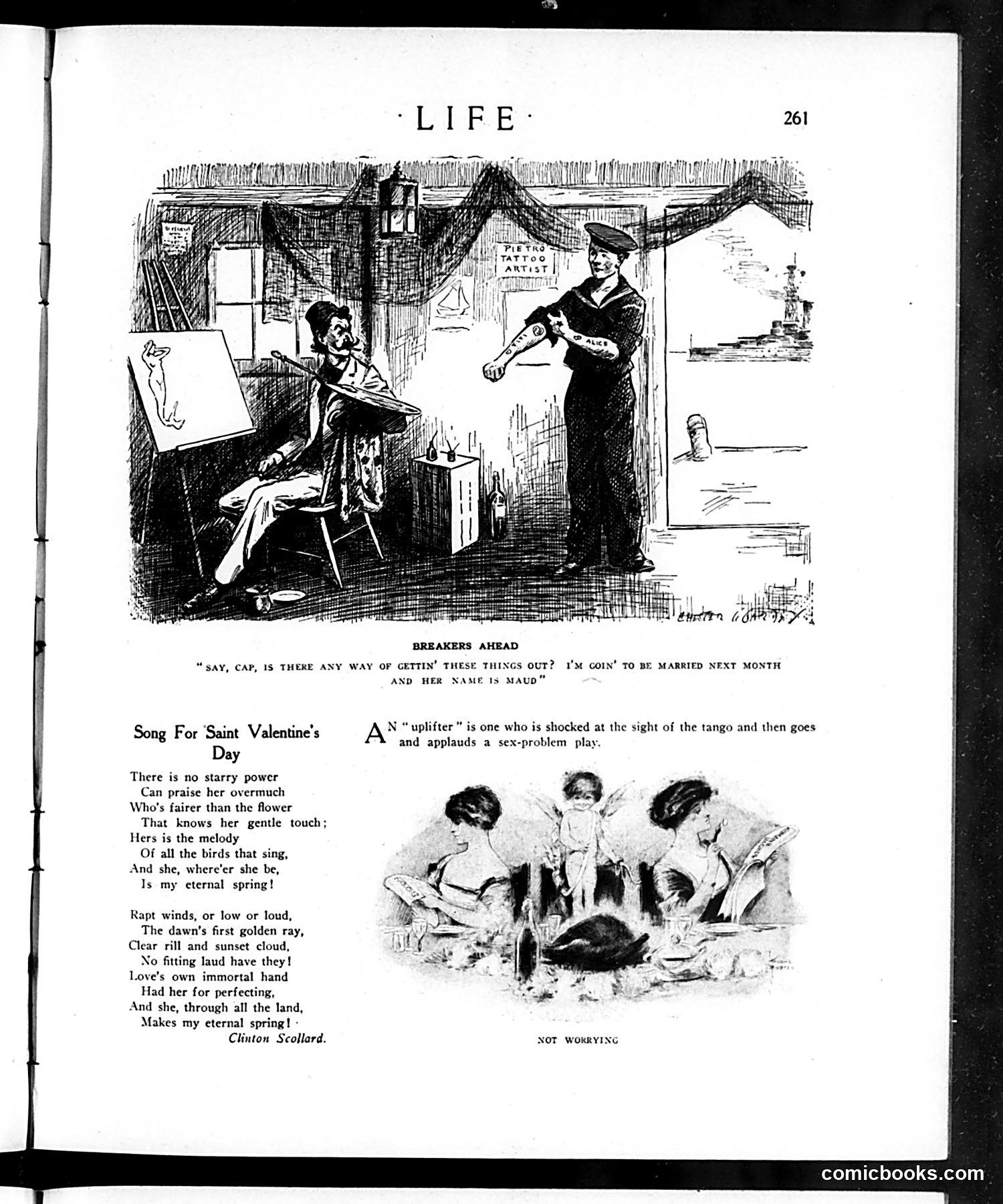
The top cartoon, titled "BREAKERS AHEAD," depicts a tattoo artist showing his work to a sailor. The sailor's caption reveals he's planning to marry someone named "Maud" next month. The joke targets working-class sailors' impulsive romantic decisions—getting tattoos of girlfriends' names was common practice, but often led to regret if relationships failed. Below is a poem, "Song For Saint Valentine's Day," celebrating an idealized woman, paired with an illustration titled "NOT WORRYING" showing women reading together outdoors. The page satirizes romantic sentimentality and male naiveté about commitment, contrasting the sailor's hasty tattoo decision with literary idealization of women. The humor relies on period-specific understanding of tattoo culture and sailor stereotypes.
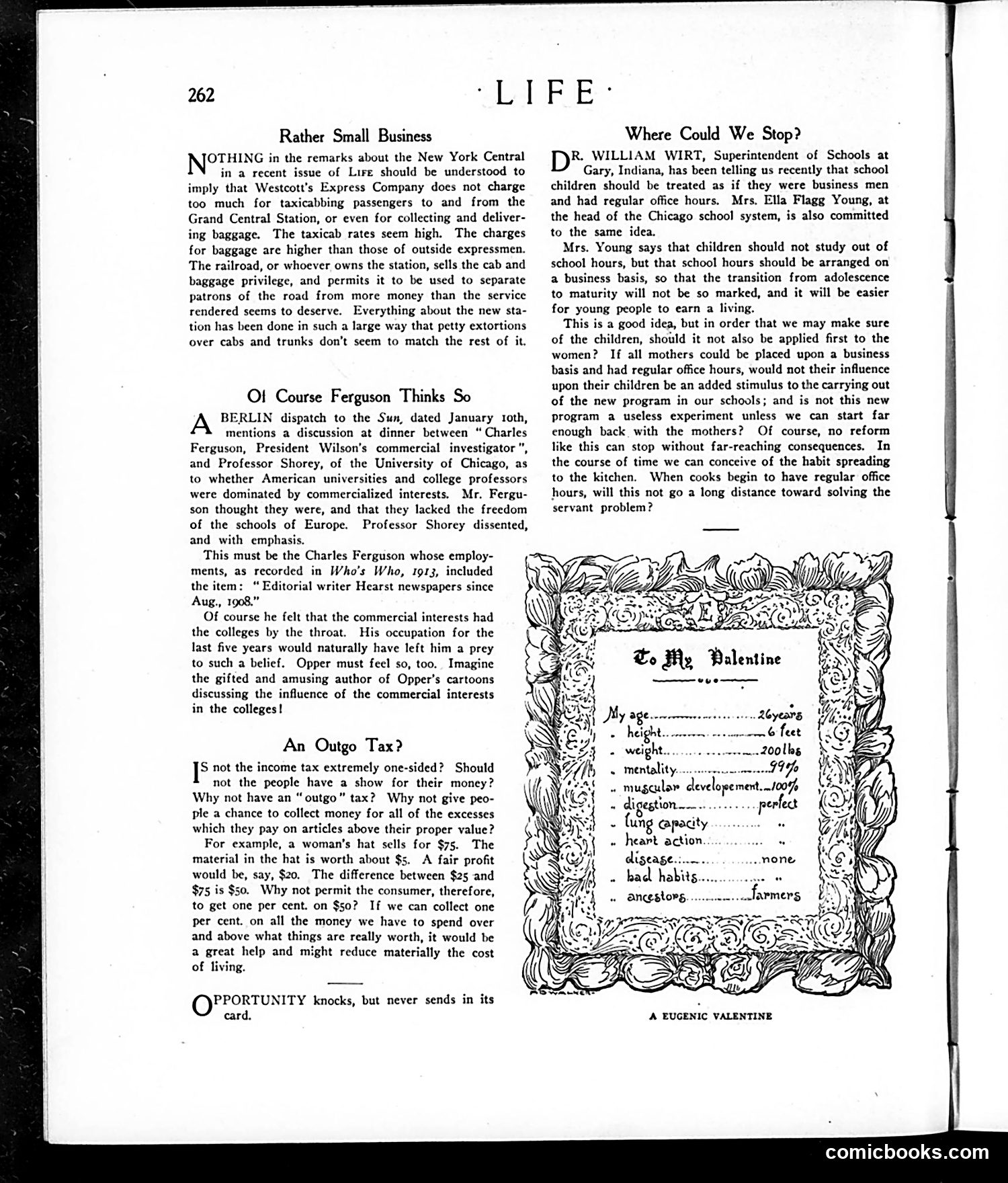
This cartoon mocks the early 20th-century eugenics movement by presenting an absurdly detailed "valentine" checklist for an ideal mate. The list rates prospective partners on pseudo-scientific traits: age, height, weight, "mentality," "muscular development," "digestion," "lung capacity," "heart action," and notably includes dismissive judgments like "bad habits...none" and ancestry as "farmers." The satire targets how eugenicists attempted to quantify human worth and breeding suitability through pseudoscientific measurements. By framing this as a romantic valentine—traditionally about love and emotion—the artist highlights the cold, dehumanizing absurdity of reducing human partnership to biological metrics and class-based ancestry evaluation.
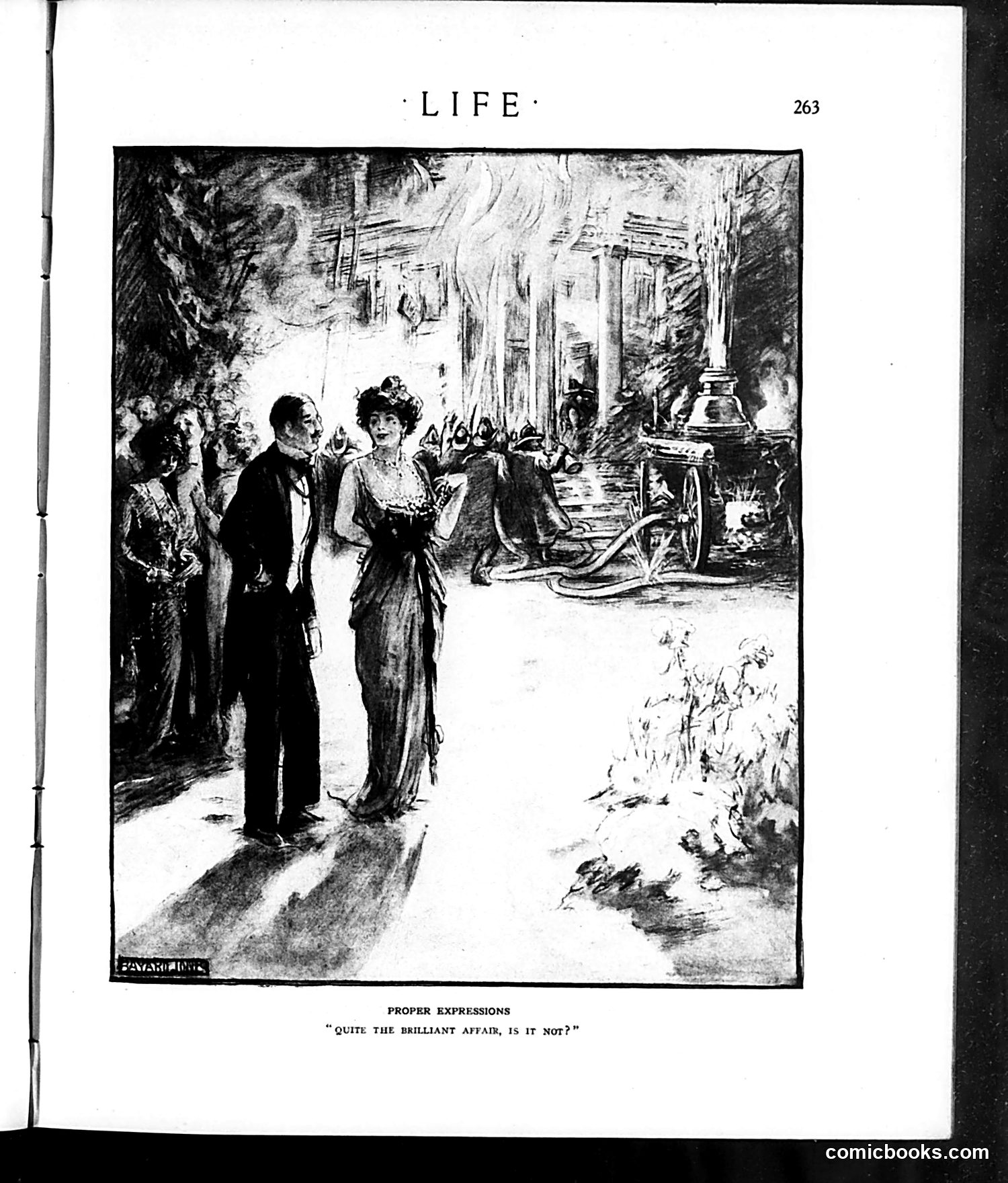
This satirical illustration depicts an elegant social gathering, likely from the early 1900s based on the clothing and artistic style. The caption reads: "Quite the brilliant affair, is it not?" The cartoon appears to mock upper-class social pretension and artificial politeness. A well-dressed couple stands prominently in conversation while other fashionably-attired guests mingle in an ornate setting with classical architecture visible in the background. The satire likely targets the performative nature of high society—how attendees make superficial comments about events being "brilliant" or impressive regardless of actual quality or substance. The exaggerated formality of dress and setting, combined with the mundane query, suggests Life magazine is ridiculing the empty conventions and hollow compliments that characterize polite society gatherings.
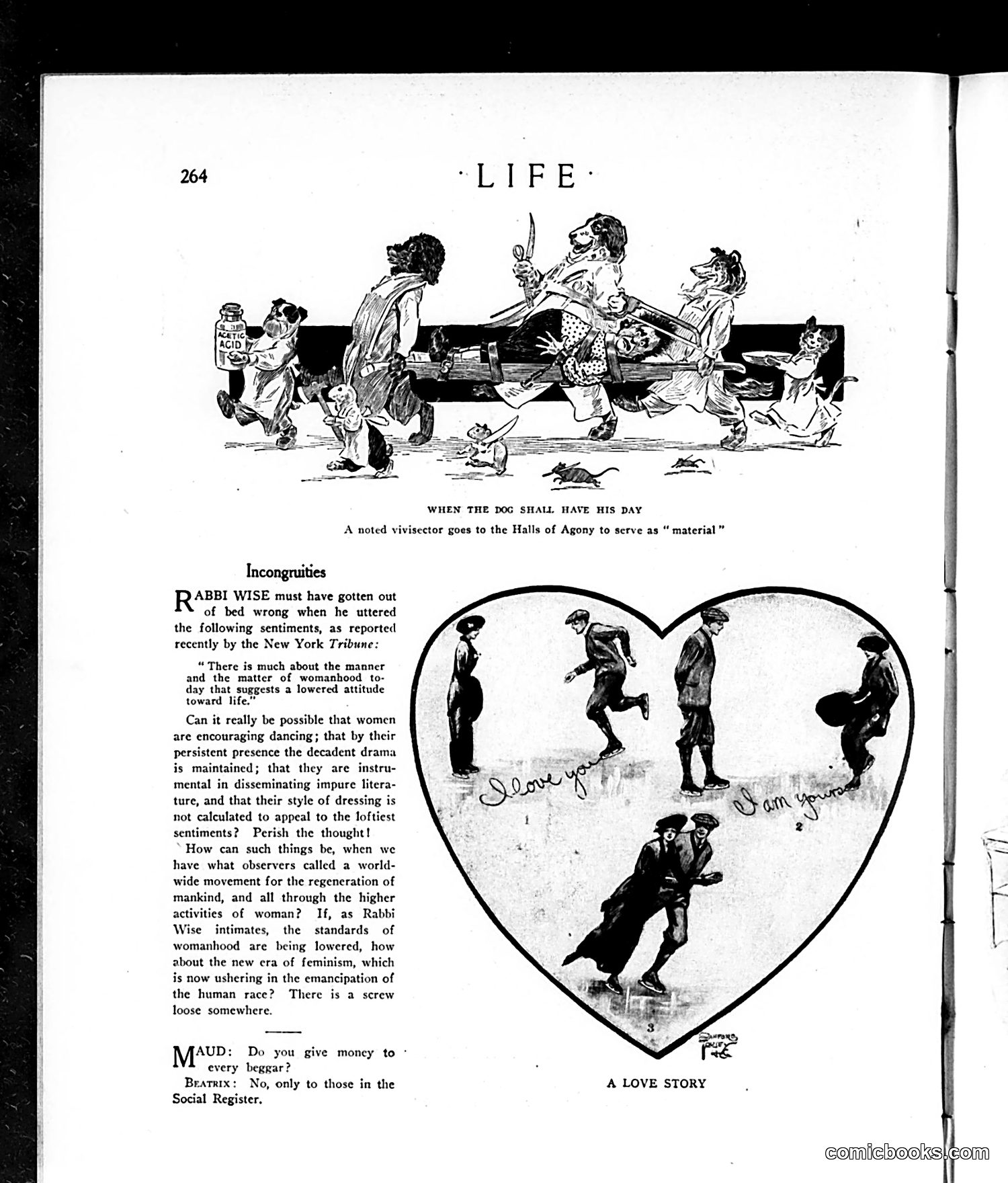
**Top cartoon ("When the Dog Shall Have His Day"):** Depicts anthropomorphized dogs in formal attire conducting what appears to be a vivisection or medical procedure on a human figure. This satirizes anti-vivisection debates of the era—the ironic reversal suggests absurdity in animal rights arguments. **"Incongruities" section:** Criticizes Rabbi Wise's recent statements (reported by New York Tribune) suggesting women's dancing and fashion lower moral standards and encourage "decadent drama." The text mocks these claims as contradicting broader movements for women's emancipation and regeneration of humanity. **"A Love Story" illustration:** A heart-shaped frame contains sketched figures in romantic scenarios, labeled with handwritten phrases. This appears a standard romantic comic feature. The page satirizes conservative opposition to women's liberation and modern social changes.
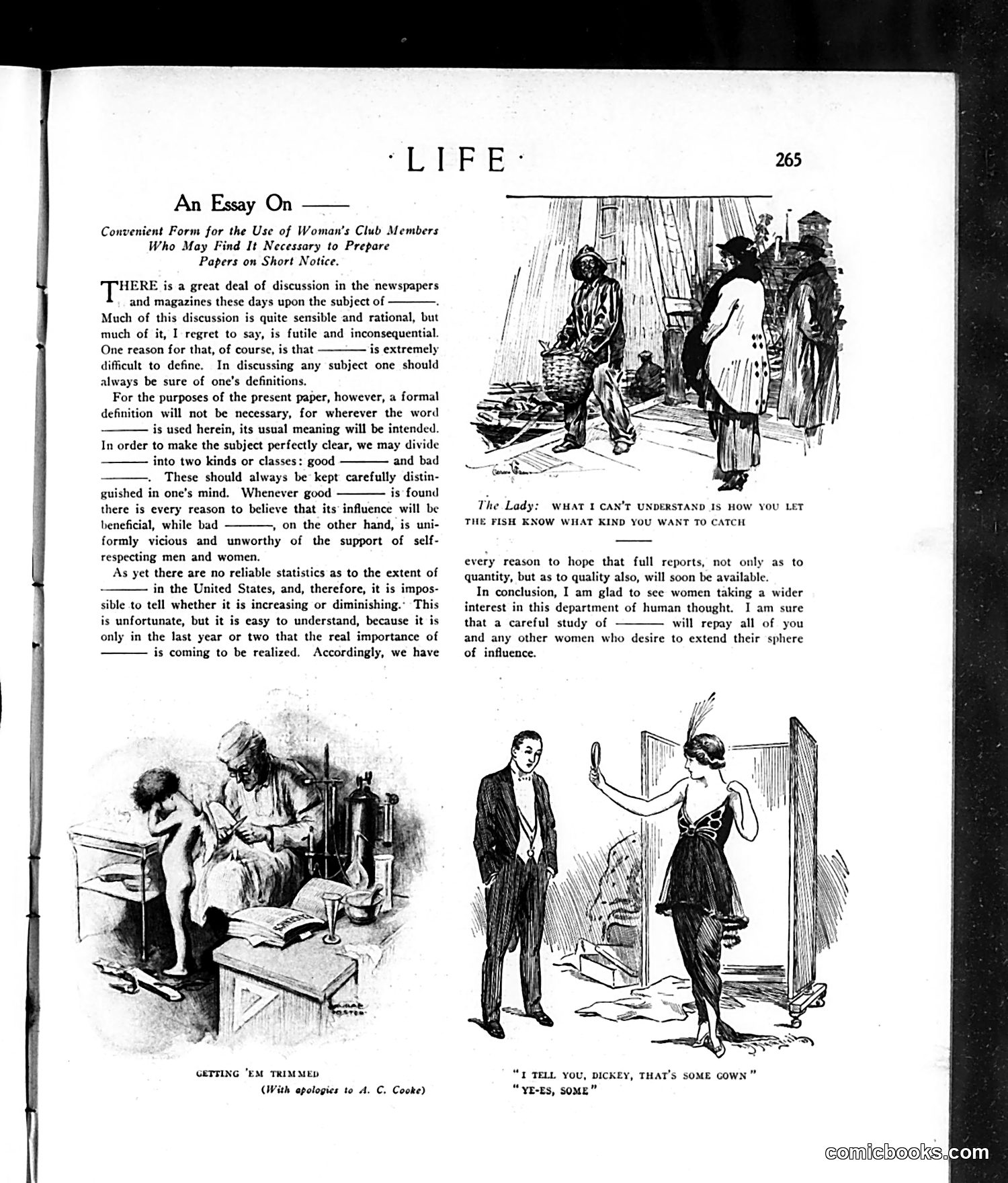
This page presents an essay on defining "life" for women's club members, alongside two satirical cartoon illustrations. The **top cartoon** depicts a woman (labeled "The Lady") questioning fishermen about their catch, with dialogue about understanding fish preferences—likely satirizing women's limited knowledge of practical matters. The **bottom left cartoon**, credited to A.C. Cooke, shows "Getting 'Em Trimmed," depicting a woman at what appears to be a salon or grooming establishment, humorously suggesting women's vanity. The **bottom right cartoon** features a woman and man with the caption "I Tell You, Dickey, That's Some Gowns / Yes, Some," satirizing either fashion obsession or superficial conversation between society figures. Overall, the page uses humor to mock women's perceived preoccupations with appearance and social trivialities, reflecting early 20th-century satirical attitudes toward women.
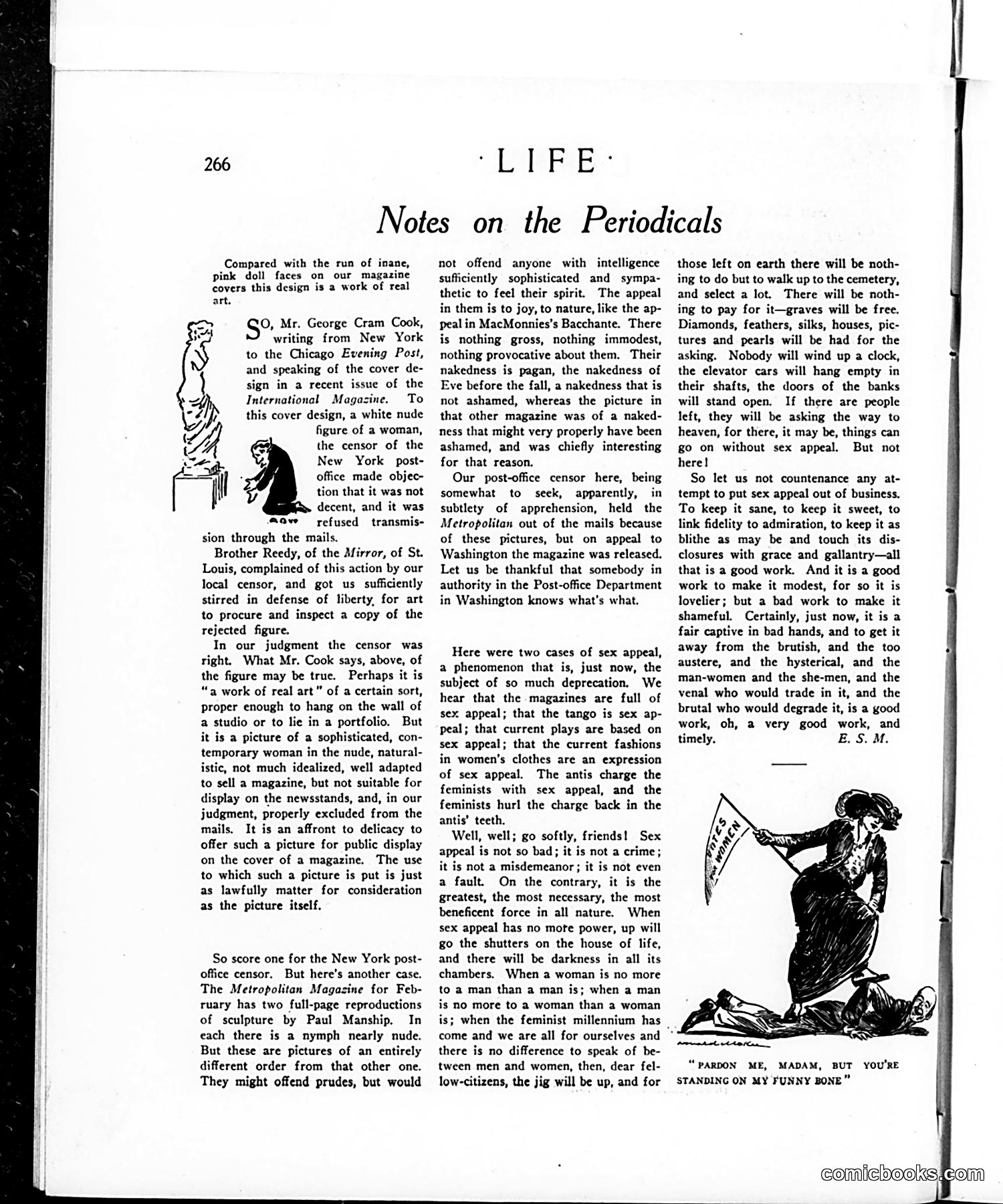
This page discusses postal censorship of magazine covers. The text describes two cases where U.S. post-office censors rejected magazine covers featuring nude or semi-nude female figures—one from the *New York* magazine and another from the *Metropolitan Magazine* featuring Paul Manship sculptures. The cartoon at bottom right depicts a figure (likely representing the censor or authority figure) examining or restraining a woman, with the caption "PARDON ME, MADAM, BUT YOU'RE STANDING ON MY FUNNY BONE." The satire criticizes overzealous censorship: the post-office is portrayed as absurdly prudish, rejecting legitimate art while the cartoon mockingly suggests the censor's own repression. The article argues such censorship stifles artistic expression and that sex appeal in art is natural, not inherently immoral.
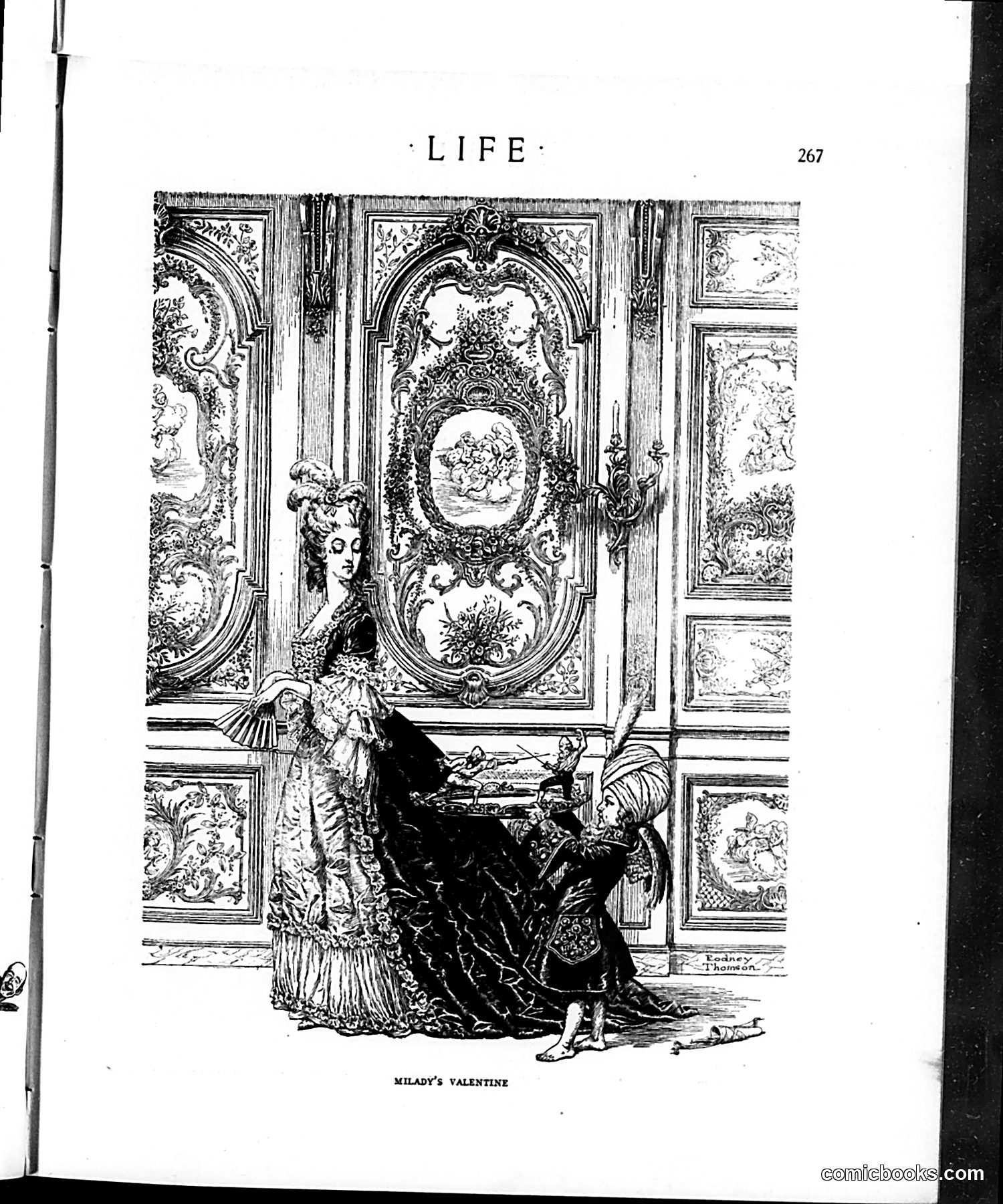
This illustration depicts an elegant 18th-century French interior with ornate wall panels and decorative moldings. A well-dressed woman in fashionable attire stands before a young child who presents her with what appears to be a Valentine's Day gift or note. The satire likely mocks aristocratic pretension and courtship customs of the period. The exaggerated grandeur of the setting—the elaborate paneled walls and ornamental details—contrasts with the simple gesture of a child offering a valentine, suggesting irony about adult romantic rituals among the upper classes. The title "Milady's Valentine" emphasizes the woman's aristocratic status, playing on period conventions where valentines were romantic gestures exchanged among the elite. The specific social commentary remains unclear without additional context about Life magazine's contemporary concerns.
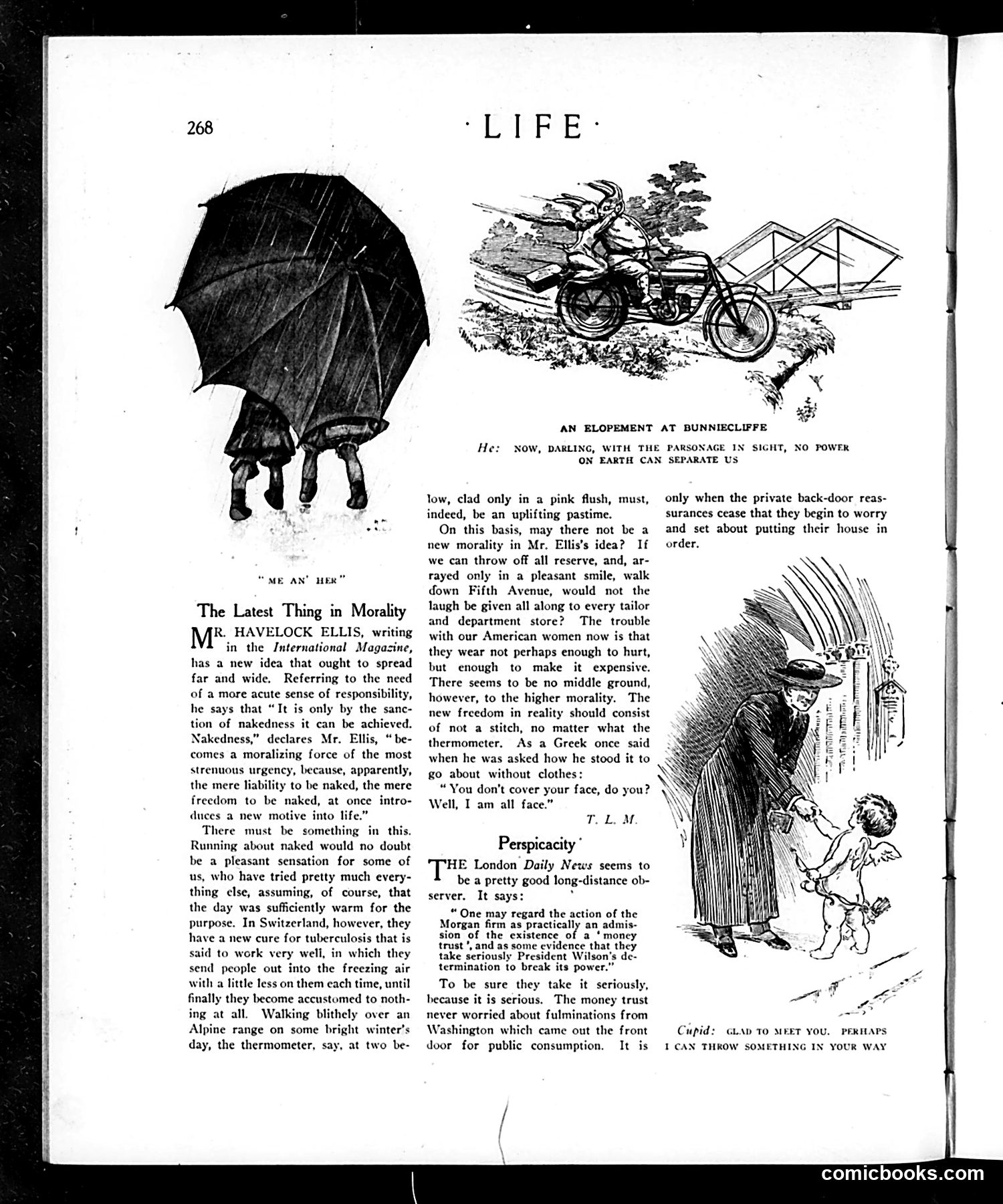
This page satirizes early 20th-century ideas about morality and freedom, primarily targeting philosopher Havelock Ellis's theory that nudity promotes moral responsibility. The left cartoon mocks this notion by suggesting that walking naked down Fifth Avenue—even in freezing Alpine conditions—would be impractical and ridiculous, while sarcastically noting American women already spend enough on clothes without pursuing "moral nakedness." The "Elopement at Bunniecliffe" cartoon depicts a couple eloping on a motorcycle, with the groom declaring nothing can separate them now that the parsonage is visible—a romantic comedy playing on elopement tropes. The "Perspicacity" section critiques the Morgan banking firm and President Wilson's anti-trust efforts, suggesting the money trust only takes government action seriously when it involves private pressure, not public pronouncements. The Cupid cartoon appears incomplete but uses the god of love as a comedic character.
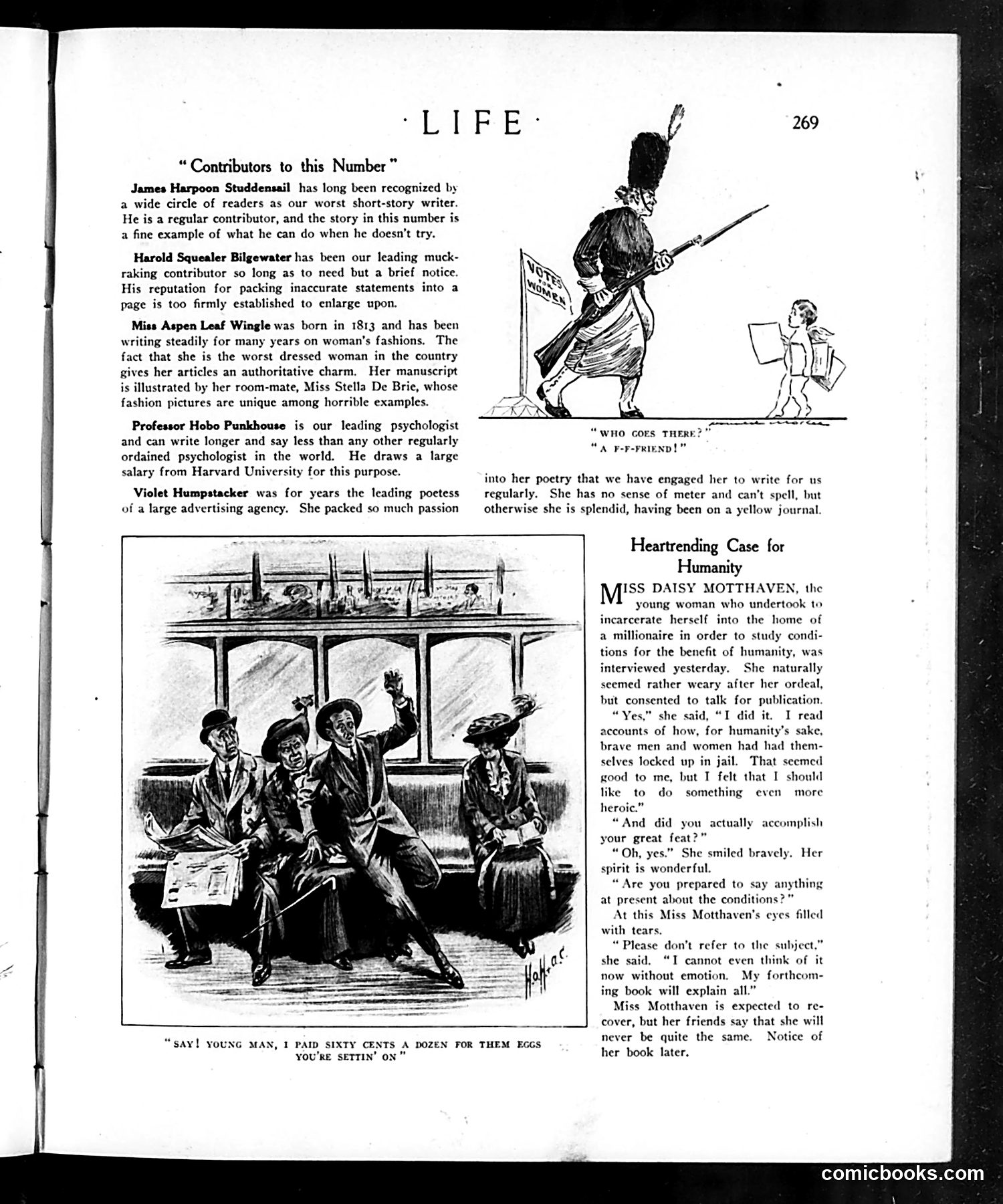
This page mocks Life's own writers through absurdist fake biographies. The humor relies on inverted praise—each contributor is described as spectacularly bad at their job: - **James Studdensail**: worst short-story writer - **Harold Bilgewater**: muckraking journalist known for inaccurate statements - **Aspen Leaf Wingle**: fashion writer who is herself worst-dressed - **Professor Hobo Punkhouse**: psychologist who talks excessively while saying nothing - **Violet Humpstacker**: poet with no sense of meter or spelling The cartoons below satirize contemporary social crusades. One shows a woman who locked herself in a millionaire's home "for humanity's sake" (parodying Upton Sinclair-style investigative journalism), now emotionally traumatized but promoting an upcoming book. The crude drawings mock both self-righteous reformers and sensationalist journalism exploiting social causes. Life here skewers its own industry's pretensions and hucksterism.
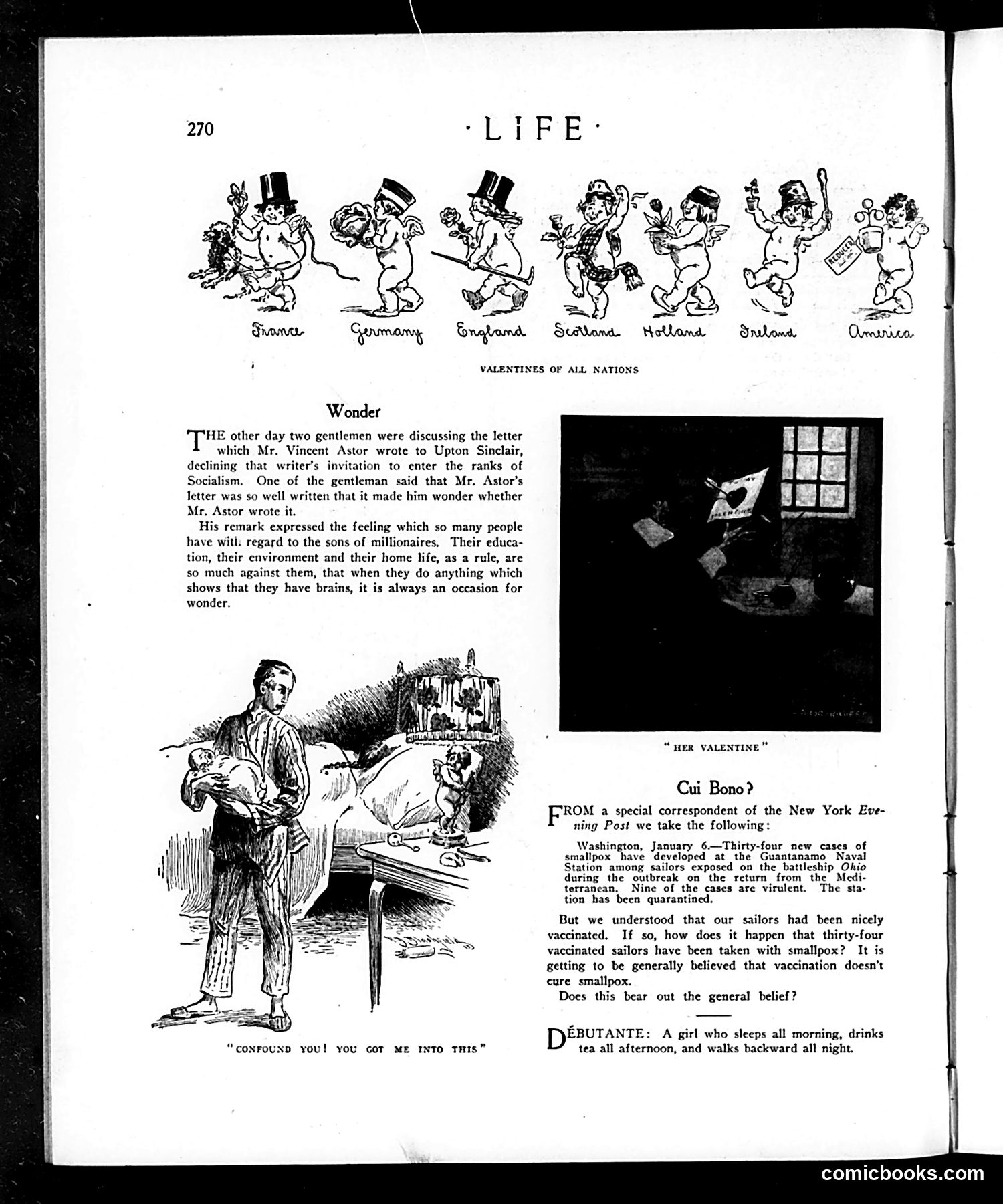
**Top Section - "Valentines of All Nations":** Caricatured cupids representing different countries (France, Germany, England, Scotland, Holland, Ireland, America) satirize national stereotypes and romantic/cultural characteristics of each nation. **"Wonder" Column:** Satirizes wealthy industrialists' sons, specifically referencing Vincent Astor's letter declining socialist Upton Sinclair's invitation. The joke: society assumes millionaires' heirs lack intelligence due to privileged upbringing, so when one writes coherently, people wonder if he actually wrote it himself—suggesting the bar for intellectual competence among the wealthy elite is laughably low. **"Cui Bono?" (Latin: "Who Benefits?"):** Questions the effectiveness of smallpox vaccination after 34 vaccinated sailors at Guantanamo Naval Station contracted the disease. This satirizes either military medical incompetence or broader public skepticism about vaccination efficacy during this era. **"Debutante" Definition:** A brief, cynical joke about wealthy young women's leisure lifestyle.
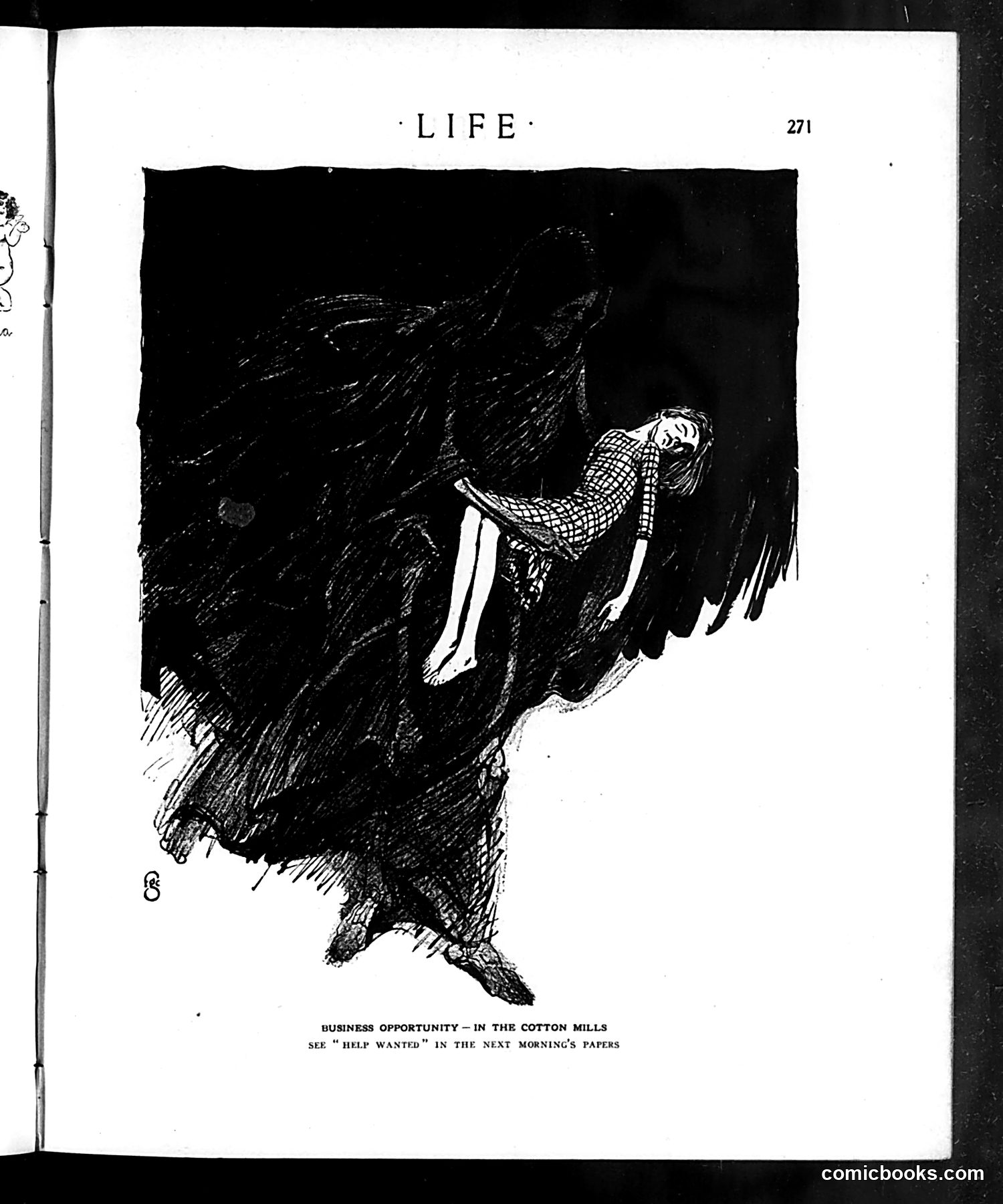
This satirical cartoon criticizes child labor in early 20th-century cotton mills. It depicts a small child being engulfed or consumed by massive industrial machinery—the dark, churning forms represent the mill equipment. The child's tiny white legs and light clothing contrast starkly against the black machinery, emphasizing their vulnerability. The caption's ironic "business opportunity" reference mocks how mills advertised job openings in newspapers' "Help Wanted" sections, treating child labor as normal economic activity. The satire suggests mills were literally devouring children through dangerous working conditions. This reflects genuine progressive-era concerns about child exploitation in factories, a major social reform issue before child labor laws were established in America.
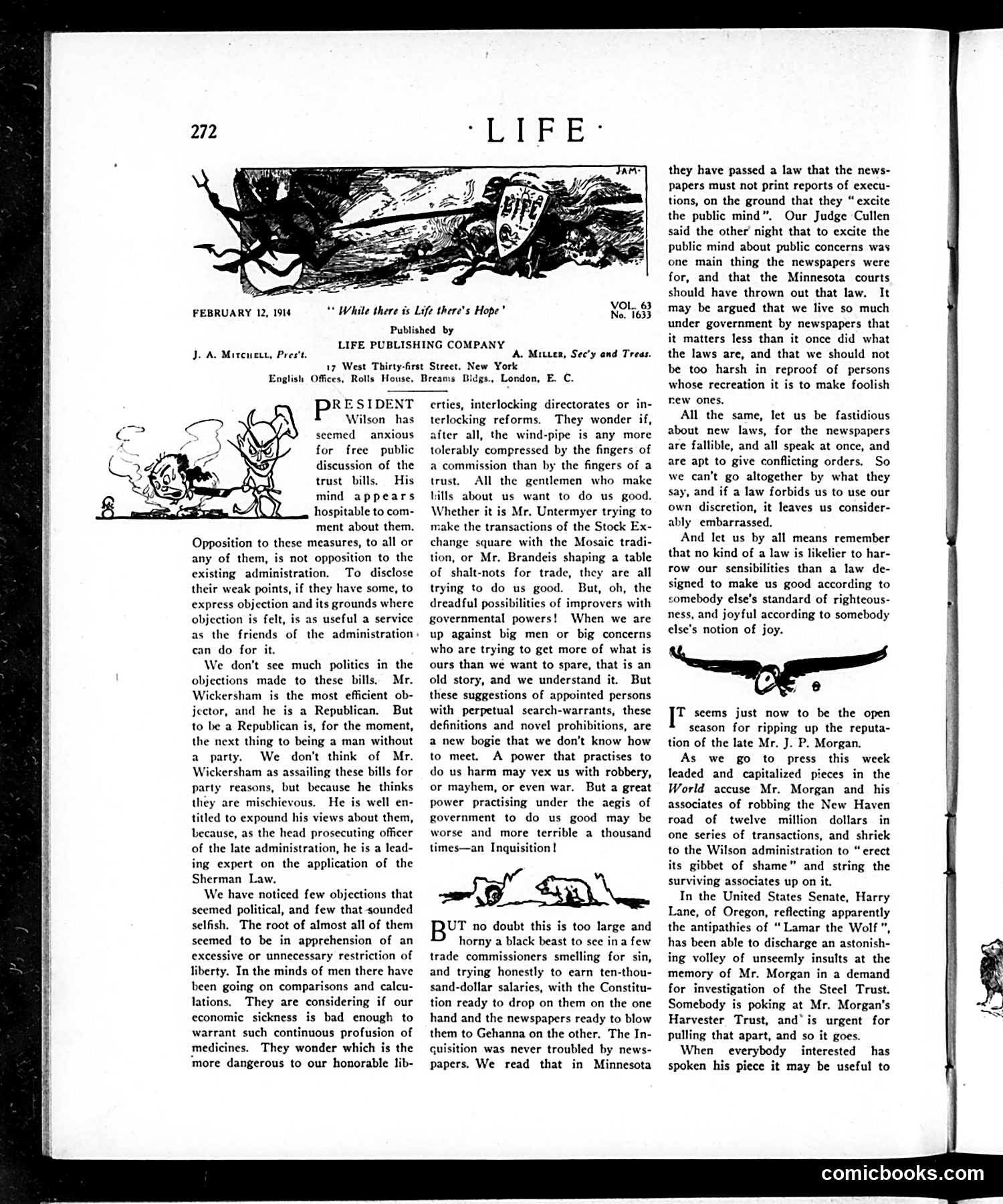
This editorial discusses President Wilson's trust-busting legislation and regulation proposals. The cartoons illustrate the article's central anxiety: the danger of government power exercised "to do us good." The text criticizes not the *intent* of reformers like Louis Untermyer (stock exchange regulation) and Louis Brandeis (trade restrictions), but fears their governmental reach. It compares expansive regulatory power to an "Inquisition"—suggesting that well-meaning bureaucrats with broad search powers and enforcement authority pose greater threats to liberty than corrupt trusts themselves. A secondary complaint addresses Minnesota's law prohibiting newspaper coverage of executions, which Life's Judge Cullen opposed. The magazine argues newspapers serve democracy by exciting public concern about public matters. The cartoons' specific figures are unclear in this reproduction, but the overall message warns against concentrated regulatory government power, however benevolent its stated purpose.
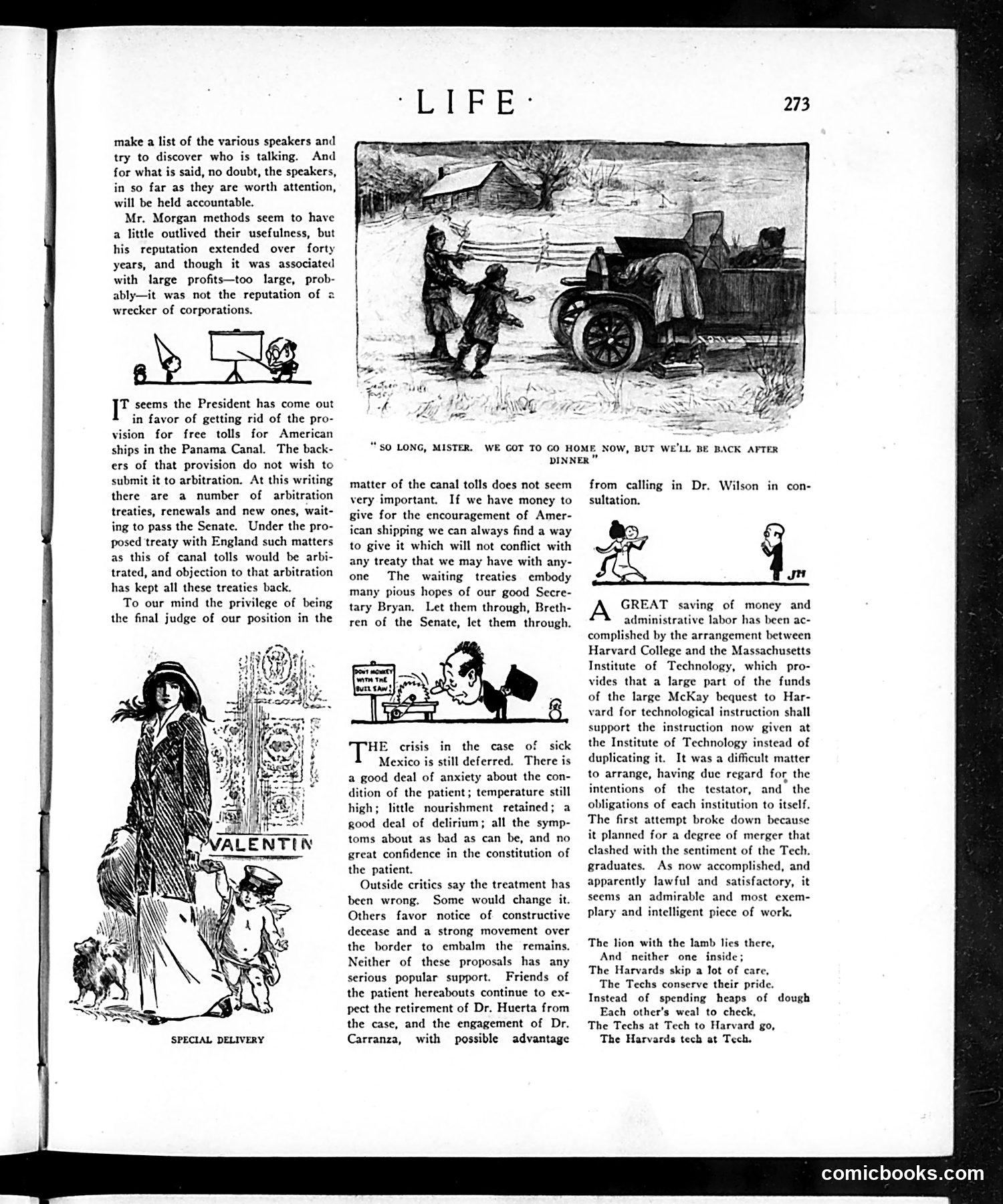
This page contains several satirical pieces typical of Life's early 20th-century format: **Top cartoon**: Shows a man and child saying goodbye to someone in a car, captioned "So long, mister. We got to go home now, but we'll be back after dinner." This appears to satirize casual or temporary departures, likely political in nature. **Left illustration**: Labeled "Special Delivery," depicts a fashionable woman (possibly caricatured as "Valentin") with small dogs—likely mocking high society or Valentine's Day sentimentality. **Text commentary** addresses: - **J.P. Morgan's business methods** and their waning relevance - **Panama Canal tolls policy** and arbitration treaty disputes with England - **Mexico's political crisis**, using medical metaphors ("sick Mexico," Dr. Huerta, Dr. Carranza) to satirize U.S. intervention debates - **Harvard-MIT funding arrangement**, praised as sensible institutional cooperation The satirical tone critiques both political establishment figures and contemporary policy debates while celebrating practical administrative solutions.
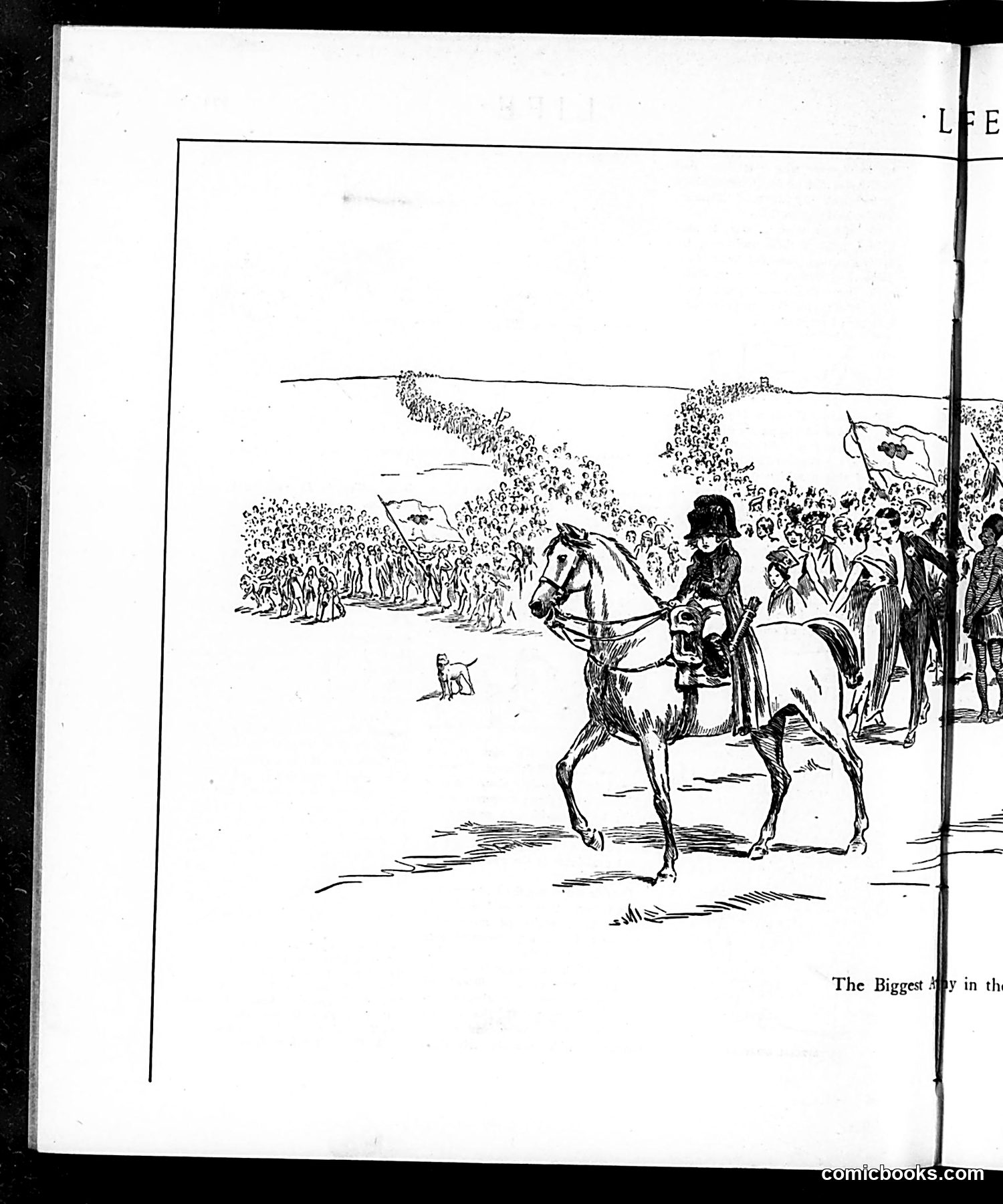
This page shows a sketch of a military or official figure on horseback addressing a large assembled crowd, with flags visible in the background. The partial caption reads "The Biggest Boy in th[e]..." suggesting this is satirizing someone prominent. The drawing style and composition—depicting an authority figure on horseback before masses of people—suggests satire of military pageantry, autocratic power, or grandiose self-promotion. The "biggest boy" phrasing implies mocking someone's inflated ego or self-importance. However, without the complete caption or publication date visible, I cannot definitively identify which historical figure or event is being satirized. The incomplete text at the bottom prevents confident interpretation of the specific political or social target.
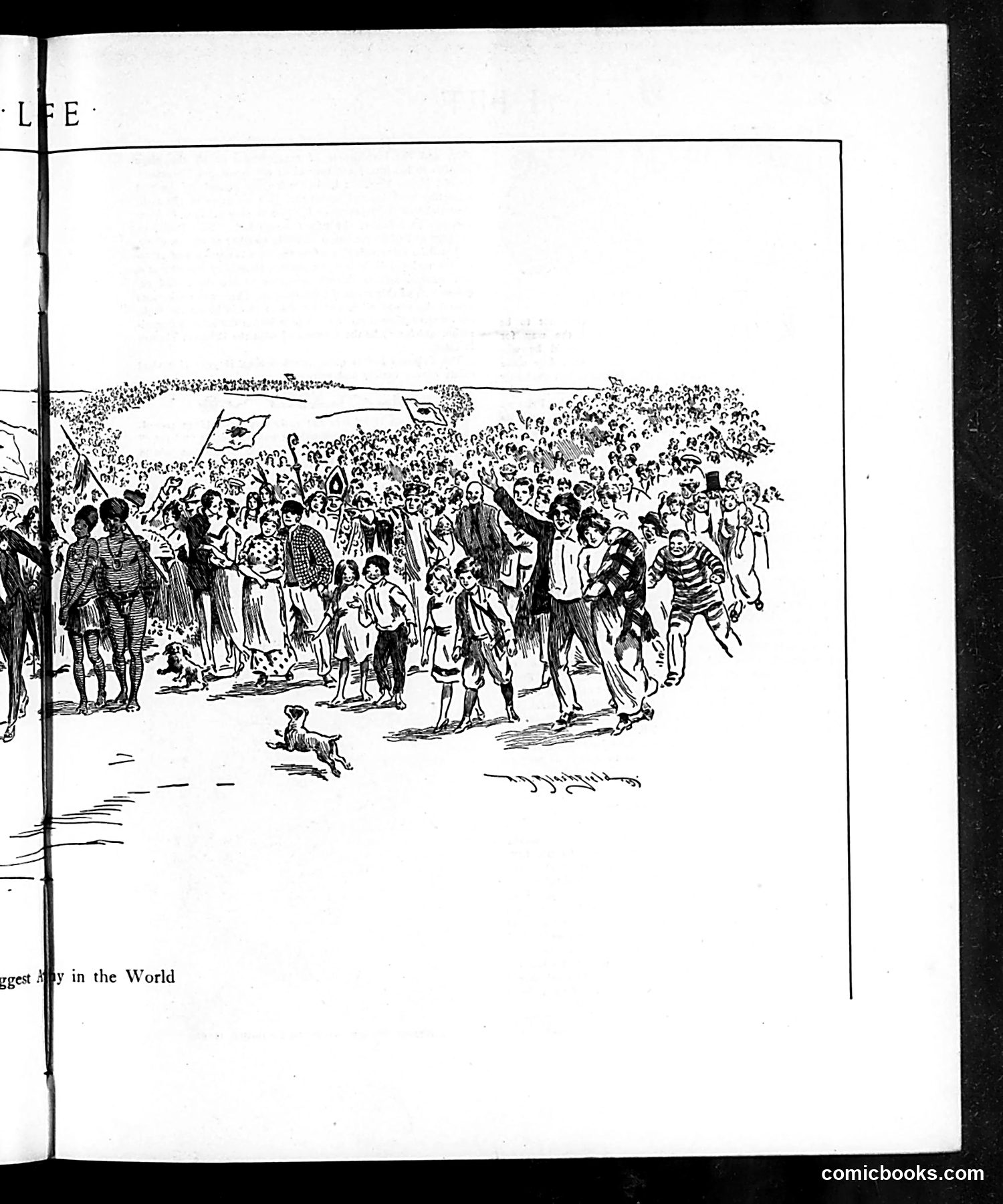
This page shows a large crowd scene with numerous figures gathered together, rendered in ink sketch style typical of early 20th-century satirical illustration. A small dog appears in the foreground. The visible text fragments—"appy in the World" (likely "Happiest Boy in the World" or similar) and the watermark "comicbooks.com"—provide minimal context for interpretation. **Without clearer text or identifying labels visible in the image itself, I cannot reliably identify specific political figures, the exact satirical target, or the intended joke.** The scene appears to depict some kind of public gathering or celebration, but the specific social or political commentary remains unclear from this reproduction alone.
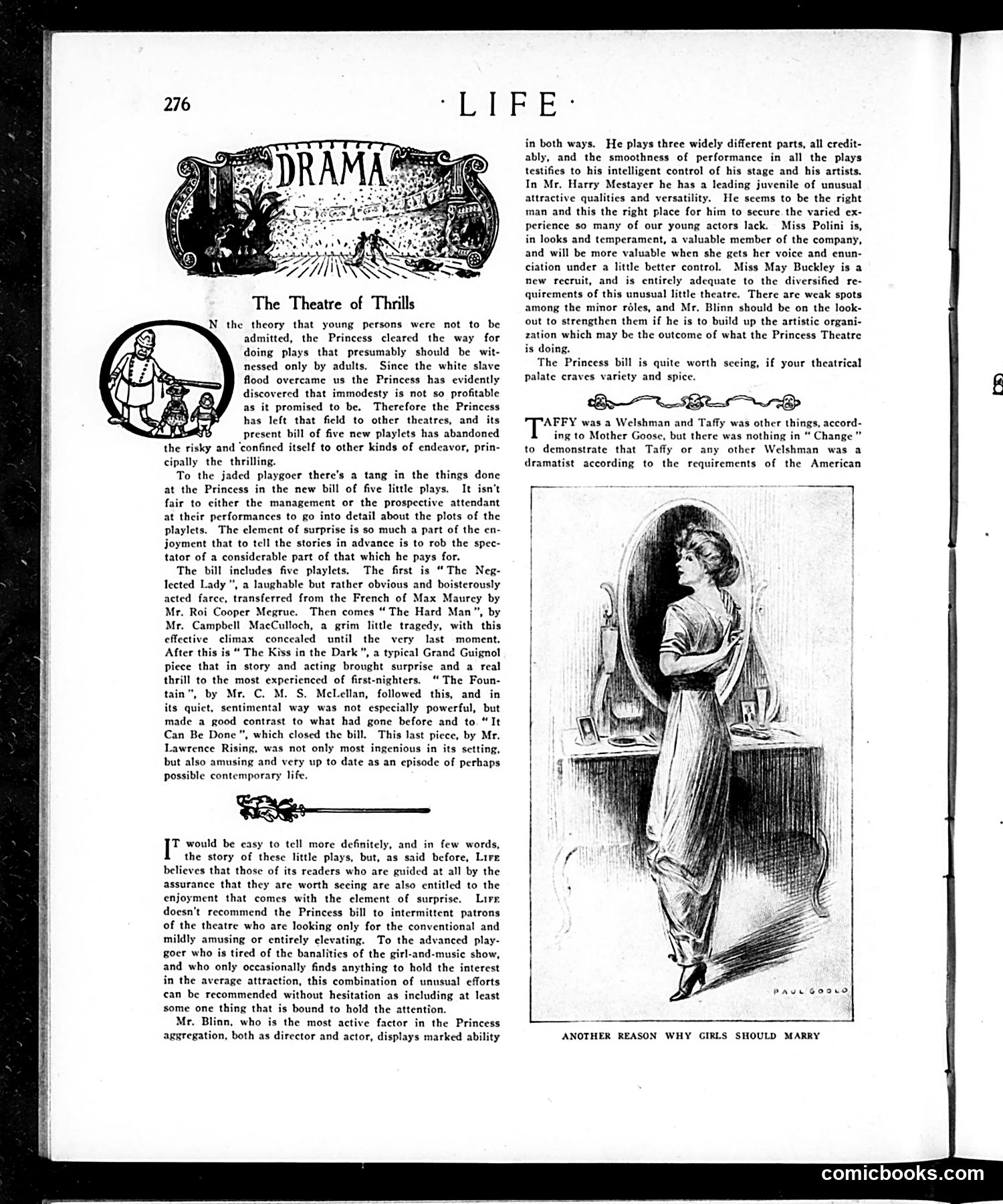
This page reviews the Princess Theatre's new bill of five one-act plays. The publication praises the venue for abandoning its previous reputation for risqué content (the text obliquely references the "white slave flood" — likely referring to sensationalist plays exploiting that social crisis) in favor of thriller and dramatic works. The review discusses five playlets: "The Neglected Lady," "The Hard Man," "The Kiss in the Dark" (described as "Grand Guignol" — theatrical horror/shock drama), "The Fountain," and "It Can Be Done." The critic deliberately avoids plot details to preserve the "element of surprise" for potential audiences. The illustration shows a woman in period dress, captioned "Another Reason Why Girls Should Marry" — a caption whose satirical meaning remains unclear without additional context, though it likely comments on contemporary social attitudes toward marriage. The review praises director/actor Mr. Blinn's "marked ability" and notes promising young performers like Harry Mestayer and others in the company.
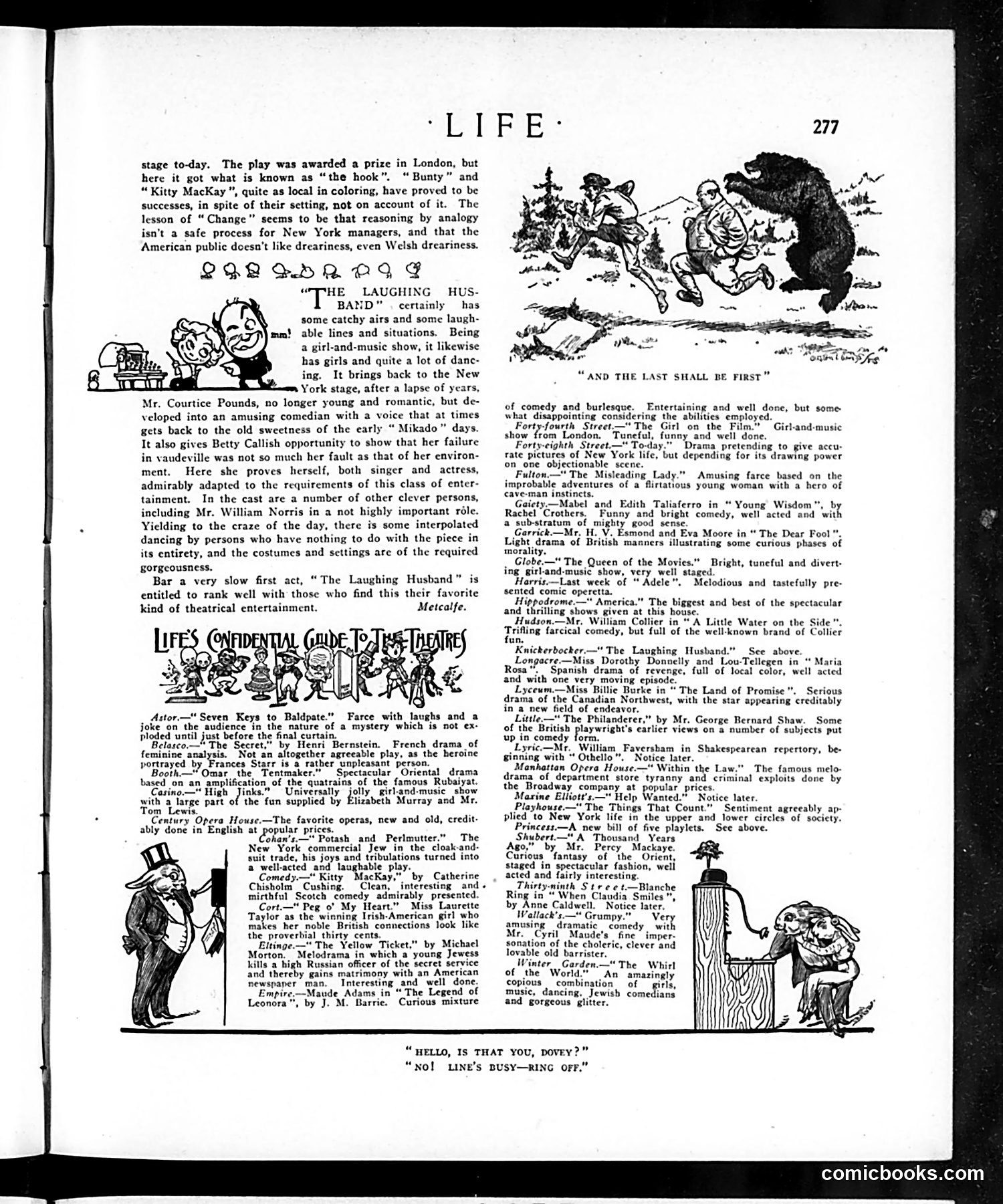
This page from *Life* magazine reviews current Broadway productions, using caricature and satire to critique theatrical offerings. The cartoons illustrate the reviews' themes. **Key elements:** The top cartoon shows figures fleeing or collapsing—visual commentary on theatrical failures. The reviews themselves are satirical, mocking plays that don't suit American audiences despite London success (like "Change," dismissed as too dreary and Welsh). **The satire's point:** American theater managers wrongly assume London's taste predicts New York success. The page celebrates comedies with "girls and music" and dancing over serious drama—reflecting early 20th-century popular entertainment preferences. **Figures mentioned** include actor Courtice Pounds (aging from his *Mikado* days) and actress Laurette Taylor, praised for her charm. The ornamental header "Life's Confidential Guide to the Theatres" and decorative illustrations frame this as insider theatrical gossip, positioning *Life* as arbiter of entertainment taste—the magazine's characteristic satirical stance toward American culture.
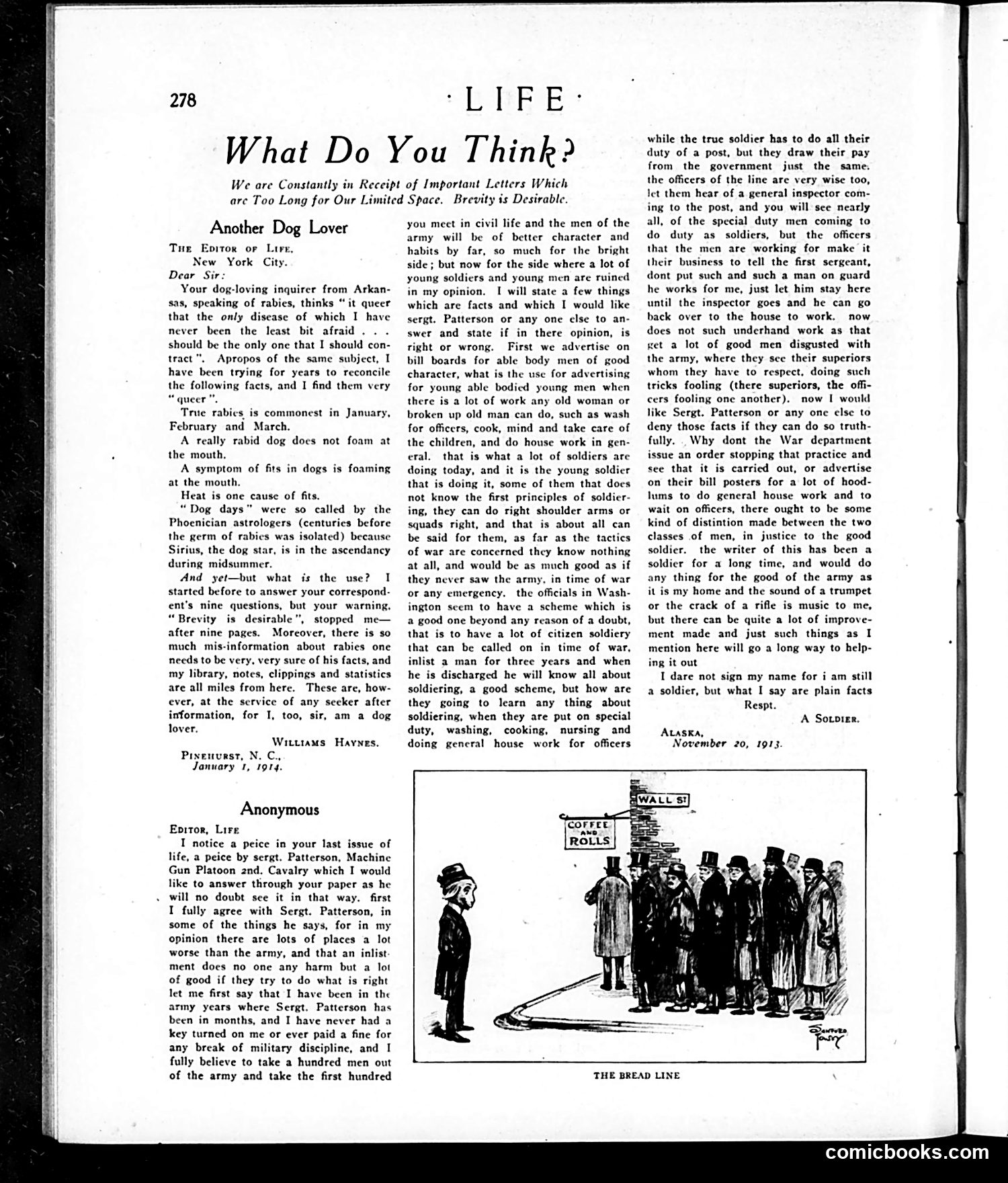
This page contains reader letters to *Life* magazine and a cartoon titled "The Bread Line." The cartoon depicts a soldier in uniform standing apart, observing a long queue of civilians (appearing to be poor or unemployed) waiting for food at a "Wall St. Coffee & Rolls" stand. The satirical point is likely a contrast between military service and urban poverty: while soldiers are being recruited and trained, ordinary citizens on the home front struggle with hunger and destitution. The reference to "Wall Street" (the financial center) may suggest irony—that wealth exists nearby while people starve in breadlines. The accompanying letters debate military service's value, with contributors arguing whether army discipline improves or harms young men, and whether recruitment practices properly utilize soldiers' abilities. The page reflects 1913 American anxieties about industrialization, poverty, and military preparedness preceding U.S. entry into World War I.
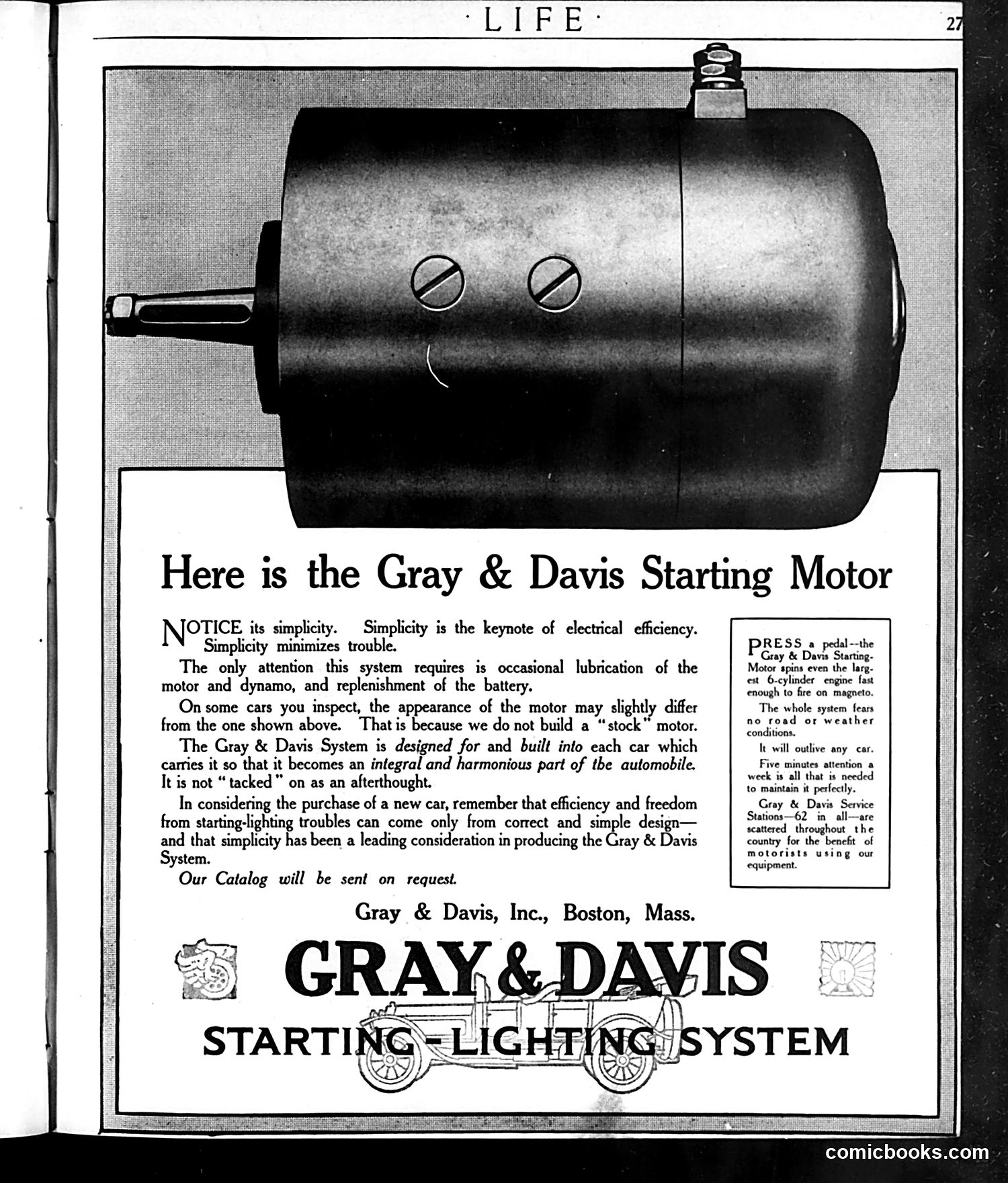
This is **not a cartoon or satire**—it's a straightforward **automobile advertisement** from Life magazine's early automotive era (likely 1910s). Gray & Davis, Inc. of Boston marketed an **electric starting and lighting system** for automobiles. The image shows their cylindrical starting motor, a major innovation that replaced hand-crank engine starting (dangerous and physically demanding). The ad emphasizes **simplicity and reliability** as selling points, claiming the system requires only occasional lubrication and battery replacement. It stresses the motor is "built into" cars rather than added as an afterthought, and highlights their network of 62 service stations nationwide. For modern readers: this represents the transition from manual to electric car starting—a significant quality-of-life improvement in early automobiles. The emphasis on service stations and maintenance reflects the era's relatively primitive automotive infrastructure.
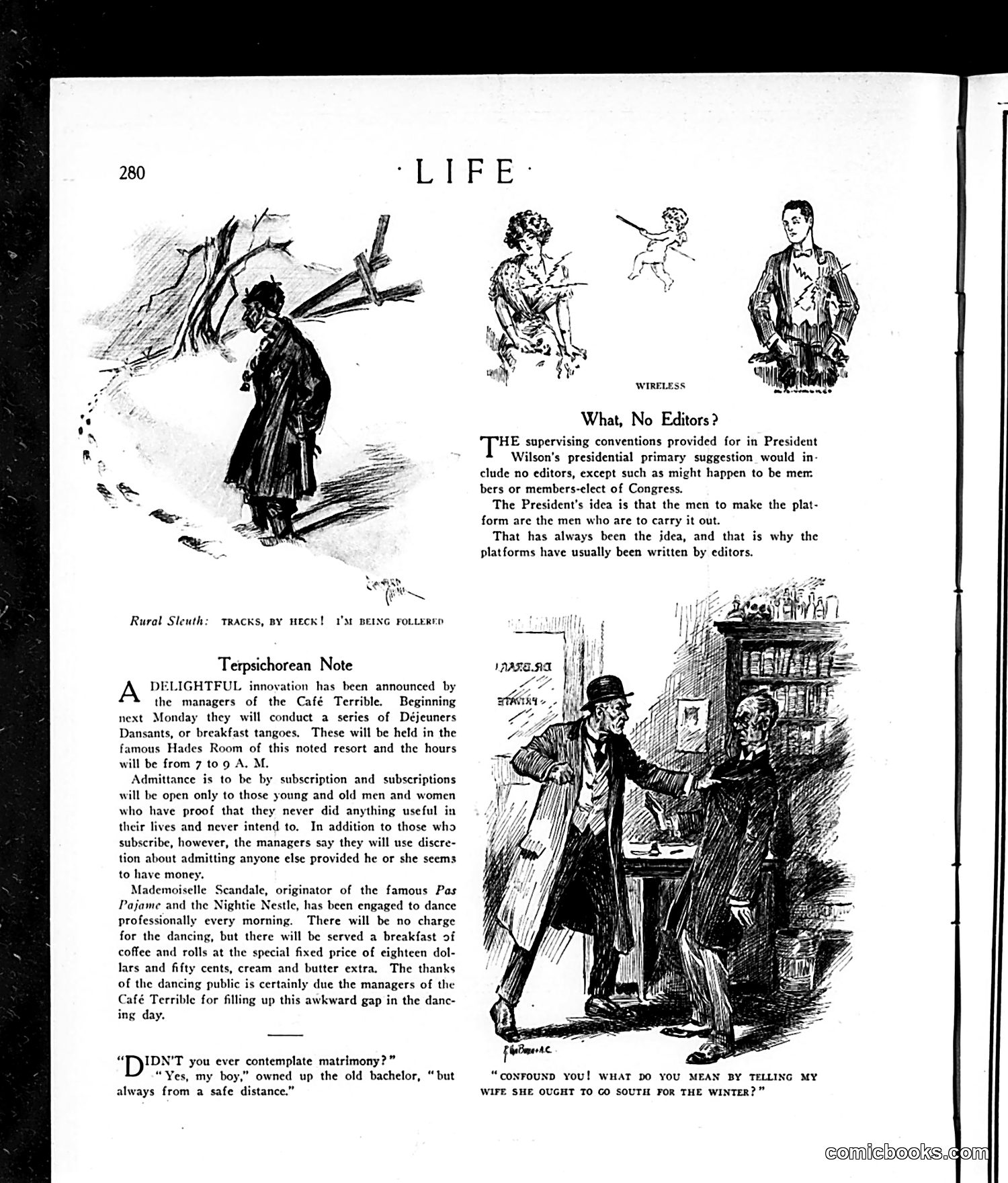
This page contains three distinct satirical pieces: **"Rural Sleuth"** (top left): A simple visual joke showing a person following footprints in snow, captioned "TRACKS, BY HECK! I'M BEING FOLLOWED"—the humor lies in the obvious self-referential absurdity. **"Terpsichorean Note"** (center): Mocks the absurd trend of "breakfast tangoes" at the Café Terrible. The satire targets wealthy idlers who pay eighteen dollars and fifty cents for dancing and minimal breakfast. Life ridicules both the pretentious French naming and the exclusive membership criteria—admission requires proof of having "never did anything useful" but also requires visible wealth. This attacks frivolous upper-class spending during an era of social concern. **"What, No Editors?"** (right): Comments on President Wilson's primary convention proposal, which would exclude newspaper editors from platform-writing. Life's joke: editors have always written platforms anyway, suggesting Wilson's reform won't change much. The marriage joke at bottom is unrelated wordplay.
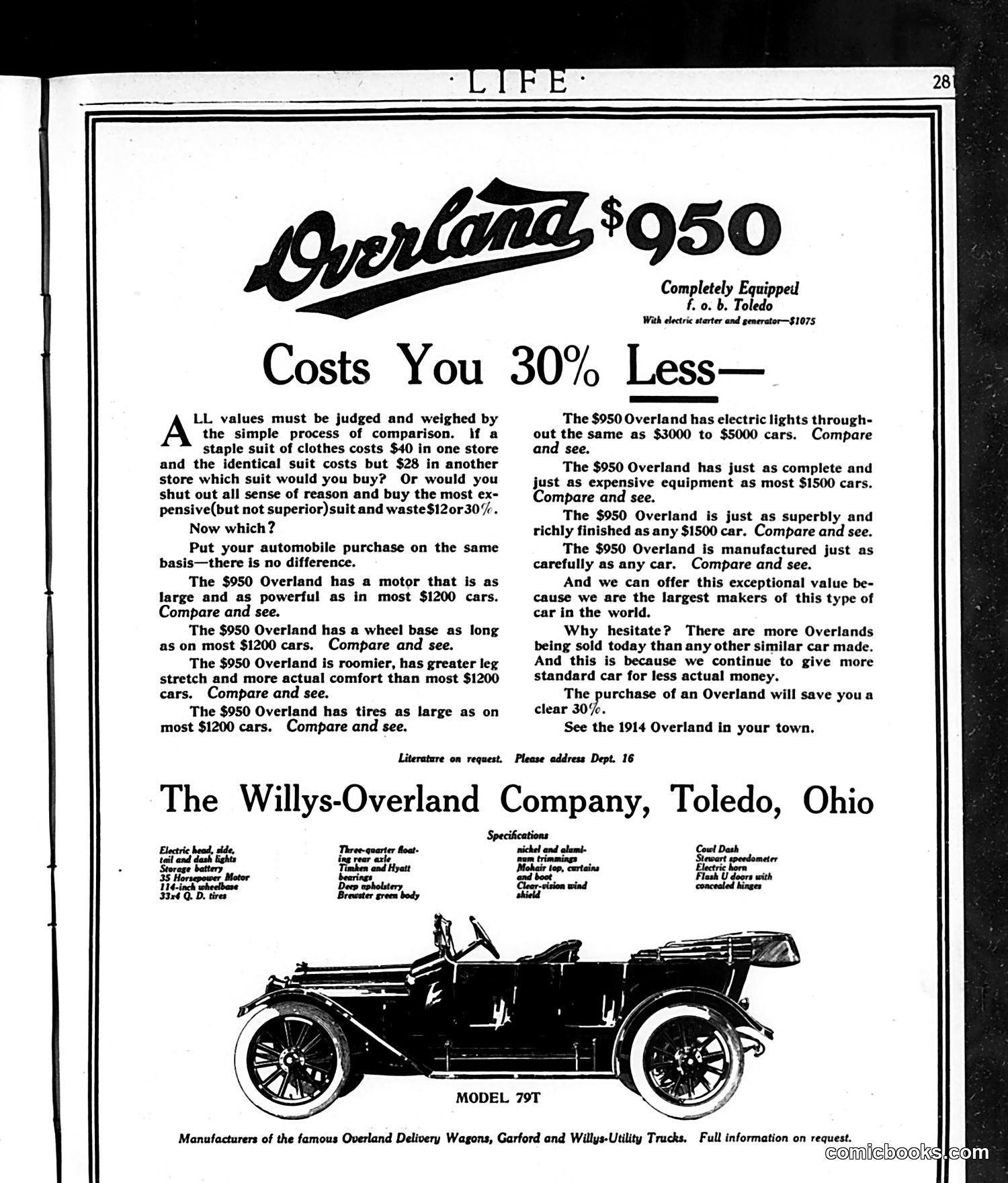
This is **not a cartoon or satire**, but a straightforward **automobile advertisement** from Life magazine's advertising section (page 28). The Willys-Overland Company promotes their $950 Model 79T car by using a comparison-shopping argument: just as consumers wouldn't buy an expensive suit over an identical cheaper one, they shouldn't overpay for cars with comparable features. The ad claims the Overland matches $1,200-$1,500 vehicles in motor power, wheelbase, comfort, and equipment—offering 30% savings. The pitch emphasizes value through repeated "Compare and see" refrains and notes Overland's market dominance ("more Overlands being sold today than any other similar car"). **Context for modern readers**: This reflects the early 1910s auto market when cars were luxury goods, and price-based marketing on feature parity was novel. The casual racism of "Life" magazine's typical content contrasts sharply with this earnest, rational sales pitch targeting middle-class buyers seeking practical economy.
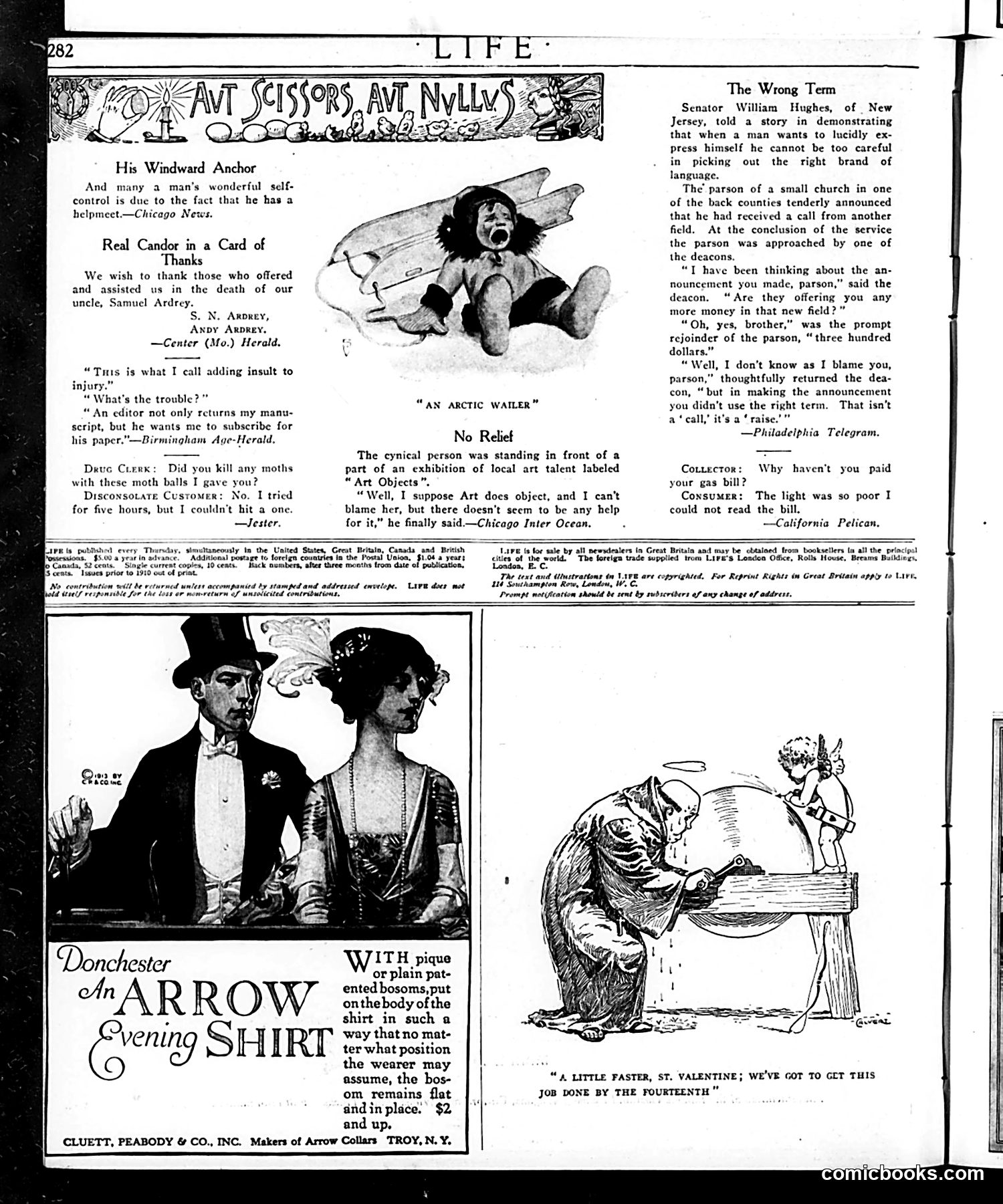
This is a typical early 20th-century Life magazine page mixing humor, advertisements, and social satire. **Main Content:** The page features several brief humorous anecdotes and jokes, including one about a church parson who announces he's received a "call" to another church offering more money—a deacon corrects him that it's a "raise," not a "call," since financial motivation contradicts the spiritual meaning of ecclesiastical calling. This satirizes how people misuse terminology and the tension between religious idealism and material self-interest. **Illustrations:** The top cartoon shows a dog or creature as an "Arctic Wailer"—likely a visual pun. The bottom illustration depicts Cupid rushing someone working at a desk, captioned about finishing a job by Valentine's Day (February 14), probably satirizing workplace pressure during the holiday. **Advertisement:** A Donchester Arrow shirt advertisement occupies the lower left, emphasizing the shirt's flat bosom that remains neat regardless of the wearer's position. The page exemplifies Life's formula: gentle social mockery through puns, wordplay, and visual humor targeting middle-class pretensions and everyday absurdities.
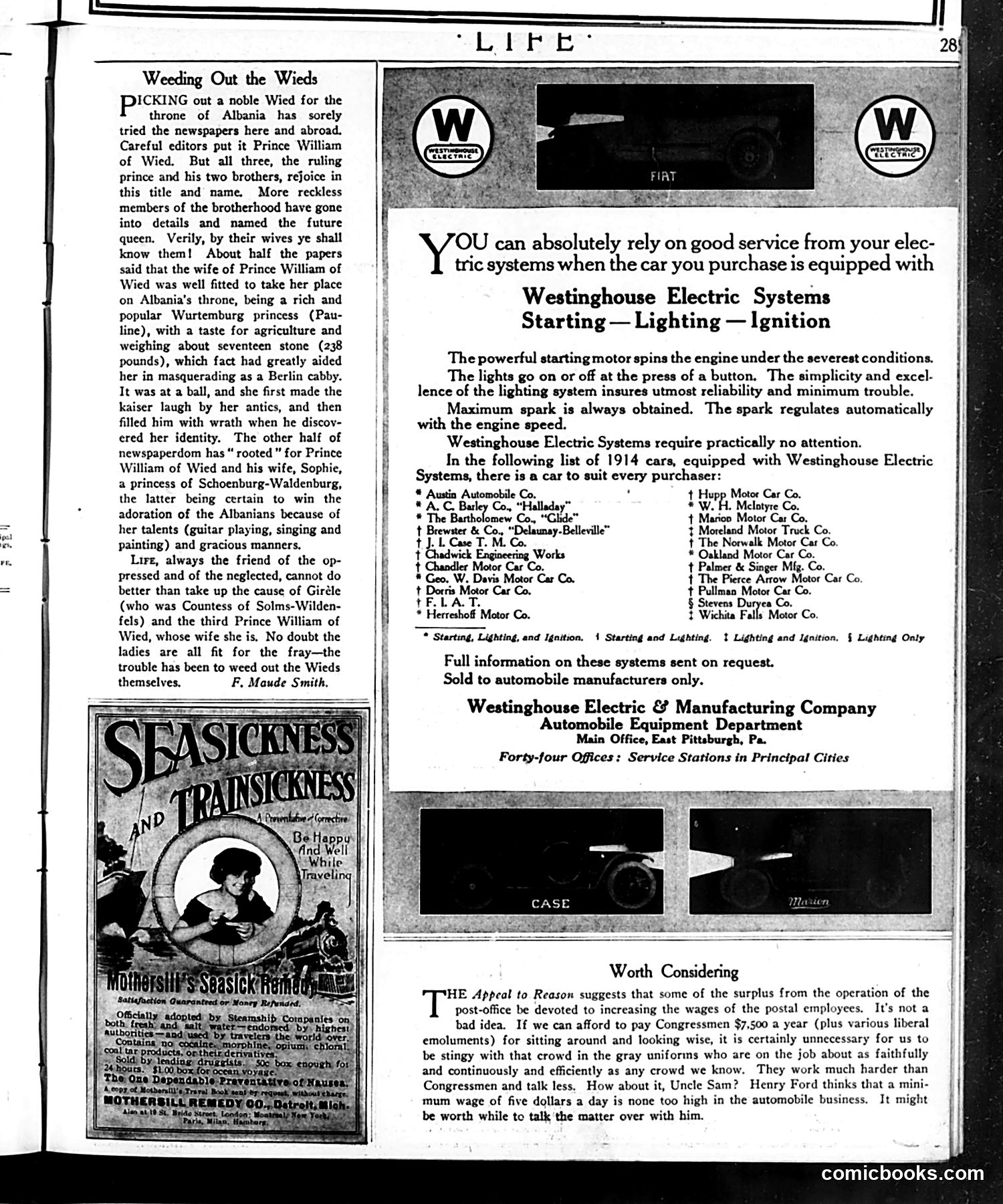
This article satirizes European newspaper coverage of Albania's search for a new ruler. In 1914, Albania selected Prince William of Wied as king—but the surname "Wied" created comic confusion. The piece mocks how papers struggled to distinguish between Prince William and his two brothers, all sharing the same name, and became even more tangled debating which brother's wife would best suit queenship. The satire highlights two competing candidates: Princess Pauline of Württemberg (described as heavy, wealthy, with agricultural interests) versus Princess Sophie of Schoenburg-Waldenburg (noted for artistic talents). The author, F. Maude Smith, jokes that the "trouble has been to weed out the Wieds themselves"—a pun on the surname—while European editors stumbled over basic genealogical facts about Albanian succession. The underlying joke targets both European royal dynasties and American newspapers' befuddled coverage of foreign affairs.
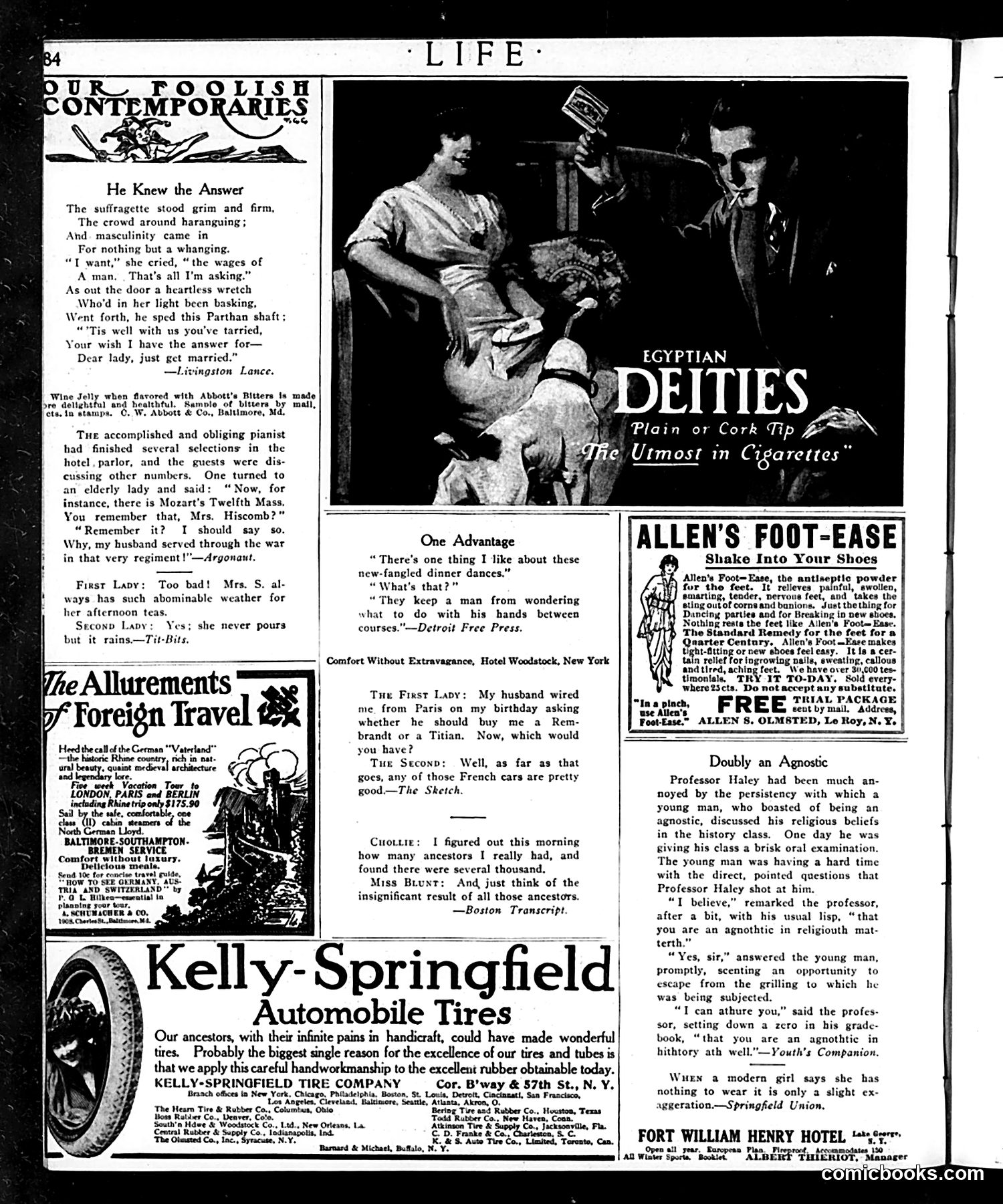
This page features early 20th-century humor mocking women's suffrage activism. The main cartoon poem depicts a suffragette demanding equal wages with men. When she argues her case to a crowd, a man leaves with a cutting retort: she should simply marry to solve her financial problems—dismissing her labor rights argument with domestic dependency. The satire reflects anti-suffrage sentiment of the era: rather than engaging women's economic justice claims seriously, the "wit" suggests marriage as the "real" answer to women's poverty. This was common rhetorical dismissal of suffragists' broader demands for equality. The page also includes unrelated period humor about Mozart, dinner dances, and ancestry—typical Life magazine fare mixing social commentary with light jokes. Several advertisements (tire company, foot powder, hotels) occupy the remaining space, standard for the publication.
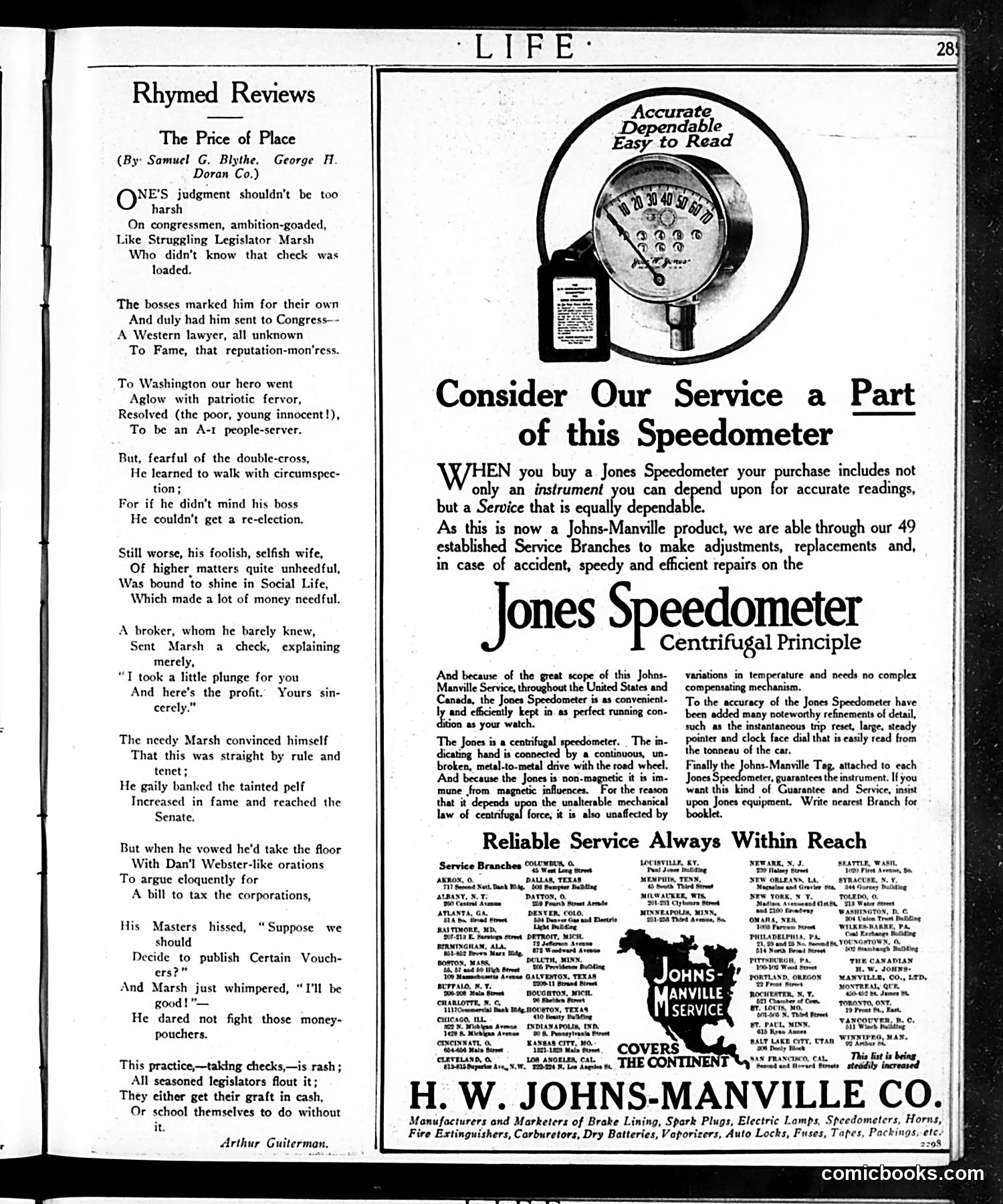
This poem by Arthur Guiterman satirizes congressional corruption through the cautionary tale of "Legislator Marsh," a naive Western lawyer sent to Congress by political bosses. The satire shows Marsh's moral decline: initially idealistic about serving the people, he learns to obey his bosses to secure re-election. When a broker sends him an unsolicited profit check, Marsh accepts it as legitimate. This "tainted pelf" helps him rise to the Senate, but his benefactors later blackmail him with vouchers, forcing him to abandon his principled stance against taxing corporations. Guiterman's final couplet delivers the punch: experienced legislators avoid this trap not through ethics, but pragmatism—they take bribes directly in cash or avoid them entirely, rather than leaving incriminating paper trails. The poem critiques both the corruption system itself and the complicity of politicians who rationalize accepting bribes as standard practice. *The right page is advertising for Jones Speedometers and is unrelated.*
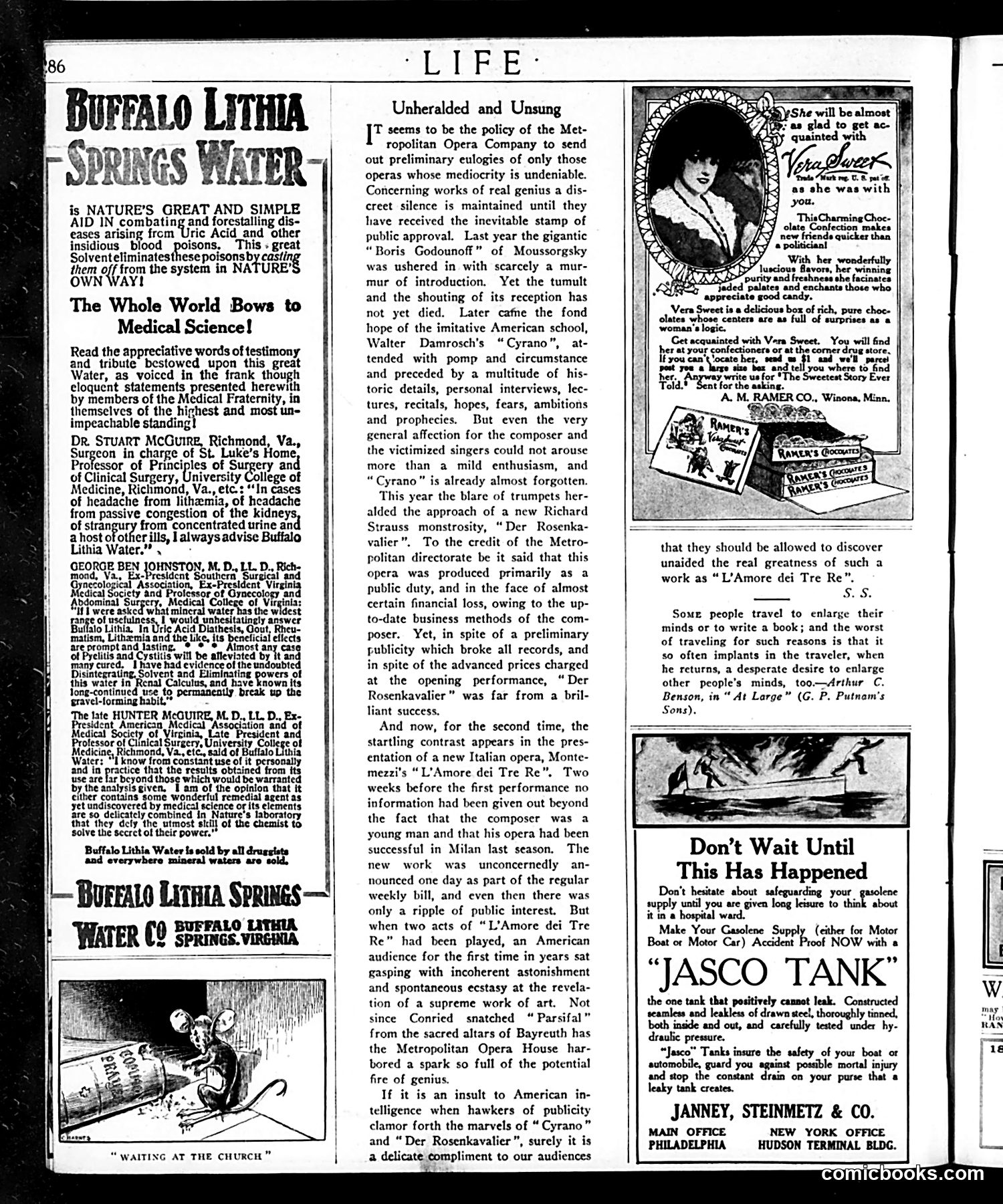
This page contains primarily **advertisements and editorial content**, not political cartoons. The main content discusses the **Metropolitan Opera Company's publicity strategy** for new operas. The satire critiques their inconsistent approach: they heavily promoted mediocre operas like Damrosch's "Cyrano" with extensive pre-release hype, yet gave little advance notice to genuinely great works like Mussorgsky's "Boris Godounoff," which nonetheless received tremendous public acclaim. The cartoon "Waiting at the Church" (bottom left) appears to use a familiar phrase suggesting someone or something stood people up—likely commenting on the opera company's unreliable or disappointing presentations despite their promotional efforts. The page is dominated by **advertisements for Buffalo Lithia Springs Water**, featuring endorsements from prominent Richmond, Virginia physicians claiming medicinal benefits for treating uric acid disorders, gout, and kidney ailments—typical patent medicine marketing of the era. The Vera Sweet chocolate advertisement and Jasco Tank ad occupy the right side.
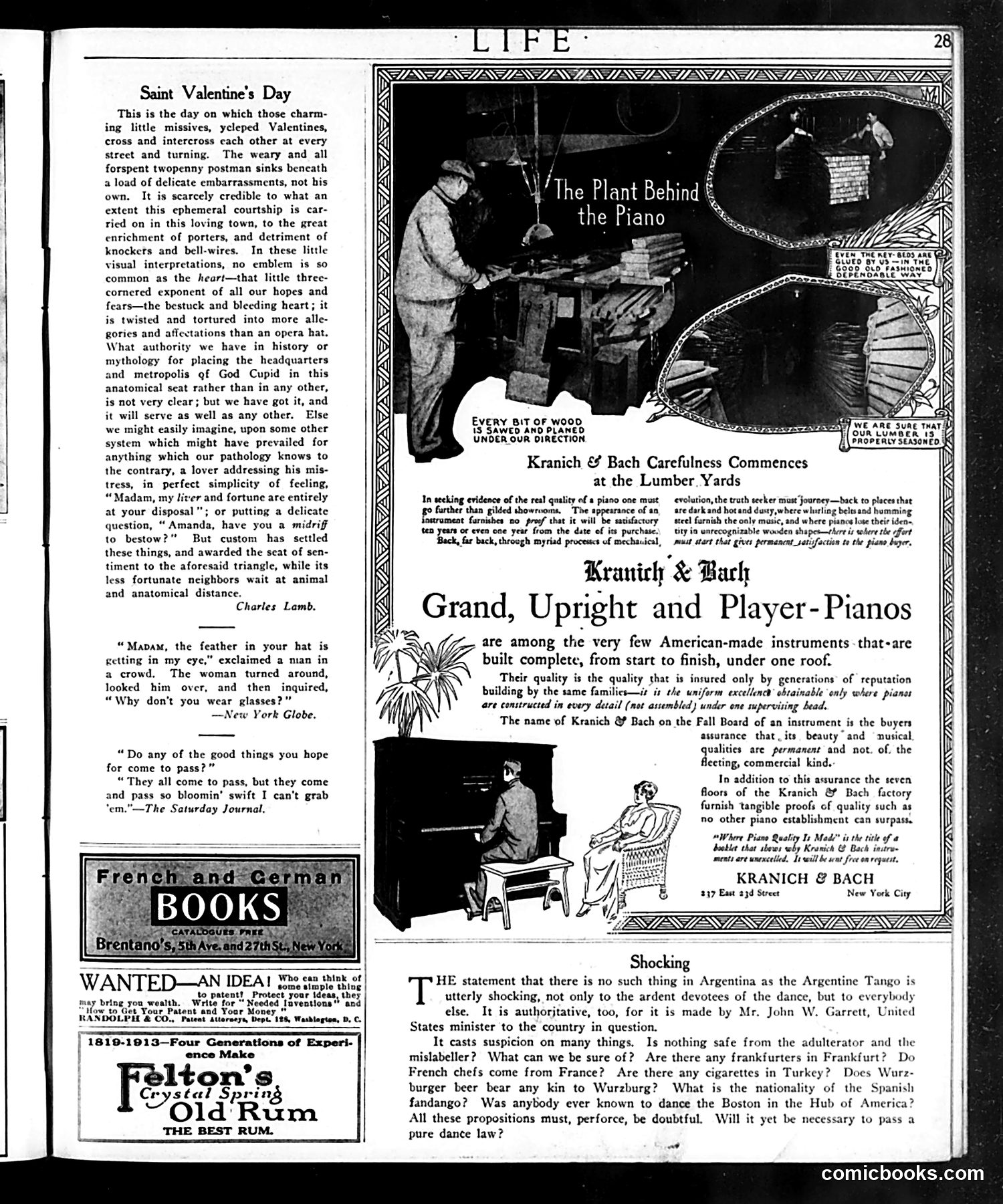
This page mixes editorial content with advertisements. The main feature is a Charles Lamb essay on Valentine's Day—a lighthearted, historically-grounded piece about how the holiday floods postal carriers with love notes, and why we symbolize romance with the heart rather than other organs. Lamb wryly suggests alternative anatomical seats for passion ("my liver...are entirely at your disposal"), satirizing romantic convention. The page includes period humor (a woman's comeback about wearing glasses) and several advertisements: French and German books, patent services, and notably a **Kranich & Bach piano advertisement** claiming superior American manufacturing quality through complete in-house production rather than assembly. The piano ads feature photographs showing craftsmen at work and lumber yards, emphasizing quality control—a marketing approach emphasizing domestic American manufacturing excellence, likely appealing to early 20th-century consumer nationalism.
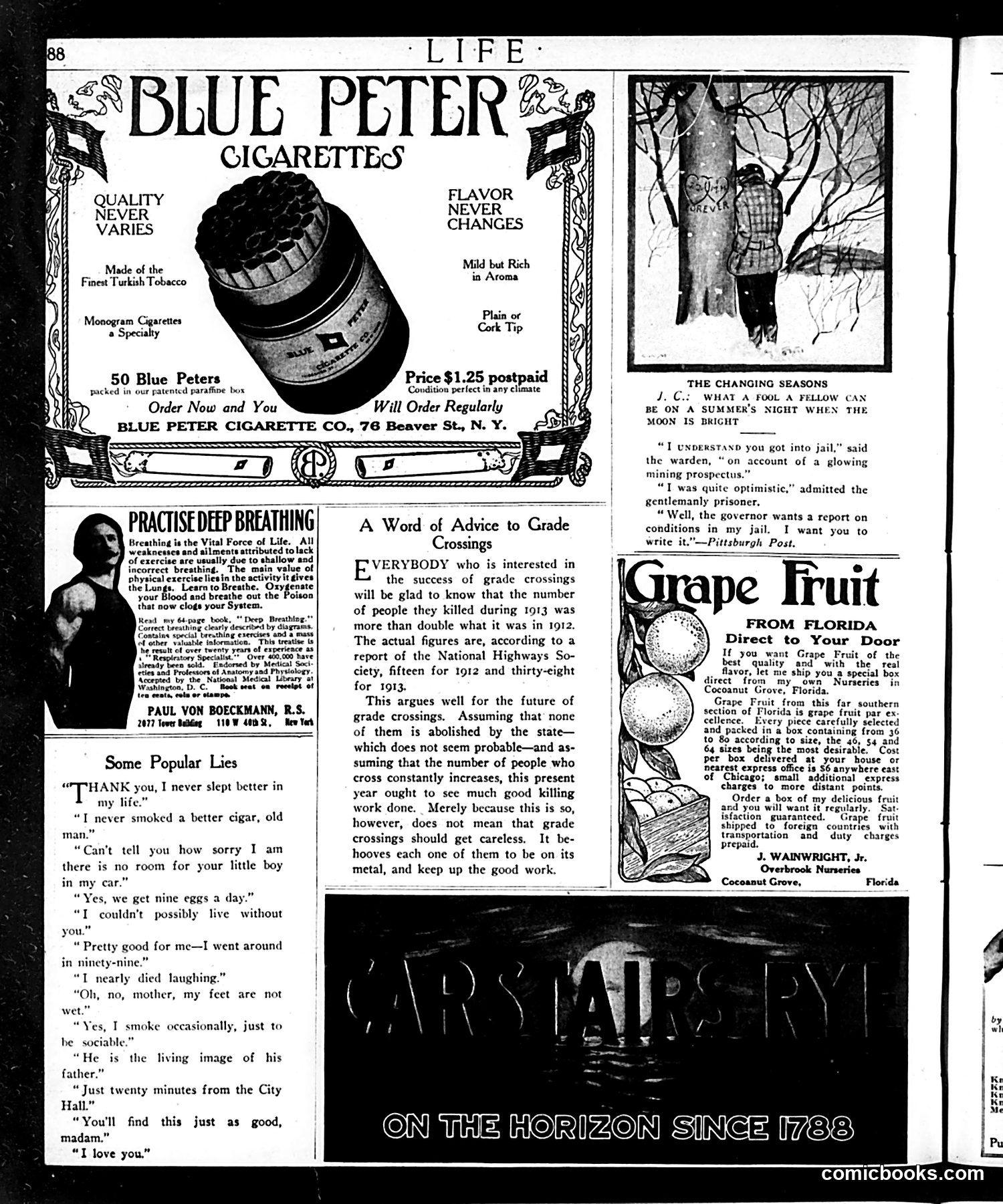
This page is primarily **advertising and satirical content** rather than political cartooning. The main items are: 1. **Blue Peter Cigarettes ad** – A straightforward product advertisement emphasizing Turkish tobacco quality. 2. **"Some Popular Lies"** – A satirical humor column listing common social falsehoods people tell (e.g., "I never slept better in my life," "I love you"). This is general social satire about everyday dishonesty, not political commentary. 3. **"A Word of Advice to Grade Crossings"** – Dark satire about railroad safety. It notes that people killed at grade crossings doubled from 15 (1912) to 38 (1913), then ironically suggests this "argues well for the future" and encourages grade crossings to maintain their "good work." This is cynical commentary on railroad safety negligence. 4. **Other content** includes a breathing exercise advertisement and a grapefruit mail-order business. The page reflects early 1910s consumer culture and contains no identifiable political figures or events—just period advertising and social humor.
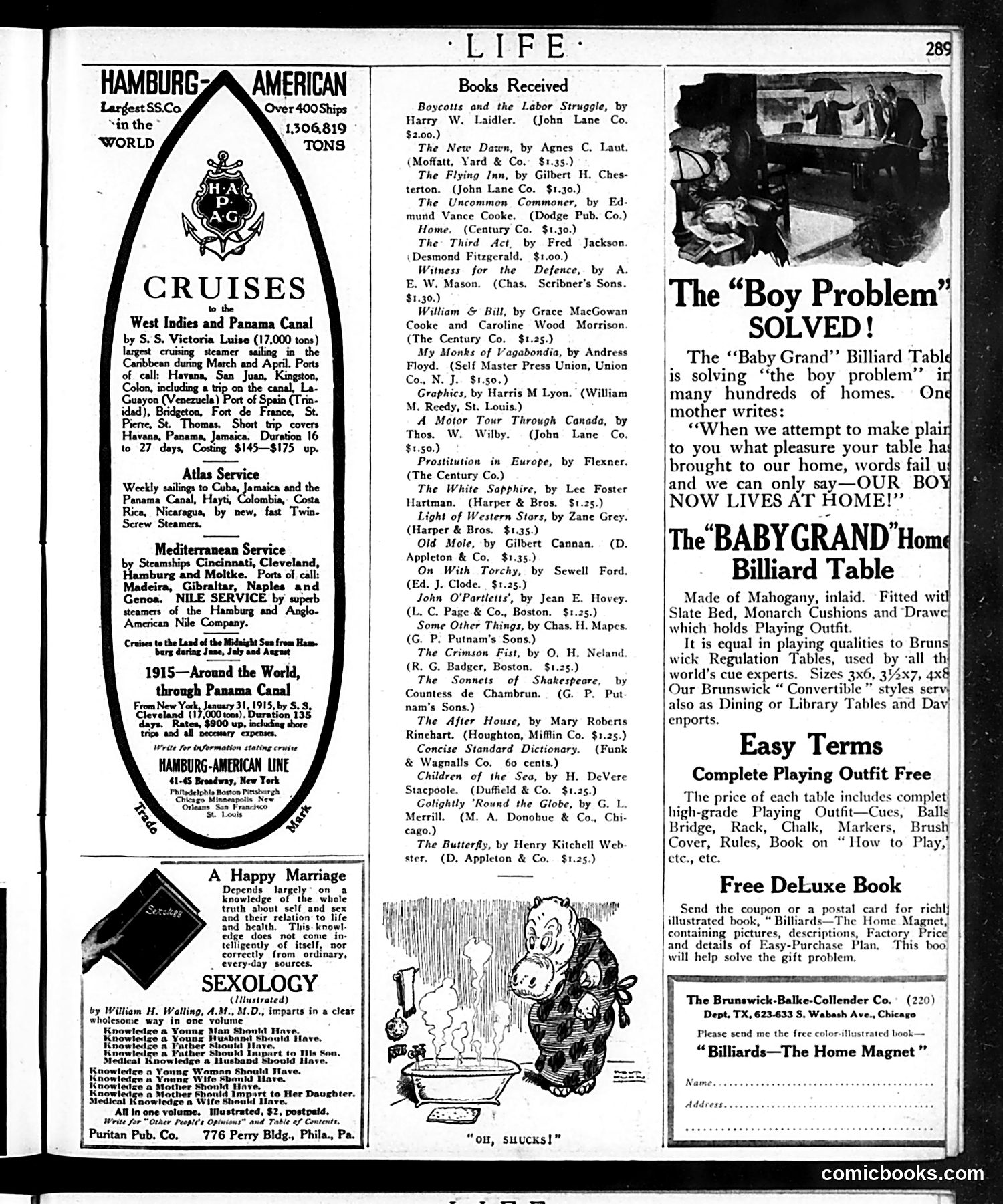
This page is primarily **advertising and book listings**, with one notable satirical element. The main cartoon (bottom right, captioned "OH, SHUCKS!") depicts a man and woman at a bathtub—likely satirizing contemporary anxieties about unmarried couples and impropriety, common subjects in Life's humor during this era. The dominant advertisement—the "Baby Grand Billiard Table"—ironically solves the "boy problem" by keeping boys occupied at home with recreation rather than roaming streets. This reflects early 20th-century concerns about juvenile delinquency and unsupervised youth. The "Sexology" book advertisement addresses marital education, reflecting Progressive Era discussions about sexual knowledge within marriage. The page also includes Hamburg-American cruise ship advertisements and a "Books Received" listing typical of literary magazines of the period, featuring works on labor issues, adventure novels (Zane Grey), and social topics like prostitution—reflecting 1910s intellectual concerns.
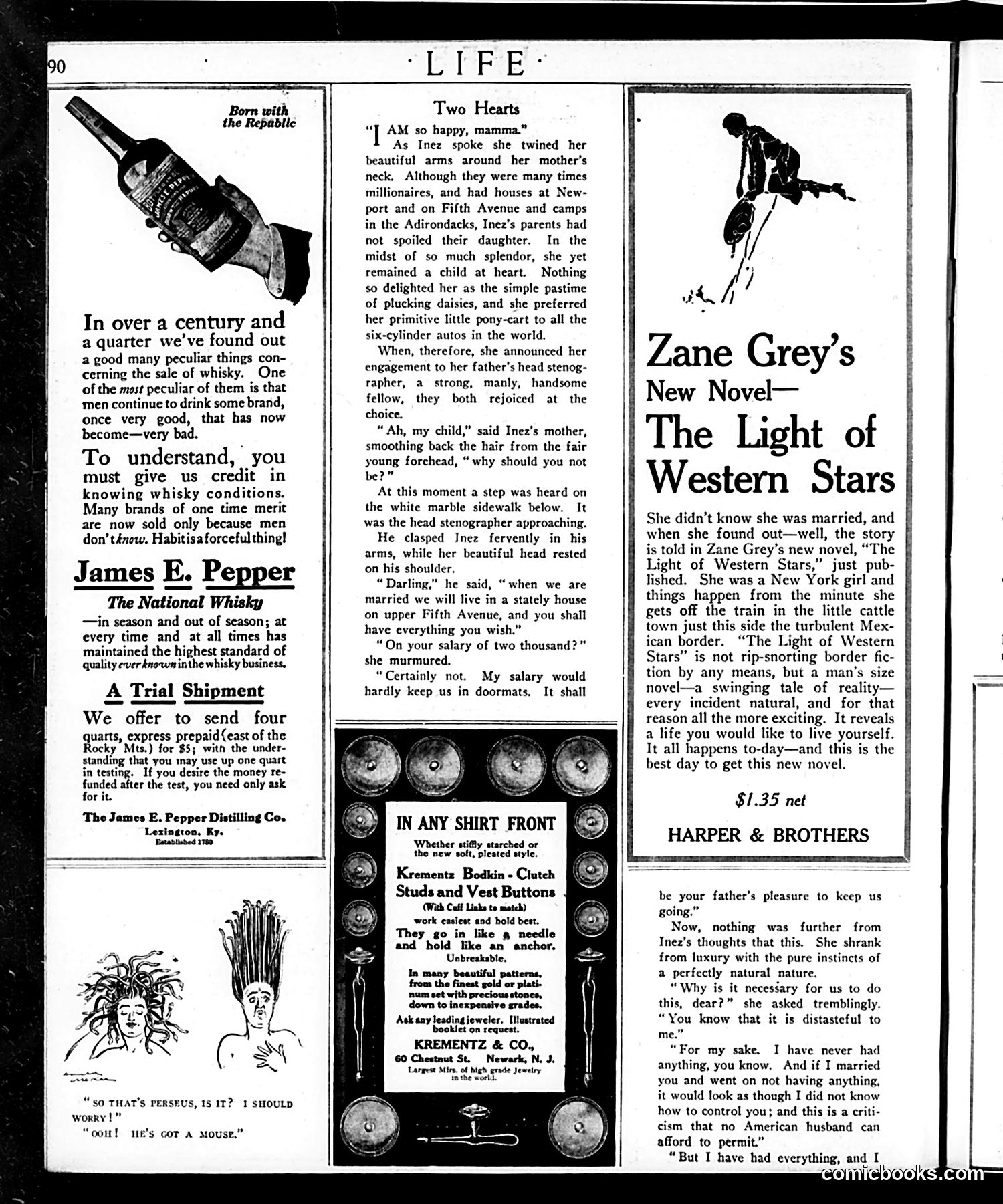
This page contains **advertising and serialized fiction** rather than political cartoons. The main content is a romantic short story titled "Two Hearts" about Inez, a wealthy young woman engaging a poor stenographer. The satire is **social commentary on class and marriage**: Inez comes from extreme wealth (Newport homes, Fifth Avenue, Adirondacks camps) yet remains "unspoiled," while her fiancé earns only $2,000 annually—insufficient for their proposed lifestyle. His vague assurance that "my salary would hardly keep us in doormats" humorously underscores the vast income gap. The surrounding ads—for James E. Pepper whisky, Krementz jewelry studs, and Zane Grey's western novel—target upper-class readers. The implicit joke critiques both naive wealthy girls and working-class suitors' delusions about supporting a luxurious life on modest wages. This reflects early 20th-century anxieties about class mobility and marriage across economic divides.
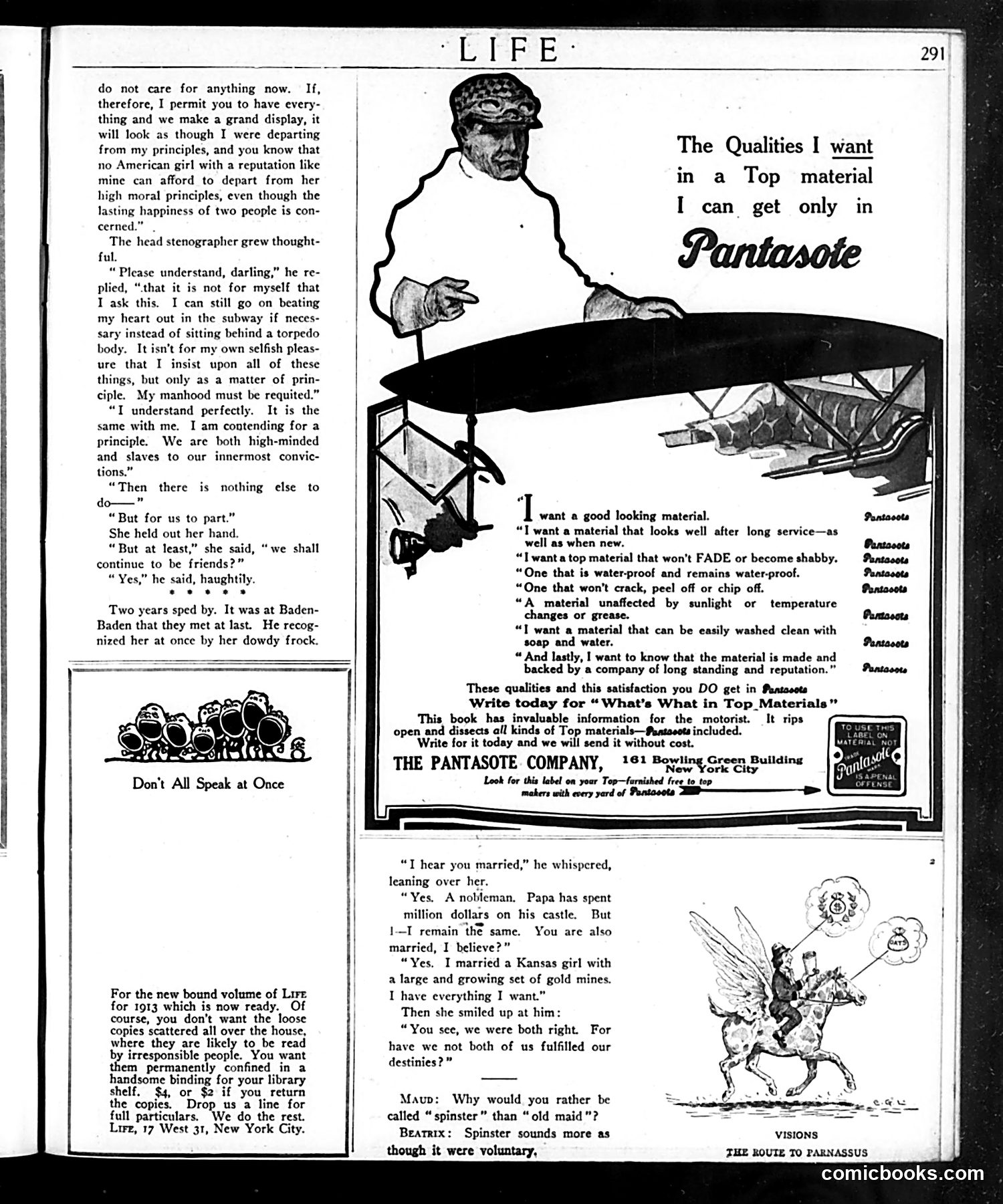
This page satirizes romantic idealism and principles versus practical reality. The main narrative (left side) depicts a couple who break their engagement to preserve their "high moral principles"—each claiming they cannot compromise their principles despite loving each other. Their dialogue is deliberately overwrought and self-righteous. The punchline arrives two years later at Baden-Baden: they've both married wealthy partners (a nobleman and a Kansas gold-mine heiress) and encounter each other again. When the woman asks if they've "fulfilled our destinies," the satire is complete—their grand principled sacrifice meant nothing. They obtained exactly what they claimed to reject: wealth and advantageous marriages. The humor targets the hypocrisy of using "principle" as an excuse for selfish desires, particularly among the leisure class. The woman's dowdy appearance contrasts with her newfound wealth, emphasizing how quickly circumstances changed. The page also contains a Pantasote auto-top material advertisement and unrelated brief comedic exchanges at the bottom.
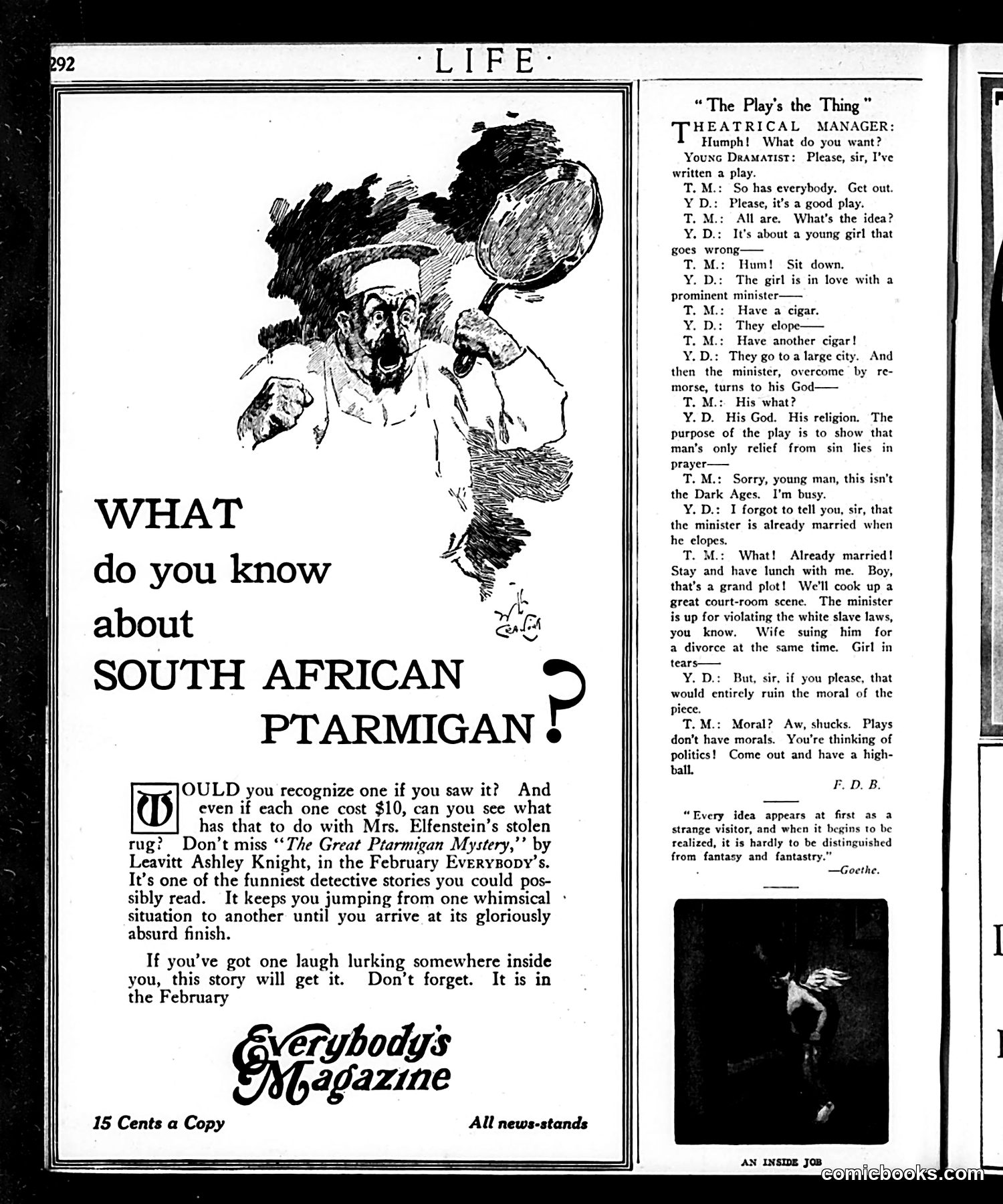
This dialogue satirizes early 20th-century theatrical producers' moral hypocrisy. A young playwright pitches a morality play about a minister who finds redemption through prayer and religion. The theater manager dismisses it as old-fashioned ("this isn't the Dark Ages"). However, when the playwright adds that the minister is *already married* when he elopes—creating scandal, legal violations, and divorce—the manager becomes enthusiastic, wanting to exploit the salacious court-room drama. The satire's point: theater producers publicly condemned immoral content but actually craved sensational plots involving adultery, legal transgression, and scandal. They prioritized commercial appeal over genuine moral instruction, despite claiming to serve audiences' ethical interests. The manager's final dismissal of "morals" as mere "politics" underscores the cynicism—entertainment values profit over principle.
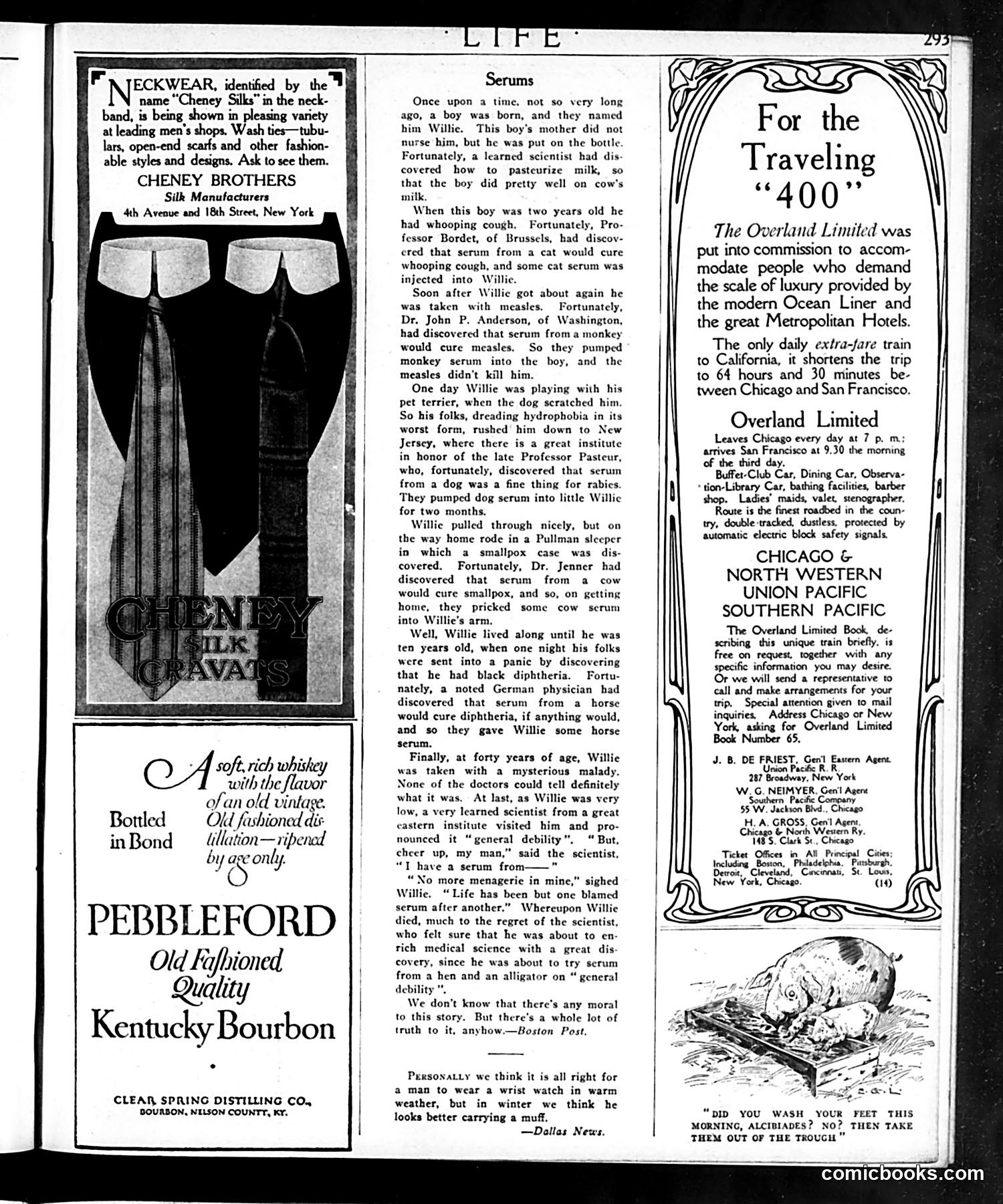
This story mocks the early 20th-century obsession with serum therapy—the belief that injecting animal serums could cure virtually any disease. The narrative follows "Willie," a boy who survives childhood illnesses (whooping cough, measles, rabies) through increasingly exotic animal serums: cat, monkey, dog, cow, and horse serum. The satire targets medical practitioners' blind faith in this unproven treatment. Each illness is "fortunately" cured by serum from a different animal, presented as miraculous scientific discovery. By age forty, Willie has become a "blamed menagerie," having received serums from multiple animals. The joke culminates when Willie dies from "general debility"—ironically, from the very treatment meant to save him. The scientist remains eager to try serum from a hen and alligator, oblivious to the absurdity. This reflects genuine medical debates of the era: serum therapy was popular but unreliable. The piece suggests doctors chased fashionable treatments without questioning their actual efficacy.
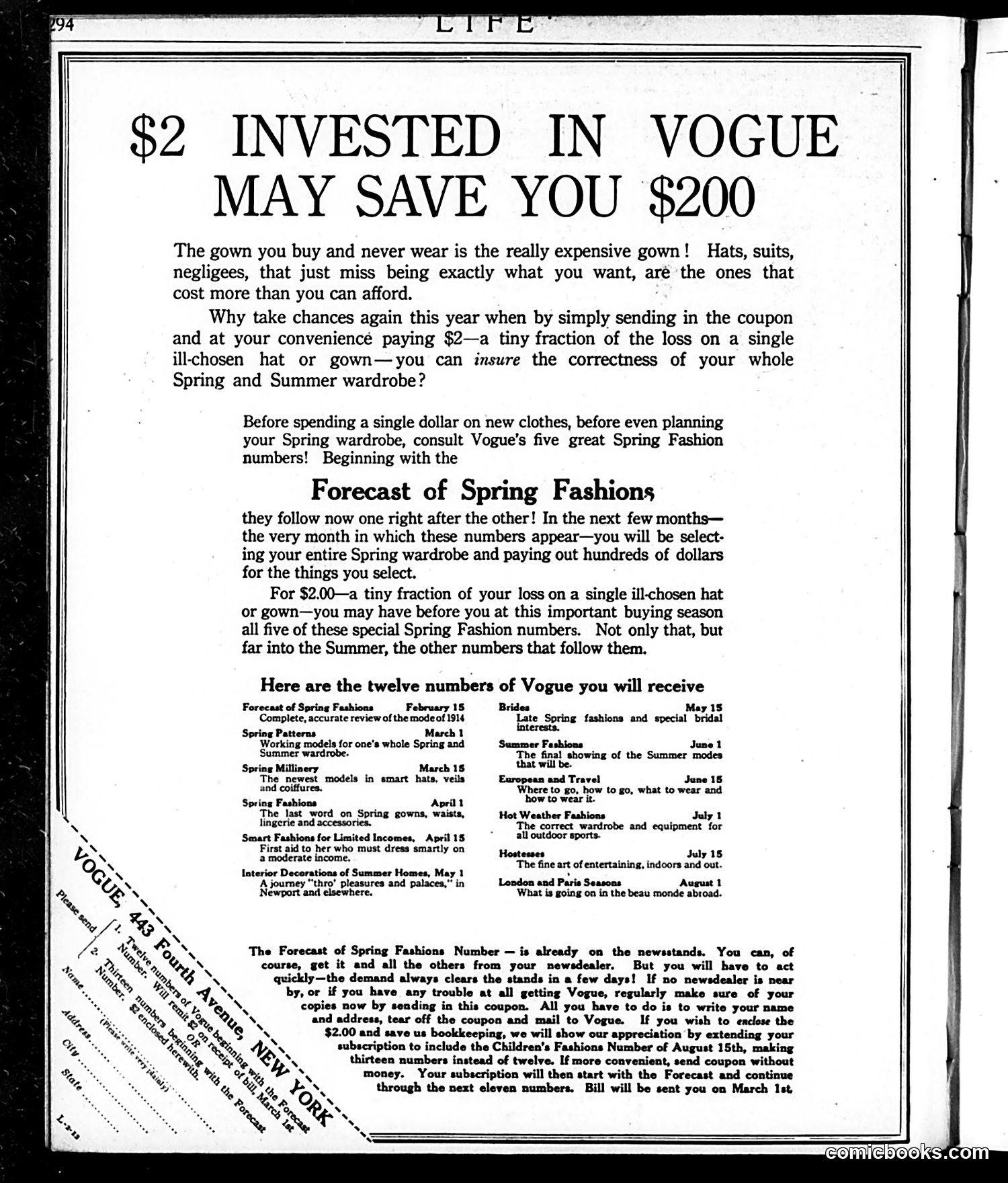
This is a **full-page advertisement for Vogue magazine**, not a cartoon. It's a subscription pitch dressed up as practical advice. The appeal targets women worried about making expensive clothing mistakes—buying hats or gowns they'll never wear. The ad promises that for just $2, subscribing to Vogue's special fashion issues will "insure the correctness of your whole Spring and Summer wardrobe," potentially saving $200 in wasteful purchases. The copy lists twelve upcoming Vogue issues (February-August 1914) covering everything from spring patterns and millinery to "Smart Fashions for Limited Incomes"—explicitly acknowledging that not all readers have unlimited budgets. **Historical context**: This reflects early 1900s consumer culture where fashion magazines positioned themselves as essential guides preventing costly wardrobe errors. The "limited incomes" issue shows Vogue was expanding beyond ultra-wealthy readers to middle-class women managing household budgets. The subscription offer was aggressive: they'd extend service if paid upfront.
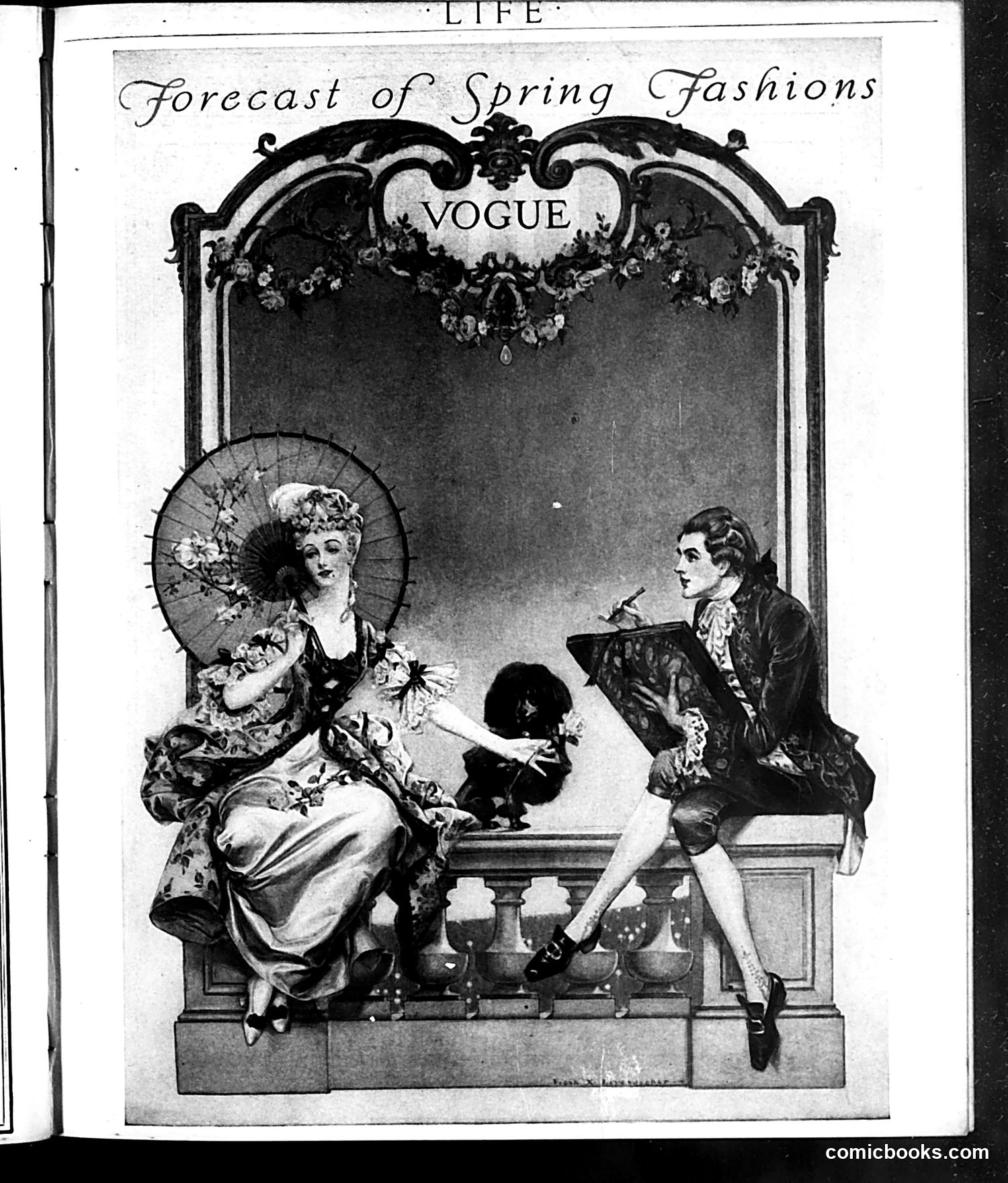
This is a title page for a fashion feature in *Life* magazine's satirical section. The illustration depicts two fashionable figures on a balcony: a woman on the left holding an ornate parasol, wearing an elaborate floral dress with her hair styled up, and a man on the right in a dark jacket holding what appears to be a fashion sketch or design. A small dog sits between them. The satire likely mocks the pretension and artificiality of high fashion forecasting—the couple's theatrical poses and exaggerated styling suggest the absurdity of treating seasonal fashion predictions as serious matters. The ornate decorative frame and classical setting emphasize the overwrought nature of fashion discourse that *Life* magazine, known for social commentary, would target for gentle ridicule.
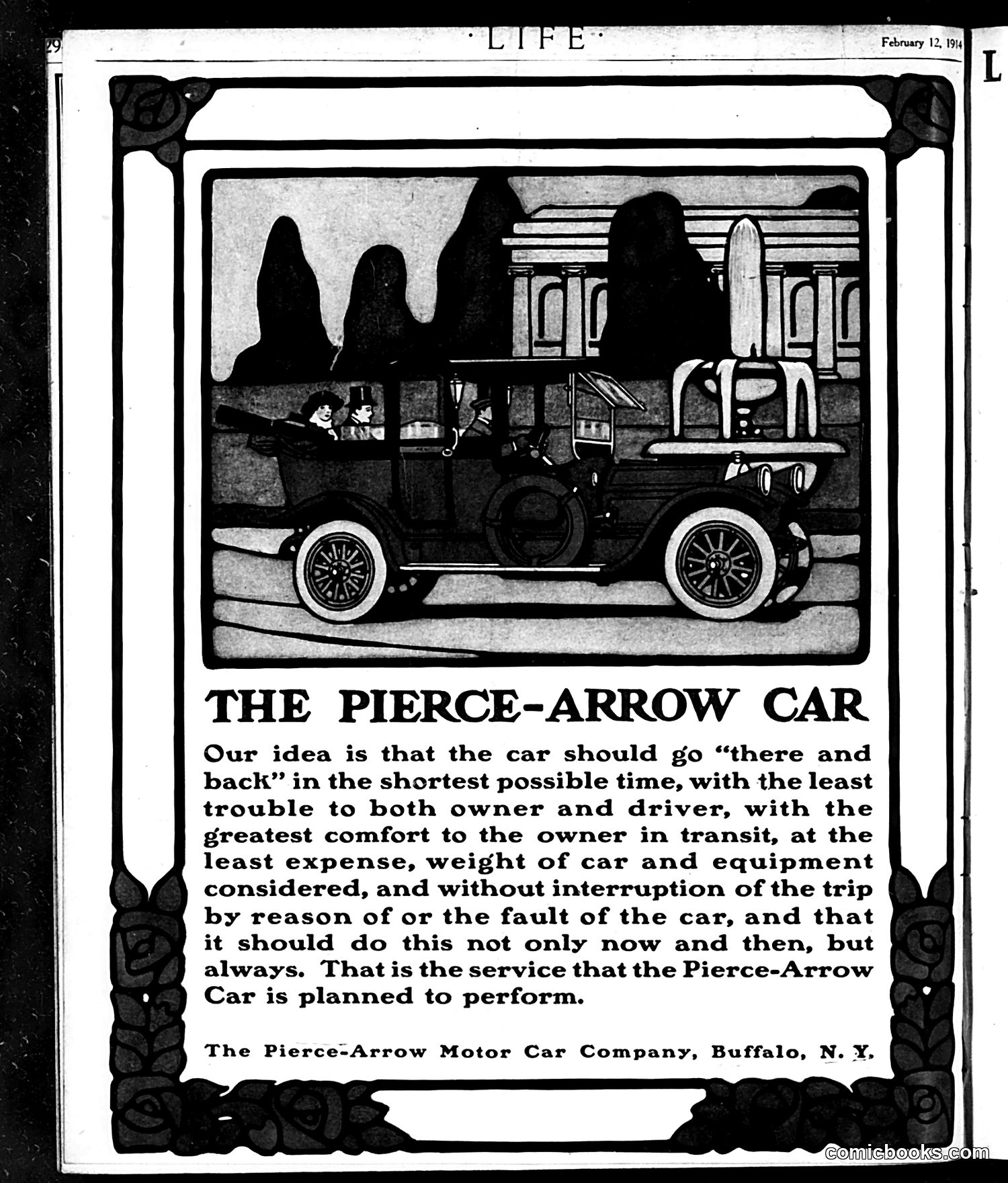
This is a **full-page advertisement** for the Pierce-Arrow Motor Car Company (Buffalo, NY), not political satire. The illustration shows an early 1910s automobile with passengers, rendered in silhouette style against an urban backdrop with tall buildings. The ad emphasizes the car's reliability and practicality—promising dependable transportation "there and back" with minimal trouble, maximum comfort, and low expense. The appeal targets affluent buyers seeking a premium vehicle that performs consistently without mechanical failures interrupting trips. This reflects early automotive-era concerns: cars were still mechanically unreliable, and breakdowns were common. Pierce-Arrow positions itself as solving this problem through superior engineering. The ornamental Art Nouveau-style border frames the message as a statement of corporate philosophy rather than price or specifications—marketing the brand's values to potential owners in *Life* magazine's upscale readership.