
Life, 1914-02-12 · page 26 of 44
Life — February 12, 1914 — page 26: what you’re looking at
What you’re looking at
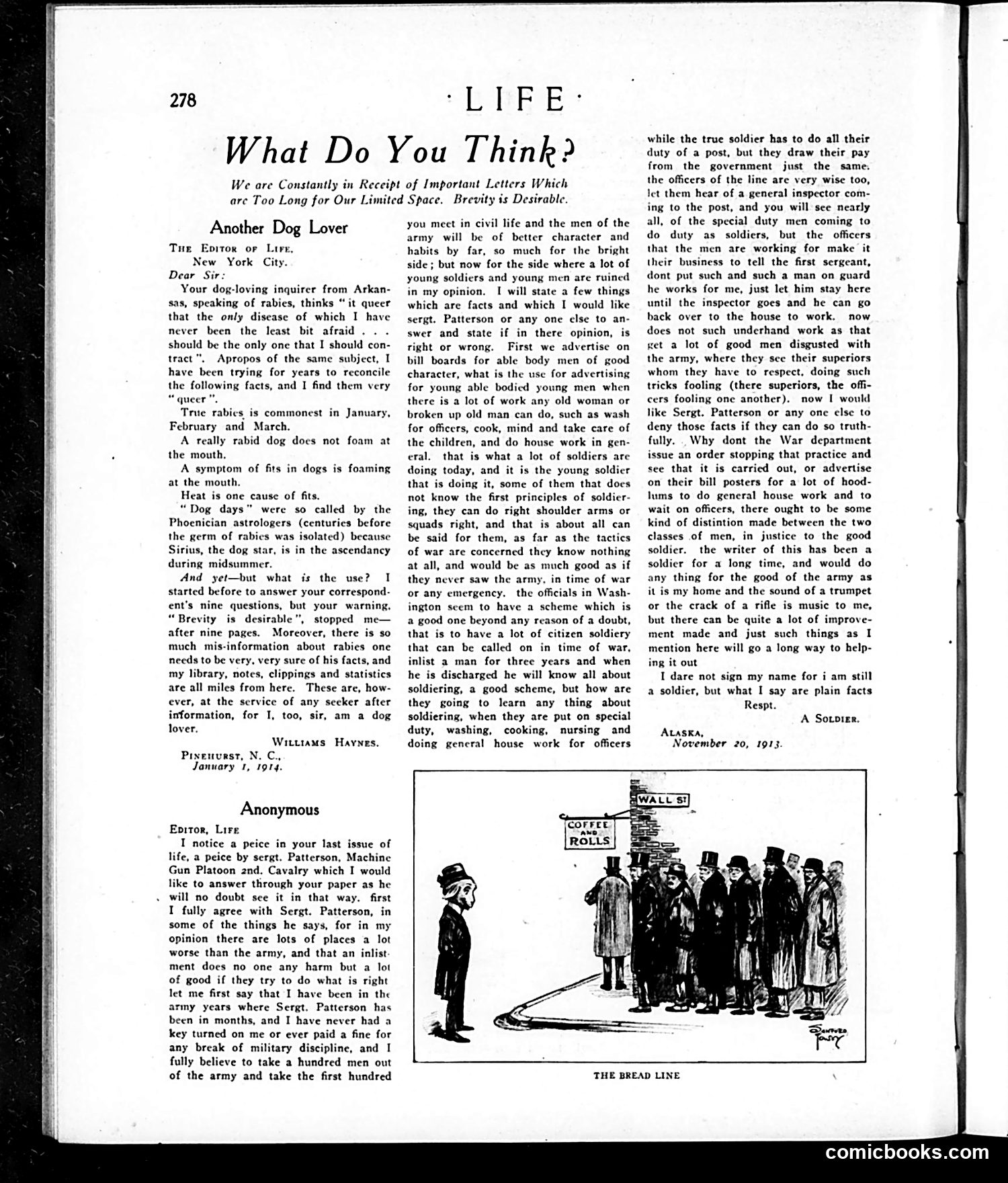
This page contains reader letters to *Life* magazine and a cartoon titled "The Bread Line." The cartoon depicts a soldier in uniform standing apart, observing a long queue of civilians (appearing to be poor or unemployed) waiting for food at a "Wall St. Coffee & Rolls" stand. The satirical point is likely a contrast between military service and urban poverty: while soldiers are being recruited and trained, ordinary citizens on the home front struggle with hunger and destitution. The reference to "Wall Street" (the financial center) may suggest irony—that wealth exists nearby while people starve in breadlines. The accompanying letters debate military service's value, with contributors arguing whether army discipline improves or harms young men, and whether recruitment practices properly utilize soldiers' abilities. The page reflects 1913 American anxieties about industrialization, poverty, and military preparedness preceding U.S. entry into World War I.
📄 Transcribed text from this page (OCR, searchable)
Machine-transcribed from the original scan — historical spelling and the odd misread are preserved.
Another Dog Lover itor oF Lire, New York City Dear Sir: Your dog-loving inquirer from Arkan- sas, speaking of rabies, thinks “it queer that the only disease of which I have never been the least bit afraid . . should be the only one that I should con- tract". Apropos of the same subject, I have been trying for years to reconcile the following facts, and I find them very “queer”. True rabies, is commonest in January, February and March. A really rabid dog does not foam at the mouth, A symptom of fits in dogs is foaming at the mouth. Heat is one cause of fits. “Dog days” were so called by the Phoenician astrologers (centuries before the germ of rabies was isolated) because Sirius, the dog star, is in the ascendancy during midsummer. And yet—but what is the use? I started before to answer your correspond- ent’s nine questions, but your warning, “Brevity is desirable", stopped me— after nine pages. Moreover, there is so much mis-information about rabies one needs to be very, very sure of his facts, and my library, notes, clippings and statistics are all miles from here. These are, how- ever, at the service of any seeker after information, for I, too, sir, am a dog lover. Wittrams Haynes. Pixenvrst, N. C., January 1, 1914. Anonymous Eprtor, Lire I notice a peice in your last issue of life, a peice by sergt. Patterson, Machine Gun Platoon 2nd. Cavalry which I would like to answer through your paper as he will no doubt sce it in that way. first I fully agree with Sergt. Patterson, in some of the things he says, for in my opinion there are lots of places a lot worse than the army, and that an inlist ment does no one any harm but a lot of good if they try to do what is right let me first say that I have been in the army years where Sergt. Patterson has been in months, and I have never had a key turned on me or ever paid a fine for any break of military discipline, and I fully believe to take a hundred men out of the army and take the first hundred ‘RE What Do You Think? We are Constantly in Receipt of Important Letters Which are Too Long for Our Limited Space. Brevity is Desirable. you meet in civil life and the men of the army will be of better character and habits by far, so much for the bright side; but now for the side where a lot of young soldiers and young men are ruined in my opinion. I will state a few things which are facts and which I would like sergt. Patterson or any one else to an- swer and state if in there opinion, is right or wrong. First we advertise on bill boards for able body men of good character, what is the use for advertising for young able bodied young men when there is a lot of work any old woman or broken up old man can do, such as wash for officers, cook, mind and take care of the children, and do house work in gen- eral. that is what a lot of soldiers are doing today, and it is the young soldier that is doing it, some of them that does not know the first principles of soldier- ing, they can do right shoulder arms or squads right, and that is about all can be said for them, as far as the tactics of war are concerned they know nothing at all, and would be as much good as if they never saw the army, in time of war or any emergency. the officials in Wash- ington seem to have a scheme which is a good one beyond any reason of a doubt, that is to have a lot of citizen soldiery that can be called on in time of war, inlist a man for three years and when he is discharged he will know all about soldiering, a good scheme, but how are they going to learn any thing about soldiering, when they are put on special duty, washing, cooking, nursing and doing gencral house work for officers while the true soldier has to do all their duty of a post, but they draw their pay from the government just the same. the officers of the line are very wise too, let them hear of a general inspector com- ing to the post, and you will see nearly all, of the special duty men coming to do duty as soldiers, but the officers that the men are working for make it their business to tell the first sergeant, dont put such and such a man on guard he works for me, just let him stay here until the inspector goes and he can go back over to the house to work. now does not such underhand work as that get a lot of good men disgusted with the army, where they sce their superiors whom they have to respect, doing such tricks fooling (there superiors, the offi- cers fooling one another). now I would like Sergt. Patterson or any one else to deny those facts if they can do so truth- fully. .Why dont the War department issue an order stopping that practice and see that it is carried out, or advertise on their bill posters for a lot of hood- lums to do general house work and to wait on officers, there ought to be some kind of distintion made between the two classes of men, in justice to the good soldier. the writer of this has been a soldier for a long time, and would do any thing for the good of the army as it is my home and the sound of a trumpet or the crack of a rifle is music to me, but there can be quite a lot of improve- ment made and just such things as I mention here will go a long way to help- ing it out I dare not sign my name for i am still a soldier, but what I say are plain facts Respt. A Soroigr. ALASKA, November 20, 1913. THE BREAD LINE comicbooks.com