
Life, 1914-02-12 · page 24 of 44
Life — February 12, 1914 — page 24: what you’re looking at
What you’re looking at
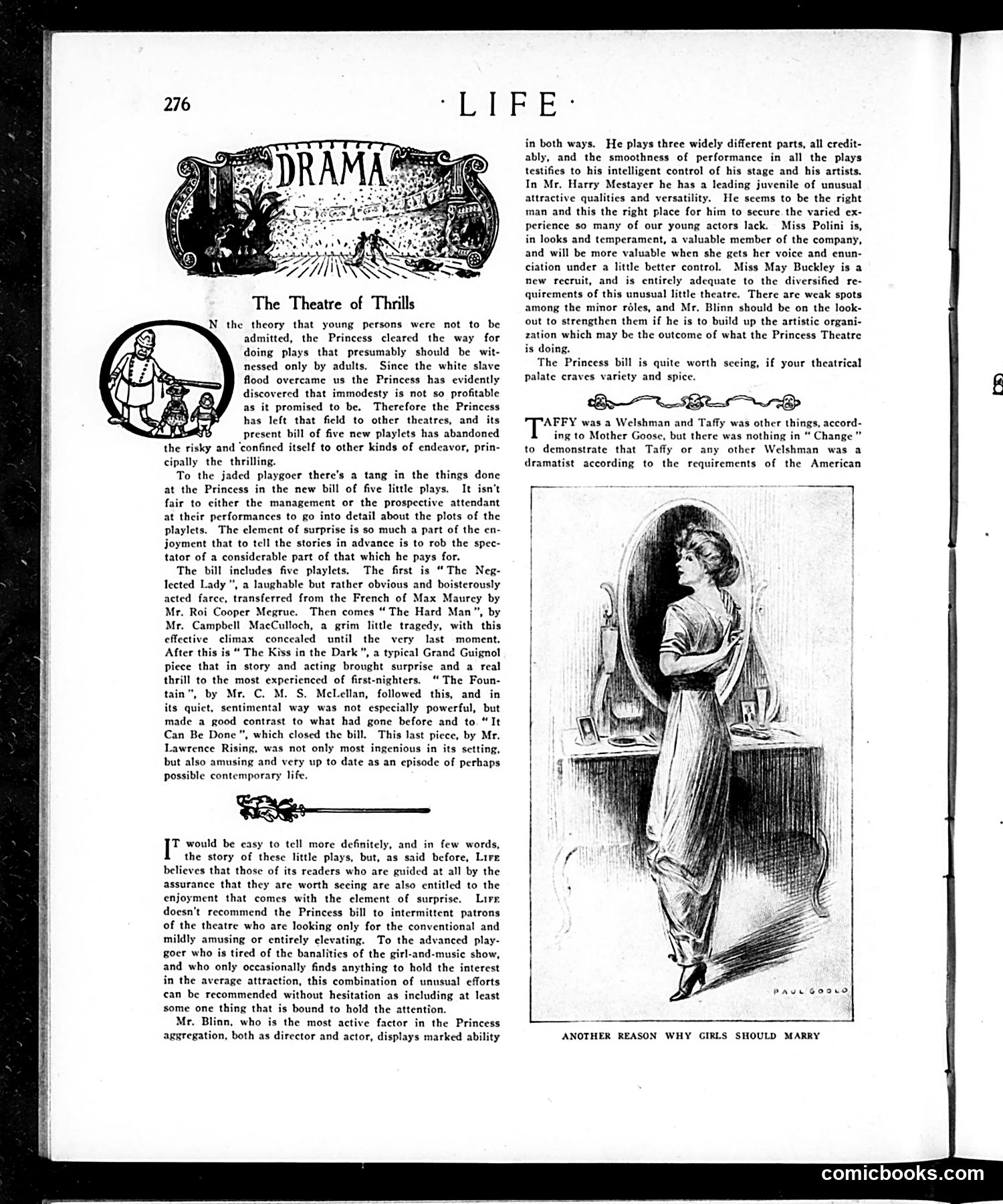
This page reviews the Princess Theatre's new bill of five one-act plays. The publication praises the venue for abandoning its previous reputation for risqué content (the text obliquely references the "white slave flood" — likely referring to sensationalist plays exploiting that social crisis) in favor of thriller and dramatic works. The review discusses five playlets: "The Neglected Lady," "The Hard Man," "The Kiss in the Dark" (described as "Grand Guignol" — theatrical horror/shock drama), "The Fountain," and "It Can Be Done." The critic deliberately avoids plot details to preserve the "element of surprise" for potential audiences. The illustration shows a woman in period dress, captioned "Another Reason Why Girls Should Marry" — a caption whose satirical meaning remains unclear without additional context, though it likely comments on contemporary social attitudes toward marriage. The review praises director/actor Mr. Blinn's "marked ability" and notes promising young performers like Harry Mestayer and others in the company.
📄 Transcribed text from this page (OCR, searchable)
Machine-transcribed from the original scan — historical spelling and the odd misread are preserved.
“Ts SRSE:* The Theatre of Thrills N the theory that young persons were not to be admitted, the Princess cleared the way for doing plays that presumably should be wit- nessed only by adults, Since the white slave flood overcame us the Princess has evidently discovered that immodesty is not so profitable as it promised to be. Therefore the Princess has left that field to other theatres, and its present bill of five new playlets has abandoned the risky and ‘confined itself to other kinds of endeavor, prin- cipally the thrilling. To the jaded playgoer there's a tang in the things done at the Princess in the new bill of five little plays, It isn’t fair to cither the management or the prospective attendant at their performances to go into detail about the plots of the playlets. The element of surprise is so much a part of the en- joyment that to tell the stories in advance is to rob the spec- tator of a considerable part of that which he pays for. The bill includes five playlets, The first is “The Neg- lected Lady ", a laughable but rather obvious and boisterously acted farce, transferred from the French of Max Maurcy by Mr. Roi Cooper Megrue. Then comes “ The Hard Man”, by Mr. Campbell MacCulloch, a grim little tragedy, with this effective ax concealed until the very last moment. After this is “ The Kiss in the Dark”, a typical Grand Guignol Piece that in story and acting brought surprise and a real thrill to the most experienced of first-nighters. “ The Foun- tain”, by Mr. C. M. S. Melellan, followed this, and in its quict, sentimental way was not especially powerful, but made a good contrast to what had gone before and to. “It Can Be Done", which closed the bill. This last piece, by Mr. Lawrence Rising, was not only most ingenious in its setting, but also amusing and very up to date as an episode of perhaps possible contemporary life. e——_—_ T would be easy to tell more definitely, and in few words, the story of these little plays, but, as said before, Lire believes that those of its readers who are guided at all by the assurance that they are worth seeing are also entitled to the enjoyment that comes with the element of surprise. Lire doesn't recommend the Princess bill to intermittent patrons of the theatre who are looking only for the conventional and mildly amusing or entirely elevating. To the advanced play- goer who is tired of the banalities of the girl-and-music show, and who only occasionally finds anything to hold the interest in the average attraction, this combination of unusual efforts can be recommended without hesitation as including at least some one thing that is bound to hold the attention. Mr. Blinn, who is the most active factor in the Princess aggregation, both as director and actor, displays marked ability in both ways. He plays three widely different parts, all credit- ably, and the smoothness of performance in all the plays testifies to his intelligent control of his stage and his artists. In Mr. Harry Mestayer he has a leading juvenile of unusual attractive qualities and versatility. He seems to be the right man and this the right place for him to secure the varied ex- perience so many of our young actors lack. Miss Polini is, in looks and temperament, a valuable member of the company, and will be more valuable when she gets her voice and enun- ciation under a little better control. Miss May Buckley is a new recruit, and is entirely adequate to the diversified re- quirements of this unusual little theatre. There are weak spots among the minor réles, and Mr, Blinn should be on the look- out to strengthen them if he is to build up the artistic organi- zation which may be the outcome of what the Princess Theatre is doing. The Princess bill is quite worth seeing, if your theatrical palate craves variety and spice. BASSI > ‘AFFY was a Welshman and Taffy was other thit ing to Mother Goose, but there was nothin; to demonstrate that Taffy or any other Welshman was a dramatist according to the requirements of the American — 7 canes ee Pave Goaro ANOTHER REASON WHY GIRLS SHOULD MARRY comicbooks.com