
Life, 1914-02-12 · page 40 of 44
Life — February 12, 1914 — page 40: what you’re looking at
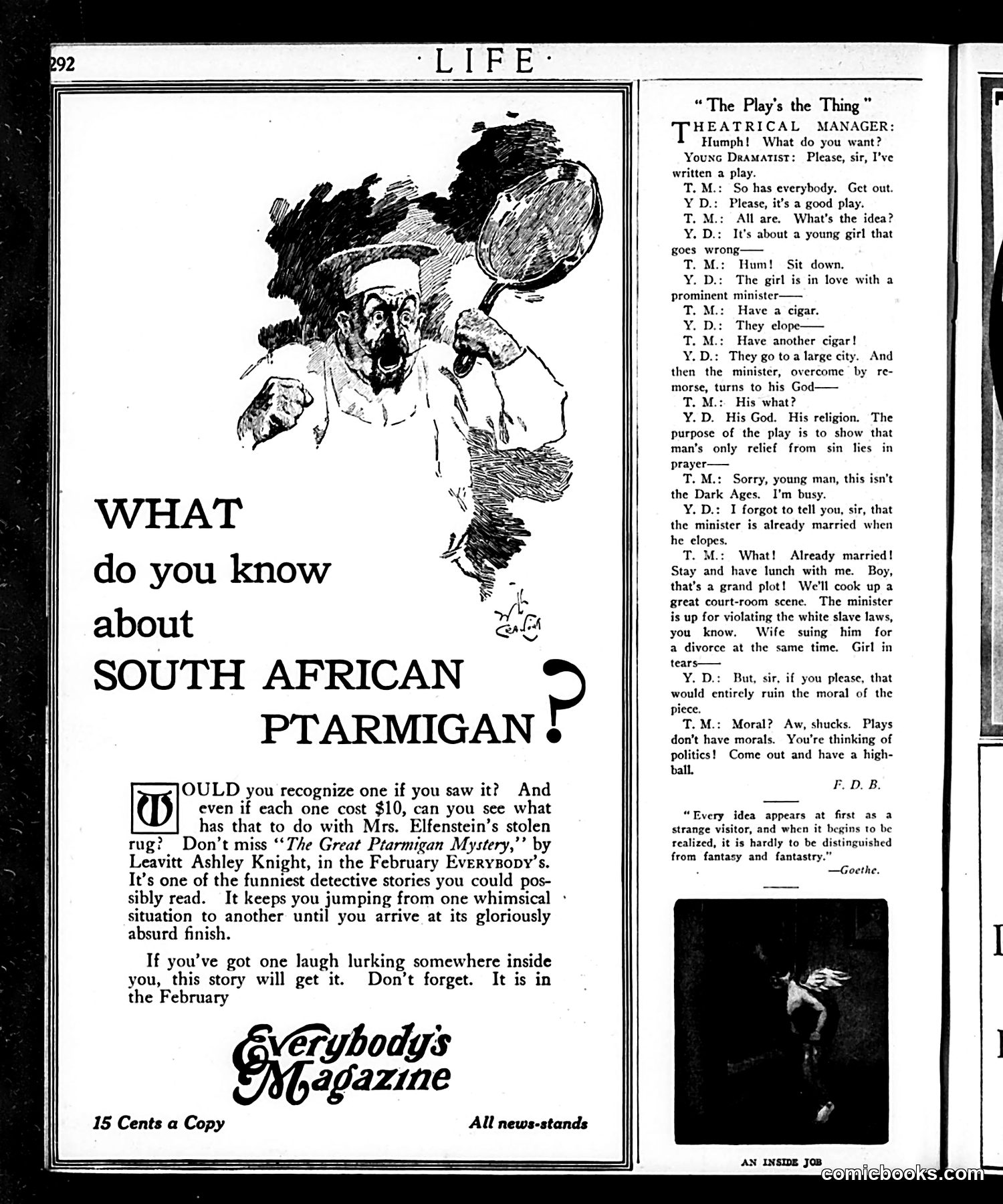
What you’re looking at
This dialogue satirizes early 20th-century theatrical producers' moral hypocrisy. A young playwright pitches a morality play about a minister who finds redemption through prayer and religion. The theater manager dismisses it as old-fashioned ("this isn't the Dark Ages"). However, when the playwright adds that the minister is *already married* when he elopes—creating scandal, legal violations, and divorce—the manager becomes enthusiastic, wanting to exploit the salacious court-room drama. The satire's point: theater producers publicly condemned immoral content but actually craved sensational plots involving adultery, legal transgression, and scandal. They prioritized commercial appeal over genuine moral instruction, despite claiming to serve audiences' ethical interests. The manager's final dismissal of "morals" as mere "politics" underscores the cynicism—entertainment values profit over principle.
📄 Transcribed text from this page (OCR, searchable)
Machine-transcribed from the original scan — historical spelling and the odd misread are preserved.
“The Play’s the Thing” HEATRICAL MANAGER: Humph! What do you want? Younc Dramatist: Please, sir, I’ve written a play. So has everybody. Get out. Please, it’s a good play. All are. What's the idea? It’s about a young girl that goes wrong— T. M.: Hum! Sit down. Y. D.: The girl is in love with a prominent minister—— Have a cigar. They elope— Have another cigar! They go toa large city. And then the minister, overcome by re- morse, turns to his God—— T. M.: His what? Y. D. His God. His religion. The purpose of the play is to show that man’s only relief from sin lies in prayer— T. M.: Sorry, young man, this isn’t the Dark Ages. I’m busy. Y. D.: I forgot to tell you, sir, that the minister is already married when SX : he elopes. A te T. M.: What! Already married! do you know Stay and have lunch with me. Boy, that’s a grand plot! We'll cook up a ¥ great court-room scene. The minister b t ; is up for violating the white slave laws, a ou you know. Wife suing him for a divorce at the same time. Girl in would entirely ruin the moral of the piece. PT ‘ARMIG AN T. M.: Moral? Aw, shucks. Plays e don't have morals. You're thinking of politics! Come out and have a high- ball. FLD. B. even if each one cost $10, can you see what “Every idea appears at first as a has that to do with Mrs. Elfenstein’s stolen strange visitor, and when it be 0 rug? Don’t miss ‘‘The Great Ptarmigan Mystery,’’ by realized, it is hardly to be di Leavitt Ashley Knight, in the February Everysopy’s. Frora:iteatagy, sed fantastey It’s one of the funniest detective stories you could pos- , , sibly read. It keeps you jumping from one whimsical situation to another until you arrive at its gloriously absurd finish. If you’ve got one laugh lurking somewhere inside you, this story will get it. Don’t forget. It is in the February vérybodys agazime 15 Cents a Copy All news-stands iy OULD you recognize one if you saw it? And