
Life, 1914-02-12 · page 14 of 44
Life — February 12, 1914 — page 14: what you’re looking at
What you’re looking at
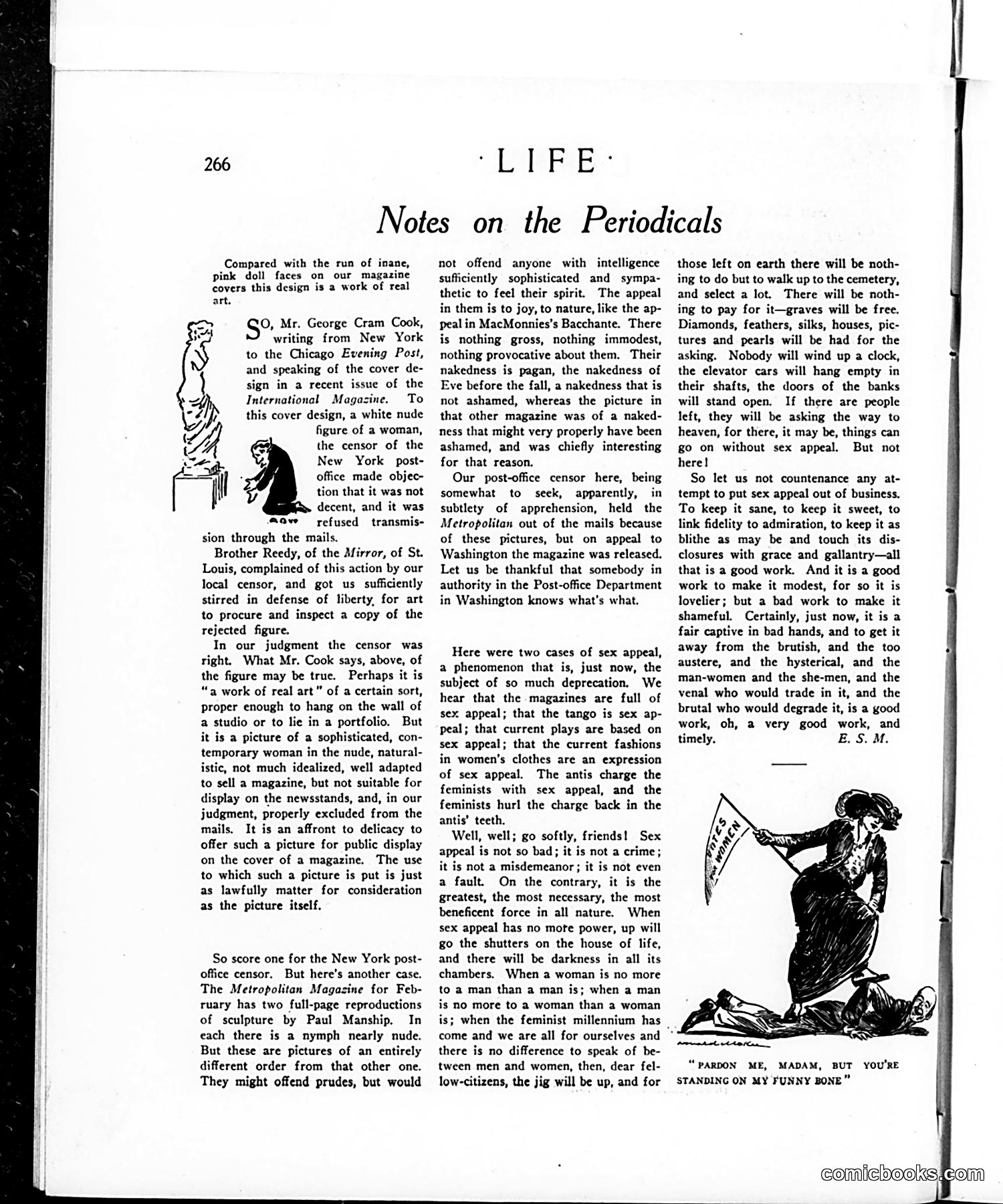
This page discusses postal censorship of magazine covers. The text describes two cases where U.S. post-office censors rejected magazine covers featuring nude or semi-nude female figures—one from the *New York* magazine and another from the *Metropolitan Magazine* featuring Paul Manship sculptures. The cartoon at bottom right depicts a figure (likely representing the censor or authority figure) examining or restraining a woman, with the caption "PARDON ME, MADAM, BUT YOU'RE STANDING ON MY FUNNY BONE." The satire criticizes overzealous censorship: the post-office is portrayed as absurdly prudish, rejecting legitimate art while the cartoon mockingly suggests the censor's own repression. The article argues such censorship stifles artistic expression and that sex appeal in art is natural, not inherently immoral.
📄 Transcribed text from this page (OCR, searchable)
Machine-transcribed from the original scan — historical spelling and the odd misread are preserved.
266 RAE Notes on the Periodicals Compared with the run of inane, pink doll faces on our magazine covers this design is a work of real art. O, Mr. George Cram Cook, writing from New York S to the Chicago Evening Post, and speaking of the cover de- sign in a recent issue of the 4h x International. Magazine, To WY this cover design, a white nude ¢ figure of a woman, Od, the censor of the ee, New York post- = | : office made objec- | tion that it was not decent, and it was aave refused transmis- sion through the mails. Brother Reedy, of the Mirror, of St. Louis, complained of this action by our local censor, and got us sufficiently stirred in defense of liberty, for art to procure and inspect a copy of the rejected figure. In our judgment the censor was right. What Mr. Cook says, above, of the figure may be true. Perhaps it is “a work of real art” of a certain sort, Proper enough to hang on the wall of a studio or to lie in a portfolio. But it is a picture of a sophisticated, con- temporary woman in the nude, natural- istic, not much idealized, well adapted to sell a magazine, but not suitable for display on the newsstands, and, in our judgment, properly excluded from the mails. It is an affront to delicacy to offer such a picture for public display on the cover of a magazine. The use to which such a picture is put is just as lawfully matter for consideration as the picture itself. So score one for the New York post- office censor. But here's another case. The Metropolitan Magazine for Feb- ruary has two full-page reproductions of sculpture by Paul Manship. In each there is a nymph nearly nude. But these are pictures of an entirely different order from that other one. They might offend prudes, but would not offend anyone with intelligence sufficiently sophisticated and sympa- thetic to feel their spirit. The appeal in them is to joy, to nature, like the ap- peal in MacMonnies’s Bacchante. There is nothing gross, nothing immodest, nothing provocative about them. Their nakedness is pagan, the nakedness of Eve before the fall, a nakedness that is not ashamed, whereas the picture in that other magazine was of a naked- ness that might very properly have been ashamed, and was chiefly interesting for that reason. Our post-office censor here, being somewhat to seek, apparently, in subtlety of apprehension, held the Metropolitan out of the mails because of these pictures, but on appeal to Washington the magazine was released. Let us be thankful that somebody in authority in the Post-office Department in Washington knows what's what. Here were two cases of sex appeal, a phenomenon that is, just now, the subject of so much deprecation. We hear that the magazines are full of sex appeal; that the tango is sex ap- peal; that current plays are based on sex appeal; that the current fashions in women’s clothes are an expression of sex appeal. The antis charge the feminists with sex appeal, and the feminists hurl the charge back in the antis’ teeth. Well, well; go softly, friends! Sex appeal is not so bad; it is not a crime; it is not a misdemeanor ; it is not even a fault. On the contrary, it is the greatest, the most necessary, the most beneficent force in all nature. When sex appeal has no mote power, up will go the shutters on the house of life, and there will be darkness in all its chambers. When a woman is no more to a man than a man is; when a man is no more to a woman than a woman is; when the feminist millennium has | come and we are all for ourselves and there is no difference to speak of be- tween men and women, then, dear fel- low-citizens, the jig will be up, and for those left on earth there will be noth- ing to do but to walk up to the cemetery, and select a lot. There will be noth- ing to pay for it—graves will be free. Diamonds, feathers, silks, houses, pic- tures and pearls will be had for the asking. Nobody will wind up a clock, the elevator cars will hang empty in their shafts, the doors of the banks will stand open. If there are people left, they will be asking the way to heaven, for there, it may be, things can go on without sex appeal. But not here! So let us not countenance any at- tempt to put sex appeal out of business. To keep it sane, to keep it sweet, to link fidelity to admiration, to keep it as blithe as may be and touch its dis- closures with grace and gallantry—all that is a good work. And it is a good work to make it modest, for so it is lovelier; but a bad work to make it shameful. Certainly, just now, it is a fair captive in bad hands, and to get it away from the brutish, and the too austere, and the hysterical, and the man-women and the she-men, and the venal who would trade in it, and the brutal who would degrade it, is a good work, oh, a very good work, and timely. E. S. M. “PARDON ME, MADAM, BUT YOU'RE STANDING ON MY FUNNY BONE”