
Life, 1914-02-12 · page 25 of 44
Life — February 12, 1914 — page 25: what you’re looking at
What you’re looking at
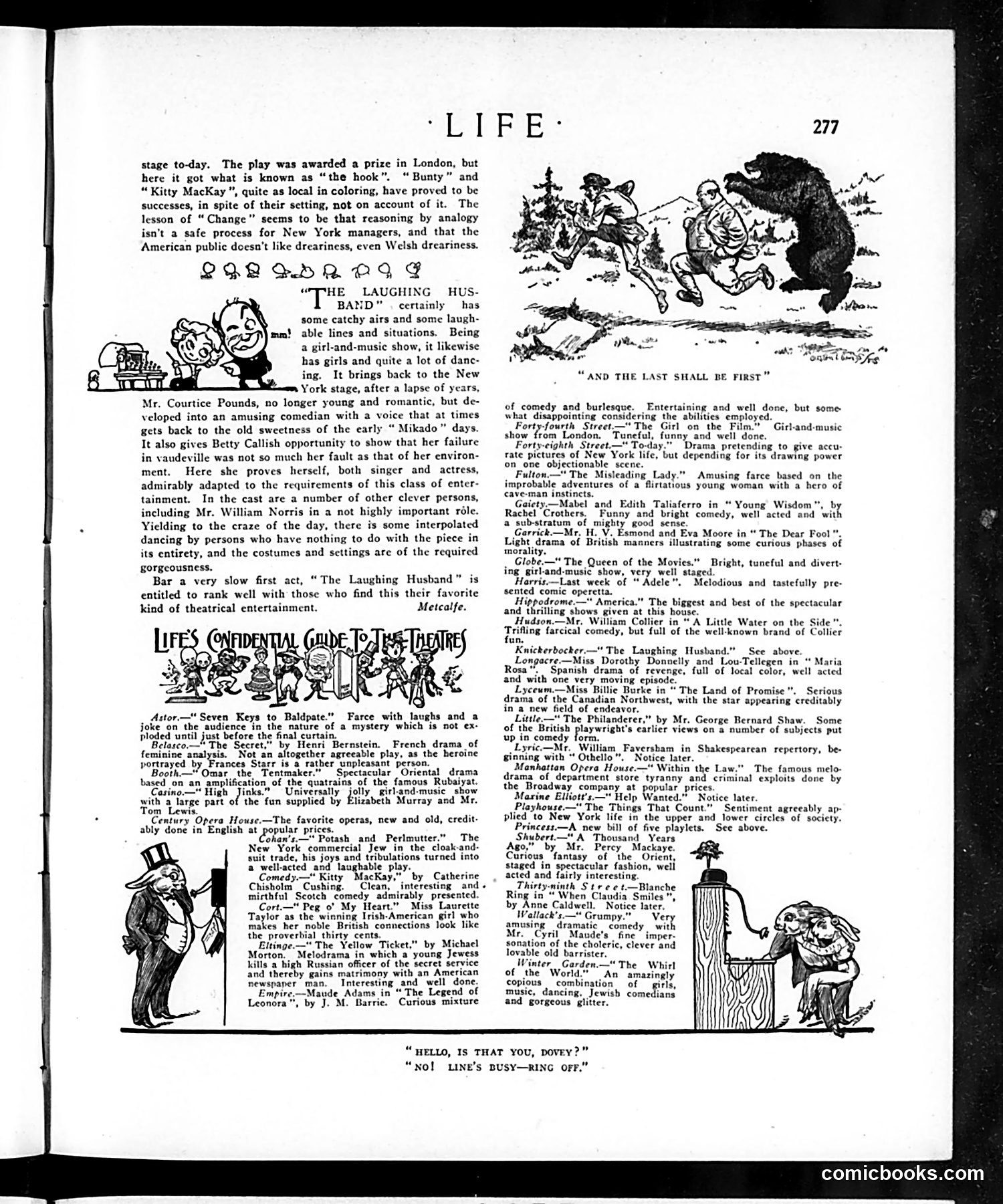
This page from *Life* magazine reviews current Broadway productions, using caricature and satire to critique theatrical offerings. The cartoons illustrate the reviews' themes. **Key elements:** The top cartoon shows figures fleeing or collapsing—visual commentary on theatrical failures. The reviews themselves are satirical, mocking plays that don't suit American audiences despite London success (like "Change," dismissed as too dreary and Welsh). **The satire's point:** American theater managers wrongly assume London's taste predicts New York success. The page celebrates comedies with "girls and music" and dancing over serious drama—reflecting early 20th-century popular entertainment preferences. **Figures mentioned** include actor Courtice Pounds (aging from his *Mikado* days) and actress Laurette Taylor, praised for her charm. The ornamental header "Life's Confidential Guide to the Theatres" and decorative illustrations frame this as insider theatrical gossip, positioning *Life* as arbiter of entertainment taste—the magazine's characteristic satirical stance toward American culture.
📄 Transcribed text from this page (OCR, searchable)
Machine-transcribed from the original scan — historical spelling and the odd misread are preserved.
op ea} la) es) stage to-day. The play was awarded a prize in London, but here it got what is known as “the hook”. Bunty” and “ Kitty MacKay”, quite as local in coloring, have proved to be successes, in spite of their setting, not on account of it. The lesson of “Change” seems to be that reasoning by analogy isn’t a safe process for New York managers, and that the American public doesn’t like dreariness, even Welsh dreariness. &OBk®@abeeag “"THE LAUGHING HUS- BAND” . certainly has some catchy airs and some laugh- able lines and situations. Being a girl-and-music show, it likewise has girls and quite a lot of danc- ing. It brings back to the New York stage, after a lapse of years, Mr. Courtice Pounds, no longer young and romantic, but de- veloped into an amusing comedian with a voice that at times gets back to the old sweetness of the early “ Mikado” days. It also gives Betty Callish opportunity to show that her failure in vaudeville was not so much her fault as that of her environ- ment. Here she proves herself, both singer and actres admirably adapted to the requirements of this class of ente tainment. In the cast are a number of other clever persons, including Mr. William Norris in a not highly important rdle. Yielding to the craze of the day, there is some interpolated dancing by persons who have nothing to do with the piece in its entirety, and the costumes and settings are of the required gorgeousness, Bar a very slow first act, “The Laughing Husband” is entitled to rank well with those who find this their favorite kind of theatrical entertainment. Metcalfe. Farce with laughs and a Astor, Seven Keys to Baldpate.” i is not ex- joke on the audience in the nature of a mystery whic! ploded until just before the final curtain. Belasco.—" The Secret,” by Henri Bernstein. French drama of feminine analysis. Not an altogether agreeable play, as the heroine portrayed by Starr is a rather unpleasant person. Booth.—* Omai Tentmaker.” Spectacular Oriental drama based on an amplification of the quatrains of the famous Rubaiyat. Carino.—" High Jinks.” Universally jolly, girl and-music show with a large part of the fun supplied by Elizabeth Murray and Mr. Tom Lewis, aCemtury Onere House—The favorite operas, new and old, credit: ably done in English at popular prices. f = Cohen's ©" Potash and Perlmutter.” The New York commercial Jew in the cloak-and- it trade, his joys and tribulations turned into a well-acted and laughable play. medy.—" Kitty MacKay,” by Catherine Chisholm Cushing. Clean,’ interesting and mirthful Scotch comedy admirably presented. Cort.—" Peg o' My Heart.” Miss Laurette Taylor as the winning Irish-American girl who makes her noble British connections look like the proverbial thirty cents. i Eltinge.-—" The Yellow Ticket,” by Michael Morton. Melodrama in which a young Jewess kills a high Russian officer of the secret service and thereby gains matrimony with an American newspaper man. Interesting and well done. Maude Adams in “The Legend of by J. M. Barrie. Curious mixture “AND THE LAST SHALL BE FIRST” of comedy and burlesque. Entertaining and well done, but some what disappointing considering the abilities employed. Forty-fourth Street—" The Girl on the Film." rom London. Tuneful, funny and well done. Forty-eighth Street.—" To-day.” Drama pretending to give accu: rate pictures of New York life, but depending for its drawing power on one objectionable scene. _ Fulton.—" The Misleading Lady.” Amusing farce based on the improbable adventures of a flirtatious young woman with a hero of cave-man instincts. Gaiety—Mabel and Edith Taliaferro in “ Young Wisdom", by Rachel Crothers, Funny and bright comedy, well acted and with a sub-stratum of mighty good sense. Garrick.—Mr, H. V. Esmond and Eva Moore in “ The Dear Fool". Light drama of British manners illustrating some curious phases of morality. , Globe.—" The Queen of the Movies.” Bright, tuneful and divert- ing girl-and-music show, very well staged. Harris-—Last week of “ Adele". Melodious and tastefully pre- sented comic operetta. Hitpodrome.—" America. and thrilling shows given at this house. Hudson.—Mr. William Collier in “A Little Water on the Side”. Trifling farcical comedy, but full of the well-known brand of Collier un, Knickerbocker." The Laughing Husband.” See above. Longacre.—Miss Dorothy Donnelly and Lou-Tellegen in ‘ Maria Rosa”. Spanish drama of revenge, full of local color, well acted and with one very moving episode. Lyceum.—Miss Billie Burke in “ The Land of Promise", Serious drama of the Canadian Northwest, with the star appearing creditably in a new field of endeavor. Little —* The Philanderer,” by Mr. George Bernard Shaw. Some of the British playwright's earlier views on a number of subjects put up in comedy form. _Lyric.—Mr. William, Faversham in Shakespearean repertory, be- ginning with “ Othello”. Notice later. Manhattan Opera House.—" Within the Law." The famous melo- drama of department store tyranny and criminal exploits done by the Broadway company at popular prices: Marine Elliott’s—" Help Wanted.” Notice later. Playhouse.—" The Things That Count.” Sentiment agreeably ap- plied to New York life in the upper and lower circles of society. Princess.—A new bill of five playlets. See above. Shubert.—" A Thousand Years Ago,” by Mr. Percy Mackaye. Curious fantasy of the Orient, staged in spectacular fashion, well acted and fairly interesting. Thirty-ninth Str ¢¢ t-—Blanche Ring in “ When Claudia Smiles”, by Anne Caldwell. Notice later. Waltack's.—" Gramp: Ver amusing dramatic. comedy with Mr. Cyril Maude’s fine imper- sonation of the choleric, clever and lovable old barrister. Winter Garden.—" The Whirl of the World.” An amazingly copious combination of girls, music, dancing, Jewish comedians and gorgeous glitter. Girl-and-music The biggest and best of the spectacular “ HELLO, IS THAT YOU, DOVEY?” “nol LINE’S BUSY—RING OFF,” comicbooks.com