
Life, 1914-02-12 · page 10 of 44
Life — February 12, 1914 — page 10: what you’re looking at
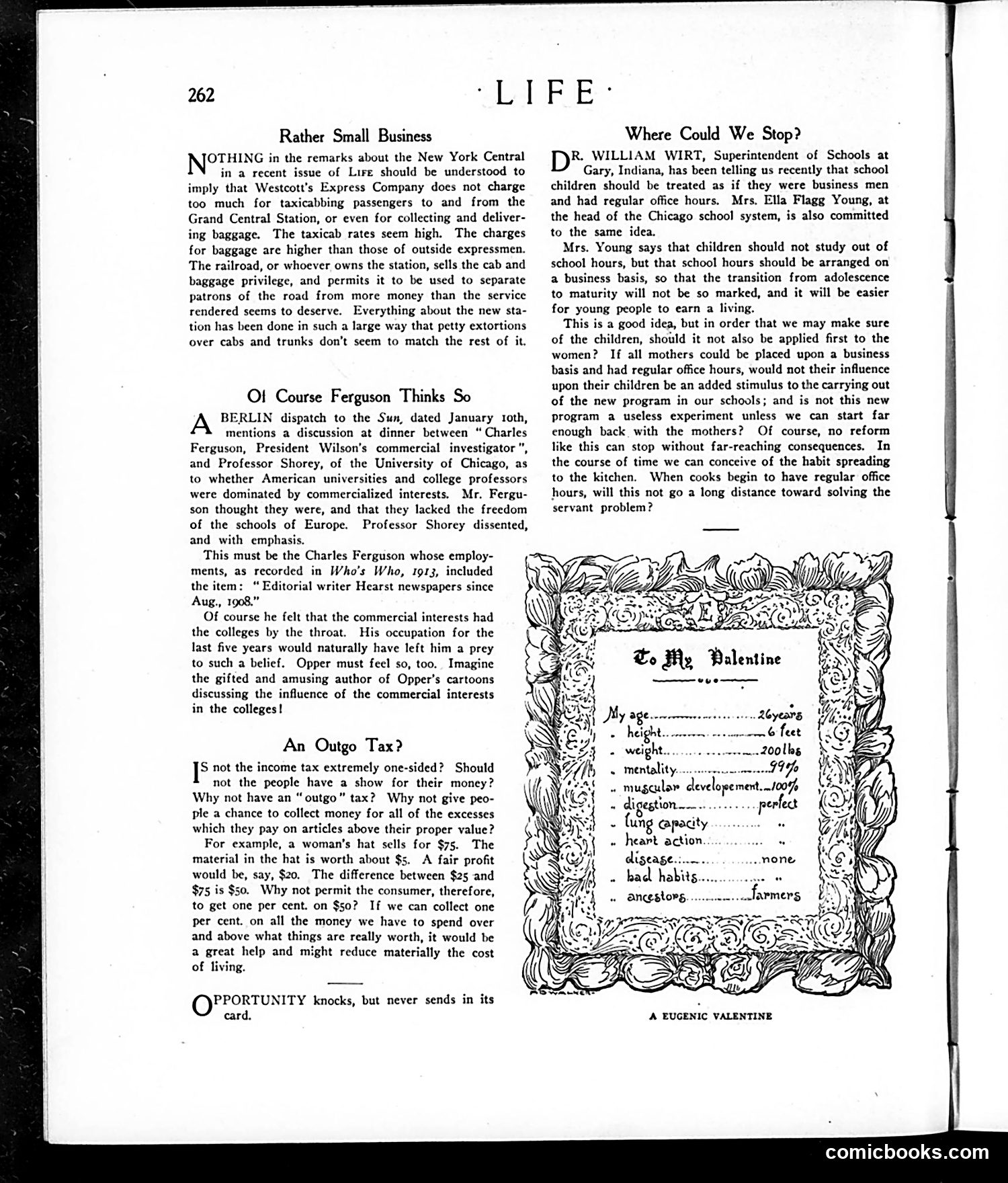
What you’re looking at
This cartoon mocks the early 20th-century eugenics movement by presenting an absurdly detailed "valentine" checklist for an ideal mate. The list rates prospective partners on pseudo-scientific traits: age, height, weight, "mentality," "muscular development," "digestion," "lung capacity," "heart action," and notably includes dismissive judgments like "bad habits...none" and ancestry as "farmers." The satire targets how eugenicists attempted to quantify human worth and breeding suitability through pseudoscientific measurements. By framing this as a romantic valentine—traditionally about love and emotion—the artist highlights the cold, dehumanizing absurdity of reducing human partnership to biological metrics and class-based ancestry evaluation.
📄 Transcribed text from this page (OCR, searchable)
Machine-transcribed from the original scan — historical spelling and the odd misread are preserved.
262 Rather Small Business OTHING in the remarks about the New York Central in a recent issue of Lire should be understood to imply that Westcott’s Express Company does not charge too much for taxicabbing passengers to and from the Grand Central Station, or even for collecting and deliver- ing baggage. The taxicab rates seem high. The charges for baggage are higher than those of outside expressmen. The railroad, or whoever owns the station, sells the cab and baggage privilege, and permits it to be used to separate patrons of the road from more money than the service rendered seems to deserve. Everything about the new sta- tion has been done in such a large way that petty extortions over cabs and trunks don’t seem to match the rest of it. Ot! Course Ferguson Thinks So BERLIN dispatch to the Sun, dated January oth, mentions a discussion at dinner between “ Charles Ferguson, President Wilson’s commercial investigator", and Professor Shorey, of the University of Chicago, as to whether American universities and college professors were dominated by commercialized interests. Mr. Fergu- son thought they were, and that they lacked the freedom of the schools of Europe. Professor Shorey dissented, and with emphasis. This must be the Charles Ferguson whose employ- ments, as recorded in Who's Who, 1913, included the item: “ Editorial writer Hearst newspapers since Aug., 19 Of course he felt that the commercial interests had the colleges by the throat. His occupation for the last five years would naturally have left him a prey to such a belief. Opper must feel so, too. Imagine the gifted and amusing author of Opper’s cartoons discussing the influence of the commercial interests in the colleges! An Outgo Tax? Is not the income tax extremely one-sided? Should not the people have a show for their money? Why not have an “outgo” tax? Why not give peo- ple a chance to collect money for all of the excesses which they pay on articles above their proper value? For example, a woman's hat sells for $75. The material in the hat is worth about $5. A fair profit would be, say, $20. The difference between $25 and $75 is $30. Why not permit the consumer, therefore, to get one per cent. on $50? If we can collect one per cent. on all the money we have to spend over and above what things are really worth, it would be a great help and might reduce materially the cost of living. PPORTUNITY knocks, but never sends in its card, “Eel FUE: Where Could We Stop? R. WILLIAM WIRT, Superintendent of Schools at Gary, Indiana, has been telling us recently that school children should be treated as if they were business men and had regular office hours. Mrs, Ella Flagg Young, at the head of the Chicago school system, is also committed to the same idea. Mrs. Young says that children should not study out of school hours, but that school hours should be arranged on a business basis, so that the transition from adolescence to maturity will not be so marked, and it will be easier for young people to earn a living. This is a good idea, but in order that we may make sure of the children, should it not also be applied first to the women? If all mothers could be placed upon a business basis and had regular office hours, would not their influence upon their children be an added stimulus to the carrying out of the new program in our schools; and is not this new program a useless experiment unless we can start far enough back with the mothers? Of course, no reform like this can stop without far-reaching consequences. In the course of time we can conceive of the habit spreading to the kitchen. When cooks begin to have regular office hours, will this not go a long distance toward solving the servant problem? NCH iS ine i vey mentality... = muscular developement digestion —...........pee fung @pacity : heart action diseage.:..—. . bad habits....... « Ancestors... A EUGENIC VALENTINE comicbooks.com