
Life, 1914-02-12 · page 20 of 44
Life — February 12, 1914 — page 20: what you’re looking at
What you’re looking at
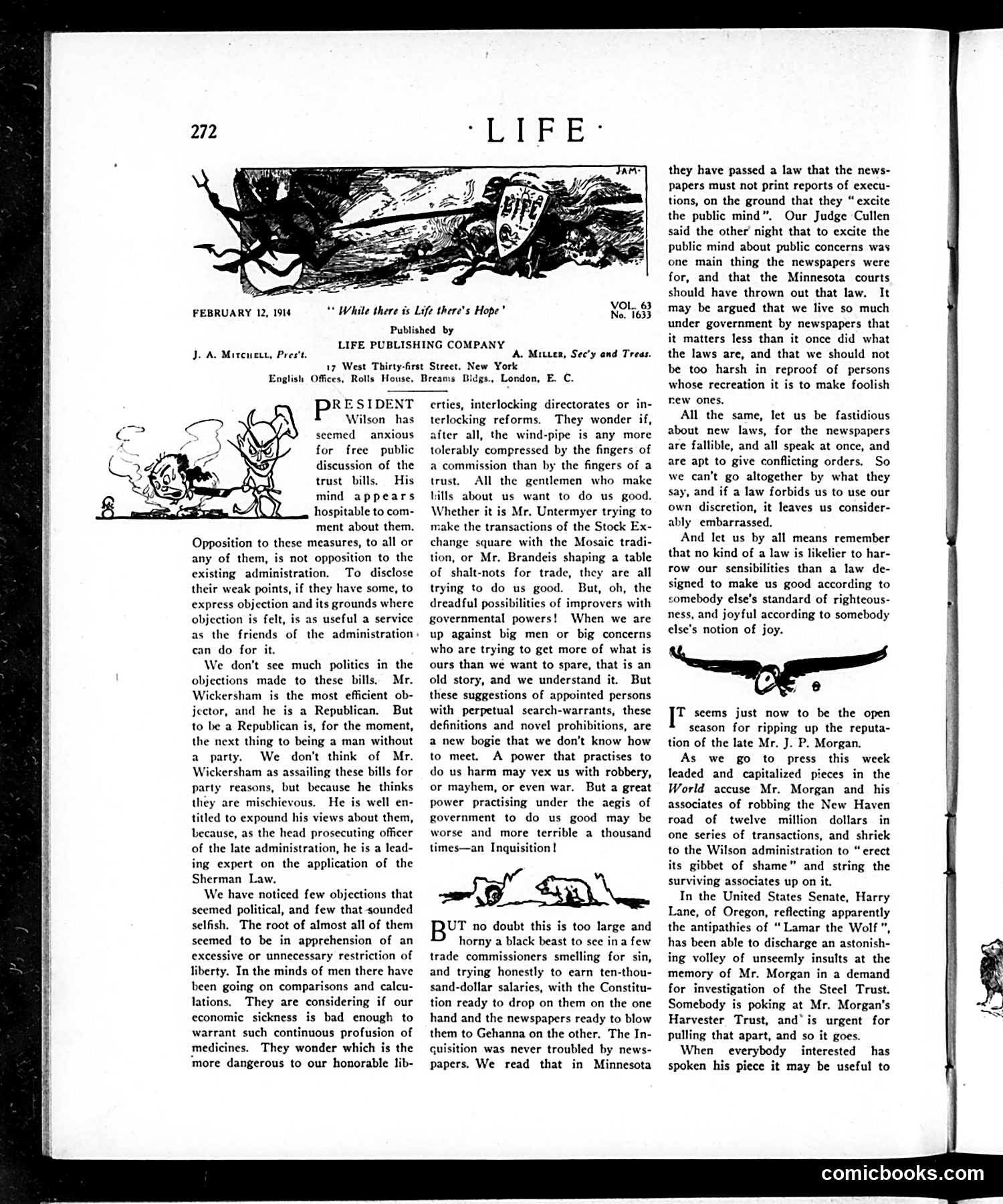
This editorial discusses President Wilson's trust-busting legislation and regulation proposals. The cartoons illustrate the article's central anxiety: the danger of government power exercised "to do us good." The text criticizes not the *intent* of reformers like Louis Untermyer (stock exchange regulation) and Louis Brandeis (trade restrictions), but fears their governmental reach. It compares expansive regulatory power to an "Inquisition"—suggesting that well-meaning bureaucrats with broad search powers and enforcement authority pose greater threats to liberty than corrupt trusts themselves. A secondary complaint addresses Minnesota's law prohibiting newspaper coverage of executions, which Life's Judge Cullen opposed. The magazine argues newspapers serve democracy by exciting public concern about public matters. The cartoons' specific figures are unclear in this reproduction, but the overall message warns against concentrated regulatory government power, however benevolent its stated purpose.
📄 Transcribed text from this page (OCR, searchable)
Machine-transcribed from the original scan — historical spelling and the odd misread are preserved.
FEBRUARY 12, 1914 ‘* While there is Life there's Hope’ No, 1633 Published by LIFE PUBLISHING COMPANY J. A. Mircucut, Pres't. A. Mitten, Sec’y and Treas. 17 West Thirty-first Street, New York English Offices, Rolls House, Breams Bidgs., London, E. C. RESIDENT Wilson has seemed anxious for free public discussion of the trust bills. His mind appears hospitable to com- ment about them. Opposition to these measures, to all or any of them, is not opposition to the existing administration. To disclose their weak points, if they have some, to express objection and its grounds where objection is felt, is as useful a service as the friends of the administration can do for it. We don't see much politics in the objections made to these bills. Mr. Wickersham is the most efficient ob- jector, and he is a Republican. But to be a Republican is, for the moment, the next thing to being a man without a party. We don’t think of Mr. Wickersham as assailing these bills for party reasons, but because he thinks they are mischievor He is well en- titled to expound his views about them, because, as the head prosecuting officer of the late ad ration, he is a lead- ing expert on the application of the Sherman Law. We have noticed few objections that seemed political, and few that sounded selfish, The root of almost all of them seemed to be in apprehension of an excessive or unnecessary restriction of liberty. In the minds of men there have been going on comparisons and calcu- lations, They are considering if our economic sickness is bad enough to warrant such continuous profusion of medicines. They wonder which is the ‘more dangerous to our honorable lib- erties, interlocking directorates or in- terlocking reforms. They wonder if, after all, the wind-pipe is any more tolerably compressed by the fingers of a commission than by the fingers of a trust. All the gentlemen who make Lills about us want to do us good. Whether it is Mr. Untermyer trying to make the transactions of the Stock Ex- change square with the Mosaic tradi- tion, or Mr. Brandeis shaping a table of shalt-nots for trade, they are all trying to do us good. But, oh, the dreadful possibilities of improvers with governmental powers! When we are up against big men or big concerns who are trying to get more of what is ours than we want to spare, that is an old story, and we understand it. But these suggestions of appointed persons with perpetual search-warrants, these definitions and novel prohibitions, are a new bogie that we don’t know how to meet. A power that practises to do us harm may vex us with robbery, or mayhem, or even war. But a great power practising under the aegis of government to do us good may be worse and more terrible a thousand times—an Inquisition! io Sp Bt no doubt this is too large and horny a black beast to see ina few trade commissioners smelling for sin, and trying honestly to earn ten-thou- sand-dollar salaries, with the Constitu- tion ready to drop on them on the one hand and the newspapers ready to blow them to Gehanna on the other. The In- quisition was never troubled by news- papers. We read that in Minnesota they have passed a law that the news- papers must not print reports of execu- tions, on the ground that they “ excite the public mind”, Our Judge Cullen said the other’ night that to excite the public mind about public concerns was one main thing the newspapers were for, and that the Minnesota courts should have thrown out that law. It may be argued that we live so much under government by newspapers that it matters less than it once did what the laws are, and that we should not be too harsh in reproof of persons whose recreation it is to make foolish new ones. All the same, let us be fastidious about new laws, for the newspapers are fallible, and all speak at once, and are apt to give conflicting orders. So we can’t go altogether by what they say, and if a law forbids us to use our own discretion, it leaves us consider- ably embarrassed. And let us by all means remember that no kind of a law is likelier to har- row our sensibilities than a law de- signed to make us good according to somebody else’s standard of righteous- ness, and joyful according to somebody else's notion of joy. , @ seems just now to be the open season for ripping up the reputa- r tion of the late Mr. J. P. Morgan. As we go to press this week leaded and capitalized pieces in the World accuse Mr. Morgan and his associates of robbing the New Haven road of twelve million dollars in one series of transactions, and shrick to the Wilson administration to “erect its gibbet of shame” and string the surviving associates up on it. In the United States Senate, Harry Lane, of Oregon, reflecting apparently the antipathies of “ Lamar the Wolf has been able to discharge an astonish- ing volley of unseemly insults at the memory of Mr. Morgan in a demand for investigation of the Steel Trust. Somebody is poking at Mr. Morgan's Harvester Trust, and’ is urgent for pulling that apart, and so it goes. When everybody interested has spoken his piece it may be useful to comicbooks.com