
A complete issue · 40 pages · 1913
Life — September 4, 1913
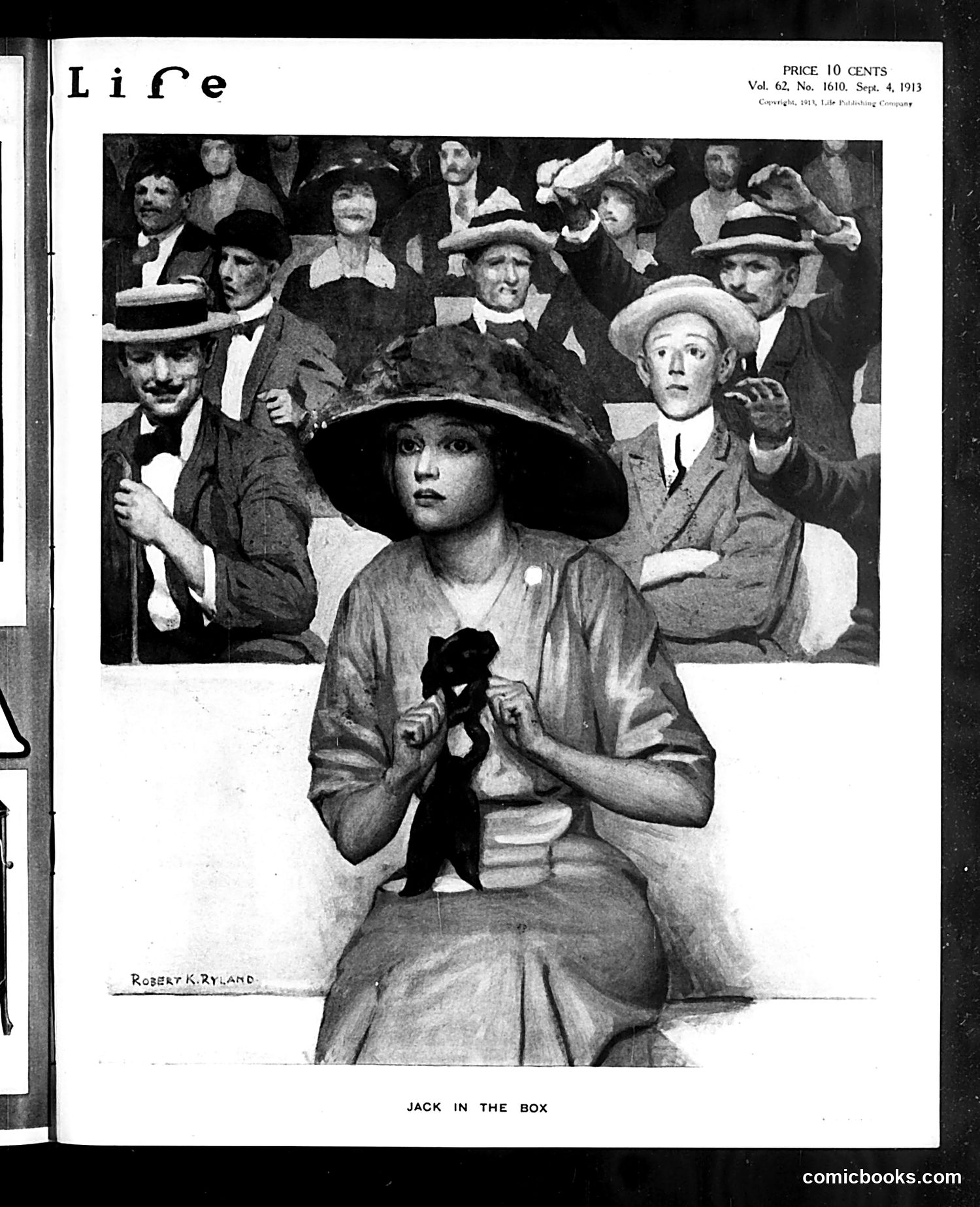
This illustration by Robert K. Ryland depicts a woman in a wide-brimmed hat holding a black cat, surrounded by an audience of formally-dressed men in hats. The title "Jack in the Box" likely references the children's toy that springs out unexpectedly. The satirical meaning appears to relate to women's unpredictability or the "new woman" of the 1910s—the woman as a surprising social force commanding male attention. The black cat suggests either bad luck or witchcraft associations, possibly satirizing contemporary anxieties about female independence and changing social roles during the Progressive Era. The crowd's focused attention suggests public fascination or concern about this female figure and her disruptive potential to social norms.
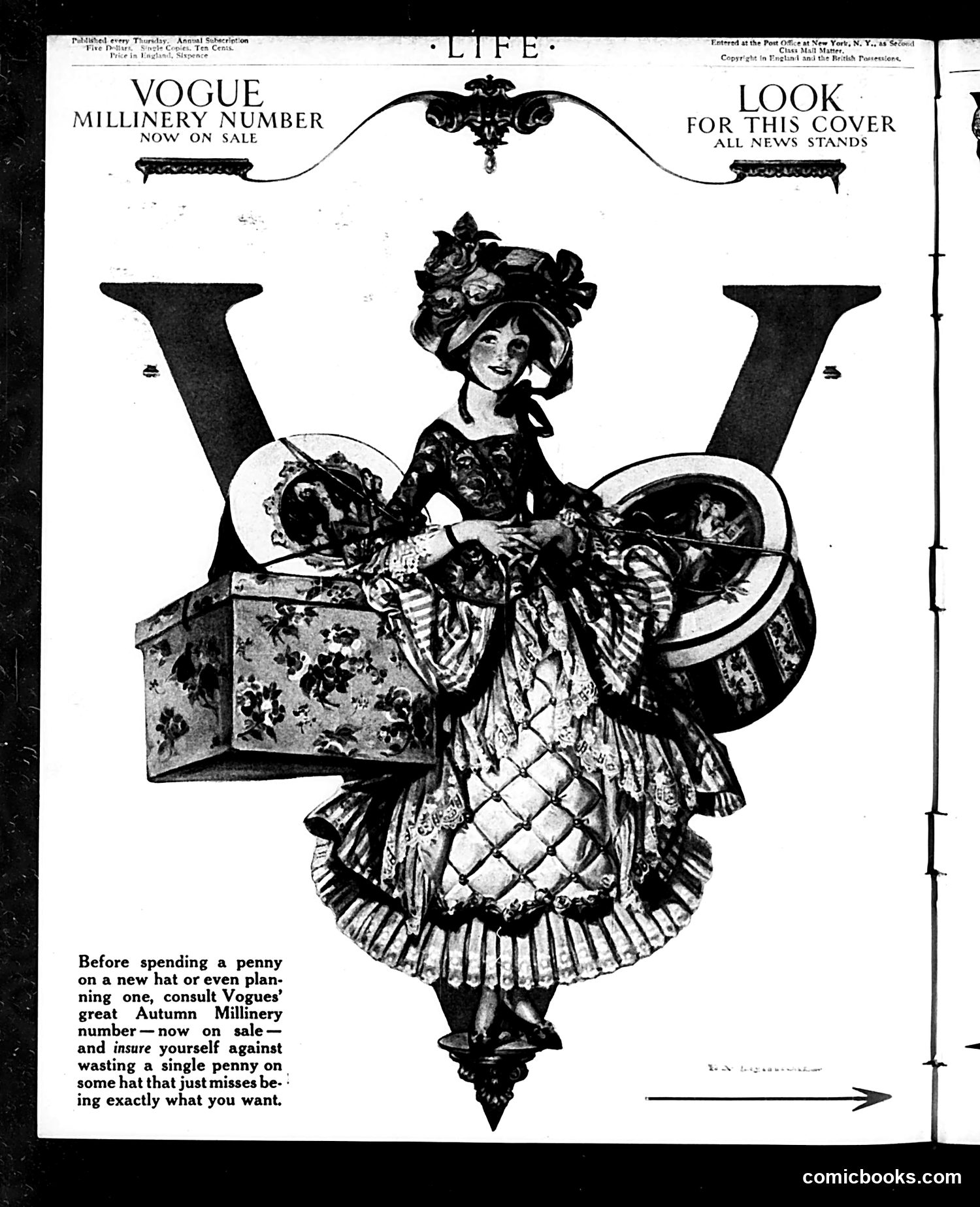
This is primarily an **advertisement for Vogue's Autumn Millinery number**, not a political cartoon. The central illustration depicts an elegantly dressed woman in early 20th-century fashion, holding elaborate decorated hat boxes. She wears an ornate feathered hat and a quilted dress with decorative elements. The "V"-shaped design frames the figure symmetrically, creating visual emphasis. The accompanying text urges readers to consult Vogue's millinery issue before purchasing hats, warning against wasting money on unsuitable styles. This reflects the **early 1900s fashion industry's marketing strategy**, positioning Vogue as an authoritative guide for women's style decisions. The elaborate presentation and messaging emphasize that proper hat selection required expert consultation—a selling point for the magazine itself.
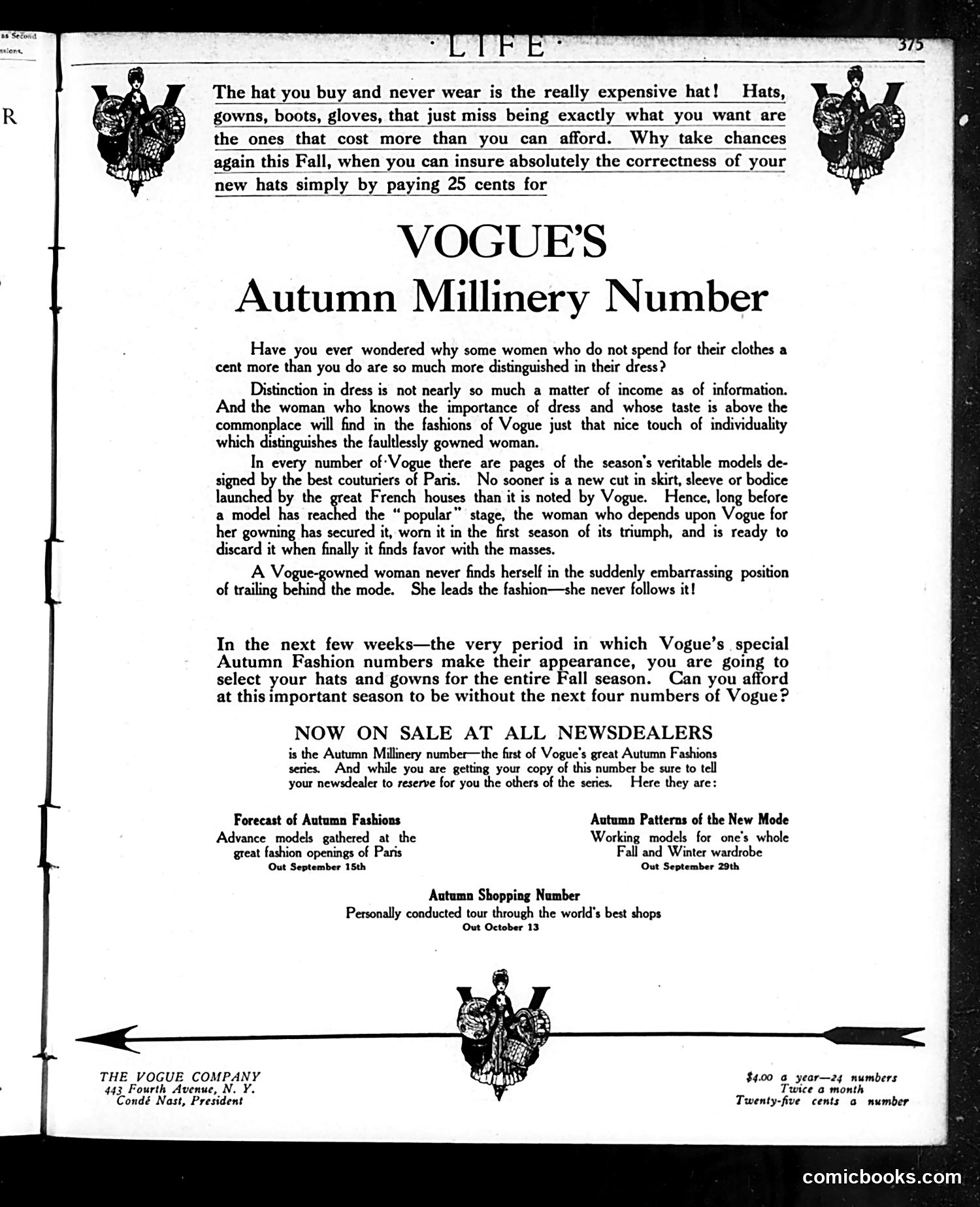
This page is primarily a **Vogue magazine advertisement**, not political satire. The decorative owl mascots flanking the text are Vogue's logo, not caricatures of specific figures. The ad promotes Vogue's "Autumn Millinery Number" and related fall fashion issues, emphasizing that fashion expertise comes from reading Vogue rather than spending excessive money. The opening paragraph makes a mild social observation: women who appear most fashionably distinguished often succeed through *knowledge* of style rather than sheer spending power. The ad argues that Vogue readers, by following Paris couture trends early, stay ahead of fashion—they "lead the fashion" rather than follow it. The satire is gentle and commercial: essentially claiming that Vogue readers possess superior taste and foresight compared to average consumers. There is no political content or reference to contemporary events.
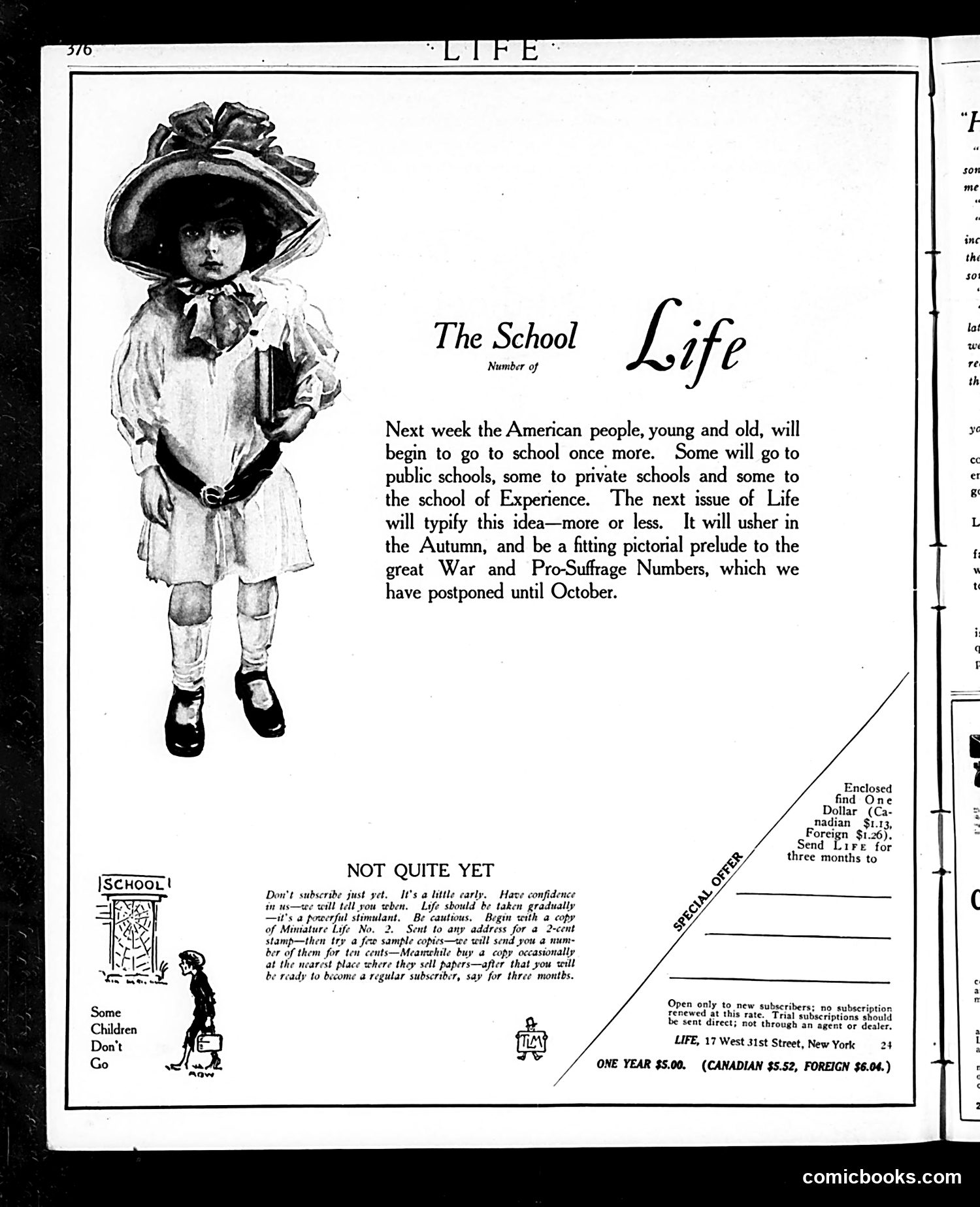
This satirical page announces Life magazine's upcoming back-to-school issue. The main illustration shows a young schoolgirl in period dress (wide-brimmed hat, high socks, Mary Jane shoes). The text humorously notes that American children will soon return to various educational settings—public schools, private schools, and "the school of Experience." Life promises its next issue will typify this theme, serving as "a fitting pictorial prelude" to upcoming coverage of World War I and women's suffrage, which they've postponed until October. The small cartoon "NOT QUITE YET" and "Some Children Don't Go" (showing a child avoiding school) appear to joke about reluctant students. This reflects early 1900s American society addressing education, while major political issues—war and voting rights—loom in the background.
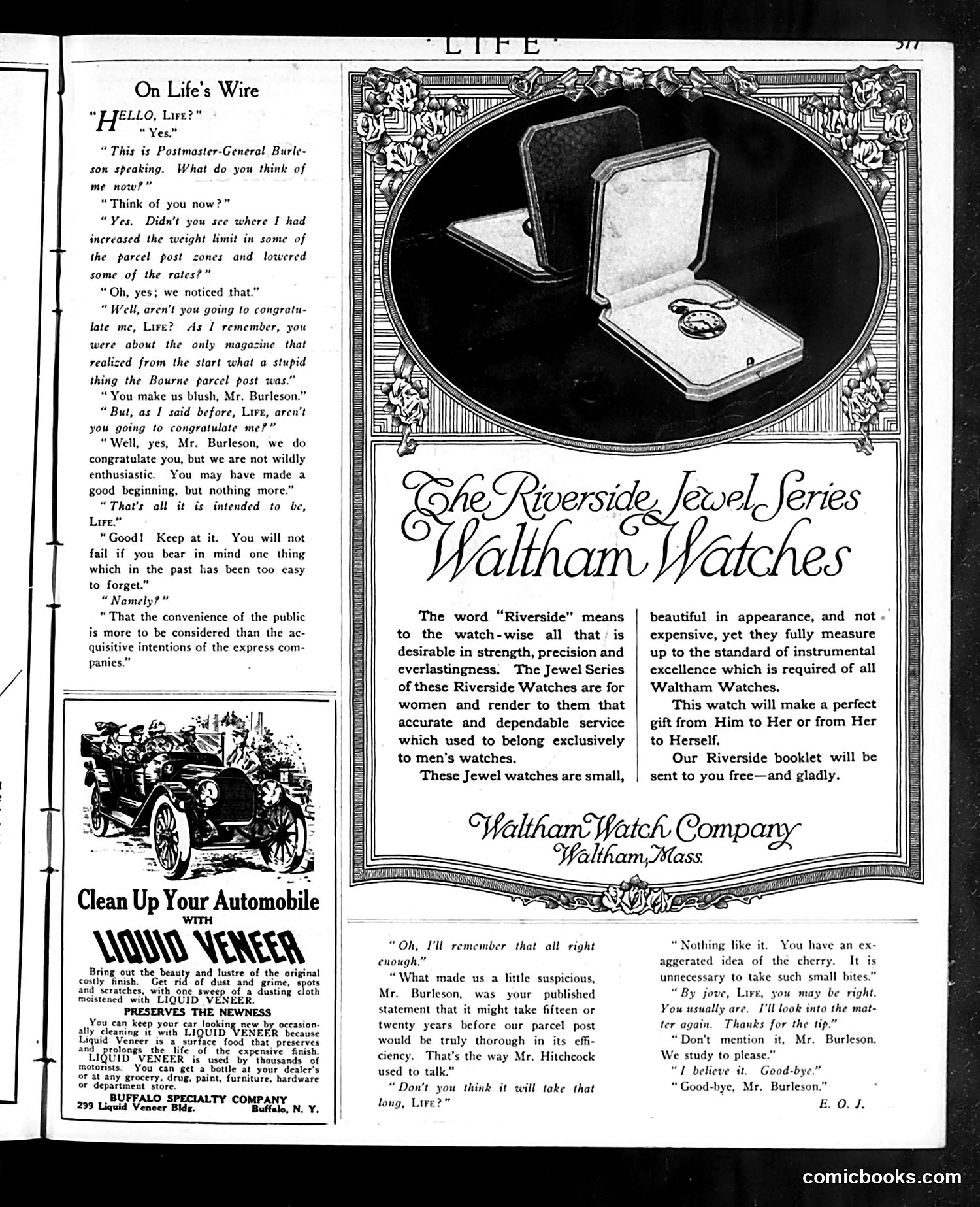
This page contains **primarily advertising** rather than political cartoons. The main content is a "Life's Wire" humor column featuring a satirical dialogue between "Life" magazine and Postmaster-General Burleson about the Bourne parcel post system. The joke mocks Burleson for claiming the parcel post was a success while Life magazine points out it was the only publication that recognized "what a stupid thing the Bourne parcel post was" from the start. Below is a Liquid Veneer automobile cleaning product advertisement and a Waltham Watches "Riverside Jewel Series" advertisement featuring an ornate jewelry box with a watch. The page is primarily **commercial**, with the Burleson exchange serving as light editorial satire about government postal policy.
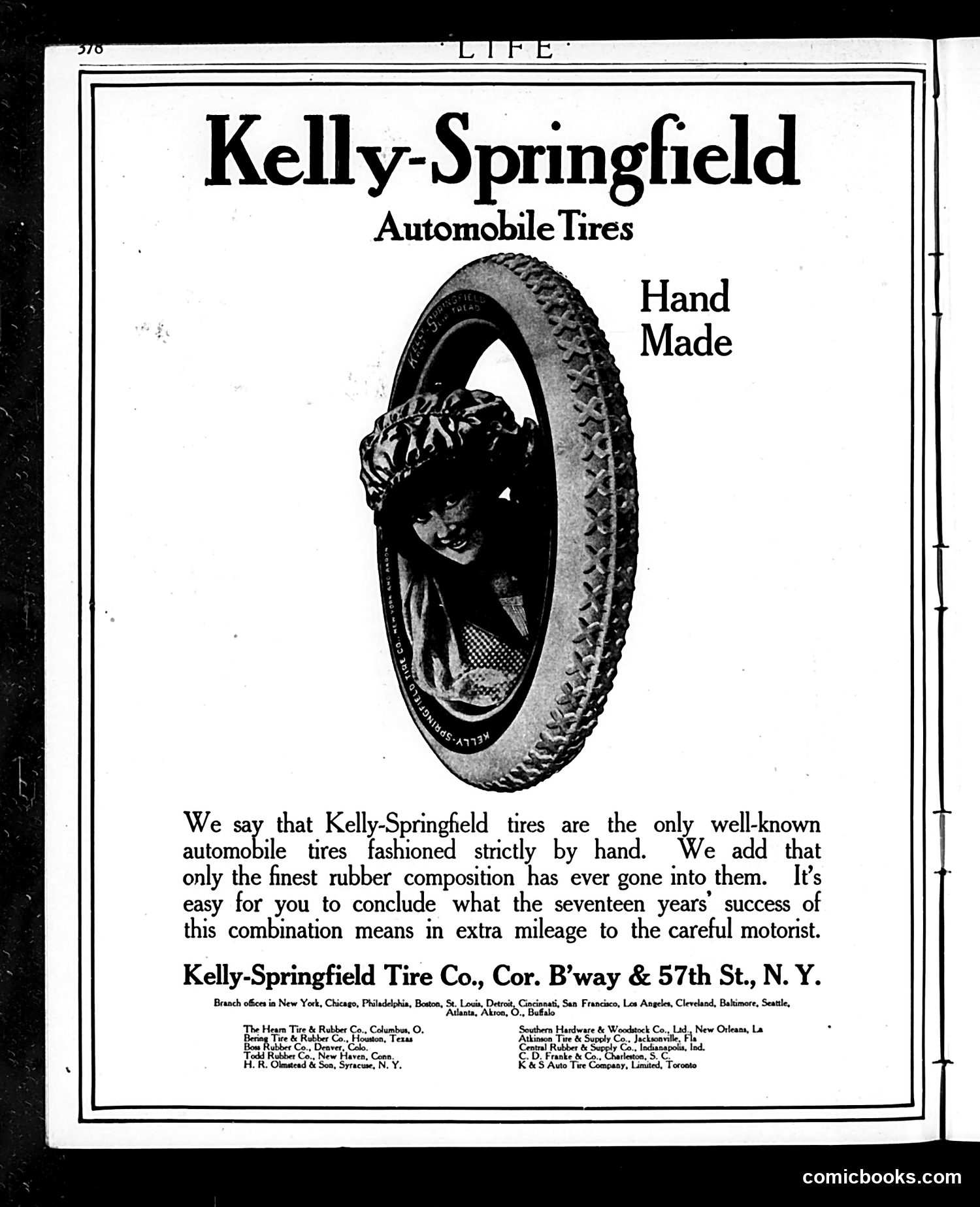
This page is a straightforward product advertisement, not satire or political commentary. It promotes Kelly-Springfield brand automobile tires, emphasizing they are "Hand Made" using "the finest rubber composition." The central image shows a tire with a woman's face visible through its center opening—a visual device designed to draw attention and make the advertisement memorable. The accompanying text claims these tires offer "extra mileage to the careful motorist" and highlights seventeen years of success. The ad lists the company's headquarters (New York) and numerous branch locations across America, indicating Kelly-Springfield's established national distribution network during this era of early automobile manufacturing.
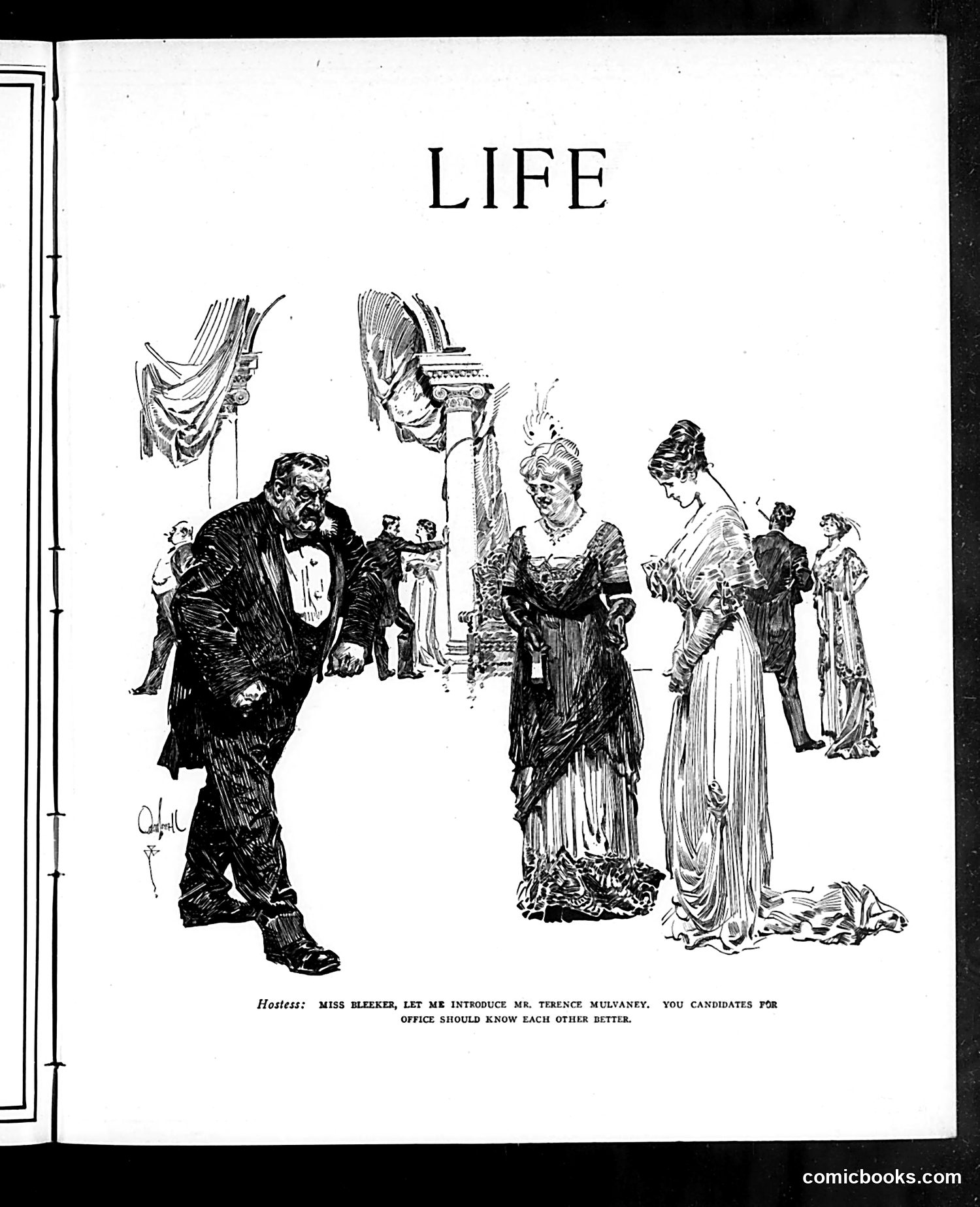
This page presents a satirical scene titled "LIFE" depicting a formal social introduction. The caption reads: "Hostess: Miss Bleeker, let me introduce Mr. Terence Mulvaney, you candidates for office should know each other better." The cartoon satirizes political networking and social climbing among office-seekers. A well-dressed hostess introduces two candidates—one appears to be an older, somewhat disheveled gentleman in formal wear, the other a younger woman in an elegant gown. Background figures observe the introduction, suggesting this is a notable social gathering. The satire likely mocks how political candidates cultivate relationships through high-society events rather than substantive policy discussion. The suggestion that candidates "should know each other better" implies ironic commentary on superficial political society and the importance of social connections over merit in securing office.
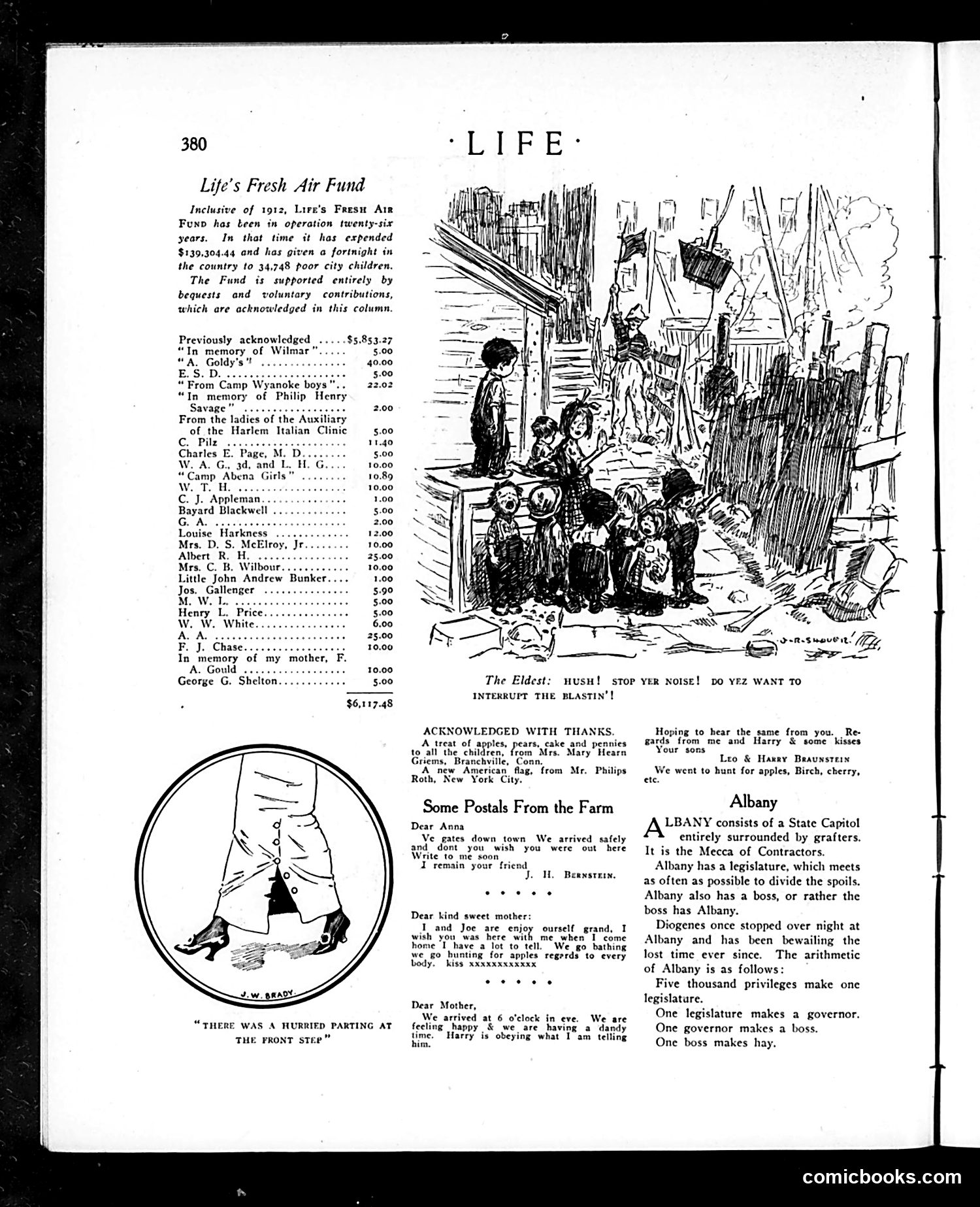
This page combines charitable fundraising with humor and rural nostalgia. The main content is **Life's Fresh Air Fund**, which since 1912 has raised money ($139,344.44 total) to send poor city children to the countryside for health benefits. The list shows small individual donations from readers. The illustrations depict urban tenement children enjoying outdoor freedom—a common Progressive Era theme contrasting grimy cities with healthful nature. The caption "The Eldest: Hush! Stop yer noise! Do yez want to interrupt the blastin'?" uses exaggerated immigrant dialect humor, typical of early 20th-century American comedy. The "Albany" section offers gentle political satire about bureaucracy, suggesting that multiple layers of government (legislature, governor, boss) ultimately serve limited purpose.
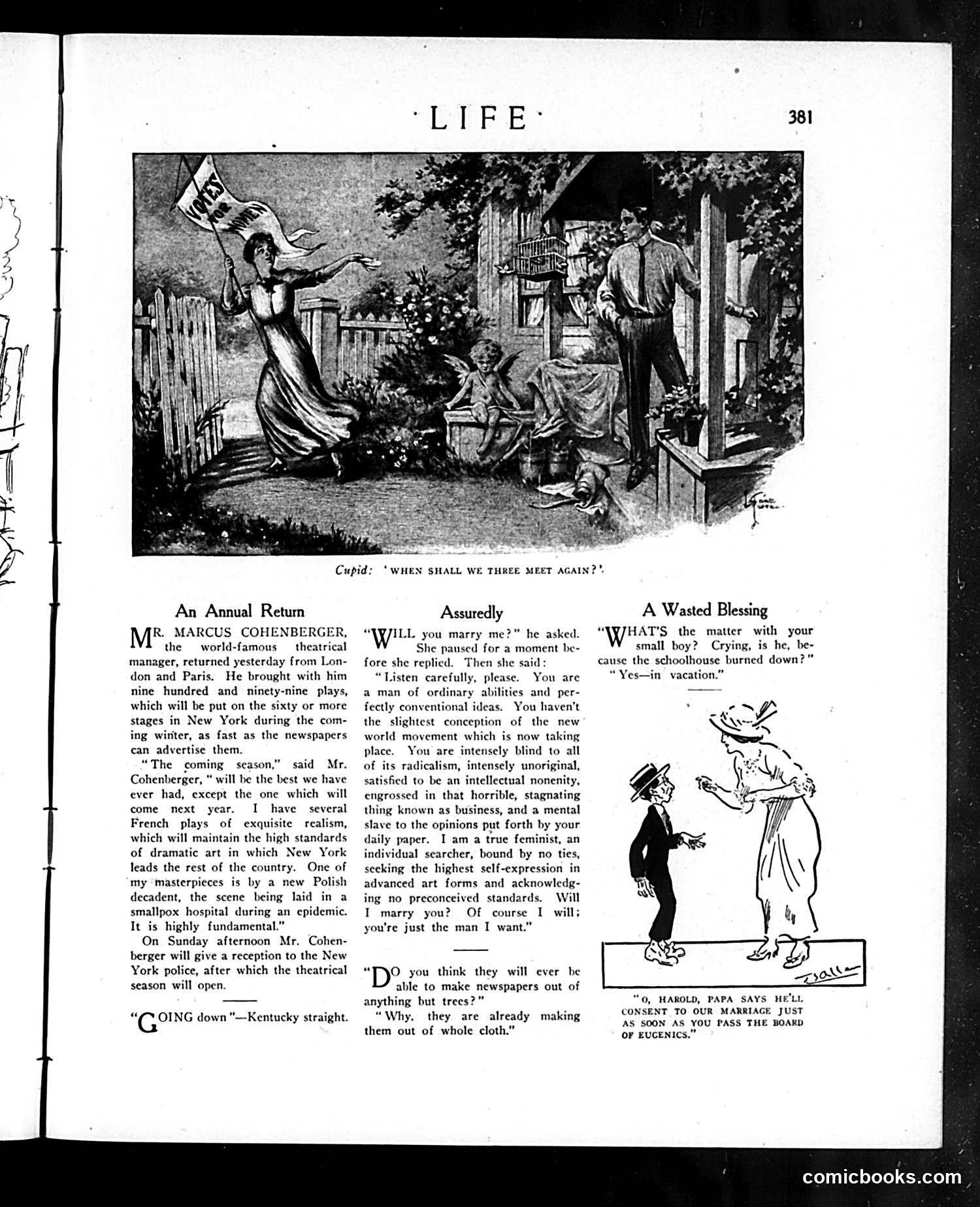
The page contains two separate pieces of satirical content: **"An Annual Return"** discusses theater manager Marcus Cohenberger's upcoming season, featuring French plays emphasizing "realism." The satire critiques conventional theater and business attitudes. **"Assuredly"** depicts a marriage proposal where the woman rejects a conventional man, stating she seeks a "true feminist" who embraces radical new ideas and "highest self-expression" rather than traditional marriage. The man agrees to marry her anyway. **"A Wasted Blessing"** (right cartoon) shows a man asking his wife why their son is crying on vacation. Her reply—"he's schoolhouse-bound"—satirizes parental anxiety about education. The cartoons mock emerging early 20th-century social movements: feminist ideology, modernism in arts, and anxieties about children's education, positioning these progressive ideas as somewhat absurd or impractical.
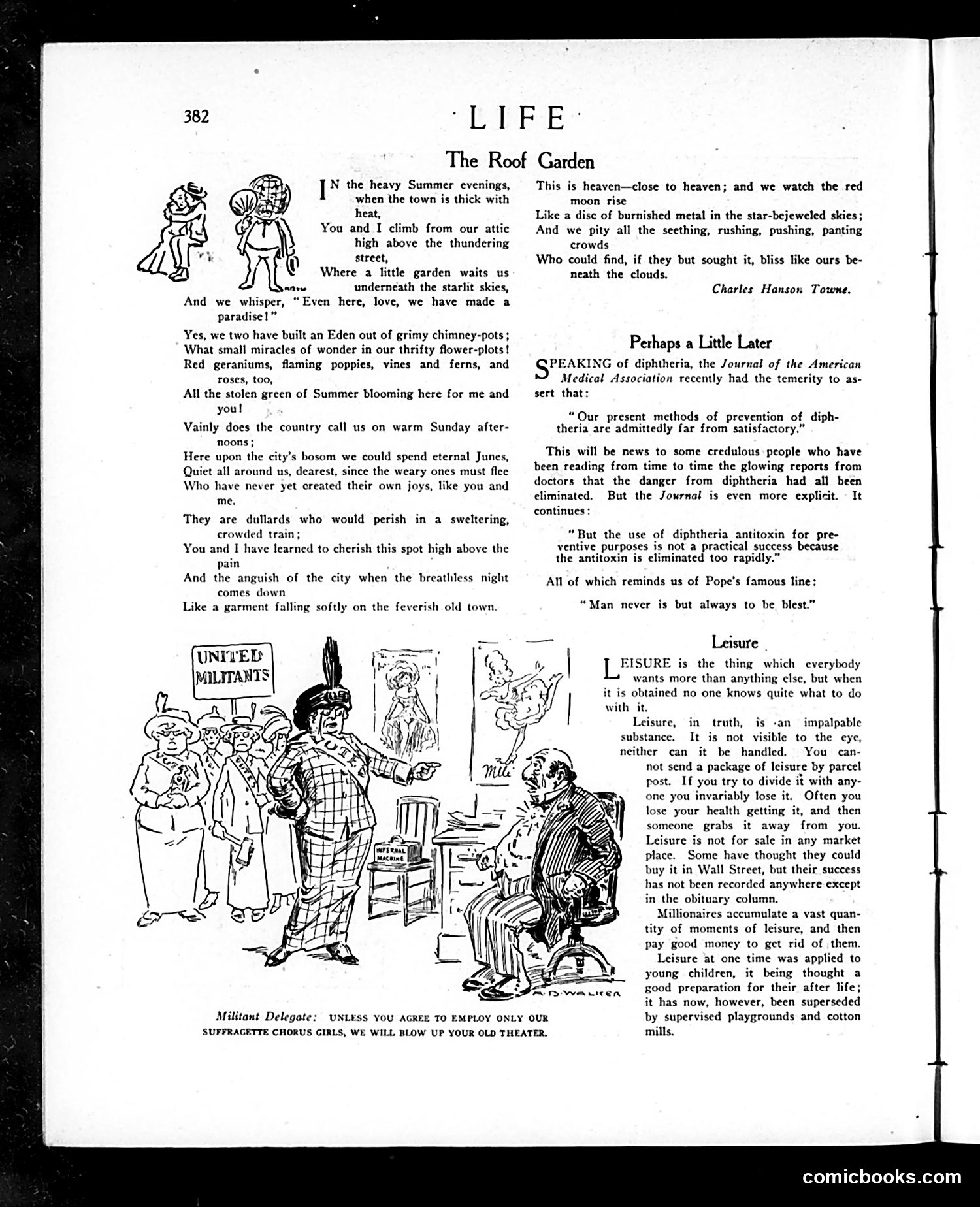
This page contains three distinct pieces: **"The Roof Garden"** (top): A romantic poem by Charles Hanson Towne celebrating urban escape—a couple finding paradise on a rooftop garden above the city's heat and crowds. **"Perhaps a Little Later"** (right column): An editorial commentary mocking medical journals' optimistic claims about eliminating diphtheria through antitoxin, quoting the American Medical Association's assertion that prevention "is not a practical success because the antitoxin is eliminated too rapidly." It's satirizing the gap between medical optimism and actual results. **"Militant Delegate" cartoon** (bottom left): Shows suffragettes threatening theater destruction unless "suffragette chorus girls" are employed. This references the women's suffrage movement and militant tactics used to pressure institutions. The cartoon satirizes their aggressive demands. **"Leisure"** (right): An essay on leisure's intangible nature and how it's become commercialized—millionaires accumulate moments then pay to escape them.
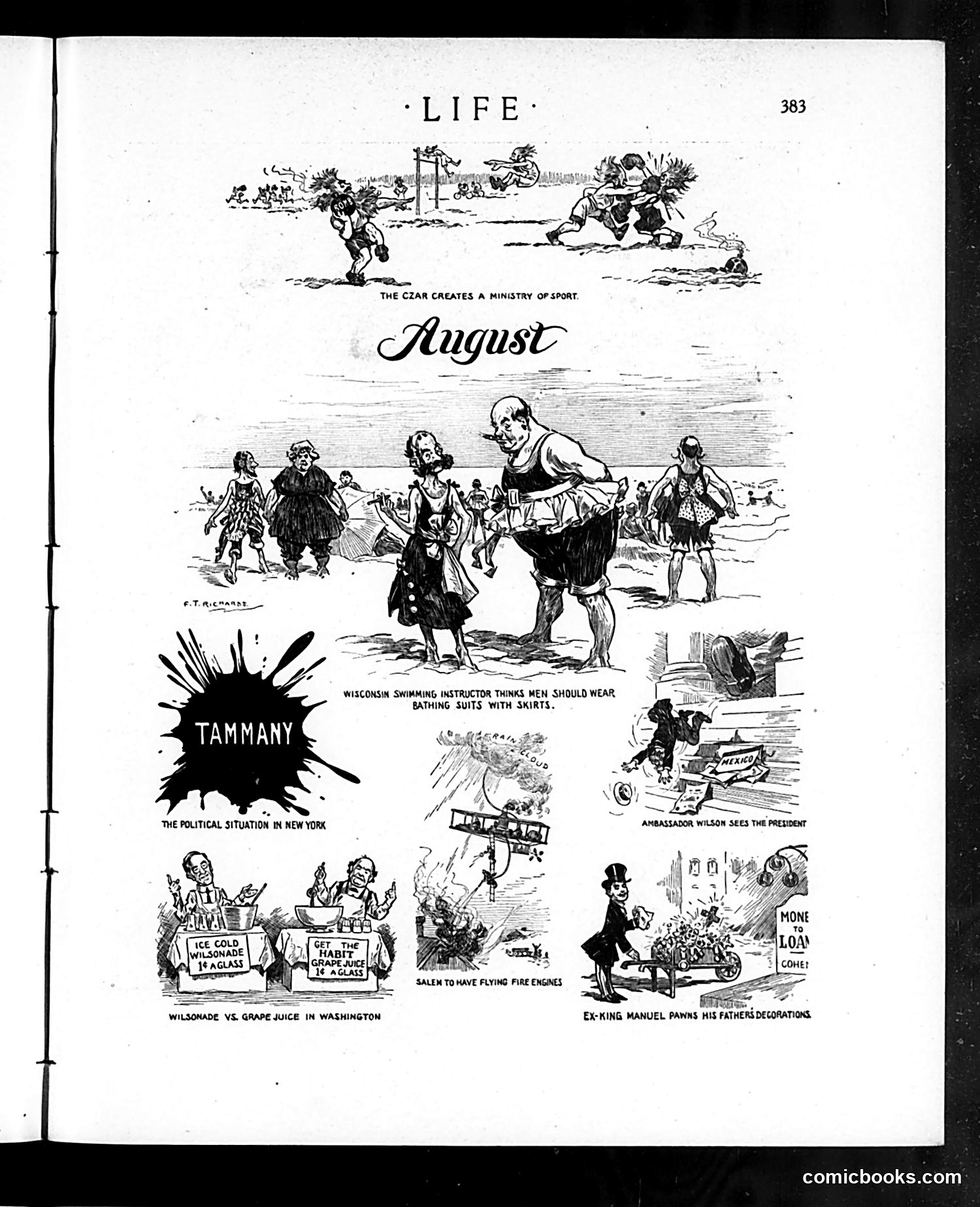
This page contains several satirical cartoons commenting on early 20th-century American politics and social issues: **Top cartoon**: "The Czar Creates a Ministry of Sport" mocks Russian autocracy through exaggerated physical activities. **Beach scene**: A Wisconsin swimming instructor's recommendation that men wear skirted bathing suits is ridiculed as absurd fashion advice. **"Wilsonade vs. Grape Juice"**: Appears to reference a political dispute in Washington, possibly about Prohibition or President Wilson's policies. **"Salem to Have Flying Fire Engines"**: Satirizes an unusual municipal innovation. **"Ex-King Manuel Pawns His Father's Decorations"**: References Manuel II of Portugal, the last Portuguese king, exiled after 1910, reduced to pawning royal medals—commentary on his diminished circumstances. The overall tone mocks political figures, social pretensions, and absurd news stories of the era.
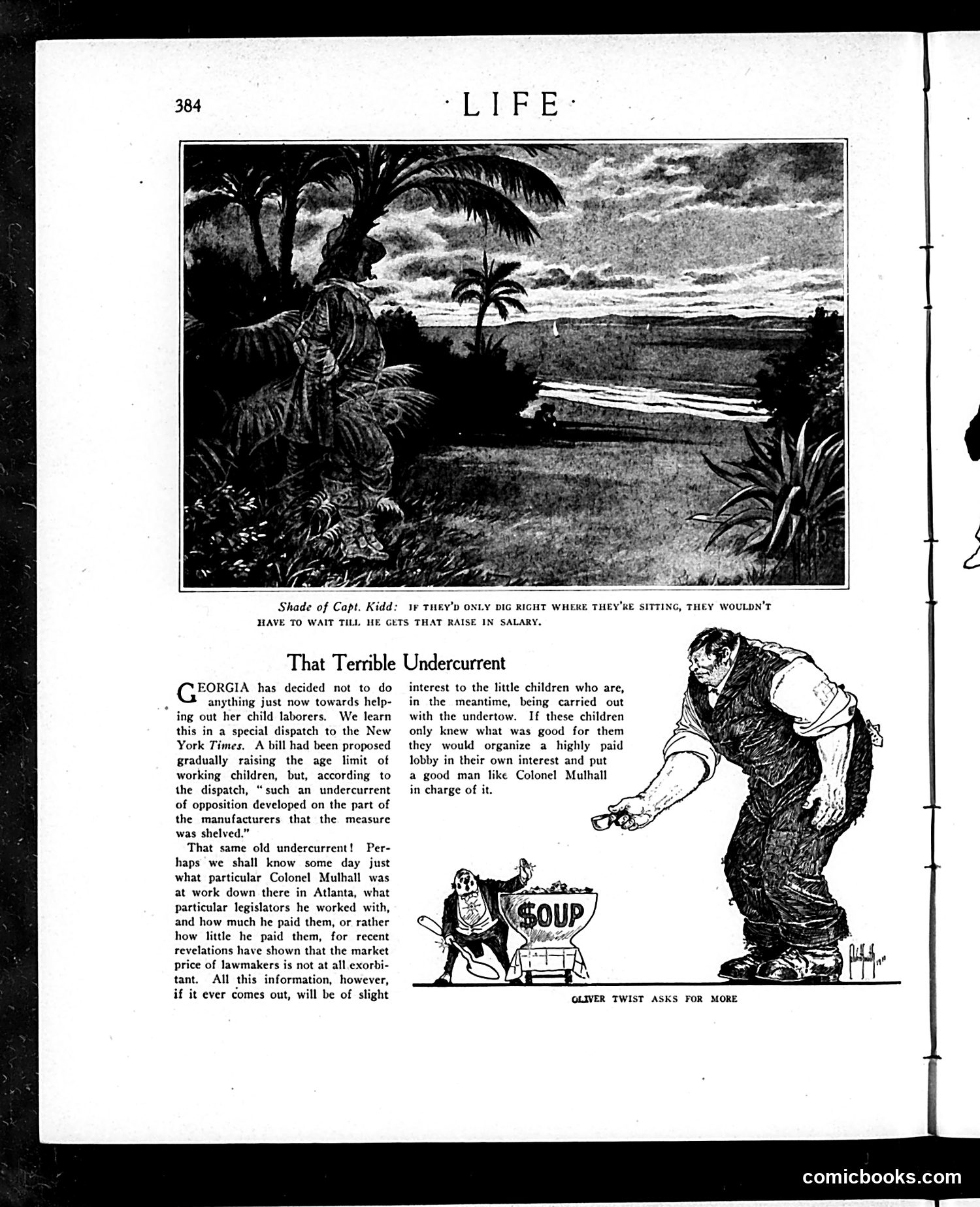
This *Life* magazine page satirizes labor exploitation and child labor. The article "That Terrible Undercurrent" discusses Georgia's decision not to immediately help child laborers. It references a proposed bill to gradually raise the working age limit, opposed by manufacturers. The cartoon "Oliver Twist Asks for More" depicts a starving child (evoking Dickens's famous orphan) requesting additional food from an overseer labeled "SOUP." This visual pun mocks the inadequacy of relief efforts for exploited children. The text hints at Colonel Mulhall's involvement in blocking child labor protections through legislative influence, though the specific details remain vague—typical of period satire exposing corporate lobbying against worker protections.
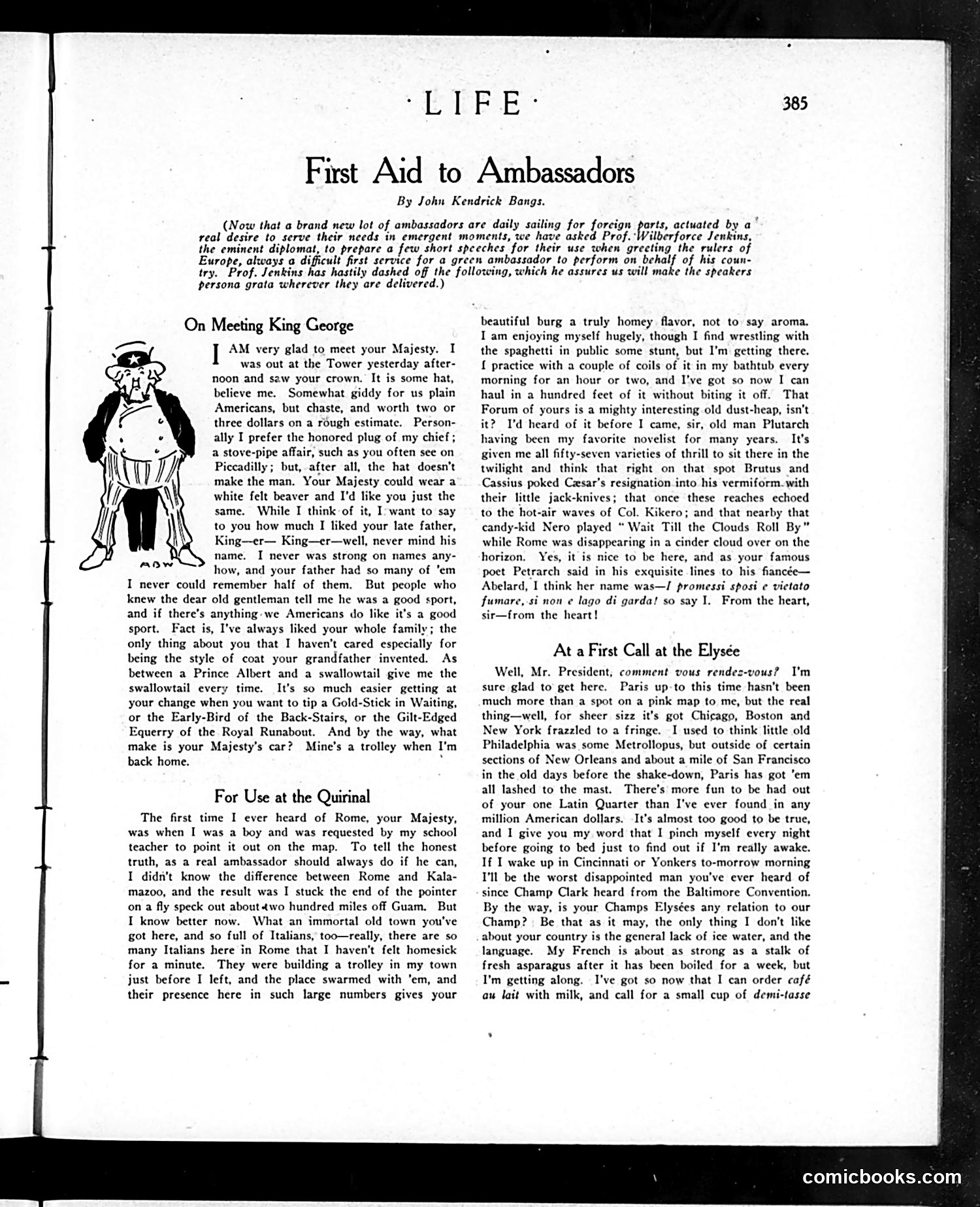
This satirical piece offers humorous advice to newly-appointed ambassadors heading to foreign posts. The cartoon shows a portly gentleman in formal dress—likely representing a typical American diplomat of the era. The text consists of three fictional scenarios offering absurd "tips": meeting King George (joking about American informality vs. British formality), navigating Roman customs at the Quirinal Palace, and attending a reception at the Élysée Palace in Paris. Each section pokes fun at American ambassadors' supposed cultural cluelessness abroad—their tendency to be overly casual, their ignorance of European customs, and their struggles with foreign languages and etiquette. The satire targets the friction between American informality and Old World diplomatic protocol during the early 20th century.
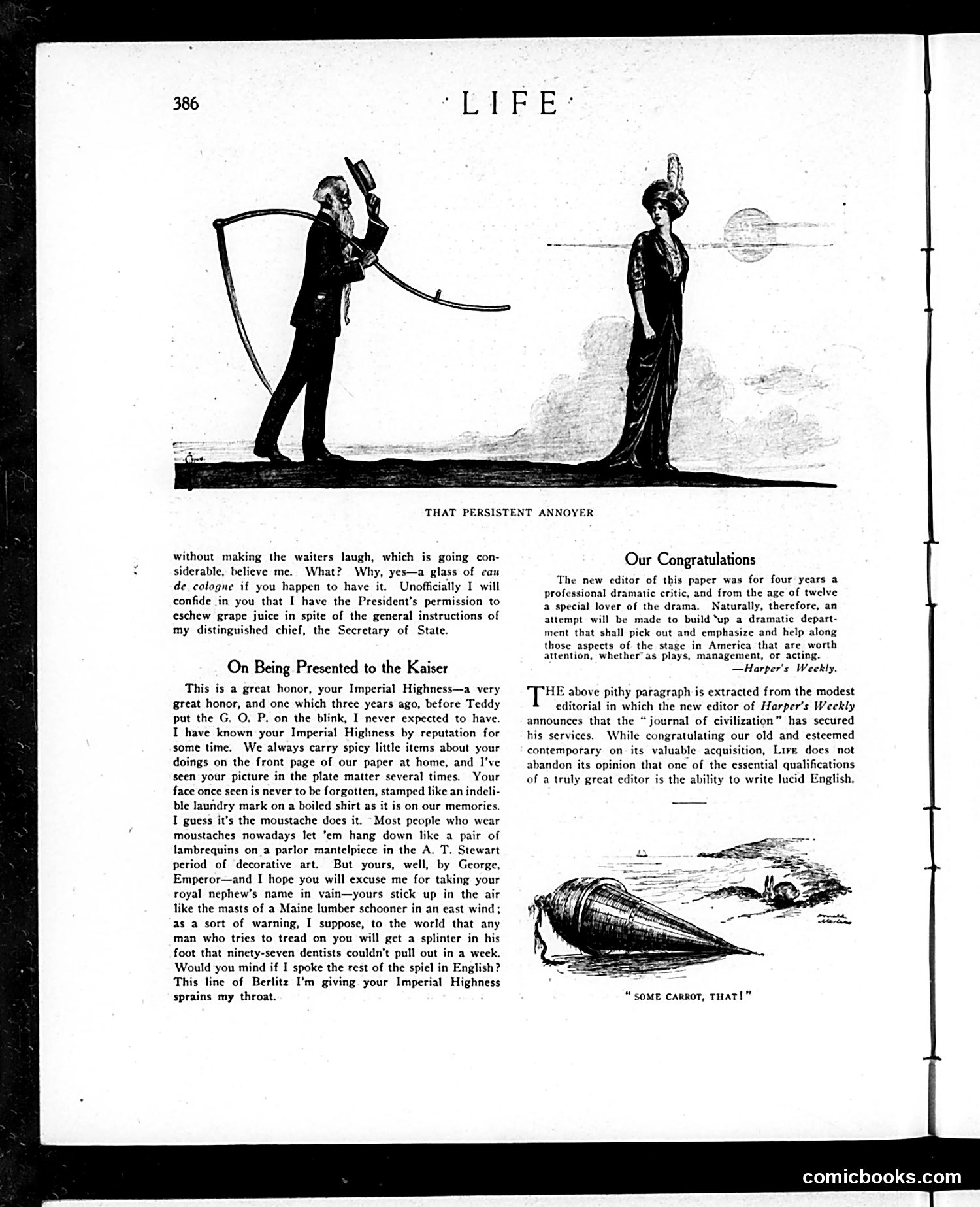
The top silhouette cartoon titled "That Persistent Annoyer" depicts a man with a curved sword or scimitar confronting a woman. The image likely satirizes unwanted romantic or social pursuit—a common Life magazine theme. The text below includes editorial commentary on a new editor for Harper's Weekly, praising his qualifications and dramatic criticism expertise. A separate section titled "On Being Presented to the Kaiser" appears to be satirical commentary on imperial protocol, referencing the German Kaiser and making humorous observations about facial features and mustaches—likely mocking Germanic formality or a specific public figure's appearance. The bottom illustration captioned "Some Carrot, That!" shows a rabbit, though its satirical meaning remains unclear from visible context.
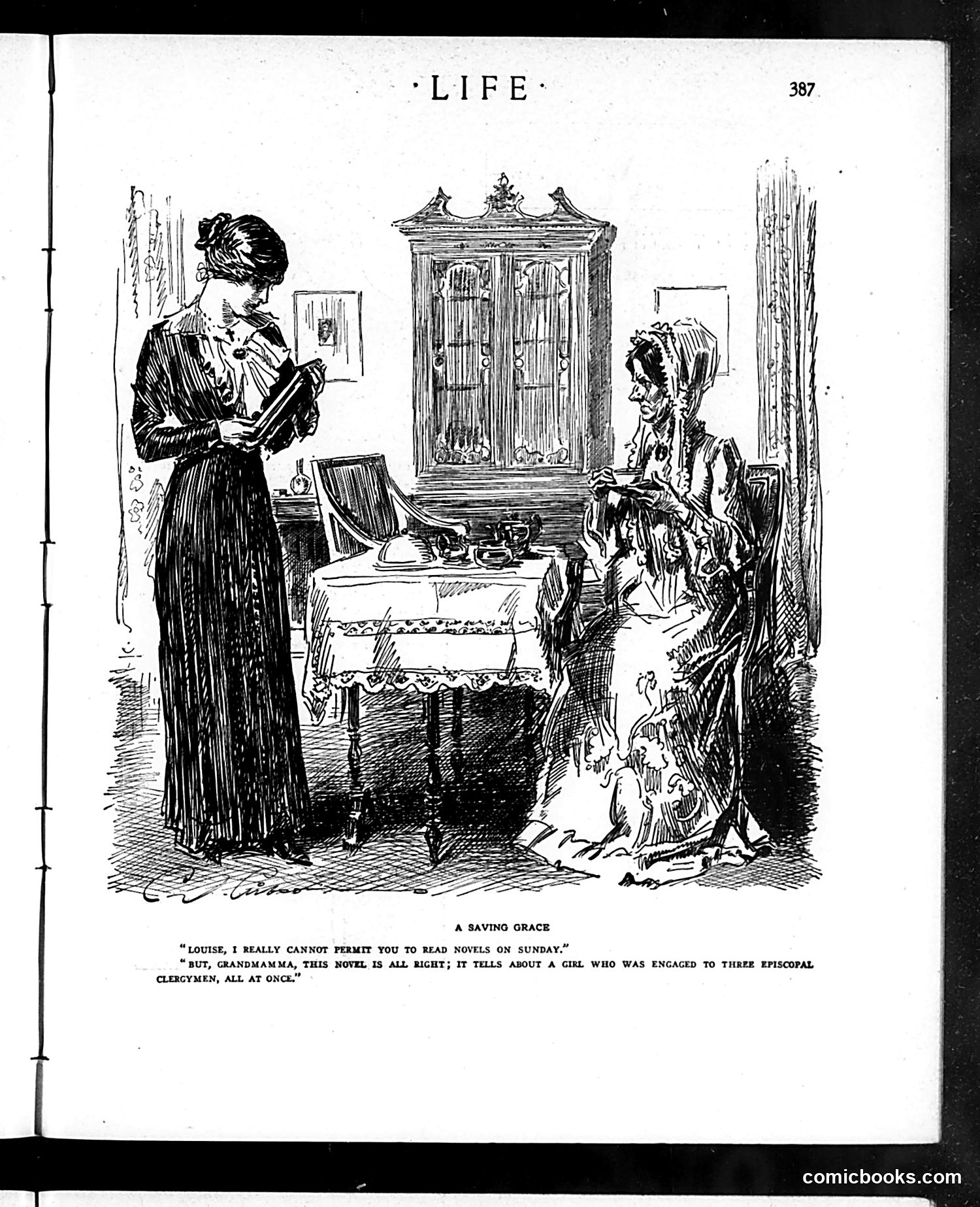
This cartoon satirizes Victorian religious hypocrisy and strict Sunday observance rules. A grandmother forbids her granddaughter Louise from reading novels on the Sabbath—considered sinful leisure. Louise's clever rejoinder claims the book is morally acceptable because its plot involves a girl engaged to three Episcopal (Protestant) clergymen simultaneously. The joke works on multiple levels: it mocks the grandmother's rigid piety while suggesting that anything involving respectable clergy somehow becomes religiously sanctioned. It also pokes fun at Episcopal clergymen as morally flexible figures. The cartoon implies that religious authority figures could justify almost any behavior, making the grandmother's moral objection absurd. The satire targets both excessive Sabbath restrictions and the perceived hypocrisy of organized religion.
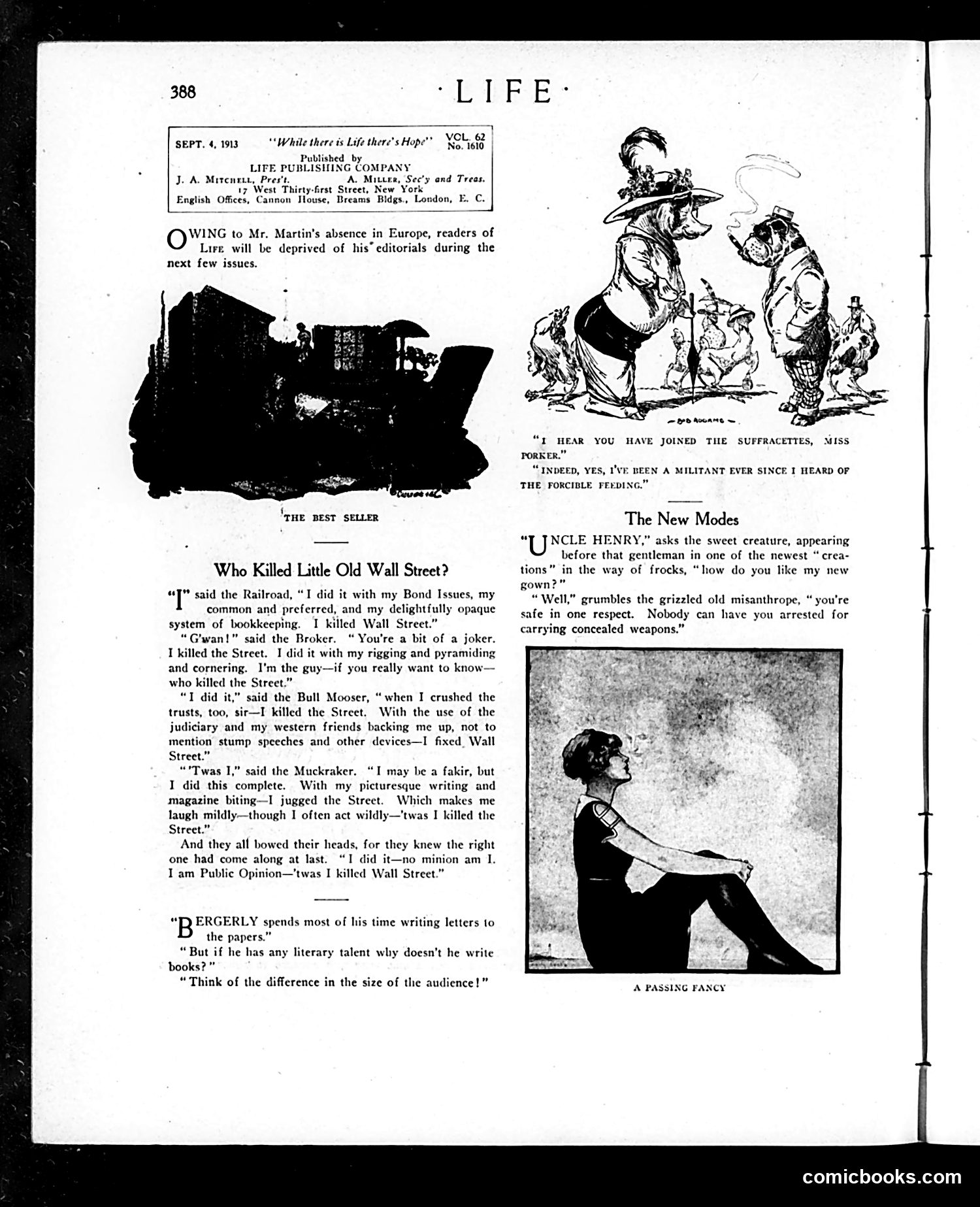
**"Who Killed Little Old Wall Street?"** is a satirical finger-pointing exercise about financial collapse. Multiple culprits claim responsibility: railroads (fraudulent bonds), brokers (market manipulation), the "Bull Mooser" (Theodore Roosevelt's trust-busting), and muckrakers (sensationalist journalism). All are silenced when "Public Opinion" arrives—the real killer. The joke: everyone blames each other, but public sentiment and loss of confidence ultimately destroyed market trust. **"The New Modes"** cartoon mocks women's suffrage activism. A woman proudly shows her fashionable new dress to "Uncle Henry," who sarcastically praises it because "nobody can have you arrested for carrying concealed weapons"—referencing suffragettes' militant tactics (arson, property destruction). The implication: militant suffragettes are so dangerous they're practically weaponized. This reflects contemporary alarm over British suffragette violence (forcible feeding is mentioned in the caption above). Both pieces employ heavy-handed satire typical of *Life*'s conservative editorial stance toward progressive reform movements.
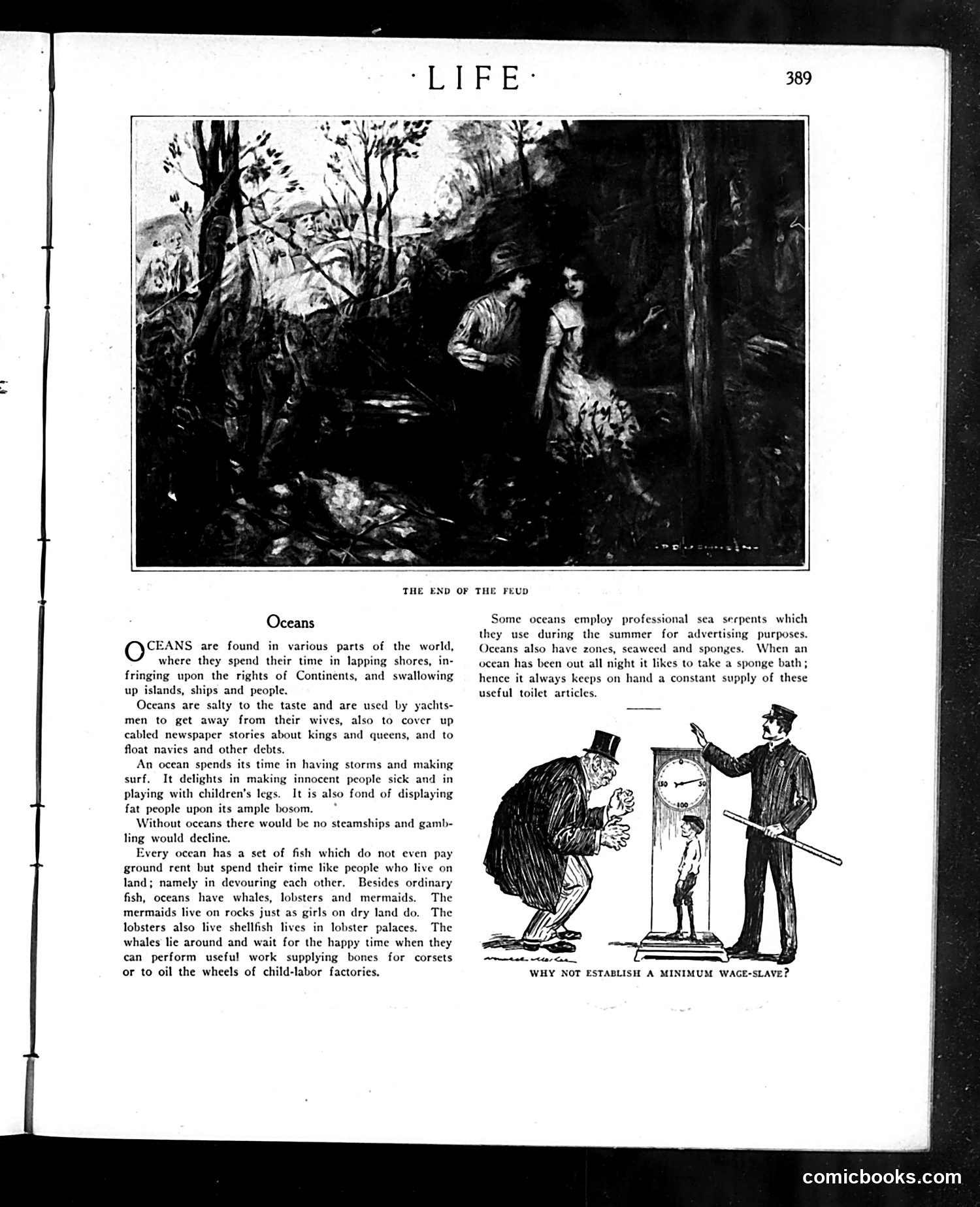
This Life magazine page contains satirical humor typical of early 20th-century American satire. The main article mockingly describes oceans and their inhabitants in absurdist terms—claiming oceans "swallow up islands," that yachtsmen use them "to get away from their wives," and that they "delight in making innocent people sick." The cartoon below, captioned "Why Not Establish a Minimum Wage-Slave?", depicts a well-dressed figure (appearing to represent wealth or authority) presenting a skeletal, malnourished person to another man, suggesting the exploitation of the desperately poor. The satire critiques labor practices where impoverished workers accept subsistence wages out of desperation—essentially becoming "slaves" to minimum compensation. The juxtaposition mocks both the absurdity of nature descriptions and real social injustice regarding workers' rights and fair wages—concerns prominent in Progressive Era America (early 1900s).
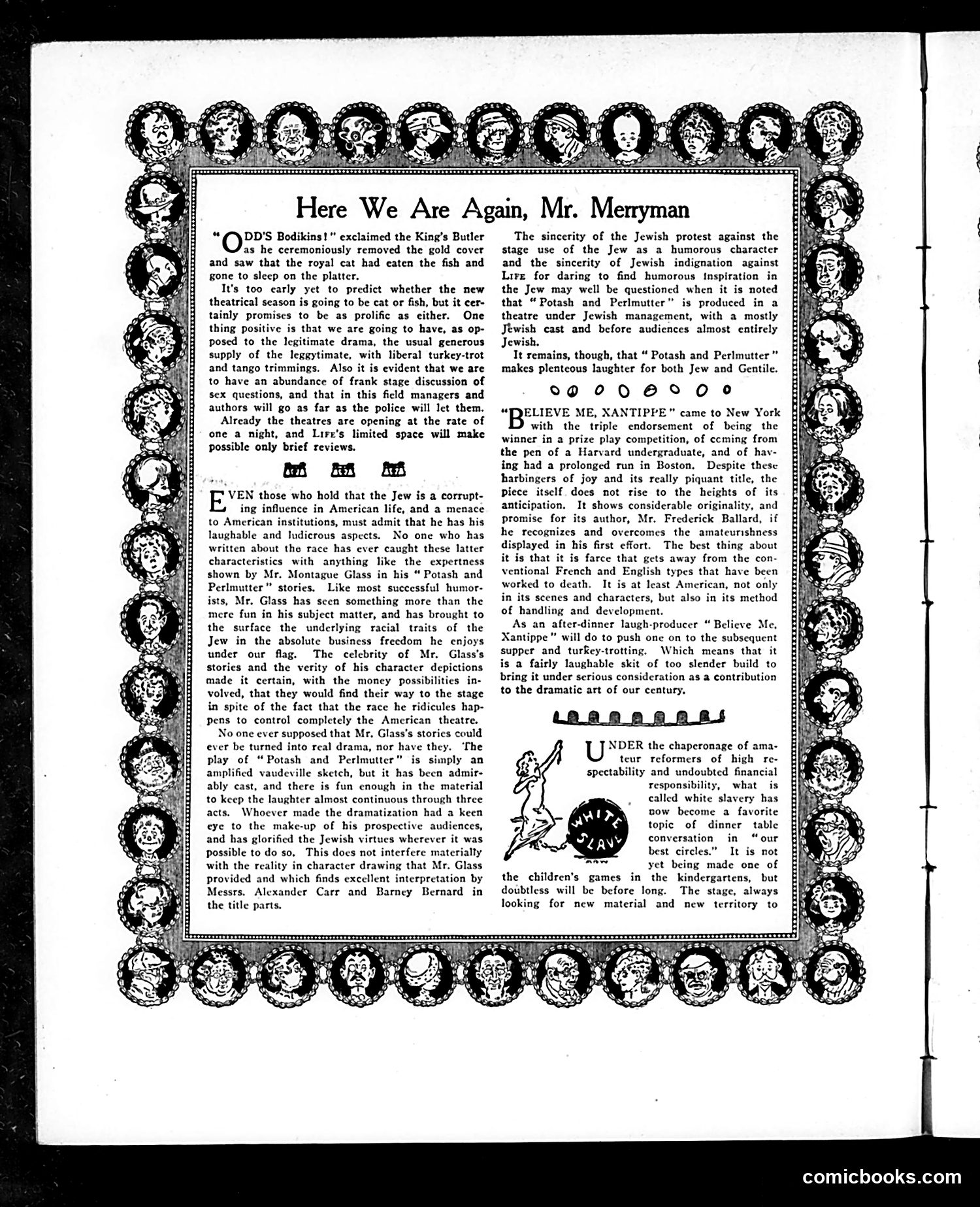
This page reviews the 1914 Broadway season, focusing on two plays: **"Potash and Perlmutter"** and **"Believe Me, Xantippe."** The main satire targets Jewish community hypocrisy. The writer notes that while some Jews criticized the stage portrayal of Jews as comedic characters, "Potash and Perlmutter"—based on Montague Glass's popular stories about Jewish businessmen—was produced by Jewish theatre owners, starred Jewish actors (Alexander Carr and Barney Bernard), and played to predominantly Jewish audiences. The piece argues this contradiction undermines their moral objections. The opening anecdote about the King's butler discovering a cat ate the fish is a theatrical device introducing the season's themes: sex, entertainment, and moral questions. The text reveals period attitudes toward ethnic humor as acceptable entertainment while also documenting Jewish community concerns about stereotyping—a tension that persisted in American theatre.
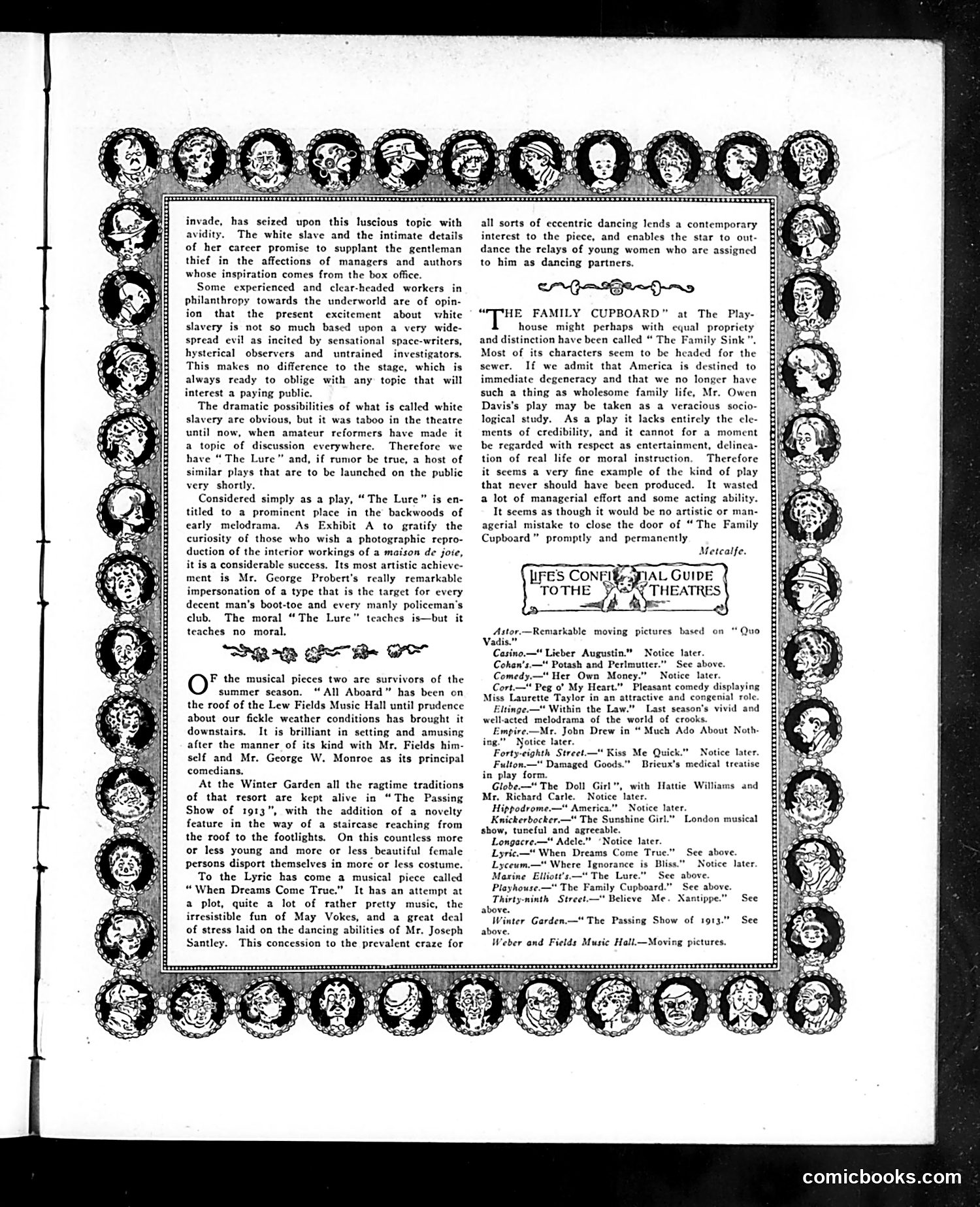
This page reviews several Broadway productions from circa 1913. The main critique concerns "The Lure," a melodrama capitalizing on the contemporary "white slavery" panic. The reviewer argues that sensationalist journalists and reformers have inflated concern over this social problem to boost theatrical attendance, yet the play itself—while technically impressive in depicting a brothel ("maison de joie")—teaches no moral lesson beyond condemning its villain. The page also reviews musical comedies at various theaters: "All Aboard" (featuring Lew Fields), "The Passing Show of 1913" (notable for a novelty staircase and chorus girls), and "When Dreams Come True" (showcasing dancer Joseph Santley). "The Family Cupboard" receives harsh criticism as morally bankrupt entertainment—the reviewer sarcastically suggests it should be retitled "The Family Sink" and argues it's artistically indefensible whether viewed as sociology, entertainment, or moral instruction. The implied satire: theater managers exploit whatever sensational social issues will fill seats, regardless of artistic merit.
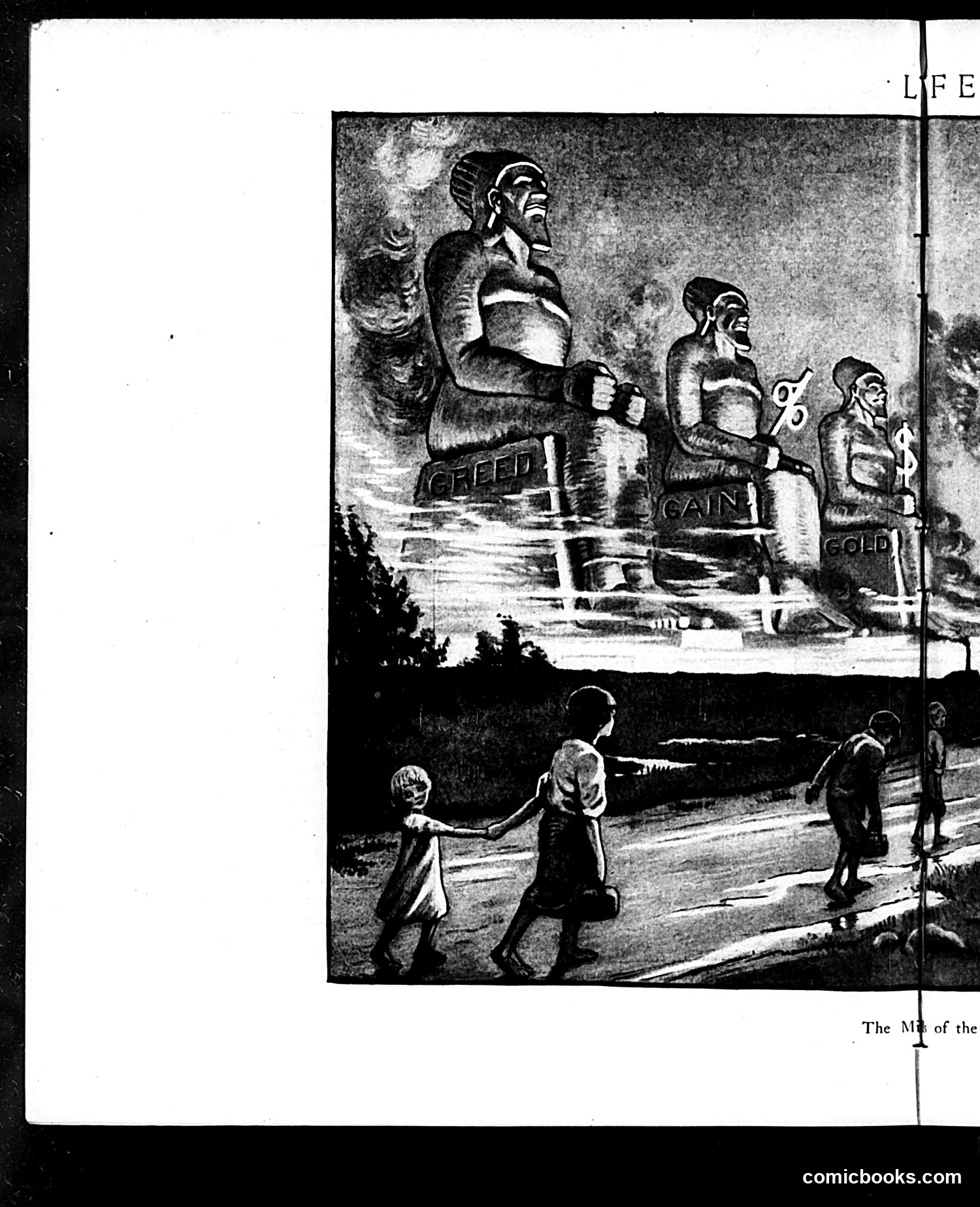
This Life magazine cartoon depicts three large, menacing figures labeled "GREED," "GAIN," and "GOLD" towering over a group of children on a street below. The composition suggests these represent abstract vices or corrupting forces looming over vulnerable youth. The satire appears to critique how greed, materialism, and acquisitiveness pose dangers to children—likely commentary on commercialism, exploitation of minors, or societal moral decay. The stark contrast between the massive, shadowy adult figures and the small children emphasizes the power imbalance and the theme of innocence threatened by corruption. The exact historical moment is unclear from visible text, but this reflects early-to-mid 20th century concerns about protecting children from moral and commercial hazards.
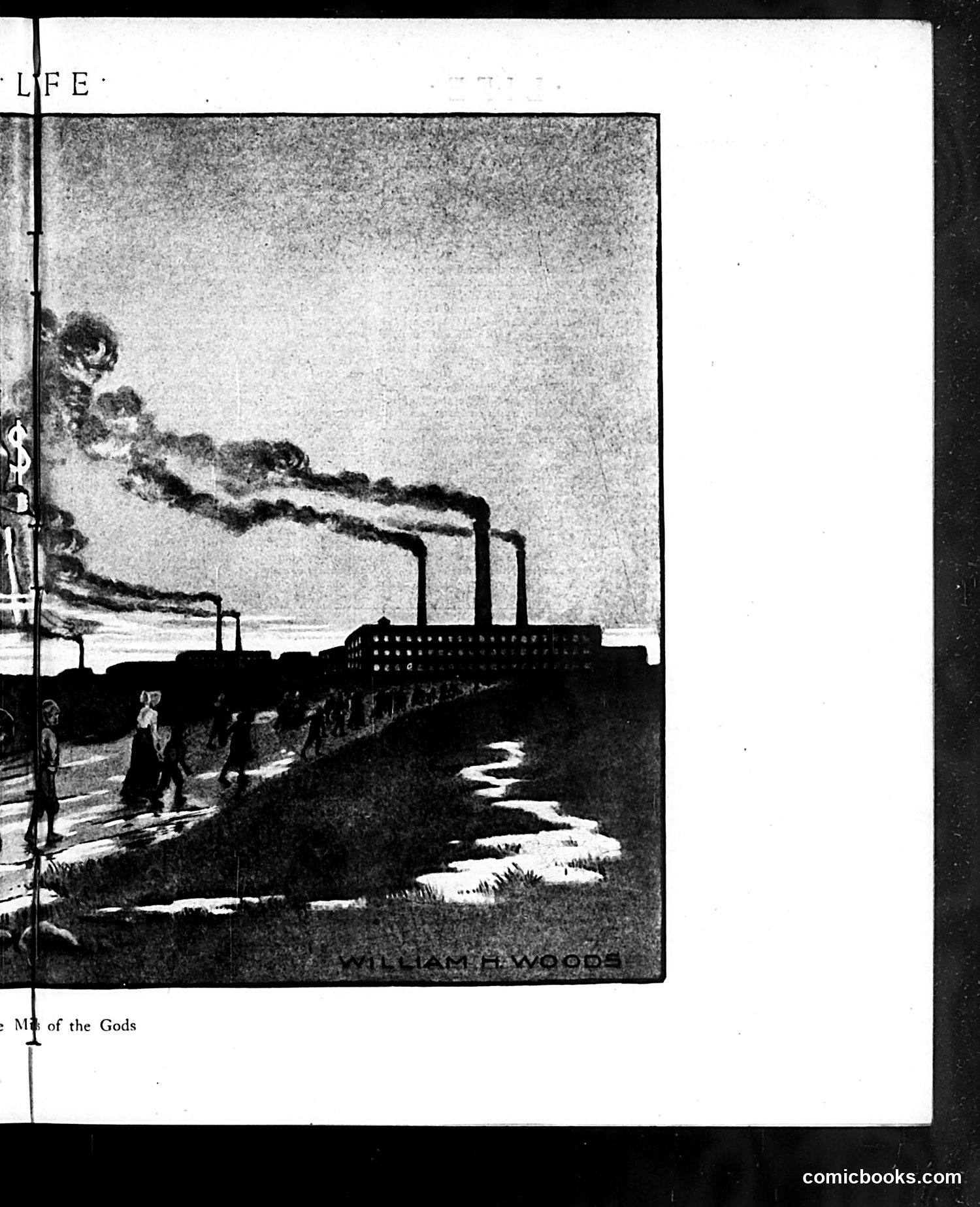
This William H. Woods illustration from *Life* magazine depicts an industrial factory with smoking smokestacks alongside a pastoral landscape with a winding stream. Several figures stand in the foreground observing the scene. The title "Mill of the Gods" suggests ironic commentary on industrial progress—the factory as a quasi-divine force reshaping the natural world. The contrast between the polluted industrial structure and the rural environment likely critiques the environmental costs of industrialization, or perhaps comments on how industrial capitalism is treated as inevitable and god-like by society. The figures' presence suggests they are witnessing this transformation, possibly representing the public's passive acceptance of industrial expansion and its environmental consequences. This reflects early 20th-century anxieties about unchecked industrial growth.
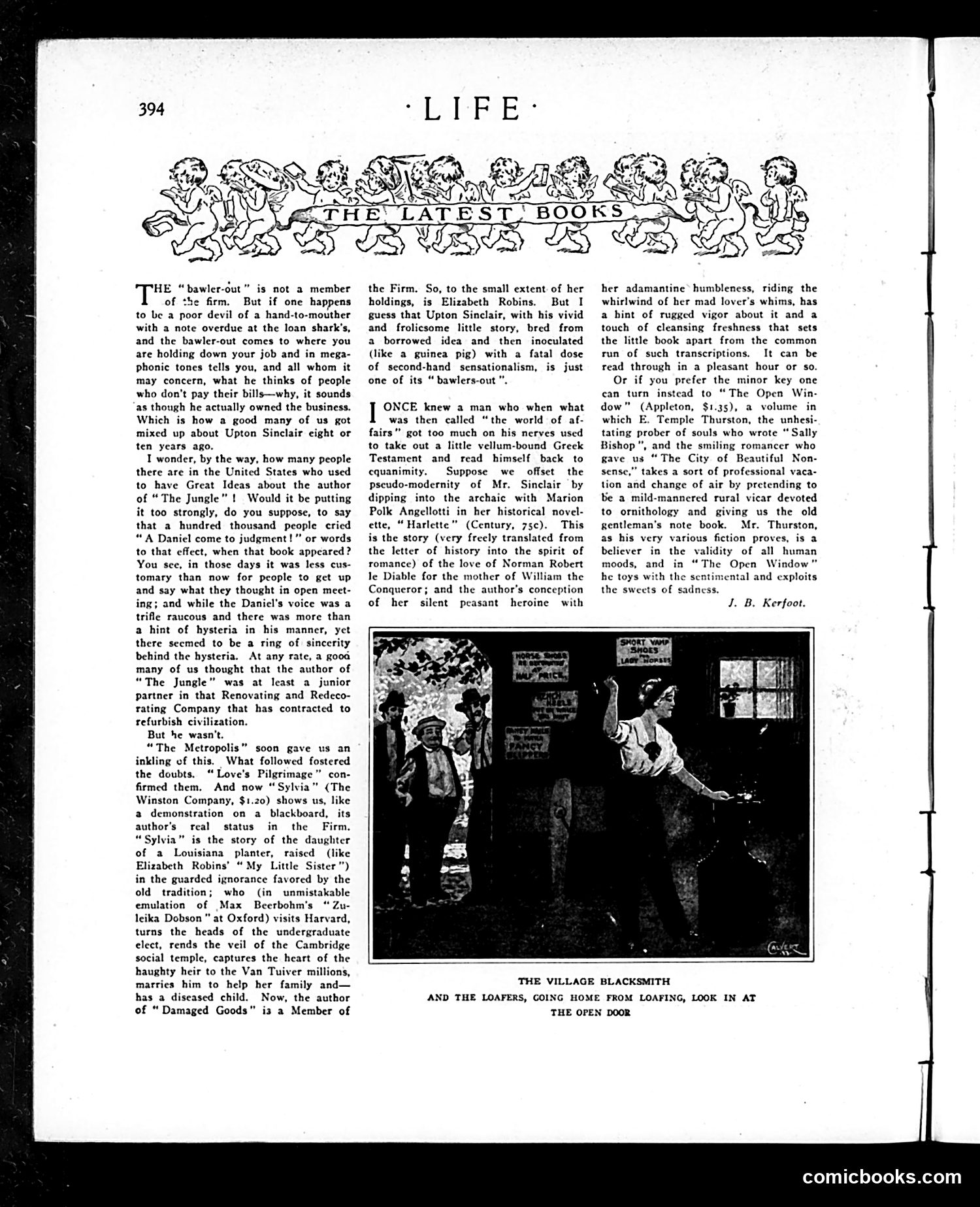
This page reviews three novels while critiquing author **Upton Sinclair**, famous for his muckraking novel *The Jungle* (1906). The unnamed author uses the metaphor of a "bawler-out"—a loud debt collector with no actual ownership—to describe Sinclair's role in social reform. The critique argues that Sinclair initially seemed a genuine reformer ("a Daniel come to judgment"), but subsequent works (*The Metropolis*, *Love's Pilgrimage*, and now *Sylvia*) revealed him as merely sensationalizing, not substantively contributing to civilization's "Renovating and Redecorating Company." His new novel *Sylvia*, borrowed from other sources and "inoculated" with "second-hand sensationalism," marks him as a mere "bawler-out"—all noise without real authority or depth. The illustration shows "The Village Blacksmith," seemingly unrelated or serving as visual relief from the literary criticism.
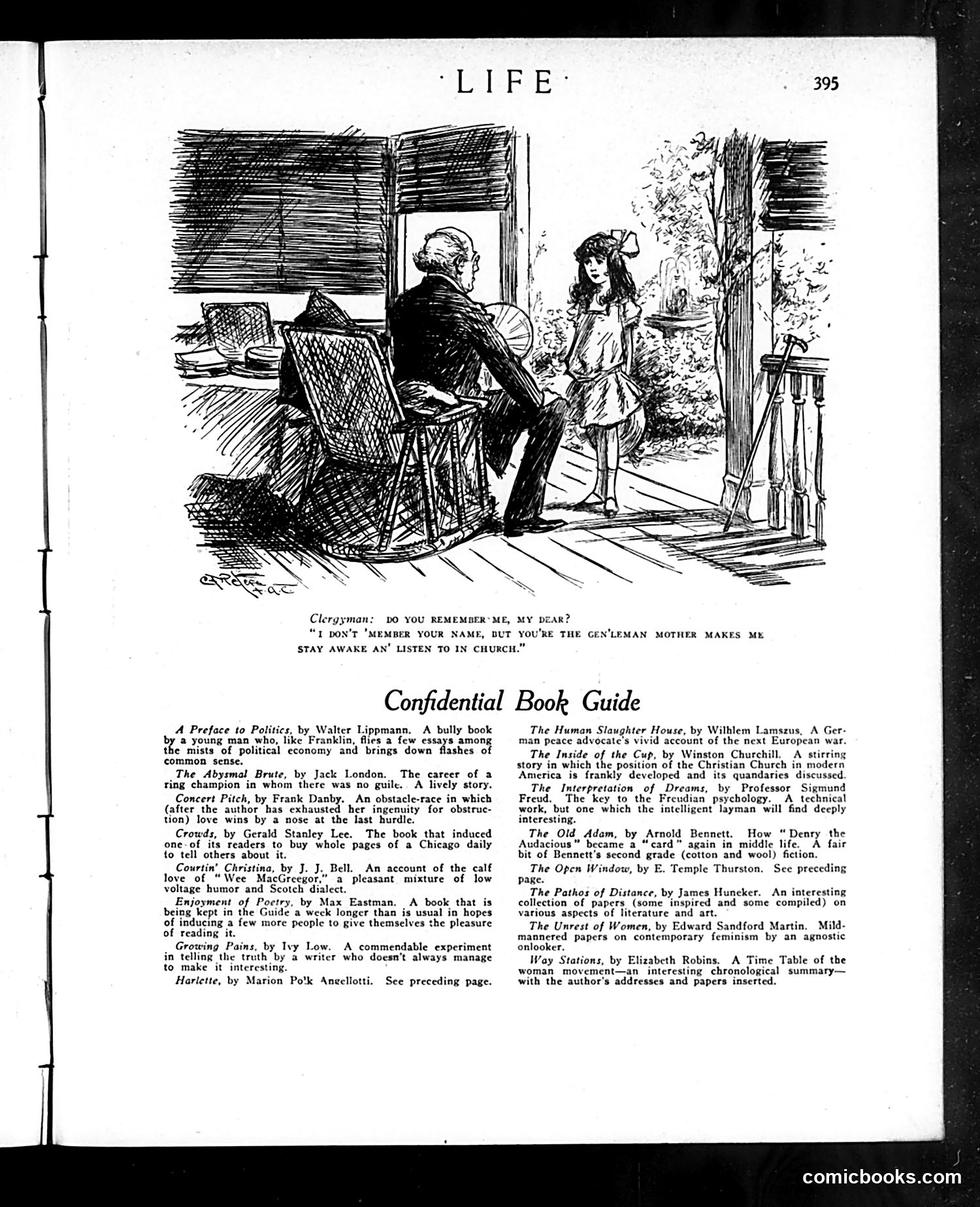
The cartoon depicts a clergyman encountering a child who fails to recognize him by name. The child's response is a gentle jab at sermon-giving: the boy only knows the clergyman as "the gentleman mother makes me stay awake and listen to in church." The humor lies in the implied criticism of clergy sermons as tedious and forgettable—so dull that a child remembers the speaker's *function* (something endured out of obligation) rather than his identity or message. It's a satirical comment on the perceived ineffectiveness or dullness of church oratory in early 20th-century America. The page is primarily a "Confidential Book Guide"—brief reviews of contemporary publications, likely intended to humorously guide readers toward worthwhile reads while dismissing mediocre ones.
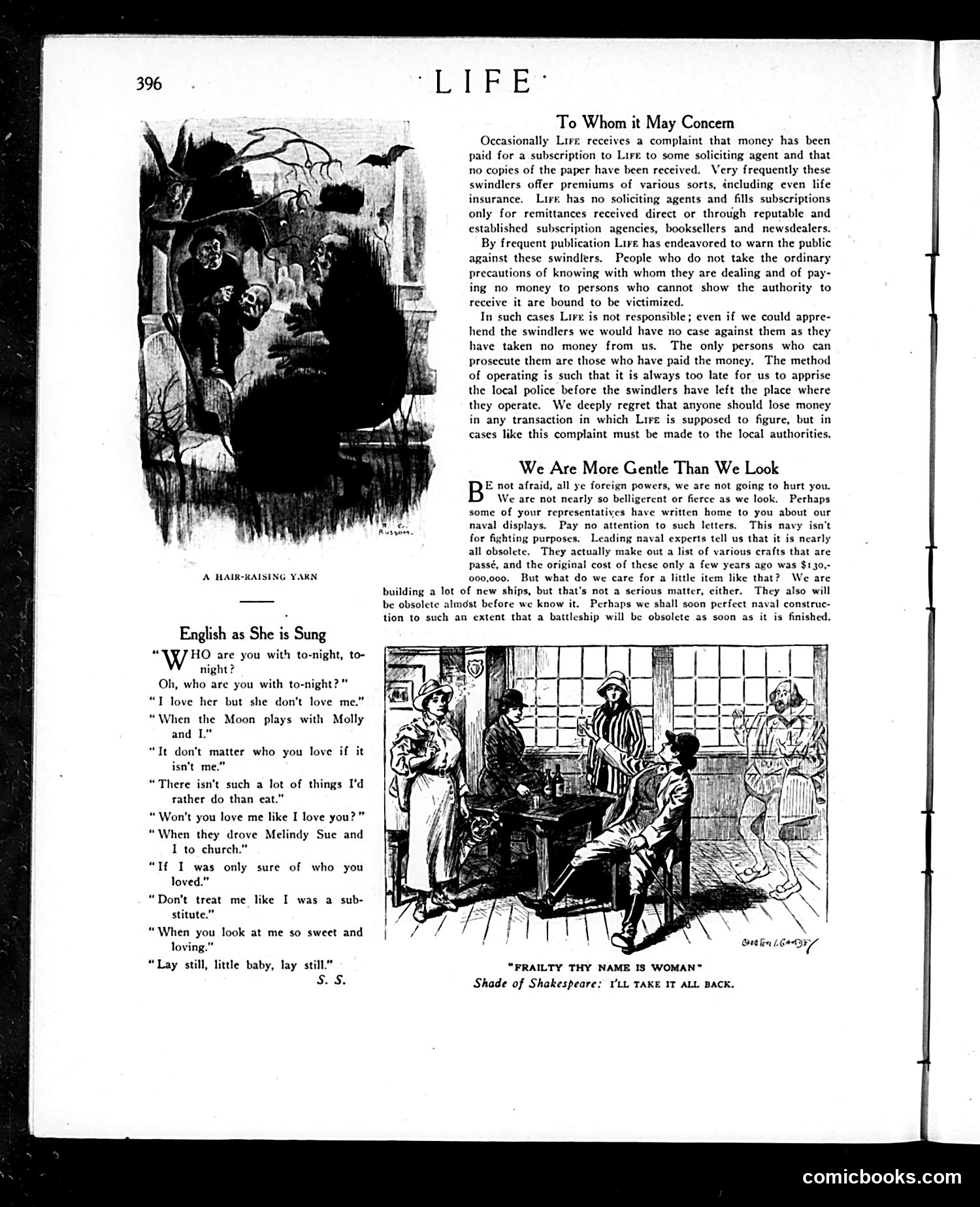
This page contains three distinct sections: **"To Whom it May Concern"** warns readers against subscription scams—fraudsters posing as Life magazine agents who collect payment but never deliver papers, sometimes offering fake premiums like life insurance. Life disclaims responsibility, noting their legitimate channels (direct mail, established agencies, booksellers) and advising readers to report fraud to local authorities. **"We Are More Gentle Than We Look"** is satirical commentary on American naval power. The piece ironically claims the U.S. Navy isn't threatening despite its size, then undercuts this by noting that warships become obsolete within years—suggesting rapid, continuous military expansion. The tone mocks both American military buildup and nervous foreign governments. **"English as She is Sung"** collects awkward, grammatically flawed song lyrics, likely from popular songs of the era. The humor derives from mangled English and sentimental clichés. The final cartoon illustration captioned "FRAILTY THY NAME IS WOMAN" (Shakespeare reference) shows a domestic scene, with the note "I'LL TAKE IT ALL BACK"—suggesting male capitulation in romantic disputes.
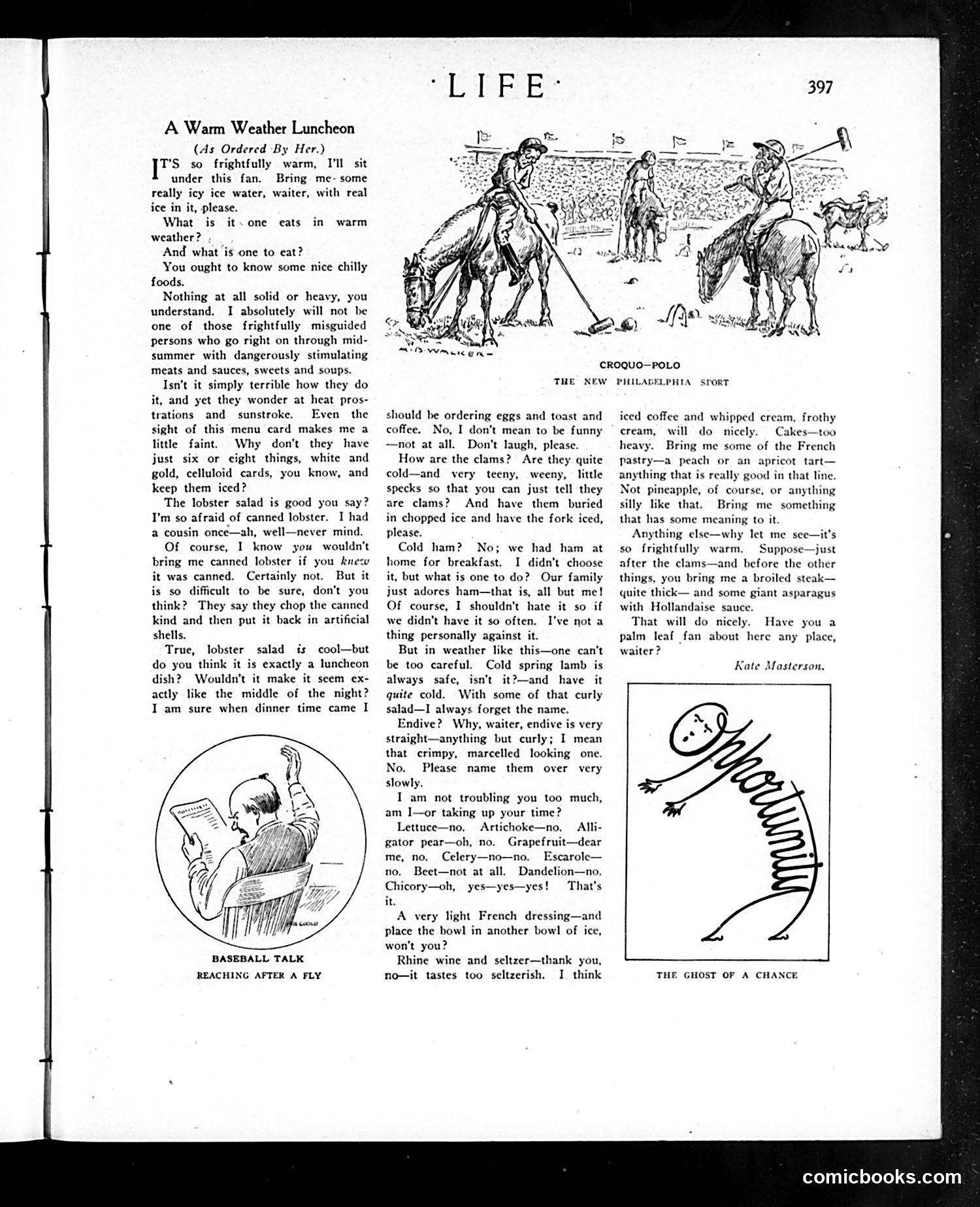
This satirical piece mocks the affectations and contradictions of wealthy women during summer dining. A fastidious female diner delivers an impossibly elaborate series of demands to her waiter, all framed as wanting light, cooling food due to the heat—yet she orders ice water, clams, cold ham, spring lamb with salad, asparagus with Hollandaise sauce, and a broiled steak. The satire targets her pretentious anxiety (refusing canned lobster due to a vague family tragedy), her indecisiveness (rejecting nearly every vegetable option), and her obsession with theatrical presentation (everything must be iced, served in specific bowls). The character represents the upper-class woman performing delicate sensibility while actually demanding extravagant, contradictory meals. The humor lies in exposing how her stated principles (avoiding heavy foods) conflict entirely with her actual behavior.
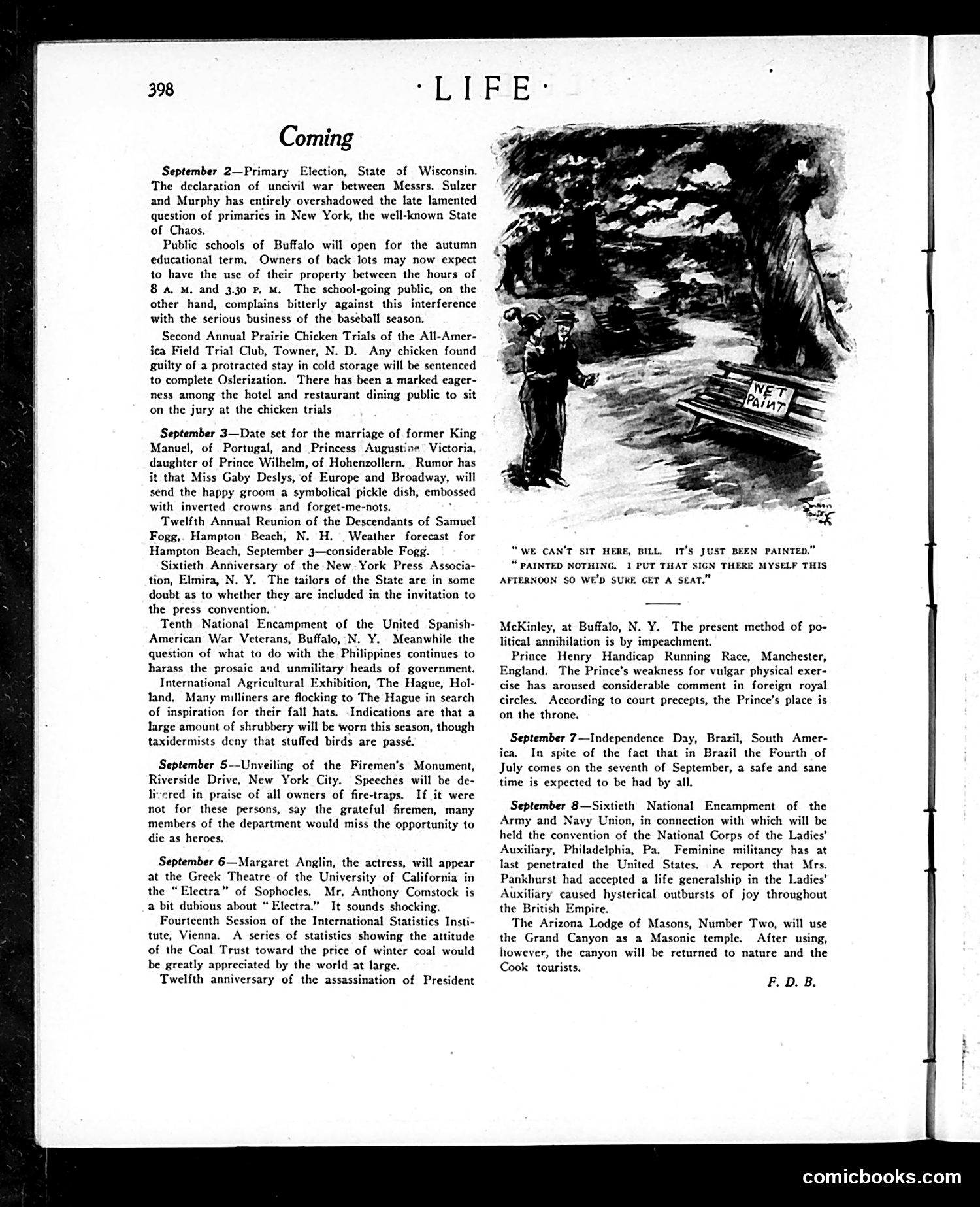
This page from *Life* magazine is a "Coming" events calendar with satirical commentary on upcoming happenings (September 2-8, undated but early 1900s based on references). The cartoon depicts two men on a bench marked "WET PAINT." One says they can't sit there because it's freshly painted; the other reveals he placed the sign himself that afternoon to reserve the seat. This is straightforward humor about resourcefulness and self-interest—using a "wet paint" warning as a crowd-control device. The text below comments on political annihilation occurring via impeachment (likely referencing New York governor Sulzer, mentioned earlier). Other items mock various events: prairie chicken trials, a Portuguese king's remarriage, a firemen's monument unveiling (sardonically praising fire-trap owners), and an actress performing *Electra* (which conservative Anthony Comstock finds shocking). The humor is light, punchy satire typical of *Life*'s style—observational comedy about contemporary events, society figures, and political absurdities.
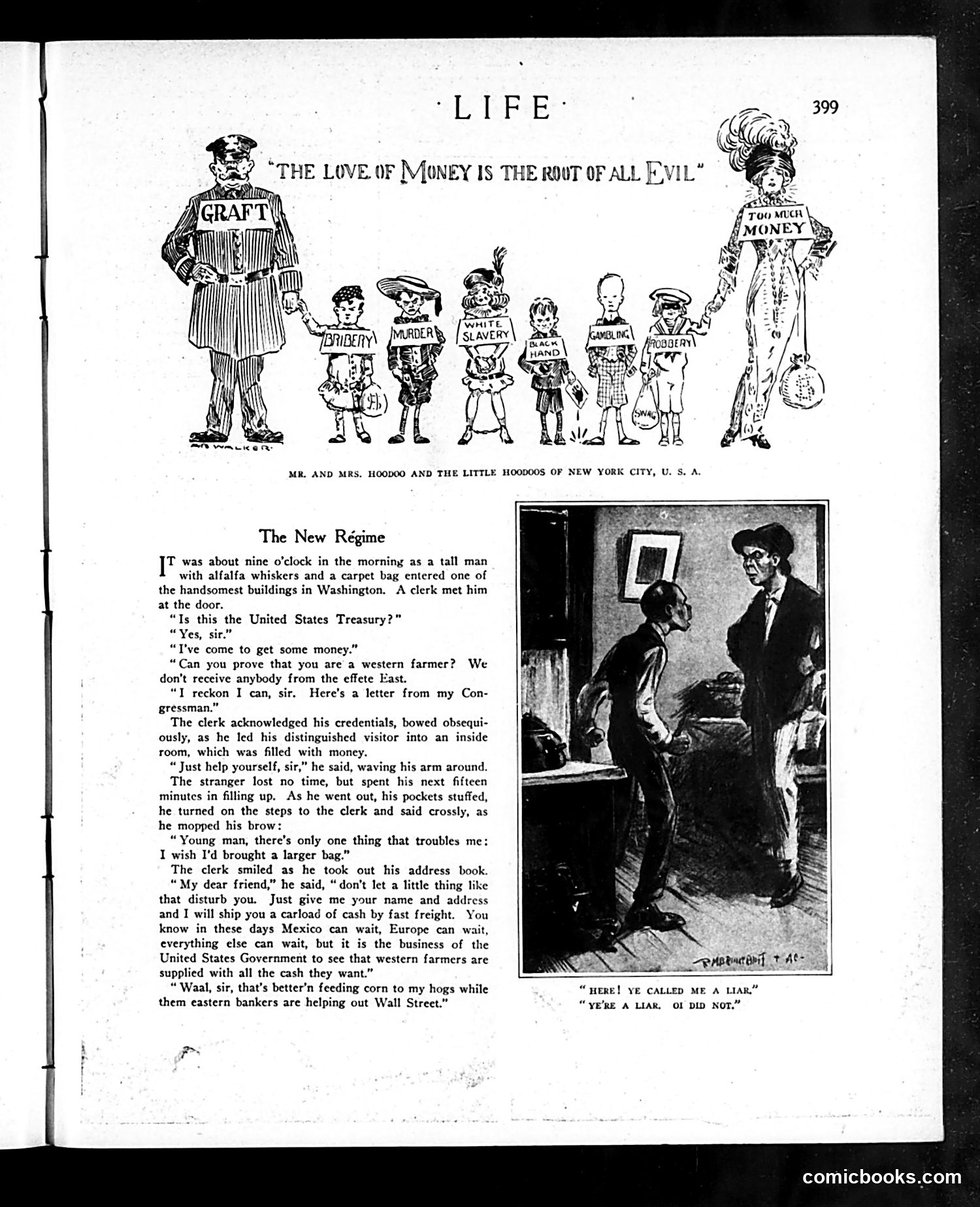
This Life magazine page satirizes what appears to be early 20th-century populist politics and the perceived favoritism toward western farmers. **The Main Cartoon:** "The New Régime" mocks a hypothetical scenario where the U.S. Treasury prioritizes western farmers over eastern interests. A farmer with "alfalfa whiskers" and a carpet bag enters the Treasury and is given unlimited cash—simply by producing a congressman's letter—while the clerk dismisses requests from Mexico and Europe as less important than "supplying western farmers." **The Satire's Point:** The piece ridicules the political power of agrarian populism and rural constituencies, suggesting the government now treats farmer requests as entitlements while neglecting international obligations and eastern financial interests (Wall Street). **The Top Cartoon:** Shows allegorical figures labeled "GRAFT" and "TOO MUCH MONEY" presiding over smaller vices (bribery, murder, white slavery, etc.), illustrating the epigraph: "The Love of Money is the Root of All Evil." **The Photograph:** Appears to show a confrontation, captioned with a dispute over being called a liar—likely commenting on political dishonesty.
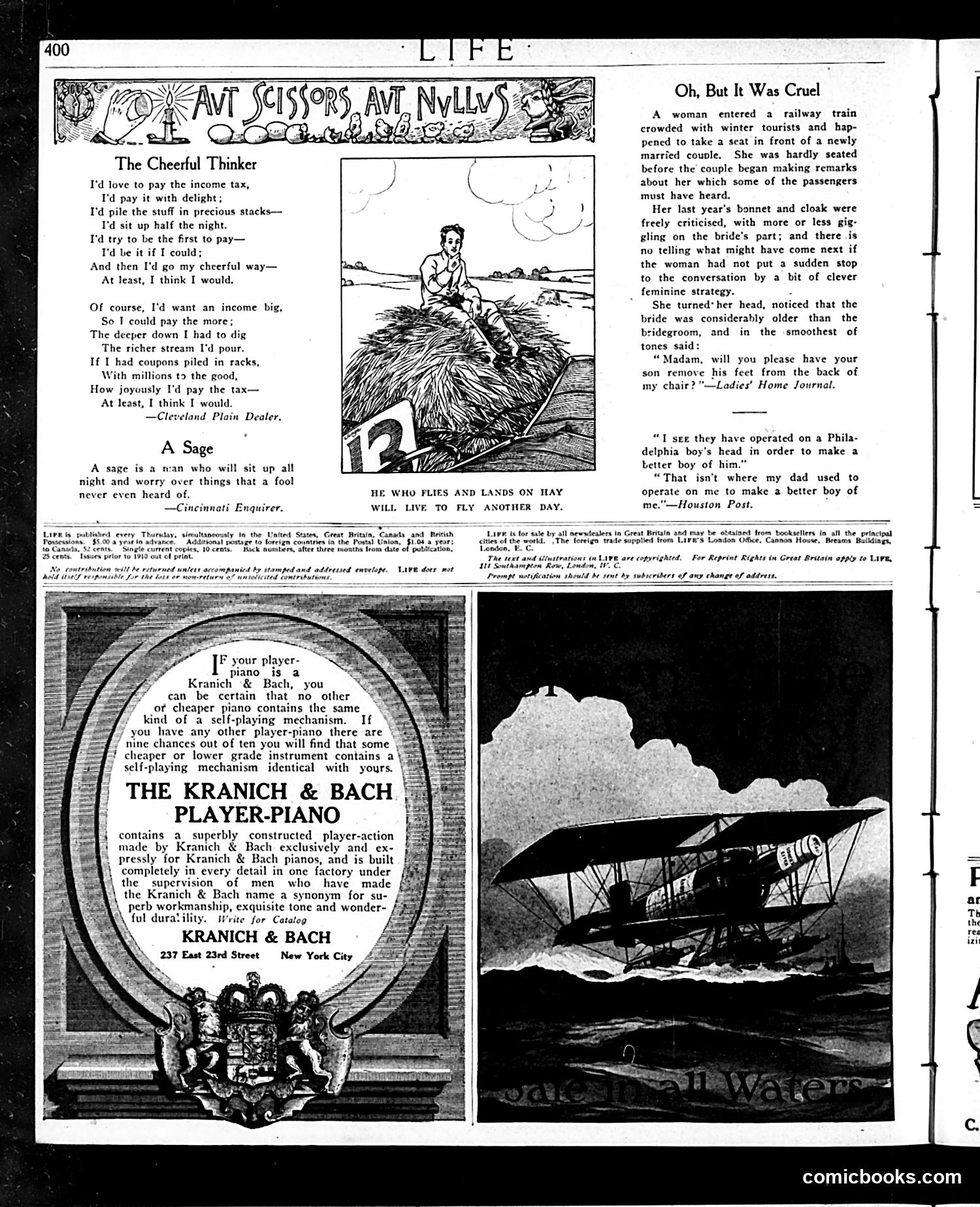
This page from *Life* magazine contains several short humorous pieces typical of early 20th-century American satire: **"The Cheerful Thinker"** (Cleveland Plain Dealer) ironically presents someone claiming they'd *love* to pay income tax—a joke about the recently instituted federal income tax, which was deeply unpopular. The humor lies in the obvious contradiction: the speaker's enthusiasm is transparently false. **"A Sage"** offers a brief philosophical quip distinguishing wise people from foolish ones. **"Oh, But It Was Cruel"** describes a woman on a train being mocked by a newlywed couple for her outdated clothing. She responds by sarcastically calling the groom "son," implying the bride is much older—a clever insult delivered as a social "gotcha." The remaining anecdotes mock medical intervention ("operating on a Philadelphia boy's head") and parental discipline. **The Kranich & Bach advertisement** promotes player-pianos, emphasizing their superior self-playing mechanism. The central illustration appears unrelated to specific text—likely decorative filler typical of magazine layouts of this era.
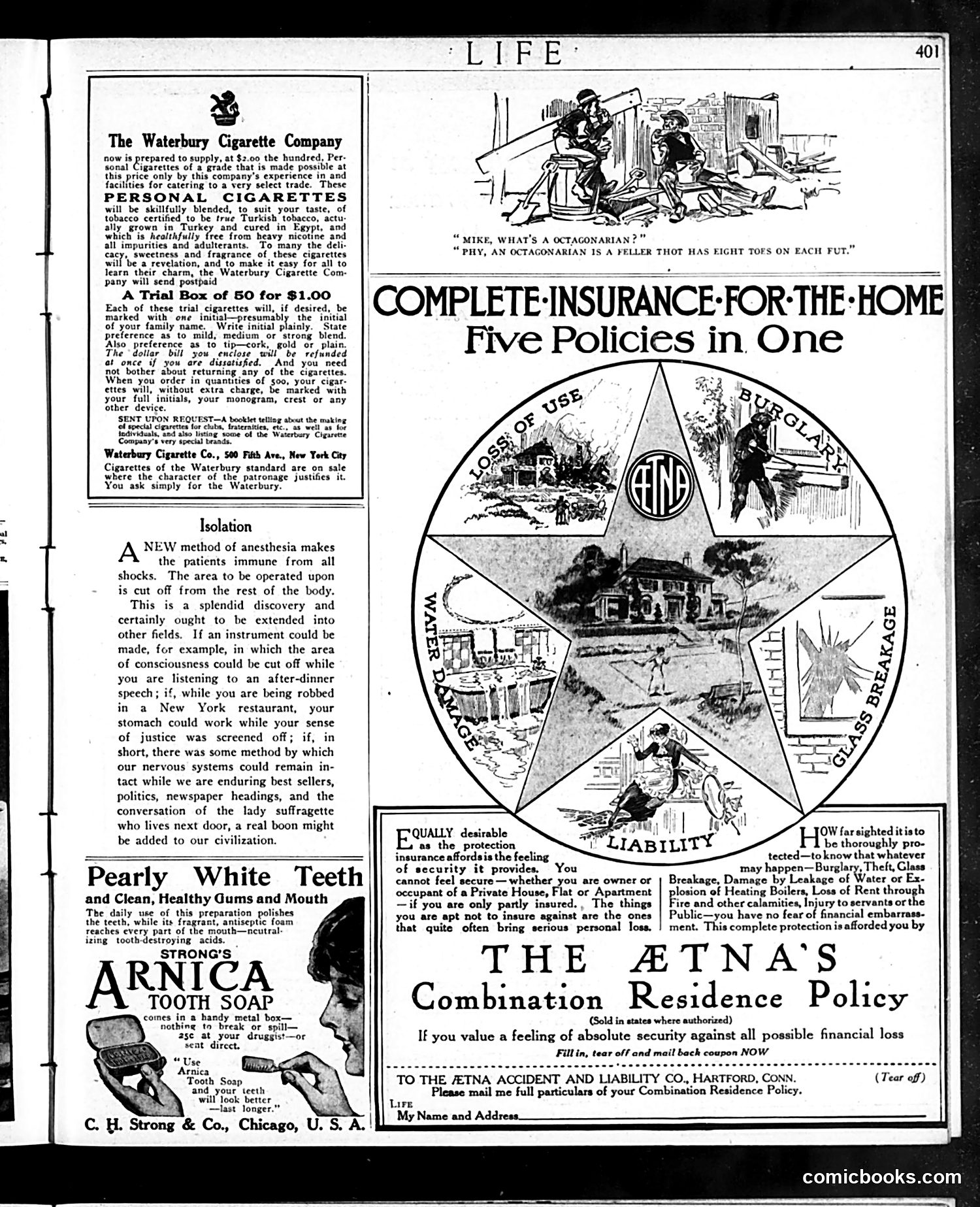
This page is primarily **advertising** from a 1910s-era *Life* magazine. The main elements are: **Advertisements:** - Waterbury Cigarettes (personalized, Turkish tobacco, $2/hundred) - Strong's Arnica Tooth Soap - Aetna Insurance "Combination Residence Policy" **Satirical Content:** A brief joke cartoon shows two men discussing an "octagonarian"—one defines it as "a feller that has eight toes on each foot," playing on the prefix "octo-" (eight) and misapplying it to body parts rather than age. The humor is simple wordplay. **Editorial Essay:** "Isolation" satirizes a new anesthesia technique by imagining applying it socially—numbing consciousness during boring after-dinner speeches, restaurant robberies, or conversations with "lady suffragettes." This mocks both emerging medical technology and contemporary social frustrations, with particular disdain toward women's suffrage advocates. The page reflects early 20th-century attitudes: consumerism, skepticism toward reform movements, and casual dismissal of women's political participation.
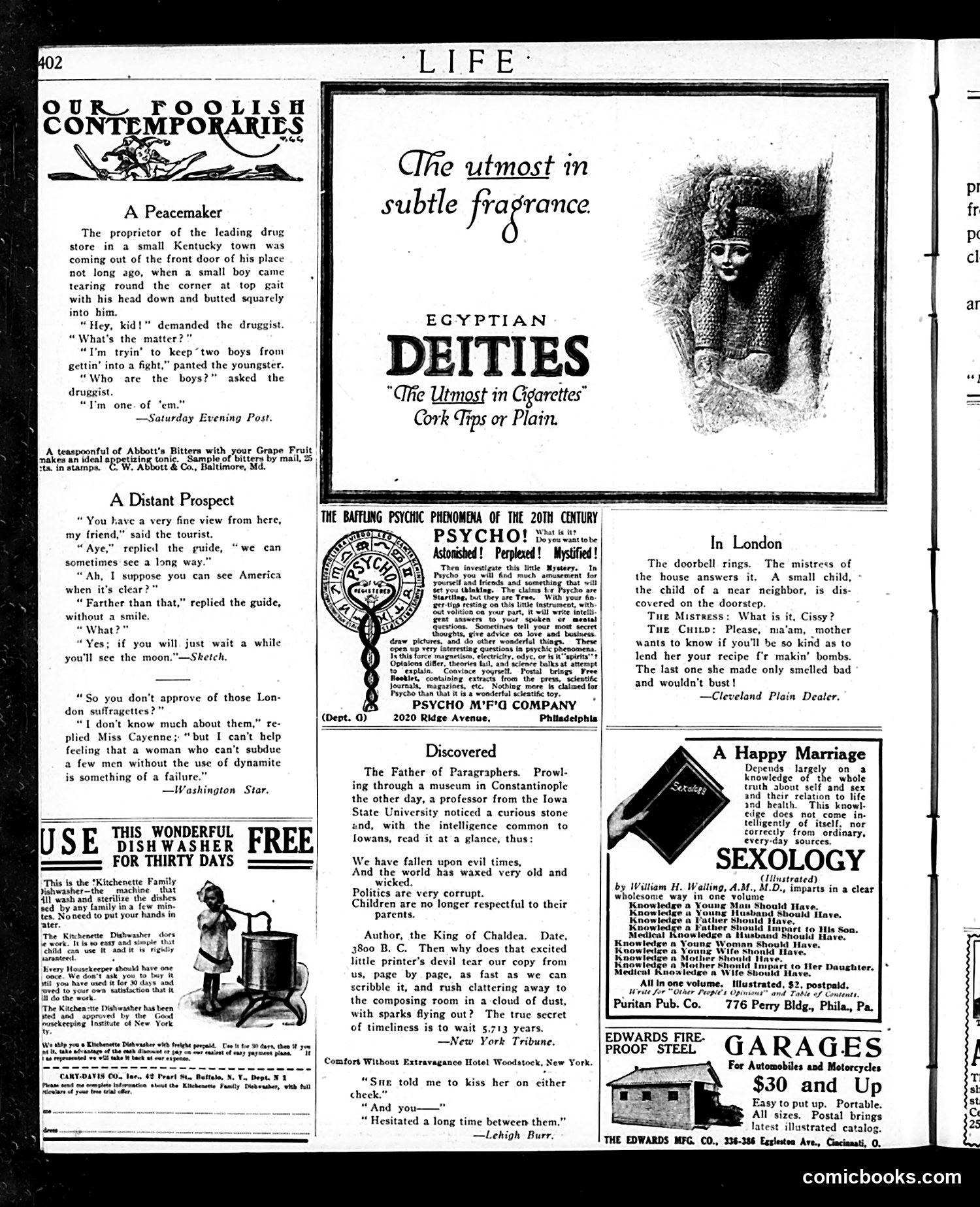
This page contains satirical humor pieces and advertisements typical of early 20th-century Life magazine. **"A Peacemaker"** jokes about a boy running to prevent a fight—he's one of the combatants himself, creating absurdist humor about conflict resolution. **"A Distant Prospect"** satirizes tourist guides' exaggeration, with a Scottish guide claiming he can see farther than America—even to the moon. **"London Suffragettes"** references the contemporary women's suffrage movement. A character dismisses suffragettes as weak for needing "dynamite" to "subdue a few men," mocking both the activists and their opponents' inflammatory rhetoric about bombing campaigns. **"In London"** satirizes suffragettes again: a neighbor's child asks to borrow a bomb-recipe because the mother's attempt "only smelled bad and wouldn't bust"—dark humor about actual bombings by militant suffragists. **"Discovered"** is a humorous piece suggesting ancient complaints about corruption and disrespectful children, implying human problems are timeless. The page reflects pre-WWI anxieties about women's activism and political violence.
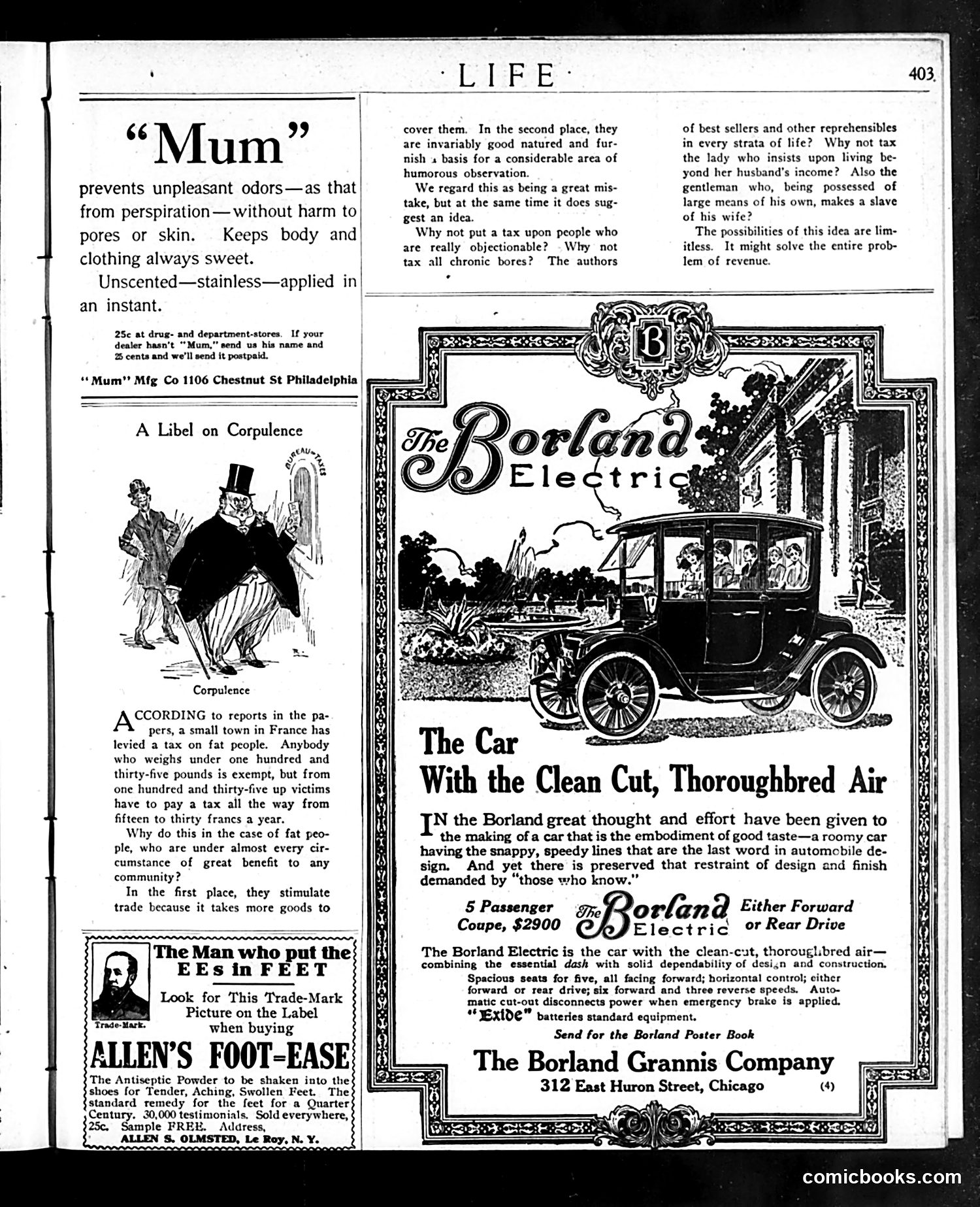
This page mixes satire with period advertising. The main satirical piece, "A Libel on Corpulence," responds to a reported French tax on overweight citizens. The author argues fat people benefit communities by stimulating trade (requiring more cloth) and providing "humorous observation"—a backhanded compliment reflecting era attitudes toward obesity as comedic. The piece then pivots its critique: if taxing fat people seems absurd, why not tax *actually* objectionable people—chronic bores, spendthrift wives, and domineering wealthy husbands? This targets contemporary social problems while using the fat-tax proposal as satire's jumping-off point. The accompanying cartoon shows a portly gentleman, visualizing "Corpulence" itself. The remainder is period advertising: "Mum" deodorant, Allen's Foot-Ease powder, and a Borland Electric automobile—typical early 20th-century consumer goods marketed via the magazine.
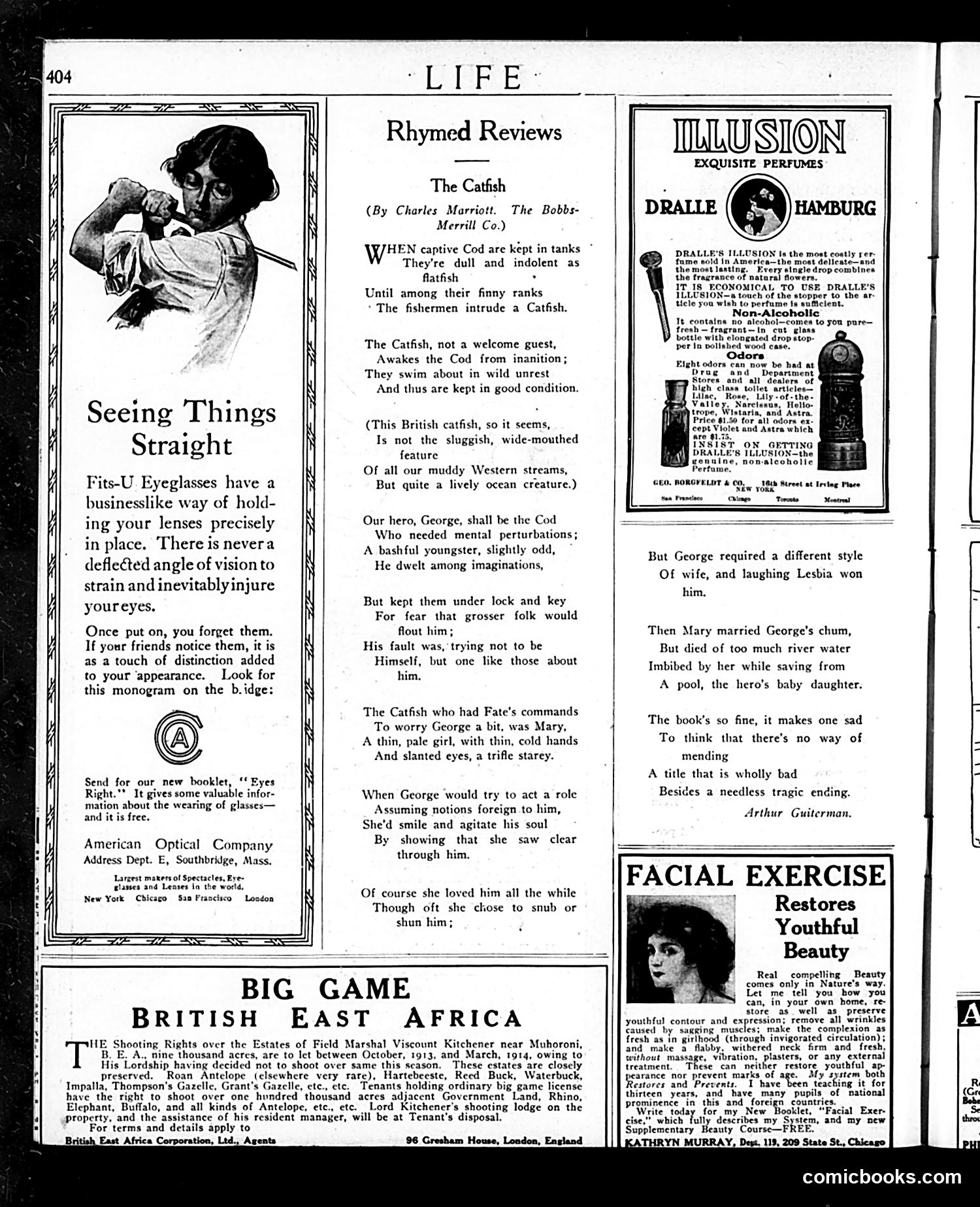
This page contains primarily **advertisements and literary reviews** rather than political satire. The main content is a rhymed book review of "The Catfish" by Charles Marriott, a novel using the catfish as a metaphor. The poem describes George, a bashful, imaginative man (the "Cod") who is emotionally stirred by Mary (the "Catfish"), a thin, pale girl with knowing eyes. Though Mary loves George, she teases him by revealing she sees through his pretenses. George eventually marries the laughing Lesbia instead, but Mary dies tragically while saving George's baby daughter from drowning. The reviewer (Arthur Guiterman) critiques the book's "wholly bad" title and "needless tragic ending." The page also advertises **Fits-U Eyeglasses**, **American Optical Company**, **Dralle's Illusion Perfume**, and **British East Africa shooting rights** under Lord Kitchener's estates. There is **no political cartoon or satire** on this page—it is standard early-20th-century magazine content mixing literature and consumer advertising.
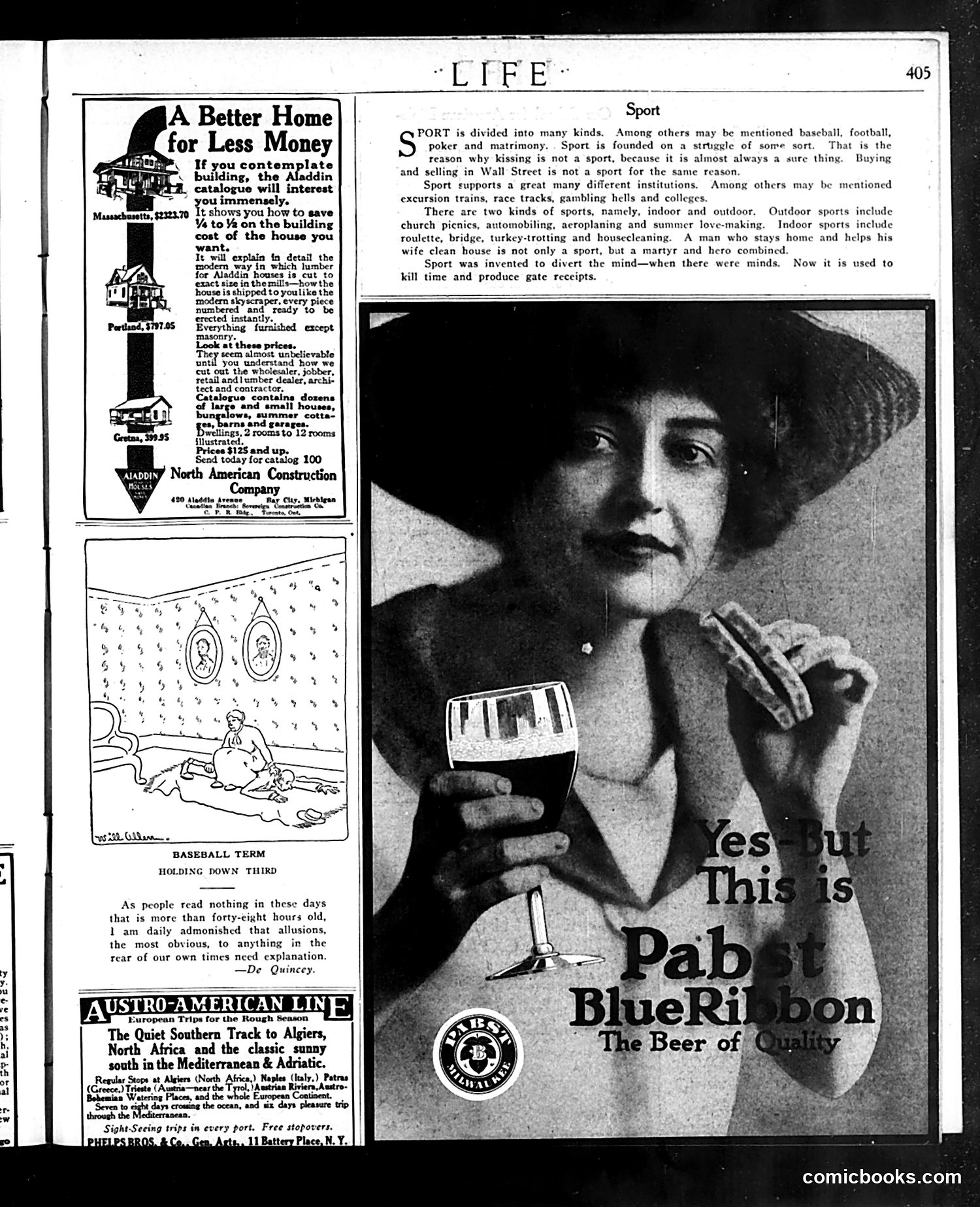
This page contains satirical commentary on "Sport" by Life magazine's editorial voice. The piece humorously defines sport broadly—including "poker and matrimony"—then critiques modern sports as commercialized spectacles. The joke is that kissing isn't a sport because it's "almost always a sure thing" (unlike competitive activities), while Wall Street trading similarly lacks struggle. The satire mocks how sports institutions now primarily serve to "produce gate receipts" rather than provide genuine diversion. A small cartoon titled "Baseball Term: Holding Down Third" appears to make a baseball joke, though details are unclear from the image quality. The page is dominated by period advertising: Aladdin kit homes promising savings through direct-mail construction, and Austro-American cruise lines offering Mediterranean voyages. These ads reflect early 20th-century American consumer capitalism—mail-order homes and leisure travel as accessible luxuries.
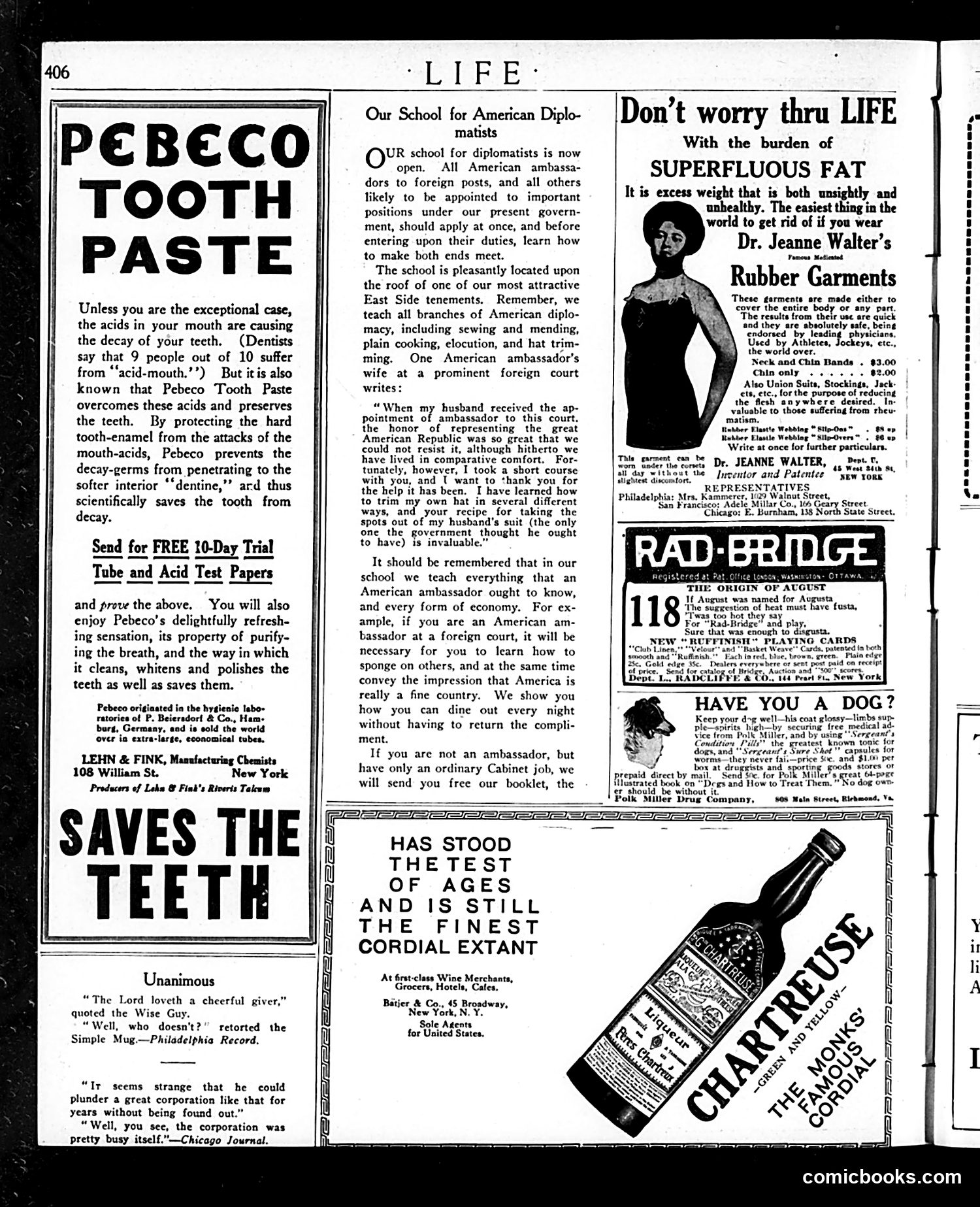
This page contains **satirical commentary on American diplomacy** disguised as a fake "school" advertisement. The satire mocks the financial struggles of American ambassadors and diplomats serving abroad. **The Central Joke:** The fictional "School for American Diplomatists" purports to teach essential skills—sewing, cooking, hat-trimming—because American diplomats are chronically underpaid. A testimonial from an ambassador's wife describes having to learn budget tricks after her husband's appointment left them in "comparative comfort" but now financially stressed. **The Satire's Point:** American diplomats were notoriously underfunded, forcing them to live below their station at foreign courts. The school teaches survival skills masquerading as diplomatic training, and humorously includes "how to sponge on others" while maintaining America's international image. **Historical Context:** This reflects genuine 1920s-era concerns about inadequate diplomatic compensation, a real policy problem of the era. The page also contains period advertisements (Pebeco toothpaste, rubber garments, cordial) typical of Life's advertising revenue model.
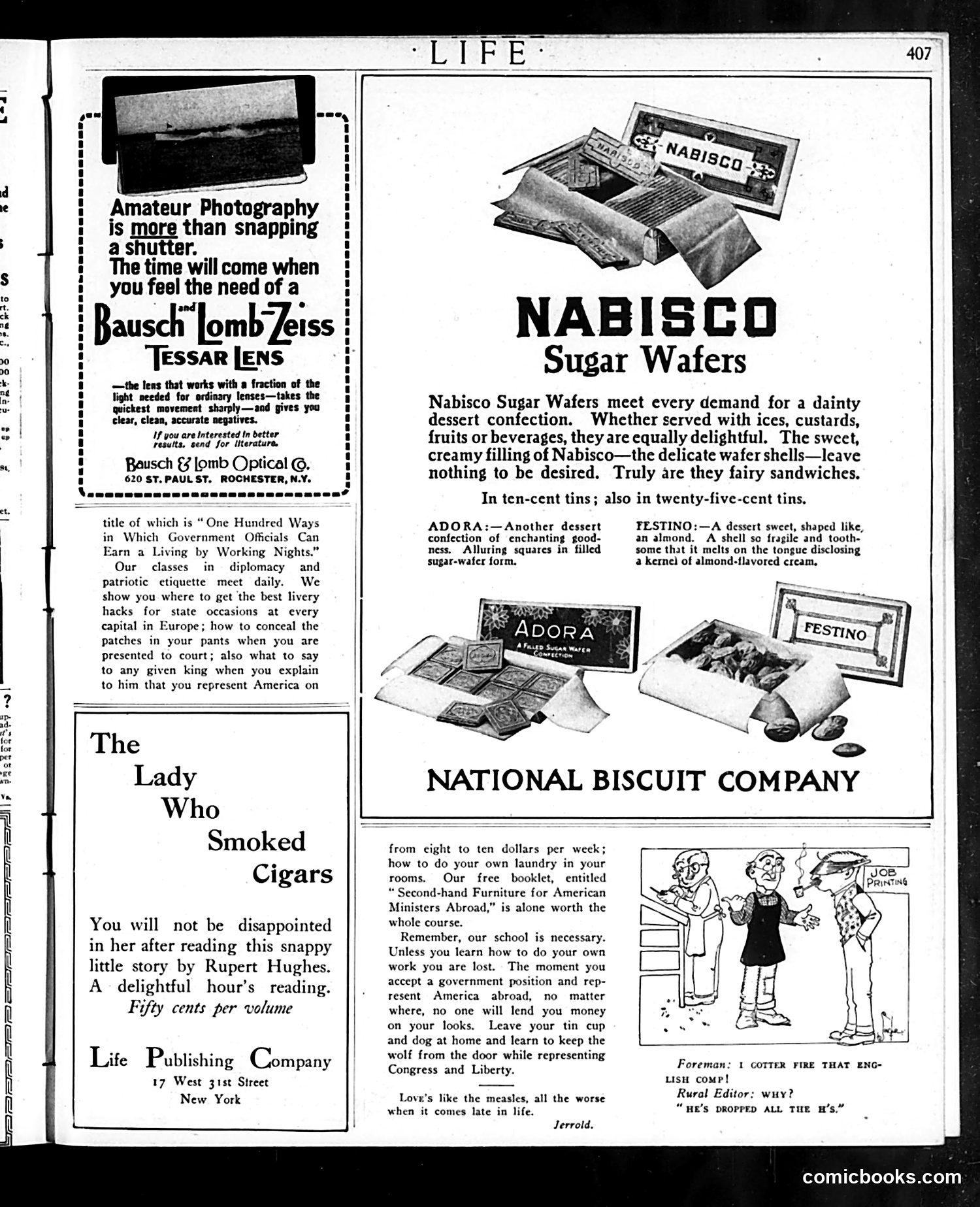
This page is primarily **advertising**, with one small cartoon at the bottom right. **Advertisements featured:** - Bausch & Lomb camera lenses (top left) - Nabisco Sugar Wafers and related confections (center/right) - Life Publishing Company books (bottom left) **The cartoon** (bottom right) shows a rural foreman and editor discussing someone who "dropped all the h's"—a visual pun on dropping the letter "H" from words, likely satirizing rural dialect or illiteracy. The cartoon mocks working-class speech patterns. **Social context:** The page also advertises "The Lady Who Smoked Cigars" and a course on "diplomacy and patriotic etiquette" for government officials working abroad—reflecting early 20th-century anxieties about American diplomatic representation and rigid social propriety. The ads suggest aspirational middle-class concerns: proper photography equipment, refined desserts, and correct behavior. The humor is genteel and commercial rather than sharply political.
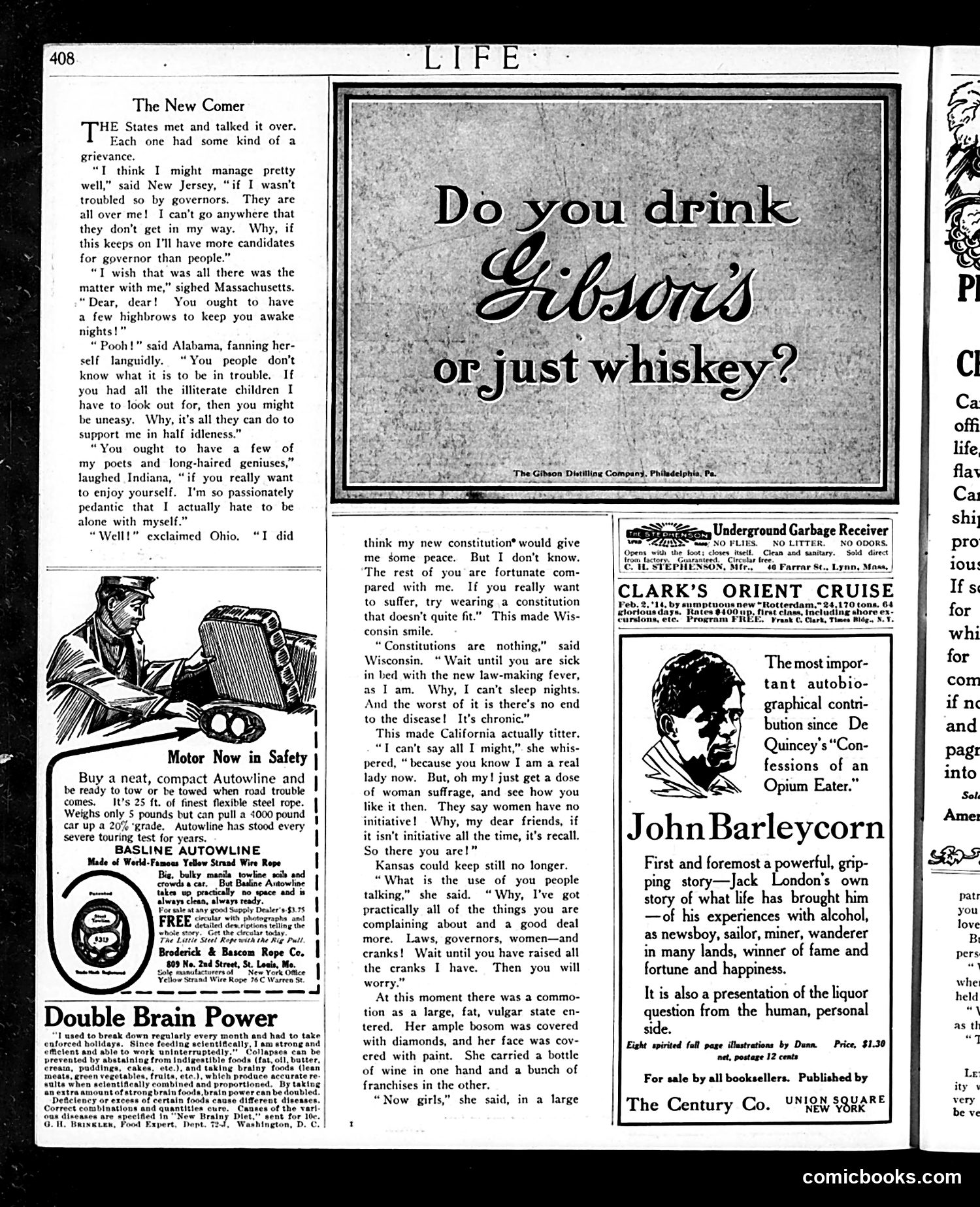
This satirical piece personifies American states as characters complaining about their respective problems. Each state represents contemporary grievances: - **New Jersey** suffers from too many gubernatorial candidates - **Massachusetts** is burdened by demanding intellectuals ("highbrows") - **Alabama** struggles with illiteracy among its population - **Indiana** is troubled by pretentious artists and poets - **Ohio** complains its new constitution doesn't fit properly - **Wisconsin** faces "law-making fever" with endless legislative problems - **California** has just gained women's suffrage and worries about its implications - **Kansas** lists multiple frustrations: laws, governors, women's issues, and "cranks" The satire critiques state-level governance challenges of the Progressive Era—constitutional reforms, women's suffrage, educational disparities, and regulatory excess. Each complaint reflects real regional issues of the period. The format allows Life magazine to comment on diverse American problems through humor and personification, making abstract political struggles relatable through exaggerated characterization.
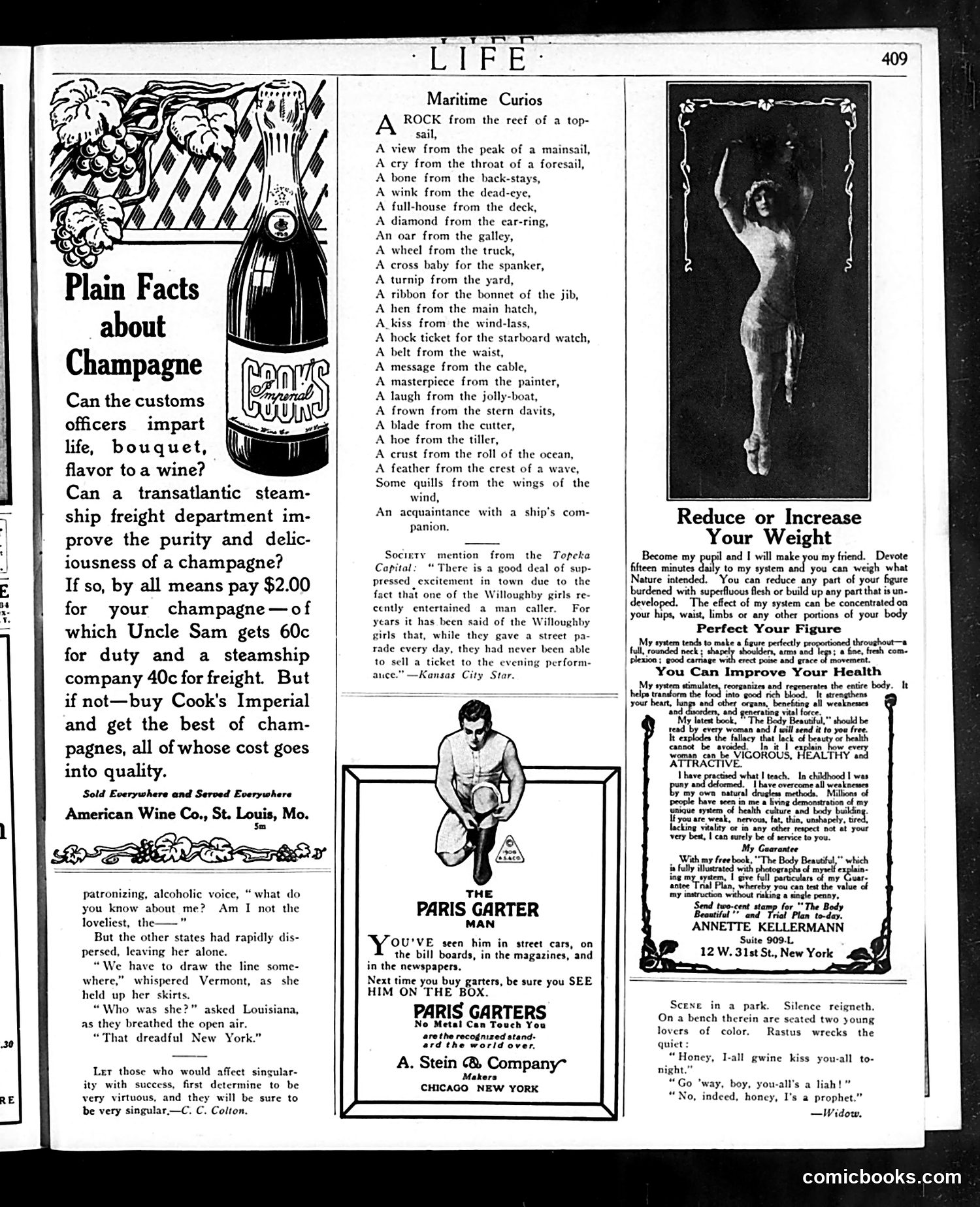
This page is primarily **advertising** with some satirical content interspersed. The main advertisements promote **Cook's Imperial Champagne** (questioning import duties and shipping costs), **Paris Garters** (featuring a recurring cartoon character), and a **weight-loss/body-improvement system** by Annette Kellermann. The satirical elements include: 1. **"Maritime Curios"** — a whimsical list of absurd nautical items (a "rock from a topsail," a "kiss from the wind-lass"), mocking tourists' fascination with ship memorabilia. 2. **A brief story** about personified U.S. states, where "New York" is depicted as disreputable, causing other states (Vermont, Louisiana) to distance themselves — social satire on New York's scandalous reputation. The page reflects early 20th-century concerns: import tariffs, maritime novelty-seeking, weight anxiety, and regional American stereotypes.
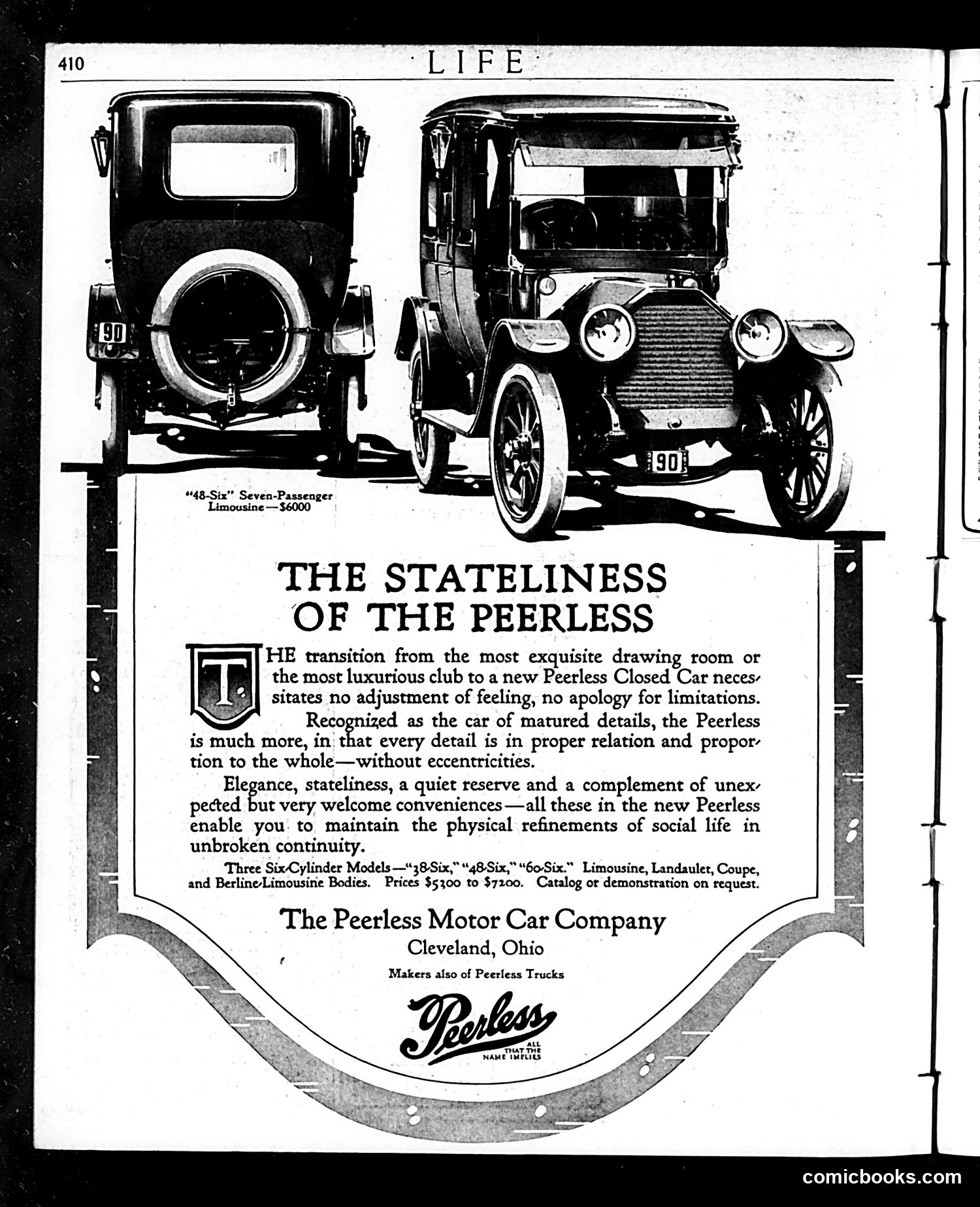
This is a **luxury automobile advertisement**, not satire or political commentary. The Peerless Motor Car Company promotes their "48-Six" seven-passenger limousine ($6,000—an enormous sum in this era, equivalent to roughly $200,000 today). The ad's pitch targets wealthy buyers by emphasizing that transitioning from exclusive drawing rooms or clubs to a Peerless car requires "no adjustment of feeling, no apology for limitations." It positions the vehicle as maintaining social refinement and "physical refinements of social life in unbroken continuity"—meaning the car itself becomes an extension of upper-class spaces. The two photographs show the car's rear view (left) and three-quarter front view (right), highlighting its enclosed, formal design. The marketing language stresses elegance, proportion, and "quiet reserve"—codes for refined taste among the wealthy during the early automobile era. This reflects a period when automobiles were luxury goods for the affluent, not mass transportation.
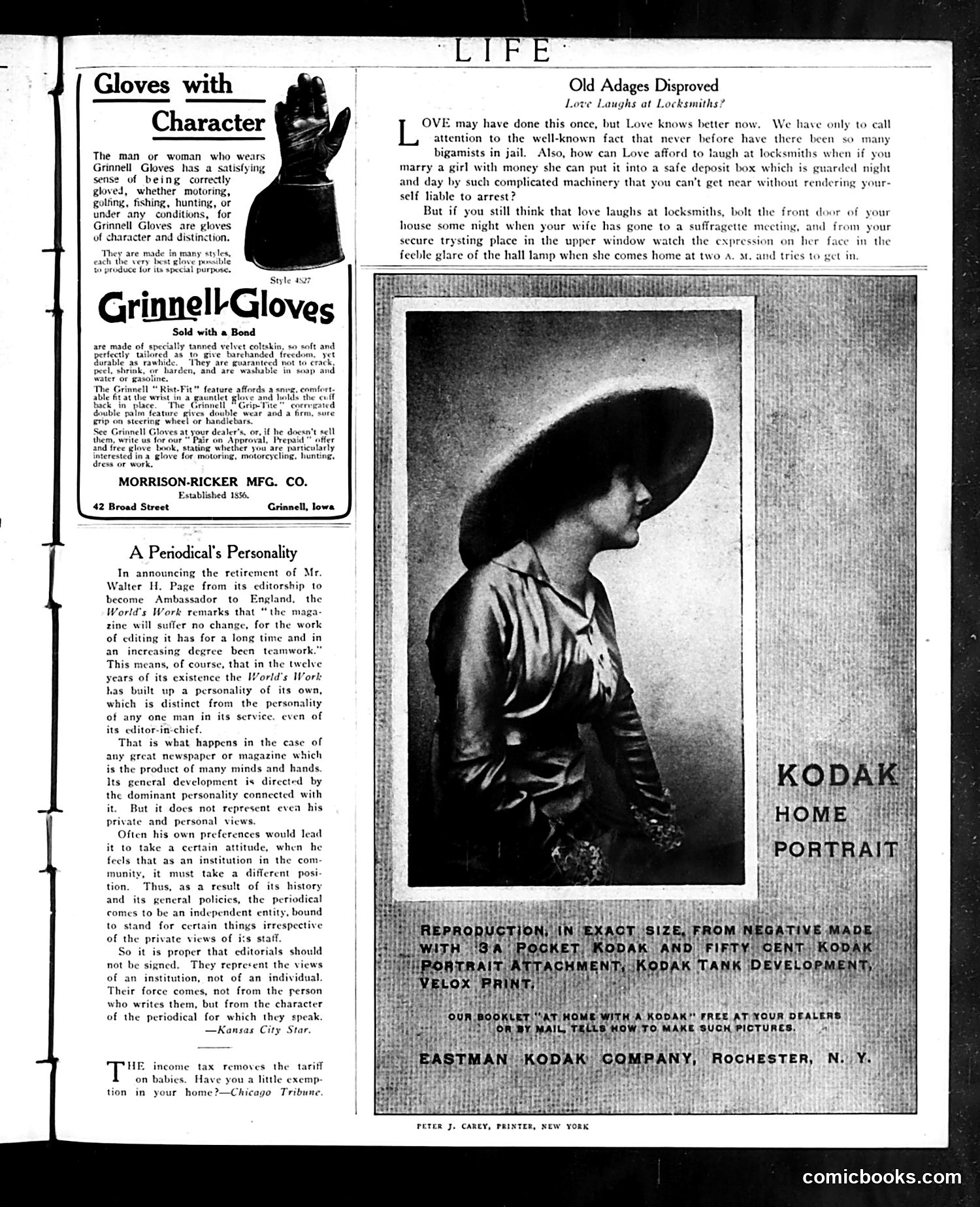
This page contains three distinct sections: advertisements and editorial commentary rather than political cartoons. **Left side:** A Grinnell Gloves advertisement emphasizing quality and durability for various activities (motoring, hunting, fishing). **Center:** An article titled "Old Adages Disproved" satirizing the saying "love laughs at locksmiths." The satire references modern developments—specifically women's suffrage activism. It mocks romantic notions by suggesting that if a wife attends a "suffragette meeting" and sneaks home at 2 a.m., her husband should watch her frustration at finding the door locked. This is a contemporary joke mocking both women's rights activism and marital infidelity, using the locked door as a punchline about surveillance and control. **Right side:** A Kodak advertisement for home portrait photography. **Bottom:** Brief editorial notes, including commentary on *World's Work* magazine's institutional identity, and a joke about income tax exemptions for children. The page is primarily commercial with light satirical commentary on contemporary social issues, particularly women's suffrage.
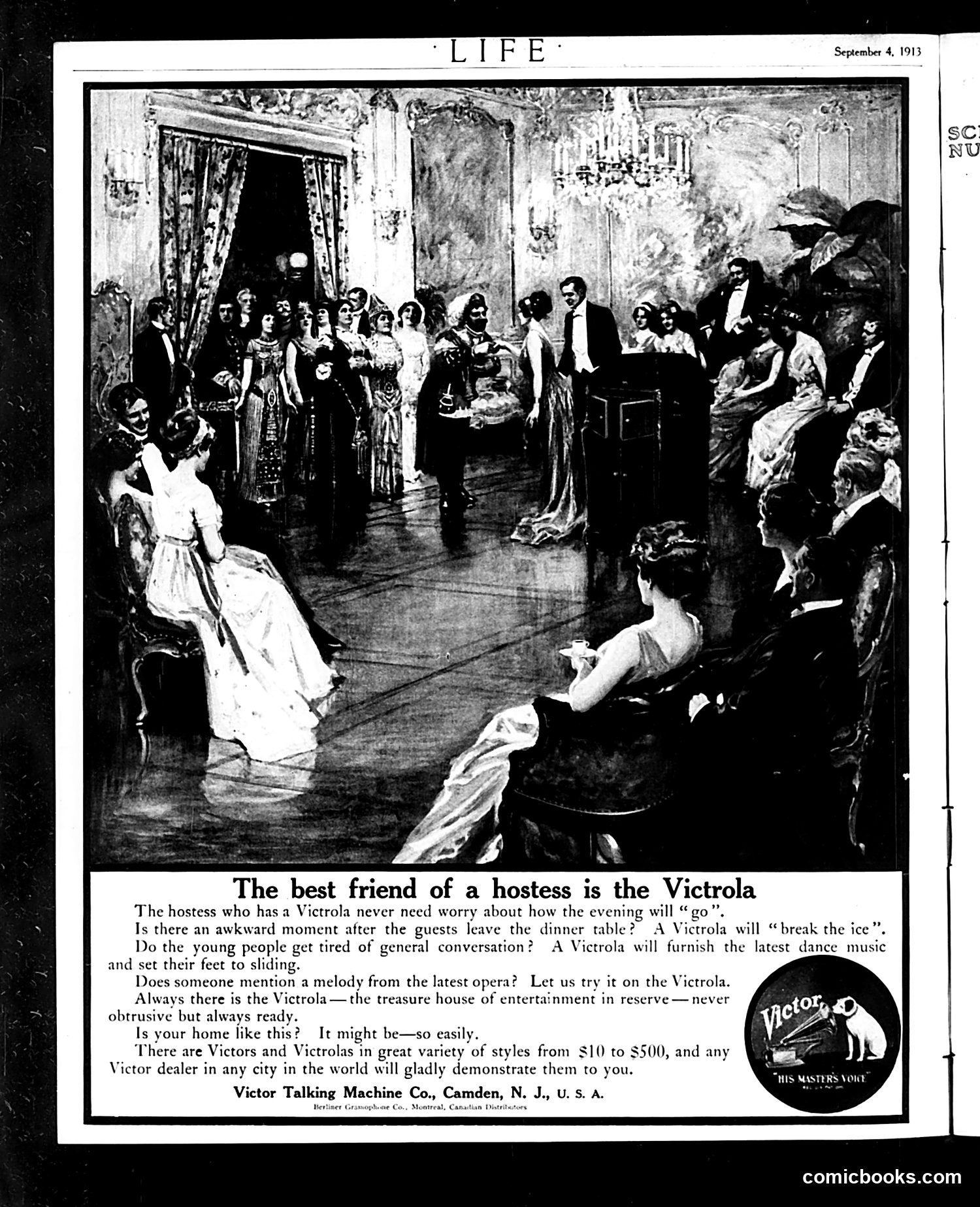
This is a **full-page advertisement**, not a political cartoon. It promotes the Victrola, an early phonograph/record player, to wealthy homeowners. The image depicts an elegant formal gathering in a grand parlor where a hostess entertains guests. The advertisement's pitch is that the Victrola solves social awkwardness: it "breaks the ice" after dinner, provides dance music when conversation flags, and supplies opera selections on demand—essentially functioning as automated entertainment for leisure-class entertaining. The copy addresses anxieties of the era's affluent hostesses about maintaining sophisticated social gatherings. Rather than satire, this is straightforward aspirational advertising, presenting the Victrola as a status symbol and practical solution to hosting etiquette challenges. The accompanying price range ($10-$500) and the famous "His Master's Voice" logo reinforce that Victor Talking Machine Co. positioned their product as both accessible and luxurious.