
Life, 1913-09-04 · page 18 of 40
Life — September 4, 1913 — page 18: what you’re looking at
What you’re looking at
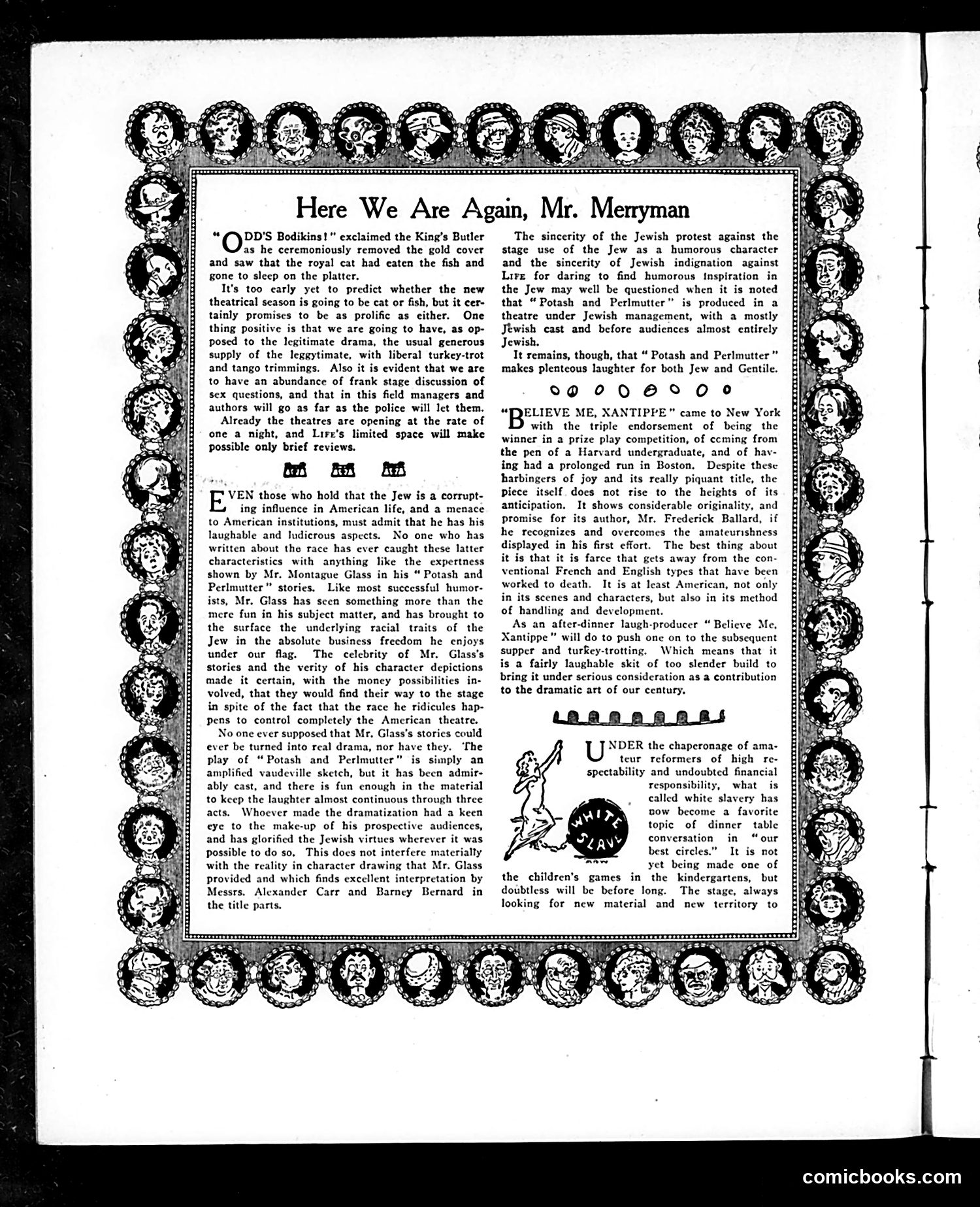
This page reviews the 1914 Broadway season, focusing on two plays: **"Potash and Perlmutter"** and **"Believe Me, Xantippe."** The main satire targets Jewish community hypocrisy. The writer notes that while some Jews criticized the stage portrayal of Jews as comedic characters, "Potash and Perlmutter"—based on Montague Glass's popular stories about Jewish businessmen—was produced by Jewish theatre owners, starred Jewish actors (Alexander Carr and Barney Bernard), and played to predominantly Jewish audiences. The piece argues this contradiction undermines their moral objections. The opening anecdote about the King's butler discovering a cat ate the fish is a theatrical device introducing the season's themes: sex, entertainment, and moral questions. The text reveals period attitudes toward ethnic humor as acceptable entertainment while also documenting Jewish community concerns about stereotyping—a tension that persisted in American theatre.
📄 Transcribed text from this page (OCR, searchable)
Machine-transcribed from the original scan — historical spelling and the odd misread are preserved.
S25 a i, Here We Are Again, Mr. Merryman J DD'S Bodikins!" exclaimed the King’s Butler as he ceremoniously removed the gold cover and saw that the royal cat had eaten the fish and gone to sleep on the platter, It's too early yet to predict whether the new theatrical season is going to be cat or fish, but it cer- tainly promises to be as prolific as either. One thing positive is that we are going to have, as op- posed to the legitimate drama, the usual generous supply of the leggytimate, with liberal turkey-trot and tango trimmings. Also it is evident that we are to have an abundance of frank stage discussion of Sex questions, and that in this field managers and authors will go as far as the police will let them. Already the theatres are opening at the rate of one a night, and Lire's limited space will make possible only brief reviews. oR A mA VEN those who hold that the Jew is a corrupt- ing influence in American life, and a menace to American institutions, must admit that he has his laughable and ludicrous aspects. No one who has written about the race has ever caught these latter characteristics with anything like the expertness shown by Mr. Montague Glass in his “ Potash and Perlmutter” stories, Like most successful humor- ists, Mr. Glass has scen something more than the mere fun in his subject matter, and has brought to the surface the underlying racial traits of the Jew in the absolute business freedom he enjoys under our flag. The celebrity of Mr. Glass’s stories and the verity of his character depictions made it certain, with the money possibilities in- volved, that they would find their way to the stage in spite of the fact that the race he ridicules hap- Pens to control completely the American theatre. No one ever supposed that Mr. Glass’s stories could ever be turned into real drama, nor have they. The play of “Potash and Perlmutter” is simply an amplified vaudeville sketch, but it has been admir- ably cast, and there is fun enough in the material to keep the laughter almost continuous through three acts. Whoever made the dramatization had a keen eye to the make-up of his prospective audiences, and has glorified the Jewish virtues wherever it was possible to do so, This docs not interfere materially with the reality in character drawing that Mr. Glass provided and which finds excellent interpretation by Messrs. Alexander Carr and Barney Bernard in the title parts. The sincerity of the Jewish protest against the stage use of the Jew as a humorous character and the sincerity of Jewish indignation against Lire for daring to find humorous Inspiration in the Jew may well be questioned when it is noted that “Potash and Perlmutter” is produced in a theatre under Jewish management, with a mostly Jewish cast and before audiences almost entirely Jewish. It remains, though, that “ Potash and Perlmutter” makes plentcous laughter for both Jew and Gentile. °0 006800 “RELIEVE ME, XANTIPPE” came to New York with the triple endorsement of being the winner in a prize play competition, of ccming from the pen of a Harvard undergraduate, and of hav- ing had a prolonged run in Boston. Despite these harbingers of joy and its really piquant title, the Piece itself does not rise to the heights of its anticipation, It shows considerable originality, and promise for its author, Mr. Frederick Ballard, if he recognizes and overcomes the amateurishness displayed in his first effort. The best thing about it is that it is farce that gets away from the con- ventional French and English types that have been worked to death. It is at least American, not only in its scenes and characters, but also in its method of handling and development. As an after-dinner laugh-producer “ Believe Me, Xantippe ” will do to push one on to the subsequent supper and turkey-trotting. Which means that it is a fairly laughable skit of too slender build to bring it under serious consideration as a contribution to the dramatic art of our century, (Aa OO A As U NDER the chaperonage of ama- teur reformers of high re- spectability and undoubted financial responsibility, what is called white slavery has pow become a favorite topic of dinner table conversation in “our best circles.” It is not yet being made one of the children’s games in the kindergartens, but doubtless will be before long. The stage, always looking for new material and new territory to comicbooks.com