
Life, 1913-09-04 · page 19 of 40
Life — September 4, 1913 — page 19: what you’re looking at
What you’re looking at
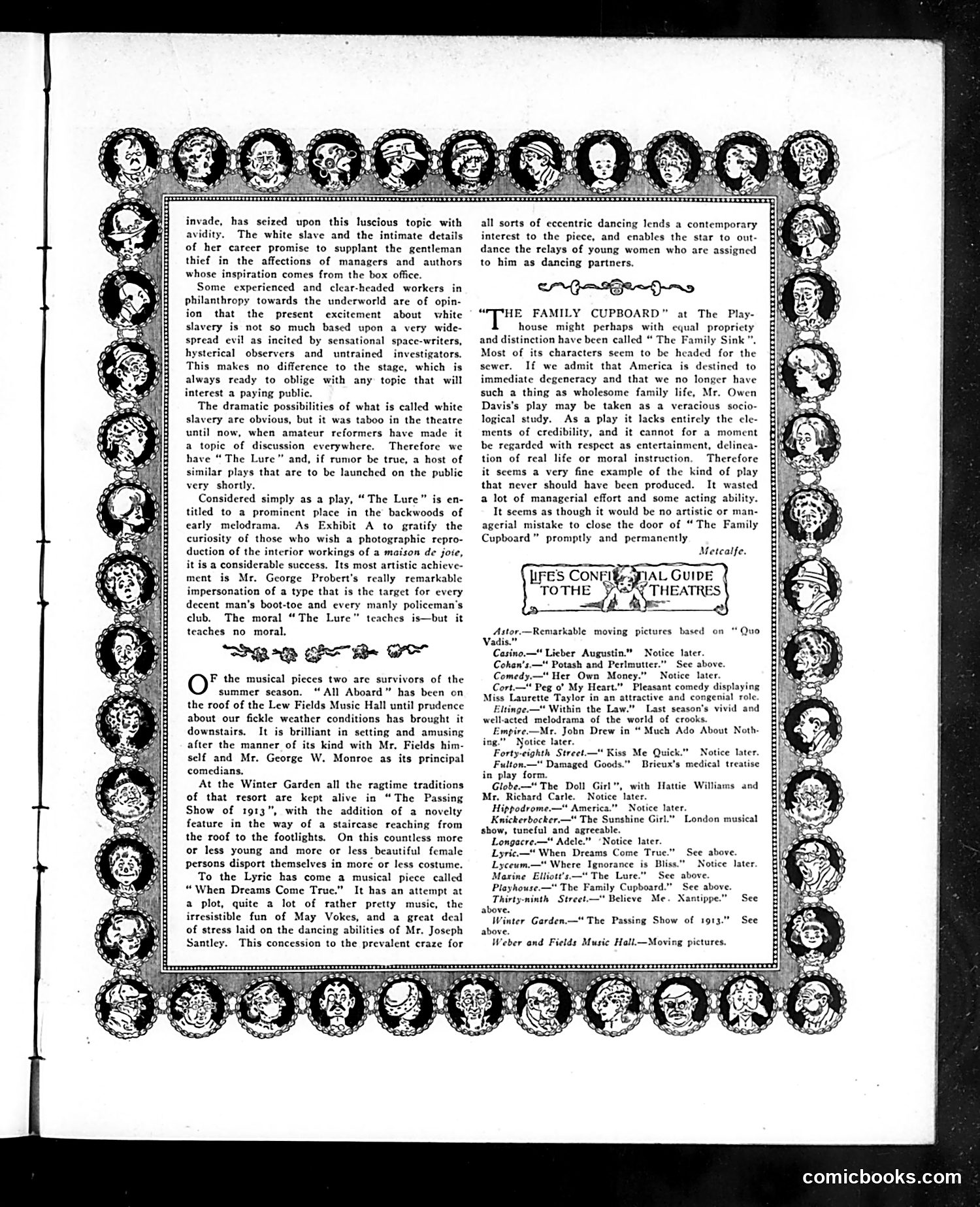
This page reviews several Broadway productions from circa 1913. The main critique concerns "The Lure," a melodrama capitalizing on the contemporary "white slavery" panic. The reviewer argues that sensationalist journalists and reformers have inflated concern over this social problem to boost theatrical attendance, yet the play itself—while technically impressive in depicting a brothel ("maison de joie")—teaches no moral lesson beyond condemning its villain. The page also reviews musical comedies at various theaters: "All Aboard" (featuring Lew Fields), "The Passing Show of 1913" (notable for a novelty staircase and chorus girls), and "When Dreams Come True" (showcasing dancer Joseph Santley). "The Family Cupboard" receives harsh criticism as morally bankrupt entertainment—the reviewer sarcastically suggests it should be retitled "The Family Sink" and argues it's artistically indefensible whether viewed as sociology, entertainment, or moral instruction. The implied satire: theater managers exploit whatever sensational social issues will fill seats, regardless of artistic merit.
📄 Transcribed text from this page (OCR, searchable)
Machine-transcribed from the original scan — historical spelling and the odd misread are preserved.
invade, has seized upon this luscious topic with avidity, The white slave and the intimate details of her career promise to supplant the gentleman thief in the affections of managers and authors whose inspiration comes from the box office. Some experienced and clear-headed workers in philanthropy towards the underworld are of opin- ion that the present excitement about white slavery is not so much based upon a very wide- spread evil as incited by sensational space-writers, hysterical observers and untrained investigators. This makes no difference to the stage, which is always ready to oblige with any topic that will interest a paying publi The dramatic possibilities of what is called white slavery are obvious, but it was taboo in the theatre until now, when amateur reformers have made it a topic of discussion everywhere. Therefore we have “ The Lure” and, if rumor be true, a host of similar plays that are to be launched on the public very shortly, Considered simply as a play, “ The Lure” is en- titled to a prominent place in the backwoods of early melodrama. As Exhibit A to gratify the curiosity of those who wish a photographic repro- duction of the interior workings of a maison de joie, it is a considerable success. Its most artistic achieve- ment is Mr. George Probert's really remarkable impersonation of a type that is the target for every decent man’s boot-toe and every manly policeman’s club. The moral “The Lure” teaches is—but it teaches no moral. Sere GR oo F the musical pieces two are survivors of the summer season. “ All Aboard” has been on the roof of the Lew Fields Music Hall until prudence about our fickle weather conditions has brought it downstairs. It is brilliant in setting and amusing after the manner of its kind with Mr, Fields him- self and Mr. George W. Monroe as its principal comedians, At the Winter Garden all the ragtime traditions of that resort are kept alive in “The Passing Show of 1913”, with the addition of a novelty feature in the way of a staircase reaching from the roof to the footlights. On this countless more or less young and more or less beautiful female persons disport themselves in more or less costume. To the Lyric has come a musical piece called “When Dreams Come Tru It has an attempt at a plot, quite a lot of rather pretty music, the irresistible fun of May Vokes, and a great deal of stress laid on the dancing abilities of Mr. Joseph Santley. This concession to the prevalent craze for all sorts of eccentric dancing lends a contemporary interest to the piece, and enables the star to out- dance the relays of young women who are assigned to him as dancing partners. EGA “THE FAMILY CUPBOARD” at The Pla house might perhaps with equal propriety and distinction have been called “ The Family Sink ”. Most of its characters seem to be headed for the sewer. If we admit that America is destined to immediate degeneracy and that we no longer have such a thing as wholesome family life, Mr. Owen Davis's play may be taken as a veracious socio- logical study. As a play it lacks entirely the cle- ments of credibility, and it cannot for a moment be regarded with respect as entertainment, delinea- tion of real life or moral instruction, Therefore it seems a very fine example of the kind of play that never should have been produced. It wasted a lot of managerial effort and some acting ability. It seems as though it would be no artistic or man- agerial mistake to close the door of “The Family Cupboard” promptly and permanently LIFES CONF Igy, TOTHE NAL GUIDE THEATRES Astor.—Remarkable moving pictures based on “Quo Vadis.’ Casino." Lieber Augustin.” Notice later. Potash and Perlmutter.” See above. Her Own Money.” Notice later. Cort.—" Peg o? My Heart.” Pleasant comedy displaying Miss Laurette Taylor in an attractive and congenial role. Eltinge —" Within the Law.” Last season's vivid and well-acted melodrama of the world of crooks. Empire-—Mr. Jobn Drew in “ Much Ado About Noth- ing.” Notice later. Forty-eighth Street—" Kiss Me Quick.” Notice later. Fulton.—" Damaged Goods.” Brieux’s medical treatise in play form. Globe—" The Doll Girl”, with Hattie Williams and Mr. Richard Carle. Notice ‘later. America.” Notice later. Knickerbocker —" The Sunshine Girl.” London musical show, tuneful and agreeable. Longacre.—" Adele.” ‘Notice later. Lyric.—" When Dreams Come True.” See above. Lyceum.—" Where Ignorance is Bliss."" Notice later. Maxine Elliott’s—" The Lure.” See above. Playhouse.—" The Family Cupboard.” See abov Thirty-ninth Street.—" Believe Me. Xantipp See above. Winter Garden.—" The Passing Show of 1913." See above. Weber and Fields Music Hall.—Moving pictures. comicbooks.com