
Life, 1913-09-04 · page 22 of 40
Life — September 4, 1913 — page 22: what you’re looking at
What you’re looking at
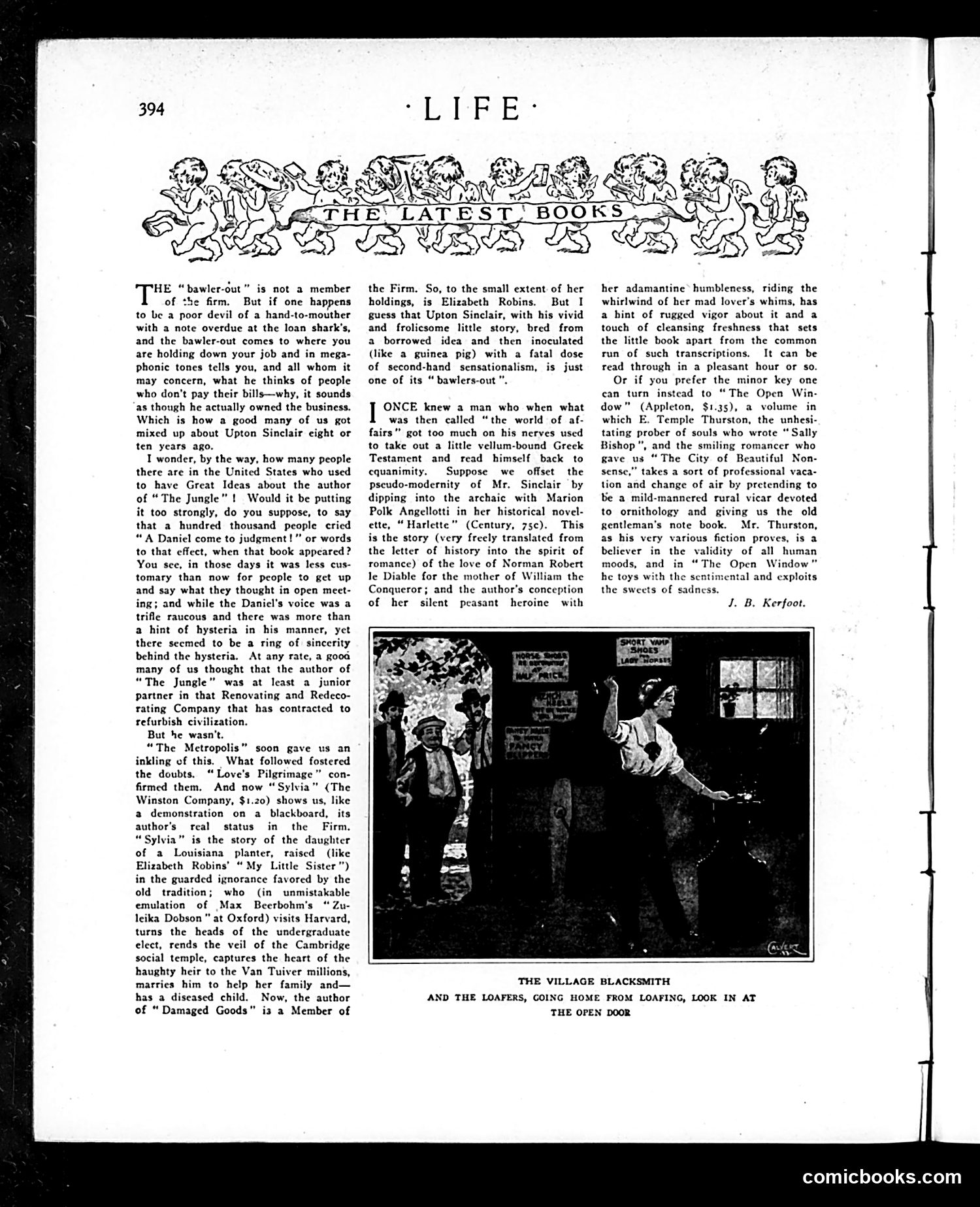
This page reviews three novels while critiquing author **Upton Sinclair**, famous for his muckraking novel *The Jungle* (1906). The unnamed author uses the metaphor of a "bawler-out"—a loud debt collector with no actual ownership—to describe Sinclair's role in social reform. The critique argues that Sinclair initially seemed a genuine reformer ("a Daniel come to judgment"), but subsequent works (*The Metropolis*, *Love's Pilgrimage*, and now *Sylvia*) revealed him as merely sensationalizing, not substantively contributing to civilization's "Renovating and Redecorating Company." His new novel *Sylvia*, borrowed from other sources and "inoculated" with "second-hand sensationalism," marks him as a mere "bawler-out"—all noise without real authority or depth. The illustration shows "The Village Blacksmith," seemingly unrelated or serving as visual relief from the literary criticism.
📄 Transcribed text from this page (OCR, searchable)
Machine-transcribed from the original scan — historical spelling and the odd misread are preserved.
HE “bawler-out” is not a member of the firm. But if one happens to be a poor devil of a hand-to-mouther with a note overdue at the loan shark's, and the bawler-out comes to where you are holding down your job and in mega- phonic tones tells you, and all whom it may concern, what he thinks of people who don’t pay their bills—why, it sounds as though he actually owned the business. Which is how a good many of us got mixed up about Upton Sinclair eight or ten years ago. I wonder, by the way, how many people there are in the United States who used to have Great Ideas about the author of “The Jungle” | Would it be putting it too strongly, do you suppose, to say that a hundred thousand people cried “A Daniel come to judgment!” or words to that effect, when that book appeared? You sce, in those days it was less cus- tomary than now for people to get up and say what they thought in open meet- ing; and while the Daniel's voice was a trifle raucous and there was more than a hint of hysteria in his manner, yet there seemed to be a ring of sincerity behind the hysteria, At any rate, a gooa many of us thought that the author of “The Jungle” was at least a junior partner in that Renovating and Redeco- rating Company that has contracted to refurbish civilization. But he wasn't. “The Metropolis” soon gave us an inkling of this, What followed fostered the doubts. “Love's Pilgrimage” con- firmed them, And now “Sylvia” (The Winston Company, $1.20) shows us, like a demonstration on a blackboard, its author's real status in the Firm. “Sylvia” is the story of the daughter of a Louisiana planter, raised (like Elizabeth Robins’ “ My Little Sister") in the guarded ignorance favored by the old tradition; who (in unmistakable emulation of Max Beerbohm’s “ Zu- leika Dobson " at Oxford) visits Harvard, turns the heads of the undergraduate elect, rends the veil of the Cambridge social temple, captures the heart of the haughty heir to the Van Tuiver millions, marries him to help her family and— has a diseased child. Now, the author of “Damaged Goods” is a Member of the Firm. So, to the small extent of her holdings, is Elizabeth Robins. But I guess that Upton Sinclair, with his vivid and frolicsome little story, bred from a borrowed idea and then inoculated (like a guinea pig) with a fatal dose of second-hand sensationalism, is just one of its “ bawlers-out ". ONCE knew a man who when what was then called “the world of af- fairs” got too much on his nerves used to take out a little vellum-bound Greek Testament and read himself back to equanimity, Suppose we offset the pscudo-modernity of Mr. Sinclair by dipping into the archaic with Marion Polk Angellotti in her historical novel- ette, “ Harlette” (Century, 75¢). This is the story (very freely translated from the letter of history into the spirit of romance) of the love of Norman Robert le Diable for the mother of William the Conqueror; and the author’s conception of her silent peasant heroine with her adamantine humbleness, riding the whirlwind of her mad lover's whims, has a hint of rugged vigor about it and a touch of cleansing freshness that sets the little book apart from the common run of such transcriptions. It can be read through in a pleasant hour or so. Or if you prefer the minor key one can turn instead to “The Open Win- dow" (Appleton, $1.35), a volume in which E. Temple Thurston, the unhesi- tating prober of souls who wrote “Sally Bishop”, and the smiling romancer who gave us “The City of Beautiful Non- sense,” takes a sort of professional vaca- tion and change of air by pretending to be a mild-mannered rural vicar devoted to ornithology and giving us the old gentleman's note book. Mr. Thurston, as his very various fiction proves, is a believer in the validity of all human moods, and “The Open Window” he toys with the sentimental and exploits the sweets of sadness. J. B. Kerfoot. THE VILLAGE BLACKSMITH AND THE LOAFERS, GOING HOME FROM LOAFING, LOOK IN AT THE OPEN DOOR comicbooks.com