
Life, 1913-09-04 · page 23 of 40
Life — September 4, 1913 — page 23: what you’re looking at
What you’re looking at
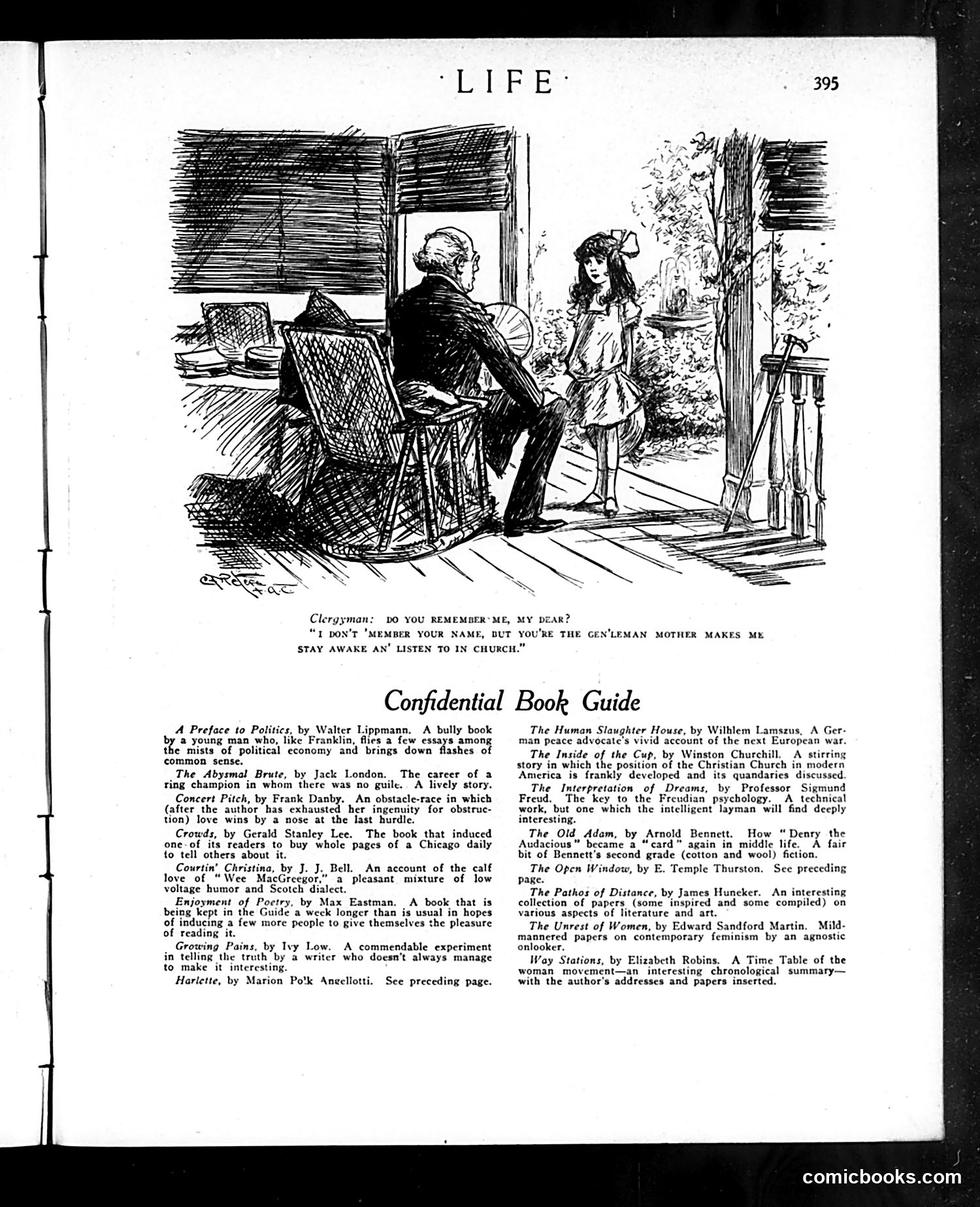
The cartoon depicts a clergyman encountering a child who fails to recognize him by name. The child's response is a gentle jab at sermon-giving: the boy only knows the clergyman as "the gentleman mother makes me stay awake and listen to in church." The humor lies in the implied criticism of clergy sermons as tedious and forgettable—so dull that a child remembers the speaker's *function* (something endured out of obligation) rather than his identity or message. It's a satirical comment on the perceived ineffectiveness or dullness of church oratory in early 20th-century America. The page is primarily a "Confidential Book Guide"—brief reviews of contemporary publications, likely intended to humorously guide readers toward worthwhile reads while dismissing mediocre ones.
📄 Transcribed text from this page (OCR, searchable)
Machine-transcribed from the original scan — historical spelling and the odd misread are preserved.
% Clergyman: DO YOU REMEMBER*ME, MY DEAR? “DON'T 'MEMBER YOUR NAME, BUT YOU'RE THE GE LEMAN MOTHER MAKES ME STAY AWAKE AN’ LISTEN TO IN CHURCH.” Confidential Book Guide A Preface to Politics, by Walter Lippmann. A bully book by a young man who, like Franklin, flies a few essays among the mists of political economy and brings down fashes of common sense. The Abysmal Brute, by Jack London. The career of a ring champion in whom there was no guile. A lively story. Concert Pitch, by Frank Danby. An obstacle-race in which (after the author has exhausted her ingenuity for obstruc- tion) love wins by a nose at the last hurdle. Crowds, by Gerald Stanley Lee. The book that induced one-of its readers to buy whole pages of a Chicago daily to tell others about it. Courtin’ Christina, by J. J. Bell. An account of the calf love of “Wee MacGregor,” a pleasant mixture of low voltage humor and Scotch dialect. Enjoyment of Poetry, by Max Eastman. A book that is being kept in the Guide’a week longer than is usual in hopes of inducing a few more people to give themselves the pleasure of reading it. _ Growing Pains, by Ivy Low. A commendable experiment in telling the truth by a writer who doesn't always manage to make it interesting. Harlette, by Marion Po'k Ancellotti, See preceding page. The Human Slaughter House, by Wilhlem Lamszus, A Ger- man peace advocate’s vivid account of the next European war. The Inside of the Cup, by Winston Churchill. A stirring story in which the position of the Christian Church in modern America is frankly developed and its quandaries discussed. The Interpretation of Dreams, by Professor Sigmund Freud. The key to the Freudian psychology. A technical work, but one which the intelligent layman will find deeply interesting. The Old, Adam, by Arnold Bennett. How “Denry the Audacious” became a “card” again in middle life. A fair bit of Bennett's second grade (cotton and wool) fiction. The Open Window, by E. Temple Thurston. See preceding page. The Pathos of Distance, by James Huncker. An interesting collection of papers (some inspired and some compiled) on various aspects of literature and art. The Unrest of Women, by Edward Sandford Martin, Mild- mannered papers on contemporary feminism by an agnostic onlooker. Way Stations, by Elizabeth Robins. A Time Table of the woman movement—an interesting chronological summary— with the author's addresses and papers inserted. comicbooks.com