
A complete issue · 44 pages · 1913
Life — January 2, 1913
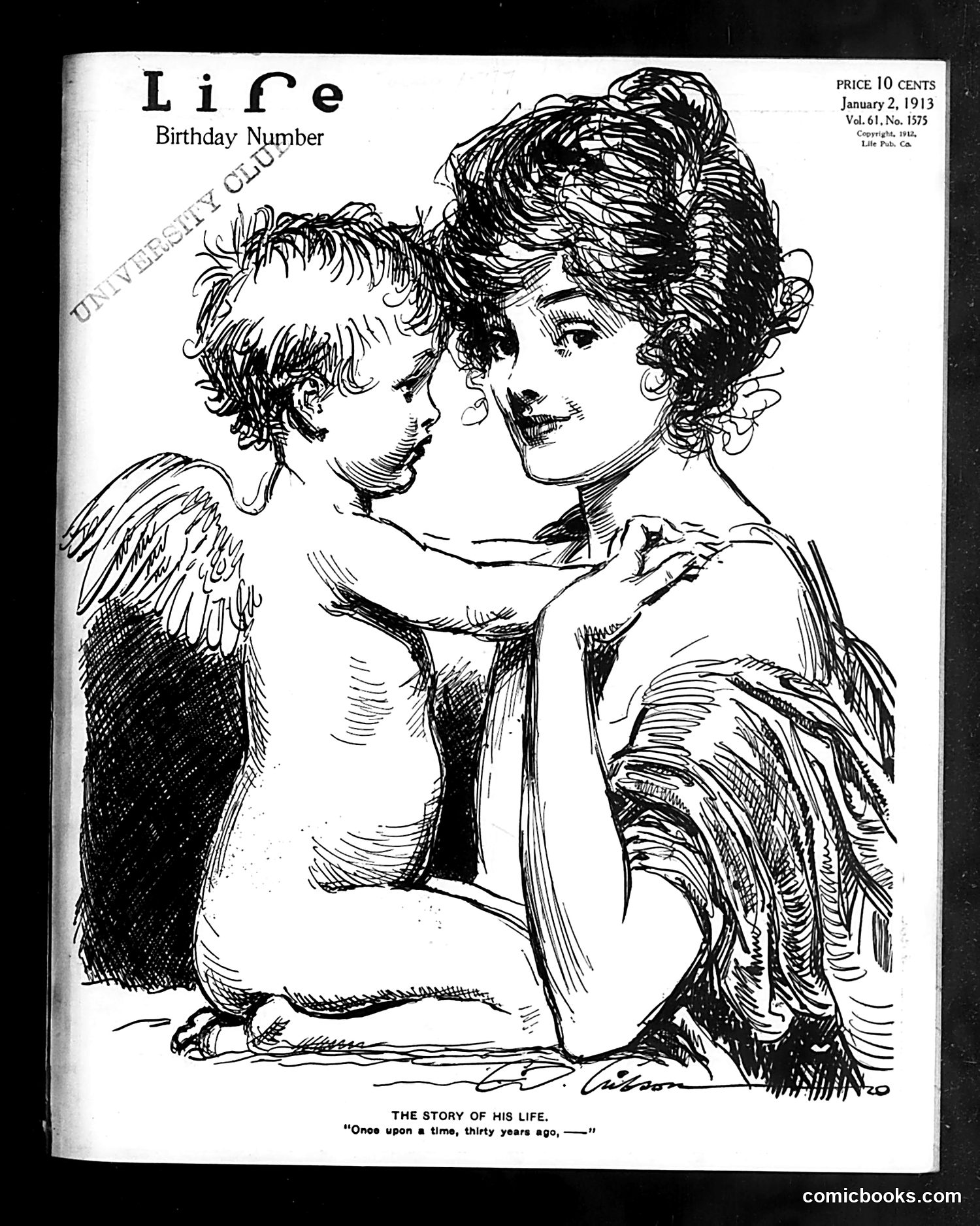
This is a "Birthday Number" cover depicting a woman with an infant cupid or cherub. The caption reads "The Story of His Life: 'Once upon a time, thirty years ago,—'" The satire appears to play on romantic or relationship narratives—specifically mocking sentimental storytelling about how relationships began. The winged cherub suggests themes of love and romance, while the woman's amused expression and the caption's opening ("once upon a time") suggest she's recounting an origin story to the child. Without additional context from the magazine's contents, the precise target of satire remains unclear—whether it's mocking particular romantic conventions, a specific public figure's romantic history, or broader attitudes about relationships and family narratives popular in 1913 society.
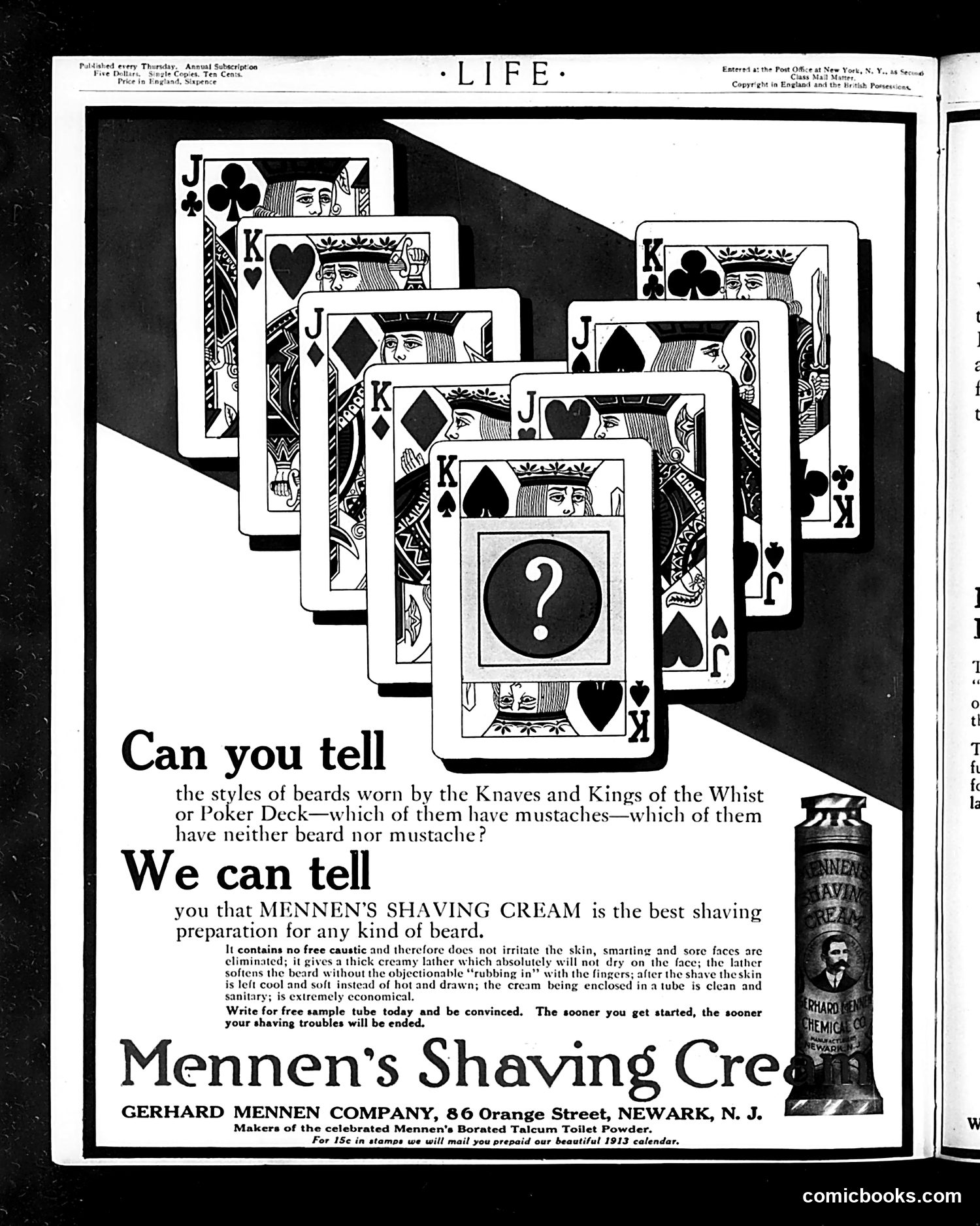
This page is primarily a **product advertisement** for Mennen's Shaving Cream, not a political cartoon or satire. The advertisement uses playing cards—Jacks and Kings from a "Whist or Poker Deck"—arranged in a fan formation with one card showing a question mark. The copy asks readers if they can identify the beards and mustaches worn by these card figures, implying subtle styling differences. The advertisement's strategy: pose this as a clever puzzle, then pivot to promoting Mennen's Shaving Cream as the solution for maintaining any beard style. The appeal emphasizes practical benefits—no skin irritation, quality lather, and cleanliness through tube packaging—targeting male grooming concerns of the era. This represents early 20th-century advertising using visual puzzles and masculine imagery to market toiletries.
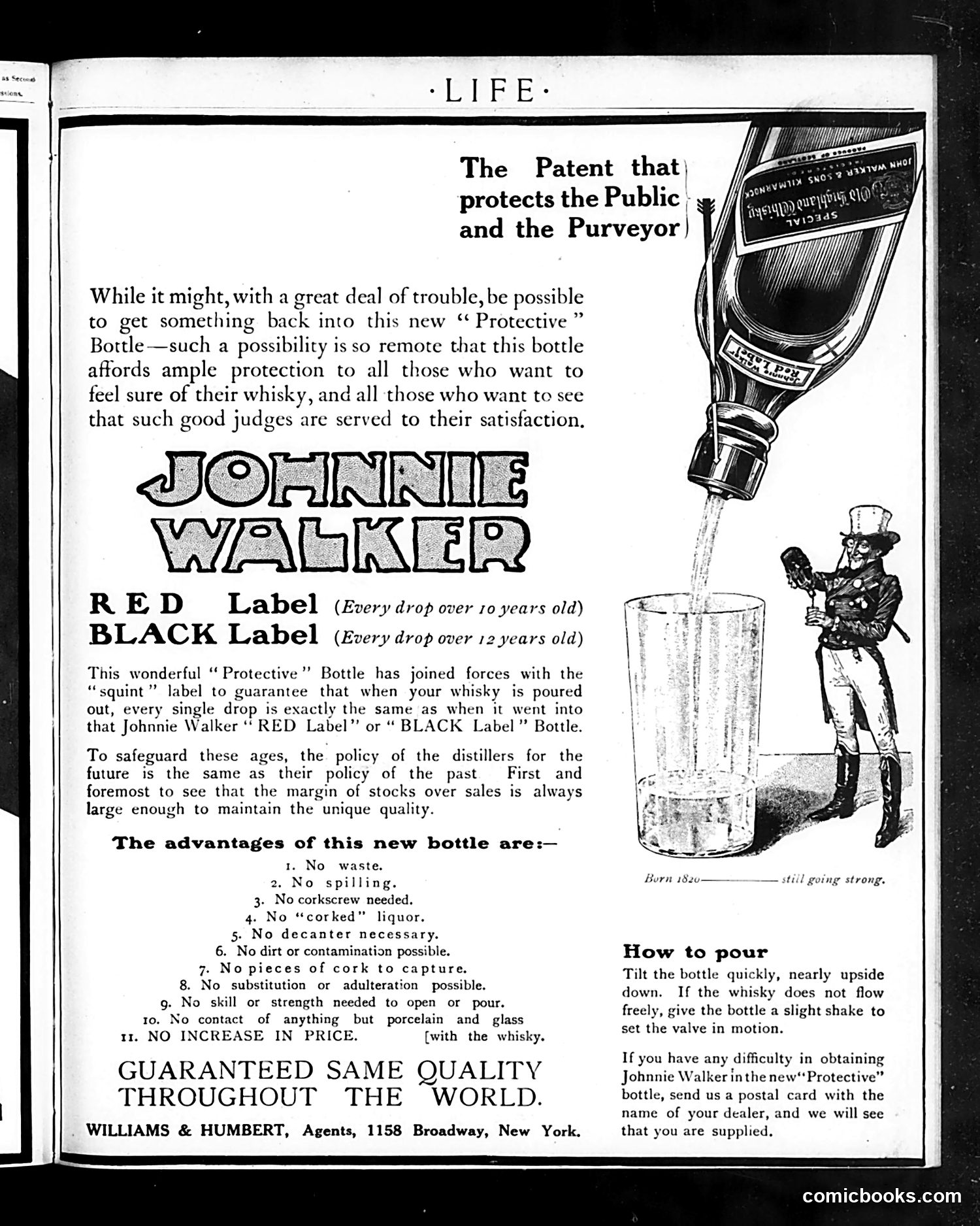
This is primarily **advertising content**, not satire or political commentary. The page promotes Johnnie Walker whisky's new "Protective Bottle" design, featuring a patented valve system. The small illustrated figure (right side) appears to be **Johnnie Walker**, the brand's iconic mascot—a jolly gentleman in top hat and tailcoat, dated "Born 1820—still going strong." This personified brand character was central to the whisky's marketing identity. The ad emphasizes the bottle's practical innovations: no waste, no spillage, no corking needed, and guaranteed quality consistency. The "Red Label" and "Black Label" designations referenced in the text refer to Johnnie Walker's actual product lines distinguished by aging requirements. **WILLIAMS & HUMBERT** served as the American agents. This reflects the magazine's commercial nature—Life published paid advertisements alongside satirical content.
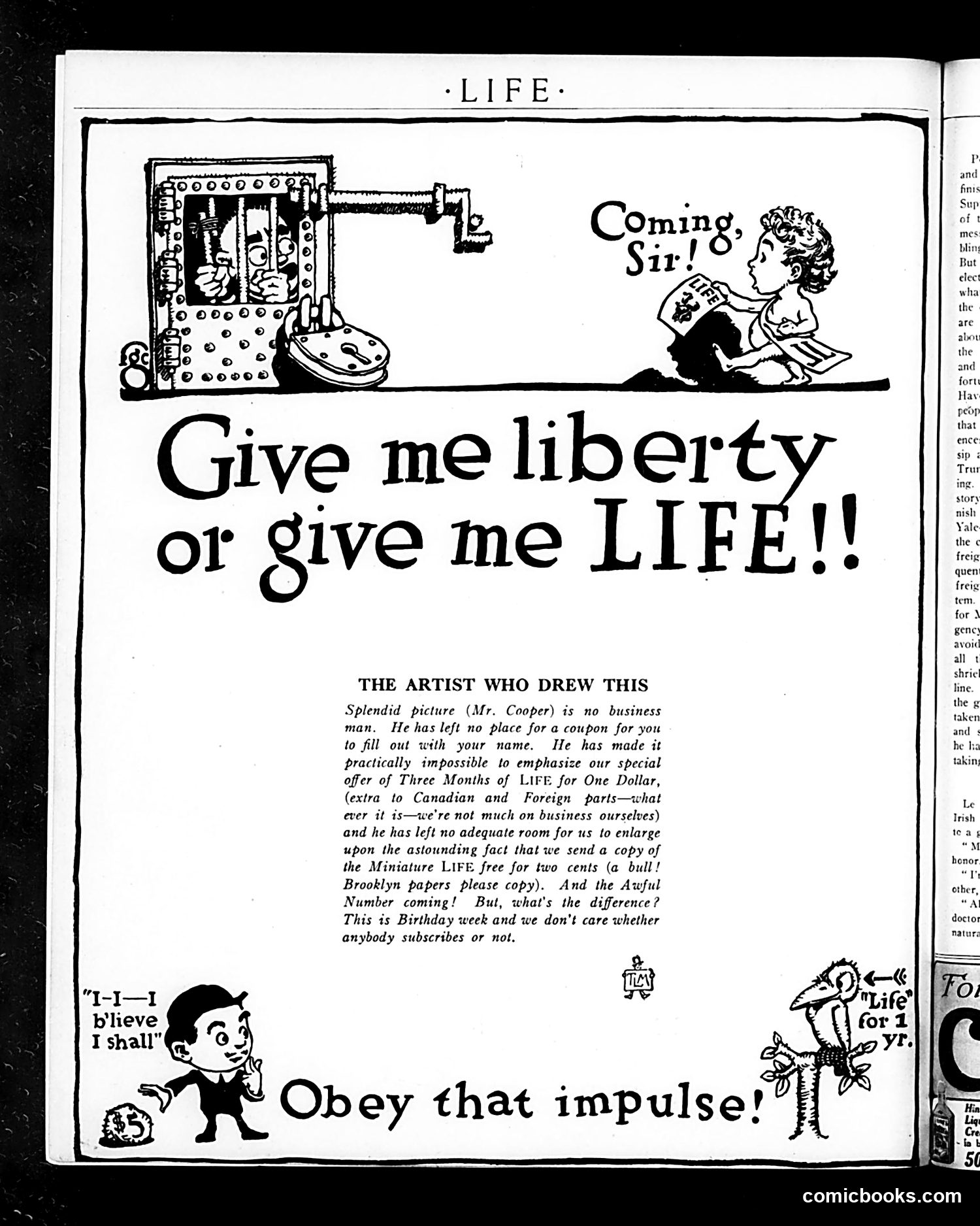
This Life magazine page is primarily an **advertisement for the magazine itself**, disguised as editorial content. The headline "Give me liberty or give me LIFE!!!" is a play on Patrick Henry's famous Revolutionary War quote, repurposing it as a subscription pitch. The text explains that artist Mr. Cooper created this illustration, and the magazine is leveraging his work to promote a special three-month subscription offer for one dollar (plus international postage). The note emphasizes Cooper "left no place for a coupon" and that Life doesn't care whether readers subscribe—it's their "Birthday week" special promotion. The cartoons at bottom ("I-I-I b'lieve I shall" and "Obey that impulse!") reinforce the sales message through visual humor, encouraging readers to act on the subscription offer.
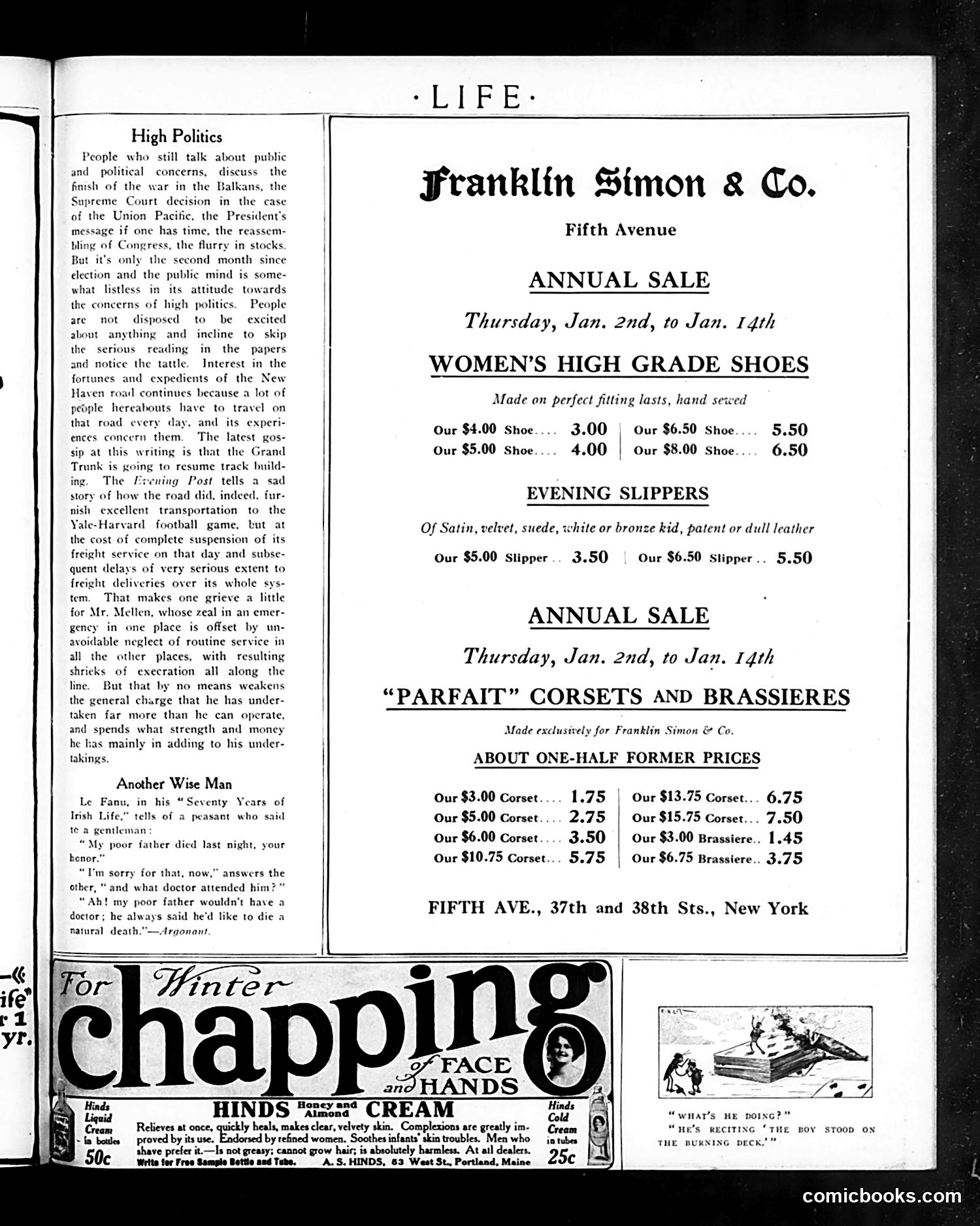
This page is primarily **advertising**, not political satire. The bulk consists of Franklin Simon & Co. department store ads for women's shoes, slippers, corsets, and brassieres during their January annual sale. The left column contains two brief opinion pieces under "High Politics" and "Another Wise Man"—satirical anecdotes about public indifference to serious political matters and Irish folk wisdom, respectively. These are light commentary rather than pointed political cartoons. At the bottom, a Hinds Honey and Almond Cream advertisement appears, with a small cartoon showing figures on a ship's deck (the caption references "The Boy Stood on the Burning Deck"), but this is just product marketing imagery, not political satire. Overall, this is a vintage magazine page mixing light editorial humor with commercial advertisements.
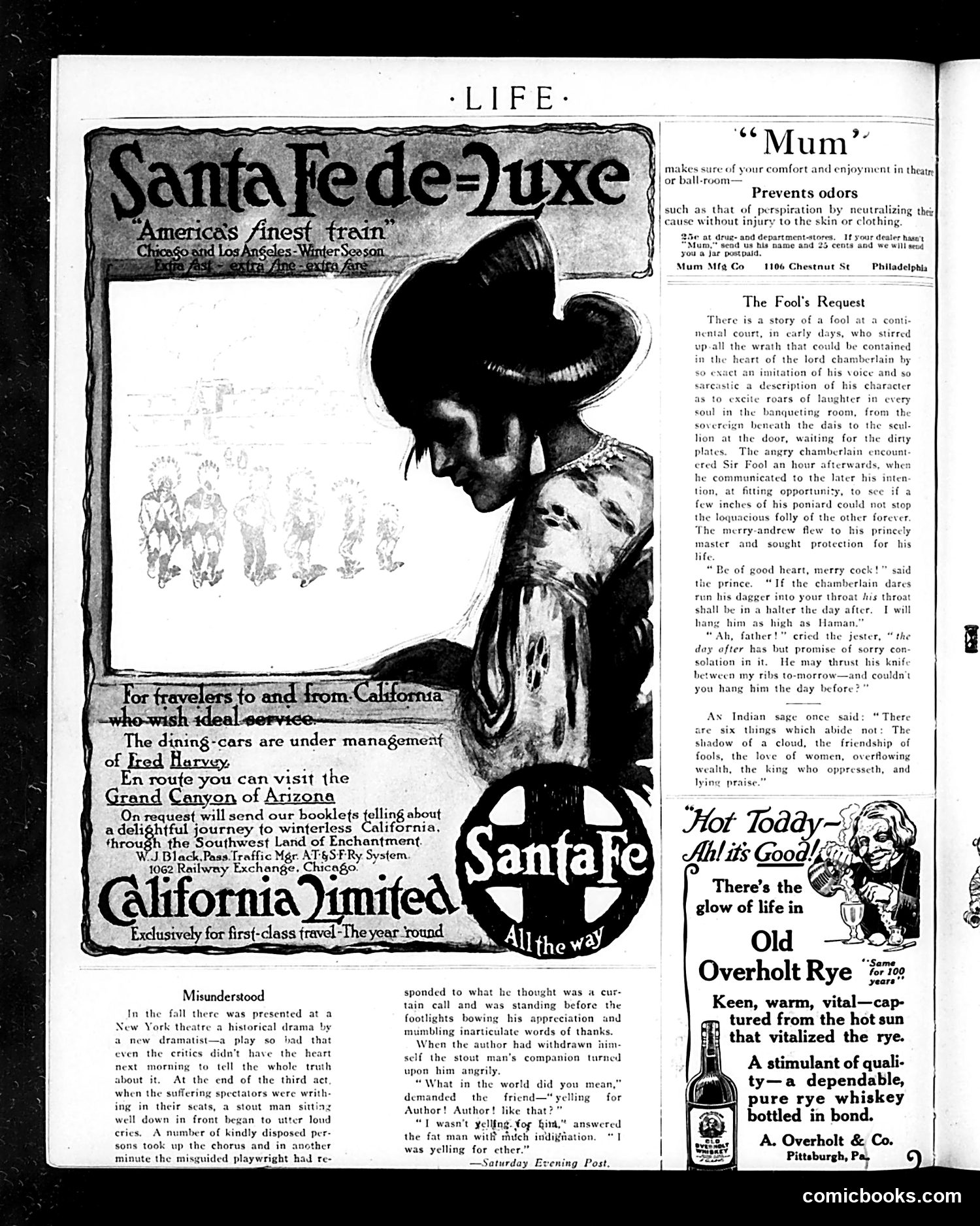
This page is primarily **advertising**, not satire. The dominant content features two Santa Fe Railway ads: the "Santa Fe de-Luxe" train advertisement (top left) prominently advertises luxury rail travel between Chicago and Los Angeles, emphasizing first-class service and dining cars managed by Fred Harvey. The "California Limited" ad (bottom left) similarly promotes southwestern travel, including Grand Canyon tours. The right side contains unrelated content: a "Mum" deodorant ad, a short story titled "The Fool's Request" (medieval in setting), another story fragment called "Misunderstood," and an "Overholt Rye" whiskey advertisement. There is no political cartoon or satire visible on this page—it represents typical early 20th-century magazine content mixing editorial material with paid advertising.
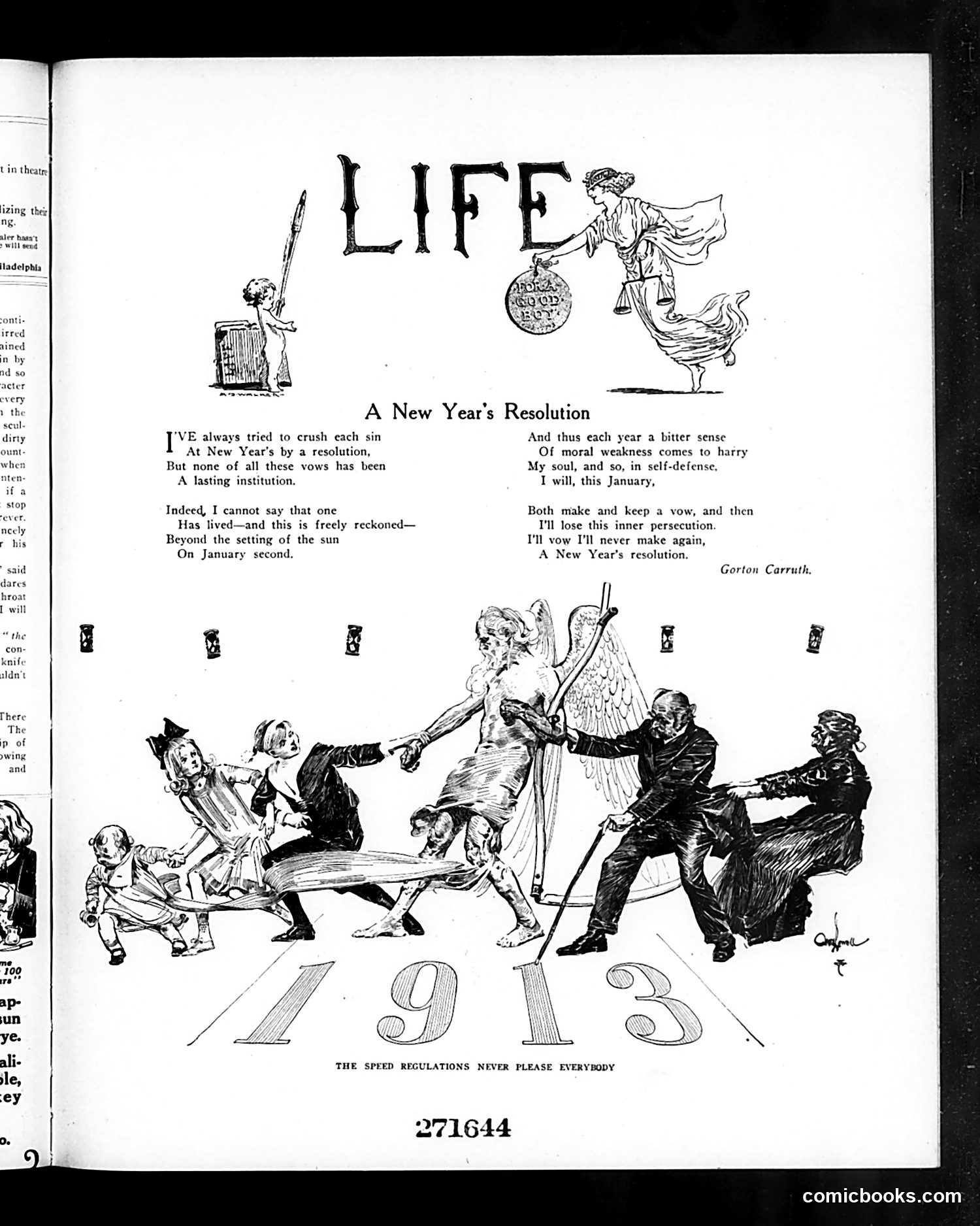
This page presents a poem by Gordon Carruth about making and breaking New Year's resolutions, accompanied by two satirical illustrations. The top vignettes show figures attempting to "crush sin" through yearly resolutions, which the poem suggests is futile—resolutions are historically "a lasting institution" that people never keep. The larger bottom illustration depicts an angelic figure being literally pulled apart by competing forces labeled 1913, with small devils and demons tugging in different directions. The caption "THE SPEED REGULATIONS NEVER PLEASE EVERYBODY" suggests this satirizes ongoing disputes over automobile speed laws during the 1910s era. The cartoon mocks how no matter what regulations are imposed, different groups remain unsatisfied—a timeless complaint about government policy.
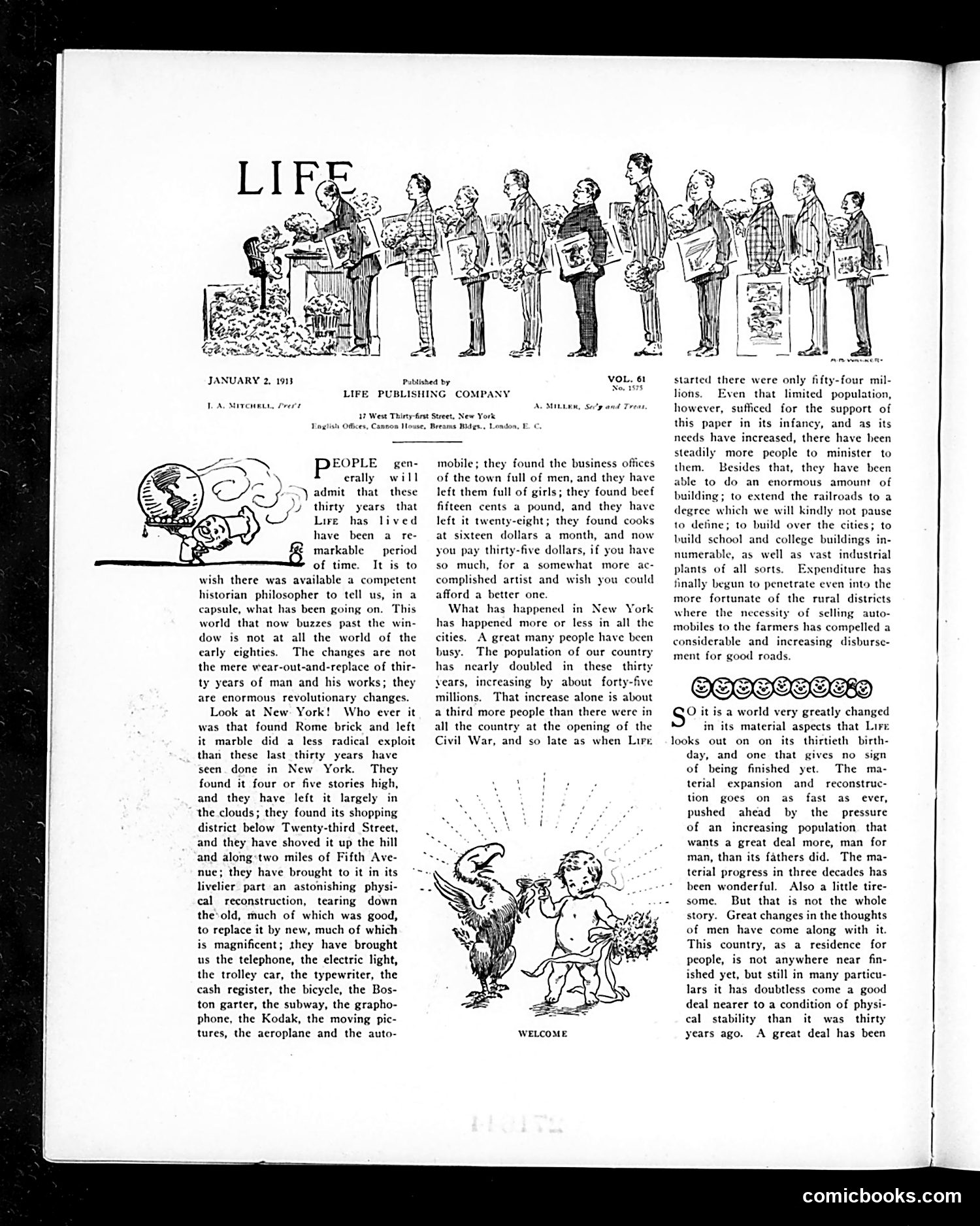
This is a celebratory New Year's editorial page marking Life's 31st birthday. The top illustration shows a line of businessmen in various professional attire carrying illustrated panels—likely representing Life's previous covers or satirical commentary on different industries and social classes. The main text celebrates America's dramatic transformation over thirty years: skyscrapers replacing brick buildings, new technologies (telephones, electric lights, automobiles, airplanes), and doubled population. The central cartoon depicts a stork delivering a baby labeled "WELCOME," symbolizing America's growth and optimistic future. The overall message expresses pride in American progress and modernization while acknowledging that material advancement hasn't fully resolved deeper social and philosophical questions about this rapidly changing nation.
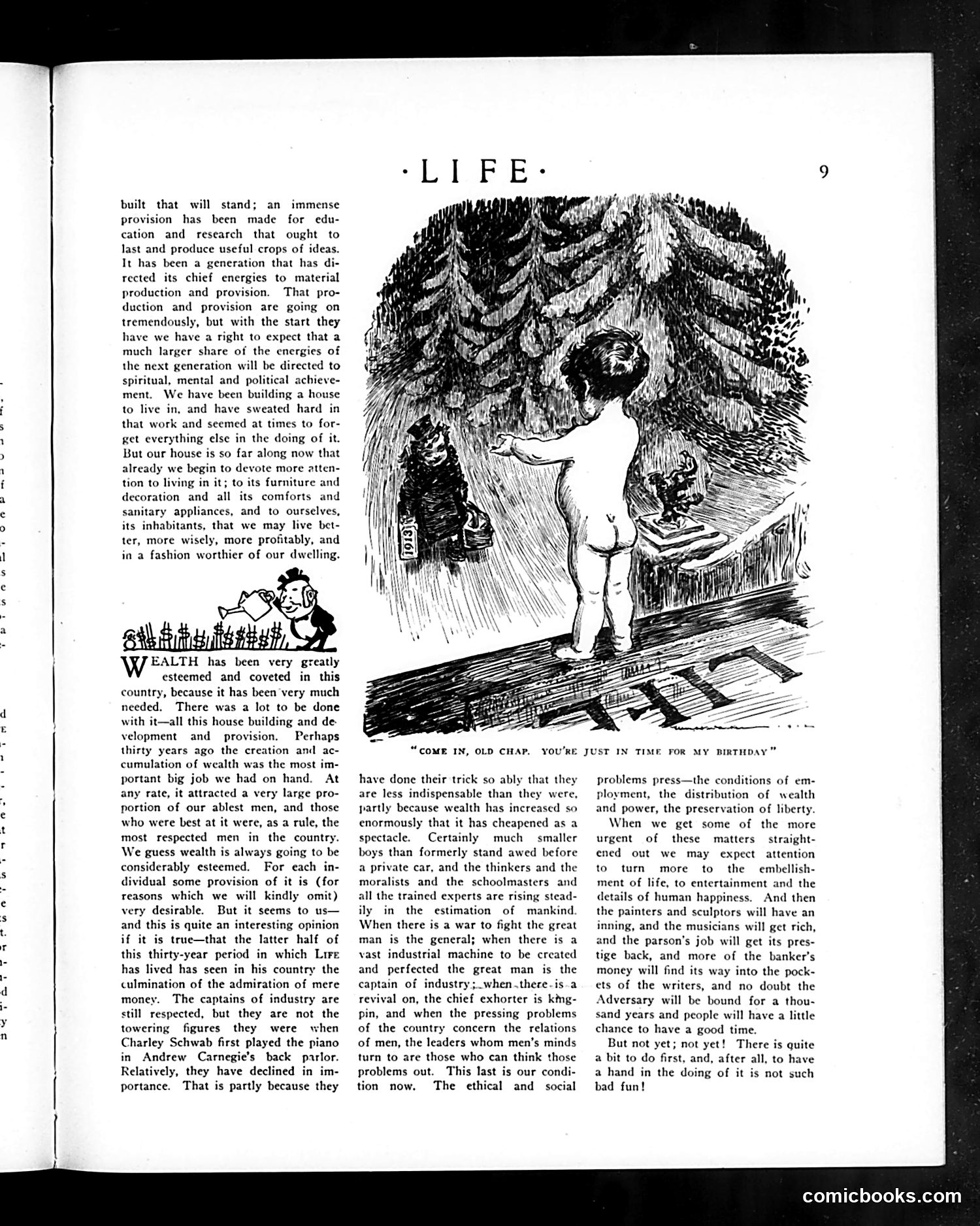
The main cartoon depicts a man entering what appears to be a cave or hollow tree, with the caption "COME IN, OLD CHAP, YOU'RE JUST IN TIME FOR MY BIRTHDAY." The illustration is a visual pun about wealth and hiding places. The accompanying text discusses how wealth has been greatly esteemed in America but has become "less indispensable" than before, and how many wealthy men have lost their fortunes. The cartoon satirizes the idea of the wealthy retreating into obscurity or "hiding out," suggesting that once-respected wealthy figures are now isolated and forgotten—literally living in caves like hermits, reduced from their former prominence. The humor relies on the contrast between the birthday celebration (typically a social, public occasion) and the remote, impoverished setting, mocking the fallen status of the wealthy.
This page contains a poem titled "Life to His Friends" by Edward S. Martin, addressing Life magazine's readership of "hundred thousand friends." The text is entirely literary—there are **no cartoons or caricatures visible** on this page. The poem defends Life's editorial approach: its role as "jester and critic" using satire and biting humor to critique society. Martin explains that Life's apparent irreverence actually serves a purpose—it exposes folly and absurdity while maintaining underlying principles of "justice and a decent heart." The poem suggests Life's satirical method, though sometimes harsh, comes from principled conviction rather than mere mockery. It's an meta-commentary justifying the magazine's own satirical mission to its audience.
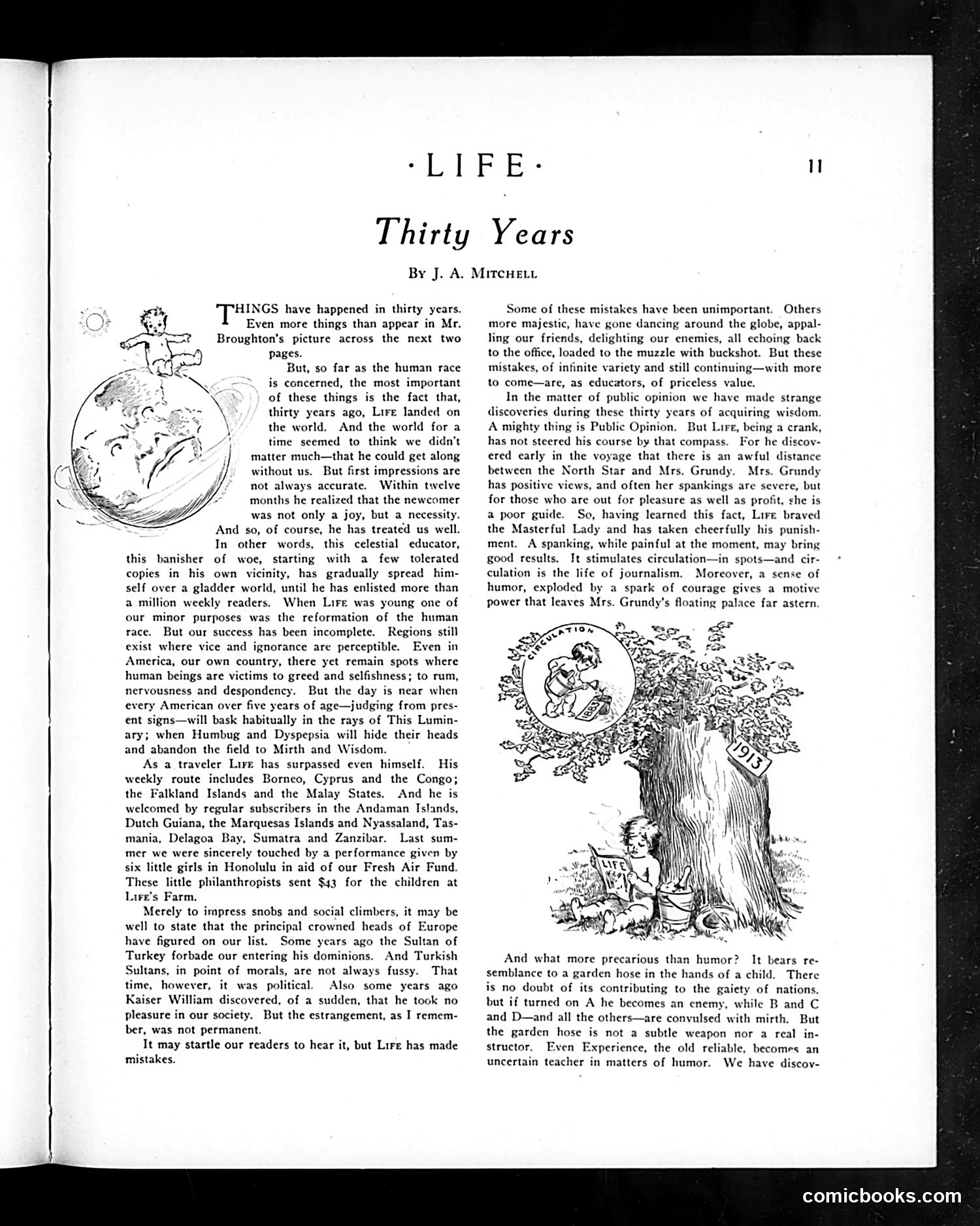
This editorial essay celebrates Life magazine's thirty-year history. The accompanying illustrations are decorative rather than political cartoons—showing whimsical figures (cherubs or children) associated with humor and satire. The text critiques Life's editorial approach: it admits the magazine has made "mistakes" over three decades but argues these served journalism's purpose. Mitchell defends Life's use of humor and satire, noting that public opinion ("Mrs. Grundy") can be an unreliable guide. He specifically mentions the Sultan of Turkey and Kaiser William as figures who opposed Life's influence, suggesting the magazine's satirical coverage had actual political consequences. The essay positions Life as an important educator using comedy to expose social ills and challenge authority.
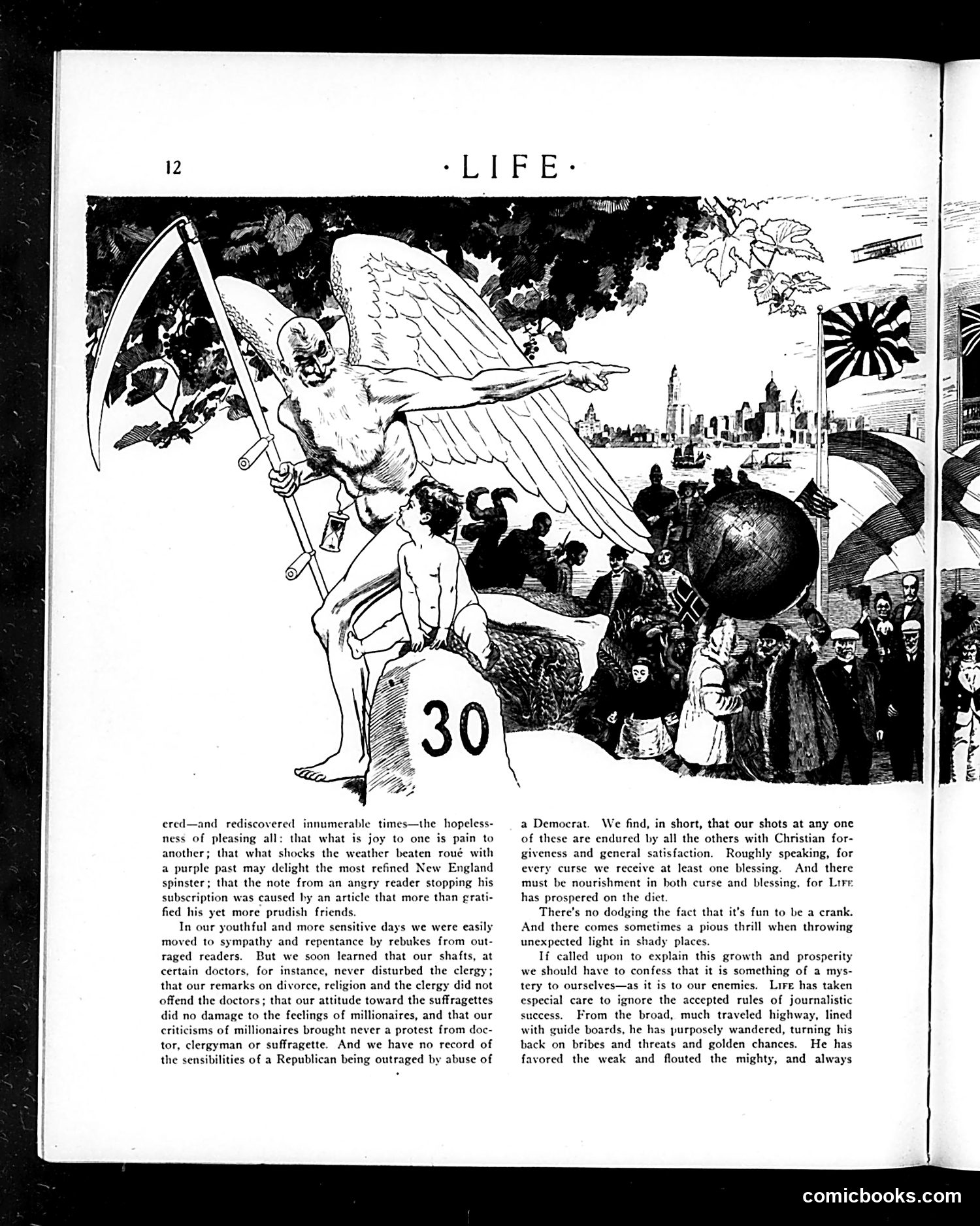
The central image depicts **Death (skeletal figure with scythe)** hovering over a naked cherub marked "30," overlooking a crowd below a cityscape. This appears to reference **mortality statistics or war casualties** numbered at 30. The accompanying text discusses Republican criticism of Democratic policies, mentioning "shots" that provoke responses and addressing debates over "divorce, religion and the clergy." The passage critiques how Republicans weaponize social issues while ignoring their own vulnerabilities. The cartoon likely satirizes **political exploitation of tragedy or statistics for partisan gain**—Death presiding as politicians below use casualty figures as ammunition in ideological disputes rather than addressing genuine suffering. The exact historical event referenced remains unclear without additional context.
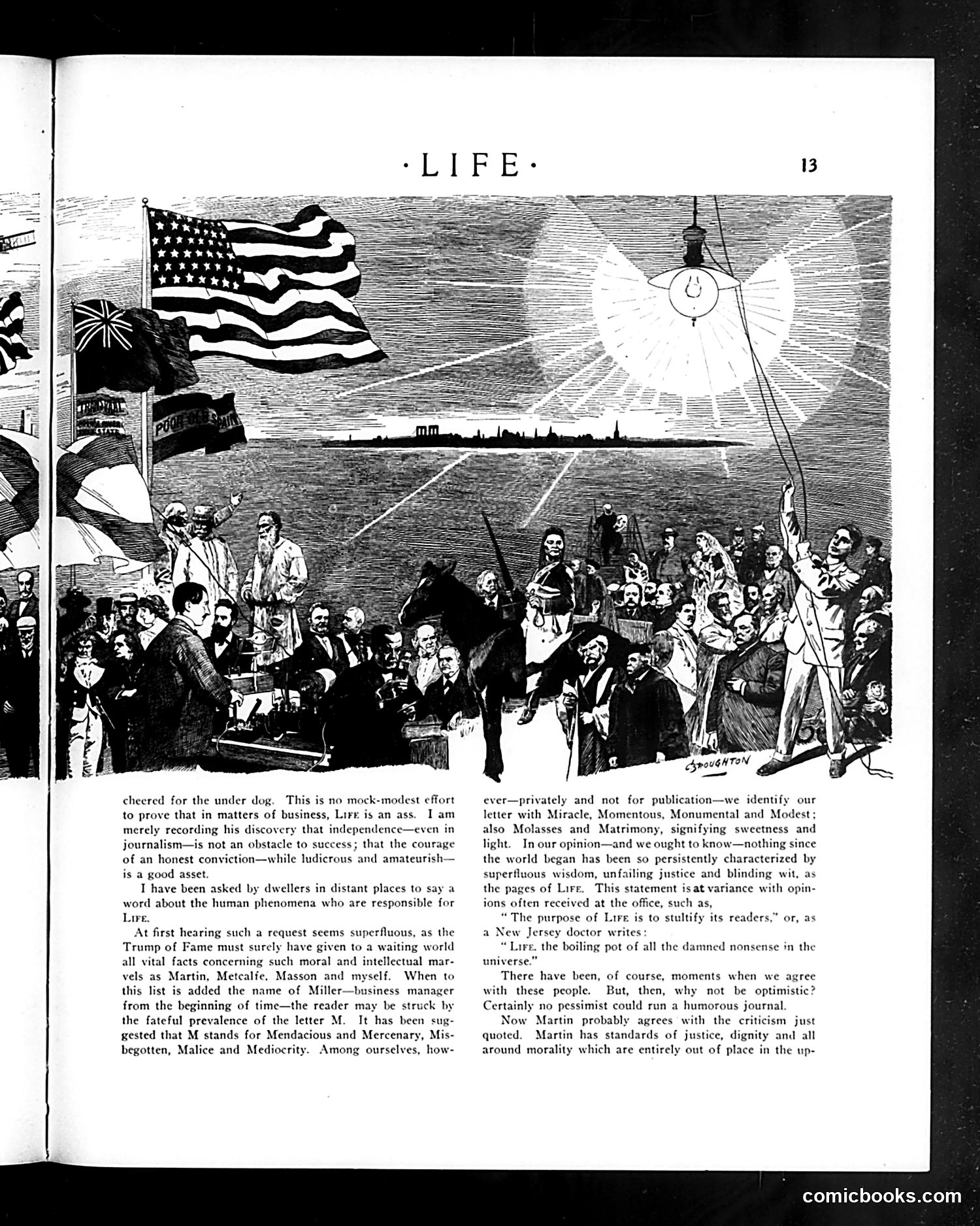
This is a satirical editorial illustration accompanying a defense of *Life* magazine's editorial standards. The large engraving depicts a crowded public gathering beneath an American flag and a radiant light (suggesting divine or enlightened guidance), with figures in formal dress and a prominent horse. The text defends *Life* against criticism that it's an "ass" in business matters, arguing instead that independence and courage—not obstacle-removal—drive journalistic success. It mentions the magazine's standards of "Miracle, Momentous, Monumental and Modest" while rejecting accusations of "superfluous wisdom, unfailing justice and blinding wit." The illustration likely represents *Life*'s self-image as a morally principled publication guiding American public discourse, though specific figures remain unclear without additional historical context.
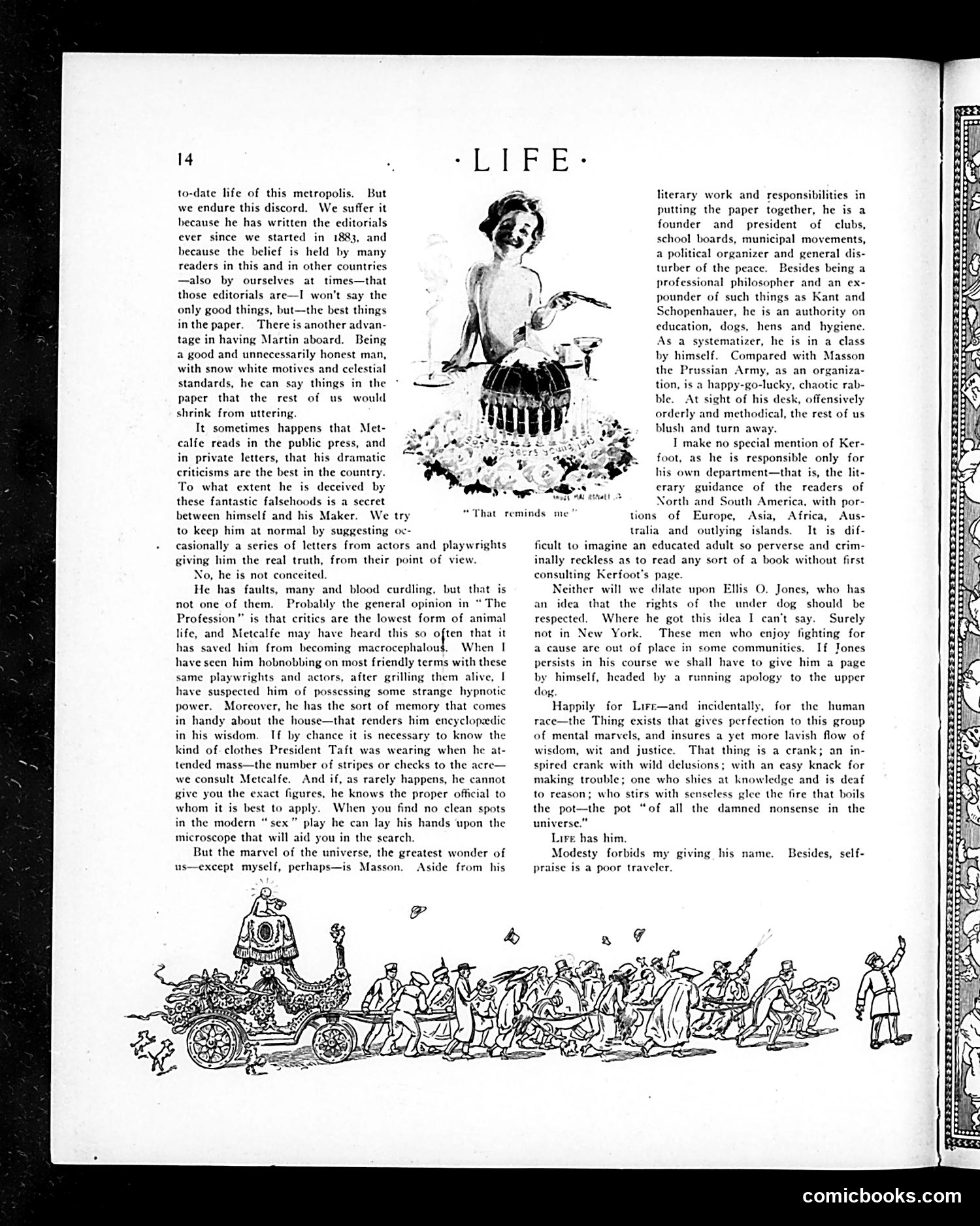
This page is primarily **textual commentary** rather than political cartoon. The main illustration shows a classical cherub or putto figure labeled "That reminds me" — a whimsical image unrelated to the surrounding text. The text discusses **editorial integrity** and attacks on the magazine's credibility. It defends the publication's "white white motives" against "fantastic falsehoods" circulated in private letters, and mentions criticisms from "actors and playwrights." The passage also critiques critics as "the lowest form of animal life," and discusses figures like **Masson** (appears to be a theatrical or literary figure) and **Ellis O. Jones**, defending their right to operate without interference. The **lower illustration** depicts a processional parade or ceremonial scene, its satirical meaning unclear without additional context. This appears to be **defensive editorial commentary** rather than satirical political content.
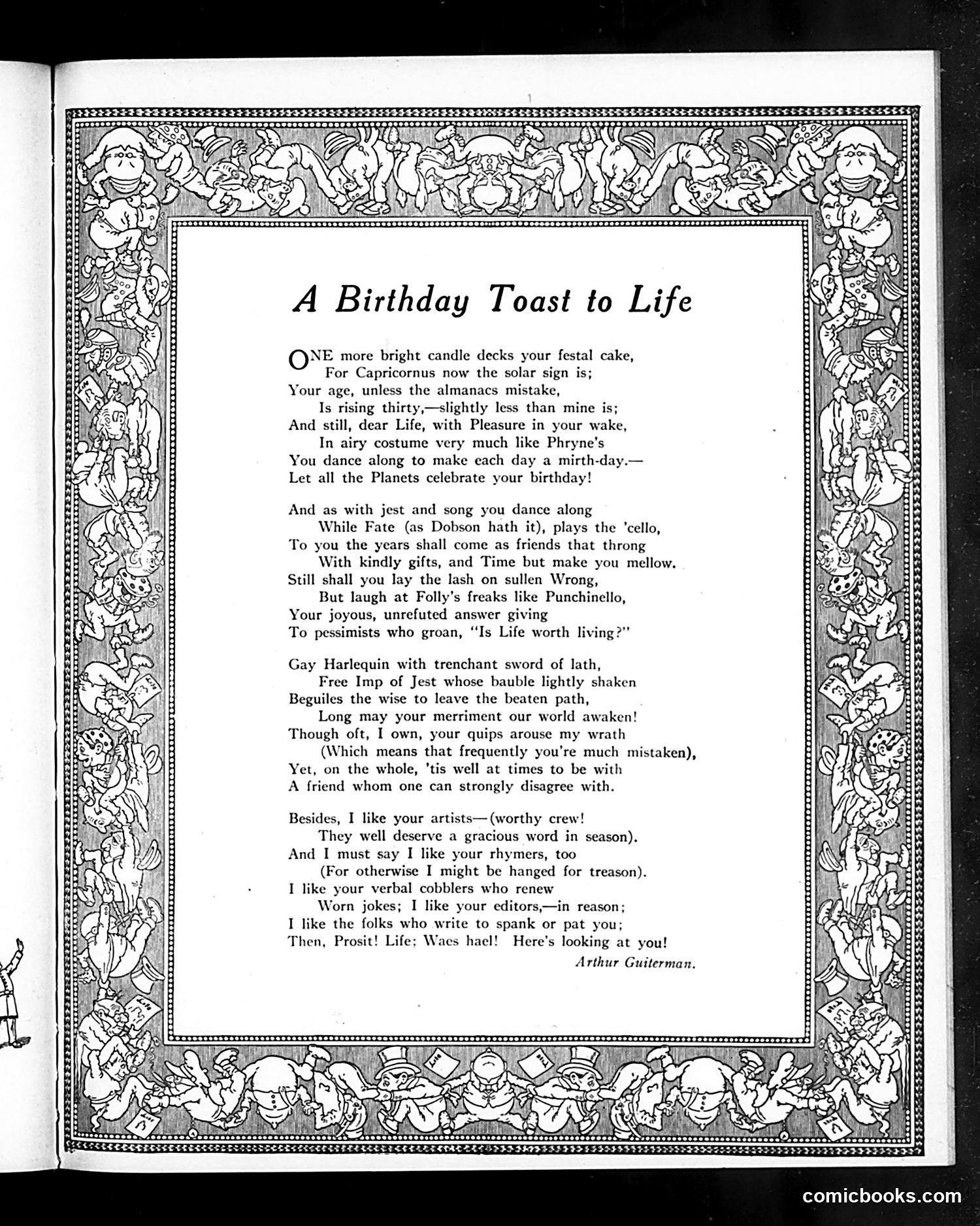
This is not a cartoon but a celebratory poem by Arthur Guiterman, apparently written for *Life* magazine's birthday (the publication, not a person). The poem personifies *Life* as a theatrical character—specifically invoking **Phryne** (an ancient Greek courtesan), **Harlequin** (commedia dell'arte trickster), and **Punchinello** (stock comedic fool). Guiterman's satire targets philosophical pessimism of the era (referenced in "Is Life worth living?") by championing *Life* magazine itself as the antidote: irreverent, artistic, witty, and unafraid to provoke disagreement. He praises the publication's contributors—artists, poets, editors, and readers—while gently mocking the magazine's tendency toward mischievous provocation ("your quips arouse my wrath"). The elaborate decorative border reinforces this as a special celebration. It's fundamentally an in-house toast celebrating the magazine's identity as sophisticated humor and social commentary.
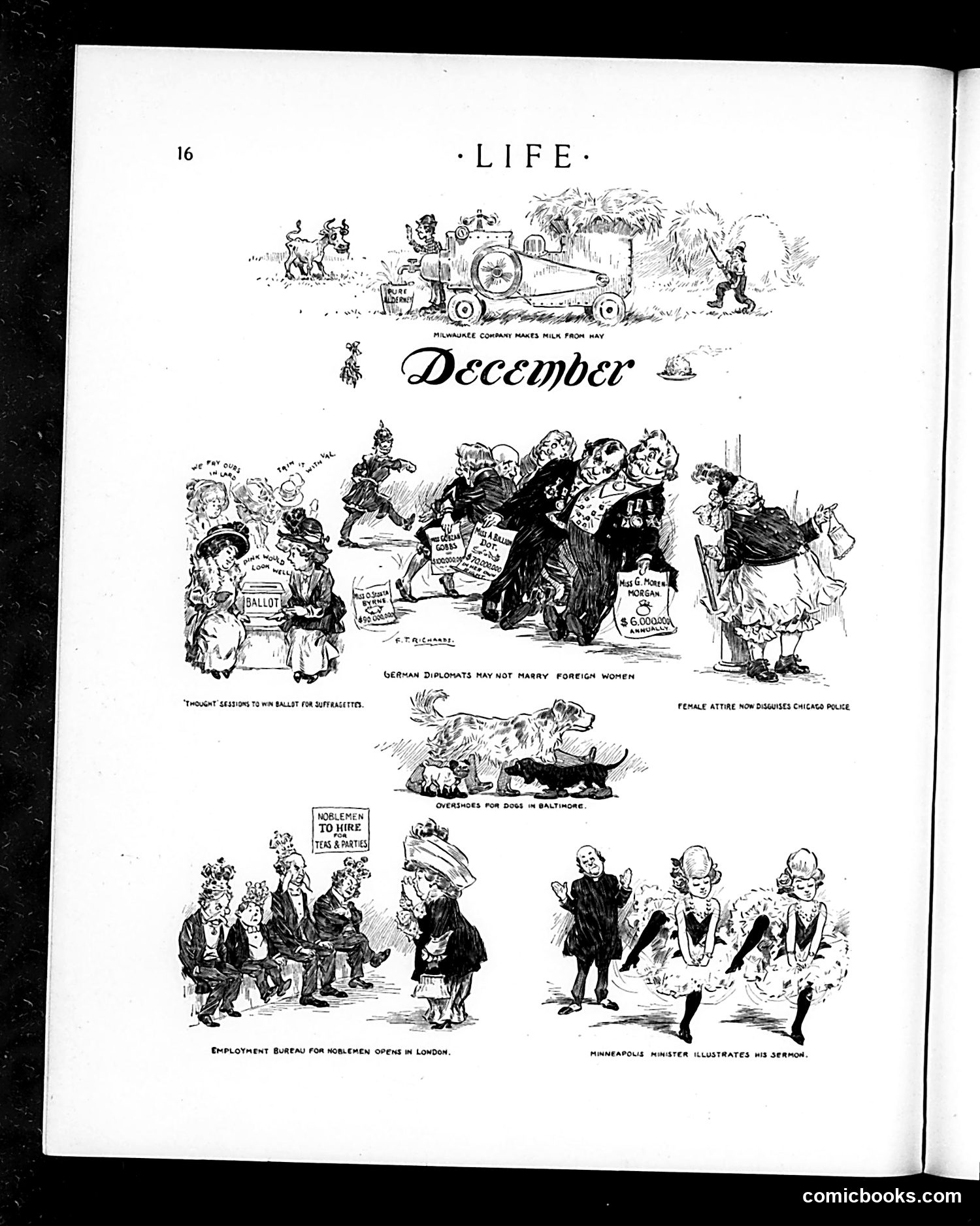
This page contains six satirical sketches on various contemporary issues: 1. **Top**: A Milwaukee dairy company's absurd claim to produce milk from hay—mocking dubious commercial claims. 2. **Center**: "German Diplomats May Not Marry Foreign Women"—caricaturing German diplomatic restrictions as overly rigid and dehumanizing. 3. **Left middle**: "Thought Sessions to Win Ballot for Suffragettes"—referring to women's suffrage activism, depicting suffragettes as eccentric. 4. **Right middle**: "Female Attire Now Disguises Chicago Police"—suggesting women police officers were difficult to identify by appearance. 5. **Bottom left**: "Employment Bureau for Noblemen Opens in London"—satirizing European aristocracy as economically obsolete, needing employment agencies. 6. **Bottom right**: "Minneapolis Minister Illustrates His Sermon"—apparently showing clergy using unusual visual aids in religious instruction. The page reflects early-20th-century anxieties about changing social roles, women's rights, and class upheaval.
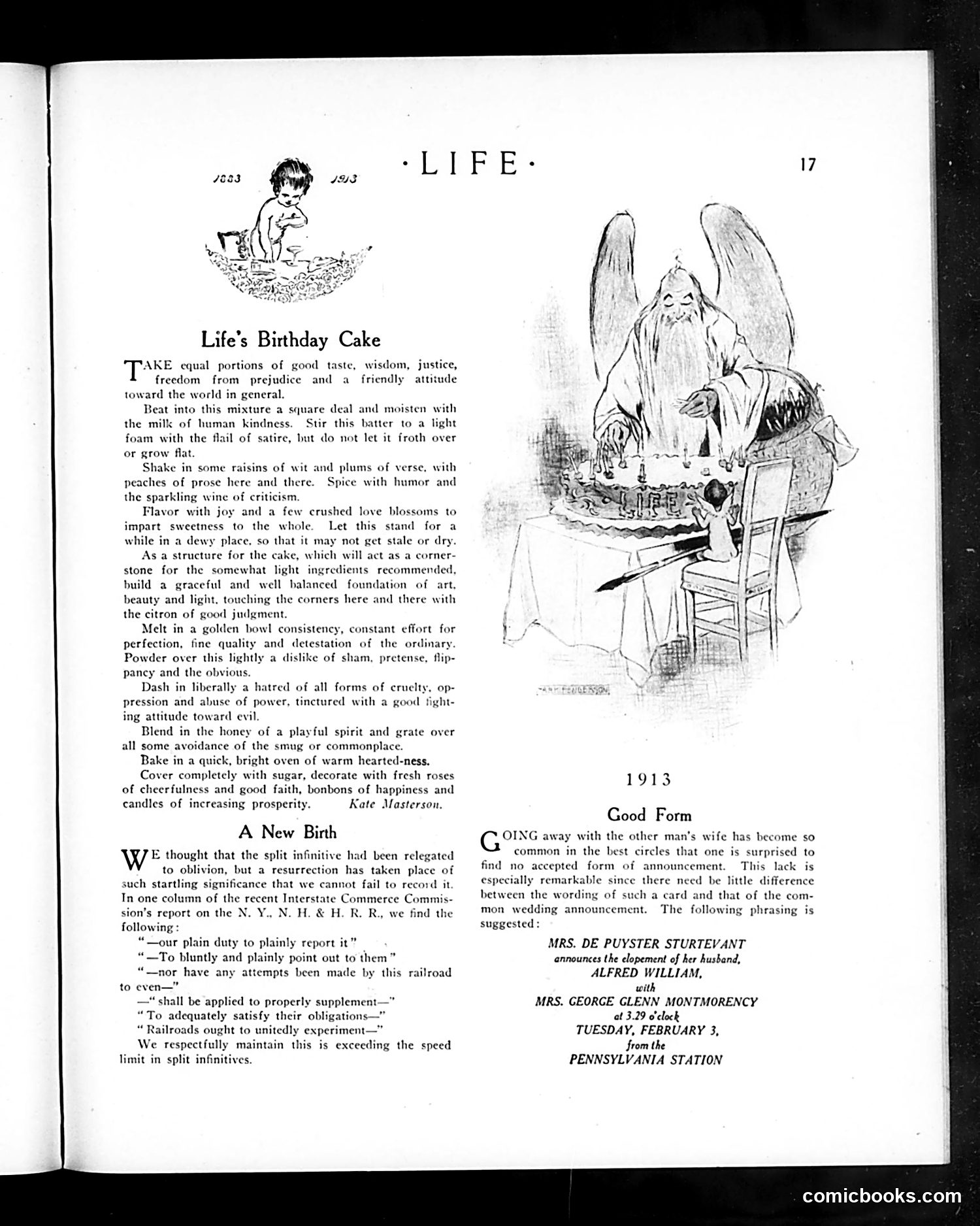
This page contains three satirical pieces typical of Life's social commentary: 1. **"Life's Birthday Cake"** (recipe format): A whimsical metaphorical recipe by Kate Masterson describing Life magazine's editorial ingredients—wisdom, justice, satire, art, and humor—presented as if baking a cake. It's self-promotional satire about the magazine's own values. 2. **"A New Birth"** (grammar satire): Mocks the Interstate Commerce Commission's recent railroad report for egregiously violating the rule against split infinitives (placing adverbs between "to" and verbs). The magazine sarcastically notes this "exceeding the speed limit in split infinitives." 3. **"Good Form"** (social satire): The most biting piece. It mockingly suggests a formal announcement card for infidelity—a husband eloping with another woman—written as if it were a standard wedding announcement. This satirizes wealthy society's casual treatment of marital scandals and the absurdity of needing "proper form" for improper behavior.
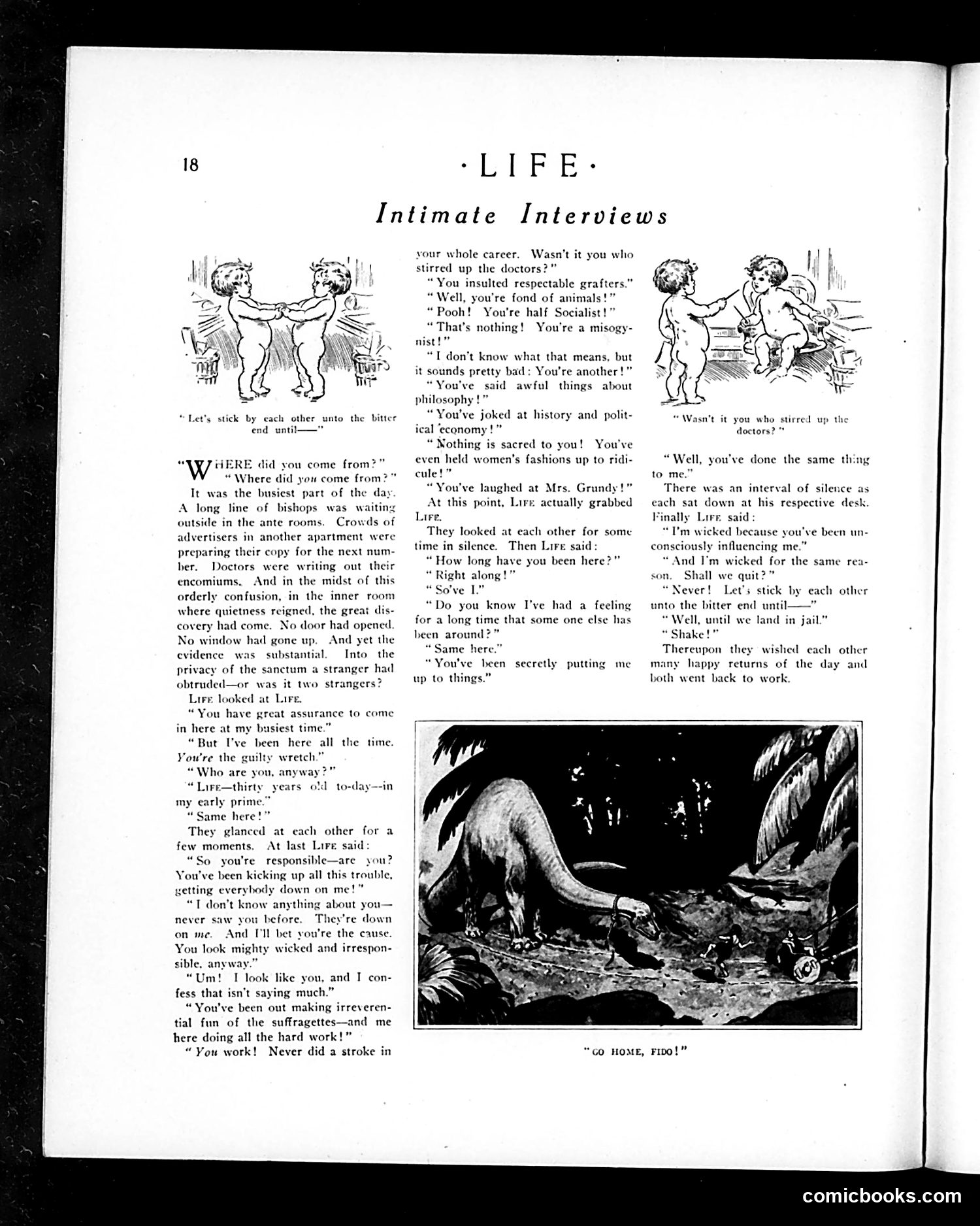
This page presents a satirical dialogue between two personified versions of "Lire" (likely representing Life magazine itself, or competing editors/voices within it). The two figures accuse each other of stirring up trouble—mocking doctors, grafters, socialists, suffragettes, philosophers, historians, and Mrs. Grundy (a symbol of conventional propriety). The joke turns on mutual recognition: each discovers the other is their exact duplicate, equally guilty of irreverent provocations. Rather than blame each other, they realize they've been unconsciously corrupting one another through shared influence. The satire critiques Life magazine's own contradictory positions—attacking multiple targets simultaneously while claiming moral authority. The resolution ("let's stick together") mockingly suggests complicity: the magazine's various satirical attacks stem from internal confusion, not principled consistency. The bottom illustration "GO HOME, FIDO!" appears unrelated—a dog or animal scene, possibly a separate feature.
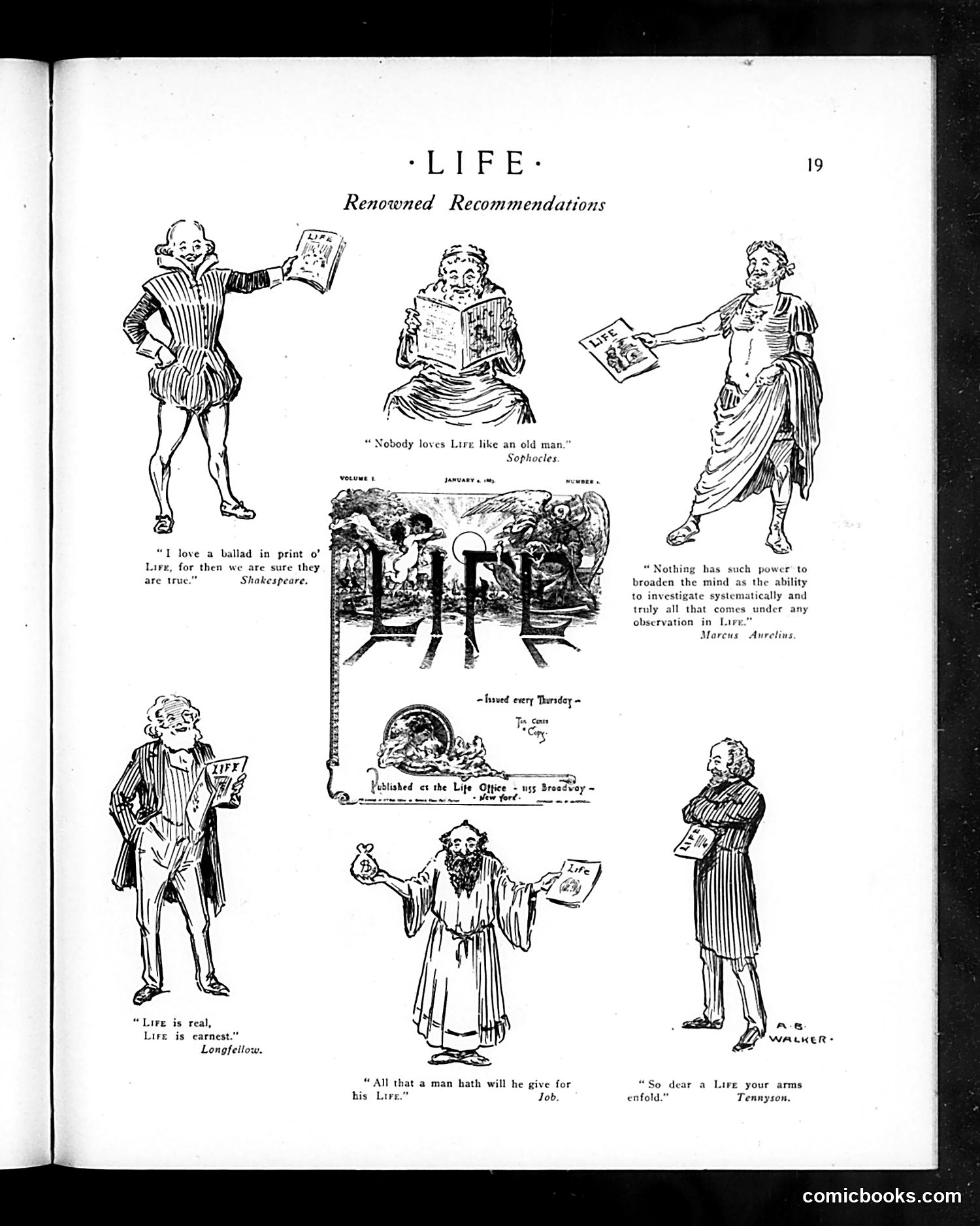
This page celebrates *Life* magazine itself through satirical "endorsements" attributed to famous literary figures—Shakespeare, Sophocles, Marcus Aurelius, Longfellow, Job, and Tennyson. Each quote is paired with a cartoon figure holding a *Life* publication, suggesting these historical/classical authorities recommend the magazine. The humor lies in the absurdity: these serious philosophers and poets are depicted endorsing a contemporary satirical magazine as if it were profound literature worthy of their praise. The contrasting quotes about "life" (existence, reality, earnestness) are cleverly repurposed to praise *Life* (the publication). This is self-promotional satire—*Life* mocks its own importance by pretending major historical figures would endorse it. The cartoonist (A.B. Walker, per signature) uses classical authority ironically, suggesting that reading *Life* offers wisdom comparable to studying great literature.
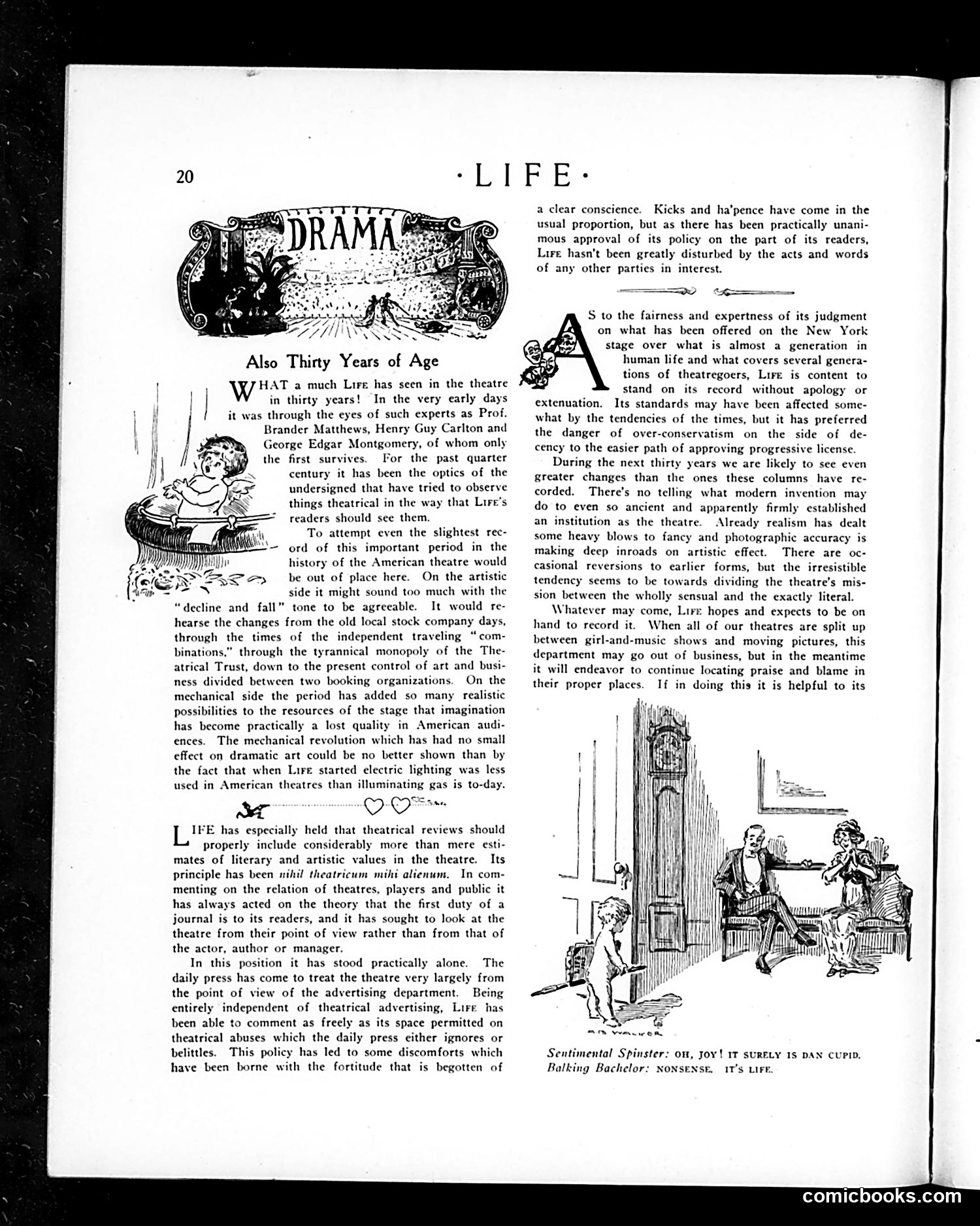
This is an **editorial essay** marking *Life* magazine's 30th anniversary covering American theatre, not primarily a political cartoon page. The small illustration at bottom shows a domestic scene with the caption "Sentimental Spinster" and "Balking Bachelor"—a light satirical sketch about romantic tension, not political commentary. The main text defends *Life*'s theatre criticism approach: it claims independence from theatrical industry advertising (unlike daily newspapers), judges shows by audience perspective rather than professionals', and has maintained moral standards against "progressive license." The essay references real theatrical history—the shift from stock companies to the "Theatrical Trust" monopoly to modern booking organizations—and notes technological change (electric lighting replacing gas). The satire is subtle: *Life* positions itself as the ethical arbiter of theatre, standing "practically alone" against press corruption and theatrical excess. This reflects turn-of-century Progressive-era rhetoric about independent journalism fighting special interests. Modern relevance: concerns about critical independence, industry influence on media, and entertainment standards remain timely.
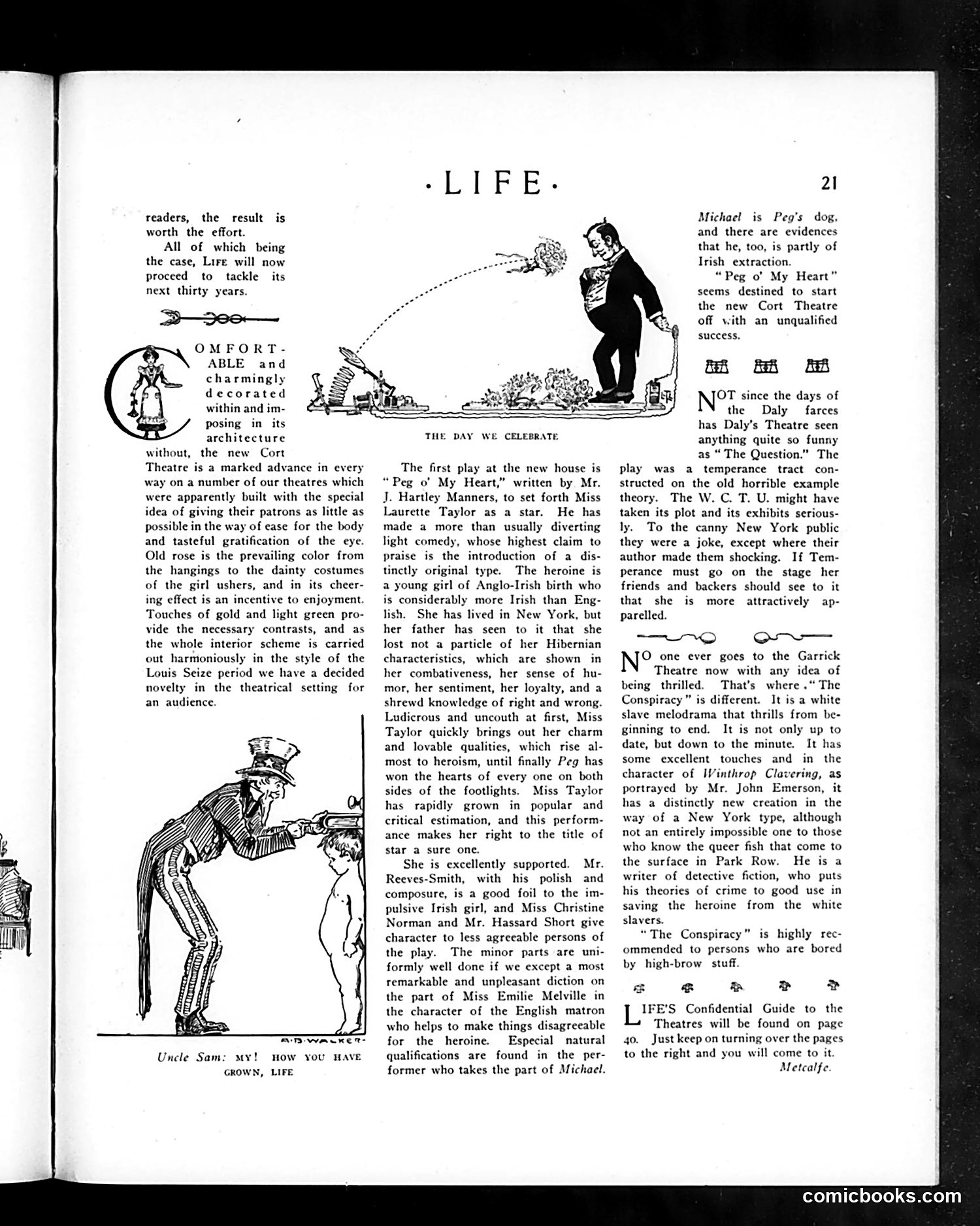
This page reviews several Broadway theatrical productions. The main cartoon depicts **Uncle Sam** (representing America/Life magazine itself) as a child, with the caption "my! how you have grown, life"—a self-congratulatory joke about the magazine's growth and influence. The page primarily discusses the opening of the new **Cort Theatre** and its inaugural production, **"Peg o' My Heart,"** starring **Laurette Taylor**. The review praises both the theater's elegant Louis XVI design and the play itself, which features a distinctly Irish-American female character. Additional reviews cover **"The Question"** (a temperance melodrama the critics found unintentionally comedic) and **"The Conspiracy"** (a white-slave trafficking thriller at the Garrick Theatre). The tone is characteristic of Life's satirical theater criticism—witty, sometimes dismissive, focused on social relevance and performance quality.
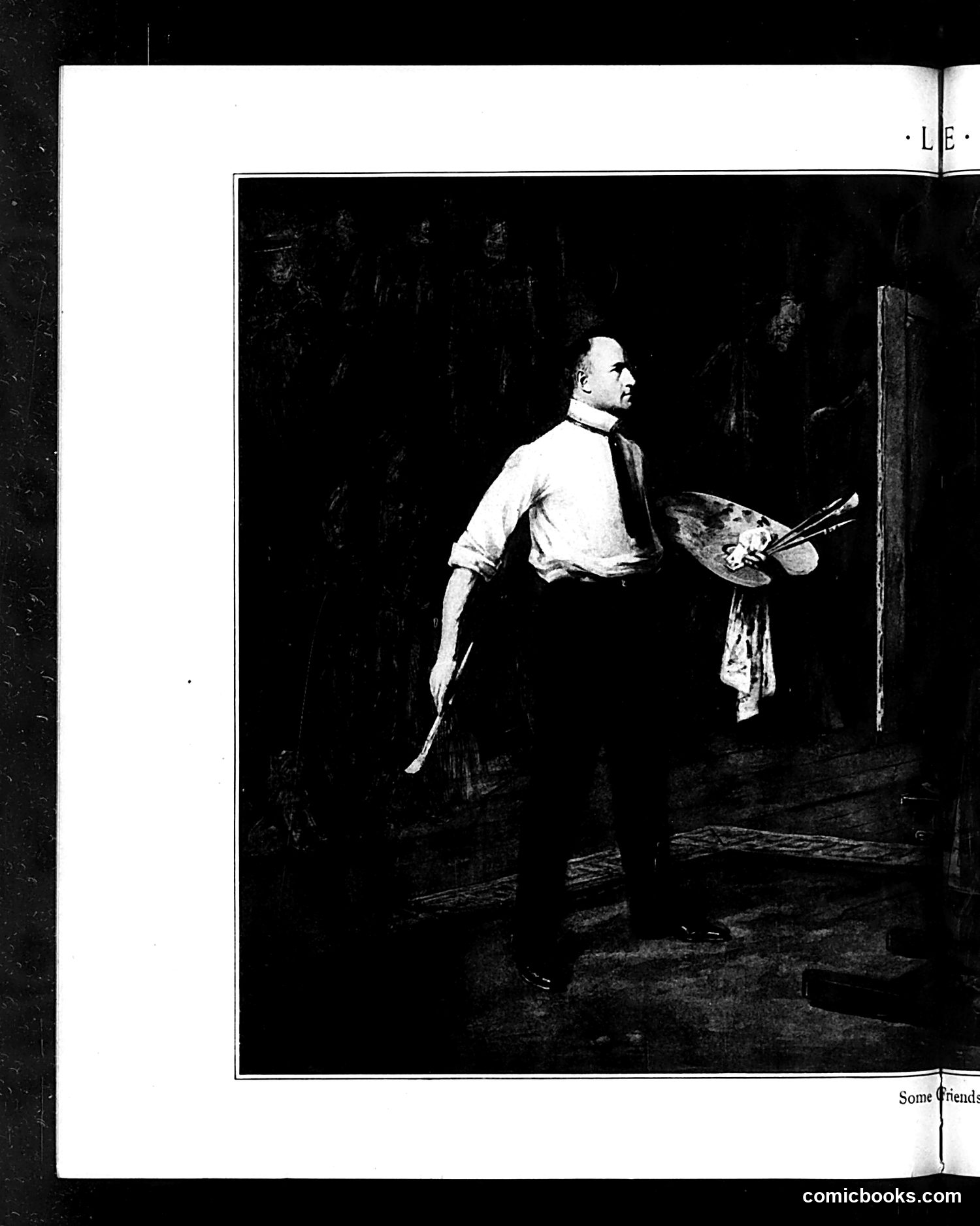
This black and white photograph shows a man in a studio setting, holding painting supplies (palette and brushes). He's dressed in working clothes—rolled-up sleeves and a tie—positioned as if actively engaged in artistic work. The dramatic lighting and dark background suggest this is a staged portrait meant to convey the subject as a serious artist or creative professional. The partial text visible reads "Some friends," though the full context is unclear from this page fragment. Without additional OCR text or identifying captions, I cannot definitively identify who this person is or what specific political or social satire this represents. The image appears to be from an early 20th-century publication, but the satirical intent remains unclear without more contextual information.
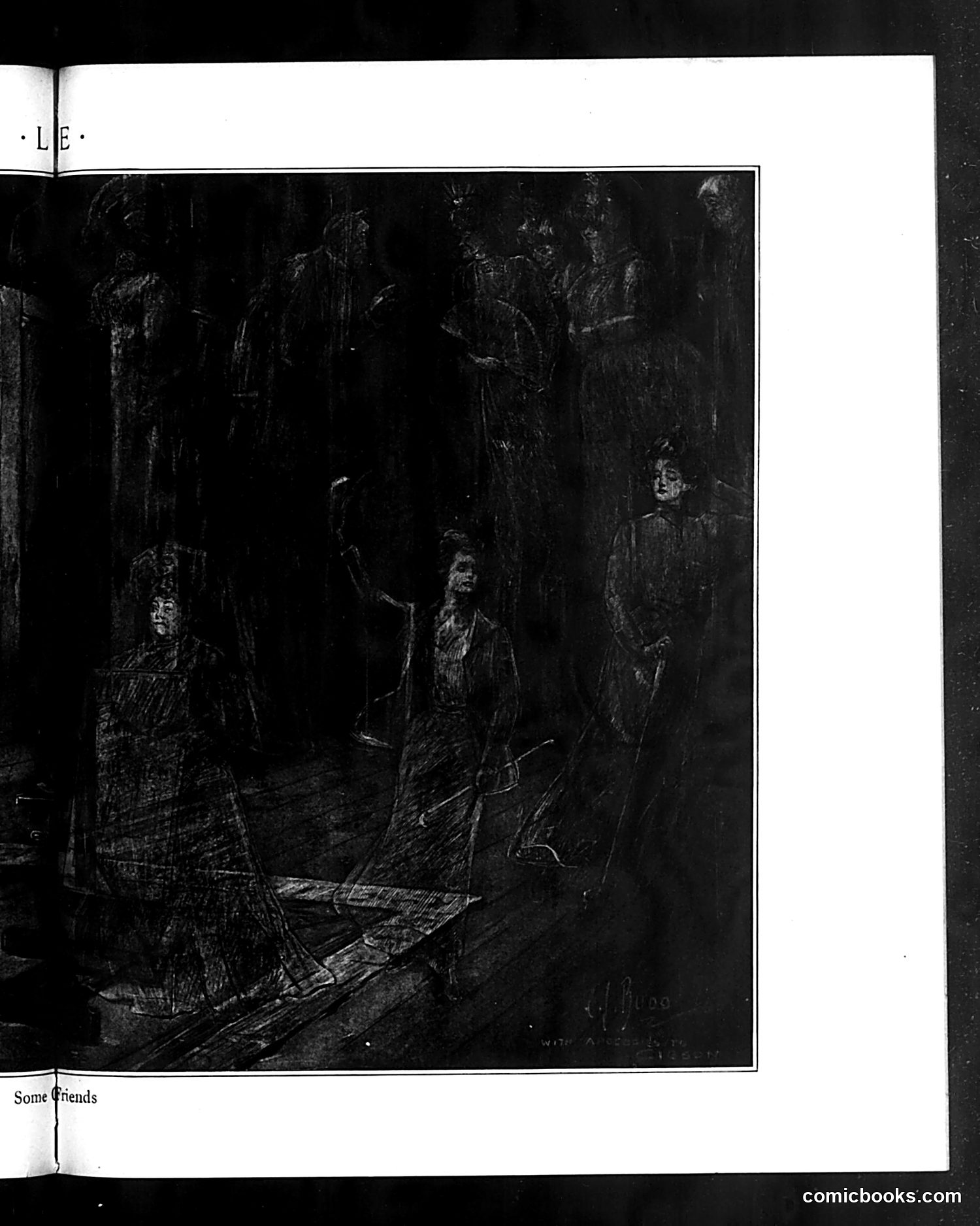
This page appears to be from a historical archive rather than the original Life magazine publication. The image shows a dark, atmospheric scene with multiple figures in what seems to be an interior setting—possibly depicting a theatrical or dramatic moment. The figures are rendered in heavy shadow and detail work. However, without legible text accompanying the image on this page, I cannot reliably identify the specific figures, historical event, or satirical intent. The caption reads only "Some Friends," which is too vague to determine the cartoon's subject or political/social commentary. The poor reproduction quality makes specific details difficult to discern. To provide accurate historical context, I would need clearer OCR text or additional identifying information about the publication date and source.
This is a literary criticism page, not a political cartoon. The main content reviews Edith Wharton's novel *"The Reef"* (Appleton's, $1.30), praising her sophisticated prose style and technical skill. The reviewer compares it favorably to her earlier work *"The House of Mirth,"* noting she has achieved greater "refinement of technical resource" while maintaining emotional depth—a progression the critic celebrates. The page also lists other contemporary books reviewed elsewhere, including works by Jean Webster, H.G. Wells, and John Galsworthy. There's a small decorative "Confidentially Book Guide" illustration in the center, but it's ornamental rather than satirical. This is essentially a serious literary supplement from an era when *Life* magazine served educated readers interested in book reviews alongside its better-known humor and satire content.
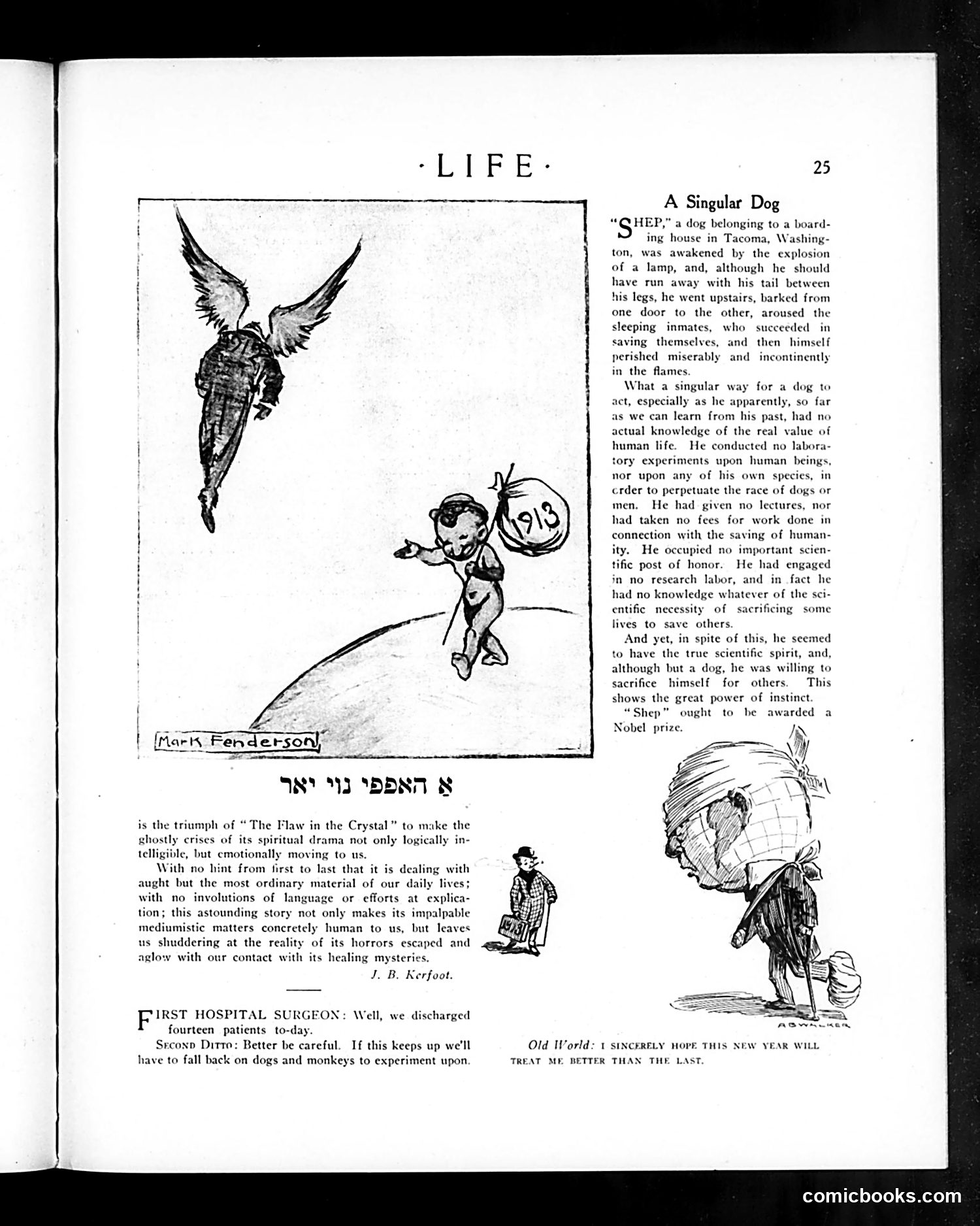
This page satirizes scientific and academic pretension through ironic contrast. The main article describes "Shep," a dog in Tacoma who died saving boarding house residents from a fire—acting heroically without formal training, credentials, or scientific knowledge. The satire targets the era's obsession with credentialism and experimental methodology. Life mocks scientists and academics who demand credentials, published research, and institutional positions to justify moral action. The article suggests Shep possessed genuine "scientific spirit" and selflessness that actual scientists, despite their degrees and laboratories, often lack. The hospital surgeons' joke below reinforces this: they've discharged so many patients they may need to experiment on "dogs and monkeys" instead—implying human subjects are becoming scarce, a dark jab at medical experimentation ethics of the period. The artist, Mark Fenderson, uses this to critique empty intellectualism: pure instinct and compassion matter more than credentials.
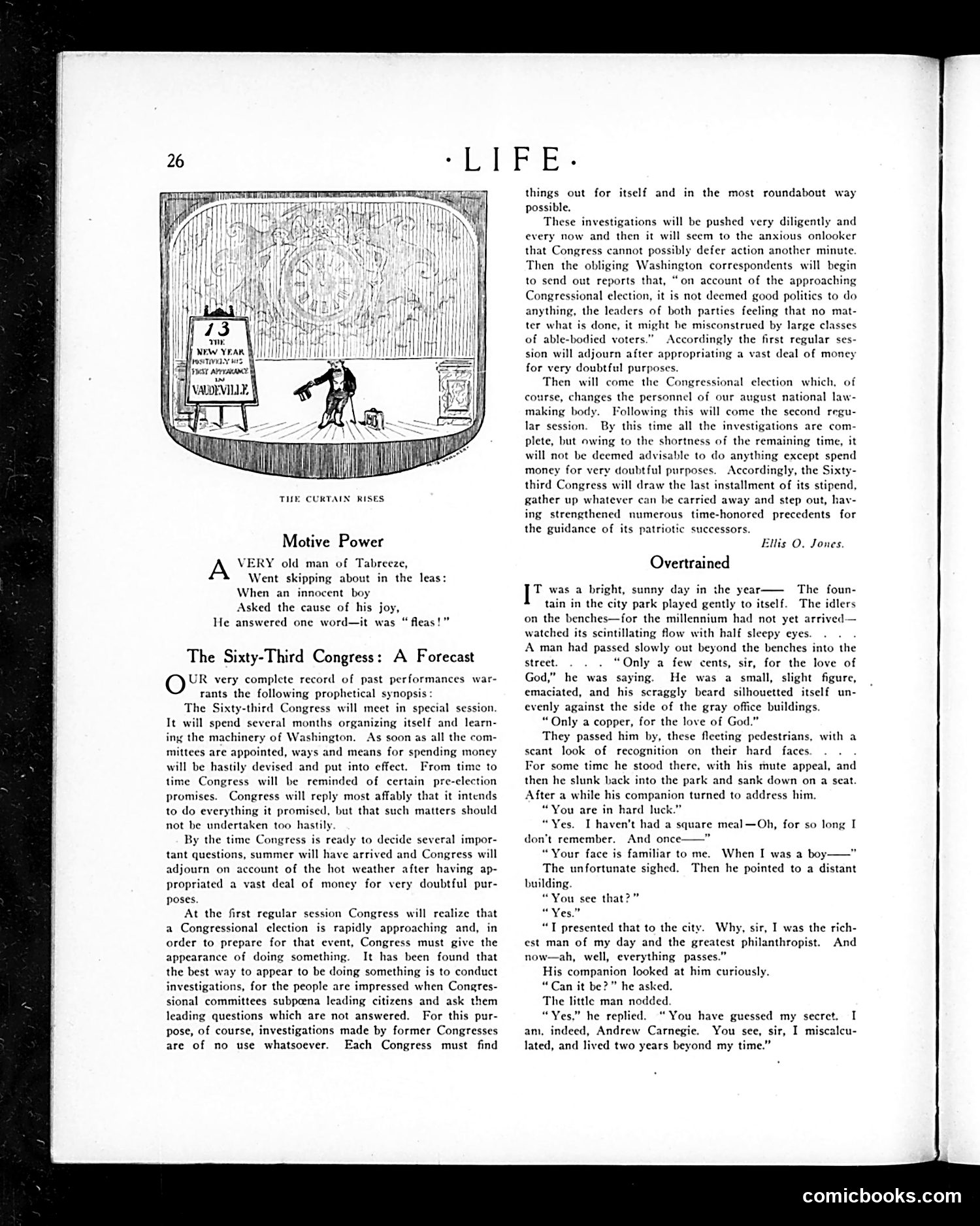
**The Cartoon ("The Curtain Rises"):** A vaudeville stage setup illustrating the joke about an old man from Tabriz who skips about because of fleas—a crude pun suggesting parasites as "motive power." This reflects Life's satirical use of theatrical framing. **"The Sixty-Third Congress: A Forecast":** This is the page's main satirical piece. It lampoons the incoming 63rd Congress as perpetually dysfunctional: committees spend months organizing, promise pre-election reforms they never enact, adjourn for summer heat before accomplishing anything, then conduct pointless investigations timed to appear productive before the next election. The satire attacks Congress for endless procedure without substance, strategic delays blamed on electoral concerns, and wasteful appropriations—suggesting the institution prioritizes re-election over governance. **"Overtrained":** A brief fictional story about a poor man begging in a city park, appears unrelated to the political content. The page reflects Progressive-era skepticism toward legislative effectiveness and political cynicism.
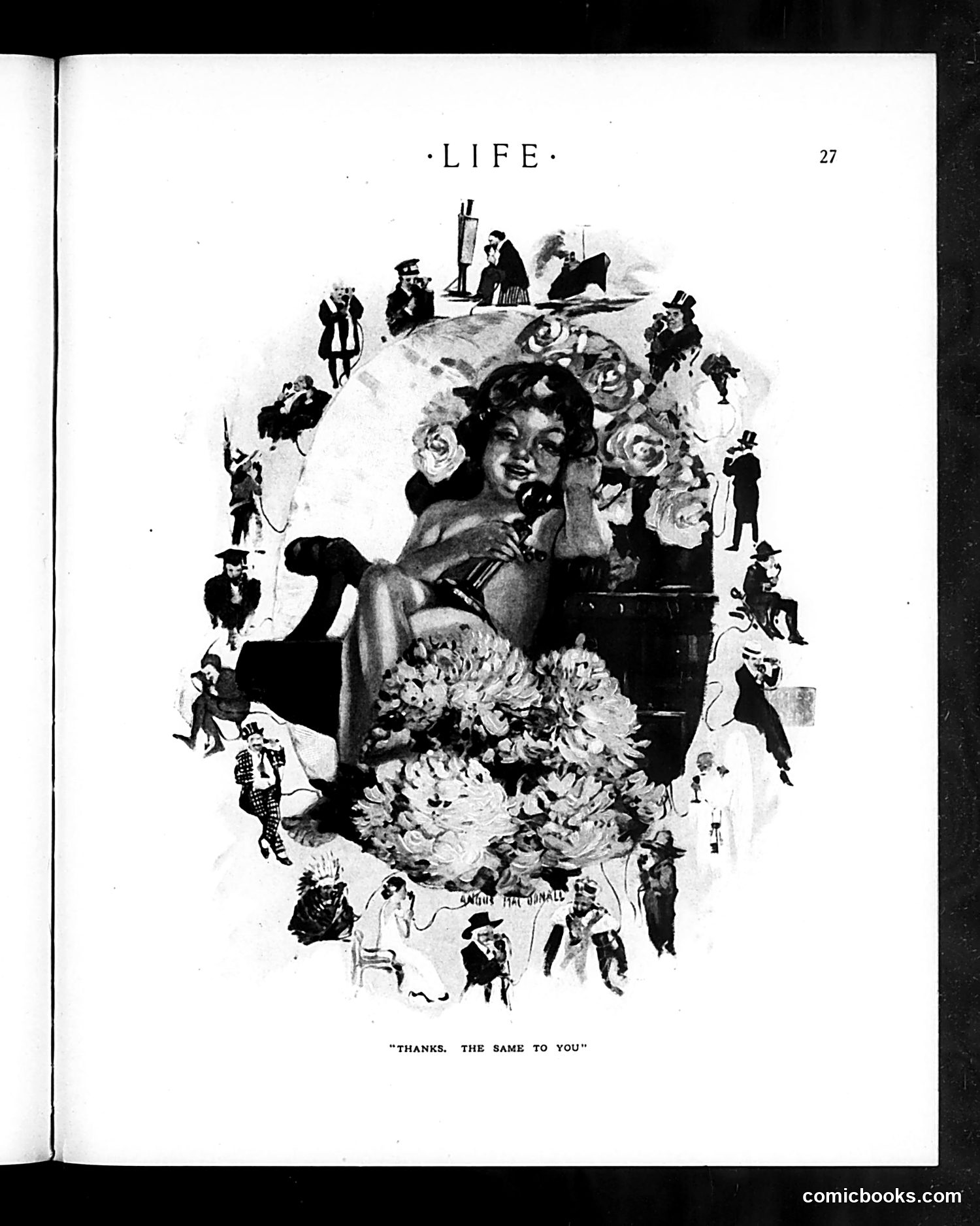
This satirical illustration depicts a glamorous woman at the center, surrounded by numerous small figures in formal attire arranged around her like a decorative border. The composition suggests she's the focal point of social attention. The caption "Thanks. The Same to You" implies a social exchange—likely commentary on superficial courtesies or reciprocal insincerities in high society. The formal figures circling her appear to represent society's establishment or social climbers paying homage. Without additional context about the publication date, it's difficult to identify the specific woman or social situation being mocked. The satire likely targets either: pretentious social climbing, the artificiality of upper-class interactions, or perhaps a specific public figure's social prominence. The juxtaposition of the elegant central figure against the crowding masses suggests commentary on celebrity or status-seeking behavior.
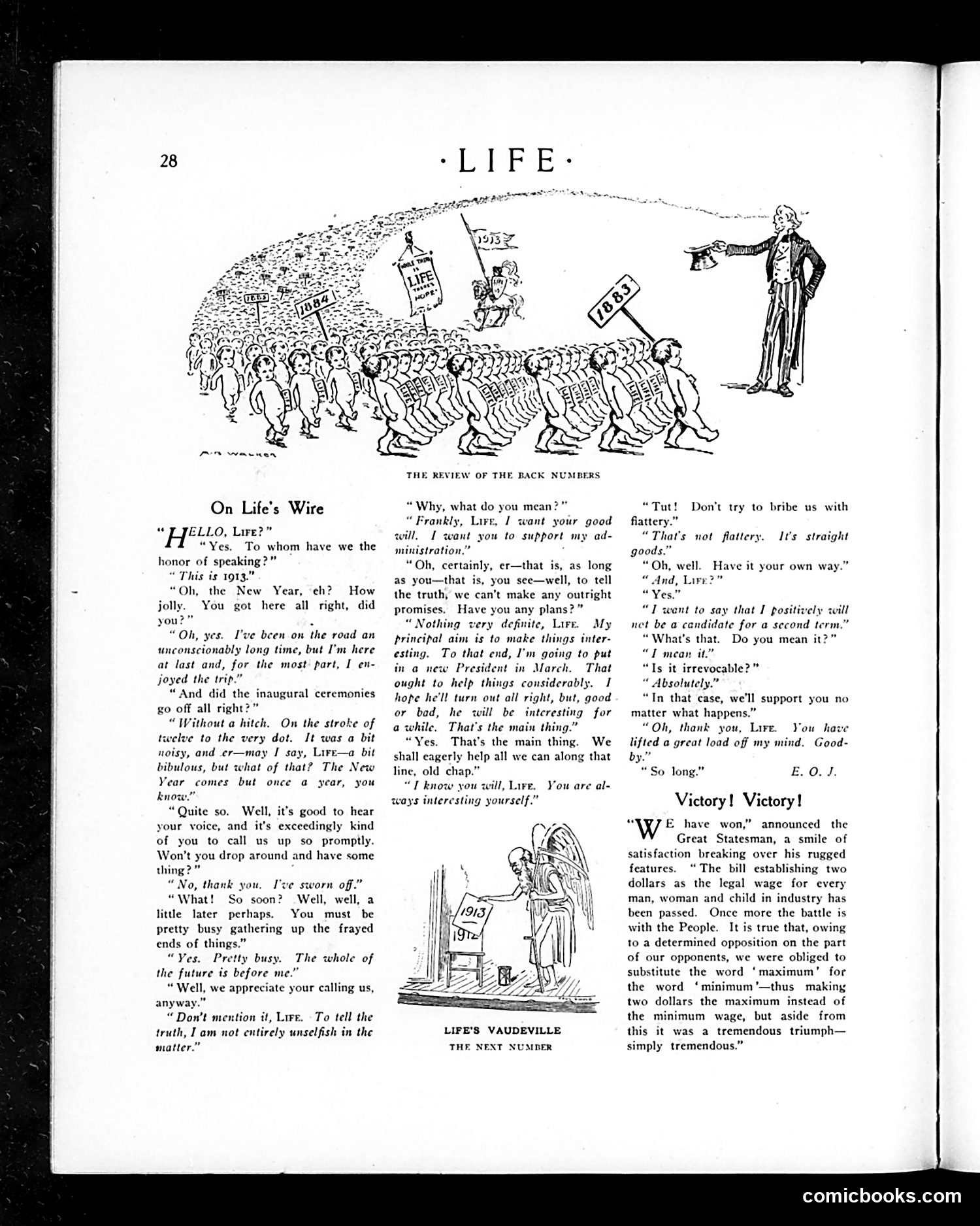
This page contains two satirical pieces about American politics, likely from early 1913 (based on the "1913" reference). **"On Life's Wire"** depicts a telephone conversation between Life magazine and the personified "New Year 1913." The New Year boasts of installing a new President in March—a reference to Woodrow Wilson's inauguration (March 4, 1913). The joke mocks Wilson's vague promises ("make things interesting") and Life's editorial eagerness to support him despite demanding nothing concrete. The satire suggests both politicians and publications speak in platitudes. **"Victory! Victory!"** ridicules labor reform through the "Great Statesman," who celebrates passing a minimum wage bill—but reveals it was watered down from "minimum" to "maximum" wage. This reversal means employers can now legally cap wages at two dollars, the opposite of the intended protection. The satire exposes how political "victories" become pyrrhic when compromised by opposition, leaving workers worse off while politicians claim triumph. Both pieces mock political rhetoric and the gap between stated intentions and actual outcomes.
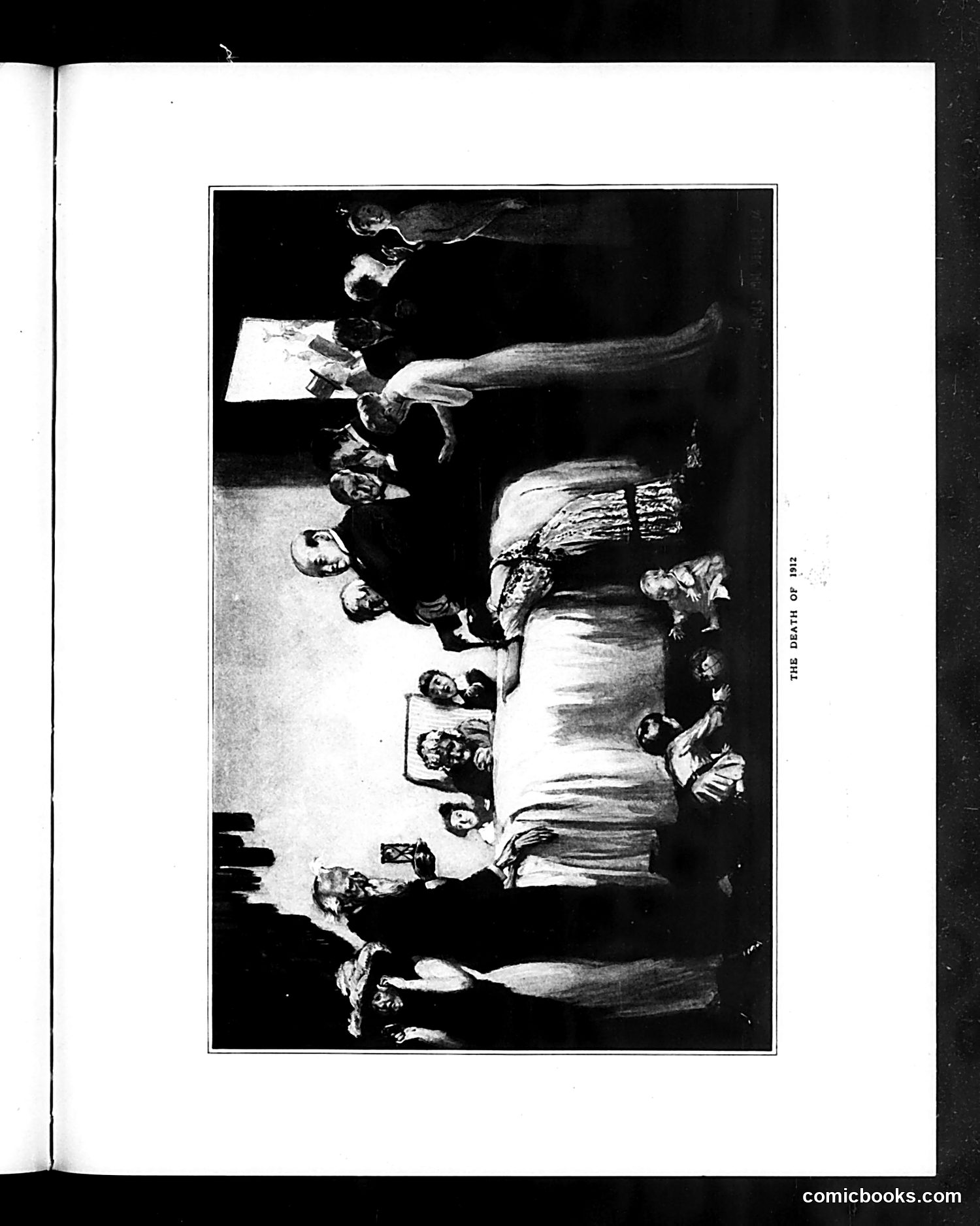
This page shows a satirical illustration titled "The Death of 1912," depicting the year personified as a deceased figure on a deathbed, surrounded by mourning attendants and observers. The image appears to be a year-end retrospective cartoon, a common Life magazine tradition marking the passing of an annual period. The composition uses Victorian deathbed imagery to humorously "mourn" 1912's conclusion. Various figures surround the dying/dead year, though their specific identities aren't clearly labeled in the visible text. Without additional context about 1912's major events, the exact satirical targets remain unclear, but the cartoon likely referenced significant political, social, or cultural moments of that year that Life's readers would have immediately recognized.
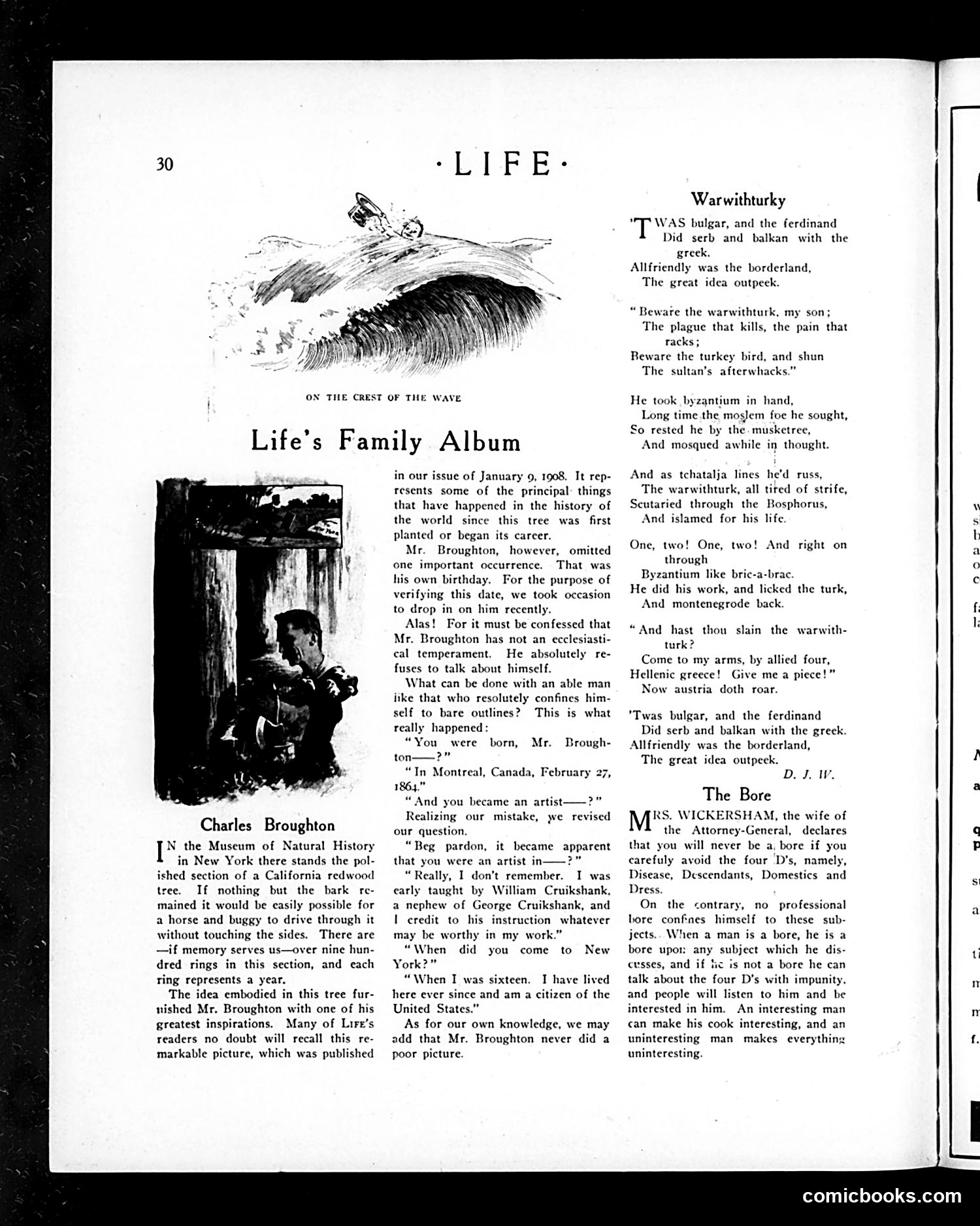
**"Life's Family Album"** profiles Charles Broughton, a respected artist and illustrator for *Life* magazine. The piece humorously documents his reluctance to discuss himself autobiographically, despite being asked about his birth (Montreal, 1864) and artistic training under William Cruikshank. The joke centers on Broughton's modesty—he refuses self-promotion while the magazine tries to verify facts about his career. **"Warwithturky"** is a mock-heroic parody poem about the Balkan Wars (circa 1912-1913), when Bulgaria, Serbia, and Greece fought Ottoman Turkey. The absurdist language and invented words ("scutaried," "islamed," "montenegrode") satirize jingoistic war reportage and the complex geopolitical entanglements of European powers supporting the Balkan states against the Ottoman Empire. **"The Bore"** is a brief satirical essay attributed to Mrs. Wickersham (wife of Attorney-General Wickersham) arguing that avoiding four topics—Disease, Descendants, Domestics, Dress—won't prevent boredom; the piece's wit lies in its counterintuitive conclusion that personality, not subject matter, determines social appeal.
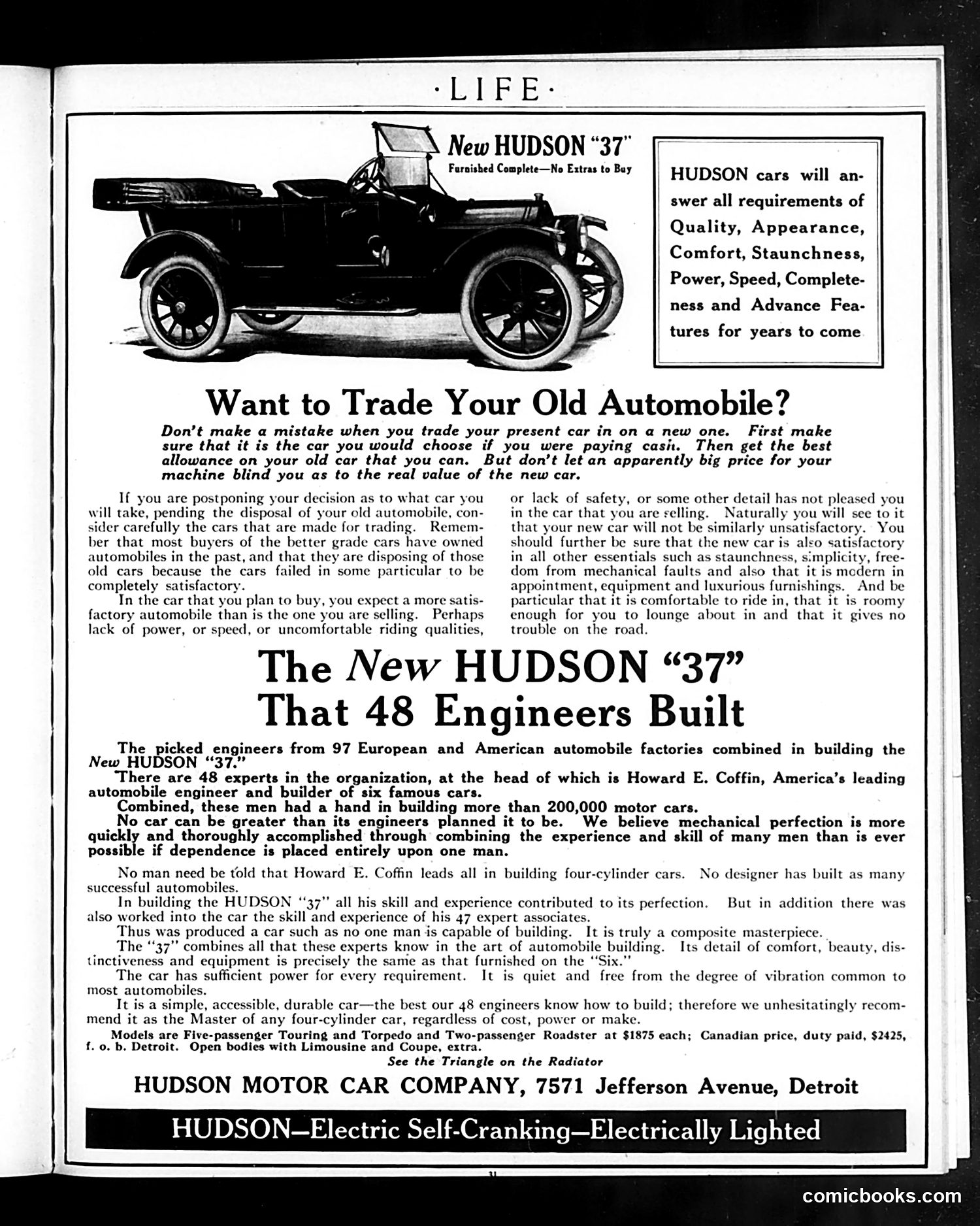
This is **not a cartoon or satire**, but rather a **full-page automobile advertisement** from an early 20th-century Life magazine. The Hudson Motor Car Company advertises their 1937 model by emphasizing engineering credibility: 48 engineers from 97 European and American factories collaborated on the design, led by renowned engineer Howard E. Coffin. The ad argues that collaborative expertise produces superior results than individual genius. The top section offers practical advice to car buyers considering trade-ins, warning against overpaying for new vehicles while undervaluing used cars—a consumer-protection message that suggests contemporary wariness about dealership practices. Key selling points include: electric self-cranking, electric lights, comfort, reliability, and power. The $1,875 price is highlighted as evidence the Hudson is a "Master" vehicle regardless of cost. For modern readers: this reflects an era when automobile engineering was novel enough to merit detailed technical justification, and when consumer protections required explicit editorial guidance.
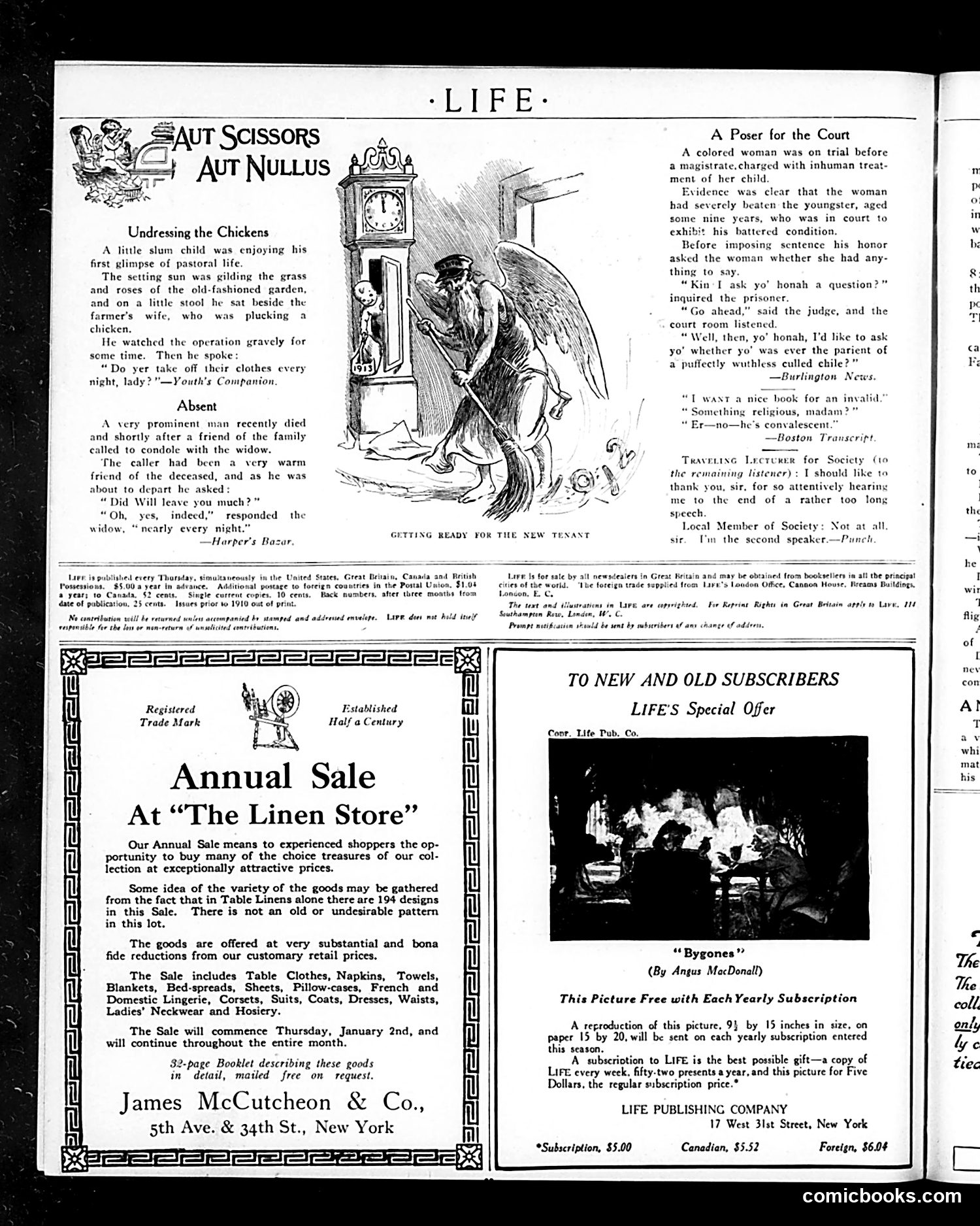
This page contains three brief comic sketches typical of *Life* magazine's satirical humor: 1. **"Undressing the Chickens"**: A slum child, unfamiliar with farm life, witnesses a farmer's wife plucking a dead chicken and naively asks if she undresses them every night—humor from the child's literal misunderstanding of adult activity. 2. **"Absent"**: Wordplay on "leave"—a widow's cryptic response that her deceased husband left her "nearly every night" (implying infidelity or regular absences) rather than financial provision. 3. **"A Poser for the Court"**: A Black woman on trial for beating her child turns the tables with a question asking if the white judge has ever parented a "worthless" child—social commentary using courtroom irony, though the dialect caricature reflects the era's casual racism. The humor relies on misunderstanding, double meanings, and social reversal. The "colored woman" sketch appears designed to challenge judicial authority through the defendant's pointed question rather than mock her.
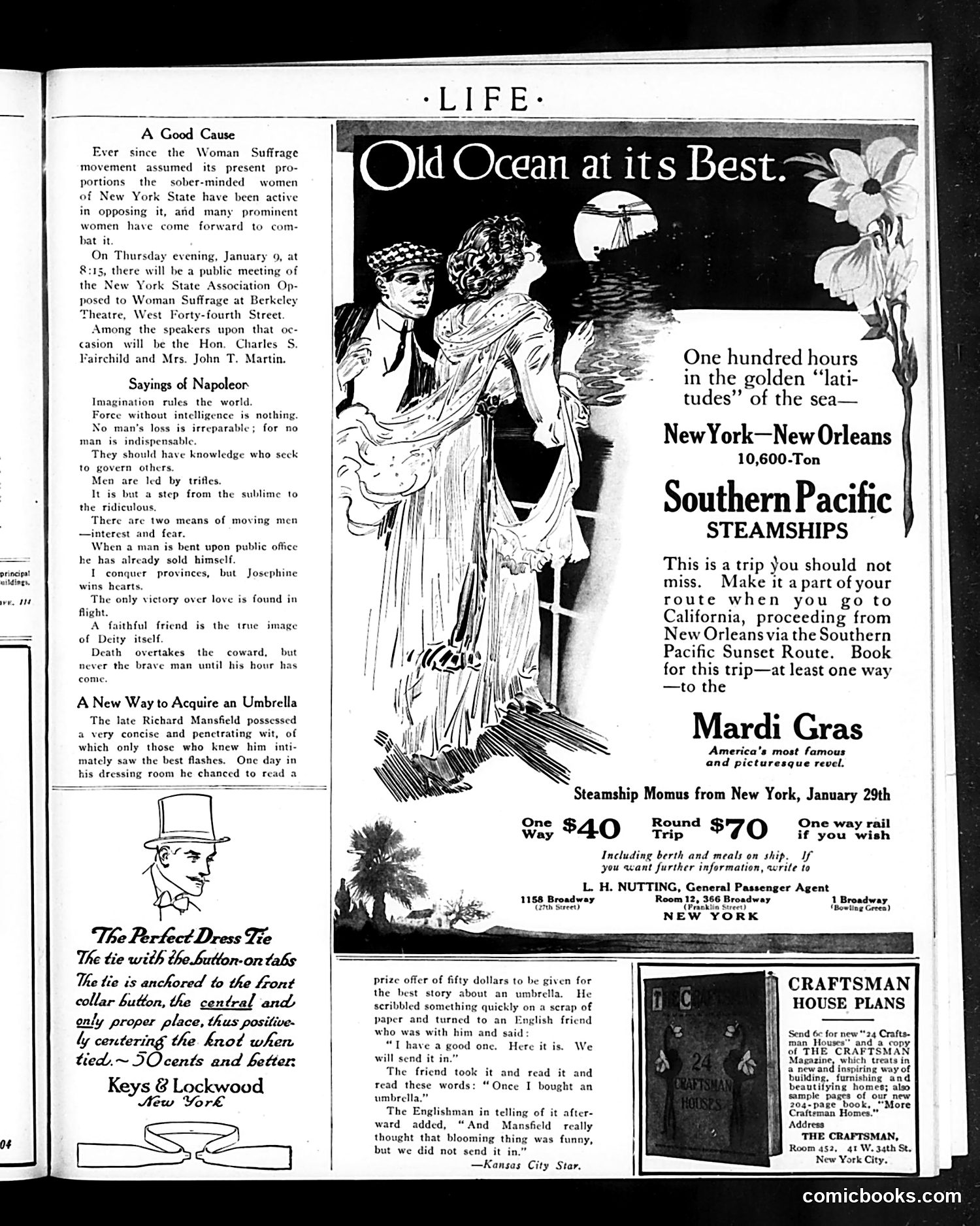
This page primarily contains **advertisements and miscellaneous content** rather than satirical cartoons. The left column features philosophical "Sayings of Napoleon" (a common feature in Life), anecdotes about wit (including one about actor Richard Mansfield and an umbrella contest), and ads for dress ties and house plans. The dominant content is a **large steamship advertisement** for the Southern Pacific's "Mardi Gras," promoting a New York-to-New Orleans voyage as a tourist route to California. The illustration shows well-dressed passengers enjoying sea travel. **Political content**: The top article announces an anti-suffrage meeting featuring speakers "opposed to Woman Suffrage," indicating Life's editorial stance against women's voting rights—a position that would soon become dated as suffrage passed in 1920. The page reflects early-20th-century middle-class interests: luxury travel, home building, fashion, and classical philosophy mixed with contemporary anti-suffrage politics.
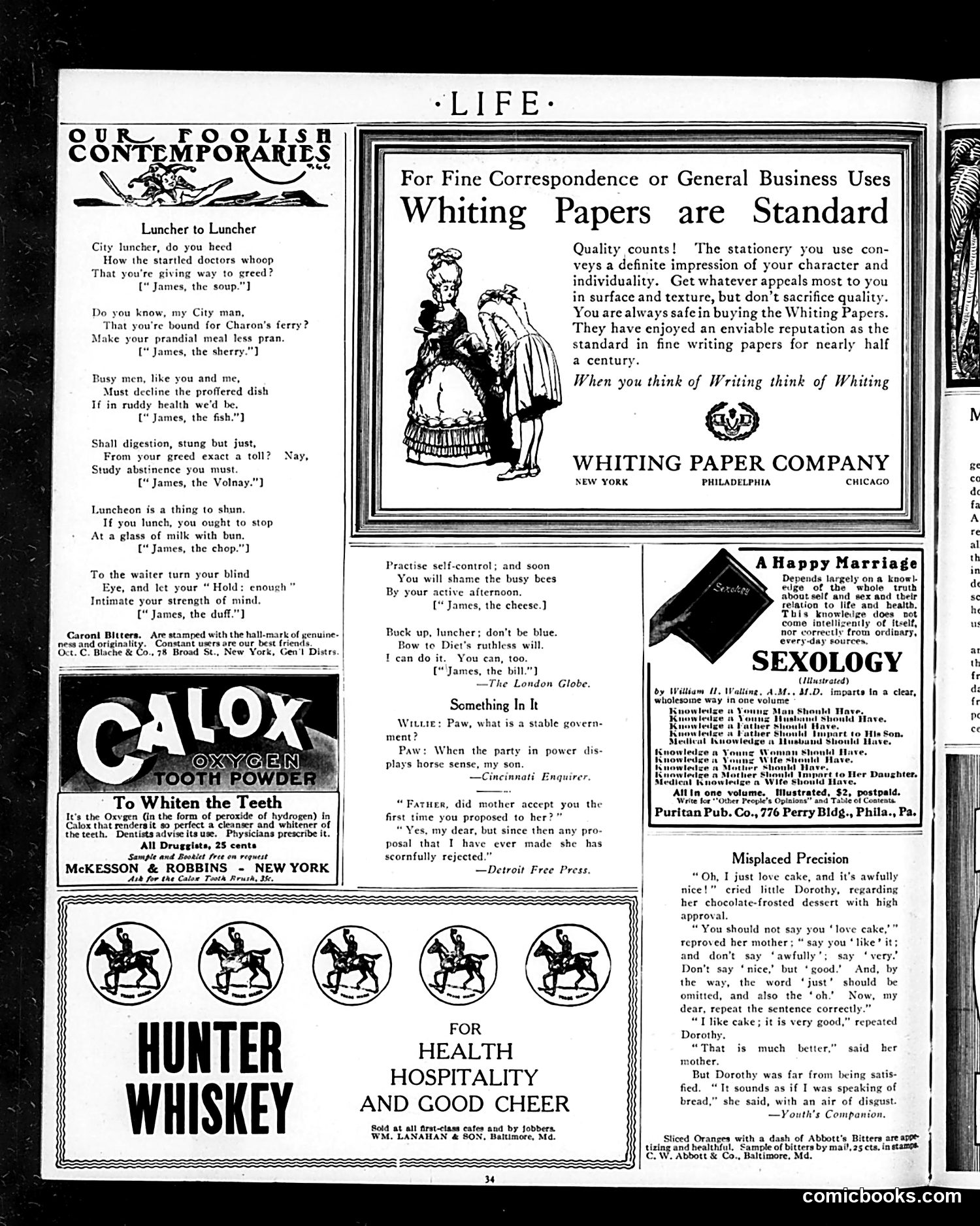
This page from *Life* magazine (undated but likely early 20th century based on style) contains primarily **advertising and light humor columns**, not political cartoons. The main content includes: **"Luncher to Luncher"** – A humorous column in verse mocking wealthy businessmen's dining habits. The jokes play on class pretension: references to "Charon's ferry" (death), expensive wines ("sherry"), and the satirical suggestion that eating lunch is somehow morally wrong or excessive. The column gently ridicules upper-class affectation and overconsumption. **"Something in It"** – A brief joke about politicians displaying "horse sense," typical period humor about governance. **"Misplaced Precision"** – A domestic humor piece about a mother correcting her daughter Dorothy's speech, mocking overly-fastidious etiquette instruction. The page is otherwise filled with **period advertisements**: Whiting Papers, Calox tooth powder, Hunter Whiskey, and a *Sexology* book—representative of early-1900s marketing to middle and upper-class readers. The satire is mild, class-conscious, and genteel rather than sharp political commentary.
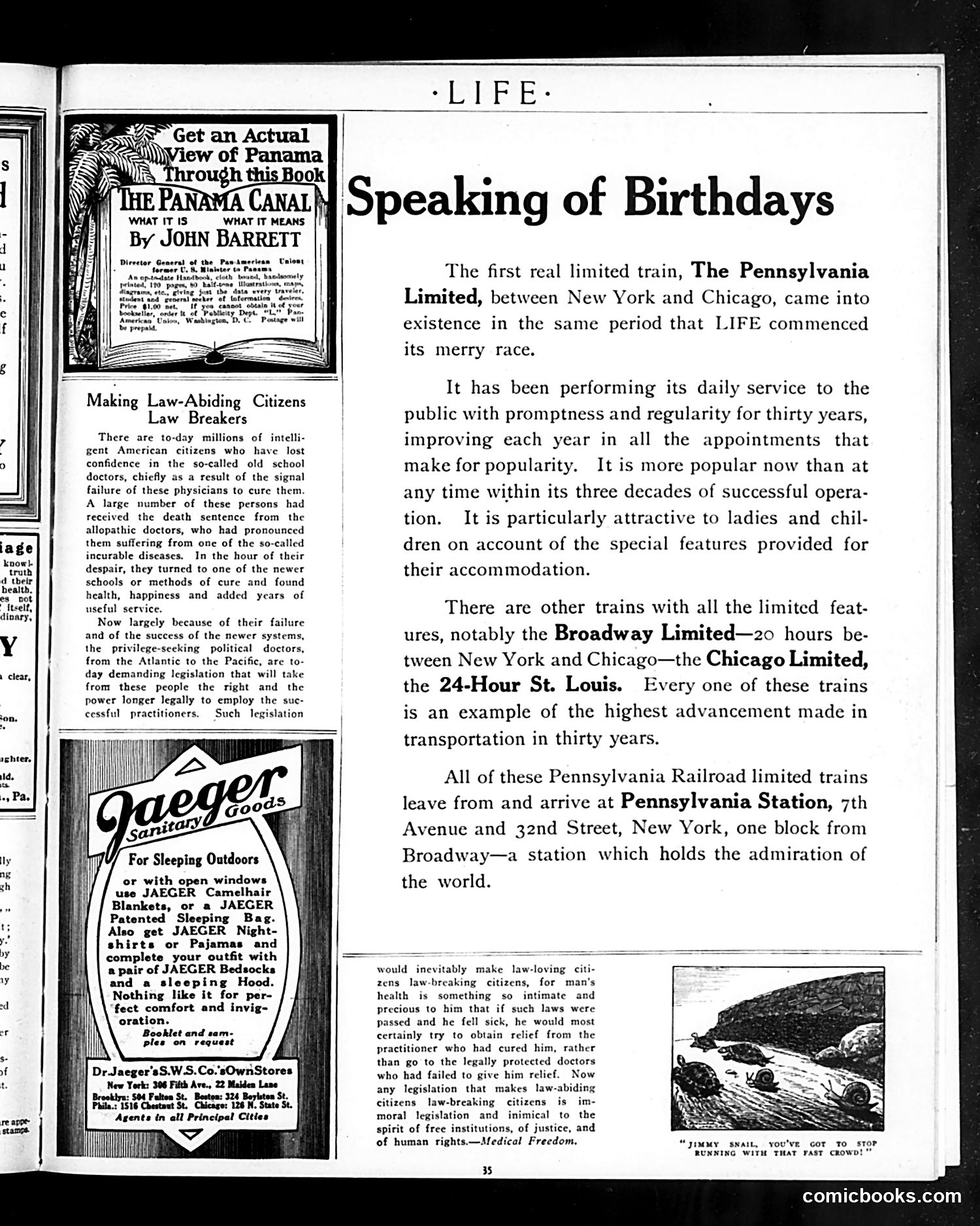
This page mixes editorial content with advertisements, lacking a traditional political cartoon. The main article, "Speaking of Birthdays," celebrates the Pennsylvania Limited train's 30-year anniversary, comparing it favorably to LIFE magazine's own founding period. It praises the train's reliability and modern amenities. The secondary article, "Making Law-Abiding Citizens Law Breakers," argues against proposed legislation restricting alternative medicine practitioners. The author contends that sick people desperate for cures would break laws prohibiting non-traditional doctors, making such legislation immoral. This reflects early 20th-century debates over medical licensing and the legitimacy of alternative healing methods. The advertisements (Jaeger sanitary goods, Dr. Jaeger's sleeping products) occupy significant space, typical for this era's magazines. A small cartoon at page bottom shows a snail with a car, likely a joke about slowness versus speed—fitting a transportation-themed page.
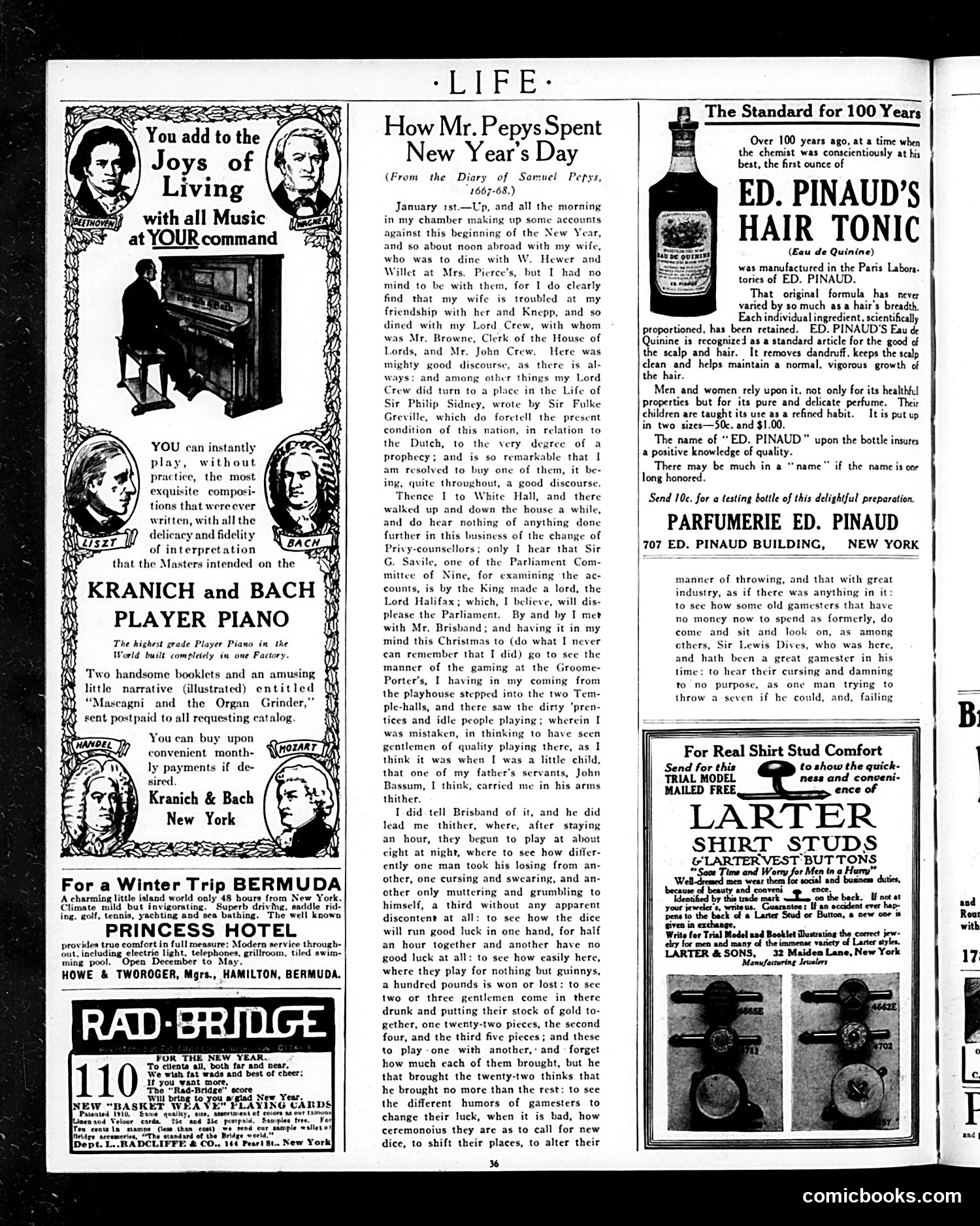
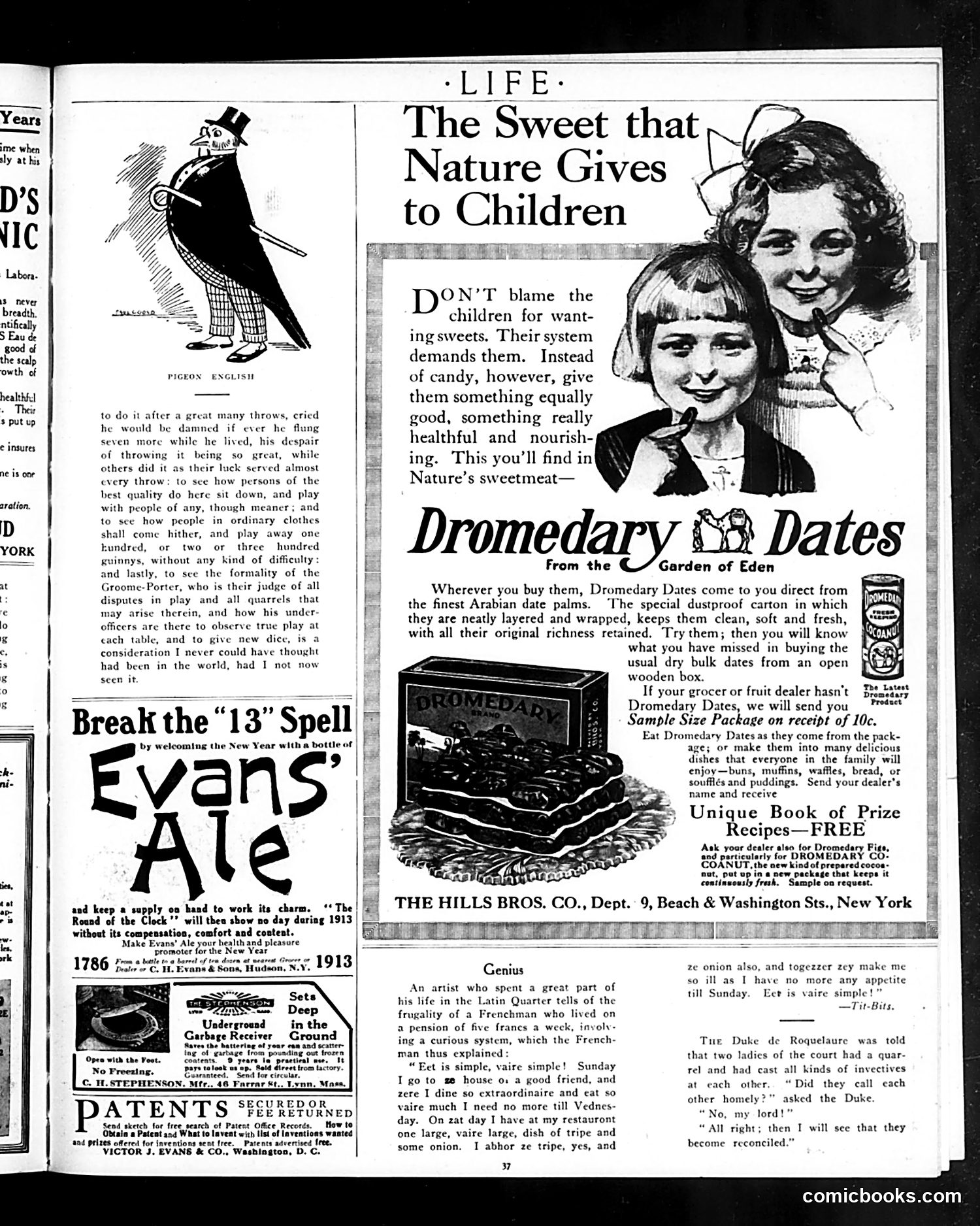
This page primarily contains **advertisements and a historical diary excerpt**, not political satire. The left side features ads for the **Kranich and Bach Player Piano**—a luxury music device allowing non-musicians to play classical compositions automatically. The decorative portraits appear to be **Mozart and Bach**, invoking classical composers to market this technology. The center presents an excerpt from **Samuel Pepys's actual 17th-century diary** (1667-68), describing his New Year's Day activities in London—visiting friends, attending court, and observing gambling. This is presented as historical entertainment for readers, not satire. The right side advertises **ED. Pinaud's Hair Tonic** and **Larter Shirt Studs**—typical early-20th-century grooming products. The **Rad-Bridge** and **Princess Hotel** ads promote leisure activities (card games and Bermuda travel). This appears to be a standard magazine page mixing light historical content with period advertisements targeting affluent male readers.
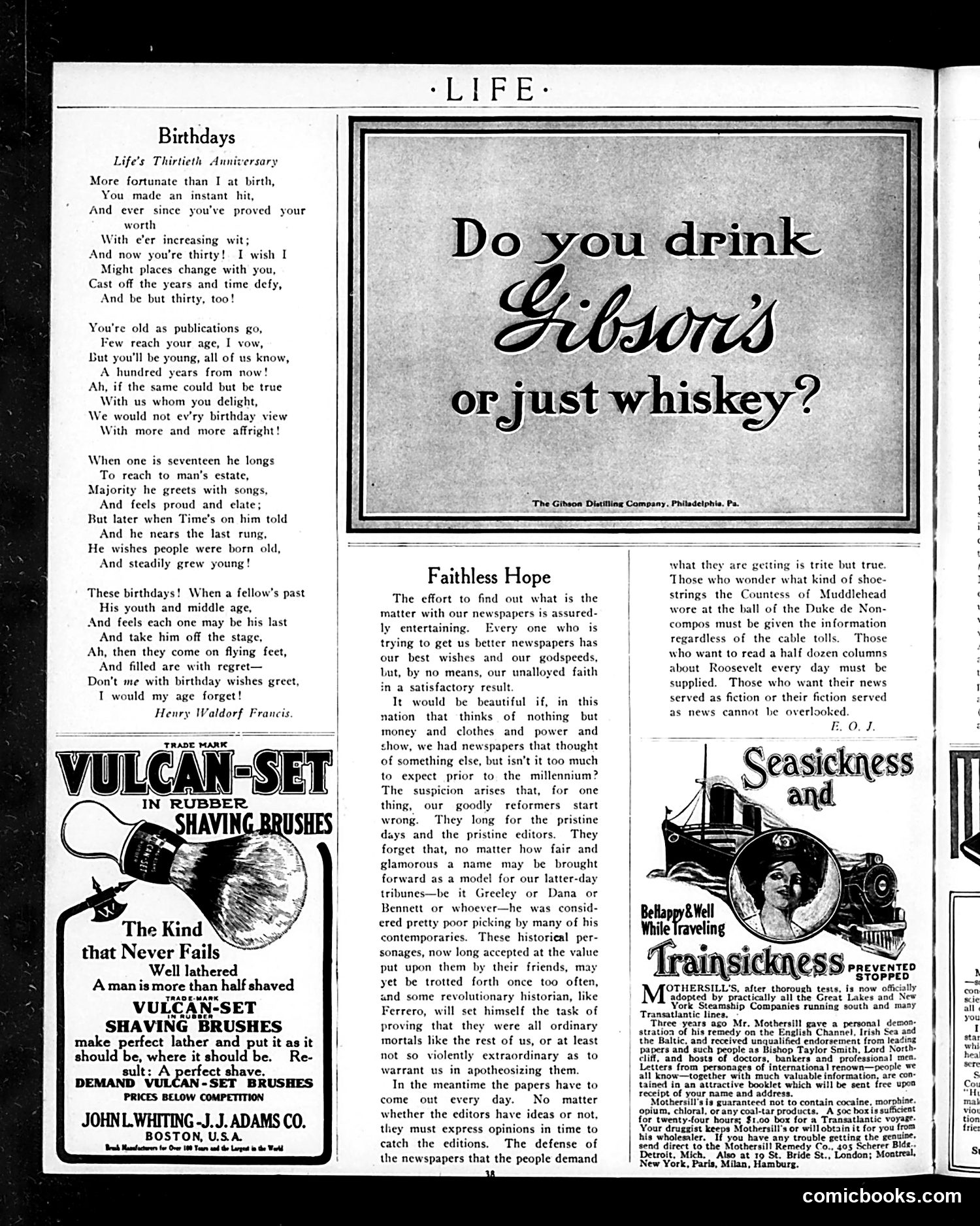
This page celebrates **Life's 30th anniversary** with a birthday poem by Henry Waldorf Francis. The poem humorously contrasts Life's enduring youth and wit with human aging—wishing the magazine could remain perpetually young while people inevitably grow old and regret their birthdays. The main article, "Faithless Hope," critiques newspaper reform movements. The author argues that while people demand better newspapers, they simultaneously want sensationalism—gossip about socialites, detailed Roosevelt coverage, and entertainment disguised as news. Reform-minded editors idealizing past journalists like Horace Greeley ignore that those figures were equally criticized in their own time. The piece suggests newspapers simply reflect public demand for trivial content over substantive journalism, making meaningful improvement impossible. The advertisements (Gibson whiskey, shaving brushes, Mothersill's seasickness remedy) are period-typical commercial content.
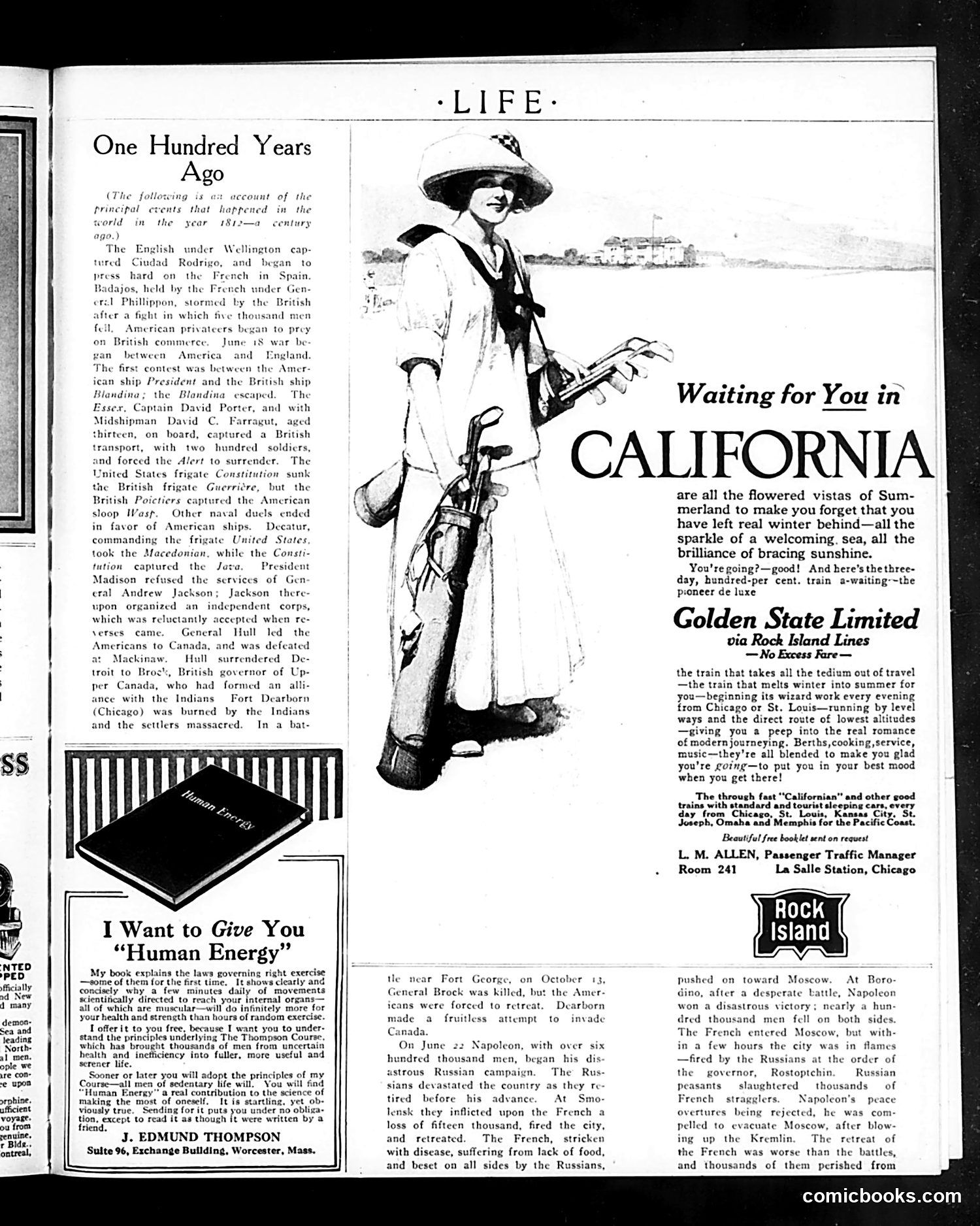
This Life magazine page from approximately 1912 contains: **Left column:** A historical retrospective titled "One Hundred Years Ago," recounting 1812 events—primarily the War of 1812 between America and Britain, including naval battles (USS Constitution vs. HMS Guerrière), military campaigns in Canada, and the burning of Fort Dearborn (Chicago). The text also references Napoleon's Russian campaign. **Right side:** Two advertisements—one promoting the "Golden State Limited" train to California, and another for a self-help book on exercise called "Human Energy." **No political cartoon appears on this page.** The layout is primarily informational (historical essay) with commercial advertising. The juxtaposition of celebrating American military victories from 1812 alongside promoting westward travel to California implicitly celebrates American expansion and progress, but this is advertising rather than satire. The page serves as a historical commemoration and commercial promotion rather than political commentary.
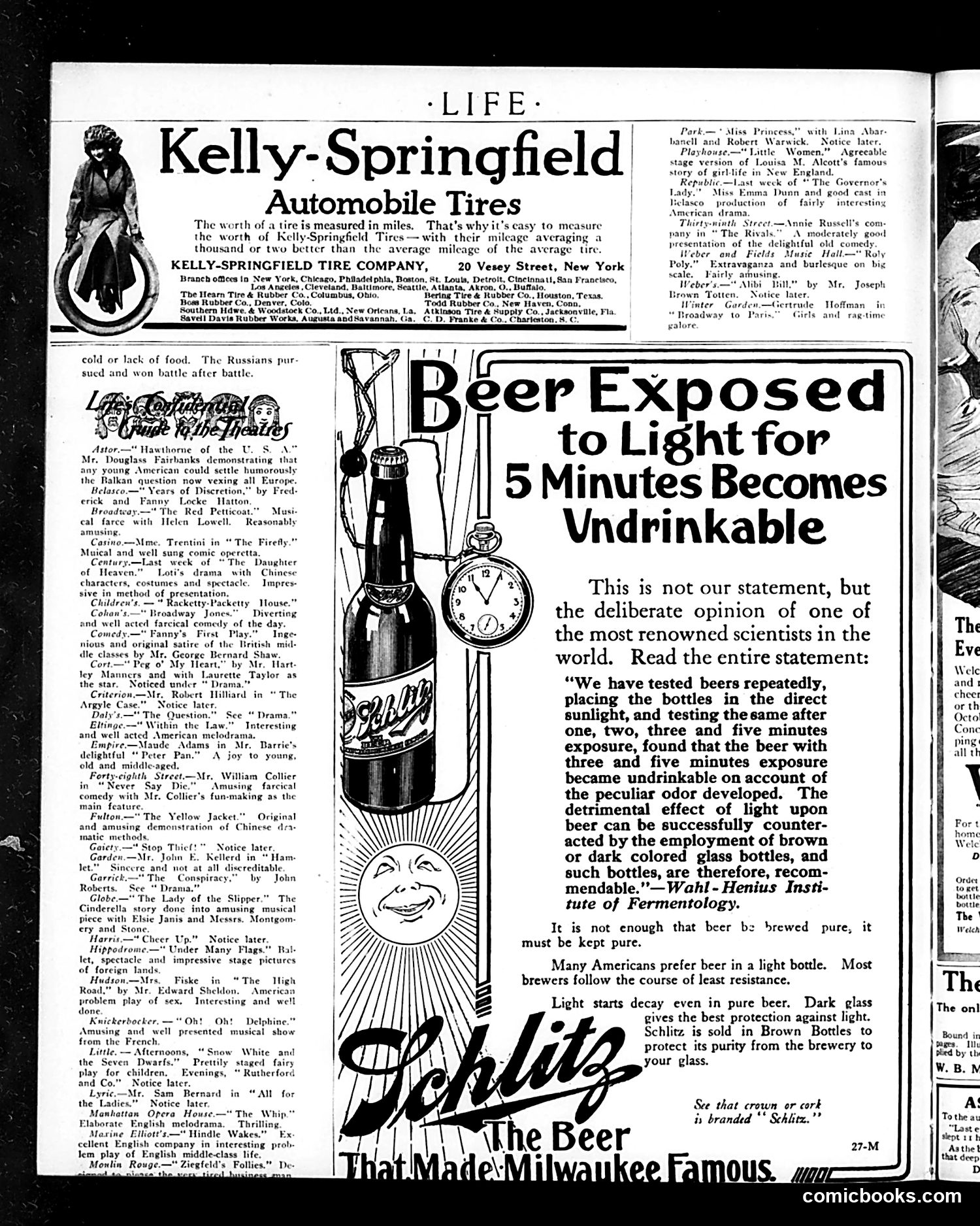
This page contains two distinct elements: **advertising** and **theater listings**. The dominant feature is a **Schlitz beer advertisement** (left column) arguing that dark glass bottles protect beer from light damage. The ad cites a scientist's claim that beer exposed to direct sunlight for five minutes becomes undrinkable due to "skunky" odors. It promotes Schlitz's use of brown bottles as superior to competitors' light bottles, and emphasizes the brand's purity and proper storage from brewery to consumer. The right side lists **New York theater productions** — reviews of Broadway shows, operas, and musicals currently running, typical of Life's entertainment coverage from this era. The **Kelly-Springfield Tire advertisement** (top left) is standard product marketing measuring tire quality by mileage. The page reflects early 1910s consumer culture: beer marketing, automobile commerce, and Broadway entertainment as indicators of American leisure and commerce.
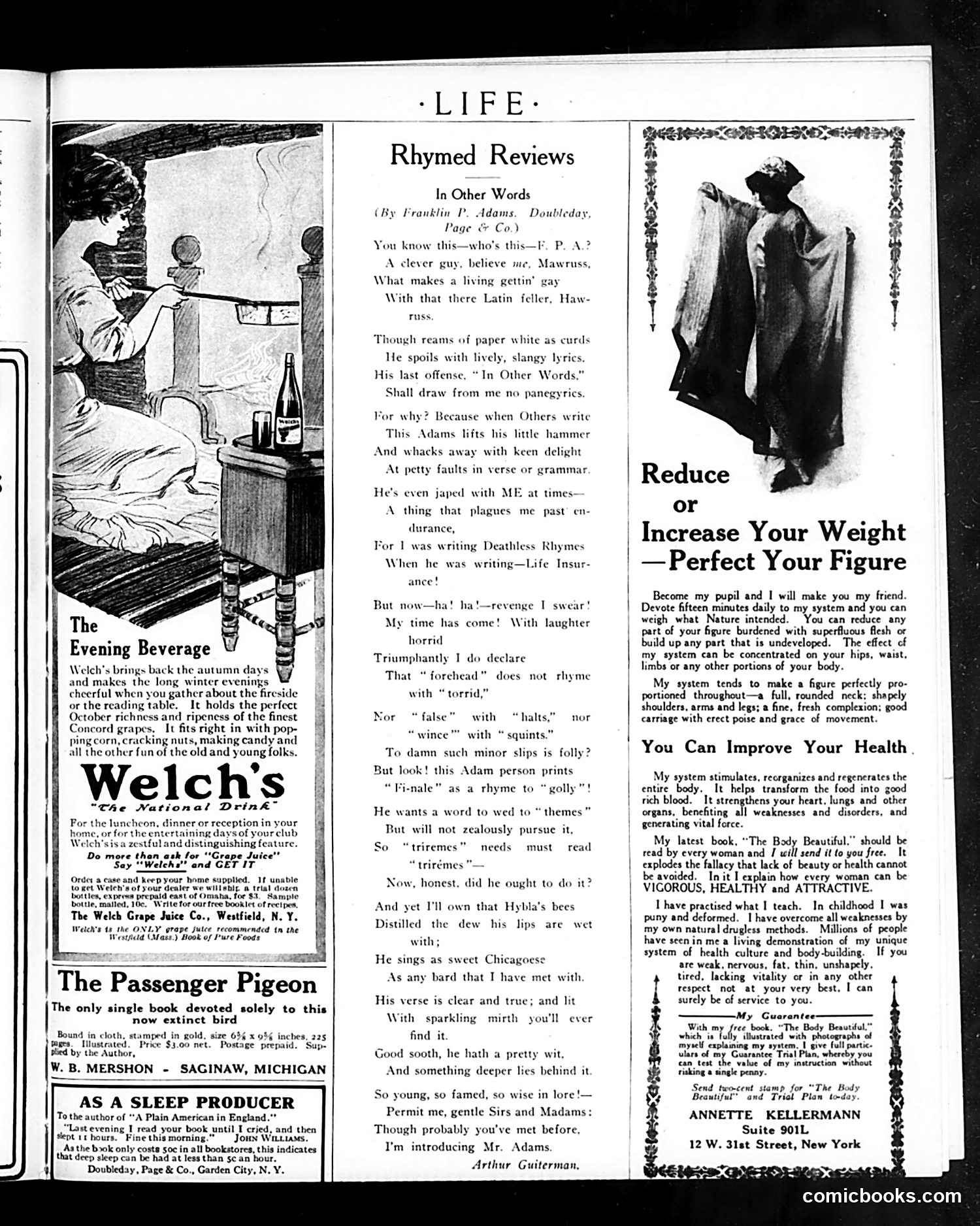
This is a satirical poem reviewing Franklin P. Adams's book *In Other Words*. Guiterman playfully attacks Adams—a well-known humorist and writer—for his hypocritical literary criticism. The satire works on two levels: First, Guiterman notes that Adams makes his living critiquing others' verse while writing mediocre poetry himself (the jab about "Life Insurance" suggests Adams's day job). Second, Guiterman catches Adams committing the very grammatical errors he condemns in others—particularly forcing "Kienale" to rhyme with "golly," and "forchead" with "torrid." The conclusion is mock-magnanimous: despite these flaws, Adams is talented ("Hybla's bees / Distilled the dew his lips are wet with") and his wit runs deep. It's the literary equivalent of the backhanded compliment—praise that highlights the subject's pretensions and failures. This reflects *Life* magazine's tradition of witty, insider critiques of contemporary literary figures.
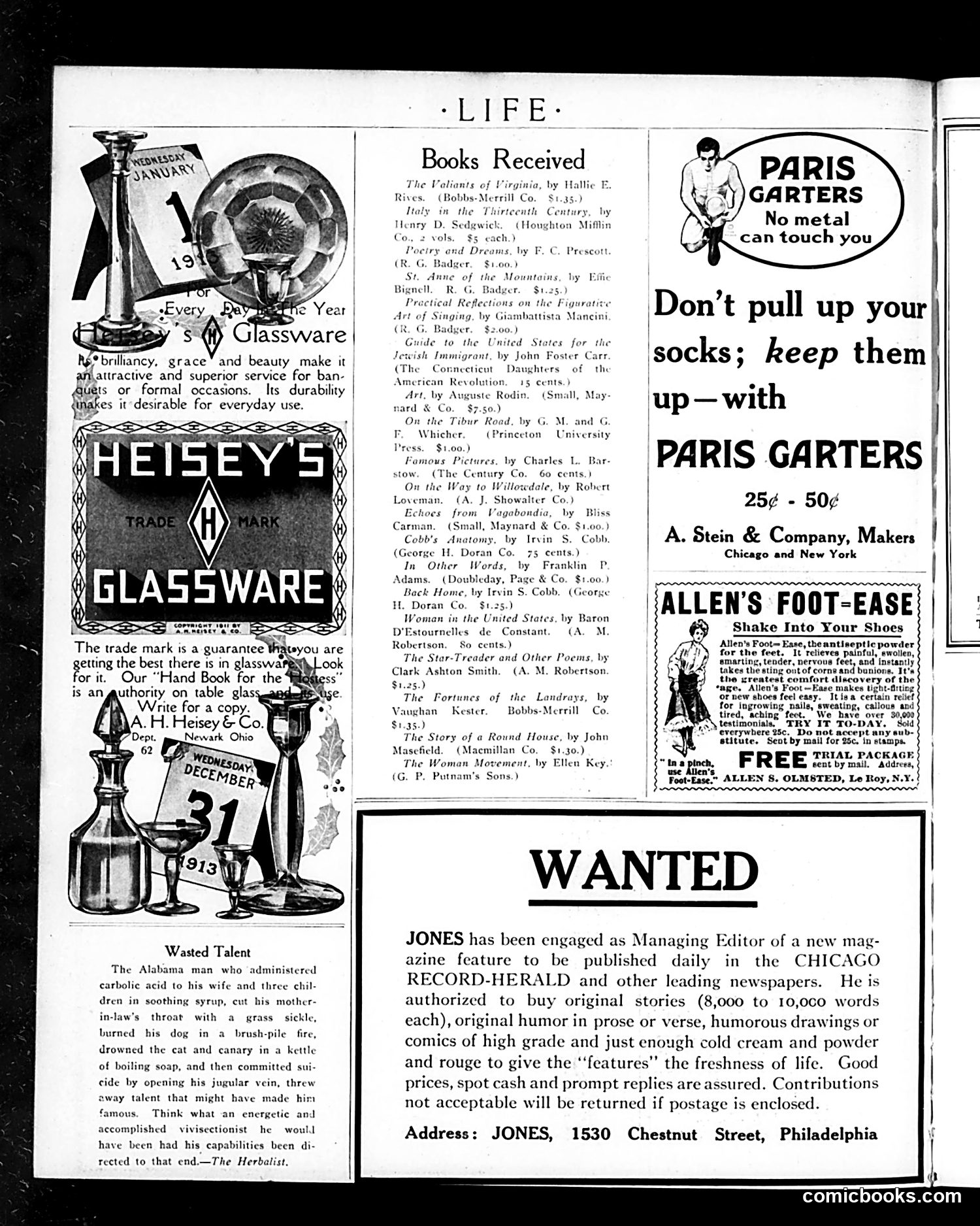
This is a dark satire piece titled "Wasted Talent," not a political cartoon. It presents a grimly ironic commentary on an actual Alabama crime: a man who murdered his wife, three children, mother-in-law, and pets, then committed suicide. The satire's bitter joke is that the author (attributed to "The Herbalist") suggests this criminal's violent capabilities were "wasted"—implying that if redirected toward legitimate scientific work (specifically vivisection, animal experimentation), he could have become famous and accomplished. The piece uses grotesque humor to critique either the perpetrator's moral failure or, more likely, to satirize society's tendency to valorize professional achievement while condemning identical acts when committed outside institutional contexts. It's deeply cynical humor reflecting early 20th-century attitudes toward both crime and scientific ethics. The rest of the page contains standard magazine content: book advertisements, product ads (garters, foot powder), and a job wanted notice seeking magazine content.
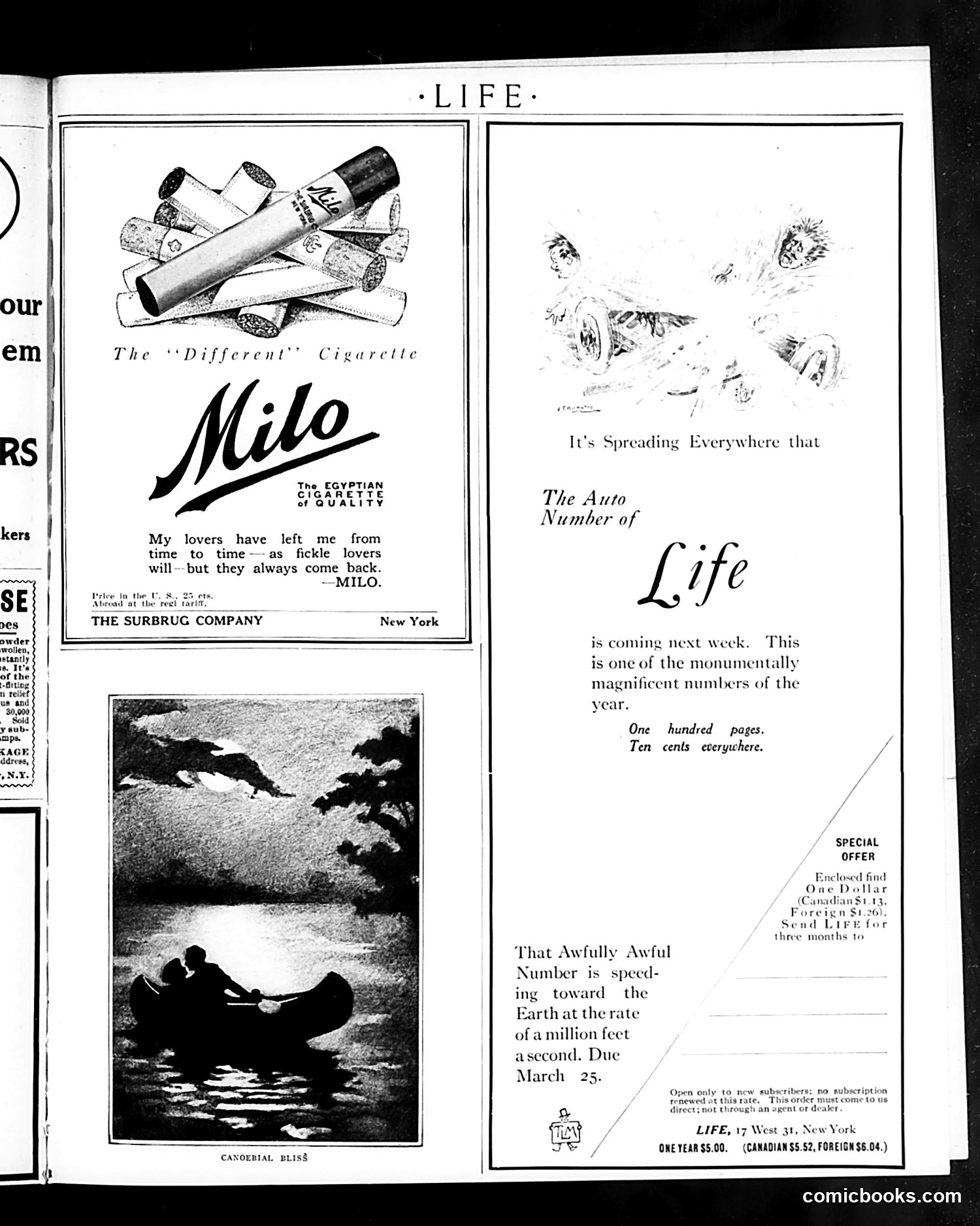
This page combines advertisements and promotional content from an early 20th-century issue of *Life* magazine. **Left side:** A Milo cigarette ad uses flirtatious language ("My lovers have left me...but they always come back"), personifying the cigarette brand as a romantic figure to appeal to smokers. **Bottom left:** "Canoebial Bliss" is a romantic photograph of a couple in a canoe—likely a humorous caption playing on the word "cannibal" to suggest intimate togetherness. **Right side:** The magazine promotes its upcoming "Auto Number"—a special issue focusing on automobiles, which were still relatively novel and exciting technology. The cryptic reference to "that Awfully Awful Number" speeding "at a million feet a second" toward Earth on "March 25" appears to be satirical promotion, possibly mocking contemporary astronomical or scientific anxieties, though the specific reference is unclear. The page demonstrates *Life*'s dual function as both satirical publication and commercial vehicle for luxury goods advertising.
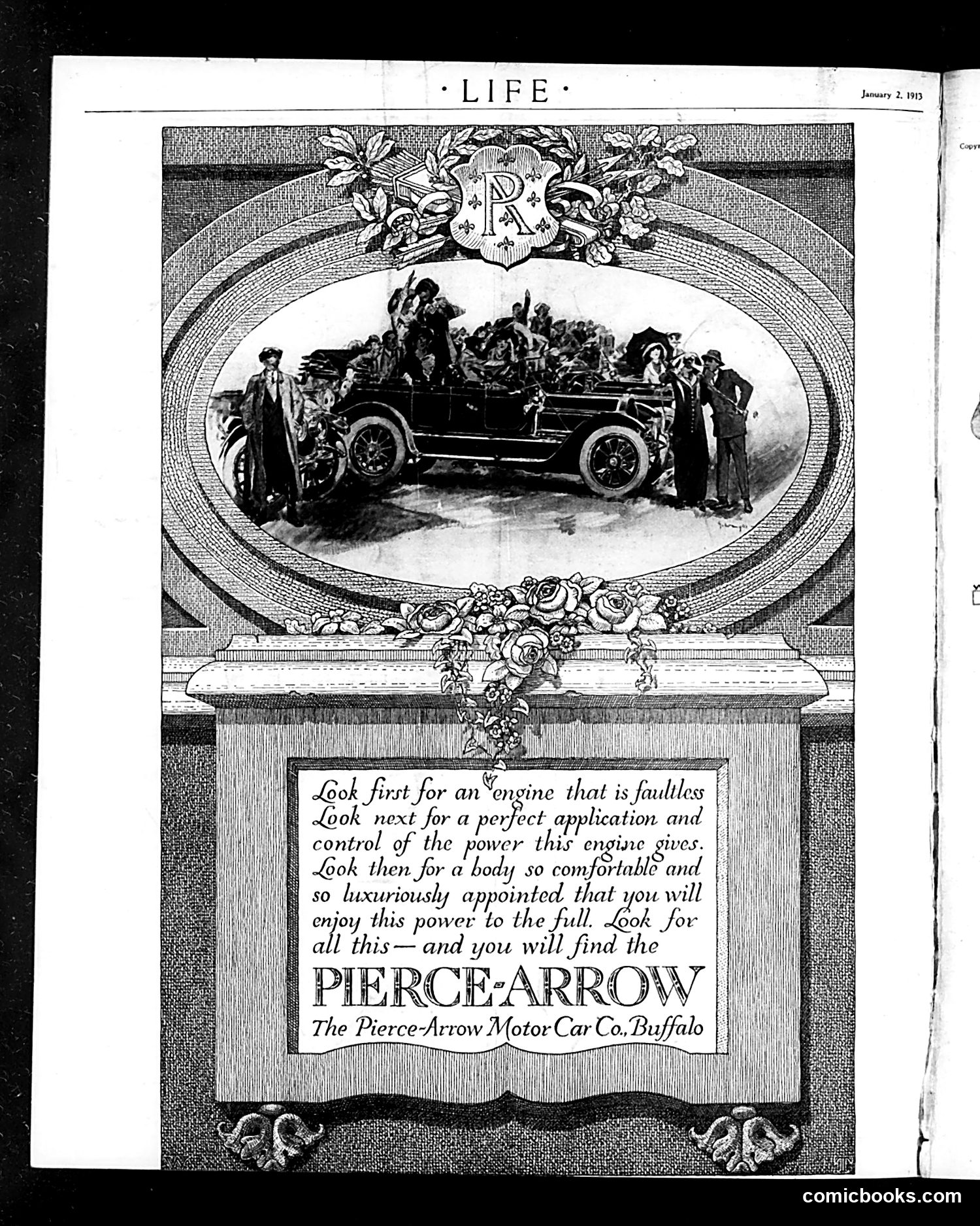
This is **not political satire** but rather a **luxury automobile advertisement**. The page features an ornate Art Nouveau border framing an illustration of a Pierce-Arrow motorcar surrounded by well-dressed passengers and onlookers. The ad copy uses aspirational language typical of early 1900s marketing, emphasizing the vehicle's reliability ("faultless engine"), power application, comfort, and luxurious appointments. The decorative treatment—with floral garlands and an elaborate frame—positions the Pierce-Arrow as a prestigious luxury good for affluent buyers. Pierce-Arrow was a real American manufacturer based in Buffalo, NY, known for producing high-end automobiles. The advertisement targets wealthy consumers by associating the car with elegance and refinement rather than practical transportation.